

Selective killing of circulating tumor cells prevents metastasis and extends survival
Open accessThe DOI matches its Crossref record; 10 of the 10 references it cites were found in a registry or an index.
Abstract
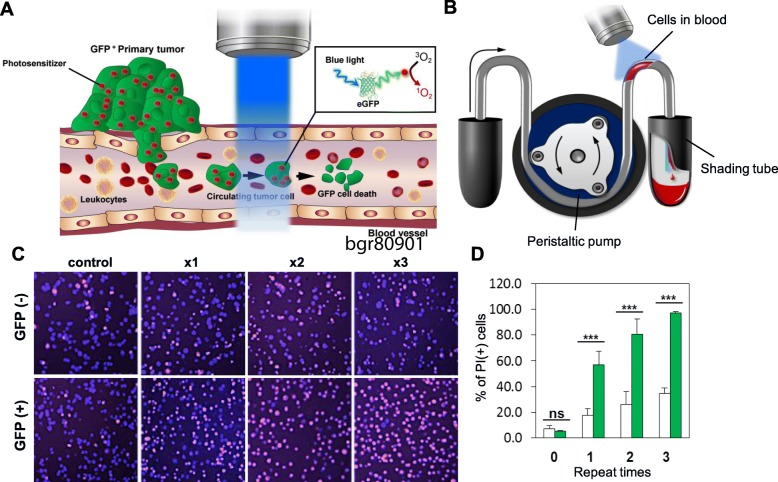
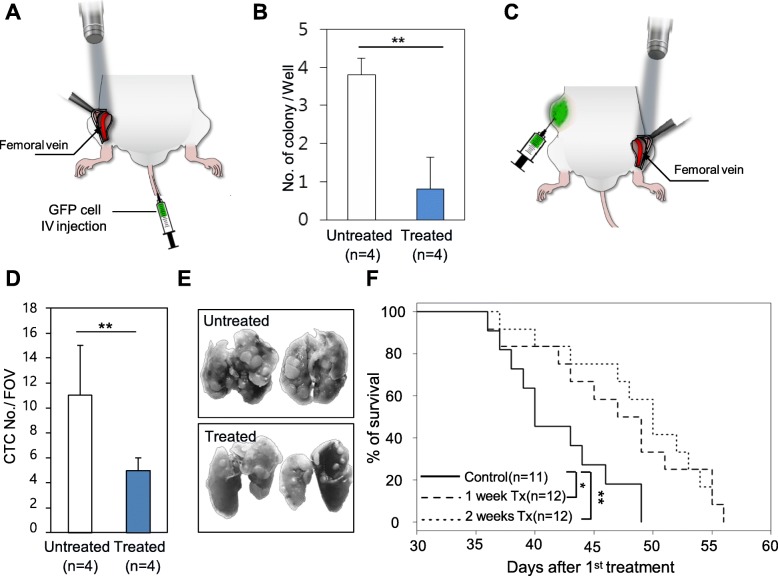
Distant metastasis is initiated by circulating tumor cells (CTCs), which are considered to be a determining factor for the degree of metastasis and the survival of cancer patients. Although CTC-based diagnostic approaches are being rapidly developed, limited studies have proven the benefits of CTC elimination, with most studies providing only hypothetical inference because of the technical difficulty in examining the effects of CTC elimination in vivo. We modified photodynamic therapy to specifically eliminate green fluorescent protein (GFP)-expressing CTCs and evaluated the therapeutic efficacy of CTC elimination. When circulating blood is illuminated with a blue laser (λ = 473 nm), the combination of GFP and photosensitizers induces a selective elimination of GFP-expressing CTCs, with limited effect on normal cells. In GFP-expressing cancer cell-infused or transplanted mice models, the treatment suppressed distant metastasis and extended the survival of the tumor-bearing mice. Taken together, CTCs are a core seed to be metastasized into secondary organs and elimination of CTCs may improve the survival of cancer patients.
Overview
The claims and statistics of this paper haven’t been checked yet.
Free: it reads the open-access text and checks the first 5 claims that cite a source we can check. Create a free account to check every claim.
Integrity signals
Registry
Cites
Statistics
Figures
Verification
Claims the paper makes
The claims and statistics of this paper haven’t been checked yet.
Free: it reads the open-access text and checks the first 5 claims that cite a source we can check. Create a free account to check every claim.
Claims other papers make about this one
Each is checked against this paper’s own text: does it say what the citing paper says it does?
The cited source says what the claim attributes to it.
In the citing paper
“Since an increase in the number of CTCs is associated with a poor prognosis”
From Tumor microenvironment complexity and therapeutic implications at a glance (2020) · cites this paper as [152]
The cited source says what the claim attributes to it.
In the citing paper
“CTC-targeted therapies may provide a new approach to improve the prognosis of cancer therapy [152].”
From Tumor microenvironment complexity and therapeutic implications at a glance (2020) · cites this paper as [152]
Self-check
Percentages, sums and reported differences re-computed from the paper’s own numbers.
The self-check needs the paper’s full text.
Citations
Cites
Isolation of rare circulating tumour cells in cancer patients by microchip technology
Nagrath, S., Sequist, L. V., Maheswaran, S., Bell, D. W., Irimia, D., Ulkus, L., Smith, M. R., Kwak, E. L., Digumarthy, S., Muzikansky, A., et al. (2007) · Nature · doi:10.1038/nature06385 · Cited by 3,559
Isolation of circulating tumor cells using a microvortex-generating herringbone-chip
Stott, S. L., Hsu, C.-H., Tsukrov, D. I., Yu, M., Miyamoto, D. T., Waltman, B. A., Rothenberg, S. M., Shah, A. M., Smas, M. E., Korir, G. K., et al. (2010) · Proceedings of the National Academy of Sciences · doi:10.1073/pnas.1012539107 · Cited by 1,634
Riethdorf, S., Fritsche, H., Müller, V., Rau, T., Schindlbeck, C., Rack, B., Janni, W., Coith, C., Beck, K., Jänicke, F., et al. (2007) · Clinical Cancer Research · doi:10.1158/1078-0432.ccr-06-1695 · Cited by 1,338
Circulating tumor cells (CTC) detection: Clinical impact and future directions
Paterlini-Brechot, P., & Benali, N. L. (2007) · Cancer Letters · doi:10.1016/j.canlet.2006.12.014 · Cited by 947
Circulating tumour cells in cancer patients: challenges and perspectives
Pantel, K., & Alix-Panabières, C. (2010) · Trends in Molecular Medicine · doi:10.1016/j.molmed.2010.07.001 · Cited by 815
Zheng, S., Lin, H., Liu, J.-Q., Balic, M., Datar, R., Cote, R. J., & Tai, Y.-C. (2007) · Journal of Chromatography A · doi:10.1016/j.chroma.2007.05.064 · Cited by 599
In vivo quantitation of rare circulating tumor cells by multiphoton intravital flow cytometry
He, W., Wang, H., Hartmann, L. C., Cheng, J.-X., & Low, P. S. (2007) · Proceedings of the National Academy of Sciences · doi:10.1073/pnas.0703875104 · Cited by 292
Cornering metastases: therapeutic targeting of circulating tumor cells and stem cells
Faltas, B. M. (2012) · Frontiers in Oncology · doi:10.3389/fonc.2012.00068 · Cited by 42 · cited 1×
“Since an increased number of CTCs are associated with poor prognosis, CTC-targeted therapies may provide a promising new approach which could improve cancer prognosis [8, 9].”
Circulating Tumor Cells in Cancer Therapy: Are we off Target?
Raimondi, C., Naso, G., Gradilone, A., Gianni, W., Cortesi, E. E., & Gazzaniga, P. (2010) · Current Cancer Drug Targets · doi:10.2174/156800910791517163 · Cited by 10
Fluorescent cell-selective ablation using an adaptive photodynamic method
Kim, Y. R., Kim, J. K., & Choi, J. W. (2017) · Chemical Communications · doi:10.1039/c7cc07550b · Cited by 3
Self-citation
Cited by
Tumor microenvironment complexity and therapeutic implications at a glance
Baghban, R., Roshangar, L., Jahanban-Esfahlan, R., Seidi, K., Ebrahimi-Kalan, A., Jaymand, M., Kolahian, S., Javaheri, T., & Zare, P. (2020) · Cell Communication and Signaling · doi:10.1186/s12964-020-0530-4 · Cited by 1,784
Bui, T. M., Wiesolek, H. L., & Sumagin, R. (2020) · Journal of Leukocyte Biology · doi:10.1002/jlb.2mr0220-549r · Cited by 957
Technologies for circulating tumor cell separation from whole blood
Bankó, P., Lee, S. Y., Nagygyörgy, V., Zrínyi, M., Chae, C. H., Cho, D. H., & Telekes, A. (2019) · Journal of Hematology & Oncology · doi:10.1186/s13045-019-0735-4 · Cited by 358
Yang, C. Q., Xia, B.-R., Jin, W., & Lou, G. (2019) · Cancer Cell International · doi:10.1186/s12935-019-1067-8 · Cited by 141
Sun, Y., Li, T., Ding, L., Wang, J., Chen, C., Liu, T., Liu, Y., Li, Q., Wang, C., Huo, R., et al. (2024) · Hepatology · doi:10.1097/hep.0000000000000934 · Cited by 105
Metadata
- Authors
- Kim, Y. R., Yoo, J. K., Jeong, C. W., & Choi, J. W.
- Affiliations
- Daejeon Sun Hospital (KR)
- Kyung Hee University (KR)
- Seoul National University Hospital (KR)
- Corresponding author
- Choi, Jin Woo
- Venue
- Journal of Hematology & Oncology
- Published
- 2018-09-10
- Volume
- 11
- Issue
- 1
- Pages
- 114-114
- ISSN
- 1756-8722 (ISSN-L)
- PMC
- PMC6131899
- OpenAlex
- W2892288563
- Cited by
- 34
- References
- 10
- Citations by year
- 2026: 2 · 2025: 4 · 2024: 3 · 2023: 4 · 2022: 3 · 2021: 4 · 2020: 7 · 2019: 7
- FWCI
- 3.39
- Type
- journal article
- Language
- en
- Update notices
- correction (2019-01-09)
- Open access
- gold
- doi.org
- Licence
- cc-by
- creativecommons.org/licenses/by/4.0/ (tdm)
- Locations
- Journal of Hematology & Oncology (publishedVersion, cc-by)
- Europe PMC (PubMed Central) (publishedVersion, other-oa)
- PubMed Central (publishedVersion, cc-by)
- PubMed (publishedVersion)
- DOAJ (DOAJ: Directory of Open Access Journals) (submittedVersion, cc-by-sa)
- Funders
- Kyung Hee University (KHU-20170844)
- the National R&D Program for Cancer Control, Ministry of Health and Welfare, Republic of Korea (HA17C0039)
- Topics
- Life Sciences › Biochemistry, Genetics and Molecular Biology › Cancer Research › Photodynamic Therapy Research Studies
- Health Sciences › Medicine › Oncology › Cancer Cells and Metastasis
- Physical Sciences › Engineering › Biomedical Engineering › Nanoplatforms for cancer theranostics
- Keywords
- circulating tumor cells, photodynamic therapy, metastasis prevention, green fluorescent protein, photosensitizers, blue laser, tumor-bearing mice, survival extension
- MeSH terms
- Animals, Humans, Lung Neoplasms, Neoplastic Cells, Circulating, Neoplasm Metastasis, Photochemotherapy, Survival Analysis, Xenograft Model Antitumor Assays, Cell Line, Tumor, Green Fluorescent Proteins, Mice
About these checks
Registry, retraction, Cites and statistics results are computed, not judged, with one exception: a printed reference that no index lists is read once by a model before it counts as a citation error. Claims are extracted by a model and kept only when their quote appears verbatim in the text; each cited source is then checked, with a model’s help, for whether it says what the claim relies on. Those verdicts can be wrong — read the claim’s quote and the cited source before relying on one.
Statistics and arithmetic are recomputed, not judged.
Confidence bands are shown only for fields calibrated on our annotated test set. None is calibrated yet, so no band is shown.
What counts as a claim ›How we measure confidence ›How we check this ›
Are you an author, or do you see a problem with this page? Request a review
How to cite
Cite CoChat for the checks on this page, and the paper for its own findings.
- This page
- CoChat. (2026). Citation check: Selective killing of circulating tumor cells prevents metastasis and extends survival. https://app.cochat.ai/papers/10.1186/s13045-018-0658-5
- The paper
- Kim, Y. R., Yoo, J. K., Jeong, C. W., & Choi, J. W. (2018). Selective killing of circulating tumor cells prevents metastasis and extends survival. Journal of Hematology & Oncology. https://doi.org/10.1186/s13045-018-0658-5
Data sources
Bibliographic data: Semantic Scholar, OpenAlex, Crossref.
Contains information from the Semantic Scholar Academic Graph Datasets, made available under the ODC Attribution License (ODC-BY 1.0).
Semantic Scholar’s data is described in: Kinney, R., et al. (2023). The Semantic Scholar Open Data Platform. arXiv:2301.10140.
