

GD2 or HER2 targeting T cell engaging bispecific antibodies to treat osteosarcoma
Open accessThe DOI matches its Crossref record; 64 of the 64 references it cites were found in a registry or an index.
Abstract
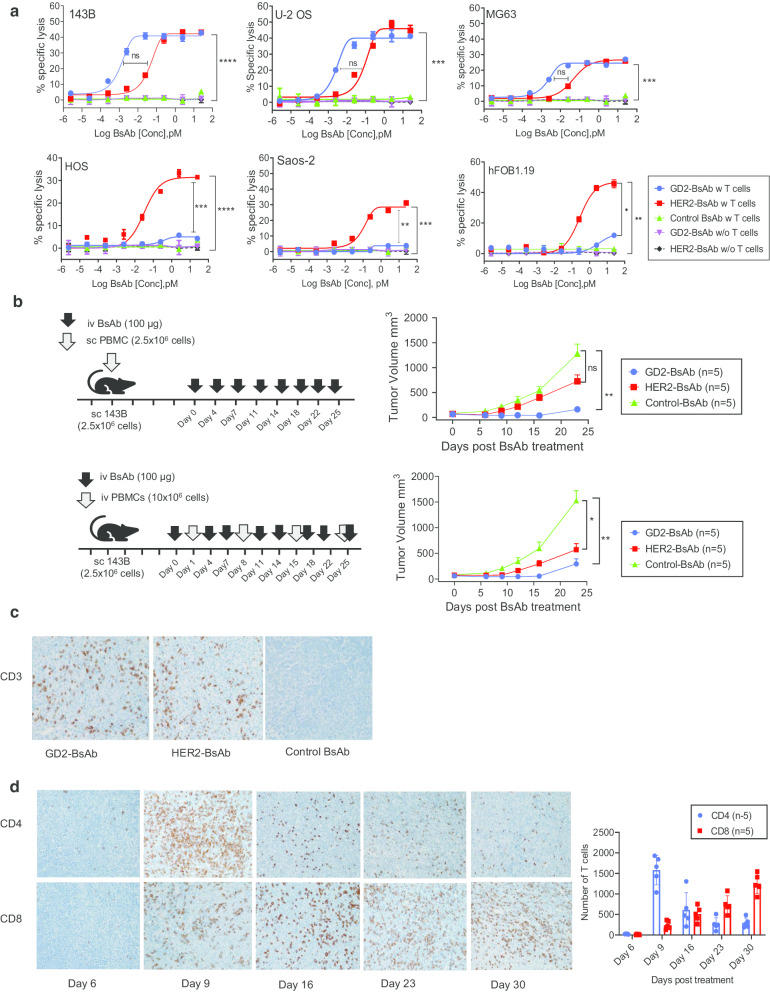
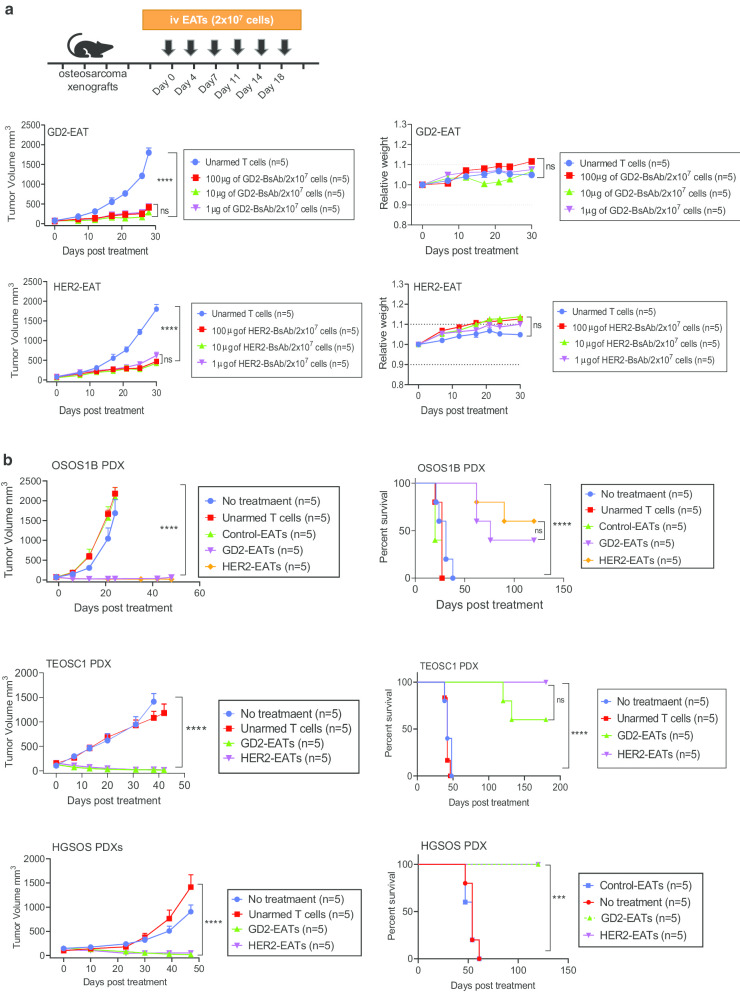
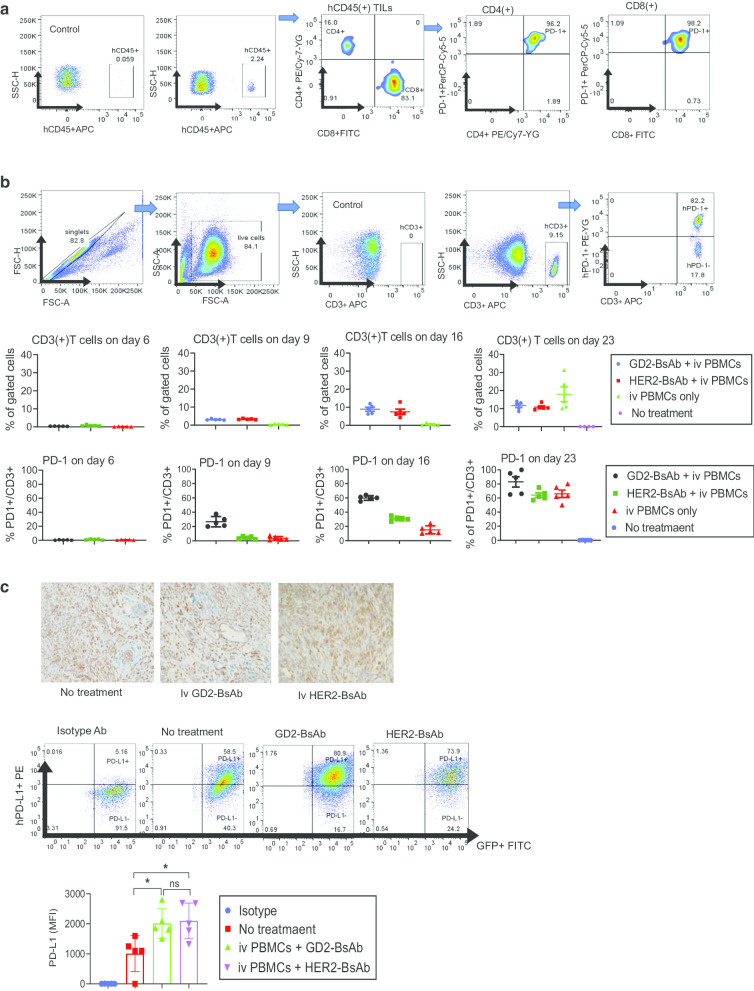
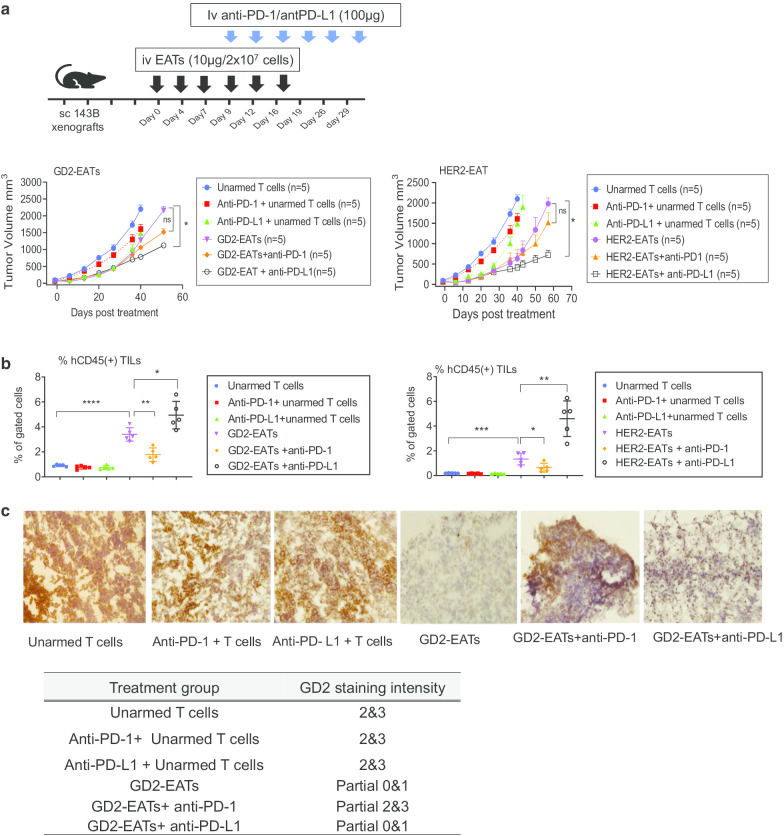
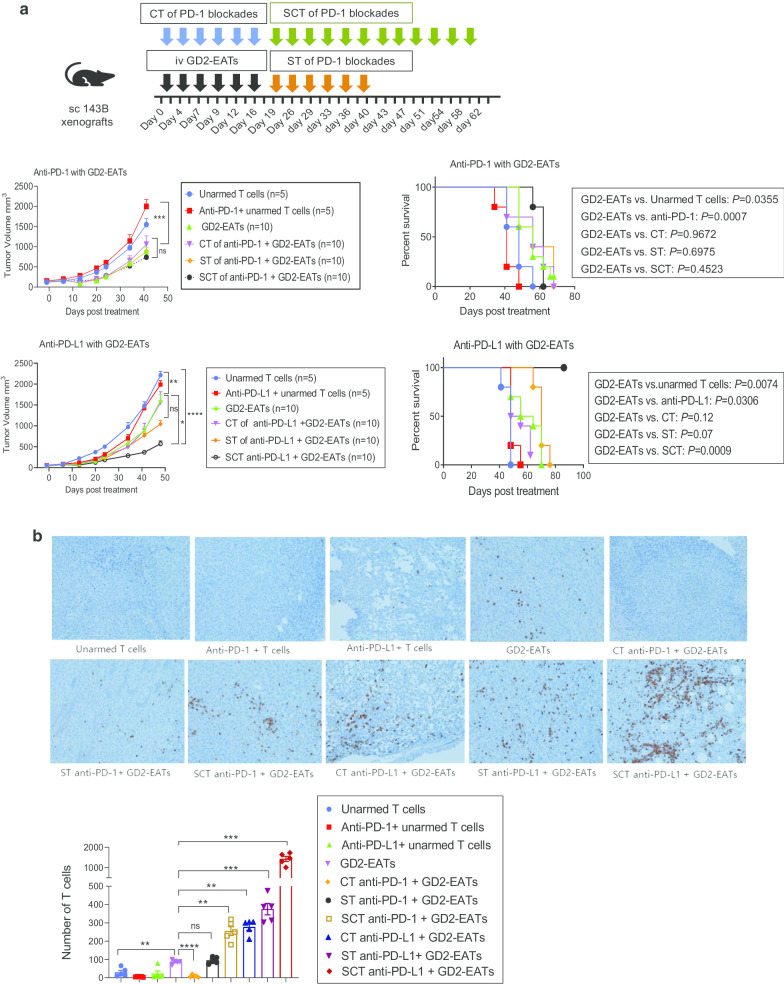
Background: The cure rate for metastatic osteosarcoma has not substantially improved over the past decades. Clinical trials of anti-HER2 trastuzumab or anti-GD2 dinutuximab for metastatic or refractory osteosarcoma were not successful, and neither was immune checkpoint inhibitors (ICIs). Methods: We tested various target antigen expressions on osteosarcoma cell lines using flow cytometry and analyzed in vitro T cell engaging BsAb (T-BsAb)-dependent T cell-mediated cytotoxicity using 4-h 51 Cr release assay. We tested in vivo anti-tumor activities of T-BsAb targeting GD2 or HER2 in established osteosarcoma cell line or patient-derived xenograft (PDX) mouse models carried out in BALB-Rag2−/−IL-2R-γc-KO (BRG) mice. We also generated ex vivo BsAb-armed T cells (EATs) and studied their tumor-suppressive effect against osteosarcoma xenografts. In order to improve the anti-tumor response, ICIs, anti-human PD-1 (pembrolizumab) or anti-human PD-L1 (atezolizumab) antibodies were tested their synergy with GD2- or HER2-BsAb against osteosarcoma. Results: GD2 and HER2 were chosen from a panel of surface markers on osteosarcoma cell lines and PDXs. Anti-GD2 BsAb or anti-HER2 BsAb exerted potent anti-tumor effect against osteosarcoma tumors in vitro and in vivo. T cells armed with anti-GD2-BsAb (GD2-EATs) or anti-HER2-BsAb (HER2-EATs) showed significant anti-tumor activities as well. Anti-PD-L1 combination treatment enhanced BsAb-armed T cell function in vivo and improved tumor control and survival of the mice, when given sequentially and continuously. Conclusion: Anti-GD2 and anti-HER2 BsAbs were effective in controlling osteosarcoma. These data support the clinical investigation of GD2 and HER2 targeted T-BsAb treatment in combination with immune checkpoint inhibitors, particularly anti-PD-L1, in patients with osteosarcoma to improve their treatment outcome.
Overview
The claims and statistics of this paper haven’t been checked yet.
Free: it reads the open-access text and checks the first 5 claims that cite a source we can check. Create a free account to check every claim.
Integrity signals
Registry
Cites
Statistics
Figures
Verification
Claims the paper makes
The claims and statistics of this paper haven’t been checked yet.
Free: it reads the open-access text and checks the first 5 claims that cite a source we can check. Create a free account to check every claim.
Claims other papers make about this one
Each is checked against this paper’s own text: does it say what the citing paper says it does?
The source backs part of the claim, not all of it — or backs it for a different population, condition or comparison.
In the citing paper
“Besides, PD-1/PD-L1 blockade significantly enhanced anti-tumor activity of GD2-BsAb and HER2-BsAb [147].”
From Advances on immunotherapy for osteosarcoma (2024) · cites this paper as [147]
Experimental — accuracy not yet measuredThe cited source says what the claim attributes to it.
In the citing paper
“GD2-BsAb and HER2-BsAb successfully directed T cells into tumor tissues and exerted potent anti-tumor activity against osteosarcoma.”
From Advances on immunotherapy for osteosarcoma (2024) · cites this paper as [147]
Self-check
Percentages, sums and reported differences re-computed from the paper’s own numbers.
The self-check needs the paper’s full text.
Citations
Cites
Tumor-associated B7-H1 promotes T-cell apoptosis: A potential mechanism of immune evasion
Dong, H., Strome, S. E., Salomao, D. R., Tamura, H., Hirano, F., Flies, D. B., Roche, P. C., Lu, J., Zhu, G., Tamada, K., et al. (2002) · Nature Medicine · doi:10.1038/nm730 · Cited by 5,025 · cited 2×
“When confronted by tumor targets, EATs produce pro-inflammatory cytokines such as IFN-γ, upregulating PD-L1, which induces T cell apoptosis and inhibits T cell cytotoxicity [60].”
BackgroundNagata, S., & Golstein, P. (1995) · Science · doi:10.1126/science.7533326 · Cited by 3,979
CD19 CAR–T cells of defined CD4+:CD8+ composition in adult B cell ALL patients
Turtle, C. J., Hanafi, L.-A., Berger, C., Gooley, T. A., Cherian, S., Hudecek, M., Sommermeyer, D., Melville, K., Pender, B., Budiarto, T. M., et al. (2016) · Journal of Clinical Investigation · doi:10.1172/jci85309 · Cited by 2,112 · cited 2×
“Furthermore, balanced ratio of CD4(+) and CD8(+) CAR T cells (CD4:CD8 ratio 1:1) seemed to be important for high remission rates in B-ALL [51].”
BackgroundResultExpanding roles for CD4+ T cells in immunity to viruses
Swain, S. L., McKinstry, K. K., & Strutt, T. M. (2012) · Nature Reviews Immunology · doi:10.1038/nri3152 · Cited by 956
Epitope spreading in immune-mediated diseases: implications for immunotherapy
Vanderlugt, C. L., & Miller, S. D. (2002) · Nature Reviews Immunology · doi:10.1038/nri724 · Cited by 950
Sommermeyer, D., Hudecek, M., Kosasih, P. L., Gogishvili, T., Maloney, D. G., Turtle, C. J., & Riddell, S. R. (2016) · Leukemia · doi:10.1038/leu.2015.247 · Cited by 867
Szabo, P. A., Levitin, H. M., Miron, M., Snyder, M. E., Senda, T., Yuan, J., Cheng, Y. L., Bush, E. C., Dogra, P., Thapa, P., et al. (2019) · Nature Communications · doi:10.1038/s41467-019-12464-3 · Cited by 756 · cited 2×
“, IFN-γ, TNF-α, IL-15, and IL-13, as confirmed by the expression of master transcription factor genes TBX21 and GATA3 [49, 50].”
BackgroundRecurrent Somatic Structural Variations Contribute to Tumorigenesis in Pediatric Osteosarcoma
Chen, X., Bahrami, A., Pappo, A., Easton, J., Dalton, J., Hedlund, E., Ellison, D., Shurtleff, S., Wu, G., Wei, L., et al. (2014) · Cell Reports · doi:10.1016/j.celrep.2014.03.003 · Cited by 752 · cited 1×
“osteosarcoma have shown high levels of chromosome structural variations, rearrangements, and mutation clusters that result in significant disease heterogeneity but few clinically approachable alterations [9, 10].”
BackgroundMeyers, P. A., Schwartz, C. L., Krailo, M. D., Healey, J. H., Bernstein, M. L., Betcher, D., Ferguson, W. S., Gebhardt, M. C., Goorin, A. M., Harris, M., et al. (2008) · Journal of Clinical Oncology · doi:10.1200/jco.2008.14.0095 · Cited by 752 · cited 1×
“Coley on bacterial toxins inducing tumor regression [5], many immunotherapy attempts have been made in soft tissue and bone sarcomas, but success has been very limited [6, 7].”
BackgroundClaudin-18 Splice Variant 2 Is a Pan-Cancer Target Suitable for Therapeutic Antibody Development
Sahin, U., Koslowski, M., Dhaene, K., Usener, D., Brandenburg, G., Seitz, G., Huber, C., & Türeci, O. (2008) · Clinical Cancer Research · doi:10.1158/1078-0432.ccr-08-1547 · Cited by 501
Cited by
Advances on immunotherapy for osteosarcoma
Yu, S., & Yao, X. (2024) · Molecular Cancer · doi:10.1186/s12943-024-02105-9 · Cited by 270
“Besides, PD-1/PD-L1 blockade significantly enhanced anti-tumor activity of GD2-BsAb and HER2-BsAb [147].”
BackgroundInchingolo, A. D., Inchingolo, A. M., Malcangi, G., Avantario, P., Azzollini, D., Buongiorno, S., Viapiano, F., Campanelli, M., Ciocia, A. M., De Leonardis, N., et al. (2022) · Nutrients · doi:10.3390/nu14173519 · Cited by 176
“These proteins can be targeted with antibody-drug conjugates and/or adoptive cell treatments [184].”
BackgroundThe role of tumor-associated macrophages in osteosarcoma progression – therapeutic implications
Huang, Q., Liang, X., Ren, T., Huang, Y., Zhang, H., Yu, Y., Chen, C., Wang, W., Niu, J., Lou, J., et al. (2021) · Cellular Oncology · doi:10.1007/s13402-021-00598-w · Cited by 118
“teosarcoma cells and xenografts [141], which provides a basis”
BackgroundImmune checkpoints in osteosarcoma: Recent advances and therapeutic potential
Yang, W., Tang, F., Tu, C., Hornicek, F. J., Duan, Z., & Min, L. (2022) · Cancer Letters · doi:10.1016/j.canlet.2022.215887 · Cited by 114
Liu, K., Liao, Y., Zhou, Z., Zhang, L., Jiang, Y., Lu, H., Xu, T., Dong, Y., Gao, Q., Li, Z., et al. (2022) · Biomaterials · doi:10.1016/j.biomaterials.2022.121383 · Cited by 91
Canine and murine models of osteosarcoma
Beck, J. A., Ren, L., Huang, S., Berger, E. P., Bardales, K., Mannheimer, J., Mazcko, C. N., & LeBlanc, A. K. (2022) · Veterinary Pathology · doi:10.1177/03009858221083038 · Cited by 87
Current Status and Prospects of Targeted Therapy for Osteosarcoma
Hu, Z., Wen, S., Huo, Z., Wang, Q., Zhao, J., Wang, Z., Chen, Y., Zhang, L., Zhou, F., Guo, Z., et al. (2022) · Cells · doi:10.3390/cells11213507 · Cited by 84
Yu, L., Zhang, J., & Li, Y. (2022) · Frontiers in Immunology · doi:10.3389/fimmu.2022.871076 · Cited by 73
Biology of GD2 ganglioside: implications for cancer immunotherapy
Machy, P., Mortier, E., & Birklé, S. (2023) · Frontiers in Pharmacology · doi:10.3389/fphar.2023.1249929 · Cited by 84
Patient‐derived xenograft models in pan‐cancer: From bench to clinic
Li, J., Gu, A., Tang, N., Zengin, G., Li, M., & Liu, Y. (2025) · Interdisciplinary medicine · doi:10.1002/inmd.20250016 · Cited by 69
Immunotherapy in soft tissue and bone sarcoma: unraveling the barriers to effectiveness
Panagi, M., Pilavaki, P., Constantinidou, A., & Stylianopoulos, T. (2022) · Theranostics · doi:10.7150/thno.72800 · Cited by 61
“A more recent study has exploited the combination of either PD-1 or PD-L1 blockade with adoptive transfer of T cells armed with anti-GD2-BsAb (GD2-EATs) or anti-HER2-BsAb (HER2-EATs) [91].”
BackgroundChu, X., Mi, B., Xiong, Y., Wang, R., Liu, T., Hu, L., Yan, C., Zeng, R., Lin, J., Fu, H., et al. (2024) · Biomaterials · doi:10.1016/j.biomaterials.2024.122714 · Cited by 61
Park, J. A., Wang, L., & Cheung, N. V. (2021) · Journal of Hematology & Oncology · doi:10.1186/s13045-021-01156-5 · Cited by 52
Self-citationDecoding the Impact of Tumor Microenvironment in Osteosarcoma Progression and Metastasis
Nirala, B. K., Yamamichi, T., Petrescu, D. I., Shafin, T. N., & Yustein, J. T. (2023) · Cancers · doi:10.3390/cancers15205108 · Cited by 58
“T cell-based immunotherapies, including chimeric antigen receptor (CAR) T cell therapy, have shown promise in preclinical models of OS [187,188].”
BackgroundGD2-targeting therapy: a comparative analysis of approaches and promising directions
Philippova, J., Shevchenko, J. A., & Sennikov, S. V. (2024) · Frontiers in Immunology · doi:10.3389/fimmu.2024.1371345 · Cited by 60
Zhang, Y., He, R. L., Xuan, L., Mao, L., Jiang, P., Ni, C., Yin, Z., Zhong, X., Chen, C., Zheng, Q., et al. (2021) · Frontiers in Genetics · doi:10.3389/fgene.2021.780780 · Cited by 50
“PYCARD is an adaptor protein that helps form inflammasomes, which contribute to inflammation by promoting the release of the active IL-1β and IL-18 (Hoffman and Wanderer, 2010; Protti and De Monte, 2020).”
BackgroundPark, J. A., Espinosa-Cotton, M., Guo, H.-F., Monette, S., & Cheung, N.-K. V. (2023) · Journal for ImmunoTherapy of Cancer · doi:10.1136/jitc-2023-006680 · Cited by 46
Self-citationPark, J. A., Santich, B. H., Xu, H., Lum, L. G., & Cheung, N. V. (2021) · Journal for ImmunoTherapy of Cancer · doi:10.1136/jitc-2020-002222 · Cited by 50
Self-citationOsteosarcoma in Children: Not Only Chemotherapy
Argenziano, M., Tortora, C., Pota, E., Paola, A. D., Martino, M. D., Leva, C. D., Pinto, D., & Rossi, F. (2021) · Pharmaceuticals · doi:10.3390/ph14090923 · Cited by 51
Modeling the Tumor Microenvironment and Cancer Immunotherapy in Next-Generation Humanized Mice
Chen, A., Neuwirth, I., & Herndler‐Brandstetter, D. (2023) · Cancers · doi:10.3390/cancers15112989 · Cited by 46
Novel potent anti-STEAP1 bispecific antibody to redirect T cells for cancer immunotherapy
Lin, T.-Y., Park, J. A., Long, A., Guo, H.-F., & Cheung, N. V. (2021) · Journal for ImmunoTherapy of Cancer · doi:10.1136/jitc-2021-003114 · Cited by 45
Self-citationPromise and Challenges of T Cell Immunotherapy for Osteosarcoma
Park, J. A., & Cheung, N. V. (2023) · International Journal of Molecular Sciences · doi:10.3390/ijms241512520 · Cited by 51
“Although osteosarcoma cell lines and tissue sections were HER2-positive by immunohistochemistry or flow cytometry [11,62], HER2 gene amplification was rarely observed in osteosarcoma, and the expression levels were much lower than those of HER2(+) breast cancers [68], accounting for the clinical insensitivity of OS to…”
BackgroundInfluentialSelf-citationCurrent status and future challenges of CAR-T cell therapy for osteosarcoma
Li, S., Zhang, H., & Shang, G. (2023) · Frontiers in Immunology · doi:10.3389/fimmu.2023.1290762 · Cited by 39
T Cell Bispecific Antibodies: An Antibody-Based Delivery System for Inducing Antitumor Immunity
Kamakura, D., Asano, R., & Yasunaga, M. (2021) · Pharmaceuticals · doi:10.3390/ph14111172 · Cited by 40
“The second T-BsAb consists of anti-HER2 IgG and two anti-CD3 scFvs fused to the C-terminus of IgG light chains [99,100].”
BackgroundZhra, M., Akhund, S. A., & Mohammad, K. S. (2025) · Pharmaceuticals · doi:10.3390/ph18040520 · Cited by 47
“This immunosuppressive environment limits the activation and efficacy of T cells, which are necessary for ICI function, as TILs often exhibit high expression of immune checkpoint molecules like PD-1, further impairing their antitumor activity [258,259].”
Unraveling molecular aberrations and pioneering therapeutic strategies in osteosarcoma
Yan, P., Wang, J., Yue, B., & Wang, X. (2024) · Biochimica et Biophysica Acta (BBA) - Reviews on Cancer · doi:10.1016/j.bbcan.2024.189171 · Cited by 32
Liang, H., Cui, M., Tu, J., & Chen, X. (2024) · Frontiers in Cell and Developmental Biology · doi:10.3389/fcell.2024.1394339 · Cited by 34
Advances and challenges in the treatment of osteosarcoma
Wang, X., Zhu, K., Hu, J., & Zhang, C. (2025) · Progress in Biophysics and Molecular Biology · doi:10.1016/j.pbiomolbio.2025.07.001 · Cited by 38
Zhang, L., Wang, M., Zhu, Z., Ding, C., Chen, S., Wu, H., Yang, Y., Che, F., Li, Q., & Li, H. (2021) · International Journal of Nanomedicine · doi:10.2147/ijn.s302450 · Cited by 27
Zhou, L., Liang, H., Ge, Y., Ding, W., Chen, Q., Zhang, T., Xiao, L., Li, Y., Dong, J., He, X., et al. (2022) · Advanced Healthcare Materials · doi:10.1002/adhm.202200938 · Cited by 29
Koumarianou, A. A., & Durán, J. (2021) · Cancers · doi:10.3390/cancers13030363 · Cited by 36
“A recent preclinical study on GD2 and HER2 overexpressing osteosarcoma cell lines and xenograft mouse models indicated that the administration of anti-GD2xanti-CD3 and anti-HER2xanti-CD3 bispecific antibodies was associated with substantial T-cell recruitment in the tumor and potent antitumor activity [59].”
BackgroundFasanya, H. O., Dopico, P., Yeager, Z., Fan, Z. H., & Siemann, D. W. (2021) · Journal of bone oncology · doi:10.1016/j.jbo.2021.100357 · Cited by 27
Neoadjuvant Chemotherapy for Adults with Osteogenic Sarcoma
Robinson, M. J., & Davis, E. J. (2024) · Current Treatment Options in Oncology · doi:10.1007/s11864-024-01269-2 · Cited by 32
“Just as HER2 and GD2 are appealing mAb targets, they are attractive as CAR T targets as well [33, 44, 47] given their overexpression on osteosarcoma cells [43, 48].”
BackgroundImmunotherapy of osteosarcoma based on immune microenvironment modulation
Lian, H., Zhang, J., Hou, S., Ma, S., Yu, J., Zhao, W., Zhao, D., & Zhang, Z. (2025) · Frontiers in Immunology · doi:10.3389/fimmu.2024.1498060 · Cited by 31
CAR T-Cell Therapy in Children with Solid Tumors
Kulczycka, M., Derlatka, K., Tasior, J., Lejman, M., & Zawitkowska, J. (2023) · Journal of Clinical Medicine · doi:10.3390/jcm12062326 · Cited by 27
Emerging immunotherapies in osteosarcoma: from checkpoint blockade to cellular therapies
Han, Z., Chen, G., & Wang, D. (2025) · Frontiers in Immunology · doi:10.3389/fimmu.2025.1579822 · Cited by 38
“These fi ndings support clinical trials investigating GD2 and HER2-targeted T-BsAb therapy in combination with immune checkpoint inhibitors to improve treatment outcomes for osteosarcoma patients (66).”
Bioactive sphingolipids as emerging targets for signal transduction in cancer development
Jia, W., Yuan, J., Zhang, J., Li, S., Lin, W., & Cheng, B. (2024) · Biochimica et Biophysica Acta (BBA) - Reviews on Cancer · doi:10.1016/j.bbcan.2024.189176 · Cited by 27
Chimeric Antigen Receptor T-Cell Therapy: The Light of Day for Osteosarcoma
Lin, Z., Wu, Z., & Luo, W. (2021) · Cancers · doi:10.3390/cancers13174469 · Cited by 21
“Similarly, HER2-targeted CAR-T cells displayed significant antitumor activity in the study conducted by Park and colleagues [23].”
BackgroundResultInfluentialWang, J., Hu, F., Yu, P., Wang, J., Liu, Z., Bao, Q., Zhang, W., & Wen, J. (2022) · Journal of Cancer Research and Clinical Oncology · doi:10.1007/s00432-022-04458-4 · Cited by 23
“2017, Park and Cheung 2020) as it can be altered by therapeutic agents and affect the therapeutic effectiveness of agents.”
BackgroundZhou, Y., Yang, Q., Dong, Y., Ji, T., Zhang, B., Yang, C., Zheng, S., Tang, L., Zhou, C., Qian, G., et al. (2022) · Clinical Cancer Research · doi:10.1158/1078-0432.ccr-22-2470 · Cited by 19
Bishop, M. W. (2025) · Hematology/Oncology Clinics of North America · doi:10.1016/j.hoc.2025.04.005 · Cited by 24
Overcoming tumor heterogeneity by ex vivo arming of T cells using multiple bispecific antibodies
Park, J. A., & Cheung, N. V. (2022) · Journal for ImmunoTherapy of Cancer · doi:10.1136/jitc-2021-003771 · Cited by 19
Self-citationLong, A. W., Xu, H., Santich, B. H., Guo, H.-F., Hoseini, S. S., de Stanchina, E., & Cheung, N. V. (2024) · Journal of Hematology & Oncology · doi:10.1186/s13045-024-01538-5 · Cited by 16
Self-citationNakano, K. (2023) · International Journal of Molecular Sciences · doi:10.3390/ijms242316823 · Cited by 16
Espinosa-Cotton, M. M., Guo, H.-F., Tickoo, S. K., & Cheung, N. V. (2023) · Frontiers in Oncology · doi:10.3389/fonc.2023.1104693 · Cited by 14
“T-BsAbs were generated as previously described (8).”
Self-citationStrategies to Overcome Resistance to Immune-Based Therapies in Osteosarcoma
Hattinger, C. M., Salaroglio, I. C., Fantoni, L., Godel, M., Casotti, C., Kopecka, J., Scotlandi, K., Ibrahim, T., Riganti, C., & Serra, M. (2023) · International Journal of Molecular Sciences · doi:10.3390/ijms24010799 · Cited by 16
“Recently, preclinical findings showing that dinutuximab, a monoclonal antibody targeting GD2, can exert relevant antitumor effects on HGOS cell lines and xenografts [93] provided the rational for the design of additional GD2-based clinical trials (Table S1).”
BackgroundChimeric antigen receptor T cells in the treatment of osteosarcoma (Review)
Yu, T., Jiang, W., Wang, Y., Zhou, Y. Y., Jiao, J., & Wu, M. (2024) · International Journal of Oncology · doi:10.3892/ijo.2024.5628 · Cited by 14
“T cells in patients with GD2 + OS (75), and bispecific antibodies targeting GD2 and HER2 have potent antitumor effects against OS in vitro and in vivo (76).”
BackgroundWang, Y., Hao, W., & Wang, H. (2021) · Artificial Cells Nanomedicine and Biotechnology · doi:10.1080/21691401.2021.1890100 · Cited by 12
“However, survival rate for osteosarcoma patients has stagnated in recent years, and the prognosis for patients with metastatic or relapsed disease remains poor, with a five-year overall survival rate of 20% [7,8].”
BackgroundRetractedBoutin, L., Barjon, C., Chauvet, M., Lafrance, L., Senechal, E., Bourges, D., Vigne, E., & Scotet, E. (2024) · European Journal of Immunology · doi:10.1002/eji.202350773 · Cited by 13
Bareke, H., Ibáñez-Navarro, A., Guerra‐García, P., Pérez, C. G., Rubio, P., de Sabando, D. P. L., Urgellés, A. S., Ortiz-Cruz, E. J., & Pérez‐Martínez, A. (2023) · International Journal of Molecular Sciences · doi:10.3390/ijms24098324 · Cited by 11
“macrophage colony-stimulating factor are currently being tested in a phase II clinical trial for adult and pediatric patients with recurrent OS (NCT02502786) A preclinical study using cell-line and patient-derived xenografts has shown that T cells that are ex vivo “armed” with anti-GD2 and anti-CD3 bispecific antibodi…”
BackgroundCho, J., Tae, N., Song, Y., Kim, C., Lee, S., Ahn, J.-H., Lee, K. H., Lee, B., Kim, B. S., Chang, S.-Y., et al. (2024) · Cancer Immunology Immunotherapy · doi:10.1007/s00262-024-03785-4 · Cited by 13
“…exosomes with tumor antigens play an important role in the enhancement and infiltration of BsTE:T. Page 14 of 16 BsTE exerts its activation function only after it reaches the tumor site and bridges tumor and T-cells via fundamental mechanisms that have been previously described [33, 34].”
BackgroundAdvancing Systemic Therapy in Chondrosarcoma: New Horizons
Li, K. H. C., Gulia, A., Duffaud, F., & Jones, R. L. (2024) · Oncology and Therapy · doi:10.1007/s40487-024-00317-z · Cited by 15
“That said, Ewing sarcoma and osteosarcoma have seen pre-clinical efficacy with CAR-T cell therapy [30, 31].”
A novel therapeutic strategy for osteosarcoma using anti-GD2 ADC and EZH2 inhibitor
Shan, J., Lin, Z., Rashid, H., Huang, P., Qiang, L., Liu, Y., Shen, G., Li, Y., Cui, J., Su, Z. Y., et al. (2025) · Biomarker Research · doi:10.1186/s40364-025-00800-3 · Cited by 9
“ADCs offer targeted therapeutic potential but are limited by the relatively low or heterogeneous expression of disialoganglioside GD2 on osteosarcoma cells [4, 5].”
Dinutuximab beta in the treatment of high-risk neuroblastoma
Achbergerová, M., Hederová, S., Hrašková, A., & Kolenová, A. (2022) · Medicine · doi:10.1097/md.0000000000028716 · Cited by 9
Immunotherapies for Childhood Cancer
Park, J. A., & Cheung, N. V. (2024) · Cold Spring Harbor Perspectives in Medicine · doi:10.1101/cshperspect.a041574 · Cited by 10
Self-citationKang, H., Li, Y., Sun, F., Li, F., Zhu, M., Zhou, Z., Wu, J. L., Wang, K., Kutilike, B., Miao, Z., et al. (2025) · Advanced Materials · doi:10.1002/adma.202503060 · Cited by 8
Barzegari, A., Salemi, F., Kamyab, A., Aratikatla, A., Nejati, N., Valizade, M., Eltouny, E., & Ebrahimi, A. (2024) · Journal of bone oncology · doi:10.1016/j.jbo.2024.100635 · Cited by 9
“Finally, Park et al. confirmed bispecific antibody engagement of GD2 elicited T cell-mediated antitumor effects against osteosarcoma in vivo, further improved by PD-L1 checkpoint blockade [123].”
Du, W., Shang, W., Wen, W. X., Deng, X., Xie, D., Zhang, Y., Su, H., & Liu, H. (2025) · Materials Chemistry Frontiers · doi:10.1039/d4qm00870g · Cited by 7
Exploring the Tumor Microenvironment in Osteosarcoma: Driver of Resistance and Progression
Schmidt, A. A., Prasad, A., Huisman, A. R., Wakefield, M. R., & Fang, Y. (2025) · Cancers · doi:10.3390/cancers17193106 · Cited by 10
“Durability concerns have been addressed in a variety of ways, but an intriguing one is the combination with PD-L1 inhibitors, which was effective in enhancing tumor control and survival in mouse OS models [229].”
Mir-615-3p promotes osteosarcoma progression via the SESN2/AMPK/mTOR pathway
Yu, X., Wang, X., Xu, F., Zhang, X., Wang, M., Zhou, R., Sun, Z., Pan, X., Lin, F., Zhang, W., et al. (2024) · Cancer Cell International · doi:10.1186/s12935-024-03604-x · Cited by 6
Kitidee, K., Amonyingcharoen, S., Preedagasamzin, S., Atjanasuppat, K., Sawaisorn, P., Srimorkun, P., Petvises, S., Chaicumpa, W., Borwornpinyo, S., Anurathapan, U., et al. (2025) · PLoS ONE · doi:10.1371/journal.pone.0325389 · Cited by 5
“Similarly, T cells equipped with anti-GD2 bispecific antibodies (anti-GD2 BsAb) have exhibited significant anti-tumor activity against osteosarcoma both in vitro and in vivo [45].”
Wei, J., Zheng, H., Dai, S., & Liu, M. (2024) · Heliyon · doi:10.1016/j.heliyon.2023.e23929 · Cited by 5
“…immunosuppressive TME via cytokine modulation [33], 3) the use of BsAb-armed activated T cells (BAT), redirecting bystander T-cells to attack tumor cells [34], and 4) the combination of BsAb therapy with conventional antitumor therapy, such as chemotherapy, radiotherapy, and targeted therapy [35].”
BackgroundChen, Y.-J., Chen, M. J., Cheng, T., Tsai, Y.-S., Wang, C.-H., Chen, C.-Y., Wu, T.-Y., Tzou, S.-C., Wang, K., Cheng, J., et al. (2023) · Journal of Biomedical Science · doi:10.1186/s12929-023-00929-z · Cited by 6
“Cheung and colleagues developed a recombinant bispecific antibody with an IgG-[L]-scFv structure (anti-CD3 scFv fused to the C-terminus of the anti-tumor IgG light chain) attached to ex vivo armed T cells (named EATs), which had effective anti-tumor abilities for neuroblastoma and osteosarcoma in vitro and in vivo [55…”
BackgroundWang, J., Li, M., Zhang, Z., Mi, T., Luo, J., & He, D. (2025) · ACS Applied Materials & Interfaces · doi:10.1021/acsami.5c12922 · Cited by 6
Overall review of curative impact and barriers of CAR-T cells in osteosarcoma
Li, G., Wang, H., & Meftahpour, V. (2024) · EXCLI journal · doi:10.17179/excli2023-6760 · Cited by 8
Yang, B., Liu, S., Liu, B., Ye, T., Ma, X., & Song, T. (2026) · Cell Communication and Signaling · doi:10.1186/s12964-026-02883-3 · Cited by 4
Immunotherapy in pediatric bone sarcomas: Current progress and future directions
Weil, R., & Loeb, D. M. (2026) · Human Vaccines & Immunotherapeutics · doi:10.1080/21645515.2026.2690876 · Cited by 2
“36,38 Two distinct RNA classes, siRNA and miRNA, activate RNAi pathway through related but mechanistically distinct mechanisms. siRNA molecules are 21–23 nucleotide double ‑ stranded RNA duplexes characterized by two 3’ nucleotide overhangs.”
Wang, B., Wang, X., Du, X., Gao, S., Liang, B., & Yao, W. (2024) · Heliyon · doi:10.1016/j.heliyon.2024.e27023 · Cited by 2
“Nevertheless, survival has stagnated in recent years and the prognosis of patients with metastatic or recurrent osteosarcoma remains unsatisfactory, with a 5-year overall survival rate of 20% [2,9].”
BackgroundCombined use of niraparib enhanced the inhibitory effect of Anti-GD2 antibody on osteosarcoma cells
Wenyao, C., Shuai, M., Fan, Y., Li, X., & Que, X. (2024) · Discover Oncology · doi:10.1007/s12672-024-01166-y · Cited by 2
Xu, H., & Tao, H. (2024) · Heliyon · doi:10.1016/j.heliyon.2024.e41191 · Cited by 2
HEY1 promotes the development and metastasis of osteosarcoma through CD44/EGFR/FAK pathway
Liu, Y., Zhang, H., Yi, X., Wang, Z., & Yu, A. (2025) · Journal of Cellular and Molecular Medicine · doi:10.1111/jcmm.70042 · Cited by 1
“13 The wide-spread utilization of immune checkpoint inhibitors has prompted the urgent need for effective methods to predict treatment efficacy and minimize side effects, representing a crucial research challenge in current immunotherapy.”
Tracking Bispecific Antibody-Induced T Cell Trafficking Using Luciferase-Transduced Human T Cells
Espinosa-Cotton, M. M., Guo, H.-F., & Cheung, N. V. (2023) · Journal of Visualized Experiments · doi:10.3791/64390
Self-citationDownregulation of B4GALNT1 inhibits proliferation and metastasis of osteosarcoma cells.
Li, S., Wang, B., Chen, X., Tu, C., Peng, D., & Dai, Y. (2024) · PubMed Central · doi:10.11817/j.issn.1672-7347.2024.240020 · Cited by 1
Principles of Immunotherapy and Novel Immunotherapeutic Agents for Pediatric Cancer Management
Morrison, Z. D., & Suliman, A. Y. (2025) · Springer eBooks · doi:10.1007/978-3-030-71113-9_39-1
Principles of Immunotherapy and Novel Immunotherapeutic Agents for Pediatric Cancer Management
Morrison, Z. D., & Suliman, A. Y. (2025) · Springer eBooks · doi:10.1007/978-3-031-76882-8_39
Wang, K., Silli, E. K., Lv, H., & Song, R. (2025) · Drug Development Research · doi:10.1002/ddr.70207 · Cited by 1
“While monoclonal antibodies targeting HER2 (Trastuzumab) and GD2 (Dinutuximab) have limited success in metastatic OS, bispecific antibodies (BsAbs) engaging CD3 and GD2 or HER2 show potent antitumor effects, further enhanced by PD‐1/PD‐L1 blockade (Park and Cheung 2020).”
Park, J. A., Wang, L., & Cheung, N.-K. V. (2021) · Figshare · doi:10.6084/m9.figshare.16590464
Self-citationLong, A. W., Xu, H., Santich, B. H., Guo, H., Hoseini, S. S., de Stanchina, E., & Cheung, N.-K. V. (2024) · Figshare · doi:10.6084/m9.figshare.25670094
Self-citationChen, Y.-J., Chen, M. J., Cheng, T.-L., Tsai, Y.-S., Wang, C.-H., Chen, C.-Y., Wu, T.-Y., Tzou, S.-C., Wang, K.-H., Cheng, J.-J., et al. (2024) · Figshare · doi:10.6084/m9.figshare.26593136
Duan, L. L., Zhu, H., Chen, C., & Liu, W. (2026) · Holistic Integrative Oncology · doi:10.1007/s44178-026-00226-3
Immunotherapeutic Strategies Targeting GD2-Expressing Malignancies
Hung, J., Chiou, S.-P., & Yu, A. L.-T. (2026) · Advances in experimental medicine and biology · doi:10.1007/978-3-032-04153-1_31
Rôle de l'hypoxie dans l'immunothérapie des ostéosarcomes pédiatriques ciblant le GD2
Pierrevelcin, M. (2021) · theses.fr (ABES) · doi:10.70675/9d2c6f5dzb23ez4823z9c0fze8ea3c9c8bc7
Yang, C., Yu, Y., Wang, Y., Cai, Z., Zhao, Y., Ma, H., Xu, J., Zhu, H., Ren, T., Tang, X., et al. (2026) · Bone Reports · doi:10.1016/j.bonr.2026.101930 · Cited by 1
“A T cell engaging bispecific antibodies (T-BsAbs) using sequences of anti-CD3 (huOKT3) and anti-GD2 (hu3F8) exhibited a potent anti-tumor effect against OTS tumors in vitro and in vivo (Park and Cheung, 2020).”
Tirtei, E., Longostrevi, S. P., Bombaci, S., Mercolini, F., Pionelli, M. G., Asaftei, S. D., & Fagioli, F. (2026) · Frontiers in Immunology · doi:10.3389/fimmu.2026.1895000
Shi, J., & Chen, R. (2026) · Frontiers in Immunology · doi:10.3389/fimmu.2026.1919497
Zhang, X., Zeng, H., Qin, F., Wei, Y., Wan, D., & Wei, X. (2026) · MedComm – Oncology · doi:10.1002/mog2.70093
Osteosarcoma Across the Age Spectrum: Why Outcomes Diverge and Trials Must Adapt
Collins, S. H., & Matushansky, I. (2026) · Journal of Clinical Medicine · doi:10.3390/jcm15187017
“Similarly, evidence for the use of antibody drug conjugates [119–122] and bispecific antibodies [123] remains limited at this time.”
Zheng, Z. (2026) · Critical Reviews in Oncology/Hematology · doi:10.1016/j.critrevonc.2026.105618
Metadata
- Authors
- Park, J. A., & Cheung, N.-K. V.
- Affiliations
- Memorial Sloan Kettering Cancer Center (US)
- Corresponding author
- Cheung, Nai-Kong V.
- Venue
- Journal of Hematology & Oncology
- Published
- 2020-12
- Volume
- 13
- Issue
- 1
- Pages
- 172-172
- ISSN
- 1756-8722 (ISSN-L)
- PMC
- PMC7731630
- OpenAlex
- W3112196236
- Semantic Scholar
- 4f296b3f76c058bd94530506b290b5ff2423ae5b
- Cited by
- 88
- References
- 64
- Citations by year
- 2026: 10 · 2025: 16 · 2024: 22 · 2023: 14 · 2022: 12 · 2021: 14
- FWCI
- 5.62
- Type
- journal article
- Language
- en
- Open access
- gold
- doi.org
- Licence
- cc-by
- creativecommons.org/licenses/by/4.0/ (tdm)
- creativecommons.org/licenses/by/4.0/ (vor, 9 d)
- Locations
- Journal of Hematology & Oncology (publishedVersion, cc-by)
- PubMed Central (publishedVersion, cc-by)
- PubMed (publishedVersion)
- DOAJ (DOAJ: Directory of Open Access Journals) (submittedVersion, cc-by-sa)
- Funders
- Enid A. Haupt Endowed Chair
- The Robert Steel Foundation
- Kids Walk for Kids with Cancer
- Y-mAbs Therapeutics
- NCI Cancer Center Support Grant (P30 CA008748)
- Division of Cancer Epidemiology and Genetics, National Cancer Institute (P30 CA008748)
- Robert Steel Foundation
- Topics
- Health Sciences › Medicine › Oncology › Sarcoma Diagnosis and Treatment
- Life Sciences › Immunology and Microbiology › Immunology › Monoclonal and Polyclonal Antibodies Research
- Health Sciences › Medicine › Oncology › Cancer Immunotherapy and Biomarkers
- Keywords
- osteosarcoma, bispecific antibodies, T cell-engaging antibody, GD2, HER2, PD-L1 inhibitors, immune checkpoint inhibitors, adoptive T cell therapy, ex vivo T cell engineering, pembrolizumab, atezolizumab, patient-derived xenografts, combination immunotherapy
- MeSH terms
- Antineoplastic Agents, Immunological, Animals, Bone Neoplasms, Gangliosides, Humans, Male, Mice, Inbred BALB C, Osteosarcoma, T-Lymphocytes, Antibodies, Bispecific, Erb-b2 Receptor Tyrosine Kinases, Cell Line, Tumor
About these checks
Registry, retraction, Cites and statistics results are computed, not judged, with one exception: a printed reference that no index lists is read once by a model before it counts as a citation error. Claims are extracted by a model and kept only when their quote appears verbatim in the text; each cited source is then checked, with a model’s help, for whether it says what the claim relies on. Those verdicts can be wrong — read the claim’s quote and the cited source before relying on one.
Statistics and arithmetic are recomputed, not judged.
Confidence bands are shown only for fields calibrated on our annotated test set. None is calibrated yet, so no band is shown.
What counts as a claim ›How we measure confidence ›How we check this ›
Are you an author, or do you see a problem with this page? Request a review
Data sources
Bibliographic data: Semantic Scholar, OpenAlex, Crossref.
Contains information from the Semantic Scholar Academic Graph Datasets, made available under the ODC Attribution License (ODC-BY 1.0).
Semantic Scholar’s data is described in: Kinney, R., et al. (2023). The Semantic Scholar Open Data Platform. arXiv:2301.10140.
