

Strong synergy with APR-246 and DNA-damaging drugs in primary cancer cells from patients with TP53 mutant High-Grade Serous ovarian cancer
Open accessThe DOI matches its Crossref record; 41 of the 41 references it cites were found in a registry or an index.
Abstract
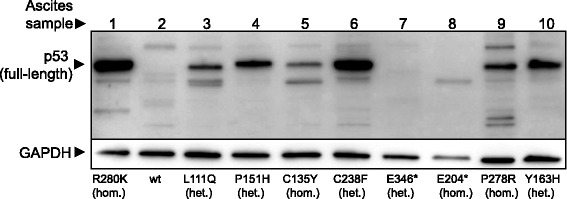
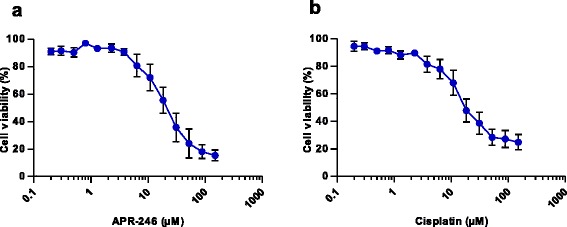
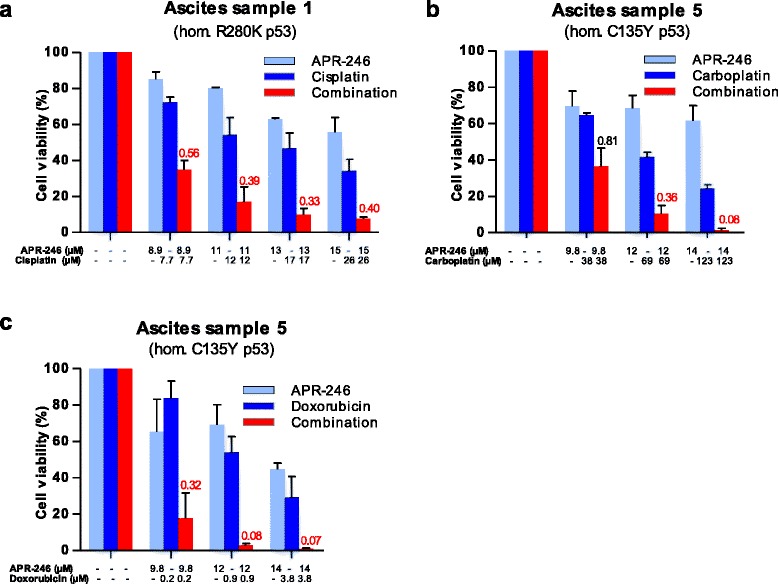
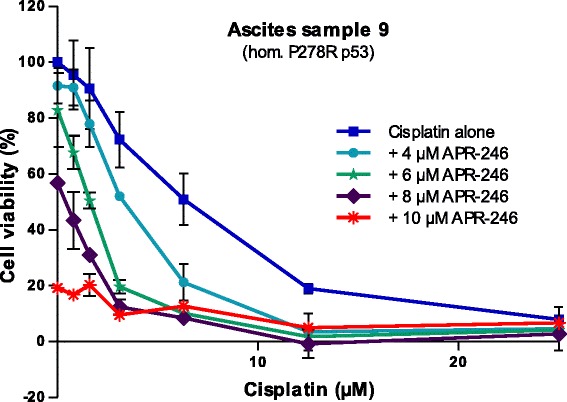
BACKGROUND: Mutation in the tumor suppressor gene TP53 is an early event in the development of high-grade serous (HGS) ovarian cancer and is identified in more than 96 % of HGS cancer patients. APR-246 (PRIMA-1(MET)) is the first clinical-stage compound that reactivates mutant p53 protein by refolding it to wild type conformation, thus inducing apoptosis. APR-246 has been tested as monotherapy in a Phase I/IIa clinical study in hematological malignancies and prostate cancer with promising results, and a Phase Ib/II study in combination with platinum-based therapy in ovarian cancer is ongoing. In the present study, we investigated the anticancer effects of APR-246 in combination with conventional chemotherapy in primary cancer cells isolated from ascitic fluid from 10 ovarian, fallopian tube, or peritoneal cancer patients, 8 of which had HGS cancer. METHODS: Cell viability was assessed with fluorometric microculture cytotoxicity assay (FMCA) and Combination Index was calculated using the Additive model. p53 status was determined by Sanger sequencing and single strand conformation analysis, and p53 protein expression by western blotting. RESULTS: We observed strong synergy with APR-246 and cisplatin in all tumor samples carrying a TP53 missense mutation, while synergistic or additive effects were found in cells with wild type or TP53 nonsense mutations. Strong synergy was also observed with carboplatin or doxorubicin. Moreover, APR-246 sensitized TP53 mutant primary ovarian cancer cells, isolated from a clinically platinum-resistant patient, to cisplatin; the IC50 value of cisplatin decreased 3.6 fold from 6.5 to 1.8 μM in the presence of clinically relevant concentration of APR-246. CONCLUSION: These results suggest that combination treatment with APR-246 and DNA-damaging drugs could significantly improve the treatment of patients with TP53 mutant HGS cancer, and thus provide strong support for the ongoing clinical study with APR-246 in combination with carboplatin and pegylated liposomal doxorubicin in patients with recurrent HGS cancer.
Overview
The claims and statistics of this paper haven’t been checked yet.
Free: it reads the open-access text and checks the first 5 claims that cite a source we can check. Create a free account to check every claim.
Integrity signals
Registry
Cites
Statistics
Figures
Verification
Claims the paper makes
The claims and statistics of this paper haven’t been checked yet.
Free: it reads the open-access text and checks the first 5 claims that cite a source we can check. Create a free account to check every claim.
Claims other papers make about this one
Each is checked against this paper’s own text: does it say what the citing paper says it does?
The source backs part of the claim, not all of it — or backs it for a different population, condition or comparison.
In the citing paper
“The most apparent sensitization effect was observed with APR-246 (PRIMA-1Met/Eprenetapopt) (14)(15)(16)(17)(18).”
From Ovarian cancers with low CIP2A tumor expression constitute an APR-246 sensitive disease subtype (2021) · cites this paper as [14]
Experimental — accuracy not yet measuredThe cited source says what the claim attributes to it.
In the citing paper
“The most apparent sensitization effect was observed with APR-246 (PRIMA-1Met/Eprenetapopt) (15,19–22). Whereas HEY-CTLshRNA cells were practically insensitive to APR-246, HEY-CIP2AshRNA cells showed a >50% reduction in cell viability (Fig. 1A).”
From Ovarian Cancers with Low CIP2A Tumor Expression Constitute an APR-246–Sensitive Disease Subtype (2022) · cites this paper as [19]
Self-check
Percentages, sums and reported differences re-computed from the paper’s own numbers.
The self-check needs the paper’s full text.
Citations
Cites
2 retracted
PRIMA-1MET induces mitochondrial apoptosis through activation of caspase-2
Shen, J., Vakifahmetoglu, H., Stridh, H., Zhivotovsky, B., & Wiman, K. G. (2008) · Oncogene · doi:10.1038/onc.2008.249 · Cited by 57
Self-citationRetractedErratum: PRIMA-1Met induces mitochondrial apoptosis through activation of caspase-2
Shen, J., Vakifahmetoglu, H., Stridh, H., Zhivotovsky, B., & Wiman, K. G. (2016) · Oncogene · doi:10.1038/onc.2016.210 · Cited by 55 · cited 2×
“This induces activation of caspase-2 and expression of p53-target genes, including, PUMA, NOXA, and BAX, leading to mitochondrial apoptosis [9, 10, 30].”
BackgroundSelf-citationRetractedThe resurgence of platinum-based cancer chemotherapy
Kelland, L. (2007) · Nature Reviews Cancer · doi:10.1038/nrc2167 · Cited by 4,717 · cited 2×
“Platinum-based drugs have for decades been used for effective treatment of many solid tumors, including ovarian cancer [25, 26].”
BackgroundOrita, M., Suzuki, Y., Sekiya, T., & Hayashi, K. (1989) · Genomics · doi:10.1016/0888-7543(89)90129-8 · Cited by 3,434 · cited 1×
“The TP53 gene status (exons 2–11) was analyzed by PCR amplification and sequencing, followed by single-strand conformation analysis (SSCA) according to the original protocol [22], and samples displaying gel mobility shifts were sequenced to confirm the nucleotide change.”
MethodCisplatin: mode of cytotoxic action and molecular basis of resistance
Siddik, Z. H. (2003) · Oncogene · doi:10.1038/sj.onc.1206933 · Cited by 3,335 · cited 1×
“Platinum-based drugs have for decades been used for effective treatment of many solid tumors, including ovarian cancer [25, 26].”
BackgroundBlinded by the Light: The Growing Complexity of p53
Vousden, K. H., & Prives, C. (2009) · Cell · doi:10.1016/j.cell.2009.04.037 · Cited by 3,163 · cited 1×
“Mutations in TP53 are identified in about 50 % of all tumors and are associated with increased resistance to chemotherapy and reduced survival in many tumor types [7, 8].”
BackgroundDNA Topoisomerases and Their Poisoning by Anticancer and Antibacterial Drugs
Pommier, Y., Leo, E., Zhang, H., & Marchand, C. (2010) · Chemistry & Biology · doi:10.1016/j.chembiol.2010.04.012 · Cited by 1,829 · cited 1×
“The main mechanisms of action of doxorubicin are inhibition of DNA and RNA synthesis by intercalation between base pairs of the DNA/RNA strands, and interference with the topoisomerase II enzyme, leading to double-strand breaks [35].”
BackgroundOvarian Cancer Development and Metastasis
Lengyel, E. (2010) · The American Journal of Pathology · doi:10.2353/ajpath.2010.100105 · Cited by 1,672 · cited 2×
“Cancer cells in ascites mirror most of the molecular characteristics of cells in the primary tumor and at metastatic sites [32].”
BackgroundMolecular mechanisms of resistance and toxicity associated with platinating agents
Rabik, C. A., & Dolan, M. E. (2007) · Cancer Treatment Reviews · doi:10.1016/j.ctrv.2006.09.006 · Cited by 1,564 · cited 1×
“drug-induced increase in intracellular glutathione (GSH) levels leading to enhanced efflux of platinum compounds, reduced drug uptake, increased drug inactivation, as well as inactivation of the tumor suppressor protein p53 [26–29].”
BackgroundEvaluating cell lines as tumour models by comparison of genomic profiles
Domcke, S., Sinha, R., Levine, D. A., Sander, C., & Schultz, N. (2013) · Nature Communications · doi:10.1038/ncomms3126 · Cited by 1,418 · cited 1×
“Indeed, pronounced differences between some of the most commonly used HGS ovarian cancer cell line models and the majority of HGS ovarian cancer samples have been revealed [14, 15].”
BackgroundRethinking ovarian cancer II: reducing mortality from high-grade serous ovarian cancer
Bowtell, D. D., Böhm, S., Ahmed, A. A., Aspuria, P.-J., Bast, R. C., Beral, V., Berek, J. S., Birrer, M. J., Blagden, S., Bookman, M. A., et al. (2015) · Nature Reviews Cancer · doi:10.1038/nrc4019 · Cited by 1,367 · cited 2×
“Despite intense research to find novel treatments there has been minimal improvement in overall survival of the patients for the past decades [4].”
BackgroundStaging classification for cancer of the ovary, fallopian tube, and peritoneum
Prat, J. (2014) · International Journal of Gynecology & Obstetrics · doi:10.1016/j.ijgo.2013.10.001 · Cited by 1,364
Role of Glutathione in Cancer Progression and Chemoresistance
Traverso, N., Ricciarelli, R., Nitti, M., Marengo, B., Furfaro, A. L., Pronzato, M. A., Marinari, U. M., & Domenicotti, C. (2013) · Oxidative Medicine and Cellular Longevity · doi:10.1155/2013/972913 · Cited by 1,208 · cited 1×
“drug-induced increase in intracellular glutathione (GSH) levels leading to enhanced efflux of platinum compounds, reduced drug uptake, increased drug inactivation, as well as inactivation of the tumor suppressor protein p53 [26–29].”
BackgroundDriver mutations in TP53 are ubiquitous in high grade serous carcinoma of the ovary
Ahmed, A. A., Etemadmoghadam, D., Temple, J., Lynch, A. G., Riad, M., Sharma, R., Stewart, C., Fereday, S., Caldas, C., deFazio, A., et al. (2010) · The Journal of Pathology · doi:10.1002/path.2696 · Cited by 787 · cited 1×
“More than 96 % of patients with HGS cancer have mutations in TP53, which supports the idea that mutations in TP53 are driver mutations essential for the early development of this disease [5].”
BackgroundGrading Ovarian Serous Carcinoma Using a Two-Tier System
Malpica, A., Deavers, M. T., Lu, K., Bodurka, D. C., Atkinson, E. N., Gershenson, D. M., & Silva, E. G. (2004) · The American Journal of Surgical Pathology · doi:10.1097/00000478-200404000-00009 · Cited by 670 · cited 2×
“All samples were from patients with serous adenocarcinoma and 8 of them fulfilled the present criteria of high-grade serous type (Table 1) [16].”
BackgroundMethodPRIMA-1 reactivates mutant p53 by covalent binding to the core domain
Lambert, J. M. R., Gorzov, P., Veprintsev, D. B., Söderqvist, M., Segerbäck, D., Bergman, J., Fersht, A. R., Hainaut, P., Wiman, K. G., & Bykov, V. J. N. (2009) · Cancer Cell · doi:10.1016/j.ccr.2009.03.003 · Cited by 592 · cited 5×
“The mode of action of APR-246 as a p53-mutant targeting compound is well documented, and the molecular mechanisms underlying the reactivation of mutant p53 and induction of apoptosis are relatively well characterized [9, 10, 30].”
BackgroundInfluentialSelf-citationAre All Pelvic (Nonuterine) Serous Carcinomas of Tubal Origin?
Przybycin, C. G., Kurman, R. J., Ronnett, B. M., Shih, I.-M., & Vang, R. (2010) · American Journal of Surgical Pathology · doi:10.1097/pas.0b013e3181ef7b16 · Cited by 410
Lehmann, S., Bykov, V. J. N., Ali, D., Andrén, O., Cherif, H., Tidefelt, U., Uggla, B., Yachnin, J., Juliusson, G., Moshfegh, A., et al. (2012) · Journal of Clinical Oncology · doi:10.1200/jco.2011.40.7783 · Cited by 406 · cited 1×
“APR-246 has been tested as monotherapy in a Phase I/IIa clinical trial in patients with hematological malignancies and prostate cancer, with encouraging results [11].”
BackgroundSelf-citationMulticellular resistance: a paradigm for clinical resistance?
Desoize, B. (2000) · Critical Reviews in Oncology/Hematology · doi:10.1016/s1040-8428(00)00086-x · Cited by 400 · cited 1×
“Ascites contains single tumor cells and multicellular tissue-like aggregates, which have reduced proliferation and limited drug penetration resulting in decreased susceptibility to chemotherapy [33].”
BackgroundMistry, P., Kelland, L., Abel, G., Sidhar, S., & Harrap, K. (1991) · British Journal of Cancer · doi:10.1038/bjc.1991.279 · Cited by 261 · cited 1×
“drug-induced increase in intracellular glutathione (GSH) levels leading to enhanced efflux of platinum compounds, reduced drug uptake, increased drug inactivation, as well as inactivation of the tumor suppressor protein p53 [26–29].”
BackgroundPRIMA-1MET synergizes with cisplatin to induce tumor cell apoptosis
Bykov, V. J. N., Zache, N., Stridh, H., Westman, J., Bergman, J., Selivanova, G., & Wiman, K. G. (2005) · Oncogene · doi:10.1038/sj.onc.1208419 · Cited by 252
Self-citationLatifi, A., Abubaker, K., Castrechini, N., Ward, A. C., Liongue, C., Dobill, F., Kumar, J., Thompson, E. W., Quinn, M. A., Findlay, J. K., et al. (2011) · Journal of Cellular Biochemistry · doi:10.1002/jcb.23199 · Cited by 243 · cited 1×
“The composition of ascites has been reported to differ between untreated and treated patients since evolution of cancer stem cell-like cells occurs in response to platinum treatment [34].”
BackgroundThe fluorometric microculture cytotoxicity assay
Lindhagen, E., Nygren, P., & Larsson, R. (2008) · Nature Protocols · doi:10.1038/nprot.2008.114 · Cited by 233
Synergistic interaction of anticancer agents: a cellular perspective.
Valeriote, F. A., & Lin, H. S. (1975) · PubMed · Cited by 186
APR-246 overcomes resistance to cisplatin and doxorubicin in ovarian cancer cells
Mohell, N., Alfredsson, J., Fransson, Å., Uustalu, M., Byström, S., Gullbo, J., Hallberg, A., Bykov, V. J. N., Björklund, U., & Wiman, K. G. (2015) · Cell Death & Disease · doi:10.1038/cddis.2015.143 · Cited by 183 · cited 5×
“We have previously demonstrated strong synergistic anticancer effects with APR-246 and DNA-damaging drugs in ovarian cancer cell lines with various p53 status [12].”
BackgroundInfluentialSelf-citationPeng, X., Zhang, M.-Q.-Z., Conserva, F., Hosny, G., Selivanova, G., Bykov, V. J. N., Arnér, E. S. J., & Wiman, K. G. (2013) · Cell Death & Disease · doi:10.1038/cddis.2013.417 · Cited by 170 · cited 1×
“APR246 can also trigger apoptosis in a p53-independent manner by binding to thioredoxin reductase 1 (TrxR1) and inducing ROS [9, 10, 12, 31].”
BackgroundSelf-citationPrecursors and pathogenesis of ovarian carcinoma
Lim, D. Y., & Oliva, E. (2013) · Pathology · doi:10.1097/pat.0b013e32835f2264 · Cited by 170 · cited 3×
“Accumulated evidence suggests that HGS cancer found in these tissues shares a similar origin and pathogenesis, pointing out the fallopian tube as the origin in the majority of cases [2, 3].”
BackgroundPeng, X., Zhang, M.-Q.-Z., Conserva, F., Hosny, G., Selivanova, G., Bykov, V. J., Arnér, E. S., & Wiman, K. G. (2017) · Cell Death & Disease · doi:10.1038/cddis.2016.137 · Cited by 134
Self-citationMutant p53 reactivation by PRIMA-1MET induces multiple signaling pathways converging on apoptosis
Lambert, J. M. R., Moshfegh, A., Hainaut, P., Wiman, K. G., & Bykov, V. J. N. (2010) · Oncogene · doi:10.1038/onc.2009.425 · Cited by 106 · cited 5×
“The mode of action of APR-246 as a p53-mutant targeting compound is well documented, and the molecular mechanisms underlying the reactivation of mutant p53 and induction of apoptosis are relatively well characterized [9, 10, 30].”
BackgroundInfluentialSelf-citationBrachova, P., Mueting, S. R., Carlson, M. J., Goodheart, M. J., Button, A. M., Mott, S. L., Dai, D., Thiel, K. W., Devor, E. J., & Leslie, K. K. (2014) · International Journal of Oncology · doi:10.3892/ijo.2014.2747 · Cited by 99
The Consequence of Oncomorphic TP53 Mutations in Ovarian Cancer
Brachova, P., Thiel, K., & Leslie, K. (2013) · International Journal of Molecular Sciences · doi:10.3390/ijms140919257 · Cited by 92 · cited 1×
“Missense mutations in TP53 are common in HGS ovarian cancer, but the disease is also characterized by the highest frequency of TP53 nonsense or frameshift mutations in any cancer (15 % of TP53 mutant tumors) [40].”
BackgroundJonsson, E. W., Fridborg, H., Nygren, P., & Larsson, R. L. (1998) · European Journal of Clinical Pharmacology · doi:10.1007/s002280050505 · Cited by 90 · cited 1×
“The model assumes a log-linear shape of the dose-response curve, which is fairly valid if the drug concentrations used cause effects in the steep part of the dose-response curve [21].”
BackgroundBeyond genomics: Critical evaluation of cell line utility for ovarian cancer research
Elias, K. M., Emori, M. M., Papp, E., MacDuffie, E., Konecny, G. E., Velculescu, V. E., & Drapkin, R. (2015) · Gynecologic Oncology · doi:10.1016/j.ygyno.2015.08.017 · Cited by 81 · cited 1×
“Indeed, pronounced differences between some of the most commonly used HGS ovarian cancer cell line models and the majority of HGS ovarian cancer samples have been revealed [14, 15].”
BackgroundP53 and its molecular basis to chemoresistance in breast cancer
Knappskog, S., & Lønning, P. E. (2012) · Expert Opinion on Therapeutic Targets · doi:10.1517/14728222.2011.640322 · Cited by 74 · cited 1×
“Although it has been reported that inactivation of p53 can cause resistance to anthracyclines [36], the significance of p53 status for sensitivity to anthracyclines is less clear than its significance for sensitivity to platinum compounds.”
BackgroundOvarian cancer treatment: The end of empiricism?
Lheureux, S., Karakasis, K., Kohn, E. C., & Oza, A. M. (2015) · Cancer · doi:10.1002/cncr.29481 · Cited by 48
Predicting survival in head and neck squamous cell carcinoma from TP53 mutation
Masica, D. L., Li, S., Douville, C. B., Manola, J. B., Ferris, R. L., Burtness, B. A., Forastiere, A. A., Koch, W. M., Chung, C. H., & Karchin, R. (2014) · Human Genetics · doi:10.1007/s00439-014-1470-0 · Cited by 37 · cited 1×
“Mutations in TP53 are identified in about 50 % of all tumors and are associated with increased resistance to chemotherapy and reduced survival in many tumor types [7, 8].”
BackgroundKobayashi, N., Abedini, M. R., Sakuragi, N., & Tsang, B. K. (2013) · Journal of Ovarian Research · doi:10.1186/1757-2215-6-7 · Cited by 28 · cited 1×
“Moreover, we and others have shown that APR-246 (or the analog PRIMA-1) can sensitize p53 mutant chemoresistant cancer cell lines to cisplatin [12, 13].”
BackgroundSurvival of patients with structurally-groupedTP53mutations in ovarian and breast cancers
Seagle, B.-L. L., Eng, K. H., Dandapani, M., Yeh, J. Y., Odunsi, K. O., & Shahabi, S. (2015) · Oncotarget · doi:10.18632/oncotarget.4080 · Cited by 26 · cited 1×
“Notably, some recent studies indicate that patients with advanced ovarian/HGS cancer with various TP53 mutations have different survival outcomes [37, 38].”
BackgroundPharmacotherapy for recurrent ovarian cancer: current status and future perspectives
Matsumoto, K., Onda, T., & Yaegashi, N. (2015) · Japanese Journal of Clinical Oncology · doi:10.1093/jjco/hyv014 · Cited by 20 · cited 1×
“, those who relapse > 6 months) treatment with carboplatin, in combination with paclitaxel, pegylated liposomal doxorubicin, or gemcitabine, is the standard therapy [24].”
BackgroundThe Fluorometric Microculture Cytotoxicity Assay. Nat Protoc 3:1364
Lindhagen, E., Nygren, P., & Larsson, R. L. (2008) · Cited by 15
Lepri, E., Barzi, A., Menconi, E., Portuesi, M. G., & Liberati, M. A. (1991) · Hematological Oncology · doi:10.1002/hon.2900090203 · Cited by 14 · cited 1×
“Combination effects were analyzed using the Additive model [19–21].”
Method
Cited by
Drugging p53 in cancer: one protein, many targets
Hassin, O., & Oren, M. (2023) · Nature Reviews Drug Discovery · doi:10.1038/s41573-022-00571-8 · Cited by 697
Targeting Transcription Factors for Cancer Treatment
Lambert, M., Jambon, S., Depauw, S., & David-Cordonnier, M.-H. (2018) · Molecules · doi:10.3390/molecules23061479 · Cited by 352
Richardson, D. L., Eskander, R. N., & O’Malley, D. M. (2023) · JAMA Oncology · doi:10.1001/jamaoncol.2023.0197 · Cited by 226
Maslah, N., Salomao, N., Drevon, L., Verger, E., Partouche, N., Ly, P., Aubin, P., Naoui, N., Schlageter, M.-H., Bally, C., et al. (2020) · Haematologica · doi:10.3324/haematol.2019.218453 · Cited by 132
Chen, P., Liu, X.-Q., Lin, X., Gao, L., Zhang, S., & Huang, X. (2021) · Molecular Therapy — Oncolytics · doi:10.1016/j.omto.2021.01.001 · Cited by 142
“The evaluation of synergistic effects by GLS inhibitor and cisplatin was conducted using the algorithm described by Fransson et al.(25) Synergy is determined by calculating a CI.”
Method
Metadata
- Authors
- Fransson, Å., Glaessgen, D., Alfredsson, J., Wiman, K. G., Bajalica-Lagercrantz, S., & Mohell, N.
- Affiliations
- Karolinska University Hospital (SE)
- Karolinska Institutet (SE)
- Corresponding author
- Mohell, Nina
- ORCID
- Wiman, Klas G.
- Venue
- Journal of Ovarian Research
- Published
- 2016-05-14
- Volume
- 9
- Issue
- 1
- Pages
- 27-27
- ISSN
- 1757-2215 (ISSN-L)
- PMC
- PMC4868029
- OpenAlex
- W2355389606
- Cited by
- 65
- References
- 41
- Citations by year
- 2026: 2 · 2025: 3 · 2024: 2 · 2023: 7 · 2022: 9 · 2021: 12 · 2020: 4 · 2019: 11 · 2018: 7 · 2017: 7 · 2016: 1
- FWCI
- 11.52
- Type
- journal article
- Language
- en
- Open access
- gold
- doi.org
- Licence
- cc-by
- Locations
- Journal of Ovarian Research (publishedVersion, cc-by)
- PubMed Central (publishedVersion, cc-by)
- PubMed (publishedVersion)
- Funders
- the Swedish Cancer Society (130260, 140616)
- Topics
- Health Sciences › Medicine › Oncology › Ovarian cancer diagnosis and treatment
- Health Sciences › Medicine › Oncology › Cancer-related Molecular Pathways
- Health Sciences › Medicine › Oncology › PARP inhibition in cancer therapy
- Keywords
- APR-246, TP53 mutation, high-grade serous ovarian cancer, cisplatin, carboplatin, doxorubicin, DNA-damaging chemotherapy, drug synergy, p53 reactivation, platinum resistance, primary tumor cells, combination therapy
- MeSH terms
- Antineoplastic Agents, Cell Survival, Cisplatin, DNA Damage, Drug Synergism, Female, Humans, Mutation, Neoplasm Staging, Ovarian Neoplasms, Quinuclidines, Tumor Suppressor Protein p53, Cystadenocarcinoma, Serous, Drug Resistance, Neoplasm, Inhibitory Concentration 50, Neoplasm Grading
About these checks
Registry, retraction, Cites and statistics results are computed, not judged, with one exception: a printed reference that no index lists is read once by a model before it counts as a citation error. Claims are extracted by a model and kept only when their quote appears verbatim in the text; each cited source is then checked, with a model’s help, for whether it says what the claim relies on. Those verdicts can be wrong — read the claim’s quote and the cited source before relying on one.
Statistics and arithmetic are recomputed, not judged.
Confidence bands are shown only for fields calibrated on our annotated test set. None is calibrated yet, so no band is shown.
What counts as a claim ›How we measure confidence ›How we check this ›
Are you an author, or do you see a problem with this page? Request a review
Data sources
Bibliographic data: Semantic Scholar, OpenAlex, Crossref.
Contains information from the Semantic Scholar Academic Graph Datasets, made available under the ODC Attribution License (ODC-BY 1.0).
Semantic Scholar’s data is described in: Kinney, R., et al. (2023). The Semantic Scholar Open Data Platform. arXiv:2301.10140.
