

The DOI matches its Crossref record; 40 of the 40 references it cites were found in a registry or an index.
Early high protein intake is associated with low mortality and energy overfeeding with high mortality in non-septic mechanically ventilated critically ill patients
Open accessAbstract
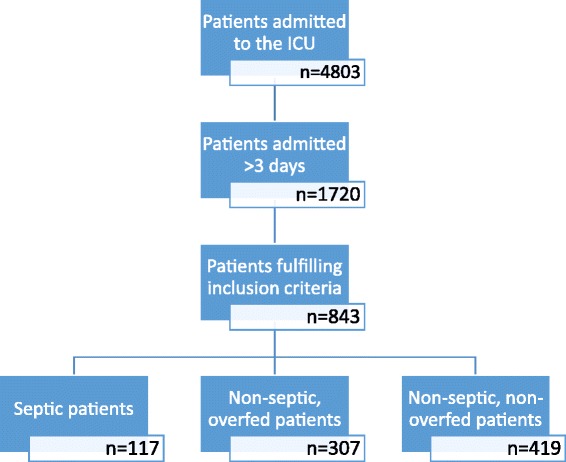
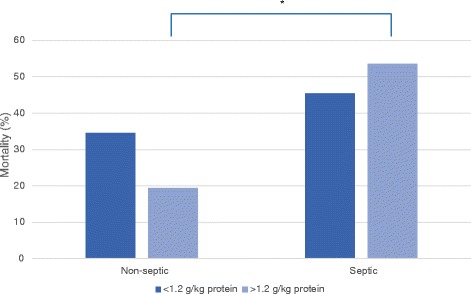
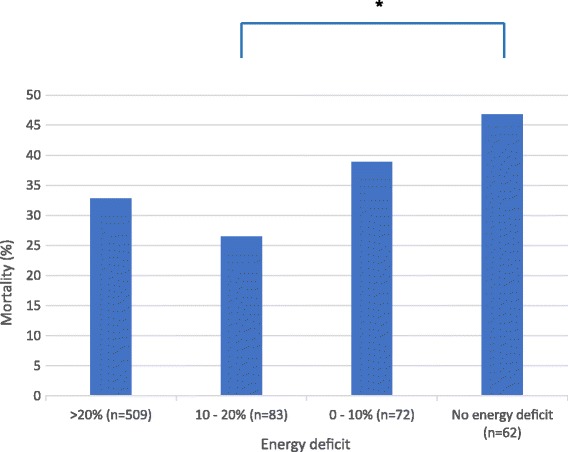
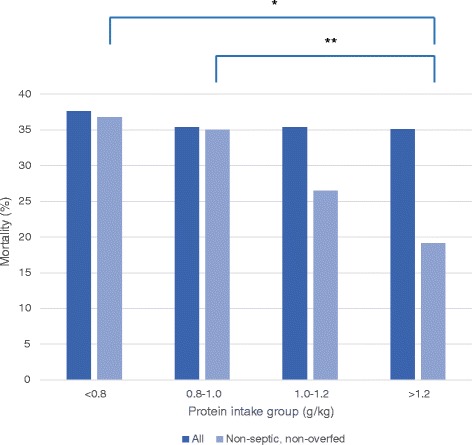
Introduction: Early protein and energy feeding in critically ill patients is heavily debated and early protein feeding hardly studied. Methods: A prospective database with mixed medical-surgical critically ill patients with prolonged mechanical ventilation (>72 hours) and measured energy expenditure was used in this study. Logistic regression analysis was used to analyse the relation between admission day-4 protein intake group (with cutoffs 0.8, 1.0, and 1.2 g/kg), energy overfeeding (ratio energy intake/measured energy expenditure > 1.1), and admission diagnosis of sepsis with hospital mortality after adjustment for APACHE II (Acute Physiology and Chronic Health Evaluation II) score. Results: A total of 843 patients were included. Of these, 117 had sepsis. Of the 736 non-septic patients 307 were overfed. Mean day-4 protein intake was 1.0 g/kg pre-admission weight per day and hospital mortality was 36%. In the total cohort, day-4 protein intake group (odds ratio (OR) 0.85; 95% confidence interval (CI) 0.73 to 0.99; P = 0.047), energy overfeeding (OR 1.62; 95%CI 1.07 to 2.44; P = 0.022), and sepsis (OR 1.77; 95%CI 1.18 to 2.65; P = 0.005) were independent risk factors for mortality besides APACHE II score. In patients with sepsis or energy overfeeding, day-4 protein intake was not associated with mortality. For non-septic, non-overfed patients (n = 419), mortality decreased with higher protein intake group: 37% for <0.8 g/kg, 35% for 0.8 to 1.0 g/kg, 27% for 1.0 to 1.2 g/kg, and 19% for ≥1.2 g/kg ( P = 0.033). For these, a protein intake level of ≥1.2 g/kg was significantly associated with lower mortality (OR 0.42, 95%CI 0.21 to 0.83, P = 0.013). Conclusions: In non-septic critically ill patients, early high protein intake was associated with lower mortality and early energy overfeeding with higher mortality. In septic patients early high protein intake had no beneficial effect on mortality.
Overview
The claims and statistics of this paper haven’t been checked yet.
Run the check — free, no account needed. It reads the open-access text and checks the sources it cites.
Integrity signals
Registry
Cites
Statistics
Figures
Verification
Claims the paper makes
The claims and statistics of this paper haven’t been checked yet.
Run the check — free, no account needed. It reads the open-access text and checks the sources it cites.
Claims other papers make about this one
Each is checked against this paper’s own text: does it say what the citing paper says it does?
The source backs part of the claim, not all of it — or backs it for a different population, condition or comparison.
In the citing paper
“Weijs et al. [24] prospectively studied 843 critically ill patients and found an overall mortality benefit of early high protein intake in non-septic subjects only.”
From Nutrition in Sepsis: A Bench-to-Bedside Review. (2020) · cites this paper as [24]
Experimental — accuracy not yet measuredThe source backs part of the claim, not all of it — or backs it for a different population, condition or comparison.
In the citing paper
“Heiddeger et al. ( 128) measured EE at day 3 and adapted the calorie intake accordingly, comparing supplemental PN from day four to an EN only group.The intervention group had a lower late nosocomial infection rate after day 9.”
From ESPEN guideline on clinical nutrition in the intensive care unit. (2019) · cites this paper as [128]
Experimental — accuracy not yet measuredThe source backs part of the claim, not all of it — or backs it for a different population, condition or comparison.
In the citing paper
“Undernutrition or over-nutrition is deleterious to outcome according to these large observational studies.”
From ESPEN practical and partially revised guideline: Clinical nutrition in the intensive care unit (2023) · cites this paper as [55]
Experimental — accuracy not yet measuredThe source backs part of the claim, not all of it — or backs it for a different population, condition or comparison.
In the citing paper
“A larger database analysis suggested that energy intake is associated with significantly improved survival when it is close to measured EE [55] or between 70 and 100% of the repeatedly measured resting EE [56].”
From ESPEN practical and partially revised guideline: Clinical nutrition in the intensive care unit (2023) · cites this paper as [55]
Experimental — accuracy not yet measuredThe cited source says what the claim attributes to it.
In the citing paper
“Some of the other studies addressing supplemental PN (128, 154, 155) did not show similar findings to the EPaNIC study.”
From ESPEN guideline on clinical nutrition in the intensive care unit. (2019) · cites this paper as [128]
Self-check
Percentages, sums and reported differences re-computed from the paper’s own numbers.
The self-check needs the paper’s full text.
Citations
Cites
Surviving Sepsis Campaign: International Guidelines for Management of Severe Sepsis and Septic Shock
Dellinger, R. P., Levy, M. M., Rhodes, A., Annane, D., Gerlach, H., Opal, S. M., Sevransky, J. E., Sprung, C. L., Douglas, I. S., Jaeschke, R., et al. (2013) · Critical Care Medicine · doi:10.1097/ccm.0b013e31827e83af · Cited by 9,694
Dellinger, R. P., Levy, M. M., Carlet, J. M., Bion, J., Parker, M. M., Jaeschke, R., Reinhart, K., Angus, D. C., Brun‐Buisson, C., Beale, R. J., et al. (2007) · Intensive Care Medicine · doi:10.1007/s00134-007-0934-2 · Cited by 6,789
Surviving Sepsis Campaign guidelines for management of severe sepsis and septic shock
Dellinger, R. P., Carlet, J. M., Masur, H., Gerlach, H., Calandra, T., Cohen, J., Gea‐Banacloche, J., Keh, D., Marshall, J. C., Parker, M. M., et al. (2004) · Intensive Care Medicine · doi:10.1007/s00134-004-2210-z · Cited by 3,309
Surviving Sepsis Campaign guidelines for management of severe sepsis and septic shock
Dellinger, R. P., Carlet, J. M., Masur, H., Gerlach, H., Calandra, T., Cohen, J., Gea‐Banacloche, J., Keh, D., Marshall, J. C., Parker, M. M., et al. (2004) · Critical Care Medicine · doi:10.1097/01.ccm.0000117317.18092.e4 · Cited by 3,038
Acute skeletal muscle wasting in critical illness
Puthucheary, Z. A., Rawal, J., McPhail, M., Connolly, B., Ratnayake, G., Chan, P., Hopkinson, N. S., Padhke, R., Dew, T., Sidhu, P. S., et al. (2013) · JAMA · doi:10.1001/jama.2013.278481 · Cited by 2,103
ESPEN guidelines on parenteral nutrition: intensive care
Singer, P., Berger, M. M., Van den Berghe, G., Biolo, G., Calder, P., Forbes, A., Griffiths, R., Kreyman, G., Leverve, X., & Pichard, C. (2009) · Clinical Nutrition · doi:10.1016/j.clnu.2009.04.024 · Cited by 1,907
Dellinger, R. P. (2004) · Critical Care Medicine · Cited by 1,848
Early versus late parenteral nutrition in critically ill adults
Casaer, M. P., Mesotten, D., Hermans, G., Wouters, P. J., Schetz, M., Meyfroidt, G., Van Cromphaut, S., Ingels, C., Meersseman, P., Muller, J., et al. (2011) · New England Journal of Medicine · doi:10.1056/nejmoa1102662 · Cited by 1,696 · cited 4×
“Of note, the increased rate of infections and longer duration of mechanical ventilation and renal replacement therapy found in the EPaNIC trial [1] could partially be explained by a component of overfeeding, because energy needs were not measured but calculated, and rather high energy targets were attained.”
InfluentialAutophagy is required to maintain muscle mass.
Masiero, E., Agatea, L., Mammucari, C., Blaauw, B., Loro, E., Komatsu, M., Metzger, D., Reggiani, C., Schiaffino, S., & Sandri, M. (2009) · Cell Metabolism · doi:10.1016/j.cmet.2009.10.008 · Cited by 1,282
The National Heart, L., Rice, T. W., Wheeler, A. P., Thompson, B. T., Steingrub, J., Hite, R. D., Moss, M., Morris, A., Dong, N., & Rock, P. (2012) · JAMA: The Journal of the American Medical Association · doi:10.1001/jama.2012.137 · Cited by 935
Cited by
Sorted by citations
Items 301–358 of 358
Early or Supplemental Parenteral Nutrition vs. Enteral Nutrition Alone in the Critically Ill
Chacko, J., Pawar, S., Seppelt, I., & Brar, G. (2023) · Springer eBooks · doi:10.1007/978-981-19-9940-6_38
FORMULACIÓN NUTRICIONAL ENTERAL PARA PACIENTES CON DIFICULTAD DE DEGLUCIÓN
Torres-Cruz, E., Figueroa, A. T., Vásquez, H. L. T., Caballero-Apaza, L., & Tebes, R. A. (2022) · Editora Científica Digital eBooks · doi:10.37885/230513176
Ciências da Saúde: desafios e potencialidades em pesquisa - Volume 3
Taroco, H. A., Lima, L. H. F., Reina, L. D. C. B., Gouvêia, M. A. D. S., Melo, M. L. O. F., Augusti, R., Silva, V. D. M., Lobo, Y. J. G., Figueiredo, Y. G., Melo, J. O. F., et al. (2022) · Editora Científica Digital eBooks · doi:10.37885/978-65-5360-367-7
Abstracts Criticare - IJCCM2023
(2023) · Indian Journal of Critical Care Medicine · doi:10.5005/ijccm-27-s1-s1
Consenso sobre el uso de proteína en el paciente crítico – ACNC
Trejos-Gallego, D. M., Fernando Pereira, P., Angélica Pérez, C., Janeth Barbosa, B., Ochoa, J. B., Waitzberg, D. L., Bladimir Gil, V., Erika Aguirre, M., B., M. A. C., G., C. E. P., et al. (2023) · Revista de Nutrición Clínica y Metabolismo · doi:10.35454/rncm.v6n2.494
Intestinal Failure in Critical Care
Itzhaki, M. H., & Singer, P. (2023) · Springer eBooks · doi:10.1007/978-3-031-22265-8_13
Formulation and Administration of Enteral Feeds
Hardy, G., & Majid, H. A. (2023) · Springer eBooks · doi:10.1007/978-3-031-22265-8_33 · Cited by 2
Evaluation of Nutritional Needs of Intensive Care Unit Patients by Clinical Pharmacists
Çakır, A., Memiş, H., & GÜN, Z. Ü. (2023) · Hacettepe University Journal of the Faculty of Pharmacy · doi:10.52794/hujpharm.1302720 · Cited by 1
Autophagy, critical illness and nutrition therapy: a narrative review for non-specialists
Cunha, H. (2021) · Braspen Journal · doi:10.37111/braspenj.2021.36.4.13
Analysis of Nutritional Support in Sepsis
陈, 若. (2024) · Advances in Clinical Medicine · doi:10.12677/acm.2024.1451609
Alimuddin, I., Taslim, N. A., Syauki, A. Y., Rasyid, H., Aminuddin, A., & Bukhari, A. (2024) · Research Square · doi:10.21203/rs.3.rs-4576360/v1
Nutrition: One Size Does Not Fit All
Merriweather, J. L. (2024) · Springer eBooks · doi:10.1007/978-3-031-53019-7_4
Protein Requirements: Refocusing on an Essential Nutrient
Pardo, E., & Preiser, J. (2024) · Springer eBooks · doi:10.1007/978-3-031-66541-7_9
Does prone positioning affect achievement of medical nutritional goals?
Selçuk, S. Ö., Arslan, M., Bilgi, D. Ö., Yılmaz, R., & Çukurova, Z. (2024) · Clinical Science of Nutrition · doi:10.62210/clinscinutr.2024.97
THE USE OF AN ABSORBER FOR THE REGENERATION OF HYDROTREATING CATALYSTS WITH A STEAM-AIR MIXTURE
Gofurovich, J. A., & Yusupov, F. M. (2024) · Practice Oriented Science: UAE – Russia – India · doi:10.34660/inf.2024.15.80.049
POSSIBILITIES OF COMPUTER TECHNOLOGY IN MORAL DEVELOPMENT PRESCHOOL CHILDREN
Krevsun, M. V., Евгеньевна, Б. И., & Vinevskaya, A. V. (2024) · Practice Oriented Science: UAE – Russia – India · doi:10.34660/inf.2024.19.53.042
COMMUNICATION AND CONTEXT IN ARTISTIC DISCOURSE SYSTEM
Chernitskaia, L. A. (2024) · Practice Oriented Science: UAE – Russia – India · doi:10.34660/inf.2024.14.81.046
Kamshilova, O. A., Prokopyev, N. Y., Ananiev, V. N., Ananieva, O. V., & Osipov, A. S. (2024) · Practice Oriented Science: UAE – Russia – India · doi:10.34660/inf.2024.72.28.055
FORMATION OF INCLUSIVE COMPETENCE AMONG MEDICAL UNIVERSITY STUDENTS
Kuznetsova, E. V., & Provotorova, A. (2024) · Practice Oriented Science: UAE – Russia – India · doi:10.34660/inf.2024.93.55.044
TECHNOLOGY OF PEDAGOGICAL GOAL SETTING AS THE BASIS FOR THE IMPLEMENTATION OF EDUCATIONAL STANDARDS
Filinova, V. S. (2024) · Practice Oriented Science: UAE – Russia – India · doi:10.34660/inf.2024.23.47.038
FEATURES OF ECONOMIC CRIME IN MODERN RUSSIA
Narimanova, O. V., & Narimanov, N. F. O. (2024) · Practice Oriented Science: UAE – Russia – India · doi:10.34660/inf.2024.97.64.032
Trysyachny, V. I., & Ukhov, V. Y. (2024) · Practice Oriented Science: UAE – Russia – India · doi:10.34660/inf.2024.69.22.030
Muhitdinova, H. N., Аkalaev, R. N., & Shamurodov, A. Y. (2024) · Practice Oriented Science: UAE – Russia – India · doi:10.34660/inf.2024.18.42.051
THE MEANING OF “CARE FOR NATURE” AND ITS REFLECTIONS ON MONGOLIAN LONG SONGS
Nan, D. (2024) · Practice Oriented Science: UAE – Russia – India · doi:10.34660/inf.2024.92.75.047
STANDARDIZATION OF PROFESSIONAL ACTIVITIES IN THE FIELD OF EDUCATION IN RUSSIA AND ABROAD
Fetisova, N. E. (2024) · Practice Oriented Science: UAE – Russia – India · doi:10.34660/inf.2024.60.89.045
CIRCADIAN RHYTHM OF AUTONOMIC REGULATION IN ACUTE RENAL FAILURE AT THE AGE OF 7.1-18 YEARS OLD
Muhitdinova, H. N., Hamrayeva, G. S., Alauatdinova, G. I., & Sabirova, F. B. (2024) · Practice Oriented Science: UAE – Russia – India · doi:10.34660/inf.2024.32.30.050
SOME ASPECTS OF GLOBAL REGULATION OF OFFSHORE ZONES
Nepoklonova, M. Y. (2024) · Practice Oriented Science: UAE – Russia – India · doi:10.34660/inf.2024.20.84.034
TSS-strategy for starting nutritional support in critically ill patients
Ershov, V. I., & Dobrynin, A. S. (2024) · Clinical nutrition and metabolism · doi:10.17816/clinutr640063
Effect of acute phase protein dose on clinical outcomes in critically ill patients
Shiraishi, S., Tatsumi, H., Haruna, J., Ishihara, E., Akatsuka, M., & Masuda, Y. (2025) · Clinical Nutrition ESPEN · doi:10.1016/j.clnesp.2025.05.024 · Cited by 1
Author Response: Challenges in Implementing High-protein Nutrition for Intensive Care Unit Patients
Khanna, P., Anand, R. K., Ray, B. R., Parasuraman, V., & Shanmugam, R. (2025) · Indian Journal of Critical Care Medicine · doi:10.5005/jp-journals-10071-25002
Tan, B., & Weigand, M. A. (2025) · Springer eBooks · doi:10.1007/978-3-032-00818-3_18
Li, J., Hu, X. G., Huang, S., & Chen, J. (2025) · Medicine · doi:10.1097/md.0000000000045948
Arabi, Y. M., Al-Dorzi, H. M., Sadat, M., Muharib, D., Algethamy, H. M., Al-Hameed, F., Mady, A. M., Alghamdi, A., Almekhlafi, G. A., Al-Fares, A. A., et al. (2024) · Figshare · doi:10.6084/m9.figshare.26607517
Abe, R., Shimazui, T., Sugo, M., Ogawa, A., Namekawa, M., Kitamura, N., & Kido, S. (2024) · Figshare · doi:10.6084/m9.figshare.25282946
Abe, R., Shimazui, T., Sugo, M., Ogawa, A., Namekawa, M., Kitamura, N., & Kido, S. (2024) · Figshare · doi:10.6084/m9.figshare.26685132
de Azevedo, J. R. A., Lima, H. C. M., Frota, P. H. D. B., Nogueira, I. R. O. M., Souza, S. C. D. C., Fernandes, E. A. A., & Cruz, A. M. D. S. (2021) · Figshare · doi:10.6084/m9.figshare.17007161
de Azevedo, J. R. A., Lima, H. C. M., Frota, P. H. D. B., Nogueira, I. R. O. M., Souza, S. C. D. C., Fernandes, E. A. A., & Cruz, A. M. D. S. (2021) · Figshare · doi:10.6084/m9.figshare.17007164
Wang, Y., Ye, Y., Xuan, L., Xu, L., Wang, P., Ma, J., Wang, Y., Chen, Y., Miao, J., Wang, W., et al. (2024) · Figshare · doi:10.6084/m9.figshare.26129650
Abe, R., Shimazui, T., Sugo, M., Ogawa, A., Namekawa, M., Kitamura, N., & Kido, S. (2024) · Figshare · doi:10.6084/m9.figshare.25282759
Arabi, Y. M., Al-Dorzi, H. M., Sadat, M., Muharib, D., Algethamy, H. M., Al-Hameed, F., Mady, A. M., Alghamdi, A., Almekhlafi, G. A., Al-Fares, A. A., et al. (2024) · Figshare · doi:10.6084/m9.figshare.26607520
Abe, R., Shimazui, T., Sugo, M., Ogawa, A., Namekawa, M., Kitamura, N., & Kido, S. (2024) · Figshare · doi:10.6084/m9.figshare.26685129
Arabi, Y. M., Al-Dorzi, H. M., Sadat, M., Muharib, D., Algethamy, H. M., Al-Hameed, F., Mady, A. M., Alghamdi, A., Almekhlafi, G. A., Al-Fares, A. A., et al. (2024) · Figshare · doi:10.6084/m9.figshare.26607514
Abe, R., Shimazui, T., Sugo, M., Ogawa, A., Namekawa, M., Kitamura, N., & Kido, S. (2024) · Figshare · doi:10.6084/m9.figshare.26685123
Abe, R., Shimazui, T., Sugo, M., Ogawa, A., Namekawa, M., Kitamura, N., & Kido, S. (2024) · Figshare · doi:10.6084/m9.figshare.26685126
Геннадьевич, С. О., Олегович, С. А., Zaitsev, E. Y., Leimanchenko, I. A., & Sivkovа, E. O. (2026) · Russian Journal of Anesthesiology and Reanimatology · doi:10.17116/anaesthesiology202601167
Mohamed, M. A., Phillips, B. E., & Williams, J. P. (2026) · BMC Nutrition · doi:10.1186/s40795-026-01314-3
Guido, S., Genovese, T., Sguazzotti, I., Ballestra, M., Ferrante, M., & Lattuada, M. (2026) · Clinical Nutrition Open Science · doi:10.1016/j.nutos.2026.100676
Intensive care unit acquired weakness: an update in the context of respiratory virus infection
Zheng, R., Lin, M., Wen, M., Shang, P., & Zhang, H. (2026) · Expert Review of Clinical Immunology · doi:10.1080/1744666x.2026.2672491
Sermet, M., Koçoğlu, H., Houssaini, D., Ekinci, O., & Alımoğlu, O. (2026) · Clinical Nutrition ESPEN · doi:10.1016/j.clnesp.2026.103362
Unat, D. S., Unat, Ö. S., & Turan, N. E. (2026) · Anatolian Current Medical Journal · doi:10.38053/acmj.1907249
Hejazi, N., Zand, F., Masoumi, S. J., Akbarzadeh, M., Sohrabi, Z., & Mousavi-Shirazi-Fard, Z. (2026) · مجله دانشگاه علوم پزشکی اراک · doi:10.66224/jams.28.6.466
ESPEN practical and partially revised guideline: Clinical nutrition in the intensive care unit
González, J. C. M., Singer, P., Blaser, A. R., Berger, M. M., Calder, P. C., Casaer, M. P., Hiesmayr, M., Mayer, K., Pichard, C., Preiser, J., et al. (2026) · Nutrición Hospitalaria · doi:10.20960/nh.06943 · Cited by 1
Lee, J. G., Sohn, Y. M., Lee, S. H., Jung, Y. T., Lee, H., Park, J. Y., Choi, N.-J., Song, J. M., Lee, J. Y., Kim, M., et al. (2026) · 한국정맥경장영양학회지 · doi:10.15747/acnm.26.0059
Suchecka, J., Nesterak, W., Szubert, I., Lamorski, J., Stępień, G., Chudecka, K., Chylewski, M., Józwa, K., Kędzierska, A., & Przewoźna, U. (2026) · International Journal of Innovative Technologies in Social Science · doi:10.31435/ijitss.2(50).2026.5909
Aue-apinya, P., Miao, G., Chittawatanarat, K., Kacha, S., Phothikun, N., & supphapipat, A. (2026) · Medicina · doi:10.3390/medicina62081591
Höchli, A., & Schuepbach, R. A. (2026) · BMJ Nutrition Prevention & Health · doi:10.1136/bmjnph-2026-001590
Präventive Ernährungsmedizin in der Anästhesie
Kumpf, O., Edel, A., & Scholtz, K. (2026) · AINS - Anästhesiologie · Intensivmedizin · Notfallmedizin · Schmerztherapie · doi:10.1055/a-2866-3733
Metadata
- Authors
- Weijs, P. J., Looijaard, W. G., Beishuizen, A., Girbes, A. R., & Oudemans-van Straaten, H. M.
- Affiliations
- Amsterdam University of Applied Sciences (NL)
- Amsterdam UMC Location Vrije Universiteit Amsterdam (NL)
- Medisch Spectrum Twente (NL)
- Amsterdam Cardiovascular Sciences (NL)
- Corresponding author
- Weijs, Peter JM
- Venue
- Critical Care
- Published
- 2014-12-14
- Volume
- 18
- Issue
- 6
- Pages
- 701-701
- ISSN
- 1364-8535 (ISSN-L)
- PMC
- PMC4279460
- OpenAlex
- W1981313739
- Cited by
- 358
- References
- 40
- Citations by year
- 2026: 18 · 2025: 17 · 2024: 48 · 2023: 30 · 2022: 35 · 2021: 30 · 2020: 38 · 2019: 43 · 2018: 43 · 2017: 24 · 2016: 26 · 2015: 6
- FWCI
- 17.38
- Type
- journal article
- Language
- en
- Open access
- gold
- doi.org
- Locations
- Critical Care (publishedVersion, cc-by)
- PubMed Central (publishedVersion, cc-by)
- PubMed (publishedVersion)
- Amsterdam UMC (VU Amsterdam) - Institutional Repository (publishedVersion)
- Data Archiving and Networked Services (DANS) (submittedVersion, cc-by)
- Pure Amsterdam UMC (submittedVersion)
- Data Archiving and Networked Services (DANS) (submittedVersion, other-oa)
- Data Archiving and Networked Services (DANS) (submittedVersion)
- Topics
- Health Sciences › Nursing › Nutrition and Dietetics › Clinical Nutrition and Gastroenterology
- Health Sciences › Medicine › Critical Care and Intensive Care Medicine › Sepsis Diagnosis and Treatment
- Health Sciences › Medicine › Endocrinology, Diabetes and Metabolism › Hyperglycemia and glycemic control in critically ill and hospitalized patients
- Keywords
- mechanical ventilation, critically ill patients, sepsis, in-hospital mortality, energy expenditure, protein intake, nutritional support, mortality risk factors, APACHE II score, prolonged mechanical ventilation, intensive care unit patients, mortality prediction model, prognostic factors, prognostic score, prognostic score validation, prognostic score comparison
- MeSH terms
- Adult, Aged, Aged, 80 and over, Energy Intake, Dietary Proteins, Female, Humans, Male, Middle Aged, Prospective Studies, Respiration, Artificial, Cohort Studies, Critical Illness, Hospital Mortality, Overnutrition
About these checks
Registry, retraction, Cites and statistics results are computed, not judged, with one exception: a printed reference that no index lists is read once by a model before it counts as a citation error. Claims are extracted by a model and kept only when their quote appears verbatim in the text; each cited source is then checked, with a model’s help, for whether it says what the claim relies on. Those verdicts can be wrong — read the claim’s quote and the cited source before relying on one.
Statistics and arithmetic are recomputed, not judged.
Confidence bands are shown only for fields calibrated on our annotated test set. None is calibrated yet, so no band is shown.
What counts as a claim ›How we measure confidence ›How we check this ›
Are you an author, or do you see a problem with this page? Request a review
