

The DOI matches its Crossref record; 40 of the 40 references it cites were found in a registry or an index.
Early high protein intake is associated with low mortality and energy overfeeding with high mortality in non-septic mechanically ventilated critically ill patients
Open accessAbstract
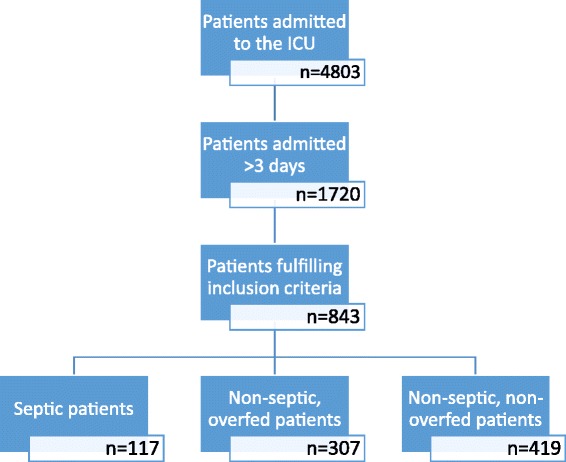
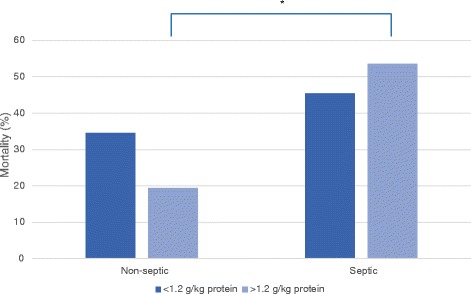
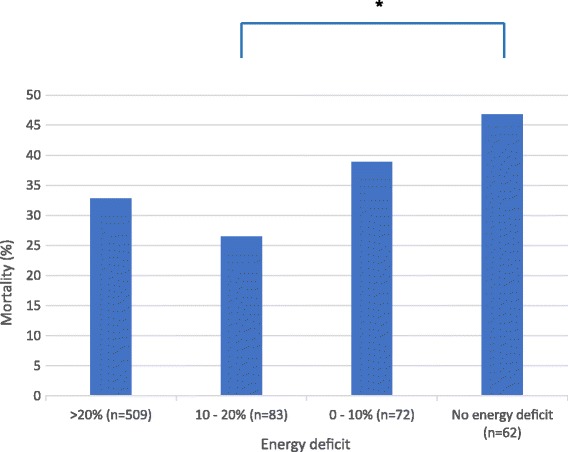
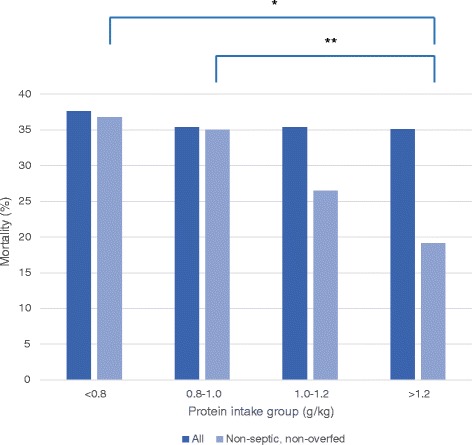
Introduction: Early protein and energy feeding in critically ill patients is heavily debated and early protein feeding hardly studied. Methods: A prospective database with mixed medical-surgical critically ill patients with prolonged mechanical ventilation (>72 hours) and measured energy expenditure was used in this study. Logistic regression analysis was used to analyse the relation between admission day-4 protein intake group (with cutoffs 0.8, 1.0, and 1.2 g/kg), energy overfeeding (ratio energy intake/measured energy expenditure > 1.1), and admission diagnosis of sepsis with hospital mortality after adjustment for APACHE II (Acute Physiology and Chronic Health Evaluation II) score. Results: A total of 843 patients were included. Of these, 117 had sepsis. Of the 736 non-septic patients 307 were overfed. Mean day-4 protein intake was 1.0 g/kg pre-admission weight per day and hospital mortality was 36%. In the total cohort, day-4 protein intake group (odds ratio (OR) 0.85; 95% confidence interval (CI) 0.73 to 0.99; P = 0.047), energy overfeeding (OR 1.62; 95%CI 1.07 to 2.44; P = 0.022), and sepsis (OR 1.77; 95%CI 1.18 to 2.65; P = 0.005) were independent risk factors for mortality besides APACHE II score. In patients with sepsis or energy overfeeding, day-4 protein intake was not associated with mortality. For non-septic, non-overfed patients (n = 419), mortality decreased with higher protein intake group: 37% for <0.8 g/kg, 35% for 0.8 to 1.0 g/kg, 27% for 1.0 to 1.2 g/kg, and 19% for ≥1.2 g/kg ( P = 0.033). For these, a protein intake level of ≥1.2 g/kg was significantly associated with lower mortality (OR 0.42, 95%CI 0.21 to 0.83, P = 0.013). Conclusions: In non-septic critically ill patients, early high protein intake was associated with lower mortality and early energy overfeeding with higher mortality. In septic patients early high protein intake had no beneficial effect on mortality.
Overview
The claims and statistics of this paper haven’t been checked yet.
Run the check — free, no account needed. It reads the open-access text and checks the sources it cites.
Integrity signals
Registry
Cites
Statistics
Figures
Verification
Claims the paper makes
The claims and statistics of this paper haven’t been checked yet.
Run the check — free, no account needed. It reads the open-access text and checks the sources it cites.
Claims other papers make about this one
Each is checked against this paper’s own text: does it say what the citing paper says it does?
The source backs part of the claim, not all of it — or backs it for a different population, condition or comparison.
In the citing paper
“Weijs et al. [24] prospectively studied 843 critically ill patients and found an overall mortality benefit of early high protein intake in non-septic subjects only.”
From Nutrition in Sepsis: A Bench-to-Bedside Review. (2020) · cites this paper as [24]
Experimental — accuracy not yet measuredThe source backs part of the claim, not all of it — or backs it for a different population, condition or comparison.
In the citing paper
“Heiddeger et al. ( 128) measured EE at day 3 and adapted the calorie intake accordingly, comparing supplemental PN from day four to an EN only group.The intervention group had a lower late nosocomial infection rate after day 9.”
From ESPEN guideline on clinical nutrition in the intensive care unit. (2019) · cites this paper as [128]
Experimental — accuracy not yet measuredThe source backs part of the claim, not all of it — or backs it for a different population, condition or comparison.
In the citing paper
“Undernutrition or over-nutrition is deleterious to outcome according to these large observational studies.”
From ESPEN practical and partially revised guideline: Clinical nutrition in the intensive care unit (2023) · cites this paper as [55]
Experimental — accuracy not yet measuredThe source backs part of the claim, not all of it — or backs it for a different population, condition or comparison.
In the citing paper
“A larger database analysis suggested that energy intake is associated with significantly improved survival when it is close to measured EE [55] or between 70 and 100% of the repeatedly measured resting EE [56].”
From ESPEN practical and partially revised guideline: Clinical nutrition in the intensive care unit (2023) · cites this paper as [55]
Experimental — accuracy not yet measuredThe cited source says what the claim attributes to it.
In the citing paper
“Some of the other studies addressing supplemental PN (128, 154, 155) did not show similar findings to the EPaNIC study.”
From ESPEN guideline on clinical nutrition in the intensive care unit. (2019) · cites this paper as [128]
Self-check
Percentages, sums and reported differences re-computed from the paper’s own numbers.
The self-check needs the paper’s full text.
Citations
Cites
Surviving Sepsis Campaign: International Guidelines for Management of Severe Sepsis and Septic Shock
Dellinger, R. P., Levy, M. M., Rhodes, A., Annane, D., Gerlach, H., Opal, S. M., Sevransky, J. E., Sprung, C. L., Douglas, I. S., Jaeschke, R., et al. (2013) · Critical Care Medicine · doi:10.1097/ccm.0b013e31827e83af · Cited by 9,694
Dellinger, R. P., Levy, M. M., Carlet, J. M., Bion, J., Parker, M. M., Jaeschke, R., Reinhart, K., Angus, D. C., Brun‐Buisson, C., Beale, R. J., et al. (2007) · Intensive Care Medicine · doi:10.1007/s00134-007-0934-2 · Cited by 6,789
Surviving Sepsis Campaign guidelines for management of severe sepsis and septic shock
Dellinger, R. P., Carlet, J. M., Masur, H., Gerlach, H., Calandra, T., Cohen, J., Gea‐Banacloche, J., Keh, D., Marshall, J. C., Parker, M. M., et al. (2004) · Intensive Care Medicine · doi:10.1007/s00134-004-2210-z · Cited by 3,309
Surviving Sepsis Campaign guidelines for management of severe sepsis and septic shock
Dellinger, R. P., Carlet, J. M., Masur, H., Gerlach, H., Calandra, T., Cohen, J., Gea‐Banacloche, J., Keh, D., Marshall, J. C., Parker, M. M., et al. (2004) · Critical Care Medicine · doi:10.1097/01.ccm.0000117317.18092.e4 · Cited by 3,038
Acute skeletal muscle wasting in critical illness
Puthucheary, Z. A., Rawal, J., McPhail, M., Connolly, B., Ratnayake, G., Chan, P., Hopkinson, N. S., Padhke, R., Dew, T., Sidhu, P. S., et al. (2013) · JAMA · doi:10.1001/jama.2013.278481 · Cited by 2,103
ESPEN guidelines on parenteral nutrition: intensive care
Singer, P., Berger, M. M., Van den Berghe, G., Biolo, G., Calder, P., Forbes, A., Griffiths, R., Kreyman, G., Leverve, X., & Pichard, C. (2009) · Clinical Nutrition · doi:10.1016/j.clnu.2009.04.024 · Cited by 1,907
Dellinger, R. P. (2004) · Critical Care Medicine · Cited by 1,848
Early versus late parenteral nutrition in critically ill adults
Casaer, M. P., Mesotten, D., Hermans, G., Wouters, P. J., Schetz, M., Meyfroidt, G., Van Cromphaut, S., Ingels, C., Meersseman, P., Muller, J., et al. (2011) · New England Journal of Medicine · doi:10.1056/nejmoa1102662 · Cited by 1,696 · cited 4×
“Of note, the increased rate of infections and longer duration of mechanical ventilation and renal replacement therapy found in the EPaNIC trial [1] could partially be explained by a component of overfeeding, because energy needs were not measured but calculated, and rather high energy targets were attained.”
InfluentialAutophagy is required to maintain muscle mass.
Masiero, E., Agatea, L., Mammucari, C., Blaauw, B., Loro, E., Komatsu, M., Metzger, D., Reggiani, C., Schiaffino, S., & Sandri, M. (2009) · Cell Metabolism · doi:10.1016/j.cmet.2009.10.008 · Cited by 1,282
The National Heart, L., Rice, T. W., Wheeler, A. P., Thompson, B. T., Steingrub, J., Hite, R. D., Moss, M., Morris, A., Dong, N., & Rock, P. (2012) · JAMA: The Journal of the American Medical Association · doi:10.1001/jama.2012.137 · Cited by 935
Compher, C., Frankenfield, D., Keim, N., & Roth-Yousey, L. (2006) · Journal of the American Dietetic Association · doi:10.1016/j.jada.2006.02.009 · Cited by 923 · cited 1×
“Enteral nutrition was deliberately continued during indirect calorimetry in order to assess total energy expenditure [18].”
Heidegger, C. P., Berger, M. M., Graf, S., Zingg, W., Darmon, P., Costanza, M. C., Thibault, R., & Pichard, C. (2013) · The Lancet · doi:10.1016/s0140-6736(12)61351-8 · Cited by 776
Singer, P., Anbar, R., Cohen, J., Shapiro, H., Shalita-Chesner, M., Lev, S., Grozovski, E., Theilla, M., Frishman, S., & Madar, Z. (2011) · Intensive Care Medicine · doi:10.1007/s00134-011-2146-z · Cited by 566
Virgin, H. W., & Levine, B. (2009) · Nature Immunology · doi:10.1038/ni.1726 · Cited by 462
Weijs, P. J. M., Stapel, S. N., de Groot, S. D. W., Driessen, R. H., de Jong, E., Girbes, A. R. J., Strack van Schijndel, R. J. M., & Beishuizen, A. (2012) · Journal of Parenteral and Enteral Nutrition · doi:10.1177/0148607111415109 · Cited by 408
Self-citationProvision of protein and energy in relation to measured requirements in intensive care patients
Allingstrup, M. J., Esmailzadeh, N., Wilkens Knudsen, A., Espersen, K., Hartvig Jensen, T., Wiis, J., Perner, A., & Kondrup, J. (2012) · Clinical Nutrition · doi:10.1016/j.clnu.2011.12.006 · Cited by 381
Hermans, G., Casaer, M. P., Clerckx, B., Güiza, F., Vanhullebusch, T., Derde, S., Meersseman, P., Derese, I., Mesotten, D., Wouters, P. J., et al. (2013) · The Lancet Respiratory Medicine · doi:10.1016/s2213-2600(13)70183-8 · Cited by 376
Arabi, Y. M., Tamim, H., Dhar, G. S., Al‐Dawood, A., Al-Sultan, M., Sakkijha, M. H., Kahoul, S. H., & Brits, R. J. (2011) · American Journal of Clinical Nutrition · doi:10.3945/ajcn.110.005074 · Cited by 355
Role of Disease and Macronutrient Dose in the Randomized Controlled EPaNIC Trial
Casaer, M. P., Wilmer, A., Hermans, G., Wouters, P. J., Mesotten, D., & Van den Berghe, G. (2013) · American Journal of Respiratory and Critical Care Medicine · doi:10.1164/rccm.201206-0999oc · Cited by 307
Insufficient Activation of Autophagy Allows Cellular Damage to Accumulate in Critically Ill Patients
Vanhorebeek, I., Gunst, J., Derde, S., Derese, I., Boussemaere, M., Güiza, F., Martinet, W., Timmermans, J.-P., D'Hoore, A., Wouters, P. J., et al. (2011) · The Journal of Clinical Endocrinology & Metabolism · doi:10.1210/jc.2010-2563 · Cited by 241
Elke, G., Wang, M., Weiler, N., Day, A. G., & Heyland, D. K. (2014) · Critical Care · doi:10.1186/cc13720 · Cited by 238
Early Versus Late Parenteral Nutrition in Critically Ill Adults
Casaer, M. P., Mesotten, D., Hermans, G., Wouters, P. J., Schetz, M., Meyfroidt, G., Cromphaut, S. J. V., Ingels, C., Meersseman, P., Muller, J., et al. (2012) · Survey of Anesthesiology · doi:10.1097/01.sa.0000412381.92989.8e · Cited by 235
Assessment of resting energy expenditure in mechanically ventilated patients
Faisy, C., Guérot, E., Diehl, J., Labrousse, J., & Fagon, J.-Y. (2003) · American Journal of Clinical Nutrition · doi:10.1093/ajcn/78.2.241 · Cited by 176
Derde, S., Vanhorebeek, I., Güiza, F., Derese, I., Gunst, J., Fahrenkrog, B., Martinet, W., Vervenne, H. B. V. K., Ververs, E.-J., Larsson, L., et al. (2012) · Endocrinology · doi:10.1210/en.2011-2068 · Cited by 169
Energy Estimation and Measurement in Critically Ill Patients
Fraipont, V., & Preiser, J. (2013) · Journal of Parenteral and Enteral Nutrition · doi:10.1177/0148607113505868 · Cited by 151
Protein metabolism and gene expression in skeletal muscle of critically ill patients with sepsis
Klaude, M., Mori, M., Tjäder, I., Gustafsson, T. P., Wernerman, J., & Rooyackers, O. (2011) · Clinical Science · doi:10.1042/cs20110233 · Cited by 147
Validation of 2 approaches to predicting resting metabolic rate in critically ill patients
Frankenfield, D. C., Js, S., & Cooney, R. (2004) · Journal of Parenteral and Enteral Nutrition · doi:10.1177/0148607104028004259 · Cited by 143
Acute Skeletal Muscle Wasting in Critical Illness
Puthucheary, Z., Rawal, J., McPhail, M. J. W., Connolly, B. A., Ratnayake, G., Chan, P., Hopkinson, N. S., Padhke, R., Dew, T. K., Sidhu, P. S., et al. (2014) · Survey of Anesthesiology · doi:10.1097/01.sa.0000450914.29374.55 · Cited by 135
Supplementation in Acute Lung Injury—Reply
Rice, T. W., Wheeler, A. P., & Thompson, B. (2012) · JAMA · doi:10.1001/jama.2011.1985 · Cited by 130
van Schijndel, R. J. M. S., Weijs, P. J. M., Koopmans, R. H., Sauerwein, H. P., Beishuizen, A., & Girbes, A. R. J. (2009) · Critical Care · doi:10.1186/cc7993 · Cited by 124
Self-citationSinger (2009) · doi:10.1016/j.clnu.2013.12.004 · Cited by 118
Weijs, P. J. M., Sauerwein, H. P., & Kondrup, J. (2012) · Clinical Nutrition · doi:10.1016/j.clnu.2012.04.007 · Cited by 82
Self-citationAutophagy in Inflammatory Diseases
Choi, A. J. S., & Ryter, S. W. (2011) · International Journal of Cell Biology · doi:10.1155/2011/732798 · Cited by 72
Optimizing energy and protein balance in the ICU
Weijs, P. J. M., & Wischmeyer, P. E. (2013) · Current Opinion in Clinical Nutrition & Metabolic Care · doi:10.1097/mco.0b013e32835bdf7e · Cited by 67
Self-citationSavard, J.-F., Faisy, C., Lerolle, N., Guérot, E., Diehl, J., & Fagon, J.-Y. (2008) · Critical Care Medicine · doi:10.1097/ccm.0b013e3181691502 · Cited by 52
Doig, G. S., Simpson, F., Sweetman, E. A., Finfer, S. R., Cooper, D. J., Heighes, P. T., Davies, A. R., O’Leary, M. J., Solano, T., & Peake, S. (2014) · Survey of Anesthesiology · doi:10.1097/01.sa.0000441042.75441.36 · Cited by 43
Computer-aided support improves early and adequate delivery of nutrients in the ICU.
van Schijndel, R. J. M. S., de Groot, S., Driessen, R., Melis, G. C., Girbes, A. R. J., Beishuizen, A., & Weijs, P. J. M. (2009) · PubMed · Cited by 33
Self-citationvan Schijndel, R. J. M. S., Weijs, P. J. M., Sauerwein, H. P., de Groot, S. D. W., Beishuizen, A., & Girbes, A. R. J. (2007) · e-SPEN the European e-Journal of Clinical Nutrition and Metabolism · doi:10.1016/j.eclnm.2007.05.001 · Cited by 21
Self-citationRice, T. W., Wheeler, A. P., Thompson, B., Steingrub, J. S., Hite, R. D., Moss, M., Morris, A., Dong, N., & Rock, P. (2012) · doi:10.1164/ajrccm-conference.2012.185.1_meetingabstracts.a6856 · Cited by 9
Cited by
Sorted by citations
ESPEN guideline on clinical nutrition in the intensive care unit.
Singer, P., Blaser, A. R., Berger, M. M., Alhazzani, W., Calder, P. C., Casaer, M. P., Hiesmayr, M., Mayer, K., Montejo, J. C., Pichard, C., et al. (2019) · Clinical Nutrition · doi:10.1016/j.clnu.2018.08.037 · Cited by 2,904
Early enteral nutrition in critically ill patients: ESICM clinical practice guidelines
ESICM Working Group on Gastrointestinal Function, Reintam Blaser, A., Starkopf, J., Alhazzani, W., Berger, M. M., Casaer, M. P., Deane, A. M., Fruhwald, S., Hiesmayr, M., Ichai, C., et al. (2017) · Intensive Care Medicine · doi:10.1007/s00134-016-4665-0 · Cited by 837
ESPEN practical and partially revised guideline: Clinical nutrition in the intensive care unit
Singer, P., Blaser, A. R., Berger, M. M., Calder, P. C., Casaer, M., Hiesmayr, M., Mayer, K., Montejo-Gonzalez, J. C., Pichard, C., Preiser, J.-C., et al. (2023) · Clinical Nutrition · doi:10.1016/j.clnu.2023.07.011 · Cited by 793
van Zanten, A. R. H., Waele, E. D., & Wischmeyer, P. E. (2019) · Critical Care · doi:10.1186/s13054-019-2657-5 · Cited by 391
Indirect calorimetry in nutritional therapy. A position paper by the ICALIC study group
Oshima, T., Berger, M. M., De Waele, E., Guttormsen, A. B., Heidegger, C.-P., Hiesmayr, M., Singer, P., Wernerman, J., & Pichard, C. (2017) · Clinical Nutrition · doi:10.1016/j.clnu.2016.06.010 · Cited by 283
Metadata
- Authors
- Weijs, P. J., Looijaard, W. G., Beishuizen, A., Girbes, A. R., & Oudemans-van Straaten, H. M.
- Affiliations
- Amsterdam University of Applied Sciences (NL)
- Amsterdam UMC Location Vrije Universiteit Amsterdam (NL)
- Medisch Spectrum Twente (NL)
- Amsterdam Cardiovascular Sciences (NL)
- Corresponding author
- Weijs, Peter JM
- Venue
- Critical Care
- Published
- 2014-12-14
- Volume
- 18
- Issue
- 6
- Pages
- 701-701
- ISSN
- 1364-8535 (ISSN-L)
- PMC
- PMC4279460
- OpenAlex
- W1981313739
- Cited by
- 358
- References
- 40
- Citations by year
- 2026: 18 · 2025: 17 · 2024: 48 · 2023: 30 · 2022: 35 · 2021: 30 · 2020: 38 · 2019: 43 · 2018: 43 · 2017: 24 · 2016: 26 · 2015: 6
- FWCI
- 17.38
- Type
- journal article
- Language
- en
- Open access
- gold
- doi.org
- Locations
- Critical Care (publishedVersion, cc-by)
- PubMed Central (publishedVersion, cc-by)
- PubMed (publishedVersion)
- Amsterdam UMC (VU Amsterdam) - Institutional Repository (publishedVersion)
- Data Archiving and Networked Services (DANS) (submittedVersion, cc-by)
- Pure Amsterdam UMC (submittedVersion)
- Data Archiving and Networked Services (DANS) (submittedVersion, other-oa)
- Data Archiving and Networked Services (DANS) (submittedVersion)
- Topics
- Health Sciences › Nursing › Nutrition and Dietetics › Clinical Nutrition and Gastroenterology
- Health Sciences › Medicine › Critical Care and Intensive Care Medicine › Sepsis Diagnosis and Treatment
- Health Sciences › Medicine › Endocrinology, Diabetes and Metabolism › Hyperglycemia and glycemic control in critically ill and hospitalized patients
- Keywords
- mechanical ventilation, critically ill patients, sepsis, in-hospital mortality, energy expenditure, protein intake, nutritional support, mortality risk factors, APACHE II score, prolonged mechanical ventilation, intensive care unit patients, mortality prediction model, prognostic factors, prognostic score, prognostic score validation, prognostic score comparison
- MeSH terms
- Adult, Aged, Aged, 80 and over, Energy Intake, Dietary Proteins, Female, Humans, Male, Middle Aged, Prospective Studies, Respiration, Artificial, Cohort Studies, Critical Illness, Hospital Mortality, Overnutrition
About these checks
Registry, retraction, Cites and statistics results are computed, not judged, with one exception: a printed reference that no index lists is read once by a model before it counts as a citation error. Claims are extracted by a model and kept only when their quote appears verbatim in the text; each cited source is then checked, with a model’s help, for whether it says what the claim relies on. Those verdicts can be wrong — read the claim’s quote and the cited source before relying on one.
Statistics and arithmetic are recomputed, not judged.
Confidence bands are shown only for fields calibrated on our annotated test set. None is calibrated yet, so no band is shown.
What counts as a claim ›How we measure confidence ›How we check this ›
Are you an author, or do you see a problem with this page? Request a review
