

Implementation of earlier antibiotic administration in patients with severe sepsis and septic shock in Japan: A descriptive analysis of a prospective observational study.
Open accessThe DOI matches its Crossref record; 34 of the 34 references it cites were found in a registry or an index.
Abstract
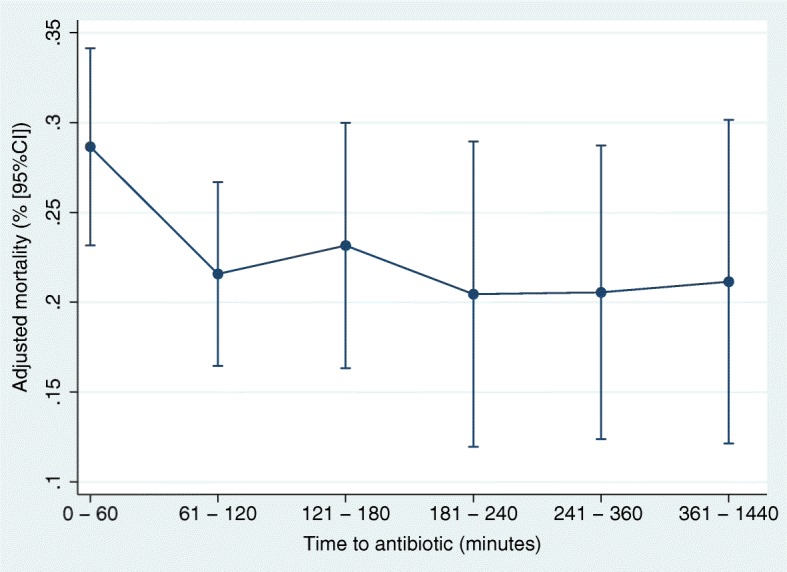
Background: Time to antibiotic administration is a key element in sepsis care; however, it is difficult to implement sepsis care bundles. Additionally, sepsis is different from other emergent conditions including acute coronary syndrome, stroke, or trauma. We aimed to describe the association between time to antibiotic administration and outcomes in patients with severe sepsis and septic shock in Japan. Methods: This prospective observational study enrolled 1184 adult patients diagnosed with severe sepsis based on the Sepsis-2 criteria and admitted to 59 intensive care units (ICUs) in Japan between January 1, 2016, and March 31, 2017, as the sepsis cohort of the Focused Outcomes Research in Emergency Care in Acute Respiratory Distress Syndrome, Sepsis and Trauma (FORECAST) study. We compared the characteristics and in-hospital mortality of patients administered with antibiotics at varying durations after sepsis recognition, i.e., 0–60, 61–120, 121–180, 181–240, 241–360, and 361–1440 min, and estimated the impact of antibiotic timing on risk-adjusted in-hospital mortality using the generalized estimating equation model (GEE) with an exchangeable, within-group correlation matrix, with “hospital” as the grouping variable. Results: Data from 1124 patients in 54 hospitals were used for analyses. Of these, 30.5% and 73.9% received antibiotics within 1 h and 3 h, respectively. Overall, the median time to antibiotic administration was 102 min [interquartile range (IQR), 55–189]. Compared with patients diagnosed in the emergency department [90 min (IQR, 48–164 min)], time to antibiotic administration was shortest in patients diagnosed in ICUs [60 min (39–180 min)] and longest in patients transferred from wards [120 min (62–226)]. Overall crude mortality was 23.4%, where patients in the 0–60 min group had the highest mortality (28.0%) and a risk-adjusted mortality rate [28.7% (95% CI 23.3–34.1%)], whereas those in the 61–120 min group had the lowest mortality (20.2%) and risk-adjusted mortality rates [21.6% (95% CI 16.5–26.6%)]. Differences in mortality were noted only between the 0–60 min and 61–120 min groups. Conclusions: We could not find any association between earlier antibiotic administration and reduction in in-hospital mortality in patients with severe sepsis.
Overview
The claims and statistics of this paper haven’t been checked yet.
Free: it reads the open-access text and checks the first 5 claims that cite a source we can check. Create a free account to check every claim.
Integrity signals
Registry
Cites
Statistics
Figures
Verification
Claims the paper makes
The claims and statistics of this paper haven’t been checked yet.
Free: it reads the open-access text and checks the first 5 claims that cite a source we can check. Create a free account to check every claim.
Claims other papers make about this one
Each is checked against this paper’s own text: does it say what the citing paper says it does?
The cited source says what the claim attributes to it.
In the citing paper
“Other studies, however, did not observe an association between antimicrobial timing and mortality [112–117].”
From Surviving sepsis campaign: international guidelines for management of sepsis and septic shock 2021 (2021) · cites this paper as [112]
Self-check
Percentages, sums and reported differences re-computed from the paper’s own numbers.
The self-check needs the paper’s full text.
Citations
Cites
Surviving Sepsis Campaign: International Guidelines for Management of Severe Sepsis and Septic Shock
Dellinger, R. P., Levy, M. M., Rhodes, A., Annane, D., Gerlach, H., Opal, S. M., Sevransky, J. E., Sprung, C. L., Douglas, I. S., Jaeschke, R., et al. (2013) · Critical Care Medicine · doi:10.1097/ccm.0b013e31827e83af · Cited by 9,694
Self-citationThe Surviving Sepsis Campaign Guidelines Committee including The Pediatric Subgroup*, Dellinger, R. P., Levy, M. M., Rhodes, A., Annane, D., Gerlach, H., Opal, S. M., Sevransky, J. E., Sprung, C. L., Douglas, I. S., et al. (2013) · Intensive Care Medicine · doi:10.1007/s00134-012-2769-8 · Cited by 7,290
Self-citationIntravenous Fluids and Acute Kidney Injury
Ding, X., Cheng, Z., & Qian, Q. (2017) · Blood Purification · doi:10.1159/000452702 · Cited by 6,827
Dellinger, R. P., Levy, M. M., Carlet, J. M., Bion, J., Parker, M. M., Jaeschke, R., Reinhart, K., Angus, D. C., Brun-Buisson, C., Beale, R., et al. (2008) · Intensive Care Medicine · doi:10.1007/s00134-007-0934-2 · Cited by 6,772
Surviving Sepsis Campaign: International guidelines for management of sepsis and septic shock: 2016.
Rhodes, A., Evans, L. E., Alhazzani, W., Levy, M. M., Antonelli, M., Ferrer, R., Kumar, A., Sevransky, J. E., Sprung, C. L., Nunnally, M. E., et al. (2017) · Intensive Care Medicine · doi:10.1007/s00134-017-4683-6 · Cited by 6,621
Self-citation2001 SCCM/ESICM/ACCP/ATS/SIS International Sepsis Definitions Conference
Levy, M. M., Fink, M. P., Marshall, J. C., Abraham, E., Angus, D., Cook, D., Cohen, J., Opal, S. M., Vincent, J.-L., & Ramsay, G. (2003) · Critical Care Medicine · doi:10.1097/01.ccm.0000050454.01978.3b · Cited by 5,995
Surviving Sepsis Campaign guidelines for management of severe sepsis and septic shock
Dellinger, R. P., Carlet, J. M., Masur, H., Gerlach, H., Calandra, T., Cohen, J., Gea-Banacloche, J., Keh, D., Marshall, J. C., Parker, M. M., et al. (2004) · Intensive Care Medicine · doi:10.1007/s00134-004-2210-z · Cited by 3,321
Surviving Sepsis Campaign guidelines for management of severe sepsis and septic shock
Dellinger, R. P., Carlet, J. M., Masur, H., Gerlach, H., Calandra, T., Cohen, J., Gea-Banacloche, J., Keh, D., Marshall, J. C., Parker, M. M., et al. (2004) · Critical Care Medicine · doi:10.1097/01.ccm.0000117317.18092.e4 · Cited by 3,018
A randomized trial of protocol-based care for early septic shock.
The ProCESS Investigators (2014) · New England Journal of Medicine · doi:10.1056/nejmoa1401602 · Cited by 2,414 · cited 1×
“Although there is no doubt that sepsis care bundle components, such as time to antibiotic, play a role in the arising importance of treatment speed, a similar situation arose when early goal-directed therapy was debated [24, 25].”
ResultTime to treatment and mortality during mandated emergency care for sepsis.
Seymour, C. W., Gesten, F., Prescott, H. C., Friedrich, M. E., Iwashyna, T. J., Phillips, G. S., Lemeshow, S., Osborn, T., Terry, K. M., & Levy, M. M. (2017) · New England Journal of Medicine · doi:10.1056/nejmoa1703058 · Cited by 2,225
Self-citation
Cited by
Surviving sepsis campaign: international guidelines for management of sepsis and septic shock 2021
Evans, L., Rhodes, A., Alhazzani, W., Antonelli, M., Coopersmith, C. M., French, C., Machado, F. R., Mcintyre, L., Ostermann, M., Prescott, H. C., et al. (2021) · Intensive Care Medicine · doi:10.1007/s00134-021-06506-y · Cited by 5,082
Self-citationSurviving Sepsis Campaign: International Guidelines for Management of Sepsis and Septic Shock 2021.
Evans, L., Rhodes, A., Alhazzani, W., Antonelli, M., Coopersmith, C. M., French, C., Machado, F. R., Mcintyre, L., Ostermann, M., Prescott, H. C., et al. (2021) · Critical Care Medicine · doi:10.1097/ccm.0000000000005337 · Cited by 2,935
Self-citation2023 Update on Sepsis and Septic Shock in Adult Patients: Management in the Emergency Department
Guarino, M., Perna, B., Cesaro, A. E., Maritati, M., Spampinato, M. D., Contini, C., & De Giorgio, R. (2023) · Journal of Clinical Medicine · doi:10.3390/jcm12093188 · Cited by 294
A Critical Analysis of the Literature on Time-to-Antibiotics in Suspected Sepsis
Weinberger, J., Rhee, C., & Klompas, M. (2020) · The Journal of Infectious Diseases · doi:10.1093/infdis/jiaa146 · Cited by 125
“Examples of Studies that Address these Potential Sources of Bias Five studies analyze sepsis and septic shock separately: Abe et al [44], Alam et al [39], Ferrer et al [22], GarnachoMontero et al [43], Liu et al [19] Several other studies include only patients with septic shock: Ko et al [41], Kumar et al [24], Larché…”
Backgroundon behalf of JAAM FORECAST group, Abe, T., Ogura, H., Kushimoto, S., Shiraishi, A., Sugiyama, T., Deshpande, G. A., Uchida, M., Nagata, I., Saitoh, D., et al. (2019) · Journal of Intensive Care · doi:10.1186/s40560-019-0383-3 · Cited by 103
Self-citationLi, A., Ling, L., Qin, H., Arabi, Y. M., Myatra, S. N., Egi, M., Kim, J. H., Nor, M. B. M., Son, D. N., Fang, W., et al. (2022) · American Journal of Respiratory and Critical Care Medicine · doi:10.1164/rccm.202112-2743oc · Cited by 105
Sepsis: diagnosis and management
Gauer, R. L., Forbes, D. A., & Boyer, N. L. (2024) · Pharmaceutical journal/The pharmaceutical journal · doi:10.1211/pj.2024.1.323850 · Cited by 213
Rüddel, H., Thomas-Rüddel, D. O., Reinhart, K., Bach, F., Gerlach, H., Lindner, M., Marshall, J. C., Simon, P., Weiß, M., Bloos, F., et al. (2022) · Critical Care · doi:10.1186/s13054-022-03901-9 · Cited by 87
“Previous studies that compared patients with and without shock partly found no effect of delayed antimicrobials at all [29], smaller effects among patients without shock [19, 26], or virtually equal effects among both groups [20, 27].”
ResultUffen, J. W., Oosterheert, J. J., Schweitzer, V. A., Thursky, K., Kaasjager, K. A. H., & Ekkelenkamp, M. B. (2020) · Clinical Microbiology and Infection · doi:10.1016/j.cmi.2020.02.022 · Cited by 87
Asner, S. A., Desgranges, F., Schrijver, I. T., & Calandra, T. (2021) · Journal of Infection · doi:10.1016/j.jinf.2021.03.003 · Cited by 82
Door-to-antibiotic time and mortality in patients with sepsis: Systematic review and meta-analysis
Leung, L. Y., Huang, H.-L., Hung, K. K. C., Leung, C. Y., Lam, C., Lo, R. S., Yeung, C. Y., Tsoi, P. J., Lai, M., Brabrand, M., et al. (2024) · European Journal of Internal Medicine · doi:10.1016/j.ejim.2024.06.015 · Cited by 73
Pak, T. R., Young, J. G., McKenna, C. S., Agan, A. A., DelloStritto, L. K., Filbin, M. R., Dutta, S., Kadri, S. S., Septimus, E. J., Rhee, C., et al. (2023) · Clinical Infectious Diseases · doi:10.1093/cid/ciad450 · Cited by 66
for the JAAM SPICE Study Group, Abe, T., Tokuda, Y., Shiraishi, A., Fujishima, S., Mayumi, T., Sugiyama, T., Deshpande, G. A., Shiino, Y., Hifumi, T., et al. (2019) · Critical Care · doi:10.1186/s13054-019-2475-9 · Cited by 57
Self-citationThe Japanese Clinical Practice Guidelines for Management of Sepsis and Septic Shock 2024
Shime, N., Nakada, T.-A., Yatabe, T., Yamakawa, K., Aoki, Y., Inoue, S., Iba, T., Ogura, H., Kawai, Y., Kawaguchi, A., et al. (2025) · Journal of Intensive Care · doi:10.1186/s40560-025-00776-0 · Cited by 52
Self-citationZhang, J., Yan, W., Dong, Y., Luo, X., Miao, H., Maimaijuma, T., Xu, X., Jiang, H., Huang, Z., Qi, L., et al. (2024) · Journal of Thoracic Disease · doi:10.21037/jtd-24-1191 · Cited by 53
“However, in other studies, a correlation between antibiotic timing and mortality was supported (116-121).”
Tonai, M., Shiraishi, A., Karumai, T., Endo, A., Kobayashi, H., Fushimi, K., & Hayashi, Y. (2022) · Critical Care · doi:10.1186/s13054-022-04013-0 · Cited by 41
Self-citationS3-Leitlinie Sepsis – Prävention, Diagnose, Therapie und Nachsorge – Update 2025
Brunkhorst, F. M., Adamzik, M., Axer, H., Bauer, M. W., Bode, C., Bone, H.-G., Brenner, T., Bucher, M., David, S., Dietrich, M., et al. (2025) · Medizinische Klinik - Intensivmedizin und Notfallmedizin · doi:10.1007/s00063-025-01317-1 · Cited by 47
Umemura, Y., Abe, T., Ogura, H., Fujishima, S., Kushimoto, S., Shiraishi, A., Saitoh, D., Mayumi, T., Otomo, Y., Hifumi, T., et al. (2022) · PLoS ONE · doi:10.1371/journal.pone.0263936 · Cited by 44
“However, we validated and agree with the importance of the hour-1 bundle as reported in previous studies [13, 14].”
BackgroundResultSelf-citationThe Japanese Clinical Practice Guidelines for Management of Sepsis and Septic Shock 2024
Shime, N., Nakada, T., Yatabe, T., Yamakawa, K., Aoki, Y., Inoue, S., Iba, T., Ogura, H., Kawai, Y., Kawaguchi, A., et al. (2025) · Acute Medicine & Surgery · doi:10.1002/ams2.70037 · Cited by 27
Self-citationThe story of critical care in Asia: a narrative review
Phua, J., Lim, C., Faruq, M. O., Nafees, K. M. K., Du, B., Gomersall, C. D., Ling, L., Divatia, J. V., Hashemian, S. M. R., Egi, M., et al. (2021) · Journal of Intensive Care · doi:10.1186/s40560-021-00574-4 · Cited by 26
Early management of adult sepsis and septic shock: Korean clinical practice guidelines
Park, C., Ku, N. S., Park, D. W., Park, J. H., Ha, T. S., Kim, D., Park, S. Y., Chang, Y., Jo, K.-W., Baek, M. S., et al. (2024) · Acute and Critical Care · doi:10.4266/acc.2024.00920 · Cited by 21
Ascuntar, J., Mendoza, D., & Jaimes, F. A. (2020) · Journal of Intensive Care · doi:10.1186/s40560-020-00448-1 · Cited by 20
Jouffroy, R., & Vivien, B. (2020) · Critical Care · doi:10.1186/s13054-020-2727-8 · Cited by 18
“In their study, the authors [1] take into account the compliance rate to the first line of hemodynamic optimization (fluid expansion completed within 3 h) as a potential cofounder in their multivariate analysis but do not inform about the mean blood pressure (the reflect of tissue perfusion pressure) reached [2].”
BackgroundArulappen, A. L., Danial, M., Ng, L. W., & Teoh, J. C. (2022) · Antibiotics · doi:10.3390/antibiotics11091202 · Cited by 14
“The researchers further concluded that there is no association between earlier antibiotic administration and reduction in hospital mortality in patients with severe sepsis [9].”
BackgroundLoza‐Gomez, A., Hofmann, E., NokLam, C., & Menchine, M. D. (2020) · The American Journal of Emergency Medicine · doi:10.1016/j.ajem.2020.08.021 · Cited by 17
Improving the diagnosis and prognosis of sepsis according to the sources of infection
Mendoza, D., Ascuntar, J., Rosero, O., & Jaimes, F. A. (2022) · Emergency Medicine Journal · doi:10.1136/emermed-2021-211910 · Cited by 13
Al-Kader, D. A., Anwar, S., Hussaini, H., Amaowei, E. E. J., Rasuli, S. F., Hussain, N., Kaddo, S., & Memon, A. (2022) · Cureus · doi:10.7759/cureus.32405 · Cited by 13
“, 2019 [40] Prospective observational 1124 ICU Septic shock and severe sepsis Shock diagnosis 0-1440, Continuous intervals In hospital No correlation was found between the time of antibiotic delivery (1 h, 3 h, or time as a continuous variable) and hospital mortality.”
BackgroundInfluentialChau, E. Y. W., Bakar, A. A., Zamhot, A. B., Zaini, I. Z., Adanan, S. N. B., & Sabardin, D. M. (2024) · BMC Emergency Medicine · doi:10.1186/s12873-024-00973-4 · Cited by 12
“These timings are notably longer in comparison to other advanced nations such as Korea, Japan and the UK where DTA time within 1 h was achieved in 28.6%, 30.5%, and 48.1% of cases, respectively [16–18].”
ResultInfluentialTantarattanapong, S., & Hemwej, T. (2021) · Archives of Academic Emergency Medicine · doi:10.22037/aaem.v9i1.1266 · Cited by 11
Timing of antibiotic initiation in sepsis and neutropenic fever
Gretland, J., Sjømæling, S., Mosevoll, K. A., & Reikvam, H. (2025) · Frontiers in Medicine · doi:10.3389/fmed.2025.1597047 · Cited by 11
Aoki, Y., Shimizu, M., Nakajima, M., Ota, K., Kaszynski, R. H., Naruse, S., Sato, T., Kato, H., Mimuro, S., & Nakajima, Y. (2025) · Critical Care Medicine · doi:10.1097/ccm.0000000000006857 · Cited by 9
Liang, C.-Y., Yang, Y.-Y., Hung, C.-C., Wang, T.-H., & Hsu, Y.-C. (2021) · Shock · doi:10.1097/shk.0000000000001854 · Cited by 9
“Excessive antibiotic use can raise concerns regarding antimicrobial resistance, risk of drug interactions, and misdiagnoses (8, 14, 37).”
BackgroundKu, N. S., Lee, Y., & Park, D. W. (2025) · The Korean Journal of Internal Medicine · doi:10.3904/kjim.2025.037 · Cited by 12
The impact of emergency antibiotic administration time on patients with sepsis
Althunayyan, S. M., Aljanoubi, M. A., Alghadeer, S. M., Alharthi, M. Z., Alotaibi, R. N., Mubarak, A. M., & Almutary, A. M. (2021) · Saudi Medical Journal · doi:10.15537/smj.2021.42.9.20210447 · Cited by 11
Kawanoue, N., Kuroda, K., Yasuda, H., Oiwa, M., Suzuki, S., Wake, H., Hosoi, H., Nishibori, M., & Morimatsu, H. (2023) · PLoS ONE · doi:10.1371/journal.pone.0283426 · Cited by 8
Carbó, M., Osorio, G. I., Fresco, L., Hernández, N. M., Gainza, M. P., & Romero, M. D. M. O. (2024) · Emergencias · doi:10.55633/s3me/009.2024 · Cited by 10
Hosokawa, T., Kinoshita, K., Ihara, S., Nakagawa, K., Iguchi, U., Hirabayashi, M., Mutoh, T., Sawada, N., Kuwana, T., & Yamaguchi, J. (2023) · PLoS ONE · doi:10.1371/journal.pone.0284886 · Cited by 9
A narrative review on antimicrobial therapy in septic shock: updates and controversies
Ling, L., Joynt, G. M., & Lipman, J. (2021) · Current Opinion in Anaesthesiology · doi:10.1097/aco.0000000000000954 · Cited by 5
“Unfortunately, many prospective observational cohorts were unable to confirm the benefits of early antibiotics in sepsis [11,12,14,22,23].”
BackgroundFriedman, G., Moraes, R. B., Haas, J. S., Vidart, J., Nicolaidis, R., Deutschendorf, C., Moretti, M. M. S., & Silva, D. (2023) · Indian Journal of Critical Care Medicine · doi:10.5005/jp-journals-10071-24483 · Cited by 7
Ohbe, H., Yamakawa, K., Kudo, D., Aso, S., Matsui, H., Fushimi, K., Yasunaga, H., Yatabe, T., Egi, M., Ogura, H., et al. (2025) · Critical Care · doi:10.1186/s13054-025-05482-9 · Cited by 4
“The same group reported that 73.9% of patients received antibiotics within 3 h of sepsis recognition [14].”
InfluentialSelf-citationAbe, T., Iriyama, H., Imaeda, T., Komori, A., Oami, T., Aizimu, T., Takahashi, N., Yamao, Y., Nakagawa, S., Ogura, H., et al. (2024) · IJID Regions · doi:10.1016/j.ijregi.2024.01.002 · Cited by 4
“Regarding the outcomes, the mortality rates were slightly lower in the present study than those in previous studies [1 , 16–18] .”
ResultSelf-citationEspat, N. N., Lee, P., Baum, S., Chin, B., Zagales, R., Yates, Z., Amin, Q., Schuemann, K. R., & Elkbuli, A. (2025) · The American Journal of Emergency Medicine · doi:10.1016/j.ajem.2025.05.048 · Cited by 4
Seminari, E. M., Colaneri, M., Corbella, M., SILVESTRI, A. D., Muzzi, A., Perlini, S., Martino, I., Marvulli, L. N., Arcuri, A., Maffezzoni, M., et al. (2023) · Scientific Reports · doi:10.1038/s41598-023-31219-1 · Cited by 4
Kubota, S., Sasano, H., Suzuki, M., Fukui, Y., Chonan, M., Kawakami, T., Tabe, Y., Miida, T., Kimura, T., & Naito, T. (2023) · International Journal of General Medicine · doi:10.2147/ijgm.s418558 · Cited by 3
“in Japanese Emergency Departments received antibiotics within 3 hours.(18) Thereafter, AST awareness-raising activities were able to improve it to the same level as the average implementation rate in 2019 from June 2021.”
BackgroundSelf-citationAntibiotics: it is all about timing, isn’t it?
Klompas, M., & Rhee, C. (2022) · Current Opinion in Critical Care · doi:10.1097/mcc.0000000000000969 · Cited by 4
Effect of Intravenous Push and Piggyback Administration of Ceftriaxone on Mortality in Sepsis
Lim, S. Y., Baek, S., Jo, Y. H., Lee, J. H., Um, Y. W., Kim, H., & Han, D. K. (2023) · Journal of Emergency Medicine · doi:10.1016/j.jemermed.2023.12.008 · Cited by 2
Havaldar, A. A., Saji, A., Thomas, T. S., Selvam, M., Josy, J., Nandhini, C. S., & Madhammal, N. (2026) · Indian Journal of Critical Care Medicine · doi:10.5005/jp-journals-10071-25170 · Cited by 2
“14 In the preplanned analysis of the randomized controlled trial in a subgroup of septic shock patients, delay in antibiotic administration was not associated with mortality.”
Abe, T., Suzuki, T., Kushimoto, S., Fujishima, S., Sugiyama, T., Iwagami, M., Ogura, H., Shiraishi, A., Saitoh, D., Mayumi, T., et al. (2020) · Medicine · doi:10.1097/md.0000000000019446 · Cited by 4
“On the other hand, it has been still controversial the relationship between mortality and time to antibiotics as well as our other secondary analysis which included all patients with sepsis (from EDs, wards, and inside ICUs) in the FORECAST study.([17]) There was no significant difference in patient-centred outcomes a…”
ResultSelf-citationThe Combination of NLCR and Enhances the Sepsis-3 Strategy
Pranggono, E. H., Aini, E. N., Sumardi, U., Hartantri, Y., & Sugianli, A. K. (2022) · Folia Medica Indonesiana · doi:10.20473/fmi.v58i2.31051 · Cited by 1
Szymański, M., Skiba, M. M., & Piasecka, M. (2025) · Journal of Clinical Laboratory Analysis · doi:10.1002/jcla.70021 · Cited by 1
“Despite the necessity for immediate antibiotic therapy in cases of septic shock [41–43], there are literature reports indicating that there is no strong correlation between patient survival and the timing of antibiotic therapy initiation within the first hours after sepsis diagnosis [44].”
Garrido, P., Cueto, P., Piris, J. B., Mañosa, E. G., Basurto, K. M., Sanchez, R. E., Perapoch, I. V., & Andreu, J. C. (2025) · Journal of Emergency Medicine · doi:10.1016/j.jemermed.2025.05.019 · Cited by 1
Pan, Y., Ma, Y., Wan, K., Wang, G., & Xie, M. (2025) · Journal of Intensive Care Medicine · doi:10.1177/08850666251387633 · Cited by 1
Infection at the vascular front: A delicate balance between defense and pathology
Zhou, J., Wang, D., & Yan, B. (2025) · Microbial Pathogenesis · doi:10.1016/j.micpath.2025.108261 · Cited by 3
Bassi, E., Tomazini, B. M., Carneiro, B. V., Siqueira, A. R. D. O., Siqueira, S. R. D. O., Guimarães, T., Novo, F. D. C. F., Utiyama, E. M., Pelosi, P. P., & Malbouisson, L. M. S. (2023) · Brazilian Journal of Anesthesiology (English Edition) · doi:10.1016/j.bjane.2023.03.003 · Cited by 1
“7 30-32 An apparent paradox merits further discussion in our study.”
BackgroundWhen to start antibiotic therapy in patients with sepsis in the ICU?
Руднов, В. А., Au, L., Bagin, V. A., & Аstafieva, M. N. (2020) · Messenger of Anesthesiology and Resuscitation · doi:10.21292/2078-5658-2020-17-5-62-70
“В работе S� Ryoo et al�, в которую включено 715 пациентов с септическим шоком, также не отмечено повышения выживаемости при начале АБТ в 1-й ч от его развития по сравнению с периодом наблюдения, составляющим 5 ч� Первичный исход в данном исследовании оценивали на основании 28-дневной выживаемости� Отношение шансов выж…”
Honoré, P. M., Mugisha, A., Kugener, L., Redant, S., Attou, R., Gallerani, A., & Bels, D. D. (2019) · Journal of Translational Critical Care Medicine · doi:10.4103/jtccm.jtccm_7_20
朗, 佐., 真知, 柳., 剛, 森., & 孝一, 有. (2020) · Nihon Kyukyu Igakukai Zasshi Journal of Japanese Association for Acute Medicine · doi:10.1002/jja2.12486
(2021) · Juntendō Igaku/Juntendo igaku · doi:10.14789/jmj.jmj.2021.67.3-pl
Bassi, E. (2022) · Digital Library of Theses and Dissertations (Universidade de São Paulo) · doi:10.11606/t.5.2022.tde-20012023-131310
A causal analysis of the impact of early antibacterial therapy on ICU patient outcomes for sepsisPreprint
Moghadam, H. M., & Moghaddam, N. M. (2023) · Research Square · doi:10.21203/rs.3.rs-3412563/v1
Assessment Predictors of Hospital Acquired Anemia among Critically Ill Patients
Mostafa, N. M. S., Diab, S. M., Ibrahim, A. G. E. H., & Elbana, H. A. (2024) · Tanta Scientific Nursing Journal · doi:10.21608/tsnj.2024.380221
Hamadalneel, Y. B., Ahmed, H. O., Abdalrhman, A. A., & Alamin, M. F. (2025) · Sudan Journal of Medical Sciences · doi:10.18502/sjms.v20i1.15663 · Cited by 1
DAMPAK KETEPATAN WAKTU TERAPI ANTIBIOTIK PADA HASIL PASIEN DENGAN SEPSIS DAN SYOK SEPTIK
Angelia, S., & Panduwiguna, I. (2024) · JKM (Jurnal Kesehatan Masyarakat) Cendekia Utama · doi:10.31596/jkm.v12i1.2153
“Dalam tiga penelitian yang melibatkan 5.807 pasien [19–21], angka kematian di rumah sakit atau lama rawat di ICU meningkat secara signifikan seiring dengan keterlambatan pemberian antibiotik setiap jamnya atau dengan pemberian antibiotik lebih dari 3 jam setelah triase di unit gawat darurat [20].”
InfluentialClinical Application of Antibiotics in Children with Sepsis
凌, 艳. (2025) · Advances in Clinical Medicine · doi:10.12677/acm.2025.1551346
Additional file 6 of The story of critical care in Asia: a narrative review
Phua, J., 임채만, Faruq, M. O., Nafees, K. M. K., Du, B., Gomersall, C. D., Ling, L., Divatia, J., Hashemian, S. M., Egi, M., et al. (2021) · Figshare · doi:10.6084/m9.figshare.16767664
Rüddel, H., Thomas-Rüddel, D. O., Reinhart, K., Bach, F., Gerlach, H., Lindner, M., Marshall, J. C., Simon, P., Weiß, M., Bloos, F., et al. (2022) · Figshare · doi:10.6084/m9.figshare.19254907
Ascuntar, J., Mendoza, D., & Jaimes, F. (2020) · Figshare · doi:10.6084/m9.figshare.12178083
Additional file 1 of The story of critical care in Asia: a narrative review
Phua, J., 임채만, Faruq, M. O., Nafees, K. M. K., Du, B., Gomersall, C. D., Ling, L., Divatia, J., Hashemian, S. M., Egi, M., et al. (2021) · Figshare · doi:10.6084/m9.figshare.16767649
Additional file 4 of The story of critical care in Asia: a narrative review
Phua, J., 임채만, Faruq, M. O., Nafees, K. M. K., Du, B., Gomersall, C. D., Ling, L., Divatia, J., Hashemian, S. M., Egi, M., et al. (2021) · Figshare · doi:10.6084/m9.figshare.16767658
Additional file 3 of The story of critical care in Asia: a narrative review
Phua, J., 임채만, Faruq, M. O., Nafees, K. M. K., Du, B., Gomersall, C. D., Ling, L., Divatia, J., Hashemian, S. M., Egi, M., et al. (2021) · Figshare · doi:10.6084/m9.figshare.16767655
Rüddel, H., Thomas-Rüddel, D. O., Reinhart, K., Bach, F., Gerlach, H., Lindner, M., Marshall, J. C., Simon, P., Weiß, M., Bloos, F., et al. (2022) · Figshare · doi:10.6084/m9.figshare.19254910
Tonai, M., Shiraishi, A., Karumai, T., Endo, A., Kobayashi, H., Fushimi, K., & Hayashi, Y. (2022) · Figshare · doi:10.6084/m9.figshare.19766115
Self-citationAscuntar, J., Mendoza, D., & Jaimes, F. (2020) · Figshare · doi:10.6084/m9.figshare.12178074
Ascuntar, J., Mendoza, D., & Jaimes, F. (2020) · Figshare · doi:10.6084/m9.figshare.12178080
Additional file 5 of The story of critical care in Asia: a narrative review
Phua, J., 임채만, Faruq, M. O., Nafees, K. M. K., Du, B., Gomersall, C. D., Ling, L., Divatia, J., Hashemian, S. M., Egi, M., et al. (2021) · Figshare · doi:10.6084/m9.figshare.16767661
Additional file 2 of The story of critical care in Asia: a narrative review
Phua, J., Lim, C.-M., Faruq, M. O., Nafees, K. M. K., Du, B., Gomersall, C. D., Ling, L., Divatia, J., Hashemian, S. M., Egi, M., et al. (2021) · Figshare · doi:10.6084/m9.figshare.16767652
KAWANOUE, N. (2023) · Okayama University Scientific Achievement Repository (Okayama University) · doi:10.18926/66064
Metadata
- Authors
- on behalf of JAAM FORECAST group, Abe, T., Kushimoto, S., Tokuda, Y., Phillips, G. S., Rhodes, A., Sugiyama, T., Komori, A., Iriyama, H., Ogura, H., Fujishima, S., Shiraishi, A., Saitoh, D., Mayumi, T., Naito, T., Takuma, K., Nakada, T.-A., Shiino, Y., Tarui, T., Hifumi, T., Otomo, Y., Okamoto, K., Umemura, Y., Kotani, J., Sakamoto, Y., Sasaki, J., Shiraishi, S.-I., Tsuruta, R., Hagiwara, A., Yamakawa, K., Masuno, T., Takeyama, N., Yamashita, N., Ikeda, H., Ueyama, M., & Gando, S.
- Affiliations
- Juntendo University (JP)
- University of Tsukuba (JP)
- Tohoku University (JP)
- The Ohio State University (US)
- St George’s University Hospitals NHS Foundation Trust (GB)
- Keio University (JP)
- National Defense Medical College Hospital (JP)
- University of Occupational and Environmental Health Japan (JP)
- Chiba University (JP)
- Kawasaki Medical School (JP)
- Kyorin University (JP)
- Tokyo Medical and Dental University (JP)
- Kitakyushu City Hospital Organization (JP)
- Kobe University (JP)
- Saga University (JP)
- Yamaguchi University Hospital (JP)
- Osaka Prefectural Medical Center (JP)
- Aichi Medical University (JP)
- Kurume University Hospital (JP)
- Teikyo University Hospital (JP)
- Hokkaido University (JP)
- Corresponding author
- Abe, Toshikazu
- ORCID
- Abe, Toshikazu
- Kushimoto, Shigeki
- Tokuda, Yasuharu
- Rhodes, Andrew
- Sugiyama, Takehiro
- Komori, Akira
- Iriyama, Hiroki
- Ogura, Hiroshi
- Fujishima, Seitaro
- Shiraishi, Atsushi
- Saitoh, Daizoh
- Mayumi, Toshihiko
- Naito, Toshio
- Shiino, Yasukazu
- Tarui, Takehiko
- Hifumi, Toru
- Otomo, Yasuhiro
- Okamoto, Kohji
- Umemura, Yutaka
- Kotani, Joji
- Sakamoto, Yuichiro
- Sasaki, Junichi
- Tsuruta, Ryosuke
- Hagiwara, Akiyoshi
- Yamakawa, Kazuma
- Masuno, Tomohiko
- Takeyama, Naoshi
- Yamashita, Norio
- Ikeda, Hiroto
- Gando, Satoshi
- Venue
- Critical Care
- Published
- 2019-11-19
- Volume
- 23
- Issue
- 1
- Pages
- 360-360
- ISSN
- 1364-8535 (ISSN-L)
- PMC
- PMC6862854
- OpenAlex
- W2989881306
- Cited by
- 73
- References
- 33
- Citations by year
- 2026: 1 · 2025: 14 · 2024: 6 · 2023: 10 · 2022: 13 · 2021: 15 · 2020: 11 · 2019: 3
- FWCI
- 7.99
- Type
- journal article
- Language
- en
- Open access
- gold
- doi.org
- Licence
- cc-by
- creativecommons.org/licenses/by/4.0/ (tdm)
- creativecommons.org/licenses/by/4.0/ (vor)
- Locations
- Critical Care (publishedVersion, cc-by)
- Europe PMC (PubMed Central) (publishedVersion, cc-by)
- PubMed Central (publishedVersion, cc-by)
- PubMed (publishedVersion)
- St George's Online Research Archive (St George's University of London) (acceptedVersion)
- DOAJ (DOAJ: Directory of Open Access Journals) (submittedVersion, cc-by-sa)
- Funders
- Japanese Association for Acute Medicine (2014-01)
- Topics
- Health Sciences › Medicine › Critical Care and Intensive Care Medicine › Sepsis Diagnosis and Treatment
- Health Sciences › Medicine › Pharmacology (medical) › Antibiotics Pharmacokinetics and Efficacy
- Health Sciences › Medicine › Endocrinology, Diabetes and Metabolism › Hyperglycemia and glycemic control in critically ill and hospitalized patients
- Keywords
- severe sepsis, septic shock, timing of antibiotic administration, in-hospital mortality, sepsis care bundle, intensive care unit, emergency department, risk-adjusted mortality, Japan, sepsis outcomes
- MeSH terms
- Aged, Aged, 80 and over, Anti-Bacterial Agents, Female, Humans, Japan, Male, Middle Aged, Prospective Studies, Time Factors, Sepsis
About these checks
Registry, retraction, Cites and statistics results are computed, not judged, with one exception: a printed reference that no index lists is read once by a model before it counts as a citation error. Claims are extracted by a model and kept only when their quote appears verbatim in the text; each cited source is then checked, with a model’s help, for whether it says what the claim relies on. Those verdicts can be wrong — read the claim’s quote and the cited source before relying on one.
Statistics and arithmetic are recomputed, not judged.
Confidence bands are shown only for fields calibrated on our annotated test set. None is calibrated yet, so no band is shown.
What counts as a claim ›How we measure confidence ›How we check this ›
Are you an author, or do you see a problem with this page? Request a review
Data sources
Bibliographic data: Semantic Scholar, OpenAlex, Crossref.
Contains information from the Semantic Scholar Academic Graph Datasets, made available under the ODC Attribution License (ODC-BY 1.0).
Semantic Scholar’s data is described in: Kinney, R., et al. (2023). The Semantic Scholar Open Data Platform. arXiv:2301.10140.
