

Mortality in sepsis and septic shock in Europe, North America and Australia between 2009 and 2019 – results from a systematic review and meta-analysis
Open accessThe DOI matches its Crossref record; 30 of the 32 references it cites were found in a registry or an index.
Abstract
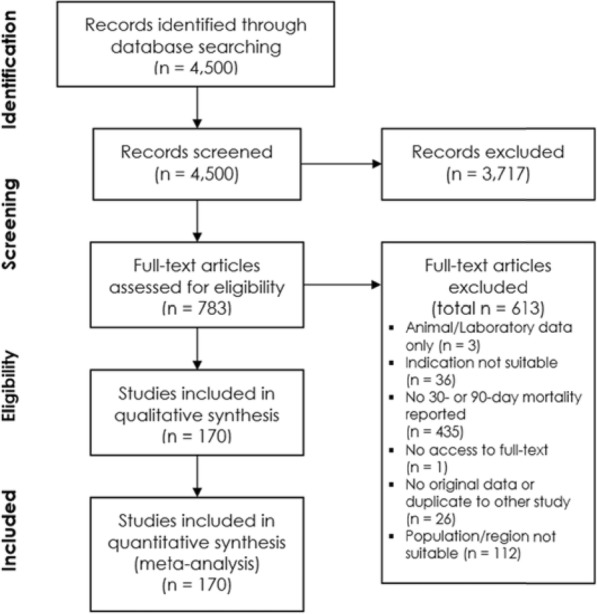
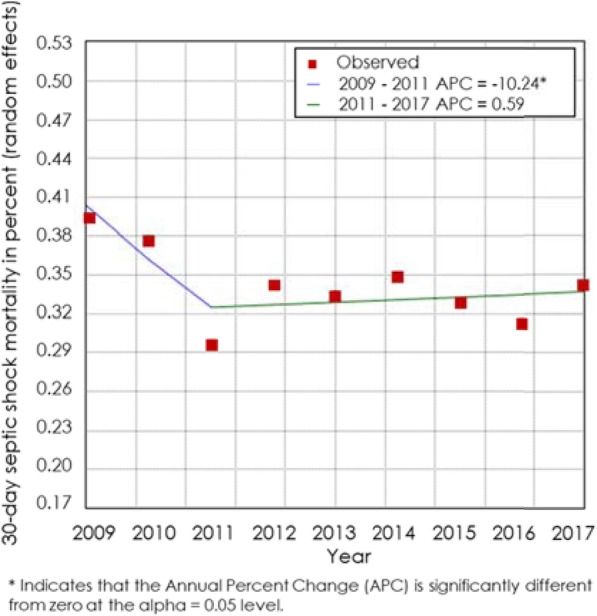
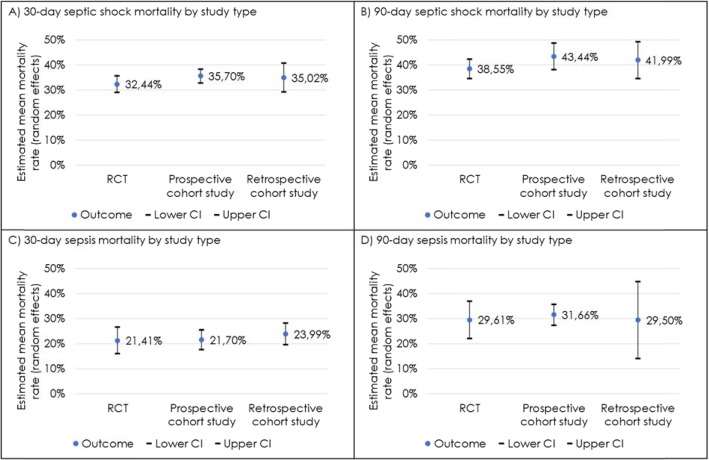
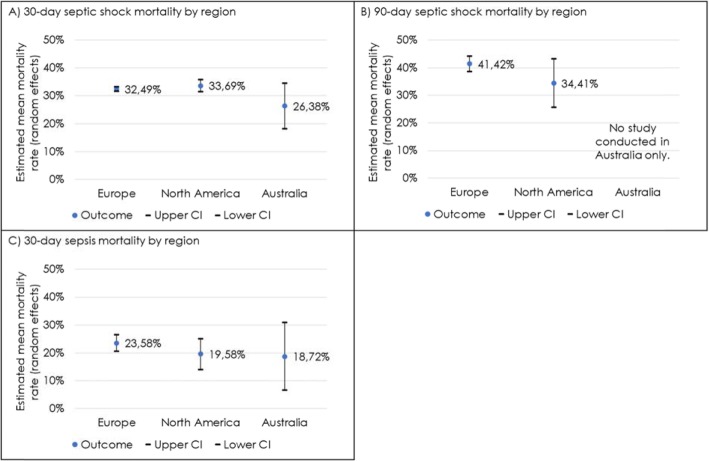
Background: Sepsis and septic shock remain drivers for mortality in critically ill patients. The heterogeneity of the syndrome hinders the generation of reproducible numbers on mortality risks. Consequently, mortality rates range from 15 to 56%. We aimed to update and extend the existing knowledge from meta-analyses and estimate 30- and 90-day mortality rates for sepsis and septic shock separately, stratify rates by region and study type and assess mortality rates across different sequential organ failure assessment (SOFA) scores. Methods: We performed a systematic review of articles published in PubMed or in the Cochrane Database, between 2009 and 2019 in English language including interventional and observational studies. A meta-analysis of pooled 28/30- and 90-day mortality rated separately for sepsis and septic shock was done using a random-effects model. Time trends were assessed via Joinpoint methodology and for the assessment of mortality rate over different SOFA scores, and linear regression was applied. Results: Four thousand five hundred records were identified. After title/abstract screening, 783 articles were assessed in full text for eligibility. Of those, 170 studies were included. Average 30-day septic shock mortality was 34.7% (95% CI 32.6–36.9%), and 90-day septic shock mortality was 38.5% (95% CI 35.4–41.5%). Average 30-day sepsis mortality was 24.4% (95% CI 21.5–27.2%), and 90-day sepsis mortality was 32.2% (95% CI 27.0–37.5%). Estimated mortality rates from RCTs were below prospective and retrospective cohort studies. Rates varied between regions, with 30-day septic shock mortality being 33.7% (95% CI 31.5–35.9) in North America, 32.5% (95% CI 31.7–33.3) in Europe and 26.4% (95% CI 18.1–34.6) in Australia. A statistically significant decrease of 30-day septic shock mortality rate was found between 2009 and 2011, but not after 2011. Per 1-point increase of the average SOFA score, average mortality increased by 1.8–3.3%. Conclusion: Trends of lower sepsis and continuous septic shock mortality rates over time and regional disparities indicate a remaining unmet need for improving sepsis management. Further research is needed to investigate how trends in the burden of disease influence mortality rates in sepsis and septic shock at 30- and 90-day mortality over time.
Overview
The claims and statistics of this paper haven’t been checked yet.
Free: it reads the open-access text and checks the first 5 claims that cite a source we can check. Create a free account to check every claim.
Integrity signals
Registry
Cites
Statistics
Figures
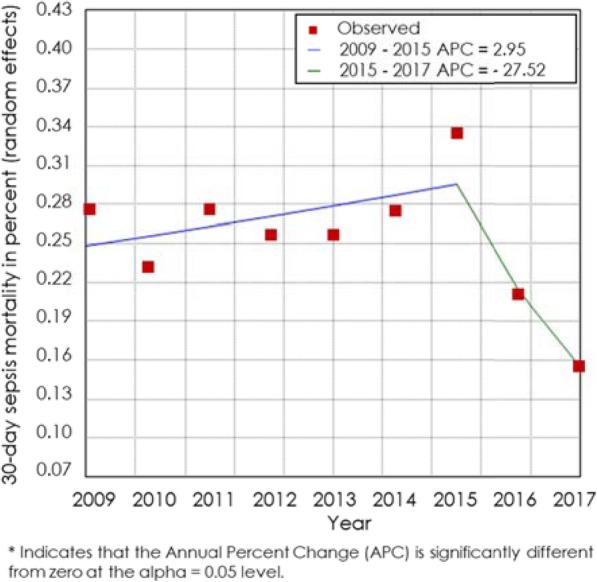
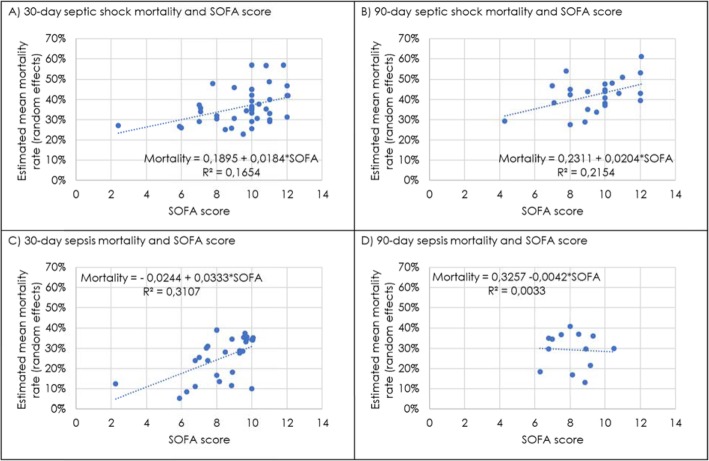
Verification
Claims the paper makes
The claims and statistics of this paper haven’t been checked yet.
Free: it reads the open-access text and checks the first 5 claims that cite a source we can check. Create a free account to check every claim.
Self-check
Percentages, sums and reported differences re-computed from the paper’s own numbers.
The self-check needs the paper’s full text.
Citations
Cites
Preferred Reporting Items for Systematic Reviews and Meta-Analyses: the PRISMA statement
Moher, D., Liberati, A., Tetzlaff, J., Altman, D. G., & for the PRISMA Group (2009) · BMJ · doi:10.1136/bmj.b2535 · Cited by 83,823
Preferred reporting items for systematic reviews and meta-analyses: the PRISMA Statement.
(2009) · PubMed Central · Cited by 44,859
RoB 2: a revised tool for assessing risk of bias in randomised trials
Sterne, J. A. C., Savović, J., Page, M. J., Elbers, R. G., Blencowe, N. S., Boutron, I., Cates, C. J., Cheng, H.-Y., Corbett, M. S., Eldridge, S. M., et al. (2019) · BMJ · doi:10.1136/bmj.l4898 · Cited by 34,787 · cited 1×
“RoB 2’ for randomized trials [18] and with ‘ROBINS-I’ used for observational studies [19], for sepsis and septic shock, 30 and 90 days mortality each.”
MethodThe third international consensus definitions for sepsis and septic shock (Sepsis-3).
Singer, M., Deutschman, C. S., Seymour, C. W., Shankar-Hari, M., Annane, D., Bauer, M., Bellomo, R., Bernard, G. R., Chiche, J.-D., Coopersmith, C. M., et al. (2016) · JAMA · doi:10.1001/jama.2016.0287 · Cited by 28,250
Self-citationROBINS-I: a tool for assessing risk of bias in non-randomised studies of interventions
Sterne, J. A., Hernán, M. A., Reeves, B. C., Savović, J., Berkman, N. D., Viswanathan, M., Henry, D., Altman, D. G., Ansari, M. T., Boutron, I., et al. (2016) · BMJ · doi:10.1136/bmj.i4919 · Cited by 20,329 · cited 1×
“RoB 2’ for randomized trials [18] and with ‘ROBINS-I’ used for observational studies [19], for sepsis and septic shock, 30 and 90 days mortality each.”
MethodBone, R. C., Balk, R. A., Cerra, F. B., Dellinger, R. P., Fein, A. M., Knaus, W. A., Schein, R. M. H., & Sibbald, W. J. (1992) · Chest · doi:10.1378/chest.101.6.1644 · Cited by 13,198
Surviving Sepsis Campaign: International Guidelines for Management of Severe Sepsis and Septic Shock
Dellinger, R. P., Levy, M. M., Rhodes, A., Annane, D., Gerlach, H., Opal, S. M., Sevransky, J. E., Sprung, C. L., Douglas, I. S., Jaeschke, R., et al. (2013) · Critical Care Medicine · doi:10.1097/ccm.0b013e31827e83af · Cited by 9,694
Self-citationThe Surviving Sepsis Campaign Guidelines Committee including The Pediatric Subgroup*, Dellinger, R. P., Levy, M. M., Rhodes, A., Annane, D., Gerlach, H., Opal, S. M., Sevransky, J. E., Sprung, C. L., Douglas, I. S., et al. (2013) · Intensive Care Medicine · doi:10.1007/s00134-012-2769-8 · Cited by 7,290
Self-citationPermutation tests for joinpoint regression with applications to cancer rates
Kim, H.-J., Fay, M. P., Feuer, E. J., & Midthune, D. N. (2000) · Statistics in Medicine · doi:10.1002/(sici)1097-0258(20000215)19:3<335::aid-sim336>3.0.co;2-z · Cited by 6,318
Severe Sepsis and Septic Shock
Angus, D. C., & van der Poll, T. (2013) · New England Journal of Medicine · doi:10.1056/nejmra1208623 · Cited by 3,961
Seymour, C. W., Liu, V. X., Iwashyna, T. J., Brunkhorst, F. M., Rea, T. D., Scherag, A., Rubenfeld, G., Kahn, J. M., Shankar-Hari, M., Singer, M., et al. (2016) · JAMA · doi:10.1001/jama.2016.0288 · Cited by 3,939
Surviving Sepsis Campaign: International guidelines for management of sepsis and septic shock: 2016.
Rhodes, A., Evans, L. E., Alhazzani, W., Levy, M. M., Antonelli, M., Ferrer, R., Kumar, A., Sevransky, J. E., Sprung, C. L., Nunnally, M. E., et al. (2017) · Critical Care Medicine · doi:10.1097/ccm.0000000000002255 · Cited by 3,652
Self-citationShankar-Hari, M., Phillips, G. S., Levy, M. L., Seymour, C. W., Liu, V. X., Deutschman, C. S., Angus, D. C., Rubenfeld, G. D., Singer, M., & for the Sepsis Definitions Task Force (2016) · JAMA · doi:10.1001/jama.2016.0289 · Cited by 2,424 · cited 4×
“In contrast to Stevenson and colleagues, the authors included observational studies only [21] while the specific time periods (dating back into the 1980s), in which mortality was monitored, were not taken into consideration as a confounder.”
BackgroundInfluentialGoal-Directed Resuscitation for Patients with Early Septic Shock
The ARISE Investigators and the ANZICS Clinical Trials Group (2014) · New England Journal of Medicine · doi:10.1056/nejmoa1404380 · Cited by 2,028
Incidence and trends of sepsis in US hospitals using clinical vs claims data, 2009-2014.
Rhee, C., Dantes, R., Epstein, L., Murphy, D. J., Seymour, C. W., Iwashyna, T. J., Kadri, S. S., Angus, D. C., Danner, R. L., Fiore, A. E., et al. (2017) · JAMA · doi:10.1001/jama.2017.13836 · Cited by 1,884 · cited 2×
“5% for septic shock patients [6], while another retrospective cohort study using health record data reported 15% in hospital mortality for sepsis and septic shock [1].”
ResultKaukonen, K.-M., Bailey, M., Suzuki, S., Pilcher, D., & Bellomo, R. (2014) · JAMA · doi:10.1001/jama.2014.2637 · Cited by 1,459
Benchmarking the Incidence and Mortality of Severe Sepsis in the United States*
Gaieski, D. F., Edwards, J. M., Kallan, M. J., & Carr, B. G. (2013) · Critical Care Medicine · doi:10.1097/ccm.0b013e31827c09f8 · Cited by 1,326
Adjunctive glucocorticoid therapy in patients with septic shock.
Venkatesh, B., Finfer, S., Cohen, J., Rajbhandari, D., Arabi, Y., Bellomo, R., Billot, L., Correa, M., Glass, P., Harward, M., et al. (2018) · New England Journal of Medicine · doi:10.1056/nejmoa1705835 · Cited by 1,037
Two Decades of Mortality Trends Among Patients With Severe Sepsis: A Comparative Meta-Analysis*
Stevenson, E. K., Rubenstein, A. R., Radin, G. T., Wiener, R. S., & Walkey, A. J. (2014) · Critical Care Medicine · doi:10.1097/ccm.0000000000000026 · Cited by 648 · cited 2×
“tality rates from clinical studies and administrative sources were similar for the US in the given time period from 1991 to 2009 [8].”
BackgroundVincent, J.-L., Jones, G., David, S., Olariu, E., & Cadwell, K. K. (2019) · Critical Care · doi:10.1186/s13054-019-2478-6 · Cited by 524 · cited 3×
“included observational studies only [22].”
BackgroundLate mortality after sepsis: propensity matched cohort study
Prescott, H. C., Osterholzer, J. J., Langa, K. M., Angus, D. C., & Iwashyna, T. J. (2016) · BMJ · doi:10.1136/bmj.i2375 · Cited by 337
Shankar-Hari, M., Harrison, D. A., Rubenfeld, G. D., & Rowan, K. (2017) · British Journal of Anaesthesia · doi:10.1093/bja/aex234 · Cited by 267
Tan, B., Wong, J. J.-M., Sultana, R., Koh, J. C. J. W., Jit, M., Mok, Y. H., & Lee, J. H. (2019) · JAMA Pediatrics · doi:10.1001/jamapediatrics.2018.4839 · Cited by 248 · cited 1×
“We decided against including studies that were solely performed in Asia, Africa, or South America because previous studies showed higher mortality rates in developing regions than in developed regions due to non-comparable healthcare systems [16].”
Karakike, E., Kyriazopoulou, E., Tsangaris, I., Routsi, C., Vincent, J., & Giamarellos‐Bourboulis, E. J. (2019) · Critical Care · doi:10.1186/s13054-019-2665-5 · Cited by 170
Luhr, R., Cao, Y., Söderquist, B., & Cajander, S. (2019) · Critical Care · doi:10.1186/s13054-019-2528-0 · Cited by 156
Data extraction for complex meta-analysis (DECiMAL) guide
Pedder, H., Sarri, G., Keeney, E., Nunes, V., & Dias, S. (2016) · Systematic Reviews · doi:10.1186/s13643-016-0368-4 · Cited by 128
the SepNet Critical Care Trials Group, Elke, G., Bloos, F., Wilson, D. C., Brunkhorst, F. M., Briegel, J., Reinhart, K., Loeffler, M., Kluge, S., Nierhaus, A., et al. (2018) · Critical Care · doi:10.1186/s13054-018-2001-5 · Cited by 127
POINT: Should the Surviving Sepsis Campaign Guidelines Be Retired? Yes
Marik, P. E., Farkas, J. D., Spiegel, R. J., Weingart, S. D., Aberegg, S. K., Beck‐Esmay, J., Carroll, S., Kenny, J. S., Koyfman, A., Lin, M., et al. (2019) · CHEST Journal · doi:10.1016/j.chest.2018.10.008 · Cited by 90
Baek, M. S., Lee, S.-M., Chung, C. R., Cho, W. H., Cho, Y.-J., Park, S., Koo, S.-M., Jung, J.-S., Park, S. Y., Chang, Y., et al. (2019) · Critical Care · doi:10.1186/s13054-018-2293-5 · Cited by 84
Karampela, Ι., Kandri, E., Antonakos, G., Vogiatzakis, E. D., Christodoulatos, G. S., Nikolaidou, A., Dimοpoulos, G., Armaganidis, A., & Dalamaga, Μ. (2017) · Journal of Critical Care · doi:10.1016/j.jcrc.2017.05.004 · Cited by 61
Variation in Postsepsis Readmission Patterns: A Cohort Study of Veterans Affairs Beneficiaries
Prescott, H. C. (2017) · Annals of the American Thoracic Society · doi:10.1513/annalsats.201605-398oc · Cited by 47
Control groups in recent septic shock trials: a systematic review
Pettilä, V., Hjortrup, P. B., Jakob, S. M., Wilkman, E., Perner, A., & Takala, J. A. (2016) · Intensive Care Medicine · doi:10.1007/s00134-016-4444-y · Cited by 21
Cited by
The pathophysiology of sepsis and precision-medicine-based immunotherapy
Giamarellos-Bourboulis, E. J., Aschenbrenner, A. C., Bauer, M., Bock, C., Calandra, T., Gat-Viks, I., Kyriazopoulou, E., Lupse, M., Monneret, G., Pickkers, P., et al. (2024) · Nature Immunology · doi:10.1038/s41590-023-01660-5 · Cited by 374
“9).”
Self-citationChicco, D., Sichenze, A., & Jurman, G. (2025) · BioData Mining · doi:10.1186/s13040-025-00465-6 · Cited by 289
Frequency and mortality of sepsis and septic shock in China: a systematic review and meta-analysis
Liu, Y., Yao, Y., Yu, M., Gao, Y., Qi, A., Jiang, T., Chen, Z.-S., Shou, S., & Chai, Y. (2022) · BMC Infectious Diseases · doi:10.1186/s12879-022-07543-8 · Cited by 131
Zhu, S., Yu, Y., Qu, M., Qiu, Z., Zhang, H., Miao, C., & Guo, K. (2023) · Cell Death Discovery · doi:10.1038/s41420-023-01614-8 · Cited by 123
“The mortality of 30-day septic shock was 34.7%, and that of 90-day septic shock reached 38.5% [5].”
BackgroundInfluentialRugg, C., Klose, R., Hornung, R., Innerhofer, N., Bachler, M., Schmid, S. W., Fries, D. R., & Ströhle, M. (2020) · Biomedicines · doi:10.3390/biomedicines8120539 · Cited by 116
Metadata
- Authors
- Bauer, M., Gerlach, H., Vogelmann, T., Preissing, F., Stiefel, J., & Adam, D.
- Affiliations
- Jena University Hospital (DE)
- Vivantes Klinikum (DE)
- CytoSorbents (Germany) (DE)
- Corresponding author
- Bauer, Michael
- Venue
- Critical Care
- Published
- 2020-05-19
- Volume
- 24
- Issue
- 1
- Pages
- 239-239
- ISSN
- 1364-8535 (ISSN-L)
- PMC
- PMC7236499
- OpenAlex
- W3027548201
- Semantic Scholar
- 17551feef1e5ba684094ee873ccb0dabe3675738
- Cited by
- 867
- References
- 32
- Citations by year
- 2026: 137 · 2025: 223 · 2024: 217 · 2023: 162 · 2022: 91 · 2021: 33 · 2020: 4
- FWCI
- 10.67
- Type
- journal article
- Language
- en
- Open access
- gold
- doi.org
- Licence
- cc-by
- creativecommons.org/licenses/by/4.0 (tdm)
- creativecommons.org/licenses/by/4.0 (vor)
- Locations
- Critical Care (publishedVersion, cc-by)
- PubMed Central (publishedVersion, cc-by)
- PubMed (publishedVersion)
- DOAJ (DOAJ: Directory of Open Access Journals) (submittedVersion, cc-by-sa)
- Funders
- CytoSorbents Europe
- Topics
- Health Sciences › Medicine › Critical Care and Intensive Care Medicine › Sepsis Diagnosis and Treatment
- Health Sciences › Medicine › Surgery › Abdominal Surgery and Complications
- Health Sciences › Medicine › Nephrology › Acute Kidney Injury Research
- Keywords
- sepsis, septic shock, mortality rates, 30-day mortality, 90-day mortality, SOFA score, regional variation, mortality trends, critically ill patients
- MeSH terms
- Australia, Europe, Humans, Mortality, North America, Shock, Septic, Sepsis
About these checks
Registry, retraction, Cites and statistics results are computed, not judged, with one exception: a printed reference that no index lists is read once by a model before it counts as a citation error. Claims are extracted by a model and kept only when their quote appears verbatim in the text; each cited source is then checked, with a model’s help, for whether it says what the claim relies on. Those verdicts can be wrong — read the claim’s quote and the cited source before relying on one.
Statistics and arithmetic are recomputed, not judged.
Confidence bands are shown only for fields calibrated on our annotated test set. None is calibrated yet, so no band is shown.
What counts as a claim ›How we measure confidence ›How we check this ›
Are you an author, or do you see a problem with this page? Request a review
Data sources
Bibliographic data: Semantic Scholar, OpenAlex, Crossref.
Contains information from the Semantic Scholar Academic Graph Datasets, made available under the ODC Attribution License (ODC-BY 1.0).
Semantic Scholar’s data is described in: Kinney, R., et al. (2023). The Semantic Scholar Open Data Platform. arXiv:2301.10140.
