

Deletions of chromosomal regulatory boundaries are associated with congenital disease
Open accessThe DOI matches its Crossref record; 71 of the 71 references it cites were found in a registry or an index.
Abstract
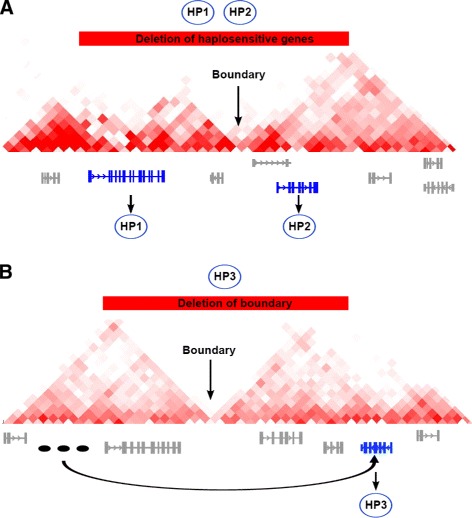
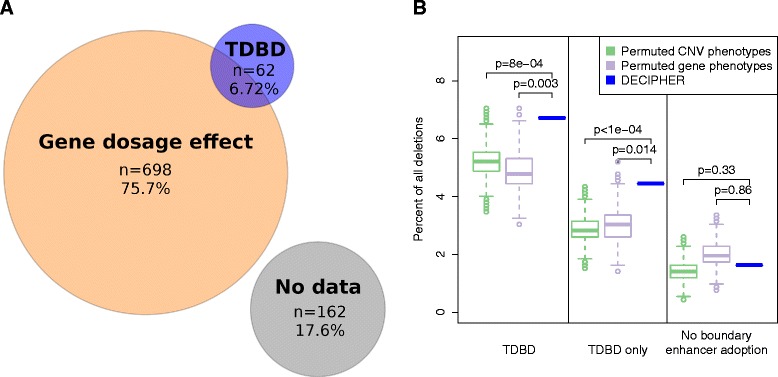
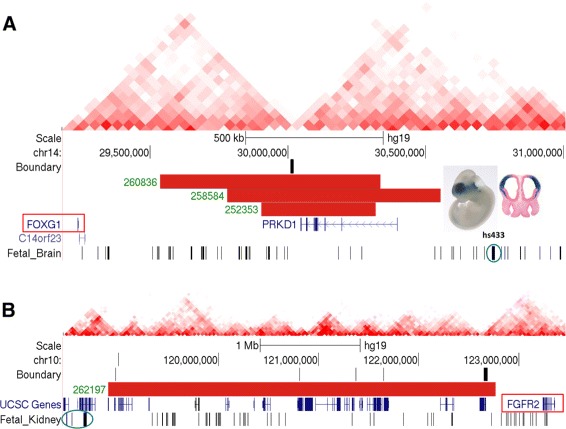
Background: Recent data from genome-wide chromosome conformation capture analysis indicate that the human genome is divided into conserved megabase-sized self-interacting regions called topological domains. These topological domains form the regulatory backbone of the genome and are separated by regulatory boundary elements or barriers. Copy-number variations can potentially alter the topological domain architecture by deleting or duplicating the barriers and thereby allowing enhancers from neighboring domains to ectopically activate genes causing misexpression and disease, a mutational mechanism that has recently been termed enhancer adoption. Results: We use the Human Phenotype Ontology database to relate the phenotypes of 922 deletion cases recorded in the DECIPHER database to monogenic diseases associated with genes in or adjacent to the deletions. We identify combinations of tissue-specific enhancers and genes adjacent to the deletion and associated with phenotypes in the corresponding tissue, whereby the phenotype matched that observed in the deletion. We compare this computationally with a gene-dosage pathomechanism that attempts to explain the deletion phenotype based on haploinsufficiency of genes located within the deletions. Up to 11.8% of the deletions could be best explained by enhancer adoption or a combination of enhancer adoption and gene-dosage effects. Conclusions: Our results suggest that enhancer adoption caused by deletions of regulatory boundaries may contribute to a substantial minority of copy-number variation phenotypes and should thus be taken into account in their medical interpretation.
Overview
The claims and statistics of this paper haven’t been checked yet.
Free: it reads the open-access text and checks the first 5 claims that cite a source we can check. Create a free account to check every claim.
Integrity signals
Registry
Cites
Statistics
Figures
Verification
Claims the paper makes
The claims and statistics of this paper haven’t been checked yet.
Free: it reads the open-access text and checks the first 5 claims that cite a source we can check. Create a free account to check every claim.
Claims other papers make about this one
Each is checked against this paper’s own text: does it say what the citing paper says it does?
The cited source says what the claim attributes to it.
In the citing paper
“Alterations in the topological structure of chromosomal bands have been associated with changes in gene expression and thus with phenotypes (292–294).”
From Epigenetic Modifications in Stress Response Genes Associated With Childhood Trauma (2019) · cites this paper as [294]
The cited source says what the claim attributes to it.
In the citing paper
“Therefore, the integrity of the domain structures is important for the proper regulation of genes8–12.”
From Disruption of chromatin folding domains by somatic genomic rearrangements in human cancer (2020) · cites this paper as [8]
Self-check
Percentages, sums and reported differences re-computed from the paper’s own numbers.
The self-check needs the paper’s full text.
Citations
Cites
BEDTools: a flexible suite of utilities for comparing genomic features
Quinlan, A. R., & Hall, I. M. (2010) · Bioinformatics · doi:10.1093/bioinformatics/btq033 · Cited by 27,437
An integrated encyclopedia of DNA elements in the human genome
The ENCODE Project Consortium (2012) · Nature · doi:10.1038/nature11247 · Cited by 18,072 · cited 1×
“The human genome is thought to harbor at least 400,000 enhancers [26], many of which exhibit tissue or developmental-stage specificity [27].”
BackgroundComprehensive Mapping of Long-Range Interactions Reveals Folding Principles of the Human Genome
Lieberman-Aiden, E., van Berkum, N. L., Williams, L., Imakaev, M., Ragoczy, T., Telling, A., Amit, I., Lajoie, B. R., Sabo, P. J., Dorschner, M. O., et al. (2009) · Science · doi:10.1126/science.1181369 · Cited by 8,898 · cited 1×
“Hi-C is a method that probes the threedimensional architecture of whole genomes by coupling proximity-based ligation with massively parallel, nextgeneration sequencing [11].”
MethodTopological domains in mammalian genomes identified by analysis of chromatin interactions
Dixon, J. R., Selvaraj, S., Yue, F., Kim, A., Li, Y., Shen, Y., Hu, M., Liu, J. S., & Ren, B. (2012) · Nature · doi:10.1038/nature11082 · Cited by 6,829 · cited 3×
“Recently, Hi-C was used to identify megabase-sized local chromatin interaction regions termed ‘topological domains’; the domains represent highly self-interacting regions bounded by narrow segments where the chromatin interactions appear to end abruptly [12].”
BackgroundMethodSystematic Localization of Common Disease-Associated Variation in Regulatory DNA
Maurano, M. T., Humbert, R., Rynes, E., Thurman, R. E., Haugen, E., Wang, H., Reynolds, A. P., Sandstrom, R., Qu, H., Brody, J., et al. (2012) · Science · doi:10.1126/science.1222794 · Cited by 3,716 · cited 1×
“While cell-type-specific DNase I hypersensitive sites (CTS-DHSs) have been identified by the Roadmap consortium [28], this previous method did not attempt to”
MethodDiagnosis of multiple cancer types by shrunken centroids of gene expression
Tibshirani, R., Hastie, T., Narasimhan, B., & Chu, G. (2002) · Proceedings of the National Academy of Sciences · doi:10.1073/pnas.082099299 · Cited by 2,930 · cited 1×
“where s0 is the mean of s over all windows to prevent division by small within-cell-type variance estimates [56].”
BackgroundMapping and analysis of chromatin state dynamics in nine human cell types
Ernst, J., Kheradpour, P., Mikkelsen, T. S., Shoresh, N., Ward, L. D., Epstein, C. B., Zhang, X., Wang, L., Issner, R., Coyne, M., et al. (2011) · Nature · doi:10.1038/nature09906 · Cited by 2,898
Resnik, P. (1999) · Journal of Artificial Intelligence Research · doi:10.1613/jair.514 · Cited by 2,047 · cited 1×
“For each HPO term t, the information content IC(t) is calculated as the negative logarithm of the frequency of annotations to the term [60]:”
MethodDECIPHER: Database of Chromosomal Imbalance and Phenotype in Humans Using Ensembl Resources
Firth, H. V., Richards, S. M., Bevan, A. P., Clayton, S., Corpas, M., Rajan, D., Vooren, S. V., Moreau, Y., Pettett, R. M., & Carter, N. P. (2009) · The American Journal of Human Genetics · doi:10.1016/j.ajhg.2009.03.010 · Cited by 1,990
The NIH Roadmap Epigenomics Mapping Consortium
Bernstein, B. E., Stamatoyannopoulos, J. A., Costello, J. F., Ren, B., Milosavljevic, A., Meissner, A., Kellis, M., Marra, M. A., Beaudet, A. L., Ecker, J. R., et al. (2010) · Nature Biotechnology · doi:10.1038/nbt1010-1045 · Cited by 1,892 · cited 1×
“DNase-seq reads from the NIH REMC [54] were counted in 200-bp windows covering the human genome.”
Method
Cited by
Items 101–143 of 143
Davidson, C., Wordsworth, B. P., Cohen, C., Knight, J. C., & Vecellio, M. L. (2023) · Frontiers in Genetics · doi:10.3389/fgene.2023.1129207 · Cited by 2
“Further, disease-associated genetic variants may disrupt higher-order genomic organization, due to elimination of annotated boundaries (Ibn-Salem et al., 2014).”
BackgroundLi, C., Bonder, M. J., Syed, S. A., HGSVC Functional Analysis Working Group, Zody, M. C., Chaisson, M., Talkowski, M. E., Marschall, T., Korbel, J. O., Eichler, E. E., et al. (2023) · bioRxiv (Cold Spring Harbor Laboratory) · doi:10.1101/2023.05.15.540856 · Cited by 3
Non-coding structural variants disrupt FOXG1 transcriptional regulation in early neurodevelopment
Hamerlinck, L., D’haene, E., Vaughan, M., Loon, N. V., Baca, M. D. R. P., Leimbacher, S., Kosicki, M., Colombo, L., Genbrugge, L., Vantomme, L., et al. (2026) · Nature Communications · doi:10.1038/s41467-026-73770-1 · Cited by 5
“For fi ve deletions (del1, 2, 5, 7, and 16) and two BCAs (bca12 and 18), the inheritance pattern is unknown.”
Structure, Function and Dynamics of Chromatin
Prakash, K. (2017) · Springer theses · doi:10.1007/978-3-319-52183-1_3 · Cited by 2
TADeus-a tool for clinical interpretation of structural variants modifying chromatin organization
Poszewiecka, B., Stankiewicz, P., Gambin, T., & Gambin, A. (2018) · IEEE International Conference on Bioinformatics and Biomedicine (BIBM) · doi:10.1109/bibm.2018.8621301 · Cited by 2
“[8] first performed the analysis of CNV deletions as a source of misexpression and disease caused by enhancer adoption (gain of positive enhancer).”
MethodEpigenetics: Chromatin Organization and Function
Delcuve, G. P., Khan, D. H., Liyanage, V. R. B., Jahan, S., Rastegar, M., Kirshenbaum, L. A., & Davie, J. (2016) · Cardiac and vascular biology · doi:10.1007/978-3-319-41457-7_1 · Cited by 4
Can abnormal chromatin folding cause high-penetrance cancer predisposition?
Schwartz, M. (2022) · Physiological Genomics · doi:10.1152/physiolgenomics.00052.2022 · Cited by 2
Computational Prediction of Position Effects of Human Chromosome Rearrangements
Zepeda‐Mendoza, C. J., Menon, S., & Morton, C. C. (2018) · Current Protocols in Human Genetics · doi:10.1002/cphg.57 · Cited by 2
“…project (Dunham et al., 2012), TAD boundaries (Dixon et al., 2012), and predicted enhancer-promoter interactions (Thurman et al., 2012)—as well as Human Phenotype Ontology (HPO; Kohler et al., 2014) terms that tailor position effect gene ranking to genes involved in a subject’s clinical phenotype.”
BackgroundMethodInfluentialLessons from the analysis of TAD boundary deletions in normal populationPreprint
Smol, T., Sigé, J., Thuillier, C., Frénois, F., Brunelle, P., Rama, M., Roche‐Lestienne, C., Manouvrier‐Hanu, S., Petit, F., & Ghoumid, J. (2020) · bioRxiv (Cold Spring Harbor Laboratory) · doi:10.1101/2020.04.01.021188 · Cited by 2
“In addition, large cohort studies identified TAD-boundary disruption as the disease-causing mechanism only in a low proportion of patients, ranging from 0.3% to 11.8% (Di Gregorio et al. 2017; Ibn-Salem et al. 2014).”
BackgroundInfluentialLi, C., Bonder, M. J., Syed, S. A., Jensen, M., HGSVC Functional Analysis Working Group, Gerstein, M., Zody, M. C., Chaisson, M., Talkowski, M. E., Marschall, T., et al. (2024) · Genome Research · doi:10.1101/gr.279419.124 · Cited by 11
“In particular, SVs can affect CTCF-associated borderel-ements, alter gene expression and enhancer – promoter interactions, and consequently result in human diseases (Ibn-Salem et al. 2014; Lupiáñez et al. 2015).”
Fast detection of deletion breakpoints using quantitative PCR
Abildinova, G. Z., Abdrakhmanova, Z., Tuchinsky, H., Nesher, E., Pinhasov, A., & Raskin, L. (2016) · Genetics and Molecular Biology · doi:10.1590/1678-4685-gmb-2015-0159 · Cited by 1
“For instance, variation in the size of a deletion in Williams syndrome involves different genes that contribute to distinct phenotypes of this multisystem disorder (Ibn-Salem et al., 2014).”
BackgroundSpector, J. D., & Wiita, A. P. (2020) · Current Protocols in Human Genetics · doi:10.1002/cphg.106 · Cited by 2
“One earlier study also estimated that as many as 11.8% of pathogenic CNVs exert their effect through TAD disruption, underscoring the potential for a significant number of missed diagnoses by current standards (Ibn-Salem et al., 2014).”
BackgroundInfluentialSrinivasan, S. S., Gong, Y., Xu, S., Hwang, A., Xu, M., Girgenti, M. J., & Zhang, J. (2022) · Genes · doi:10.3390/genes13040621 · Cited by 1
Magdinier, F., & Robin, J. D. (2022) · Elsevier eBooks · doi:10.1016/b978-0-323-91909-8.00003-7 · Cited by 1
Santos, A. P., Meinel, J. A., Piveta, C. S. C., de Andrade, J. G. R., Fabbri‐Scallet, H., Gil‐da‐Silva‐Lopes, V. L., Guerra‐Júnior, G., Künstner, A., Kaiser, F. J., Holterhus, P., et al. (2020) · medRxiv · doi:10.1101/2020.03.25.20041418 · Cited by 2
“…of topologically associating domains (TADs) have been shown to alter the architecture and enhancer-promoter interactions within TADs with effects on development (Ibn-Salem et al., 2014; Lettice et al., 2011; Lupianez et al., 2015) and oncogenesis (Hnisz et al., 2016; Weischenfeldt et al., 2017).”
BackgroundSun, Z., Wang, Y., Song, Z., Zhang, H., Ma, M., Wang, P., Fang, Y., Cai, D., Li, G., & Fang, Y. (2021) · bioRxiv (Cold Spring Harbor Laboratory) · doi:10.1101/2021.12.15.472849 · Cited by 1
Spielmann, M., & Mundlos, S. (2015) · Medizinische Genetik · doi:10.1007/s11825-014-0033-z
Self-citationGene-disease association through topological and biological feature integration
Hanna, E. M., & Zaki, N. (2015) · International Conference on Innovations in Information Technology · doi:10.1109/innovations.2015.7381544
“• Topological Domains: The topology and the compartments of proteins in the cell can potentially take part in disease or non-disease gene classification [21].”
BackgroundRegulatory Mutations of FOXG1 in the Context of Topological Domains
Mehrjouy, M. M., Fonseca, A. C., Ehmke, N., Busa, T., Mencarelli, M. A., Novelli, A., Bak, M., & Tommerup, N. (2016) · Cancer Genetics · doi:10.1016/j.cancergen.2016.05.051
Self-organization of a chromatin fibril into topologically-associated domains
Razin, S. V., Gavrilov, A. A., Kos, P. I., & Ulianov, S. V. (2017) · Russian Journal of Bioorganic Chemistry · doi:10.1134/s1068162017010083 · Cited by 1
Spatial Organization of the Nucleus Compartmentalizes and Regulates the Genome
Robson, M. I., Rizzotto, A., & Schirmer, E. C. (2018) · Springer eBooks · doi:10.1007/978-3-319-71614-5_1
Mechanizmy kontrolujące strukturę chromatyny
Sacharowski, S., & Sarnowski, T. J. (2019) · Postępy Biochemii · doi:10.18388/pb.2019_252 · Cited by 3
Organizing Principles for the Spatial Folding of Chromosomes
Josipović, N., & Papantonis, A. (2019) · Elsevier eBooks · doi:10.1016/b978-0-12-814879-2.00005-4
Radke, D. W., Sul, J. H., Balick, D. J., Akle, S., Initiative, A. D. N., Green, R. C., & Sunyaev, S. R. (2020) · bioRxiv (Cold Spring Harbor Laboratory) · doi:10.1101/2020.05.19.105205
Eukaryotic Genome in Three Dimensions
Razin, S. V., Gavrilov, A. A., & Ulianov, S. V. (2020) · Springer eBooks · doi:10.1007/978-3-030-62532-0_2
3D cytogenomics: Structural variation in the three-dimensional genome
Yumiceba, V., Melo, U. S., & Spielmann, M. (2021) · Elsevier eBooks · doi:10.1016/b978-0-12-823579-9.00020-5 · Cited by 11
Self-citationRegulation of clathrin-coated vesicle nucleation
Thieman, J. R. (2011) · D-Scholarship@Pitt (University of Pittsburgh)
Carvalho, D. D. D., & Ishak, C. A. (2019) · Faculty Opinions – Post-Publication Peer Review of the Biomedical Literature · doi:10.3410/f.736464528.793566607
Fonseca, A. C. D. S. (2016) · Digital Library of Theses and Dissertations (Universidade de São Paulo) · doi:10.11606/t.41.2016.tde-05052016-112830
Widespread link between DNA-packing density distribution and TAD boundary locationsPreprint
Meng, L., Sheong, F. K., & Luo, Q. (2023) · Research Square · doi:10.21203/rs.3.rs-3470944/v1
Jiang, F., Wu, J., Yang, M., Chen, X., Li, R., Yu, Q., Zuo, L., Zhou, J., Zhang, Y., Zhen, L., et al. (2025) · Annals of Hematology · doi:10.1007/s00277-025-06223-2
“11.8% of pathogenic CNVs (Copy number variations) were believed to exert their effect through disruption of TADs [10], which have been identified to cause disease without altering gene sequences.”
InfluentialTastemel, M., Jussila, A., Saravanan, B., Huang, H., Xie, Y., Zhu, Q. K., Jiang, Y., Armand, E. J., & Ren, B. (2025) · bioRxiv (Cold Spring Harbor Laboratory) · doi:10.1101/2025.02.21.639596 · Cited by 2
Ramamurthy, A., Bandouil, M. D., Aluru, L., Joshi, O., Yoon, E., Bodkin, N., Cheng, J. Z., Biar, C. G., Calhoun, J. D., & Carvill, G. L. (2025) · bioRxiv (Cold Spring Harbor Laboratory) · doi:10.1101/2025.04.11.648472
Breaking a chromatin domain boundary by deleting a single CTCF motif impacts development
Liu, X., & Ding, J. (2025) · Developmental Cell · doi:10.1016/j.devcel.2025.05.005
Genome Organization, Evolution of
Schaeffer, S. W. (2025) · Elsevier eBooks · doi:10.1016/b978-0-443-15750-9.00152-x
Investigating the Impact of Natural SNPs on hETF Conformational Dynamics and FAD Cofactor AlterationPreprint
Khan, S. (2025) · Research Square · doi:10.21203/rs.3.rs-7346934/v1
Pellow, R., & Comeron, J. M. (2026) · PLoS Computational Biology · doi:10.1371/journal.pcbi.1013887 · Cited by 1
Deciphering X chromosome architecture during mouse preimplantation development
Ranisavljevic, N. (2017) · theses.fr (ABES) · doi:10.70675/08dd1e70z4ea4z4fd1zbcf2z153b2944c2eb
Zebrafish as a model to determine conserved gene regulatory mechanisms in vertebrates
Perez-Rico, Y. A. (2018) · theses.fr (ABES) · doi:10.70675/3b7b3dc7z2a68z4c2czbdefz57bf4abbe1cc
Etude des éléments cis-régulateurs dans les pathologies associées au gène CFTR
Collobert, M. (2021) · theses.fr (ABES) · doi:10.70675/88d0128fzfaa1z423czbbe8z64062873c0a2
Distal enhancer-insulator module of GDF6 is essential for cochlear formation
Zafeer, M. F., Abad, C., Ortabozkoyun, H., Ramzan, M., Bademci, G., Robayo, M. C., Duman, D., Quadros, R. M., Guo, S., Young, J. I., et al. (2026) · JCI Insight · doi:10.1172/jci.insight.195462 · Cited by 1
Ramamurthy, A., Bandouil, M. D., Aluru, L., Joshi, O., Yoon, E., Bodkin, N., Cheng, J. N., Biar, C. G., Calhoun, J. D., & Carvill, G. L. (2026) · Nature Communications · doi:10.1038/s41467-026-75694-2
“TAD disruption by SVs has been reported in human limb malformations and congenital disorders 12,13 .”
Metadata
- Authors
- Ibn-Salem, J., Köhler, S., Love, M. I., Chung, H.-R., Huang, N., Hurles, M. E., Haendel, M., Washington, N. L., Smedley, D., Mungall, C. J., Lewis, S. E., Ott, C.-E., Bauer, S., Schofield, P. N., Mundlos, S., Spielmann, M., & Robinson, P. N.
- Affiliations
- Max Planck Society (DE)
- Charité – Universitätsmedizin Berlin (DE)
- Max Planck Institute for Molecular Genetics (DE)
- Wellcome Sanger Institute (GB)
- Oregon Health & Science University (US)
- Lawrence Berkeley National Laboratory (US)
- University of Cambridge (GB)
- Berlin-Brandenburger Centrum für Regenerative Therapien (DE)
- Corresponding author
- Spielmann, Malte
- Robinson, Peter N
- ORCID
- Venue
- Genome Biology
- Published
- 2014-09-04
- Volume
- 15
- Issue
- 9
- Pages
- 423-423
- ISSN
- 1465-6906 (ISSN-L)
- 1474-760X
- PMC
- PMC4180961
- OpenAlex
- W2169500338
- Cited by
- 143
- References
- 71
- Citations by year
- 2026: 5 · 2025: 10 · 2024: 5 · 2023: 7 · 2022: 8 · 2021: 13 · 2020: 16 · 2019: 16 · 2018: 14 · 2017: 17 · 2016: 18 · 2015: 12 · 2014: 1
- FWCI
- 10.48
- Type
- journal article
- Language
- en
- Open access
- gold
- doi.org
- Licence
- cc-by
- creativecommons.org/licenses/by/4.0 (tdm)
- creativecommons.org/licenses/by/4.0 (vor)
- Locations
- Genome biology (publishedVersion, cc-by)
- PubMed Central (publishedVersion, cc-by)
- PubMed (publishedVersion)
- OSTI OAI (U.S. Department of Energy Office of Scientific and Technical Information) (submittedVersion)
- MPG.PuRe (Max Planck Society) (submittedVersion, cc-by)
- Funders
- Max-Planck-Förderstiftung
- European Commission (602300)
- Bundesministerium für Bildung und Forschung (0313911)
- Berlin-Brandenburg School for Regenerative Therapies
- National Institutes of Health (R24OD011883)
- NIH Office of the Director (5R24 OD011883)
- National Cancer Institute (T32CA009337)
- Topics
- Life Sciences › Biochemistry, Genetics and Molecular Biology › Genetics › Genomic variations and chromosomal abnormalities
- Life Sciences › Biochemistry, Genetics and Molecular Biology › Molecular Biology › Genomics and Chromatin Dynamics
- Life Sciences › Biochemistry, Genetics and Molecular Biology › Genetics › Genomics and Rare Diseases
- Keywords
- regulatory boundaries, copy number variation, topological domains, chromatin looping, gene dosage, haploinsufficiency, congenital diseases, phenotype prediction, tissue-specific enhancers, Human Phenotype Ontology, DECIPHER, chromosomal deletion
- MeSH terms
- Chromosomes, Human, Humans, Models, Genetic, Phenotype, Genome, Human, Sequence Deletion, Gene Dosage, Genomics, Genetic Diseases, Inborn, Databases, Genetic, DNA Copy Number Variations, Haploinsufficiency, Molecular Sequence Annotation, Gene Ontology
About these checks
Registry, retraction, Cites and statistics results are computed, not judged, with one exception: a printed reference that no index lists is read once by a model before it counts as a citation error. Claims are extracted by a model and kept only when their quote appears verbatim in the text; each cited source is then checked, with a model’s help, for whether it says what the claim relies on. Those verdicts can be wrong — read the claim’s quote and the cited source before relying on one.
Statistics and arithmetic are recomputed, not judged.
Confidence bands are shown only for fields calibrated on our annotated test set. None is calibrated yet, so no band is shown.
What counts as a claim ›How we measure confidence ›How we check this ›
Are you an author, or do you see a problem with this page? Request a review
Data sources
Bibliographic data: Semantic Scholar, OpenAlex, Crossref.
Contains information from the Semantic Scholar Academic Graph Datasets, made available under the ODC Attribution License (ODC-BY 1.0).
Semantic Scholar’s data is described in: Kinney, R., et al. (2023). The Semantic Scholar Open Data Platform. arXiv:2301.10140.
