

Multi-omics approaches to disease
Open accessThe DOI matches its Crossref record; 185 of the 186 references it cites were found in a registry or an index; 78 of the 108 sources its claims cite were checked for support.
Abstract
High-throughput technologies have revolutionized medical research. The advent of genotyping arrays enabled large-scale genome-wide association studies and methods for examining global transcript levels, which gave rise to the field of "integrative genetics". Other omics technologies, such as proteomics and metabolomics, are now often incorporated into the everyday methodology of biological researchers. In this review, we provide an overview of such omics technologies and focus on methods for their integration across multiple omics layers. As compared to studies of a single omics type, multi-omics offers the opportunity to understand the flow of information that underlies disease.
Overview
CoChat Summary
TL;DR
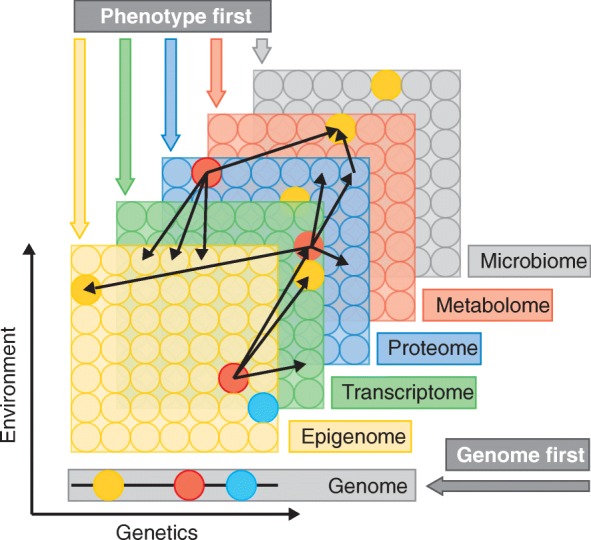
This review surveys omics technologies and argues that integrating multiple omics layers (“multi-omics”) can reveal the flow of information from genetic, environmental, or developmental causes to disease consequences better than single-omics studies. It organizes integrative approaches into genome-first, phenotype-first, and environment-first frameworks and discusses design, statistical, and translational challenges.
Key findings
- Single-omics analyses are mostly correlative; multi-omics integration is motivated by observations that GWAS loci explain only a fraction of heritability, common diseases often involve regulatory variation, and the same variants can yield different outcomes depending on environment and genetic background.
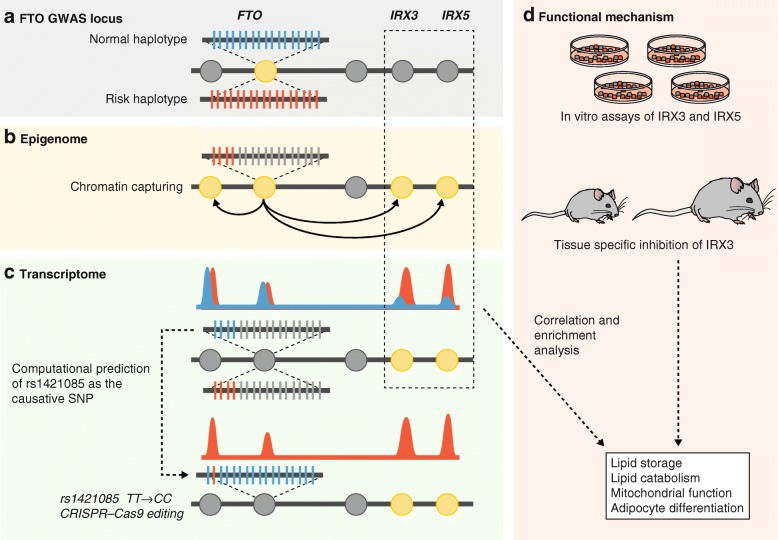
- Genome-first example: at the FTO obesity locus, chromatin maps across 127 cell types narrowed the region to an adipose-specific enhancer; IRX3 and IRX5 expression correlated with risk haplotype across 20 risk-allele and 18 non-risk-allele carriers, and CRISPR-Cas9 editing of rs1421085 implicated a single nucleotide variant disrupting ARID5B binding.
- Phenotype-first examples: in Alzheimer’s disease, profiling seven epigenetic modifications found AD-associated genetic variants enriched in immune-related enhancers but not promoters or neuronal-function enhancers; in cardiac arrhythmia, immunoprecipitation of five long QT proteins identified 584 co-precipitated proteins, with 12 genes overlapping 35 GWAS loci.
- Environment-first and population examples: 25 diets in over 800 mice showed macronutrient ratio effects on cardiometabolic health; about 100 inbred mouse strains were used to study high-fat/high-sucrose diet; 800 individuals were analyzed for personalized glycemic prediction; reference resources include METSIM (~10,000 Finnish men aged 45–65), MuTher (several hundred female twins), and UK Biobank (500,000 people).
Methods
- Narrative review, not a primary study; it describes genomics, epigenomics, transcriptomics, proteomics, metabolomics, and microbiomics technologies and their application to human disease.
- No primary data or sample collection; evidence comes from cited published studies and consortia, including Roadmap Epigenomics, GTEx, ENCODE, UK Biobank, MuTher, and METSIM.
- Synthesis organizes multi-omics integration into genome-first, phenotype-first, and environment-first approaches and discusses correlation/co-mapping, mediation and conditional analysis, network modeling, ID conversion, and future directions.
Limitations
- Paper-stated: human omics studies face confounding (e.g., diet, lifestyle), limited sample sizes/power, batch effects, lack of agreed gold-standard pipelines, and difficulty distinguishing causal from reactive changes; animal models have limitations including single genetic backgrounds and incomplete recapitulation of human complex disease.
- Paper-stated: standardization across studies is difficult (e.g., RNA-Seq comparability depends on genome version, annotation, and quantification tools), and coordinated consortia are needed for multi-scale data generation, analysis, and translation.
- Evident: as a review, it presents no new empirical results, does not perform a systematic search or meta-analysis, and its examples are selected to illustrate concepts rather than to quantify effects.
Model-written summary. Check it against the paper before relying on it.
Integrity signals
Registry
Cites
Statistics
Figures
Verification
Claims the paper makes
35 Valid · 11 Not valid · 16 Not checked · 33 Own results and interpretations
The cited sources support only part of this claim — read each source’s verdict below.
In the paper
“First, the loci that have been identified so far generally explain only a fraction of the heritable component for specific diseases.”
§ Multi-omics approaches to disease > Introduction
What the sources say
- Could not verifycites [1] LaFramboise T Single nucleotide polymorphism arrays: a decade of biological, computational and technological advances Nucleic Acids Res 2009 37 4181 93 10.1093/nar/gkp552 19570852 PMC2715261 sourceExperimental — accuracy not yet measured
The Introduction and the GWAS subsection discuss identifying variants associated with disease, but neither assesses how much disease heritability the identified loci explain. Searches for the claim’s wording, heritability, and explained genetic risk found no passage addressing that comparison; the indexed passages provide no page numbers. (LLM, conf=0.72)
- Partly supportedcites [2] Begum F Ghosh D Tseng GC Feingold E Comprehensive literature review and statistical considerations for GWAS meta-analysis Nucleic Acids Res 2012 40 3777 84 10.1093/nar/gkr1255 22241776 PMC3351172 sourceExperimental — accuracy not yet measured
The Introduction (page unavailable) says GWAS discoveries have been modest for many phenotypes and that typical effect sizes are small. It does not say what fraction of disease heritability the identified loci explain, so it supports the general idea of limited findings but not the claim’s specific heritability comparison. (LLM, conf=0.73)
- Supportedcites [3] Manolio TA Genomewide association studies and assessment of the risk of disease N Engl J Med 2010 363 166 76 10.1056/NEJMra0905980 20647212 source
The Challenges section states that genomewide association findings typically explain only a small proportion of disease heritability. The opening passage likewise says identified variants account for little heritability, supporting the claim's general wording. (LLM, conf=0.94)
plain- Asserted: passes — The authors put it forward as true.
- Checkable: passes — It can be checked against evidence.
- Load-bearing: passes — The paper’s conclusions depend on it.
- Based: passes — The paper gives a reason why it holds.
- Could not verify
The cited sources support only part of this claim — read each source’s verdict below.
In the paper
“Third, the same genetic variants often contribute to different final outcomes, depending on the environment and genetic background.”
§ Multi-omics approaches to disease > Introduction
What the sources say
- Could not verifycites [1] LaFramboise T Single nucleotide polymorphism arrays: a decade of biological, computational and technological advances Nucleic Acids Res 2009 37 4181 93 10.1093/nar/gkp552 19570852 PMC2715261 sourceExperimental — accuracy not yet measured
Our copy of LaFramboise (2009) is a technical review of SNP array platforms, genotyping algorithms, LD/phasing, GWAS design, germline CNV and somatic LOH; no passage states that a single variant can yield different outcomes depending on environment or genetic background. Searches for 'penetrance/phenotype/variable expression', 'environmental factors/genetic background/modifier genes', 'pleiotropy/epistasis/gene-environment interaction' returned only the INTRODUCTION (variants encode diversity and disease susceptibility), the GWAS section (associated variant as putative predisposition allele), the ancestry/population-stratification section and the reference list — none of which make the claim's point. Since our copy neither states nor contradicts it, the attribution cannot be checked here. (LLM, conf=0.68)
- Partly supportedcites [2] Begum F Ghosh D Tseng GC Feingold E Comprehensive literature review and statistical considerations for GWAS meta-analysis Nucleic Acids Res 2012 40 3777 84 10.1093/nar/gkr1255 22241776 PMC3351172 sourceExperimental — accuracy not yet measured
The GWAS META-ANALYSIS DATA AND METHODS section states that populations with different environmental backgrounds may have 'different genes ... relevant to the trait' (gene × environment interaction), and the Between-study heterogeneity / Case study sections note the same RNF212 variants act differently in males and females — so the environment-dependent modulation of genetic effects is in our copy. However, our copy nowhere says the SAME variants contribute to DIFFERENT final outcomes (pleiotropy), and it offers nothing on genetic background/epistasis as a modifier; the direction of its point is the reverse (different genes for one trait). The claim also states as a frequent fact ('often contribute') what the source hedges ('may be relevant', 'there may be gene × environment interaction'). (LLM, conf=0.65)
- Partly supportedcites [3] Manolio TA Genomewide association studies and assessment of the risk of disease N Engl J Med 2010 363 166 76 10.1056/NEJMra0905980 20647212 sourceExperimental — accuracy not yet measured
Our copy supports the first half of the claim: the Survey-of-Findings/Abstract section states that "genomewide association studies have identified loci that are shared by conditions previously thought to be unrelated (Table 2)," and Table 2 lists examples (CDKN2A/CDKN2B in coronary disease, type 2 diabetes and invasive melanoma; ORMDL3 in asthma and Crohn's disease; LRRK2 in Parkinson's disease and Crohn's disease; C10orf67 in sarcoidosis and celiac disease). What the source does NOT support is the conditional modifier "depending on the environment and genetic background": the Abstract and Glossary only say complex conditions arise from many genetic and environmental factors working together and list "interactions between genes or between genes and environmental factors" as candidate explanations for missing heritability, never as the reason a shared variant yields different outcomes. The word "often" is likewise not quantified in our copy. (LLM, conf=0.72)
plainstates a possible cause- Asserted: passes — The authors put it forward as true.
- Checkable: passes — It can be checked against evidence.
- Load-bearing: passes — The paper’s conclusions depend on it.
- Based: passes — The paper gives a reason why it holds.
- Could not verify
The cited sources that could be checked couldn’t confirm or dispute this claim.
In the paper
“Analyses of causal variants at GWAS loci focused originally on coding regions, but it has become clear that for many common diseases regulatory variation explains most of the risk burden [21].”
§ Multi-omics approaches to disease > Approaches to integrative analysis of multiple omics data > The genome first approach
What the sources say
- Could not verifycites [21] Wahl S Drong A Lehne B Loh M Scott WR Kunze S Epigenome-wide association study of body mass index and the adverse outcomes of adiposity Nature 2016 541 81 6 10.1038/nature20784 28002404 PMC5570525 sourceExperimental — accuracy not yet measured
Our copy of Wahl et al. (2017) is an epigenome-wide association study of BMI; it reports that the 187 adiposity-related methylation loci are enriched in active chromatin/cis-regulatory regions (DNase hypersensitivity sites, H3K4me1, H3K27ac) and link to cis-gene expression (Abstract, functional genomics section), and that candidate genes implicate regulatory pathways linking adiposity to metabolic, cardiovascular, respiratory and neoplastic disease (Abstract). However, no passage states or supports the general proposition that for many common diseases regulatory variation explains most of the risk burden, nor contrasts early causal-variant work in coding regions with regulatory mechanisms. Searched: 'regulatory variation explains most of the risk burden', 'GWAS loci mostly non-coding regulatory variants rather than coding variants disease risk', 'most disease-associated variants lie in non-coding regulatory regions rather than protein-coding exons', 'common variants conferring disease risk act through gene regulation' — nothing on the claimed point, and nothing contrary to it. (LLM, conf=0.70)
boostedstates a cause- Asserted: passes — The authors put it forward as true.
- Checkable: passes — It can be checked against evidence.
- Load-bearing: passes — The paper’s conclusions depend on it.
- Based: passes — The paper gives a reason why it holds.
- Could not verify
The cited sources support only part of this claim — read each source’s verdict below.
In the paper
“To identify differentially expressed genes between the cases and controls, the power provided by more samples is generally preferable to the increased accuracy provided by higher depth of sequencing.”
§ Multi-omics approaches to disease > Considerations for the design of omics studies > Downstream analysis, sample sizes, and power
What the sources say
- Partly supportedcites [7] Schurch NJ Schofield P Gierlinski M Cole C Sherstnev A Singh V How many biological replicates are needed in an RNA-seq experiment and which differential expression tool should you use? RNA 2016 22 839 51 10.1261/rna.053959.115 27022035 PMC4878611 sourceExperimental — accuracy not yet measured
The Introduction (page unavailable) says increasing biological replicates usually makes RNA-seq results more robust, and the Discussion (page unavailable) recommends at least 12 clean replicates per condition when identifying most differentially expressed genes is important. The paper does not compare adding samples with increasing sequencing depth, so it does not establish the claimed preference between them. (LLM, conf=0.85)
- Partly supportedcites [8] Conesa A Madrigal P Tarazona S Gomez-Cabrero D Cervera A McPherson A A survey of best practices for RNA-seq data analysis Genome Biol 2016 17 13 10.1186/s13059-016-0881-8 26813401 PMC4728800 sourceExperimental — accuracy not yet measured
Box 1 (Number of replicates; page unavailable) says that, after a certain sequencing depth, increasing the number of replicates is the better way to improve power. It does not establish that more samples are generally preferable: the same passage says deeper sequencing can improve power for low-expression genes and that the best trade-off depends on the experiment and budget. (LLM, conf=0.85)
- Partly supportedcites [9] Williams AG Thomas S Wyman SK Holloway AK RNA-seq data: challenges in and recommendations for experimental design and analysis Curr Protoc Hum Genet 2014 83 11.13.1 11.13.20 10.1002/0471142905.hg1113s83 25271838 PMC4230301 sourceExperimental — accuracy not yet measured
In “Simulated Differential Expression with Varying Numbers of Replicates and Sequence Depth” (page unavailable), the paper reports that more replicates can improve detection of differentially expressed genes, particularly when biological variance is high. It does not establish that adding samples is generally preferable to deeper sequencing: it also reports that substantial reductions in read depth sharply reduce detection power and recommends both a minimum number of replicates and a minimum sequencing depth. (LLM, conf=0.85)
plainstates a cause- Asserted: passes — The authors put it forward as true.
- Checkable: passes — It can be checked against evidence.
- Load-bearing: unclear — It is unclear whether the paper’s conclusions depend on it.
- Based: passes — The paper gives a reason why it holds.
- Partly supported
The cited sources support only part of this claim — read each source’s verdict below.
In the paper
“In large studies, some technical artifacts cannot be avoided, and in these cases it is crucial to understand to what extent those artifacts limit our ability to draw conclusions from observations”
§ Multi-omics approaches to disease > Considerations for the design of omics studies > Downstream analysis, sample sizes, and power
What the sources say
- Could not verifycites [10] Gilad Y Mizrahi-Man O A reanalysis of mouse ENCODE comparative gene expression data F1000Res 2015 4 121 26236466 PMC4516019 sourceExperimental — accuracy not yet measured
The Discussion identifies a sequencing batch effect and calls the Mouse ENCODE study design flawed, but does not say that technical artifacts are unavoidable in large studies. A search for unavoidable artifacts and large-study limitations found no passage making that point. (LLM, conf=0.72)
- Partly supportedcites [11] Peixoto L Risso D Poplawski SG Wimmer ME Speed TP Wood MA How data analysis affects power, reproducibility and biological insight of RNA-seq studies in complex datasets Nucleic Acids Res 2015 43 7664 74 10.1093/nar/gkv736 26202970 PMC4652761 sourceExperimental — accuracy not yet measured
The Introduction (page unavailable) says many sources of unwanted variation cannot be controlled in in-vivo brain gene-expression studies. The Discussion (page unavailable) also describes batch effects and artifacts when integrating RNA-seq data across laboratories. The paper does not establish that technical artifacts are unavoidable in large studies generally. (LLM, conf=0.82)
- Partly supportedcites [12] SEQC/MAQC-III Consortium A comprehensive assessment of RNA-seq accuracy, reproducibility and information content by the Sequencing Quality Control Consortium Nat Biotechnol 2014 32 903 14 10.1038/nbt.2957 25150838 PMC4321899 sourceExperimental — accuracy not yet measured
The Discussion (page unavailable) identifies GC bias, sequence bias and non-specific signal as sources of unwanted or missed differential-expression calls in this multi-site study. It supports the presence and consequences of technical artifacts, but does not say that some artifacts cannot be avoided in large studies. (LLM, conf=0.78)
- Partly supportedcites [13] Hartley SW Mullikin JC QoRTs: a comprehensive toolset for quality control and data processing of RNA-Seq experiments BMC Bioinformatics 2015 16 224 10.1186/s12859-015-0670-5 26187896 PMC4506620 sourceExperimental — accuracy not yet measured
The Background says RNA-Seq is prone to artifacts and that some biases are inherent; the Implementation section says such issues can call results into question. The paper does not establish that technical artifacts are unavoidable specifically in large studies, and it notes that many biases can be accounted for or corrected. The indexed passages provide section labels but no page numbers. (LLM, conf=0.83)
plain- Asserted: passes — The authors put it forward as true.
- Checkable: passes — It can be checked against evidence.
- Load-bearing: unclear — It is unclear whether the paper’s conclusions depend on it.
- Based: passes — The paper gives a reason why it holds.
- Could not verify
49 more claims · 25 with their cited sources checked
Create a free account to see all 95 claims and to verify the 30 references still open.
- It may state two separate claims as one. 26
- Probably not a substantial claim. 20
- The quote only partly states this claim. 1
Claims other papers make about this one
Each is checked against this paper’s own text: does it say what the citing paper says it does?
The source backs part of the claim, not all of it — or backs it for a different population, condition or comparison.
In the citing paper
“In summary, by using new technologies, “omic” analysis and “big data”-integration of data from different platforms in a system biology approach-bias will be reduced and understanding of molecular mechanisms will be deepened (317).”
From Epigenetic Modifications in Stress Response Genes Associated With Childhood Trauma (2019) · cites this paper as [317]
Experimental — accuracy not yet measuredThe source backs part of the claim, not all of it — or backs it for a different population, condition or comparison.
In the citing paper
“Currently, many of the multi-omic reviews are focussed on individual sub-topics.For example, designing studies (Haas et al., 2017;Hasin et al., 2017), setting up workflows (Kohl et al., 2014), choosing software tools (Misra et al., 2019) and evaluating overfitted performance (McCabe et al., 2020).”
From Using machine learning approaches for multi-omics data analysis: A review (2021) · cites this paper as Hasin et al., 2017
Experimental — accuracy not yet measured
Self-check
Percentages, sums and reported differences re-computed from the paper’s own numbers.
Each contradiction between two passages listed here was confirmed by an independent check.
Rated minor: it would not touch a result — a value no result rests on, a p-value that stays on the same side of the significance level, or a conflict that is clerical, resolved elsewhere in the paper, or outside its own findings.
In the paper
§ Multi-omics approaches to disease > Approaches to integrative analysis of multiple omics data > The genome first approach
“Claussnitzer and colleagues confirmed the roles of IRX2 and IRX5 using experimental manipulation in primary adipocytes and in mice.”
§ Multi-omics approaches to disease > Approaches to integrative analysis of multiple omics data > The genome first approach
“c Transcriptomics: this technique was used to identify which of the candidate genes are differentially expressed between the risk and normal haplotypes, identifying IRX3 and IRX5 as the likely downstream targets.”
Citations
Cites
QIIME allows analysis of high-throughput community sequencing data
Caporaso, J. G., Kuczynski, J., Stombaugh, J., Bittinger, K., Bushman, F. D., Costello, E. K., Fierer, N., Peña, A. G., Goodrich, J. K., Gordon, J. I., et al. (2010) · Nature Methods · doi:10.1038/nmeth.f.303 · Cited by 34,887 · cited 1×
“Several analytic tools have been developed for analyzing NGS data from targeted 16S or metagenomics analysis, such as QIIME (quantitative insights into microbial ecology) [167].”
MethodAn integrated encyclopedia of DNA elements in the human genome
The ENCODE Project Consortium (2012) · Nature · doi:10.1038/nature11247 · Cited by 18,072
Trapnell, C., Williams, B. A., Pertea, G., Mortazavi, A., Kwan, G., van Baren, M. J., Salzberg, S. L., Wold, B. J., & Pachter, L. (2010) · Nature Biotechnology · doi:10.1038/nbt.1621 · Cited by 15,556
Tissue-based map of the human proteome
Uhlén, M., Fagerberg, L., Hallström, B. M., Lindskog, C., Oksvold, P., Mardinoglu, A., Sivertsson, Å., Kampf, C., Sjöstedt, E., Asplund, A., et al. (2015) · Science · doi:10.1126/science.1260419 · Cited by 15,286
RNA-Seq: a revolutionary tool for transcriptomics
Wang, Z., Gerstein, M., & Snyder, M. (2009) · Nature Reviews Genetics · doi:10.1038/nrg2484 · Cited by 13,174 · cited 6×
“Thus, transcriptomics, employing either expression arrays or RNA-Seq (Box 1), has proven to be particularly useful for identifying causal genes at GWAS loci [16, 22–24].”
BackgroundInfluentialSudlow, C., Gallacher, J., Allen, N., Beral, V., Burton, P., Danesh, J., Downey, P., Elliott, P., Green, J., Landray, M., et al. (2015) · PLOS Medicine · doi:10.1371/journal.pmed.1001779 · Cited by 12,728 · cited 1×
“The UK biobank [15] collects samples and physiologic measures and follows 500,000 people with respect to their activity.”
BackgroundKlindworth, A., Pruesse, E., Schweer, T., Peplies, J., Quast, C., Horn, M., & Glöckner, F. O. (2013) · Nucleic Acids Research · doi:10.1093/nar/gks808 · Cited by 8,850
Human gut microbes associated with obesity
Ley, R. E., Turnbaugh, P. J., Klein, S., & Gordon, J. I. (2006) · Nature · doi:10.1038/4441022a · Cited by 8,785 · cited 1×
“The microbiome has been shown to alter many aspects of host physiology, from obesity [86, 87] to cognition [88].”
BackgroundDNA methylation age of human tissues and cell types
Horvath, S. (2013) · Genome Biology · doi:10.1186/gb-2013-14-10-r115 · Cited by 7,075 · cited 1×
“For example, differentially methylated regions of DNA can be used as indicators of disease status for metabolic syndrome [124, 125], cardiovascular disease [126], cancer [127], and many other pathophysiologic states [128].”
BackgroundNewman, M. (2010) · doi:10.1093/acprof:oso/9780199206650.001.0001 · Cited by 6,595
Cited by
Items 601–700 of 1,008
The role of DNA methylation in personalized medicine for immune-related diseases
Gupta, M. K., Peng, H., Li, Y., & Xu, C. (2023) · Pharmacology & Therapeutics · doi:10.1016/j.pharmthera.2023.108508 · Cited by 25
Multi-modal molecular determinants of clinically relevant osteoporosis subtypes
Yuan, C., Yu, X., Wang, J., Shu, B., Wang, X., Huang, C., Lv, X., Peng, Q., Qi, W.-H., Zhang, J., et al. (2024) · Cell Discovery · doi:10.1038/s41421-024-00652-5 · Cited by 31
Eissa, T., Leonardo, C., Kepesidis, K. V., Fleischmann, F., Linkohr, B., Meyer, D., Zoka, V., Huber, M., Voronina, L., Richter, L., et al. (2024) · Cell Reports Medicine · doi:10.1016/j.xcrm.2024.101625 · Cited by 34
Animal Wellness: The Power of Multiomics and Integrative Strategies
Choudhary, R. K., ., S. K. B. V., Mukhopadhyay, C. S., Kashyap, N., Sharma, V., Singh, N., Tazerji, S. S., Kalantari, R., Hajipour, P., & Malik, Y. S. (2024) · Veterinary Medicine International · doi:10.1155/2024/4125118 · Cited by 31
Liu, Z., & Park, T. (2024) · Frontiers in Genetics · doi:10.3389/fgene.2024.1488683 · Cited by 27
Single-cell omics reveal the mechanisms of traditional Chinese medicines
Jiang, B., Si, J., Luo, H., & Le, L. (2025) · Phytomedicine · doi:10.1016/j.phymed.2025.157204 · Cited by 34
Luo, Y., Zhang, N., Yang, J., Cui, M., Tsoi, K. K., Lip, G. Y. H., Liu, T., & Zhang, Q. (2026) · Nature Communications · doi:10.1038/s41467-026-68956-6 · Cited by 42
Wang, L., Felts, S. J., Keulen, V. P. V., Scheid, A. D., Block, M. S., Markovic, S. N., Pease, L. R., & Zhang, Y. (2018) · Cancer Research · doi:10.1158/0008-5472.can-18-0529 · Cited by 29
A review of the molecular profile of benign and malignant odontogenic lesions
Duarte‐Andrade, F. F., Vitório, J. G., Pereira, T. D. S. F., Gomes, C. C., & Gomez, R. S. (2020) · Oral Surgery Oral Medicine Oral Pathology and Oral Radiology · doi:10.1016/j.oooo.2019.12.017 · Cited by 31
Recent Advances in Necrotizing Enterocolitis Research
Pammi, M., Plaen, I. G. D., & Maheshwari, A. (2020) · Clinics in Perinatology · doi:10.1016/j.clp.2020.02.011 · Cited by 33
Davaapil, H., Shetty, D. K., & Sinha, S. (2020) · Frontiers in Cell and Developmental Biology · doi:10.3389/fcell.2020.550504 · Cited by 28
Gao, J., Yang, C., Li, Q., Chen, L., Jiang, Y., Liu, S., Zhang, J., Liu, G., & Chen, J. (2021) · Frontiers in Aging Neuroscience · doi:10.3389/fnagi.2021.691518 · Cited by 27
Potential Metabolic Biomarkers in Adult Asthmatics
Sim, S., Choi, Y., & Park, H. (2021) · Metabolites · doi:10.3390/metabo11070430 · Cited by 27
Apoptosis and Autophagy: Current Understanding in Tick–Pathogen Interactions
Wang, X., & Cull, B. (2022) · Frontiers in Cellular and Infection Microbiology · doi:10.3389/fcimb.2022.784430 · Cited by 27
Metabolic Phenotyping in Prostate Cancer Using Multi-Omics Approaches
Gómez-Cebrián, N., Poveda, J. L., Pineda‐Lucena, A., & Puchades‐Carrasco, L. (2022) · Cancers · doi:10.3390/cancers14030596 · Cited by 28
Telleria, O., Albóniga, O. E., Clos‐Garcia, M., Jiménez, B. N., Cubiella, J., Bujanda, L., & Falcón‐Pérez, J. M. (2022) · Metabolites · doi:10.3390/metabo12060550 · Cited by 27
Multimodal Learning for Multi-omics: A Survey
Tabakhi, S., Suvon, M. N. I., Ahadian, P., & Lu, H. (2023) · World Scientific Annual Review of Artificial Intelligence · doi:10.1142/s2811032322500047 · Cited by 31
Woldemariam, S., Dorner, T. E., Wiesinger, T., & Stein, K. V. (2023) · Wiener klinische Wochenschrift · doi:10.1007/s00508-022-02146-4 · Cited by 72
Molecular Mechanisms Underlying NMDARs Dysfunction and Their Role in ADHD Pathogenesis
Kuś, J., Saramowicz, K., Czerniawska, M., Wiese, W., Siwecka, N., Rozpędek‐Kamińska, W., Kucharska-Lusina, A., Strzelecki, D., & Majsterek, I. (2023) · International Journal of Molecular Sciences · doi:10.3390/ijms241612983 · Cited by 31
Jalili, M., Gebhardt, T., Wolkenhauer, O., & Salehzadeh‐Yazdi, A. (2018) · Biochimica et Biophysica Acta (BBA) - Molecular Basis of Disease · doi:10.1016/j.bbadis.2018.02.010 · Cited by 27
Alligier, M., Barrès, R., Blaak, E. E., Boirie, Y., Bouwman, J., Brunault, P., Campbell, K., Clément, K., Farooqi, I. S., Farpour‐Lambert, N. J., et al. (2020) · Obesity Facts · doi:10.1159/000505342 · Cited by 32
Re-evaluating the relationship between missing heritability and the microbiome
Douglas, G. M., Bielawski, J. P., & Langille, M. G. I. (2020) · Microbiome · doi:10.1186/s40168-020-00839-4 · Cited by 42
von Gerichten, J., Saunders, K., Bailey, M. J., Gethings, L. A., Onoja, A., Geifman, N., & Spick, M. P. (2024) · Metabolites · doi:10.3390/metabo14080461 · Cited by 29
From Genes to Clinical Practice: Exploring the Genomic Underpinnings of Endometrial Cancer
Molefi, T., Mabonga, L., Hull, R., Sebitloane, M., & Dlamini, Z. (2025) · Cancers · doi:10.3390/cancers17020320 · Cited by 30
Kim, H.-Y., Choi, H., Lee, J., & Kong, G. (2019) · Briefings in Bioinformatics · doi:10.1093/bib/bbz003 · Cited by 24
Gómez-Cebrián, N., García-Flores, M., Rubio‐Briones, J., López‐Guerrero, J. A., Pineda‐Lucena, A., & Puchades‐Carrasco, L. (2020) · Journal of Proteome Research · doi:10.1021/acs.jproteome.0c00493 · Cited by 26
Cellular Reprogramming—A Model for Melanoma Cellular Plasticity
Granados, K., Poelchen, J., Novak, D., & Utikal, J. S. (2020) · International Journal of Molecular Sciences · doi:10.3390/ijms21218274 · Cited by 27
Palego, L., Giannaccini, G., & Betti, L. (2020) · Central Nervous System Agents in Medicinal Chemistry · doi:10.2174/1871524920999201214231243 · Cited by 33
Advancing and refining archaeological dental calculus research using multiomic frameworks
Wright, S. L., Dobney, K., & Weyrich, L. (2021) · STAR: Science & Technology of Archaeological Research · doi:10.1080/20548923.2021.1882122 · Cited by 21
Use of omic technologies in early life gastrointestinal health and disease: from bench to bedside
Beck, L. C., Granger, C. L., Masi, A. C., & Stewart, C. J. (2021) · Expert Review of Proteomics · doi:10.1080/14789450.2021.1922278 · Cited by 25
Identification of early and intermediate biomarkers for ARDS mortality by multi-omic approaches
Liao, S., Casanova, N. G., Bime, C., Camp, S. M., Lynn, H., & Garcia, J. G. N. (2021) · Scientific Reports · doi:10.1038/s41598-021-98053-1 · Cited by 29
Wang, Y.-C., Wu, Y., Choi, J. Y., Allington, G., Zhao, S., Khanfar, M., Yang, K., Fu, P.-Y., Wrubel, M., Yu, X., et al. (2022) · Journal of Personalized Medicine · doi:10.3390/jpm12020175 · Cited by 25
Using Omics to Study Leprosy, Tuberculosis, and Other Mycobacterial Diseases
Ahamad, N., Gupta, S. K., & Parashar, D. (2022) · Frontiers in Cellular and Infection Microbiology · doi:10.3389/fcimb.2022.792617 · Cited by 29
Khan, M. Z. I., Tam, S. Y., & Law, H. (2022) · Cells · doi:10.3390/cells11060973 · Cited by 26
Marciano, D. P., & Snyder, M. P. (2019) · Methods in molecular biology · doi:10.1007/978-1-4939-9236-2_27 · Cited by 27
Modelling urea cycle disorders using iPSCs
Duff, C. E., & Baruteau, J. (2022) · npj Regenerative Medicine · doi:10.1038/s41536-022-00252-5 · Cited by 27
A binary interaction map between turnip mosaic virus and Arabidopsis thaliana proteomes
Martínez, F., Carrasco, J. L., Toft, C., Hillung, J., Giménez‐Santamarina, S., Yenush, L., Rodrigo, G., & Elena, S. F. (2023) · Communications Biology · doi:10.1038/s42003-023-04427-8 · Cited by 31
Fabbri, L., Garlantézec, R., Audouze, K., Bustamante, M., Carracedo, Á., Chatzi, L., González, J. R., Gražulevičienė, R., Keun, H. C., Lau, C. E., et al. (2023) · Environment International · doi:10.1016/j.envint.2023.107856 · Cited by 27
Proteomics-Driven Biomarkers in Pancreatic Cancer
Ramalhete, L., Vigia, E., Araújo, R., & Marques, H. P. (2023) · Proteomes · doi:10.3390/proteomes11030024 · Cited by 29
Li, A., Yan, C., Qiu, J., Ji, Y., Fu, Y., & Yan, W. (2023) · The Science of The Total Environment · doi:10.1016/j.scitotenv.2023.167246 · Cited by 24
Ren, Z., Liu, Q., Wang, Y., Dong, Y., & Huang, Y. (2020) · Scientific Reports · doi:10.1038/s41598-020-58245-7 · Cited by 25
Calciolari, E., & Donos, N. (2020) · PROTEOMICS - CLINICAL APPLICATIONS · doi:10.1002/prca.201900084 · Cited by 26
Shipkova, M., & Christians, U. (2019) · Therapeutic Drug Monitoring · doi:10.1097/ftd.0000000000000627 · Cited by 24
The Need for Precision Medicine to be Applied to Diabetes
Klonoff, D. C., Florez, J. C., German, M. S., & Fleming, A. (2020) · Journal of Diabetes Science and Technology · doi:10.1177/1932296819894295 · Cited by 26
Multiomics Analysis Revealed Colorectal Cancer Pathogenesis
Xu, Y., He, Y., Chen, C., Shi, J., He, M., Liu, Y., Zhang, Y., Liu, Y., & Zhang, Y. (2024) · Journal of Proteome Research · doi:10.1021/acs.jproteome.3c00894 · Cited by 23
Xia, X., Zhu, C., Zhong, F., & Liu, L. (2024) · BMC Biology · doi:10.1186/s12915-024-02023-8 · Cited by 32
Camps, J., Iftimie, S. M., Jiménez-Franco, A., Castro, A., & Joven, J. (2025) · Biomolecules · doi:10.3390/biom15071027 · Cited by 33
Berlin, R. B., Gruen, R. L., & Best, J. D. (2018) · Frontiers in Bioengineering and Biotechnology · doi:10.3389/fbioe.2018.00112 · Cited by 26
Identify gene expression pattern change at transcriptional and post-transcriptional levels
Zhang, J., Xu, C., Zhang, L., Zhu, W., Shen, H., & Deng, H. (2019) · Transcription · doi:10.1080/21541264.2019.1575159 · Cited by 26
Molina-Mora, J. A., & García, F. (2021) · Phenomics · doi:10.1007/s43657-021-00016-z · Cited by 24
Defining NASH from a Multi-Omics Systems Biology Perspective
Niu, L., Sulek, K., Vasilopoulou, C. G., Santos, A., Albrechtsen, N. J. W., Rasmussen, S., Meier, F., & Mann, M. (2021) · Journal of Clinical Medicine · doi:10.3390/jcm10204673 · Cited by 24
Gao, X., Li, R., Yourick, J. J., & Sprando, R. L. (2021) · Toxicology in Vitro · doi:10.1016/j.tiv.2021.105274 · Cited by 26
Recent Advances in Chinese Herbal Medicine for Cerebral Ischemic Reperfusion Injury
Huang, P. C., Wan, H., Shao, C., Li, C., Zhang, L., & He, Y. T. (2022) · Frontiers in Pharmacology · doi:10.3389/fphar.2021.688596 · Cited by 30
Omics of endothelial cell dysfunction in sepsis
Langston, J. C., Rossi, M. T., Yang, Q., Ohley, W. J., Perez, E., Kilpatrick, L. E., Prabhakarpandian, B., & Kiani, M. F. (2022) · Vascular Biology · doi:10.1530/vb-22-0003 · Cited by 27
A Review of Omics Studies on Arboviruses: Alphavirus, Orthobunyavirus and Phlebovirus
Peinado, R. D. S., Eberle, R. J., Arni, R. K., & Coronado, M. A. (2022) · Viruses · doi:10.3390/v14102194 · Cited by 31
Fennell, E. M. J., Aponte‐Collazo, L. J., Pathmasiri, W., Rushing, B. R., Barker, N. K., Partridge, M. C., Li, Y., White, C. A., Greer, Y. E., Herring, L. E., et al. (2023) · Frontiers in Pharmacology · doi:10.3389/fphar.2023.1136317 · Cited by 25
Hubers, N., Hagenbeek, F. A., Pool, R., Dejean, S., Harms, A. C., Roetman, P. J., van Beijsterveldt, C. E. M., Fanos, V., Ehli, E. A., Vermeiren, R. R. J. M., et al. (2023) · American Journal of Medical Genetics Part B Neuropsychiatric Genetics · doi:10.1002/ajmg.b.32955 · Cited by 29
Pang, J., Liang, B., Ding, R., Yan, Q., Chen, R., & Xu, J. (2023) · Briefings in Bioinformatics · doi:10.1093/bib/bbad304 · Cited by 26
Drouard, G., Hagenbeek, F. A., Whipp, A. M., Pool, R., Hottenga, J., Jansen, R., Hubers, N., Afonin, A. М., Willemsen, G. A. H. M., de Geus, E. J. C., et al. (2023) · BMC Medicine · doi:10.1186/s12916-023-03198-7 · Cited by 29
Multi-omics in stress and health research: study designs that will drive the field forward
Mengelkoch, S., Gassen, J., Lev‐Ari, S., Alley, J. C., Rose, S. M. S., Snyder, M. P., & Slavich, G. M. (2024) · Stress · doi:10.1080/10253890.2024.2321610 · Cited by 28
Barathikannan, K., Chelliah, R., Vinothkanna, A., Prathiviraj, R., Tyagi, A., Vijayalakshmi, S., Lim, M.-J., Jia, A.-Q., & Oh, D.-H. (2024) · npj Science of Food · doi:10.1038/s41538-024-00258-x · Cited by 21
Deciphering host immunity to malaria using systems immunology
Loiseau, C., Cooper, M. M., & Doolan, D. L. (2019) · Immunological Reviews · doi:10.1111/imr.12814 · Cited by 26
Network Analysis for Complex Neurodegenerative Diseases
Manzoni, C., Lewis, P. A., & Ferrari, R. (2020) · Current Genetic Medicine Reports · doi:10.1007/s40142-020-00181-z · Cited by 23
Periodontal diseases in Africa
Olujitan, M., Ayanbadejo, P. O., Umeizudike, K. A., Oyapero, A., Okunseri, C. E., & Butali, A. (2024) · Periodontology 2000 · doi:10.1111/prd.12617 · Cited by 33
Endogenous Metabolic Modulators: Emerging Therapeutic Potential of Amino Acids
Hamill, M. J., Afeyan, R., Chakravarthy, M. V., & Tramontin, T. (2020) · iScience · doi:10.1016/j.isci.2020.101628 · Cited by 24
Three-Dimensional Molecular Cartography of the Caribbean Reef-Building Coral Orbicella faveolata
Little, M., George, E. E., Arts, M. G. I., Shivak, J., Benler, S., Huckeba, J., Quinlan, Z. A., Boscaro, V., Mueller, B., Güemes, A. G. C., et al. (2021) · Frontiers in Marine Science · doi:10.3389/fmars.2021.627724 · Cited by 26
A New Era of Neuro-Oncology Research Pioneered by Multi-Omics Analysis and Machine Learning
Takahashi, S., Takahashi, M., Tanaka, S., Takayanagi, S., Takami, H., Yamazawa, E., Nambu, S., Miyake, M., Satomi, K., Ichimura, K., et al. (2021) · Biomolecules · doi:10.3390/biom11040565 · Cited by 27
Time to infer miRNA sponge modules
Zhang, J., Liu, L., Xu, T., Zhang, W., Li, J., Rao, N., & Le, T. D. (2021) · Wiley Interdisciplinary Reviews - RNA · doi:10.1002/wrna.1686 · Cited by 25
Machuca, A., García‐Calvo, E., Anunciação, D. S., & Luque-Garcia, J. L. (2021) · Pharmaceutics · doi:10.3390/pharmaceutics13101629 · Cited by 23
Seo, Y., Bang, S., Son, J., Kim, D., Jeong, Y., Kim, P., Yang, J.-H., Eom, J.-H., Choi, N., & Kim, H. N. (2021) · Bioactive Materials · doi:10.1016/j.bioactmat.2021.11.009 · Cited by 24
Identifying biomarkers for prenatal diagnosis of neural tube defects based on “omics”
Huang, W., Gu, H., & Yuan, Z. (2021) · Clinical Genetics · doi:10.1111/cge.14087 · Cited by 28
Xing, X., Yang, F., Li, H., Zhang, J., Zhao, Y., Gao, M., Huang, J., & Yao, J. (2021) · IEEE International Conference on Bioinformatics and Biomedicine (BIBM) · doi:10.1109/bibm52615.2021.9669621 · Cited by 27
Wu, Y., Wang, M., Yang, T., Qin, T.-Y., Qin, L., Hu, Y.-M., Zhang, C.-F., Sun, B., Ding, L., Wu, L., et al. (2022) · Frontiers in Nutrition · doi:10.3389/fnut.2021.794841 · Cited by 24
Li, M., & Chen, C.-W. D. (2022) · Biomedicines · doi:10.3390/biomedicines10061325 · Cited by 25
Lin, S., Li, Q., Xu, Z., Chen, Z., Tao, Y., Tong, Y., Wang, T., Chen, S., & Wang, P. (2022) · Psychopharmacology · doi:10.1007/s00213-022-06239-w · Cited by 23
Searching for the Metabolic Signature of Cancer: A Review from Warburg’s Time to Now
Jacquet, P., & Stéphanou, A. (2022) · Biomolecules · doi:10.3390/biom12101412 · Cited by 31
Caenorhabditis elegans in microgravity: An omics perspective
Scott, A., Willis, C. R. G., Muratani, M., Higashitani, A., Etheridge, T., Szewczyk, N. J., & Deane, C. S. (2023) · iScience · doi:10.1016/j.isci.2023.107189 · Cited by 26
Multiset correlation and factor analysis enables exploration of multi-omics data
Brown, B. C., Wang, C., Kasela, S., Aguet, F., Nachun, D. C., Taylor, K. D., Tracy, R. P., Durda, P., Liu, Y., Johnson, W. C., et al. (2023) · Cell Genomics · doi:10.1016/j.xgen.2023.100359 · Cited by 25
Wang, C.-X., Xiu, L., Hu, Q., Lee, T., Liu, J., Shi, L., Zhou, X., Guo, X., Hou, L., & Yin, K. (2023) · Advances in Climate Change Research · doi:10.1016/j.accre.2023.11.014 · Cited by 33
Liu, D., Langston, J. C., Prabhakarpandian, B., Kiani, M. F., & Kilpatrick, L. E. (2024) · Frontiers in Cellular and Infection Microbiology · doi:10.3389/fcimb.2023.1274842 · Cited by 30
Harnessing Nanotechnology: Emerging Strategies for Multiple Myeloma Therapy
Yang, M., Chen, Y., Zhu, L., You, L., Tong, H., Meng, H., Sheng, J., & Jin, J. (2024) · Biomolecules · doi:10.3390/biom14010083 · Cited by 29
Multi-OMICS analyses unveil STAT1 as a potential modifier gene in mevalonate kinase deficiency
Carapito, R., Carapito, C., Morlon, A., Paul, N., Jácome, A. S. V., Alsaleh, G., Rolli, V., Tahar, O., Aouadi, I., Rompais, M., et al. (2018) · Annals of the Rheumatic Diseases · doi:10.1136/annrheumdis-2018-213524 · Cited by 23
Charkoftaki, G., Thompson, D. C., Golla, J. P., García-Milian, R., Lam, T. T., Engel, J., & Vasiliou, V. (2019) · Chemico-Biological Interactions · doi:10.1016/j.cbi.2019.02.030 · Cited by 28
Electrochemical biosensing to assist multiomics analysis in precision medicine
Campuzano, S., Barderas, R., Yáñez‐Sedeño, P., & Pingarrón, J. M. (2021) · Current Opinion in Electrochemistry · doi:10.1016/j.coelec.2021.100703 · Cited by 22
Liu, Z., Waters, J., & Rui, B. (2022) · Biomedical Journal · doi:10.1016/j.bj.2022.01.004 · Cited by 27
Althubaiti, S., Kulmanov, M., Liu, Y., Gkoutos, G. V., Schofield, P. N., & Hoehndorf, R. (2021) · bioRxiv (Cold Spring Harbor Laboratory) · doi:10.1101/2021.03.02.433454 · Cited by 28
Implications of topological imbalance for representation learning on biomedical knowledge graphs
Bonner, S., Kirik, U., Engkvist, O., Tang, J., & Barrett, I. P. (2022) · Briefings in Bioinformatics · doi:10.1093/bib/bbac279 · Cited by 38
Artificial intelligence 101 for veterinary diagnostic imaging
Hespel, A., Zhang, Y., & Basran, P. S. (2022) · Veterinary Radiology & Ultrasound · doi:10.1111/vru.13160 · Cited by 32
Li, Y., Guo, Z., Gao, X., & Wang, G. (2023) · Bioinformatics · doi:10.1093/bioinformatics/btad734 · Cited by 27
Wang, W., Deng, M., Li, M., Liu, L., Zou, J., & Qian, Y. (2024) · Investigative Ophthalmology & Visual Science · doi:10.1167/iovs.65.1.21 · Cited by 23
A review of Ribosome profiling and tools used in Ribo-seq data analysis
Limbu, M. S., Xiong, T., & Wang, S. (2024) · Computational and Structural Biotechnology Journal · doi:10.1016/j.csbj.2024.04.051 · Cited by 32
Machine learning-powered multi-omics for food microbiology and smarter food safety
Bansal, S., Rodriguez, C. Z., Thompson‐Witrick, K. A., Wang, Y., Taft, D. H., & Zhang, B. (2025) · Trends in Food Science & Technology · doi:10.1016/j.tifs.2025.105145 · Cited by 26
Samarkhazan, H. S. (2025) · Clinical and Experimental Medicine · doi:10.1007/s10238-025-01858-x · Cited by 30
From Metabolite to Metabolome: Metabolomics Applications in Plasmodium Research
Yu, X., Feng, G., Zhang, Q., & Cao, J. (2021) · Frontiers in Microbiology · doi:10.3389/fmicb.2020.626183 · Cited by 24
You, L., Zhang, S., Li, T., Sang, X., Li, K., Wang, W. J., Gao, X., Wu, J., Huang, G., Wang, T., et al. (2021) · Chinese Medicine · doi:10.1186/s13020-020-00416-9 · Cited by 23
A Single-Organelle Optical Omics Platform for Cell Science and Biomarker Discovery
Pliss, A., Kuzmin, A. N., Lita, A., Kumar, R., Celiku, O., Atilla‐Gokcumen, G. E., Gökçümen, Ö., Chandra, D., Larion, M., & Prasad, P. N. (2021) · Analytical Chemistry · doi:10.1021/acs.analchem.1c01131 · Cited by 24
Genomic medicine on the frontier of precision medicine
Hasanzad, M., Sarhangi, N., Naghavi, A., Ghavimehr, E., Khatami, F., Chimeh, S. E., Larijani, B. A., & Meybodi, H. R. A. (2021) · Journal of Diabetes & Metabolic Disorders · doi:10.1007/s40200-021-00880-6 · Cited by 23
Chitwood, J. R., Chakraborty, N., Hammamieh, R., Moe, S. M., Chen, N. X., Kacena, M. A., & Natoli, R. M. (2021) · Biomarkers · doi:10.1080/1354750x.2021.1985171 · Cited by 23
Dissecting single-cell genomes through the clonal organoid technique
Youk, J., Kwon, H. W., Kim, R., & Ju, Y. S. (2021) · Experimental & Molecular Medicine · doi:10.1038/s12276-021-00680-1 · Cited by 22
Demirel, H. C., Arici, M. K., & Tunçbağ, N. (2021) · Molecular Omics · doi:10.1039/d1mo00158b · Cited by 30
Metadata
- Authors
- Hasin, Y., Seldin, M., & Lusis, A.
- Affiliations
- University of California, Los Angeles (US)
- Corresponding author
- Lusis, Aldons
- Venue
- Genome Biology
- Published
- 2017-05-05
- Volume
- 18
- Issue
- 1
- Pages
- 83-83
- ISSN
- 1465-6906 (ISSN-L)
- 1474-760X
- PMC
- PMC5418815
- OpenAlex
- W2611138580
- Semantic Scholar
- 7710b482b5956665598c0b8ca4c2cb37555287aa
- Cited by
- 2,953
- References
- 186
- Citations by year
- 2026: 650 · 2025: 467 · 2024: 395 · 2023: 328 · 2022: 315 · 2021: 317 · 2020: 225 · 2019: 152 · 2018: 84 · 2017: 18
- FWCI
- 12.26
- Type
- journal article
- Language
- en
- Open access
- gold
- doi.org
- Licence
- cc-by
- creativecommons.org/licenses/by/4.0/ (tdm)
- creativecommons.org/licenses/by/4.0/ (vor)
- Locations
- Genome biology (publishedVersion, cc-by)
- PubMed Central (publishedVersion, cc-by)
- PubMed (publishedVersion)
- DOAJ (DOAJ: Directory of Open Access Journals) (submittedVersion)
- eScholarship (California Digital Library) (submittedVersion, cc-by)
- Funders
- National Institutes of Health (HL114437, HL28481)
- Topics
- Life Sciences › Biochemistry, Genetics and Molecular Biology › Molecular Biology › Bioinformatics and Genomic Networks
- Life Sciences › Biochemistry, Genetics and Molecular Biology › Genetics › Genetic Associations and Epidemiology
- Physical Sciences › Environmental Science › Health, Toxicology and Mutagenesis › Health, Environment, Cognitive Aging
- Keywords
- multi-omics integration, omics technologies, proteomics, metabolomics, transcriptomics, genomics, disease mechanisms
- MeSH terms
- Humans, Computational Biology, Genetic Predisposition to Disease, Genome-Wide Association Study, Datasets as Topic
About these checks
Registry, retraction, Cites and statistics results are computed, not judged, with one exception: a printed reference that no index lists is read once by a model before it counts as a citation error. Claims are extracted by a model and kept only when their quote appears verbatim in the text; each cited source is then checked, with a model’s help, for whether it says what the claim relies on. Those verdicts can be wrong — read the claim’s quote and the cited source before relying on one.
The claim verdicts this report counts are experimental: their accuracy is not yet measured.
A language model drew the claims from the paper on 2026-10-05, under version 3 of the claim definition (model deepseek-v4.1-flash, prompt extract-v3).
A second model labelled each claim on 2026-10-05 (model jev-1.13-20260917, definition revision gold-guideline-v0.2).
Cited sources are checked with a language model’s help (gpt-6-sol and qwen3.8-omni-flash).
Statistics and arithmetic are recomputed, not judged.
Confidence bands are shown only for fields calibrated on our annotated test set. None is calibrated yet, so no band is shown.
What counts as a claim ›How we measure confidence ›How we check this ›
Are you an author, or do you see a problem with this page? Request a review
Data sources
Bibliographic data: Semantic Scholar, OpenAlex, Crossref.
Contains information from the Semantic Scholar Academic Graph Datasets, made available under the ODC Attribution License (ODC-BY 1.0).
Semantic Scholar’s data is described in: Kinney, R., et al. (2023). The Semantic Scholar Open Data Platform. arXiv:2301.10140.
