

Multi-omics approaches to disease
Open accessThe DOI matches its Crossref record; 185 of the 186 references it cites were found in a registry or an index; 78 of the 108 sources its claims cite were checked for support.
Abstract
High-throughput technologies have revolutionized medical research. The advent of genotyping arrays enabled large-scale genome-wide association studies and methods for examining global transcript levels, which gave rise to the field of "integrative genetics". Other omics technologies, such as proteomics and metabolomics, are now often incorporated into the everyday methodology of biological researchers. In this review, we provide an overview of such omics technologies and focus on methods for their integration across multiple omics layers. As compared to studies of a single omics type, multi-omics offers the opportunity to understand the flow of information that underlies disease.
Overview
CoChat Summary
TL;DR
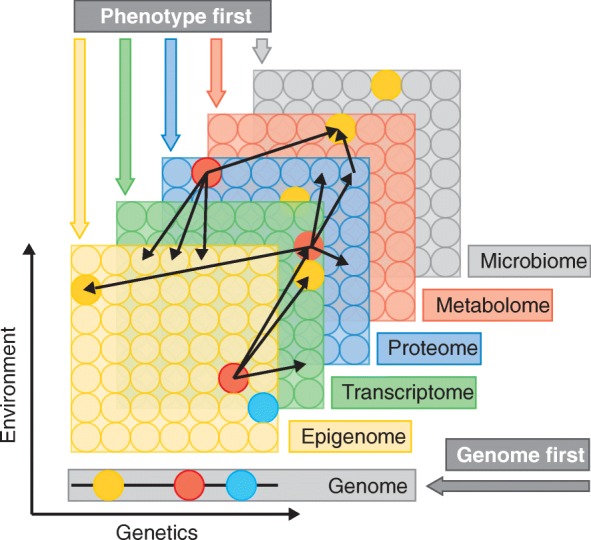
This review surveys omics technologies and argues that integrating multiple omics layers (“multi-omics”) can reveal the flow of information from genetic, environmental, or developmental causes to disease consequences better than single-omics studies. It organizes integrative approaches into genome-first, phenotype-first, and environment-first frameworks and discusses design, statistical, and translational challenges.
Key findings
- Single-omics analyses are mostly correlative; multi-omics integration is motivated by observations that GWAS loci explain only a fraction of heritability, common diseases often involve regulatory variation, and the same variants can yield different outcomes depending on environment and genetic background.
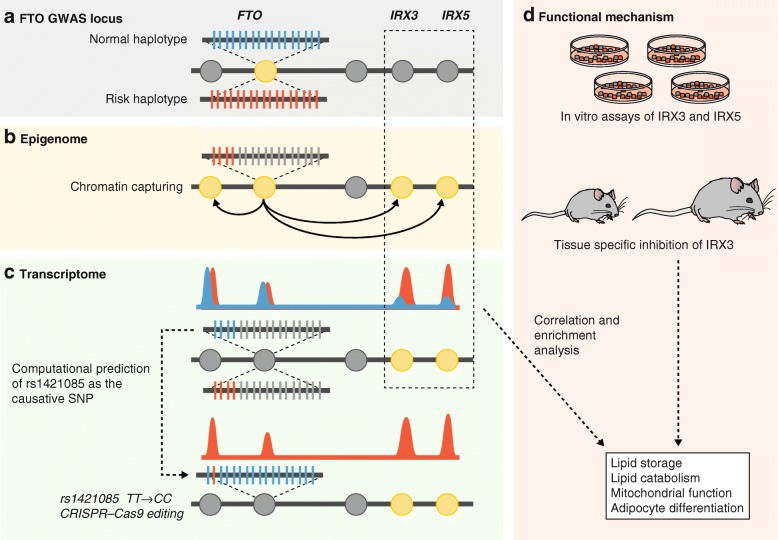
- Genome-first example: at the FTO obesity locus, chromatin maps across 127 cell types narrowed the region to an adipose-specific enhancer; IRX3 and IRX5 expression correlated with risk haplotype across 20 risk-allele and 18 non-risk-allele carriers, and CRISPR-Cas9 editing of rs1421085 implicated a single nucleotide variant disrupting ARID5B binding.
- Phenotype-first examples: in Alzheimer’s disease, profiling seven epigenetic modifications found AD-associated genetic variants enriched in immune-related enhancers but not promoters or neuronal-function enhancers; in cardiac arrhythmia, immunoprecipitation of five long QT proteins identified 584 co-precipitated proteins, with 12 genes overlapping 35 GWAS loci.
- Environment-first and population examples: 25 diets in over 800 mice showed macronutrient ratio effects on cardiometabolic health; about 100 inbred mouse strains were used to study high-fat/high-sucrose diet; 800 individuals were analyzed for personalized glycemic prediction; reference resources include METSIM (~10,000 Finnish men aged 45–65), MuTher (several hundred female twins), and UK Biobank (500,000 people).
Methods
- Narrative review, not a primary study; it describes genomics, epigenomics, transcriptomics, proteomics, metabolomics, and microbiomics technologies and their application to human disease.
- No primary data or sample collection; evidence comes from cited published studies and consortia, including Roadmap Epigenomics, GTEx, ENCODE, UK Biobank, MuTher, and METSIM.
- Synthesis organizes multi-omics integration into genome-first, phenotype-first, and environment-first approaches and discusses correlation/co-mapping, mediation and conditional analysis, network modeling, ID conversion, and future directions.
Limitations
- Paper-stated: human omics studies face confounding (e.g., diet, lifestyle), limited sample sizes/power, batch effects, lack of agreed gold-standard pipelines, and difficulty distinguishing causal from reactive changes; animal models have limitations including single genetic backgrounds and incomplete recapitulation of human complex disease.
- Paper-stated: standardization across studies is difficult (e.g., RNA-Seq comparability depends on genome version, annotation, and quantification tools), and coordinated consortia are needed for multi-scale data generation, analysis, and translation.
- Evident: as a review, it presents no new empirical results, does not perform a systematic search or meta-analysis, and its examples are selected to illustrate concepts rather than to quantify effects.
Model-written summary. Check it against the paper before relying on it.
Integrity signals
Registry
Cites
Statistics
Figures
Verification
Claims the paper makes
35 Valid · 11 Not valid · 16 Not checked · 33 Own results and interpretations
The cited sources support only part of this claim — read each source’s verdict below.
In the paper
“First, the loci that have been identified so far generally explain only a fraction of the heritable component for specific diseases.”
§ Multi-omics approaches to disease > Introduction
What the sources say
- Could not verifycites [1] LaFramboise T Single nucleotide polymorphism arrays: a decade of biological, computational and technological advances Nucleic Acids Res 2009 37 4181 93 10.1093/nar/gkp552 19570852 PMC2715261 sourceExperimental — accuracy not yet measured
The Introduction and the GWAS subsection discuss identifying variants associated with disease, but neither assesses how much disease heritability the identified loci explain. Searches for the claim’s wording, heritability, and explained genetic risk found no passage addressing that comparison; the indexed passages provide no page numbers. (LLM, conf=0.72)
- Partly supportedcites [2] Begum F Ghosh D Tseng GC Feingold E Comprehensive literature review and statistical considerations for GWAS meta-analysis Nucleic Acids Res 2012 40 3777 84 10.1093/nar/gkr1255 22241776 PMC3351172 sourceExperimental — accuracy not yet measured
The Introduction (page unavailable) says GWAS discoveries have been modest for many phenotypes and that typical effect sizes are small. It does not say what fraction of disease heritability the identified loci explain, so it supports the general idea of limited findings but not the claim’s specific heritability comparison. (LLM, conf=0.73)
- Supportedcites [3] Manolio TA Genomewide association studies and assessment of the risk of disease N Engl J Med 2010 363 166 76 10.1056/NEJMra0905980 20647212 source
The Challenges section states that genomewide association findings typically explain only a small proportion of disease heritability. The opening passage likewise says identified variants account for little heritability, supporting the claim's general wording. (LLM, conf=0.94)
plain- Asserted: passes — The authors put it forward as true.
- Checkable: passes — It can be checked against evidence.
- Load-bearing: passes — The paper’s conclusions depend on it.
- Based: passes — The paper gives a reason why it holds.
- Could not verify
The cited sources support only part of this claim — read each source’s verdict below.
In the paper
“Third, the same genetic variants often contribute to different final outcomes, depending on the environment and genetic background.”
§ Multi-omics approaches to disease > Introduction
What the sources say
- Could not verifycites [1] LaFramboise T Single nucleotide polymorphism arrays: a decade of biological, computational and technological advances Nucleic Acids Res 2009 37 4181 93 10.1093/nar/gkp552 19570852 PMC2715261 sourceExperimental — accuracy not yet measured
Our copy of LaFramboise (2009) is a technical review of SNP array platforms, genotyping algorithms, LD/phasing, GWAS design, germline CNV and somatic LOH; no passage states that a single variant can yield different outcomes depending on environment or genetic background. Searches for 'penetrance/phenotype/variable expression', 'environmental factors/genetic background/modifier genes', 'pleiotropy/epistasis/gene-environment interaction' returned only the INTRODUCTION (variants encode diversity and disease susceptibility), the GWAS section (associated variant as putative predisposition allele), the ancestry/population-stratification section and the reference list — none of which make the claim's point. Since our copy neither states nor contradicts it, the attribution cannot be checked here. (LLM, conf=0.68)
- Partly supportedcites [2] Begum F Ghosh D Tseng GC Feingold E Comprehensive literature review and statistical considerations for GWAS meta-analysis Nucleic Acids Res 2012 40 3777 84 10.1093/nar/gkr1255 22241776 PMC3351172 sourceExperimental — accuracy not yet measured
The GWAS META-ANALYSIS DATA AND METHODS section states that populations with different environmental backgrounds may have 'different genes ... relevant to the trait' (gene × environment interaction), and the Between-study heterogeneity / Case study sections note the same RNF212 variants act differently in males and females — so the environment-dependent modulation of genetic effects is in our copy. However, our copy nowhere says the SAME variants contribute to DIFFERENT final outcomes (pleiotropy), and it offers nothing on genetic background/epistasis as a modifier; the direction of its point is the reverse (different genes for one trait). The claim also states as a frequent fact ('often contribute') what the source hedges ('may be relevant', 'there may be gene × environment interaction'). (LLM, conf=0.65)
- Partly supportedcites [3] Manolio TA Genomewide association studies and assessment of the risk of disease N Engl J Med 2010 363 166 76 10.1056/NEJMra0905980 20647212 sourceExperimental — accuracy not yet measured
Our copy supports the first half of the claim: the Survey-of-Findings/Abstract section states that "genomewide association studies have identified loci that are shared by conditions previously thought to be unrelated (Table 2)," and Table 2 lists examples (CDKN2A/CDKN2B in coronary disease, type 2 diabetes and invasive melanoma; ORMDL3 in asthma and Crohn's disease; LRRK2 in Parkinson's disease and Crohn's disease; C10orf67 in sarcoidosis and celiac disease). What the source does NOT support is the conditional modifier "depending on the environment and genetic background": the Abstract and Glossary only say complex conditions arise from many genetic and environmental factors working together and list "interactions between genes or between genes and environmental factors" as candidate explanations for missing heritability, never as the reason a shared variant yields different outcomes. The word "often" is likewise not quantified in our copy. (LLM, conf=0.72)
plainstates a possible cause- Asserted: passes — The authors put it forward as true.
- Checkable: passes — It can be checked against evidence.
- Load-bearing: passes — The paper’s conclusions depend on it.
- Based: passes — The paper gives a reason why it holds.
- Could not verify
The cited sources that could be checked couldn’t confirm or dispute this claim.
In the paper
“Analyses of causal variants at GWAS loci focused originally on coding regions, but it has become clear that for many common diseases regulatory variation explains most of the risk burden [21].”
§ Multi-omics approaches to disease > Approaches to integrative analysis of multiple omics data > The genome first approach
What the sources say
- Could not verifycites [21] Wahl S Drong A Lehne B Loh M Scott WR Kunze S Epigenome-wide association study of body mass index and the adverse outcomes of adiposity Nature 2016 541 81 6 10.1038/nature20784 28002404 PMC5570525 sourceExperimental — accuracy not yet measured
Our copy of Wahl et al. (2017) is an epigenome-wide association study of BMI; it reports that the 187 adiposity-related methylation loci are enriched in active chromatin/cis-regulatory regions (DNase hypersensitivity sites, H3K4me1, H3K27ac) and link to cis-gene expression (Abstract, functional genomics section), and that candidate genes implicate regulatory pathways linking adiposity to metabolic, cardiovascular, respiratory and neoplastic disease (Abstract). However, no passage states or supports the general proposition that for many common diseases regulatory variation explains most of the risk burden, nor contrasts early causal-variant work in coding regions with regulatory mechanisms. Searched: 'regulatory variation explains most of the risk burden', 'GWAS loci mostly non-coding regulatory variants rather than coding variants disease risk', 'most disease-associated variants lie in non-coding regulatory regions rather than protein-coding exons', 'common variants conferring disease risk act through gene regulation' — nothing on the claimed point, and nothing contrary to it. (LLM, conf=0.70)
boostedstates a cause- Asserted: passes — The authors put it forward as true.
- Checkable: passes — It can be checked against evidence.
- Load-bearing: passes — The paper’s conclusions depend on it.
- Based: passes — The paper gives a reason why it holds.
- Could not verify
The cited sources support only part of this claim — read each source’s verdict below.
In the paper
“To identify differentially expressed genes between the cases and controls, the power provided by more samples is generally preferable to the increased accuracy provided by higher depth of sequencing.”
§ Multi-omics approaches to disease > Considerations for the design of omics studies > Downstream analysis, sample sizes, and power
What the sources say
- Partly supportedcites [7] Schurch NJ Schofield P Gierlinski M Cole C Sherstnev A Singh V How many biological replicates are needed in an RNA-seq experiment and which differential expression tool should you use? RNA 2016 22 839 51 10.1261/rna.053959.115 27022035 PMC4878611 sourceExperimental — accuracy not yet measured
The Introduction (page unavailable) says increasing biological replicates usually makes RNA-seq results more robust, and the Discussion (page unavailable) recommends at least 12 clean replicates per condition when identifying most differentially expressed genes is important. The paper does not compare adding samples with increasing sequencing depth, so it does not establish the claimed preference between them. (LLM, conf=0.85)
- Partly supportedcites [8] Conesa A Madrigal P Tarazona S Gomez-Cabrero D Cervera A McPherson A A survey of best practices for RNA-seq data analysis Genome Biol 2016 17 13 10.1186/s13059-016-0881-8 26813401 PMC4728800 sourceExperimental — accuracy not yet measured
Box 1 (Number of replicates; page unavailable) says that, after a certain sequencing depth, increasing the number of replicates is the better way to improve power. It does not establish that more samples are generally preferable: the same passage says deeper sequencing can improve power for low-expression genes and that the best trade-off depends on the experiment and budget. (LLM, conf=0.85)
- Partly supportedcites [9] Williams AG Thomas S Wyman SK Holloway AK RNA-seq data: challenges in and recommendations for experimental design and analysis Curr Protoc Hum Genet 2014 83 11.13.1 11.13.20 10.1002/0471142905.hg1113s83 25271838 PMC4230301 sourceExperimental — accuracy not yet measured
In “Simulated Differential Expression with Varying Numbers of Replicates and Sequence Depth” (page unavailable), the paper reports that more replicates can improve detection of differentially expressed genes, particularly when biological variance is high. It does not establish that adding samples is generally preferable to deeper sequencing: it also reports that substantial reductions in read depth sharply reduce detection power and recommends both a minimum number of replicates and a minimum sequencing depth. (LLM, conf=0.85)
plainstates a cause- Asserted: passes — The authors put it forward as true.
- Checkable: passes — It can be checked against evidence.
- Load-bearing: unclear — It is unclear whether the paper’s conclusions depend on it.
- Based: passes — The paper gives a reason why it holds.
- Partly supported
The cited sources support only part of this claim — read each source’s verdict below.
In the paper
“In large studies, some technical artifacts cannot be avoided, and in these cases it is crucial to understand to what extent those artifacts limit our ability to draw conclusions from observations”
§ Multi-omics approaches to disease > Considerations for the design of omics studies > Downstream analysis, sample sizes, and power
What the sources say
- Could not verifycites [10] Gilad Y Mizrahi-Man O A reanalysis of mouse ENCODE comparative gene expression data F1000Res 2015 4 121 26236466 PMC4516019 sourceExperimental — accuracy not yet measured
The Discussion identifies a sequencing batch effect and calls the Mouse ENCODE study design flawed, but does not say that technical artifacts are unavoidable in large studies. A search for unavoidable artifacts and large-study limitations found no passage making that point. (LLM, conf=0.72)
- Partly supportedcites [11] Peixoto L Risso D Poplawski SG Wimmer ME Speed TP Wood MA How data analysis affects power, reproducibility and biological insight of RNA-seq studies in complex datasets Nucleic Acids Res 2015 43 7664 74 10.1093/nar/gkv736 26202970 PMC4652761 sourceExperimental — accuracy not yet measured
The Introduction (page unavailable) says many sources of unwanted variation cannot be controlled in in-vivo brain gene-expression studies. The Discussion (page unavailable) also describes batch effects and artifacts when integrating RNA-seq data across laboratories. The paper does not establish that technical artifacts are unavoidable in large studies generally. (LLM, conf=0.82)
- Partly supportedcites [12] SEQC/MAQC-III Consortium A comprehensive assessment of RNA-seq accuracy, reproducibility and information content by the Sequencing Quality Control Consortium Nat Biotechnol 2014 32 903 14 10.1038/nbt.2957 25150838 PMC4321899 sourceExperimental — accuracy not yet measured
The Discussion (page unavailable) identifies GC bias, sequence bias and non-specific signal as sources of unwanted or missed differential-expression calls in this multi-site study. It supports the presence and consequences of technical artifacts, but does not say that some artifacts cannot be avoided in large studies. (LLM, conf=0.78)
- Partly supportedcites [13] Hartley SW Mullikin JC QoRTs: a comprehensive toolset for quality control and data processing of RNA-Seq experiments BMC Bioinformatics 2015 16 224 10.1186/s12859-015-0670-5 26187896 PMC4506620 sourceExperimental — accuracy not yet measured
The Background says RNA-Seq is prone to artifacts and that some biases are inherent; the Implementation section says such issues can call results into question. The paper does not establish that technical artifacts are unavoidable specifically in large studies, and it notes that many biases can be accounted for or corrected. The indexed passages provide section labels but no page numbers. (LLM, conf=0.83)
plain- Asserted: passes — The authors put it forward as true.
- Checkable: passes — It can be checked against evidence.
- Load-bearing: unclear — It is unclear whether the paper’s conclusions depend on it.
- Based: passes — The paper gives a reason why it holds.
- Could not verify
49 more claims · 25 with their cited sources checked
Create a free account to see all 95 claims and to verify the 30 references still open.
- It may state two separate claims as one. 26
- Probably not a substantial claim. 20
- The quote only partly states this claim. 1
Claims other papers make about this one
Each is checked against this paper’s own text: does it say what the citing paper says it does?
The source backs part of the claim, not all of it — or backs it for a different population, condition or comparison.
In the citing paper
“In summary, by using new technologies, “omic” analysis and “big data”-integration of data from different platforms in a system biology approach-bias will be reduced and understanding of molecular mechanisms will be deepened (317).”
From Epigenetic Modifications in Stress Response Genes Associated With Childhood Trauma (2019) · cites this paper as [317]
Experimental — accuracy not yet measuredThe source backs part of the claim, not all of it — or backs it for a different population, condition or comparison.
In the citing paper
“Currently, many of the multi-omic reviews are focussed on individual sub-topics.For example, designing studies (Haas et al., 2017;Hasin et al., 2017), setting up workflows (Kohl et al., 2014), choosing software tools (Misra et al., 2019) and evaluating overfitted performance (McCabe et al., 2020).”
From Using machine learning approaches for multi-omics data analysis: A review (2021) · cites this paper as Hasin et al., 2017
Experimental — accuracy not yet measured
Self-check
Percentages, sums and reported differences re-computed from the paper’s own numbers.
Each contradiction between two passages listed here was confirmed by an independent check.
Rated minor: it would not touch a result — a value no result rests on, a p-value that stays on the same side of the significance level, or a conflict that is clerical, resolved elsewhere in the paper, or outside its own findings.
In the paper
§ Multi-omics approaches to disease > Approaches to integrative analysis of multiple omics data > The genome first approach
“Claussnitzer and colleagues confirmed the roles of IRX2 and IRX5 using experimental manipulation in primary adipocytes and in mice.”
§ Multi-omics approaches to disease > Approaches to integrative analysis of multiple omics data > The genome first approach
“c Transcriptomics: this technique was used to identify which of the candidate genes are differentially expressed between the risk and normal haplotypes, identifying IRX3 and IRX5 as the likely downstream targets.”
Citations
Cites
QIIME allows analysis of high-throughput community sequencing data
Caporaso, J. G., Kuczynski, J., Stombaugh, J., Bittinger, K., Bushman, F. D., Costello, E. K., Fierer, N., Peña, A. G., Goodrich, J. K., Gordon, J. I., et al. (2010) · Nature Methods · doi:10.1038/nmeth.f.303 · Cited by 34,887 · cited 1×
“Several analytic tools have been developed for analyzing NGS data from targeted 16S or metagenomics analysis, such as QIIME (quantitative insights into microbial ecology) [167].”
MethodAn integrated encyclopedia of DNA elements in the human genome
The ENCODE Project Consortium (2012) · Nature · doi:10.1038/nature11247 · Cited by 18,072
Trapnell, C., Williams, B. A., Pertea, G., Mortazavi, A., Kwan, G., van Baren, M. J., Salzberg, S. L., Wold, B. J., & Pachter, L. (2010) · Nature Biotechnology · doi:10.1038/nbt.1621 · Cited by 15,556
Tissue-based map of the human proteome
Uhlén, M., Fagerberg, L., Hallström, B. M., Lindskog, C., Oksvold, P., Mardinoglu, A., Sivertsson, Å., Kampf, C., Sjöstedt, E., Asplund, A., et al. (2015) · Science · doi:10.1126/science.1260419 · Cited by 15,286
RNA-Seq: a revolutionary tool for transcriptomics
Wang, Z., Gerstein, M., & Snyder, M. (2009) · Nature Reviews Genetics · doi:10.1038/nrg2484 · Cited by 13,174 · cited 6×
“Thus, transcriptomics, employing either expression arrays or RNA-Seq (Box 1), has proven to be particularly useful for identifying causal genes at GWAS loci [16, 22–24].”
BackgroundInfluentialSudlow, C., Gallacher, J., Allen, N., Beral, V., Burton, P., Danesh, J., Downey, P., Elliott, P., Green, J., Landray, M., et al. (2015) · PLOS Medicine · doi:10.1371/journal.pmed.1001779 · Cited by 12,728 · cited 1×
“The UK biobank [15] collects samples and physiologic measures and follows 500,000 people with respect to their activity.”
BackgroundKlindworth, A., Pruesse, E., Schweer, T., Peplies, J., Quast, C., Horn, M., & Glöckner, F. O. (2013) · Nucleic Acids Research · doi:10.1093/nar/gks808 · Cited by 8,850
Human gut microbes associated with obesity
Ley, R. E., Turnbaugh, P. J., Klein, S., & Gordon, J. I. (2006) · Nature · doi:10.1038/4441022a · Cited by 8,785 · cited 1×
“The microbiome has been shown to alter many aspects of host physiology, from obesity [86, 87] to cognition [88].”
BackgroundDNA methylation age of human tissues and cell types
Horvath, S. (2013) · Genome Biology · doi:10.1186/gb-2013-14-10-r115 · Cited by 7,075 · cited 1×
“For example, differentially methylated regions of DNA can be used as indicators of disease status for metabolic syndrome [124, 125], cardiovascular disease [126], cancer [127], and many other pathophysiologic states [128].”
BackgroundNewman, M. (2010) · doi:10.1093/acprof:oso/9780199206650.001.0001 · Cited by 6,595
Cited by
Items 301–400 of 1,008
Type 2 Diabetes Mellitus: Integrative Analysis of Multiomics Data for Biomarker Discovery
Ge, S., Wang, Y., Song, M., Li, X., Yu, X., Wang, H., Wang, J., Zeng, Q., & Wang, W. (2018) · OMICS A Journal of Integrative Biology · doi:10.1089/omi.2018.0053 · Cited by 60
Using OmicsNet for Network Integration and 3D Visualization
Zhou, G., & Xia, J. (2018) · Current Protocols in Bioinformatics · doi:10.1002/cpbi.69 · Cited by 61
Preterm neonatal immunology at the intestinal interface
Belkum, M. V., Alvarez, L. M., & Neu, J. (2019) · Cellular and Molecular Life Sciences · doi:10.1007/s00018-019-03316-w · Cited by 71
La Cognata, V., Morello, G., & Cavallaro, S. (2021) · International Journal of Molecular Sciences · doi:10.3390/ijms22094820 · Cited by 54
The unmet potential of artificial intelligence in veterinary medicine
Basran, P. S., & Appleby, R. B. (2022) · American Journal of Veterinary Research · doi:10.2460/ajvr.22.03.0038 · Cited by 68
Bioprospecting of microbial enzymes: current trends in industry and healthcare
Tatta, E. R., Imchen, M., Moopantakath, J., & Kumavath, R. (2022) · Applied Microbiology and Biotechnology · doi:10.1007/s00253-022-11859-5 · Cited by 63
Advances in Prostate Cancer Biomarkers and Probes
Li, K., Wang, Q., Tang, X., Akakuru, O. U., Li, R., Wang, Y., Zhang, R., Jiang, Z., & Yang, Z. (2024) · Cyborg and Bionic Systems · doi:10.34133/cbsystems.0129 · Cited by 57
Mapping cancer biology in space: applications and perspectives on spatial omics for oncology
Lee, S., Kim, G., Lee, J., Lee, A. C., & Kwon, S. (2024) · Molecular Cancer · doi:10.1186/s12943-024-01941-z · Cited by 61
Multiomic analyses uncover immunological signatures in acute and chronic coronary syndromes
Pekayvaz, K., Losert, C., Knottenberg, V., Gold, C., van Blokland, I. V., Oelen, R., Groot, H. E., Benjamins, J. W., Brambs, S., Kaiser, R. W. J., et al. (2024) · Nature Medicine · doi:10.1038/s41591-024-02953-4 · Cited by 68
Genome-scale models in human metabologenomics
Mardinoglu, A., & Palsson, B. Ø. (2025) · Nature Reviews Genetics · doi:10.1038/s41576-024-00768-0 · Cited by 54
Integrative Multi-Omics and Artificial Intelligence: A New Paradigm for Systems Biology
Kant, S., Deepika, & Roy, S. (2025) · OMICS A Journal of Integrative Biology · doi:10.1177/15578100251392371 · Cited by 75
Deciphering the Ecology of Cystic Fibrosis Bacterial Communities: Towards Systems-Level Integration
Bevivino, A., Bacci, G., Dřevínek, P., Nelson, M. T., Hoffman, L. R., & Mengoni, A. (2019) · Trends in Molecular Medicine · doi:10.1016/j.molmed.2019.07.008 · Cited by 67
Qiu, C., Yu, F., Su, K., Zhao, Q., Zhang, L., Xu, C., Hu, W., Wang, Z., Zhao, L., Tian, Q., et al. (2020) · iScience · doi:10.1016/j.isci.2020.100847 · Cited by 69
Metabolomic Biomarkers for Detection, Prognosis and Identifying Recurrence in Endometrial Cancer
Njoku, K., Sutton, C. J. J., Whetton, A. D., & Crosbie, E. J. (2020) · Metabolites · doi:10.3390/metabo10080314 · Cited by 64
Lytrivi, M., Ghaddar, K., Lopes, M., Rosengren, V., Piron, A., Yi, X., Johansson, H. J., Lehtiö, J., Igoillo‐Esteve, M., Cunha, D. A., et al. (2020) · BMC Genomics · doi:10.1186/s12864-020-07003-0 · Cited by 61
Systems biology of angiogenesis signaling: Computational models and omics
Zhang, Y., Wang, H., Oliveira, R. H. D. M., Zhao, C., & Popel, A. S. (2021) · WIREs Mechanisms of Disease · doi:10.1002/wsbm.1550 · Cited by 60
Nanopore approaches for single-molecule temporal omics: promises and challenges
Li, M., Jiang, J., Li, J., Niu, H., Ying, Y., Tian, R., & Long, Y. (2024) · Nature Methods · doi:10.1038/s41592-024-02492-3 · Cited by 64
Roh, H., Kim, A., Kim, N., Lee, Y., & Kim, D. (2020) · International Journal of Molecular Sciences · doi:10.3390/ijms21239198 · Cited by 56
Asrani, P., Hasan, G. M., Sohal, S. S., & Hassan, M. I. (2020) · OMICS A Journal of Integrative Biology · doi:10.1089/omi.2020.0131 · Cited by 59
Yin, K., Chen, T., Gu, X., Su, W., Jiang, Z., Lu, S., Cao, B., Chi, L., Gao, X., & Chen, Y. (2024) · Journal of Cachexia Sarcopenia and Muscle · doi:10.1002/jcsm.13479 · Cited by 59
Application of multi-omics in the study of traditional Chinese medicine
Zhao, M., Che, Y., Gao, Y., & Zhang, X. (2024) · Frontiers in Pharmacology · doi:10.3389/fphar.2024.1431862 · Cited by 88
Approximate Graph Laplacians for Multimodal Data Clustering
Khan, A., & Maji, P. (2019) · IEEE Transactions on Pattern Analysis and Machine Intelligence · doi:10.1109/tpami.2019.2945574 · Cited by 54
Kuo, E. Y., Yang, R., Chin, Y. Y., Chien, Y., Chen, Y. C., Wei, C., Kao, L., Chang, Y., Li, Y., Chen, T., et al. (2022) · Biotechnology Journal · doi:10.1002/biot.202100603 · Cited by 51
Infrared molecular fingerprinting of blood-based liquid biopsies for the detection of cancer
Huber, M., Kepesidis, K. V., Voronina, L., Fleischmann, F., Fill, E. E., Hermann, J., Koch, I., Milger, K., Kolben, T., Schulz, G. B., et al. (2021) · eLife · doi:10.7554/elife.68758 · Cited by 59
Association between Human Blood Metabolome and the Risk of Alzheimer's Disease
Sun, L., Guo, D., Jia, Y., Shi, M., Yang, P., Wang, Y., Liu, F., Chen, G., Zhang, Y., & Zhu, Z. (2022) · Annals of Neurology · doi:10.1002/ana.26464 · Cited by 65
Omics technologies to understand drug toxicity mechanisms
Nguyen, N., Jennen, D. G. J., & Kleinjans, J. C. S. (2022) · Drug Discovery Today · doi:10.1016/j.drudis.2022.103348 · Cited by 52
Machine learning for the advancement of genome-scale metabolic modeling
Kundu, P., Beura, S., Mondal, S., Das, A. K., & Ghosh, A. (2024) · Biotechnology Advances · doi:10.1016/j.biotechadv.2024.108400 · Cited by 57
Gender-related metabolomics and lipidomics: From experimental animal models to clinical evidence
Audano, M., Maldini, M., Fabiani, E. D., Mitro, N., & Caruso, D. (2017) · Journal of Proteomics · doi:10.1016/j.jprot.2017.11.001 · Cited by 59
Dong, Y. H., Qiu, P., Zhao, L., Zhang, P., Huang, X., Li, C., Chai, K., & Shou, D. (2018) · Phytomedicine · doi:10.1016/j.phymed.2018.09.232 · Cited by 56
Endometriosis research in the -omics era
Goulielmos, G. N., Matalliotakis, M., Matalliotaki, C., Eliopoulos, E., Matalliotakis, I., & Zervou, M. I. (2020) · Gene · doi:10.1016/j.gene.2020.144545 · Cited by 62
Recent advances in crustacean genomics and their potential application in aquaculture
Yuan, J., Yu, Y., Zhang, X., Li, S., Xiang, J., & Li, F. (2023) · Reviews in Aquaculture · doi:10.1111/raq.12791 · Cited by 55
Mohapatra, M., Sahu, C., & Mohapatra, S. (2024) · Current Drug Targets · doi:10.2174/0113894501322734241008163304 · Cited by 61
Systems Biology, Systems Medicine, Systems Pharmacology: The What and The Why
Stéphanou, A., Fanchon, E., Innominato, P. F., & Ballesta, A. (2018) · Acta Biotheoretica · doi:10.1007/s10441-018-9330-2 · Cited by 50
“…time points and several disease relevant tissues, have the potential to uncover molecular processes involved in the 1 3 Systems Biology, Systems Medicine, Systems Pharmacology:… development of diseases, and distinguish those that are causal from others which are consequences (Hasin et al. 2017).”
BackgroundPan, T., Li, C., Bi, Y., Wang, Z., Gasser, R. B., Purcell, A. W., Akutsu, T., Webb, G. I., Imoto, S., & Song, J. (2023) · Bioinformatics · doi:10.1093/bioinformatics/btad094 · Cited by 48
Unveiling heterogeneity in MSCs: exploring marker-based strategies for defining MSC subpopulations
Chen, S., Liang, B., & Xu, J. (2024) · Journal of Translational Medicine · doi:10.1186/s12967-024-05294-5 · Cited by 64
Integrating multi-omics data: Methods and applications in human complex diseases
Sibilio, P., Smaele, E. D., Paci, P., & Conte, F. (2025) · Biotechnology Reports · doi:10.1016/j.btre.2025.e00938 · Cited by 80
Liu, X. F., Tao, Y., Cai, Z., Bao, P., Ma, H., Li, K., Li, M., Zhu, Y., & Lu, Z. J. (2024) · Bioinformatics · doi:10.1093/bioinformatics/btae316 · Cited by 73
Channon, L. M., Tyma, V. M., Xu, Z., Greening, D. W., Wilson, J. S., Perera, C. J., & Apte, M. V. (2022) · Biochimica et Biophysica Acta (BBA) - Reviews on Cancer · doi:10.1016/j.bbcan.2022.188728 · Cited by 51
Quantum computing algorithms: getting closer to critical problems in computational biology
Marchetti, L., Nifosì, R., Martelli, P. L., Da Pozzo, E., Cappello, V., Banterle, F., Trincavelli, M. L., Martini, C., & D’Elia, M. (2022) · Briefings in Bioinformatics · doi:10.1093/bib/bbac437 · Cited by 47
“Overall, this bulk of information can be used for several purposes, among which understanding the causes of disease susceptibility, especially in those cases in which the aetiology is multifactorial, of individual responses to drugs and possibly predicting the individual prognosis during a therapeutic treatment [29].”
BackgroundProfiling Chromatin Accessibility at Single-Cell Resolution
Sinha, S., Satpathy, A. T., Zhou, W., Ji, H., Stratton, J. A., Jaffer, A., Bahlis, N. J., Morrissy, A. S., & Biernaskie, J. A. (2021) · Genomics Proteomics & Bioinformatics · doi:10.1016/j.gpb.2020.06.010 · Cited by 50
Qiao, J., & Cui, L. (2022) · Frontiers in Immunology · doi:10.3389/fimmu.2022.905601 · Cited by 53
Tang, S., Yuan, K., & Chen, L. (2022) · Fundamental Research · doi:10.1016/j.fmre.2022.07.011 · Cited by 61
Jeffery, N. D., & Granger, N. P. (2023) · Frontiers in Veterinary Science · doi:10.3389/fvets.2023.1114798 · Cited by 62
Popejoy, A. B. (2019) · Pharmacogenomics and Personalized Medicine · doi:10.2147/pgpm.s179742 · Cited by 60
iNetModels 2.0: an interactive visualization and database of multi-omics data
Arif, M., Zhang, C., Li, X., Güngör, C., Çakmak, B., Arslantürk, M., Tebani, A., Özcan, B., Subaş, O., Zhou, W., et al. (2021) · Nucleic Acids Research · doi:10.1093/nar/gkab254 · Cited by 48
Diabetes and Heart Failure: Multi-Omics Approaches
Tayanloo-Beik, A., Roudsari, P. P., Rezaei–Tavirani, M., Biglar, M., Tabatabaei‐Malazy, O., Arjmand, B., & Larijani, B. A. (2021) · Frontiers in Physiology · doi:10.3389/fphys.2021.705424 · Cited by 48
Mohammed, M. A., Lakhan, A. R., Abdulkareem, K. H., & García-Zapirain, B. (2023) · Computers in Biology and Medicine · doi:10.1016/j.compbiomed.2023.106617 · Cited by 55
Leveraging transcriptomics for precision diagnosis: Lessons learned from cancer and sepsis
Tsakiroglou, M., Evans, A. G., & Pirmohamed, M. (2023) · Frontiers in Genetics · doi:10.3389/fgene.2023.1100352 · Cited by 55
Multi-omics based artificial intelligence for cancer research
Li, L., Sun, M., Wang, J., & Wan, S. (2024) · Advances in cancer research · doi:10.1016/bs.acr.2024.06.005 · Cited by 58
Mallik, S., & Zhao, Z. (2019) · Briefings in Bioinformatics · doi:10.1093/bib/bby120 · Cited by 55
Ramanathan, S., Douglas, S. R., Alexander, G. M., Shenoda, B. B., Barrett, J. E., Aradillas, E., Saçan, A., & Ajit, S. K. (2019) · Journal of Translational Medicine · doi:10.1186/s12967-019-1833-3 · Cited by 52
Zheng, Y., Guo, Z., Zhang, Y., Shang, J., Yu, L., Fu, P., Liu, Y., Li, X., Wang, H., Ren, L., et al. (2022) · The EPMA Journal · doi:10.1007/s13167-022-00283-4 · Cited by 48
Kumar, V., Singh, K. K., Shah, M. P., Singh, A. K., Kumar, A. M., & Kumar, Y. (2021) · Elsevier eBooks · doi:10.1016/b978-0-12-821881-5.00001-5 · Cited by 45
Chisari, E., Cho, J., Wouthuyzen‐Bakker, M., & Parvizi, J. (2022) · The Journal of Arthroplasty · doi:10.1016/j.arth.2022.03.030 · Cited by 50
Donovan, S. M., Aghaeepour, N., Andres, A., Azad, M. B., Becker, M., Carlson, S. E., Järvinen, K. M., Lin, W., Lönnerdal, B. L., Slupsky, C. M., et al. (2023) · American Journal of Clinical Nutrition · doi:10.1016/j.ajcnut.2022.12.021 · Cited by 56
Multi-omics integration and epilepsy: Towards a better understanding of biological mechanisms
Chong, D., Jones, N. C., Schittenhelm, R. B., Anderson, A., & Casillas-Espinosa, P. M. (2023) · Progress in Neurobiology · doi:10.1016/j.pneurobio.2023.102480 · Cited by 52
Assessing inorganic nanoparticle toxicity through omics approaches
Li, Y., Vulpe, C. D., Lammers, T., & Pallares, R. M. (2024) · Nanoscale · doi:10.1039/d4nr02328e · Cited by 51
Scala, G., Kinaret, P., Marwah, V. S., Sund, J., Fortino, V., & Greco, D. (2018) · NanoImpact · doi:10.1016/j.impact.2018.05.003 · Cited by 51
New medical big data for P4 medicine on allergic conjunctivitis
Inomata, T., Sung, J., Nakamura, M., Fujisawa, K., Muto, K., Ebihara, N., Iwagami, M., Nakamura, M., Fujio, K., Okumura, Y., et al. (2020) · Allergology International · doi:10.1016/j.alit.2020.06.001 · Cited by 46
Aging and cancer epigenetics: Where do the paths fork?
Pérez, R. F., Tejedor, J. R., Fernández, A. F., & Fraga, M. F. (2022) · Aging Cell · doi:10.1111/acel.13709 · Cited by 44
Mass Spectrometry–Based Proteomics of Epithelial Ovarian Cancers: A Clinical Perspective
Qian, L., Sun, R., Xue, Z., & Guo, T. (2023) · Molecular & Cellular Proteomics · doi:10.1016/j.mcpro.2023.100578 · Cited by 54
Yan, H. H., Weng, D., Li, D., Gu, Y., Ma, W., & Liu, Q. (2024) · Briefings in Bioinformatics · doi:10.1093/bib/bbae184 · Cited by 57
Stolfi, F., Abreu, H., Sinella, R., Nembrini, S., Centonze, S., Landra, V., Brasso, C., Cappellano, G., Rocca, P., & Chiocchetti, A. (2024) · Frontiers in Psychiatry · doi:10.3389/fpsyt.2024.1422939 · Cited by 64
Rashid, M. M., & Selvarajoo, K. (2024) · Briefings in Bioinformatics · doi:10.1093/bib/bbae300 · Cited by 55
Qiao, L., Khalilimeybodi, A., Linden-Santangeli, N. J., & Rangamani, P. (2025) · Annual Review of Biomedical Engineering · doi:10.1146/annurev-bioeng-102723-065309 · Cited by 62
Khan, S. N., Danishuddin, Khan, M. W. A., Guarnera, L., & Akhtar, S. M. F. (2026) · Frontiers in Artificial Intelligence · doi:10.3389/frai.2025.1743921 · Cited by 80
Liang, Y., Zhu, Y., Dou, M., Xu, K., Chu, R., Chrisler, W., Zhao, R., Hixson, K. K., & Kelly, R. (2018) · Analytical Chemistry · doi:10.1021/acs.analchem.8b03005 · Cited by 48
STATegra: Multi-Omics Data Integration – A Conceptual Scheme With a Bioinformatics Pipeline
Planell, N., Lagani, V., Sebastián-León, P., van der Kloet, F. M., Ewing, E., Karathanasis, N., Urdangarin, A., Arozarena, I., Jagodic, M., Tsamardinos, I., et al. (2021) · Frontiers in Genetics · doi:10.3389/fgene.2021.620453 · Cited by 51
The promise of graphene-based transistors for democratizing multiomics studies
Lu, H., Kane, A. A., Parkinson, J., Gao, Y., Hajian, R., Heltzen, M., Goldsmith, B. R., & Aran, K. (2021) · Biosensors and Bioelectronics · doi:10.1016/j.bios.2021.113605 · Cited by 45
Wang, X., Wang, M., Wang, L., Feng, H., He, X., Chang, S., Wang, D., Wang, L., Yang, J., An, G., et al. (2022) · Plant Biotechnology Journal · doi:10.1111/pbi.13896 · Cited by 46
PROMO: an interactive tool for analyzing clinically-labeled multi-omic cancer datasets
Netanely, D., Stern, N., Laufer, I., & Ron Shamir, A. (2019) · BMC Bioinformatics · doi:10.1186/s12859-019-3142-5 · Cited by 43
Precision medicine journey through omics approach
Hasanzad, M., Sarhangi, N., Chimeh, S. E., Ayati, N., Afzali, M., Khatami, F., Nikfar, S., & Meybodi, H. R. A. (2021) · Journal of Diabetes & Metabolic Disorders · doi:10.1007/s40200-021-00913-0 · Cited by 54
Understanding treatment-resistant depression using “omics” techniques: A systematic review
Amasi-Hartoonian, N., Pariante, C. M., Cattaneo, A., & Sforzini, L. (2022) · Journal of Affective Disorders · doi:10.1016/j.jad.2022.09.011 · Cited by 48
Higginbotham, L. A., Carter, E. K., Dammer, E. B., Haque, R. U., Johnson, E. C. B., Duong, D. M., Yin, L., Jager, P. L. D., Bennett, D. A., Felsky, D., et al. (2023) · Neurobiology of Disease · doi:10.1016/j.nbd.2023.106286 · Cited by 43
Tuly, J. A., & Ma, H. (2024) · Trends in Food Science & Technology · doi:10.1016/j.tifs.2024.104391 · Cited by 47
Technology and Future of Multi-Cancer Early Detection
Milner, D. A., & Lennerz, J. K. (2024) · Life · doi:10.3390/life14070833 · Cited by 50
Organic quantum dots: An ultrasmall nanoplatform for cancer theranostics
Dhas, N. L., Pastagia, M., Sharma, A., Khera, A., Kudarha, R. R., Kulkarni, S., Soman, S., Mutalik, S., Barnwal, R. P., Singh, G., et al. (2022) · Journal of Controlled Release · doi:10.1016/j.jconrel.2022.06.033 · Cited by 44
Shokhirev, M. N., & Johnson, A. A. (2022) · Ageing Research Reviews · doi:10.1016/j.arr.2022.101721 · Cited by 42
Artificial intelligence to predict outcomes of head and neck radiotherapy
Bang, C., Bernard, G., Le, W., Lalonde, A., Kadoury, S., & Bahig, H. (2023) · Clinical and Translational Radiation Oncology · doi:10.1016/j.ctro.2023.100590 · Cited by 58
Papachristou, N., Kotronoulas, G., Δικαίος, Ν., Allison, S. J., Eleftherochorinou, H., Rai, T., Kunz, H. R., Barnaghi, P. M., Miaskowski, C. A., & Bamidis, P. D. (2023) · Seminars in Oncology Nursing · doi:10.1016/j.soncn.2023.151433 · Cited by 58
Karpov, O. A., Stotland, A. B., Raedschelders, K., Chazarin, B., Ai, L., Murray, C. I., & Eyk, J. E. V. (2024) · Physiological Reviews · doi:10.1152/physrev.00026.2023 · Cited by 47
Lin, Y., Li, H. R., Zheng, S., Han, R., Wu, K., Tang, S., Zhong, X., & Chen, J. (2024) · Ecotoxicology and Environmental Safety · doi:10.1016/j.ecoenv.2024.117343 · Cited by 44
Identifying Molecular Biomarkers for Diseases With Machine Learning Based on Integrative Omics
Shi, K., Lin, W. J., & Zhao, X. (2020) · IEEE Transactions on Computational Biology and Bioinformatics · doi:10.1109/tcbb.2020.2986387 · Cited by 49
Precision Medicine for Obesity
Cifuentes, L., Hurtado, M. D., Eckel‐Passow, J. E., & Acosta, A. J. (2021) · Digestive Disease Interventions · doi:10.1055/s-0041-1729945 · Cited by 50
Neuroimmunometabolism: A New Pathological Nexus Underlying Neurodegenerative Disorders
Mitra, S., Banik, A., Saurabh, S., Maulik, M., & Khatri, S. (2022) · Journal of Neuroscience · doi:10.1523/jneurosci.0998-21.2022 · Cited by 50
Yang, W., Guo, T., Luo, J., Zhang, R., Zhao, J., Warburton, M. L., Xiao, Y., & Yan, J. (2022) · Genome biology · doi:10.1186/s13059-022-02650-w · Cited by 45
Using Artificial Intelligence to Better Predict and Develop Biomarkers
Michelhaugh, S. A., & Januzzi, J. L. (2022) · Heart Failure Clinics · doi:10.1016/j.hfc.2021.11.004 · Cited by 46
Proteomics: An In‐Depth Review on Recent Technical Advances and Their Applications in Biomedicine
Liang, J., Tian, J., Zhang, H., Li, H., & Chen, L. (2025) · Medicinal Research Reviews · doi:10.1002/med.22098 · Cited by 46
Advances of Single-Cell Protein Analysis
Liu, L., Chen, D., Wang, J., & Chen, J. (2020) · Cells · doi:10.3390/cells9051271 · Cited by 43
Feature Selection Methods for Protein Biomarker Discovery from Proteomics or Multiomics Data
Shi, Z., Wen, B., Gao, Q., & Zhang, B. (2021) · Molecular & Cellular Proteomics · doi:10.1016/j.mcpro.2021.100083 · Cited by 49
Li, J., Wang, Y., & Suh, J. H. (2022) · Food Science and Human Wellness · doi:10.1016/j.fshw.2021.12.010 · Cited by 48
Huang, X., Luu, L. D. W., Jia, N., Zhu, J., Fu, J., Xiao, F., Liu, C., Li, S., Shu, G., Hou, J., et al. (2022) · Frontiers in Immunology · doi:10.3389/fimmu.2022.833699 · Cited by 42
Meta‐analysis of caries microbiome studies can improve upon disease prediction outcomes
Butcher, M. C., Short, B., Veena, C. L. R., Bradshaw, D., Pratten, J. R., McLean, W., Shaban, S. M. A., Ramage, G., & Delaney, C. (2022) · Apmis · doi:10.1111/apm.13272 · Cited by 42
Spatial Multiomics of Lipids, N-Glycans, and Tryptic Peptides on a Single FFPE Tissue Section
Denti, V., Capitoli, G., Piga, I., Clerici, F., Pagani, L., Criscuolo, L., Bindi, G., Principi, L., Chinello, C., Paglia, G., et al. (2022) · Journal of Proteome Research · doi:10.1021/acs.jproteome.2c00601 · Cited by 49
Clark, C., Rabl, M., Dayon, L., & Popp, J. (2022) · Frontiers in Aging Neuroscience · doi:10.3389/fnagi.2022.1065904 · Cited by 50
Wang, J., Tian, Q., Zhou, H., Kang, J., Yu, X., & Shen, L. (2023) · Bioresource Technology · doi:10.1016/j.biortech.2023.129718 · Cited by 43
Progress and challenges in exploring aquatic microbial communities using non-targeted metabolomics
Thukral, M., Allen, A. E., & Petras, D. (2023) · The ISME Journal · doi:10.1038/s41396-023-01532-8 · Cited by 47
Fawaz, A., Ferraresi, A., & Isidoro, C. (2023) · Journal of Personalized Medicine · doi:10.3390/jpm13111590 · Cited by 54
Wu, J., Chen, Z., Xiao, S., Liu, G., Wu, W., & Wang, S. (2024) · BMC Genomics · doi:10.1186/s12864-024-11112-5 · Cited by 57
Isaic, A., Motofelea, N., Hoinoiu, T., Motofelea, A. C., Leancu, I. C., Stan, E., Gheorghe, S. R., Duţu, A., & Crintea, A. (2025) · Diagnostics · doi:10.3390/diagnostics15192425 · Cited by 58
Metadata
- Authors
- Hasin, Y., Seldin, M., & Lusis, A.
- Affiliations
- University of California, Los Angeles (US)
- Corresponding author
- Lusis, Aldons
- Venue
- Genome Biology
- Published
- 2017-05-05
- Volume
- 18
- Issue
- 1
- Pages
- 83-83
- ISSN
- 1465-6906 (ISSN-L)
- 1474-760X
- PMC
- PMC5418815
- OpenAlex
- W2611138580
- Semantic Scholar
- 7710b482b5956665598c0b8ca4c2cb37555287aa
- Cited by
- 2,953
- References
- 186
- Citations by year
- 2026: 650 · 2025: 467 · 2024: 395 · 2023: 328 · 2022: 315 · 2021: 317 · 2020: 225 · 2019: 152 · 2018: 84 · 2017: 18
- FWCI
- 12.26
- Type
- journal article
- Language
- en
- Open access
- gold
- doi.org
- Licence
- cc-by
- creativecommons.org/licenses/by/4.0/ (tdm)
- creativecommons.org/licenses/by/4.0/ (vor)
- Locations
- Genome biology (publishedVersion, cc-by)
- PubMed Central (publishedVersion, cc-by)
- PubMed (publishedVersion)
- DOAJ (DOAJ: Directory of Open Access Journals) (submittedVersion)
- eScholarship (California Digital Library) (submittedVersion, cc-by)
- Funders
- National Institutes of Health (HL114437, HL28481)
- Topics
- Life Sciences › Biochemistry, Genetics and Molecular Biology › Molecular Biology › Bioinformatics and Genomic Networks
- Life Sciences › Biochemistry, Genetics and Molecular Biology › Genetics › Genetic Associations and Epidemiology
- Physical Sciences › Environmental Science › Health, Toxicology and Mutagenesis › Health, Environment, Cognitive Aging
- Keywords
- multi-omics integration, omics technologies, proteomics, metabolomics, transcriptomics, genomics, disease mechanisms
- MeSH terms
- Humans, Computational Biology, Genetic Predisposition to Disease, Genome-Wide Association Study, Datasets as Topic
About these checks
Registry, retraction, Cites and statistics results are computed, not judged, with one exception: a printed reference that no index lists is read once by a model before it counts as a citation error. Claims are extracted by a model and kept only when their quote appears verbatim in the text; each cited source is then checked, with a model’s help, for whether it says what the claim relies on. Those verdicts can be wrong — read the claim’s quote and the cited source before relying on one.
The claim verdicts this report counts are experimental: their accuracy is not yet measured.
A language model drew the claims from the paper on 2026-10-05, under version 3 of the claim definition (model deepseek-v4.1-flash, prompt extract-v3).
A second model labelled each claim on 2026-10-05 (model jev-1.13-20260917, definition revision gold-guideline-v0.2).
Cited sources are checked with a language model’s help (gpt-6-sol and qwen3.8-omni-flash).
Statistics and arithmetic are recomputed, not judged.
Confidence bands are shown only for fields calibrated on our annotated test set. None is calibrated yet, so no band is shown.
What counts as a claim ›How we measure confidence ›How we check this ›
Are you an author, or do you see a problem with this page? Request a review
Data sources
Bibliographic data: Semantic Scholar, OpenAlex, Crossref.
Contains information from the Semantic Scholar Academic Graph Datasets, made available under the ODC Attribution License (ODC-BY 1.0).
Semantic Scholar’s data is described in: Kinney, R., et al. (2023). The Semantic Scholar Open Data Platform. arXiv:2301.10140.
