

The DOI matches its Crossref record; 26 of the 26 references it cites were found in a registry or an index.
Predicting age from the transcriptome of human dermal fibroblasts
Open accessAbstract
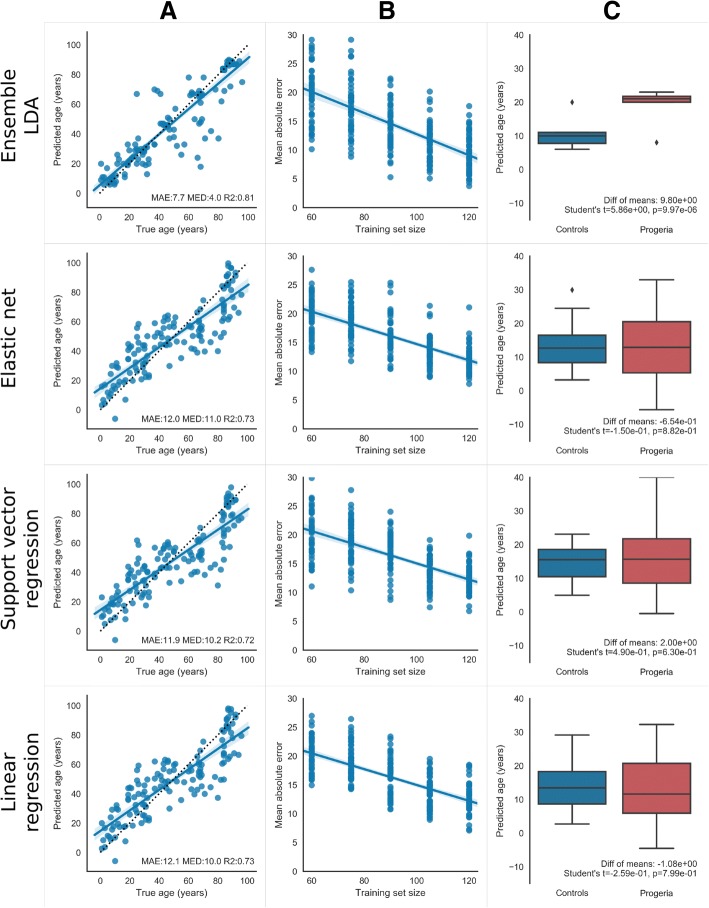
Biomarkers of aging can be used to assess the health of individuals and to study aging and age-related diseases. We generate a large dataset of genome-wide RNA-seq profiles of human dermal fibroblasts from 133 people aged 1 to 94 years old to test whether signatures of aging are encoded within the transcriptome. We develop an ensemble machine learning method that predicts age to a median error of 4 years, outperforming previous methods used to predict age. The ensemble was further validated by testing it on ten progeria patients, and our method is the only one that predicts accelerated aging in these patients.
Overview
The claims and statistics of this paper haven’t been checked yet.
Run the check — free, no account needed. It reads the open-access text and checks the sources it cites.
Integrity signals
Registry
Cites
Statistics
Figures
Verification
Claims the paper makes
The claims and statistics of this paper haven’t been checked yet.
Run the check — free, no account needed. It reads the open-access text and checks the sources it cites.
Claims other papers make about this one
Each is checked against this paper’s own text: does it say what the citing paper says it does?
The cited source says what the claim attributes to it.
In the citing paper
“this error being higher than that of the epigenetic clock consistent with previous transcription age predictors (Peters et al., 2015; Fleischer et al., 2018).”
From Multi-omic rejuvenation of human cells by maturation phase transient reprogramming (2022) · cites this paper as Fleischer et al., 2018
The cited source says what the claim attributes to it.
In the citing paper
“The combat function was also used in Figure 3 to batch correct the fibroblast aging reference data set (Fleischer et al., 2018) to our data set.”
From Multi-omic rejuvenation of human cells by maturation phase transient reprogramming (2022) · cites this paper as Fleischer et al., 2018
In the citing paper
“Additionally, they demonstrated, using human fibroblast data from Fleischer et al.82, that an elastic net-based clock derived from binarized transcriptomic data improved chronological age prediction to an r2 of 0.92 and mean error of 6.63 years and could detect accelerated ageing in progeria samples.”
From Measuring biological age using omics data (2022) · cites this paper as [82]
In the citing paper
“However, the model was not evaluated on an independent test dataset, so it remains to be seen whether the method was a true improvement.”
From Measuring biological age using omics data (2022) · cites this paper as [82]
In the citing paper
“The method outperformed standard penalized linear regression-based clocks at chronological age prediction and uniquely detected accelerated ageing in progeria samples, suggesting that methods designed to be robust to transcriptional noise improve performance.”
From Measuring biological age using omics data (2022) · cites this paper as [82]
Self-check
Percentages, sums and reported differences re-computed from the paper’s own numbers.
The self-check needs the paper’s full text.
Citations
Cites
Scikit-learn: Machine Learning in Python
Pedregosa, F., Varoquaux, G., Gramfort, A., Michel, V., Thirion, B., Grisel, O., Blondel, M., Müller, A., Nothman, J., Louppe, G., et al. (2012) · arXiv · doi:10.48550/arxiv.1201.0490 · Cited by 71,016
STAR: ultrafast universal RNA-seq aligner
Dobin, A., Davis, C. A., Schlesinger, F., Drenkow, J., Zaleski, C., Jha, S., Batut, P., Chaisson, M., & Gingeras, T. R. (2013) · Bioinformatics · doi:10.1093/bioinformatics/bts635 · Cited by 51,709
Heinz, S., Benner, C., Spann, N., Bertolino, E., Lin, Y. C., Laslo, P., Cheng, J. X., Murre, C., Singh, H., & Glass, C. K. (2010) · Molecular Cell · doi:10.1016/j.molcel.2010.05.004 · Cited by 13,382
Ensemble methods in machine learning
Dietterich, T. G. (2000) · Lecture Notes in Computer Science · doi:10.1007/3-540-45014-9_1 · Cited by 8,408
DNA methylation age of human tissues and cell types
Horvath, S. (2013) · Genome Biology · doi:10.1186/gb-2013-14-10-r115 · Cited by 7,075
Genome-wide methylation profiles reveal quantitative views of human aging rates
Hannum, G., Guinney, J., Zhao, L., Zhang, L., Hughes, G., Sadda, S., Klotzle, B., Bibikova, M., Fan, J.-B., Gao, Y., et al. (2013) · Molecular Cell · doi:10.1016/j.molcel.2012.10.016 · Cited by 4,270
Hansen, L. K., & Salamon, P. (1990) · IEEE Transactions on Pattern Analysis and Machine Intelligence · doi:10.1109/34.58871 · Cited by 4,260
Jupyter Notebooks – a publishing format for reproducible computational workflows
Kluyver, T. A., Ragan-Kelley, B., Fernando, P., Granger, B., Bussonnier, M., Frederic, J., Kelley, K., Hamrick, J. B., Grout, J., Corlay, S., et al. (2016) · IOS Press eBooks · doi:10.3233/978-1-61499-649-1-87 · Cited by 3,517
A well-conditioned estimator for large-dimensional covariance matrices
Ledoit, O., & Wolf, M. (2004) · Journal of Multivariate Analysis · doi:10.1016/s0047-259x(03)00096-4 · Cited by 3,046 · cited 2×
“Linear discriminant analysis was performed using the eigenvalue decomposition solver and Ledoit-Wolf shrinkage of the covariance matrix [22].”
MethodLamin A-dependent nuclear defects in human aging
Scaffidi, P., & Misteli, T. (2006) · Science · doi:10.1126/science.1127168 · Cited by 1,125
Research works printed but not linked: 2
- Hastie T, Tibshirani R, Friedman J. The elements of statistical learning: data mining, inference, and prediction. 2nd edition. New York: Springer; 2008.
- Shokirev MN. Predicting age from the transcriptome of human dermal fibroblasts. Data sets. [Internet]. Gene Expression Omnibus; 2018. Available from: https://www.ncbi.nlm.nih.gov/geo/query/acc.cgi?acc=GSE113957 . Accessed 12 Dec 2018.
Cited by
Sorted by citations
Measuring biological age using omics data
Rutledge, J., Oh, H., & Wyss-Coray, T. (2022) · Nature Reviews Genetics · doi:10.1038/s41576-022-00511-7 · Cited by 570
The role of lipid metabolism in aging, lifespan regulation, and age‐related disease
Johnson, A. A., & Stolzing, A. (2019) · Aging Cell · doi:10.1111/acel.13048 · Cited by 464
Senolysis by glutaminolysis inhibition ameliorates various age-associated disorders
Johmura, Y., Yamanaka, T., Omori, S., Wang, T.-W., Sugiura, Y., Matsumoto, M., Suzuki, N., Kumamoto, S., Yamaguchi, K., Hatakeyama, S., et al. (2021) · Science · doi:10.1126/science.abb5916 · Cited by 440
Cai, Y., Song, W., Li, J., Jing, Y., Liang, C., Zhang, L., Zhang, X., Zhang, W., Liu, B., An, Y., et al. (2022) · Science China Life Sciences · doi:10.1007/s11427-022-2161-3 · Cited by 450
Bao, H., Cao, J., Chen, M., Min, C., Chen, W., Chen, X., Chen, Y., Chen, Y., Chen, Y., Chen, Z., et al. (2023) · Science China Life Sciences · doi:10.1007/s11427-023-2305-0 · Cited by 402
Metadata
- Authors
- Fleischer, J. G., Schulte, R., Tsai, H. H., Tyagi, S., Ibarra, A., Shokhirev, M. N., Huang, L., Hetzer, M. W., & Navlakha, S.
- Affiliations
- Salk Institute for Biological Studies (US)
- Corresponding author
- Hetzer, Martin W.
- Navlakha, Saket
- ORCID
- Venue
- Genome Biology
- Published
- 2018-12
- Volume
- 19
- Issue
- 1
- Pages
- 221-221
- ISSN
- 1465-6906 (ISSN-L)
- 1474-760X
- PMC
- PMC6300908
- OpenAlex
- W2905232298
- Cited by
- 232
- References
- 26
- Citations by year
- 2026: 25 · 2025: 34 · 2024: 36 · 2023: 43 · 2022: 27 · 2021: 33 · 2020: 23 · 2019: 10 · 2018: 1
- FWCI
- 6.58
- Type
- journal article
- Language
- en
- Open access
- gold
- doi.org
- Licence
- Locations
- Genome biology (publishedVersion, cc-by)
- Europe PMC (PubMed Central) (publishedVersion, other-oa)
- PubMed Central (publishedVersion, cc-by)
- PubMed (publishedVersion)
- Cold Spring Harbor Laboratory Institutional Repository (Cold Spring Harbor Laboratory) (acceptedVersion)
- DOAJ (DOAJ: Directory of Open Access Journals) (submittedVersion, cc-by-sa)
- Funders
- National Institutes of Health (R01-NS096786, 1R01DC017695)
- Topics
- Life Sciences › Biochemistry, Genetics and Molecular Biology › Aging › Genetics, Aging, and Longevity in Model Organisms
- Life Sciences › Biochemistry, Genetics and Molecular Biology › Molecular Biology › Single-cell and spatial transcriptomics
- Life Sciences › Biochemistry, Genetics and Molecular Biology › Molecular Biology › Gene expression and cancer classification
- Keywords
- age prediction, aging biomarkers, transcriptome, human dermal fibroblasts, RNA-seq, ensemble learning, Hutchinson-Gilford progeria syndrome, accelerated aging, age-related diseases
- MeSH terms
- Machine Learning, Adolescent, Adult, Aged, Aged, 80 and over, Aging, Child, Child, Preschool, Fibroblasts, Humans, Middle Aged, Progeria, Gene Expression Profiling, Genomics, Young Adult, Transcriptome
About these checks
Registry, retraction, Cites and statistics results are computed, not judged, with one exception: a printed reference that no index lists is read once by a model before it counts as a citation error. Claims are extracted by a model and kept only when their quote appears verbatim in the text; each cited source is then checked, with a model’s help, for whether it says what the claim relies on. Those verdicts can be wrong — read the claim’s quote and the cited source before relying on one.
Statistics and arithmetic are recomputed, not judged.
Confidence bands are shown only for fields calibrated on our annotated test set. None is calibrated yet, so no band is shown.
What counts as a claim ›How we measure confidence ›How we check this ›
Are you an author, or do you see a problem with this page? Request a review
