

Genotype-free demultiplexing of pooled single-cell RNA-seq
Open accessPublished version of a preprint
The DOI matches its Crossref record; 18 of the 18 references it cites were found in a registry or an index.
Abstract
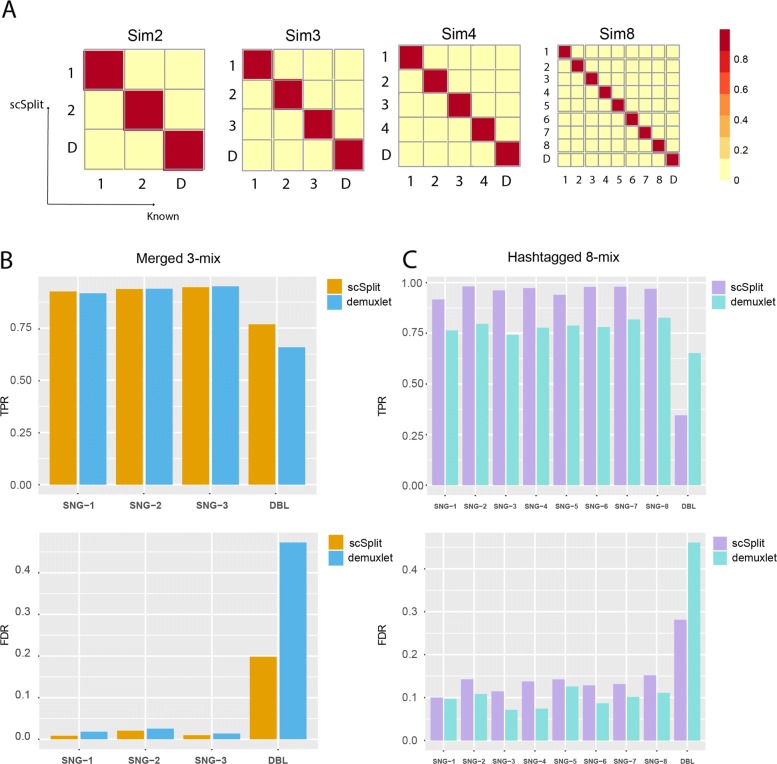
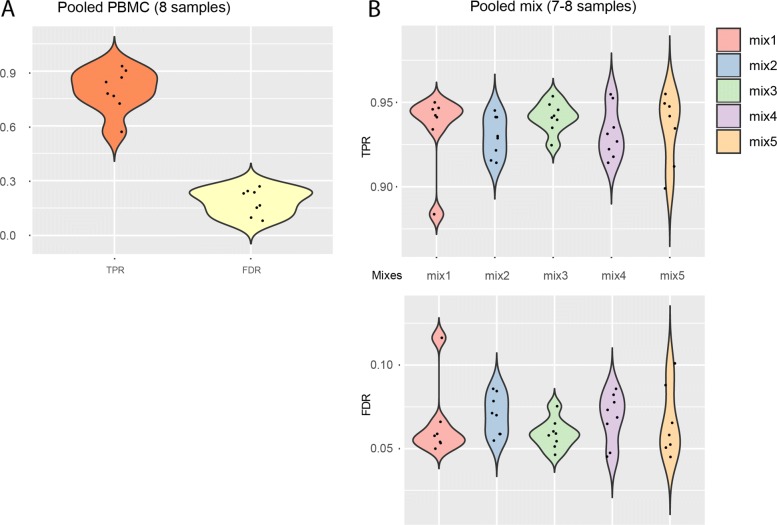
A variety of methods have been developed to demultiplex pooled samples in a single cell RNA sequencing (scRNA-seq) experiment which either require hashtag barcodes or sample genotypes prior to pooling. We introduce scSplit which utilizes genetic differences inferred from scRNA-seq data alone to demultiplex pooled samples. scSplit also enables mapping clusters to original samples. Using simulated, merged, and pooled multi-individual datasets, we show that scSplit prediction is highly concordant with demuxlet predictions and is highly consistent with the known truth in cell-hashing dataset. scSplit is ideally suited to samples without external genotype information and is available at: https://github.com/jon-xu/scSplit
Overview
The claims and statistics of this paper haven’t been checked yet.
Free: it reads the open-access text and checks the first 5 claims that cite a source we can check. Create a free account to check every claim.
Integrity signals
Registry
Cites
Statistics
Figures
Verification
Claims the paper makes
The claims and statistics of this paper haven’t been checked yet.
Free: it reads the open-access text and checks the first 5 claims that cite a source we can check. Create a free account to check every claim.
Claims other papers make about this one
Each is checked against this paper’s own text: does it say what the citing paper says it does?
The cited source says what the claim attributes to it.
In the citing paper
“Increasing biological replicates through sample pooling prior to library preparation followed by demultiplexing (i.e., identifying and isolating the sequencing data related to each sample within the pool) to the original biological sample is an effective strategy to overcome these issues as well as reduce batch effects [5–9].”
From Benchmarking of computational demultiplexing methods for single-nucleus RNA sequencing data (2025) · cites this paper as [8]
Self-check
Percentages, sums and reported differences re-computed from the paper’s own numbers.
The self-check needs the paper’s full text.
Citations
Cites
PLINK: a tool set for whole-genome association and population-based linkage analyses.
Purcell, S., Neale, B., Todd-Brown, K., Thomas, L., Ferreira, M. A. R., Bender, D., Maller, J., Sklar, P., de Bakker, P. I. W., Daly, M. J., et al. (2007) · The American Journal of Human Genetics · doi:10.1086/519795 · Cited by 34,089
Weighted kappa: nominal scale agreement provision for scaled disagreement or partial credit
Cohen, J. (1968) · Psychological Bulletin · doi:10.1037/h0026256 · Cited by 8,736
Massively parallel digital transcriptional profiling of single cells
Zheng, G. X. Y., Terry, J. M., Belgrader, P., Ryvkin, P., Bent, Z. W., Wilson, R., Ziraldo, S. B., Wheeler, T. D., McDermott, G. P., Zhu, J., et al. (2017) · Nature Communications · doi:10.1038/ncomms14049 · Cited by 7,353 · cited 5×
“We used PBMC donor B [2] and genotype data from demuxlet [6] as simulation templates”
InfluentialHighly parallel genome-wide expression profiling of individual cells using nanoliter droplets.
Macosko, E. Z., Basu, A., Satija, R., Nemesh, J., Shekhar, K., Goldman, M., Tirosh, I., Bialas, A. R., Kamitaki, N., Martersteck, E. M., et al. (2015) · Cell · doi:10.1016/j.cell.2015.05.002 · Cited by 7,110 · cited 2×
“example Drop-Seq [1] or 10X Genomics Systems [2]) allows profiling large numbers 9”
BackgroundDimensionality reduction for visualizing single-cell data using UMAP
Becht, E., McInnes, L., Healy, J., Dutertre, C.-A., Kwok, I. W. H., Ng, L. G., Ginhoux, F., & Newell, E. W. (2019) · Nature Biotechnology · doi:10.1038/nbt.4314 · Cited by 5,358 · cited 1×
“The results were plotted using Uniform Manifold Approximation and Projection 322 for Dimension Reduction (UMAP [14]).”
MethodMcGinnis, C. S., Murrow, L. M., & Gartner, Z. J. (2019) · Cell Systems · doi:10.1016/j.cels.2019.03.003 · Cited by 4,521
Haplotype-based variant detection from short-read sequencing
Garrison, E., & Marth, G. (2012) · arXiv · doi:10.48550/arxiv.1207.3907 · Cited by 3,700 · cited 2×
“SNV calling on scRNA-Seq dataset 83 SNVs were called on the scRNA-Seq mixed sample BAM file with freebayes [9], a 84 widely used variant calling tool.”
MethodSimultaneous epitope and transcriptome measurement in single cells
Stoeckius, M., Hafemeister, C., Stephenson, W., Houck-Loomis, B., Chattopadhyay, P. K., Swerdlow, H., Satija, R., & Smibert, P. (2017) · Nature Methods · doi:10.1038/nmeth.4380 · Cited by 3,098 · cited 1×
“Other methods like Cite-seq [2] can similarly derive sample origin in the sequencing result based on the barcodes used for different samples, but still makes the assumption that original samples are available before mixture.”
MethodScrublet: computational identification of cell doublets in single-cell transcriptomic data
Wolock, S. L., Lopez, R., & Klein, A. M. (2018) · doi:10.1101/357368 · Cited by 2,758 · cited 2×
“Demuxlet [6] uses external genotype information to address 32 this issue, and other tools have been developed to solve this issue based on expression 33 data alone, including Scrublet [7] and Doubletdetection [8].”
MethodScrublet: computational identification of cell doublets in single-cell transcriptomic data
Wolock, S. L., Lopez, R., & Klein, A. M. (2019) · Cell Systems · doi:10.1016/j.cels.2018.11.005 · Cited by 2,758
Research works printed but not linked: 1
- Xu J, Falconer C, Nguyen Q, Crawford J, McKinnon BD, Mortlock S, et al.Genotype-free demultiplexing of pooled single-cell RNA-seq (Version 1.0.0). 2019. Available from: 10.5281/zenodo.3464622. PMC6921391 31856883 · doi:10.5281/zenodo.3464622
Cited by
Scrublet: computational identification of cell doublets in single-cell transcriptomic data
Wolock, S. L., Lopez, R., & Klein, A. M. (2019) · Cell Systems · doi:10.1016/j.cels.2018.11.005 · Cited by 2,758
Souporcell: robust clustering of single-cell RNA-seq data by genotype without reference genotypes
Heaton, H., Talman, A. M., Knights, A., Imaz, M., Gaffney, D. J., Durbin, R., Hemberg, M., & Lawniczak, M. K. N. (2020) · Nature Methods · doi:10.1038/s41592-020-0820-1 · Cited by 533
Single-nucleus cross-tissue molecular reference maps toward understanding disease gene function
Eraslan, G., Drokhlyansky, E., Anand, S., Fiskin, E., Subramanian, A., Slyper, M., Wang, J., Van Wittenberghe, N., Rouhana, J. M., Waldman, J., et al. (2022) · Science · doi:10.1126/science.abl4290 · Cited by 405
“Toward large-scale snRNA-seq of human tissues with pooling To enable future studies at the population scale, we tested whether frozen samples from different individuals can be pooled for snRNAseq, followed by computational demultiplexing, as a cost-effective and scalable approach (167), as previously applied to large-…”
Resultpropeller: testing for differences in cell type proportions in single cell data
Phipson, B., Sim, C. B., Porrello, E. R., Hewitt, A. W., Powell, J., & Oshlack, A. (2022) · Bioinformatics · doi:10.1093/bioinformatics/btac582 · Cited by 373
“The first three methods do not take into account sample to sample variability, while the remaining 6 methods (4-9) do.”
Self-citationVanderbeke, L., Van Mol, P., Van Herck, Y., De Smet, F., Humblet-Baron, S., Martinod, K., Antoranz, A., Arijs, I., Boeckx, B., Bosisio, F. M., et al. (2021) · Nature Communications · doi:10.1038/s41467-021-24360-w · Cited by 247
Metadata
- Authors
- Xu, J., Falconer, C., Nguyen, Q., Crawford, J., McKinnon, B. D., Mortlock, S., Senabouth, A., Andersen, S., Chiu, H. S., Jiang, L., Palpant, N. J., Yang, J., Mueller, M. D., Hewitt, A. W., Pébay, A., Montgomery, G. W., Powell, J. E., & Coin, L. J. M.
- Affiliations
- The University of Queensland (AU)
- Garvan Institute of Medical Research (AU)
- University Hospital of Bern (CH)
- University of Tasmania (AU)
- The University of Melbourne (AU)
- Corresponding author
- Coin, Lachlan J.M
- ORCID
- Venue
- Genome Biology
- Published
- 2019-12
- Volume
- 20
- Issue
- 1
- Pages
- 290-290
- ISSN
- 1465-6906 (ISSN-L)
- 1474-760X
- PMC
- PMC6921391
- OpenAlex
- W2997393200
- Semantic Scholar
- 96c08a77ed4ba2b708fc47003e61cd1edf26dd22
- Cited by
- 94
- References
- 18
- Citations by year
- 2026: 10 · 2025: 13 · 2024: 26 · 2023: 16 · 2022: 12 · 2021: 7 · 2020: 7 · 2019: 3
- FWCI
- 2.40
- Type
- journal article
- Language
- en
- Open access
- gold
- doi.org
- Licence
- cc-by
- creativecommons.org/licenses/by/4.0 (tdm)
- creativecommons.org/licenses/by/4.0 (vor, 18 d)
- Locations
- Genome biology (publishedVersion, cc-by)
- Europe PMC (PubMed Central) (publishedVersion, cc-by)
- PubMed Central (publishedVersion, cc-by)
- PubMed (publishedVersion)
- UTAS Research Repository (acceptedVersion)
- DOAJ (DOAJ: Directory of Open Access Journals) (submittedVersion)
- Minerva Access (University of Melbourne) (submittedVersion, cc-by)
- Funders
- Stem Cells Australia
- Medical Research Council
- Australian Research Council (DE190100116, FT140100047, DP180101405)
- National Health and Medical Research Council (1107599, 1143163, FT140100047, 1154389, 1149029, 1130084)
- Topics
- Life Sciences › Biochemistry, Genetics and Molecular Biology › Molecular Biology › Single-cell and spatial transcriptomics
- Life Sciences › Biochemistry, Genetics and Molecular Biology › Molecular Biology › Genomics and Phylogenetic Studies
- Life Sciences › Biochemistry, Genetics and Molecular Biology › Molecular Biology › Gene expression and cancer classification
- Keywords
- single-cell RNA sequencing, demultiplexing, pooled samples, cell clustering, cell hashing, single-cell genomics
- MeSH terms
- Humans, Software, Sequence Analysis, RNA, Single-Cell Analysis
About these checks
Registry, retraction, Cites and statistics results are computed, not judged, with one exception: a printed reference that no index lists is read once by a model before it counts as a citation error. Claims are extracted by a model and kept only when their quote appears verbatim in the text; each cited source is then checked, with a model’s help, for whether it says what the claim relies on. Those verdicts can be wrong — read the claim’s quote and the cited source before relying on one.
Statistics and arithmetic are recomputed, not judged.
Confidence bands are shown only for fields calibrated on our annotated test set. None is calibrated yet, so no band is shown.
What counts as a claim ›How we measure confidence ›How we check this ›
Are you an author, or do you see a problem with this page? Request a review
How to cite
Cite CoChat for the checks on this page, and the paper for its own findings.
- This page
- CoChat. (2026). Citation check: Genotype-free demultiplexing of pooled single-cell RNA-seq. https://app.cochat.ai/papers/10.1186/s13059-019-1852-7
- The paper
- Xu, J., Falconer, C., Nguyen, Q., Crawford, J., McKinnon, B. D., Mortlock, S., Senabouth, A., Andersen, S., Chiu, H. S., Jiang, L., Palpant, N. J., Yang, J., Mueller, M. D., Hewitt, A. W., Pébay, A., Montgomery, G. W., Powell, J. E., & Coin, L. J. M. (2019). Genotype-free demultiplexing of pooled single-cell RNA-seq. Genome Biology. https://doi.org/10.1186/s13059-019-1852-7
Data sources
Bibliographic data: Semantic Scholar, OpenAlex, Crossref.
Contains information from the Semantic Scholar Academic Graph Datasets, made available under the ODC Attribution License (ODC-BY 1.0).
Semantic Scholar’s data is described in: Kinney, R., et al. (2023). The Semantic Scholar Open Data Platform. arXiv:2301.10140.
