

Sfaira accelerates data and model reuse in single cell genomics
Open accessPublished version of a preprint
The DOI matches its Crossref record; 77 of the 77 references it cites were found in a registry or an index.
Abstract
Single-cell RNA-seq datasets are often first analyzed independently without harnessing model fits from previous studies, and are then contextualized with public data sets, requiring time-consuming data wrangling. We address these issues with sfaira, a single-cell data zoo for public data sets paired with a model zoo for executable pre-trained models. The data zoo is designed to facilitate contribution of data sets using ontologies for metadata. We propose an adaption of cross-entropy loss for cell type classification tailored to datasets annotated at different levels of coarseness. We demonstrate the utility of sfaira by training models across anatomic data partitions on 8 million cells.
Overview
The claims and statistics of this paper haven’t been checked yet.
Free: it reads the open-access text and checks the first 5 claims that cite a source we can check. Create a free account to check every claim.
Integrity signals
Registry
Cites
Statistics
Figures




Verification
Claims the paper makes
The claims and statistics of this paper haven’t been checked yet.
Free: it reads the open-access text and checks the first 5 claims that cite a source we can check. Create a free account to check every claim.
Claims other papers make about this one
Each is checked against this paper’s own text: does it say what the citing paper says it does?
In the citing paper
“Unified frameworks for accessing single-cell data are in active development, but do not currently support perturbation datasets or standardize perturbation annotations37,38.”
From scPerturb: harmonized single-cell perturbation data (2024) · cites this paper as [37]
Self-check
Percentages, sums and reported differences re-computed from the paper’s own numbers.
The self-check needs the paper’s full text.
Citations
Cites
ImageNet classification with deep convolutional neural networks
Krizhevsky, A., Sutskever, I., & Hinton, G. E. (2017) · Communications of the ACM · doi:10.1145/3065386 · Cited by 112,155
Integrated analysis of multimodal single-cell data
Hao, Y., Hao, S., Andersen-Nissen, E., Mauck, W. M., Zheng, S., Butler, A., Lee, M. J., Wilk, A. J., Darby, C., Zagar, M., et al. (2020) · doi:10.1101/2020.10.12.335331 · Cited by 15,508
SCANPY: large-scale single-cell gene expression data analysis
Wolf, F. A., Angerer, P., & Theis, F. J. (2018) · Genome Biology · doi:10.1186/s13059-017-1382-0 · Cited by 8,881 · cited 2×
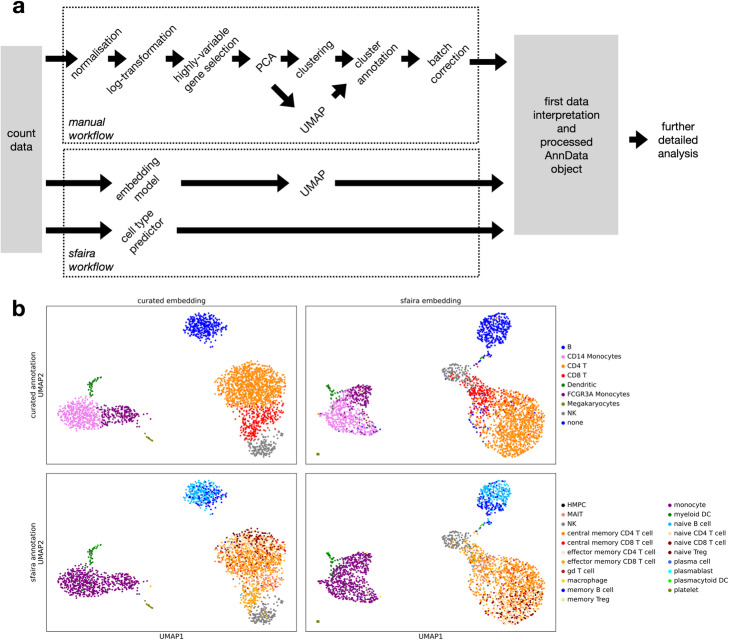
“As an example case, we processed human peripheral blood mononuclear cells (PBMC) data in a standard preprocessing workflow 4,8 and compared this to a UMAP of a linear model embedding.”
MethodSelf-citationMcGinnis, C. S., Murrow, L. M., & Gartner, Z. J. (2019) · Cell Systems · doi:10.1016/j.cels.2019.03.003 · Cited by 4,521
Simultaneous epitope and transcriptome measurement in single cells
Stoeckius, M., Hafemeister, C., Stephenson, W., Houck-Loomis, B., Chattopadhyay, P. K., Swerdlow, H., Satija, R., & Smibert, P. (2017) · Nature Methods · doi:10.1038/nmeth.4380 · Cited by 3,098
Single-cell transcriptomics of 20 mouse organs creates a Tabula Muris
The Tabula Muris Consortium, coordination, O., coordination, L., processing, O. C. A., sequencing, L. P. A., analysis, C. D., annotation, C. T., Writing group, Supplemental text writing group, & Principal investigators (2018) · Nature · doi:10.1038/s41586-018-0590-4 · Cited by 2,842
Scrublet: computational identification of cell doublets in single-cell transcriptomic data
Wolock, S. L., Lopez, R., & Klein, A. M. (2019) · Cell Systems · doi:10.1016/j.cels.2018.11.005 · Cited by 2,758
Scrublet: computational identification of cell doublets in single-cell transcriptomic data
Wolock, S. L., Lopez, R., & Klein, A. M. (2018) · doi:10.1101/357368 · Cited by 2,758
Deep generative modeling for single-cell transcriptomics
Lopez, R., Regier, J., Cole, M. B., Jordan, M. I., & Yosef, N. (2018) · Nature Methods · doi:10.1038/s41592-018-0229-2 · Cited by 2,530
Single-cell reconstruction of the early maternal–fetal interface in humans
Vento-Tormo, R., Efremova, M., Botting, R. A., Turco, M. Y., Vento-Tormo, M., Meyer, K. B., Park, J.-E., Stephenson, E., Polański, K., Goncalves, A., et al. (2018) · Nature · doi:10.1038/s41586-018-0698-6 · Cited by 2,358
Research works printed but not linked: 3
- Dony L, Koenig M, Fischer D, Theis FJ. Variational autoencoders with flexible priors enable robust distribution learning on single-cell RNA sequencing data. In: ICML 2020 Workshop on Computational Biology (WCB) Proceedings Paper 37; 2020.
- Fischer DS, Dony L, König M, Moeed A, Zappia L, Heumos L, et al. Theis. PyPi: Sfaira accelerates data and model reuse in single cell genomics. PyPi https://pypi.org/project/sfaira/0.3.0/. 2021. · DOI
- Fischer DS, Dony L, König M, Moeed A, Zappia L, Heumos L, et al. Theis. Zenodo: Sfaira accelerates data and model reuse in single cell genomics. Zenodo https://zenodo.org/record/4836517. 2021. · DOI
Cited by
An integrated cell atlas of the lung in health and disease
Sikkema, L., Ramírez-Suástegui, C., Strobl, D. C., Gillett, T. E., Zappia, L., Madissoon, E., Markov, N. S., Zaragosi, L.-E., Ji, Y., Ansari, M., et al. (2023) · Nature Medicine · doi:10.1038/s41591-023-02327-2 · Cited by 854
Self-citationA Python library for probabilistic analysis of single-cell omics data
Gayoso, A., Lopez, R., Xing, G., Boyeau, P., Valiollah Pour Amiri, V., Hong, J., Wu, K., Jayasuriya, M., Mehlman, E., Langevin, M., et al. (2022) · Nature Biotechnology · doi:10.1038/s41587-021-01206-w · Cited by 789
Self-citationMulti-omics single-cell data integration and regulatory inference with graph-linked embedding
Cao, Z.-J., & Gao, G. (2022) · Nature Biotechnology · doi:10.1038/s41587-022-01284-4 · Cited by 616
“In particular, the incorporation of batch correction could further enable effective curation of new datasets with the integrated atlas as a global reference 49 .”
BackgroundThe scverse project provides a computational ecosystem for single-cell omics data analysis
Virshup, I., Bredikhin, D., Heumos, L., Palla, G., Sturm, G., Gayoso, A., Kats, I., Koutrouli, M., Community, S., Angerer, P., et al. (2023) · Nature Biotechnology · doi:10.1038/s41587-023-01733-8 · Cited by 341
Self-citationscPerturb: harmonized single-cell perturbation data
Peidli, S., Green, T. D., Shen, C., Gross, T., Min, J., Garda, S., Yuan, B., Schumacher, L. J., Taylor-King, J. P., Marks, D. S., et al. (2024) · Nature Methods · doi:10.1038/s41592-023-02144-y · Cited by 194
“Unified frameworks for accessing single-cell data are in active development, but do not currently support perturbation datasets or standardize perturbation annotations 37,38 .”
Metadata
- Authors
- Fischer, D. S., Dony, L., König, M., Moeed, A., Zappia, L., Heumos, L., Tritschler, S., Holmberg, O., Aliee, H., & Theis, F. J.
- Affiliations
- Helmholtz Munich (DE)
- Corresponding author
- Theis, Fabian J.
- ORCID
- Venue
- Genome Biology
- Published
- 2021-08-25
- Volume
- 22
- Issue
- 1
- Pages
- 248-248
- ISSN
- 1465-6906 (ISSN-L)
- 1474-760X
- PMC
- PMC8386039
- OpenAlex
- W3194078460
- Cited by
- 33
- References
- 75
- Citations by year
- 2026: 1 · 2025: 5 · 2024: 5 · 2023: 11 · 2022: 6 · 2021: 5
- FWCI
- 2.12
- Type
- journal article
- Language
- en
- Open access
- gold
- doi.org
- Licence
- cc-by
- creativecommons.org/licenses/by/4.0 (tdm)
- creativecommons.org/licenses/by/4.0 (vor)
- Locations
- Genome biology (publishedVersion, cc-by)
- bioRxiv (Cold Spring Harbor Laboratory) (acceptedVersion, cc-by)
- PubMed Central (publishedVersion, cc-by)
- PubMed (publishedVersion)
- PuSH - Publication Server of Helmholtz Zentrum München (submittedVersion, cc-by)
- DOAJ (DOAJ: Directory of Open Access Journals) (submittedVersion, cc-by-sa)
- mediaTUM (Technical University of Munich) (submittedVersion, other-oa)
- Site cant be reached (submittedVersion)
- Site cant be reached (submittedVersion, cc-by)
- Funders
- Deutsche Forschungsgemeinschaft (GSC 1006)
- Bundesministerium für Bildung und Forschung (01IS18036B, 01IS18053A)
- Chan Zuckerberg Initiative (2019-207271)
- Helmholtz Zentrum München (ZT-I-PF-5-01)
- Joachim Herz Stiftung (-)
- Helmholtz Zentrum München - Deutsches Forschungszentrum für Gesundheit und Umwelt (GmbH)
- Topics
- Life Sciences › Biochemistry, Genetics and Molecular Biology › Molecular Biology › Single-cell and spatial transcriptomics
- Life Sciences › Biochemistry, Genetics and Molecular Biology › Molecular Biology › Gene expression and cancer classification
- Social Sciences › Decision Sciences › Information Systems and Management › Scientific Computing and Data Management
- Keywords
- single-cell RNA sequencing, data reuse, model reuse, pre-trained models, model zoo, metadata ontology, cross-entropy loss, cell type classification, multi-omics integration
- MeSH terms
- Animals, Humans, Statistics as Topic, Reproducibility of Results, Genomics, Databases, Genetic, Mice, Molecular Sequence Annotation, Single-Cell Analysis, Gene Ontology
About these checks
Registry, retraction, Cites and statistics results are computed, not judged, with one exception: a printed reference that no index lists is read once by a model before it counts as a citation error. Claims are extracted by a model and kept only when their quote appears verbatim in the text; each cited source is then checked, with a model’s help, for whether it says what the claim relies on. Those verdicts can be wrong — read the claim’s quote and the cited source before relying on one.
Statistics and arithmetic are recomputed, not judged.
Confidence bands are shown only for fields calibrated on our annotated test set. None is calibrated yet, so no band is shown.
What counts as a claim ›How we measure confidence ›How we check this ›
Are you an author, or do you see a problem with this page? Request a review
How to cite
Cite CoChat for the checks on this page, and the paper for its own findings.
- This page
- CoChat. (2026). Citation check: Sfaira accelerates data and model reuse in single cell genomics. https://app.cochat.ai/papers/10.1186/s13059-021-02452-6
- The paper
- Fischer, D. S., Dony, L., König, M., Moeed, A., Zappia, L., Heumos, L., Tritschler, S., Holmberg, O., Aliee, H., & Theis, F. J. (2021). Sfaira accelerates data and model reuse in single cell genomics. Genome Biology. https://doi.org/10.1186/s13059-021-02452-6
Data sources
Bibliographic data: Semantic Scholar, OpenAlex, Crossref.
Contains information from the Semantic Scholar Academic Graph Datasets, made available under the ODC Attribution License (ODC-BY 1.0).
Semantic Scholar’s data is described in: Kinney, R., et al. (2023). The Semantic Scholar Open Data Platform. arXiv:2301.10140.
