

Inevitability of the emergence and persistence of genetic parasites caused by evolutionary instability of parasite-free states
Open accessPublished version of a preprint
The DOI matches its Crossref record; 73 of the 73 references it cites were found in a registry or an index.
Abstract
Genetic parasites, including viruses and mobile genetic elements, are ubiquitous among cellular life forms, and moreover, are the most abundant biological entities on earth that harbor the bulk of the genetic diversity. Here we examine simple thought experiments to demonstrate that both the emergence of parasites in simple replicator systems and their persistence in evolving life forms are inevitable because the putative parasite-free states are evolutionarily unstable. REVIEWERS: This article has been reviewed by Yitzhak Pilpel, Bojan Zagrovic, and Eric van Nimwegen.
Overview
The claims and statistics of this paper haven’t been checked yet.
Free: it reads the open-access text and checks the first 5 claims that cite a source we can check. Create a free account to check every claim.
Integrity signals
Registry
Cites
Statistics
Figures
Verification
Claims the paper makes
The claims and statistics of this paper haven’t been checked yet.
Free: it reads the open-access text and checks the first 5 claims that cite a source we can check. Create a free account to check every claim.
Claims other papers make about this one
Each is checked against this paper’s own text: does it say what the citing paper says it does?
The source backs part of the claim, not all of it — or backs it for a different population, condition or comparison.
In the citing paper
“The widespread presence of parasites in both artificial and natural communities suggests that they are a universal outcome of the evolution of complex adaptive systems [330–332].”
From Fundamental constraints to the logic of living systems (2024) · cites this paper as [331]
Experimental — accuracy not yet measured
Self-check
Percentages, sums and reported differences re-computed from the paper’s own numbers.
The self-check needs the paper’s full text.
Citations
Cites
Evolution and the Theory of Games
Smith, J. M. (1988) · Did Darwin Get It Right? · doi:10.1007/978-1-4684-7862-4_22 · Cited by 7,906 · cited 1×
“Furthermore, it appears intuitive: genetic parasites can be considered cheaters, in game-theoretical terms, and as soon as, in a replicator system, there is a distributable resource, such as a replicase, cheaters would emerge to steal that resource without producing their share of it [40].”
BackgroundEvolution and the Theory of Games
Smith, J. M. (1982) · Cambridge University Press eBooks · doi:10.1017/cbo9780511806292 · Cited by 6,922
Irreversibility and heat generation in the computing process
Landauer, R. (1961) · IBM Journal of Research and Development · doi:10.1147/rd.53.0183 · Cited by 4,980
Probability theory the logic of science
Jaynes, E. T., & Bretthorst, G. L. (2003) · Cited by 4,643
Probability Theory: The Logic of Science
Jaynes, E. T. (2003) · doi:10.1017/cbo9780511790423 · Cited by 4,045
Selforganization of matter and the evolution of biological macromolecules
Eigen, M. (1971) · Die Naturwissenschaften · doi:10.1007/bf00623322 · Cited by 3,788
Marine viruses — major players in the global ecosystem
Suttle, C. A. (2007) · Nature Reviews Microbiology · doi:10.1038/nrmicro1750 · Cited by 3,157
Irreversibility and heat generation in the computing process
Landauer, R. (2000) · IBM Journal of Research and Development · doi:10.1147/rd.441.0261 · Cited by 2,585 · cited 1×
“and value of this minimum information cost is known as Landauer’s principle [46] which is a corollary of the second law of thermodynamics, under the informationtheoretic interpretation of thermodynamics [47–49] In all known systems, this cost is many orders of magnitude higher [46, 48, 49].”
BackgroundEvolutionary Dynamics: Exploring the Equations of Life
NOWAK, M. A. (2006) · doi:10.2307/j.ctvjghw98 · Cited by 2,438
Bacteriophage resistance mechanisms
Labrie, S. J., Samson, J. E., & Moineau, S. (2010) · Nature Reviews Microbiology · doi:10.1038/nrmicro2315 · Cited by 2,397
Research works printed but not linked: 2
- Kornberg A Baker T DNA replication 1992 2 New York, NY W. H. Freeman and Co
- Koonin EV The logic of chance: the nature and origin of biological evolution upper Saddle River 2011 New Jersey FT press
Cited by
Global Organization and Proposed Megataxonomy of the Virus World
Koonin, E. V., Dolja, V. V., Krupovic, M., Varsani, A., Wolf, Y. I., Yutin, N., Zerbini, F. M., & Kuhn, J. H. (2020) · Microbiology and Molecular Biology Reviews · doi:10.1128/mmbr.00061-19 · Cited by 585
Self-citationEvolutionary entanglement of mobile genetic elements and host defence systems: guns for hire
Koonin, E. V., Makarova, K. S., Wolf, Y. I., & Krupovic, M. (2020) · Nature Reviews Genetics · doi:10.1038/s41576-019-0172-9 · Cited by 236
Self-citationOrigin of viruses: primordial replicators recruiting capsids from hosts
Krupovic, M., Dolja, V. V., & Koonin, E. V. (2019) · Nature Reviews Microbiology · doi:10.1038/s41579-019-0205-6 · Cited by 218
Self-citationDeep Roots and Splendid Boughs of the Global Plant Virome
Dolja, V. V., Krupovìč, M., & Koonin, E. V. (2020) · Annual Review of Phytopathology · doi:10.1146/annurev-phyto-030320-041346 · Cited by 125
“Therefore, virus/MGE replication modules appear to emerge at the earliest stages of evolution, possibly even within protocellular replication systems, in accord with the concept of genetic parasite inevitability (90).”
BackgroundSelf-citationRNA-targeting CRISPR–Cas systems
van Beljouw, S. P. B., Sanders, J., Rodríguez-Molina, A., & Brouns, S. J. J. (2022) · Nature Reviews Microbiology · doi:10.1038/s41579-022-00793-y · Cited by 130
Toward a theory of evolution as multilevel learning
Vanchurin, V., Wolf, Y. I., Katsnelson, M. I., & Koonin, E. V. (2022) · Proceedings of the National Academy of Sciences · doi:10.1073/pnas.2120037119 · Cited by 151
Self-citationThe LUCA and its complex virome
Krupovic, M., Dolja, V. V., & Koonin, E. V. (2020) · Nature Reviews Microbiology · doi:10.1038/s41579-020-0408-x · Cited by 128
Self-citationEvolutionary transition from a single RNA replicator to a multiple replicator network
Mizuuchi, R., Furubayashi, T., & Ichihashi, N. (2022) · Nature Communications · doi:10.1038/s41467-022-29113-x · Cited by 106
Viruses Defined by the Position of the Virosphere within the Replicator Space
Koonin, E. V., Dolja, V. V., Krupovic, M., & Kuhn, J. H. (2021) · Microbiology and Molecular Biology Reviews · doi:10.1128/mmbr.00193-20 · Cited by 91
Self-citationMegataxonomy and global ecology of the virosphere
Koonin, E. V., Kuhn, J. H., Dolja, V. V., & Krupovìč, M. (2024) · The ISME Journal · doi:10.1093/ismejo/wrad042 · Cited by 103
Self-citationThe global virome: How much diversity and how many independent origins?
Koonin, E. V., Krupovic, M., & Dolja, V. V. (2023) · Environmental Microbiology · doi:10.1111/1462-2920.16207 · Cited by 82
“Empirical observations on the ubiquity of viruses are buttressed by theoretical argument on the inevitable emergence of genetic parasites in any replicator system (Koonin et al., 2017).”
BackgroundSelf-citationThe depths of virus exaptation
Koonin, E. V., & Krupovic, M. (2018) · Current Opinion in Virology · doi:10.1016/j.coviro.2018.07.011 · Cited by 75
Self-citationA Place for Viruses on the Tree of Life
Harris, H. M. B., & Hill, C. (2021) · Frontiers in Microbiology · doi:10.3389/fmicb.2020.604048 · Cited by 81
“Current evidence suggests a cellular origin of BMCs and, indeed, the recruitment by viruses of many cellular structural proteins (Krupovic and Koonin, 2017).”
BackgroundMicrobial Arsenal of Antiviral Defenses – Part I
Isaev, A. B., Musharova, O. S., & Severinov, K. (2021) · Biochemistry (Moscow) · doi:10.1134/s0006297921030081 · Cited by 64
Microbial Arsenal of Antiviral Defenses. Part II
Isaev, A. B., Musharova, O. S., & Severinov, K. (2021) · Biochemistry (Moscow) · doi:10.1134/s0006297921040064 · Cited by 54
Evidence supporting a viral origin of the eukaryotic nucleus
Bell, P. (2020) · Virus Research · doi:10.1016/j.virusres.2020.198168 · Cited by 52
Towards physical principles of biological evolution
Katsnelson, M. I., Wolf, Y. I., & Koonin, E. V. (2018) · Physica Scripta · doi:10.1088/1402-4896/aaaba4 · Cited by 45
Self-citationType III CRISPR-Cas Systems: Deciphering the Most Complex Prokaryotic Immune System
Kolesnik, M. V., Fedorova, I., Karneyeva, K., Artamonova, D., & Severinov, K. (2021) · Biochemistry (Moscow) · doi:10.1134/s0006297921100114 · Cited by 63
“The hosts are apparently incapable to complete ly get rid of genetic parasites, since this entails reduction of the horizontal gene transfer essential for the long term genome stability and evolution [2].”
BackgroundEmergence and diversification of a host-parasite RNA ecosystem through Darwinian evolution
Furubayashi, T., Ueda, K., Bansho, Y., Motooka, D., Nakamura, S., Mizuuchi, R., & Ichihashi, N. (2020) · eLife · doi:10.7554/elife.56038 · Cited by 56
“Even in a simplest form of replication systems, parasites inevitably appear through a functional loss of self-replicating molecules and threaten the sustainability of the replication system (Bansho et al., 2012; Koonin et al., 2017).”
BackgroundWen, T., Cheong, K. H., Lai, J. W., Koh, J. M., & Koonin, E. V. (2022) · Physical Review Letters · doi:10.1103/physrevlett.128.218101 · Cited by 39
Self-citationCarvalho, G., Fouchet, D., Danesh, G., Godeux, A.-S., Laaberki, M.-H., Pontier, D., Charpentier, X., & Venner, S. (2020) · mBio · doi:10.1128/mbio.02443-19 · Cited by 42
Fundamental constraints to the logic of living systems
Solé, R., Kempes, C. P., Corominas-Murtra, B., De Domenico, M., Kolchinsky, A., Lachmann, M., Libby, E., Saavedra, S., Smith, E., & Wolpert, D. (2024) · Interface Focus · doi:10.1098/rsfs.2024.0010 · Cited by 34
Ribozyme activity modulates the physical properties of RNA–peptide coacervates
Vay, K. K. L., Salibi, E., Ghosh, B., Tang, T. ‐. D., & Mutschler, H. (2023) · eLife · doi:10.7554/elife.83543 · Cited by 38
Pressley, M., Salvioli, M., Lewis, D. B., Richards, C. L., Brown, J. S., & Staňková, K. (2021) · Frontiers in Ecology and Evolution · doi:10.3389/fevo.2021.681121 · Cited by 42
Viroids and Viroid-like Circular RNAs: Do They Descend from Primordial Replicators?
Lee, B. D., & Koonin, E. V. (2022) · Life · doi:10.3390/life12010103 · Cited by 34
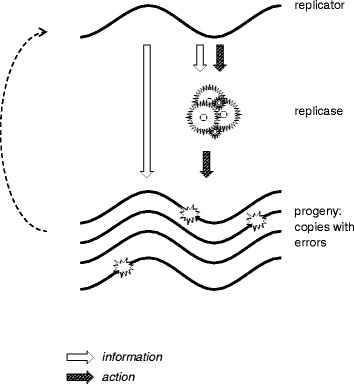
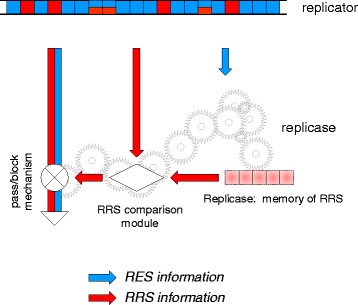
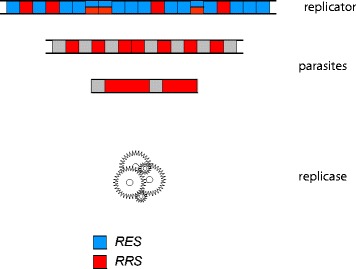
“Generally, the information content of replicators splits into “replicase expression signal” (RES), which can consist of one or more genes encoding replicative enzyme (s) and possibly various accessory proteins, and “replicase recognition signal” (RRS), non-coding elements that are necessary and sufficient to hijack th…”
BackgroundSelf-citationBabajanyan, S. G., Wolf, Y. I., Khachatryan, A., ALLAHVERDYAN, A. E., López‐García, P., & Koonin, E. V. (2023) · Proceedings of the National Academy of Sciences · doi:10.1073/pnas.2301522120 · Cited by 29
“Replicators, however, present an inherent, major problem in that their evolution inevitably gives rise to parasitic elements that hijack the replications machinery of autonomous elements (30, 31).”
BackgroundSelf-citationThe Creativity of Natural Selection? Part II: The Synthesis and Since
Beatty, J. (2019) · Journal of the History of Biology · doi:10.1007/s10739-019-09583-4 · Cited by 32
Markose, S. M. (2022) · Biosystems · doi:10.1016/j.biosystems.2022.104718 · Cited by 21
Furubayashi, T., & Ichihashi, N. (2018) · Life · doi:10.3390/life8010003 · Cited by 22
Eukaryogenesis: The Rise of an Emergent Superorganism
Bell, P. (2022) · Frontiers in Microbiology · doi:10.3389/fmicb.2022.858064 · Cited by 20
de la Higuera, I., & Lázaro, E. (2022) · Frontiers in Microbiology · doi:10.3389/fmicb.2022.1032918 · Cited by 24
“Parasites would multiply at the expense of the products of the network without contributing to their generation, as it is shown in some theoretical studies (Iranzo et al., 2016; Koonin et al., 2017).”
BackgroundParsimonious Scenario for the Emergence of Viroid-Like Replicons De Novo
Catalán, P., Elena, S. F., Cuesta, J. A., & Manrubia, S. C. (2019) · Viruses · doi:10.3390/v11050425 · Cited by 18
“390 The emergence of genetic parasites is unavoidable [67,68].”
BackgroundBraga, L. P. P., Coutinho, F. H., Amgarten, D., Kot, W., Hansen, L. H., Setúbal, J. C., & Philippot, L. (2021) · Environmental Microbiology Reports · doi:10.1111/1758-2229.12939 · Cited by 16
Hickinbotham, S. J., Stepney, S., & Hogeweg, P. (2021) · Royal Society Open Science · doi:10.1098/rsos.210441 · Cited by 14
Torri, A., Mongelli, V. C., Mondotte, J. A., & Saleh, M. (2020) · Frontiers in Immunology · doi:10.3389/fimmu.2020.00362 · Cited by 13
The simple emergence of complex molecular function
Manrubia, S. (2022) · Philosophical Transactions of the Royal Society A: Mathematical, Physical and Engineering Sciences · doi:10.1098/rsta.2020.0422 · Cited by 13
“self-replicating system, however rudimentary, is subject to the emergence of parasites [98,99], of non-cooperative defectors that use a system’s resources for their sole benefit.”
BackgroundUnclear Intentions: Eavesdropping in Microbial and Plant Systems
Rebolleda‐Gómez, M., & Wood, C. W. (2019) · Frontiers in Ecology and Evolution · doi:10.3389/fevo.2019.00385 · Cited by 15
Stable coevolutionary regimes for genetic parasites and their hosts: you must differ to coevolve
Berezovskaya, F., Karev, G. P., Katsnelson, M. I., Wolf, Y. I., & Koonin, E. V. (2018) · Biology Direct · doi:10.1186/s13062-018-0230-9 · Cited by 16
“In our previous theoretical analysis of the evolution of genetic parasites in simple replicator systems [26] which was, to a large extent, inspired by the seminal early experiments of Spiegelman and colleagues on reductive evolution of bacteriophages genomes in vitro [27–30], we present a semi-formal argument that the…”
InfluentialSelf-citationHow genetic parasites persist despite the purge of natural selection
Iranzo, J., & Koonin, E. V. (2018) · Europhysics Letters (EPL) · doi:10.1209/0295-5075/122/58001 · Cited by 11
Self-citationPre-Darwinian Evolution Before LUCA
Tang, S. (2020) · Biological Theory · doi:10.1007/s13752-020-00359-2 · Cited by 9
Modelling the evolution of holobionts: an incomplete review
Rodrigo, A. G. (2023) · New Zealand Journal of Zoology · doi:10.1080/03014223.2023.2255142 · Cited by 9
“Evolutionary biologists distinguish processes that are involved in the emergence of a trait or habit, from its persistence over time (Koonin et al. 2017).”
How Turing parasites expand the computational landscape of digital life
Seoane, L. F., & Solé, R. (2023) · Physical Review E · doi:10.1103/physreve.108.044407 · Cited by 8
Biophysical approaches to understand and re-purpose bacterial microcompartments
Kumar, G., & Sinha, S. (2021) · Current Opinion in Microbiology · doi:10.1016/j.mib.2021.05.008 · Cited by 8
Recent Advances in Origins of Life Research by Biophysicists in Japan
Jia, T. Z., & Kuruma, Y. (2019) · Challenges · doi:10.3390/challe10010028 · Cited by 9
“However, in the cases of evolutionary selection of genetic components in various environmentally-promoted conditions, one possible problem that an early evolving genetic system would have had is the emergence of parasites, or “cheaters” [123].”
BackgroundMuzyukina, P., Shkaruta, A., Guzman, N. M., Andréani, J., Borges, A. L., Bondy‐Denomy, J., Maikova, A., Semenova, E., Severinov, K., & Soutourina, O. A. (2023) · mSphere · doi:10.1128/msphere.00401-23 · Cited by 10
“To avoid extermination by viruses, which are estimated to outnumber their prokaryotic hosts by an order of magnitude (3), cells have evolved numerous defense strategies.”
BackgroundUno, M., Watanabe‐Nakayama, T., Konno, H., Akagi, K., Tsutsumi, N., Fukao, T., Shirakawa, M., Ohnishi, H., & Tochio, H. (2018) · Chemical Communications · doi:10.1039/c8cc06480f · Cited by 6
Towards a Theory of Evolution as Multilevel LearningPreprint
Vanchurin, V., Wolf, Y. I., Katsnelson, M. I., & Koonin, E. V. (2021) · bioRxiv (Cold Spring Harbor Laboratory) · doi:10.1101/2021.11.03.466494 · Cited by 7
Self-citationPhysical foundations of biological complexity
Wolf, Y. I., Katsnelson, M. I., & Koonin, E. V. (2018) · Proceedings of the National Academy of Sciences · doi:10.1073/pnas.1807890115 · Cited by 171
Self-citationOrganization and evolution of the virosphere and the replicator space
Krupovìč, M., & Koonin, E. V. (2026) · Comptes Rendus Biologies · doi:10.5802/crbiol.193 · Cited by 15
Self-citationThe Contribution of Viruses to Immune Systems
Broecker, F. (2022) · Advances in environmental microbiology · doi:10.1007/978-3-030-85395-2_8 · Cited by 4
Conrad, B., Iseli, C., & Pirovino, M. (2023) · PLoS ONE · doi:10.1371/journal.pone.0281661 · Cited by 6
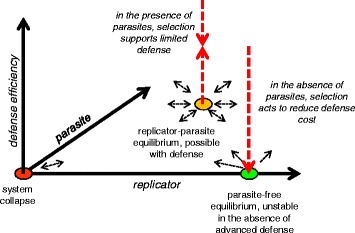
“Arguably the emergence and persistence of parasites is unavoidable, since parasite-free states are evolutionary unstable, and microbial populations cannot simultaneously clear parasites yet escape extinction through Muller’s ratchet [8, 9].”
BackgroundWhat is a Parasite? Defining reaction and network properties in an open ended automata chemistry
Stepney, S., & Hickinbotham, S. (2021) · Conference on Artificial Life (ALIFE) · doi:10.1162/isal_a_00413 · Cited by 3
“RNA world systems have similar initial properties, whether in vitro (Koonin et al., 2017) or in silico (Bansho et al., 2012): the process of replication happens when two entities in the system combine, and one partner manufactures a copy of the other partner.”
BackgroundPirovino, M., Iseli, C., Curran, J. A., & Conrad, B. (2023) · bioRxiv (Cold Spring Harbor Laboratory) · doi:10.1101/2023.05.25.542273 · Cited by 3
Virus Origins and the Origin of Life
Pan, D. (2021) · Advances in astrobiology and biogeophysics · doi:10.1007/978-3-030-81039-9_8 · Cited by 2
Saakian, D. B. (2020) · Chinese Journal of Physics · doi:10.1016/j.cjph.2020.11.009 · Cited by 1
Virolithopanspermia: Might viruses be transported in rocks through space?
Bushman, F. D. (2025) · PLoS Pathogens · doi:10.1371/journal.ppat.1012955 · Cited by 2
Ignatov, S. G., Filippovich, S. Y., & Dyatlov, I. A. (2021) · Springer eBooks · doi:10.1007/978-3-030-55490-3_7 · Cited by 1
“However, despite the rapid short-term evolution of viruses, the key genes responsible for virion formation and virus genome replication are conserved over the long term due to selective constraints (Szathmáry and Maynard Smith 1997; Takeuchi and Hogeweg 2007; Takeuchi and Hogeweg 2012; Iranzo et al. 2016; Koonin et al…”
BackgroundKoonin, E. V., Wolf, Y. I., & Katsnelson, M. I. (2021) · Elsevier eBooks · doi:10.1016/b978-0-323-90752-1.00004-3 · Cited by 1
Self-citationChromatin and viral integration in immunity: The challenge of silencing non-self genes
Kabi, M., & Filion, G. J. P. (2022) · Trends in Immunology · doi:10.1016/j.it.2022.04.003 · Cited by 1
Smolovich, A. M. (2019) · arXiv (Cornell University) · doi:10.48550/arxiv.1906.07605 · Cited by 1
“id. However, opinions differ on whether viruses are a form of life or organic structures that interact with living organisms. They have been described as "organisms at the edge of life." In [7] viruses are considered to act an important part in the evaluation process. The viruses don’t demonstrate the life c…”
BackgroundBerezovskaya, F., Karev, G. P., & Koonin, E. V. (2021) · bioRxiv (Cold Spring Harbor Laboratory) · doi:10.1101/2021.02.20.432109 · Cited by 1
“This result supports the hypothesis of inevitable emergence and 132 persistence of genetic parasites caused by the evolutionary instability of parasite-free states [4].”
BackgroundMethodResultInfluentialSelf-citationStability of host-parasite systems: you must differ to coevolvePreprint
Berezovskaya, F., Karev, G. P., Katsnelson, M. I., Wolf, Y. I., & Koonin, E. V. (2018) · bioRxiv (Cold Spring Harbor Laboratory) · doi:10.1101/400150
Self-citationThe Origin(s) of Cell: Some Radical New HypothesesPreprint
Tang, S. (2020) · Preprints.org · doi:10.20944/preprints202002.0039.v1
The Pathophysiology of Repurposed Antiviral Drugs for treatment of COVID-19 Infection
Haider, A., Faheem, M. Q., Jamal, S. B., Naeem, M., Khalil, A. A. K., Khan, R., & Subhan, F. (2020) · Life and Science · doi:10.37185/lns.1.1.155
Hickinbotham, S., Stepney, S., & Hogeweg, P. (2021) · bioRxiv (Cold Spring Harbor Laboratory) · doi:10.1101/2021.02.25.432891
“In such systems, the emergence of ‘parasites’, which are replicated but do not harbour replication potential, is deemed inevitable in real life [17,18], in models [19], and in experiments [20].”
BackgroundМикробный арсенал противовирусной защиты. Глава I
Isaev, A. B., Musharova, O. S., & Severinov, K. (2021) · Biochemistry (Moscow) · doi:10.31857/s0320972521030076
Smolovich, A. M. (2021) · Biosystems · doi:10.1016/j.biosystems.2021.104541 · Cited by 1
Биологическая роль и эволюционная история систем CRISPR-Cas типа III
Kolesnik, M. V., Федорова, Я. В., Корнеева, К. О., Artamonova, D., & Severinov, K. (2021) · Biochemistry (Moscow) · doi:10.31857/s0320972521100134
Furubayashi, T., & Ichihashi, N. (2022) · Biophysics and Physicobiology · doi:10.2142/biophysico.bppb-v19.0005
“Since parasites inevitably appear in systems above a certain complexity [38,39], they could have played a pivotal role for continuous evolution and diversification of primitive replication systems that approached more complex cellular organisms.”
BackgroundPirovino, M., Iseli, C., Curran, J. A., & Conrad, B. (2025) · PLoS Computational Biology · doi:10.1371/journal.pcbi.1012162 · Cited by 6
Godeux, A.-S. (2020) · theses.fr (ABES) · doi:10.70675/d7245e5az0dbbz45e7zbe30z6dfedd7acd37 · Cited by 4
Broecker, F. (2026) · Springer eBooks · doi:10.1007/978-3-032-24295-2_10 · Cited by 1
Kanai, Y., & Ichihashi, N. (2026) · Molecular Biology and Evolution · doi:10.1093/molbev/msag184
“These parasitic molecules lack catalytic activity but replicate efficiently by exploiting enzymes encoded by active replica-tors (Mills et al. 1967; Bansho et al. 2016; Matsumura et al. 2016; Koonin et al. 2017).”
Metadata
- Authors
- Koonin, E. V., Wolf, Y. I., & Katsnelson, M. I.
- Affiliations
- National Institutes of Health (US)
- Radboud University Nijmegen (NL)
- Corresponding author
- Koonin, Eugene V.
- Venue
- Biology Direct
- Published
- 2017-12
- Volume
- 12
- Issue
- 1
- Pages
- 31-31
- ISSN
- 1745-6150 (ISSN-L)
- PMC
- PMC5715634
- OpenAlex
- W2752330500
- Cited by
- 74
- References
- 73
- Citations by year
- 2026: 3 · 2025: 2 · 2024: 2 · 2023: 7 · 2022: 13 · 2021: 19 · 2020: 12 · 2019: 7 · 2018: 9
- FWCI
- 5.08
- Type
- journal article
- Language
- en
- Open access
- gold
- doi.org
- Licence
- cc-by
- Locations
- Biology Direct (publishedVersion, cc-by)
- bioRxiv (Cold Spring Harbor Laboratory) (acceptedVersion, public-domain)
- Europe PMC (PubMed Central) (publishedVersion, cc-by)
- PubMed Central (publishedVersion, cc-by)
- PubMed (publishedVersion)
- Radboud Repository (Radboud University) (submittedVersion, other-oa)
- DOAJ (DOAJ: Directory of Open Access Journals) (submittedVersion)
- Radboud Repository (Radboud University) (submittedVersion)
- Funders
- U.S. Department of Health and Human Services (Intramural funds)
- Topics
- Life Sciences › Biochemistry, Genetics and Molecular Biology › Genetics › Evolution and Genetic Dynamics
- Physical Sciences › Physics and Astronomy › Astronomy and Astrophysics › Origins and Evolution of Life
- Social Sciences › Arts and Humanities › History and Philosophy of Science › Philosophy of Biology and Scientific Explanation
- Keywords
- evolutionary instability, viruses, mobile genetic elements, genetic diversity, thought experiments
- MeSH terms
- Animals, Biological Evolution, Models, Biological, Parasites
About these checks
Registry, retraction, Cites and statistics results are computed, not judged, with one exception: a printed reference that no index lists is read once by a model before it counts as a citation error. Claims are extracted by a model and kept only when their quote appears verbatim in the text; each cited source is then checked, with a model’s help, for whether it says what the claim relies on. Those verdicts can be wrong — read the claim’s quote and the cited source before relying on one.
Statistics and arithmetic are recomputed, not judged.
Confidence bands are shown only for fields calibrated on our annotated test set. None is calibrated yet, so no band is shown.
What counts as a claim ›How we measure confidence ›How we check this ›
Are you an author, or do you see a problem with this page? Request a review
Data sources
Bibliographic data: Semantic Scholar, OpenAlex, Crossref.
Contains information from the Semantic Scholar Academic Graph Datasets, made available under the ODC Attribution License (ODC-BY 1.0).
Semantic Scholar’s data is described in: Kinney, R., et al. (2023). The Semantic Scholar Open Data Platform. arXiv:2301.10140.
