

Stepped wedge randomised controlled trials: systematic review of studies published between 2010 and 2014
Open accessThe DOI matches its Crossref record; 69 of the 69 references it cites were found in a registry or an index.
Abstract
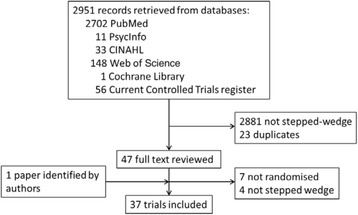
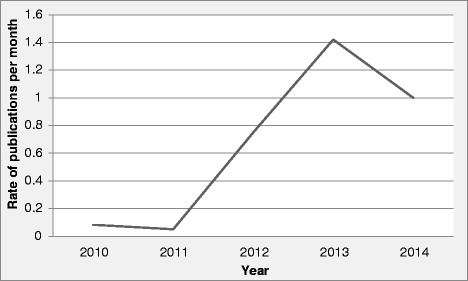
BACKGROUND: In a stepped wedge, cluster randomised trial, clusters receive the intervention at different time points, and the order in which they received it is randomised. Previous systematic reviews of stepped wedge trials have documented a steady rise in their use between 1987 and 2010, which was attributed to the design's perceived logistical and analytical advantages. However, the interventions included in these systematic reviews were often poorly reported and did not adequately describe the analysis and/or methodology used. Since 2010, a number of additional stepped wedge trials have been published. This article aims to update previous systematic reviews, and consider what interventions were tested and the rationale given for using a stepped wedge design. METHODS: We searched PubMed, PsychINFO, the Cumulative Index to Nursing and Allied Health Literature (CINAHL), the Web of Science, the Cochrane Library and the Current Controlled Trials Register for articles published between January 2010 and May 2014. We considered stepped wedge randomised controlled trials in all fields of research. We independently extracted data from retrieved articles and reviewed them. Interventions were then coded using the functions specified by the Behaviour Change Wheel, and for behaviour change techniques using a validated taxonomy. RESULTS: Our review identified 37 stepped wedge trials, reported in 10 articles presenting trial results, one conference abstract, 21 protocol or study design articles and five trial registrations. These were mostly conducted in developed countries (n = 30), and within healthcare organisations (n = 28). A total of 33 of the interventions were educationally based, with the most commonly used behaviour change techniques being 'instruction on how to perform a behaviour' (n = 32) and 'persuasive source' (n = 25). Authors gave a wide range of reasons for the use of the stepped wedge trial design, including ethical considerations, logistical, financial and methodological. The adequacy of reporting varied across studies: many did not provide sufficient detail regarding the methodology or calculation of the required sample size. CONCLUSIONS: The popularity of stepped wedge trials has increased since 2010, predominantly in high-income countries. However, there is a need for further guidance on their reporting and analysis.
Overview
The claims and statistics of this paper haven’t been checked yet.
Free: it reads the open-access text and checks the first 5 claims that cite a source we can check. Create a free account to check every claim.
Integrity signals
Registry
Cites
Statistics
Figures
Verification
Claims the paper makes
The claims and statistics of this paper haven’t been checked yet.
Free: it reads the open-access text and checks the first 5 claims that cite a source we can check. Create a free account to check every claim.
Claims other papers make about this one
Each is checked against this paper’s own text: does it say what the citing paper says it does?
The source backs part of the claim, not all of it — or backs it for a different population, condition or comparison.
In the citing paper
“The phased approach allows for adjustments based on initial findings, enhancing the intervention's overall effectiveness (3, 12, 20–22).”
From Applications and implementation considerations for stepped-wedge designs in sub-Saharan Africa: a systematic review (2026) · cites this paper as [20]
Experimental — accuracy not yet measuredThe source backs part of the claim, not all of it — or backs it for a different population, condition or comparison.
In the citing paper
“The primary motivations for employing the SWD in SSA research are to address ethical concerns regarding withholding potentially beneficial interventions and to manage the logistical challenges of simultaneous intervention implementation across diverse, resource-limited settings (3, 13, 18, 20).”
From Applications and implementation considerations for stepped-wedge designs in sub-Saharan Africa: a systematic review (2026) · cites this paper as [20]
Experimental — accuracy not yet measured
Self-check
Percentages, sums and reported differences re-computed from the paper’s own numbers.
The self-check needs the paper’s full text.
Citations
Cites
Michie, S., Richardson, M., Johnston, M., Abraham, C., Francis, J., Hardeman, W., Eccles, M. P., Cane, J., & Wood, C. E. (2013) · Annals of Behavioral Medicine · doi:10.1007/s12160-013-9486-6 · Cited by 7,629 · cited 2×
“EB then used a taxonomy of 93 Behaviour Change Techniques (BCT Taxonomy v1) [22], to describe the components of each intervention.”
MethodConsort 2010 statement: extension to cluster randomised trials
Campbell, M. K., Piaggio, G., Elbourne, D. R., Altman, D. G., & for the CONSORT Group (2012) · BMJ · doi:10.1136/bmj.e5661 · Cited by 3,510
CONSORT statement: extension to cluster randomised trials
Campbell, M. K., Elbourne, D. R., & Altman, D. G. (2004) · BMJ · doi:10.1136/bmj.328.7441.702 · Cited by 2,557 · cited 1×
“randomised trials are now well established [1, 2].”
A taxonomy of behavior change techniques used in interventions
Abraham, C., & Michie, S. (2008) · Health Psychology · doi:10.1037/0278-6133.27.3.379 · Cited by 2,525 · cited 1×
“[22, 23] were followed, including only coding BCTs when there was unequivocal evidence of their inclusion in a given intervention.”
Method(2014) · Cited by 2,276
The stepped wedge cluster randomised trial: rationale, design, analysis, and reporting
Hemming, K., Haines, T. P., Chilton, P. J., Girling, A. J., & Lilford, R. J. (2015) · BMJ · doi:10.1136/bmj.h391 · Cited by 1,410
Design and analysis of stepped wedge cluster randomized trials
Hussey, M. A., & Hughes, J. P. (2007) · Contemporary Clinical Trials · doi:10.1016/j.cct.2006.05.007 · Cited by 1,393 · cited 3×
“Those accounting for the stepped wedge design most commonly used the approach recommended by Hussey and Hughes [6].”
MethodInfluentialCollins, L. M., Murphy, S. A., & Strecher, V. (2007) · American Journal of Preventive Medicine · doi:10.1016/j.amepre.2007.01.022 · Cited by 1,082 · cited 1×
“However, the excess expense of this over factorial designs should be considered [64].”
BackgroundThe stepped wedge trial design: a systematic review
Brown, C. A., & Lilford, R. J. (2006) · BMC Medical Research Methodology · doi:10.1186/1471-2288-6-54 · Cited by 907
Hayes, R. J., & Moulton, L. H. (2009) · Chapman & Hall/CRC eBooks · doi:10.1201/9781584888178 · Cited by 887
Research works printed but not linked: 1
- Fearon P Quinn T Wright F Fraser P McAlpine C Stott D Evaluation of a telephone hotline to enhance rapid outpatient assessment of minor stroke or TIA: a stepped wedge cluster randomised control trial, International Journal of Stroke 2013 NJ Wiley-Blackwell
Cited by
Items 101–147 of 147
de Kraker, M. E. A., & Harbarth, S. (2017) · Elsevier eBooks · doi:10.1016/b978-0-12-810477-4.00020-9 · Cited by 6
Lorente-Català, R., Gili, M., del Hoyo, Y. L., Mayoral, F., Pérez‐Aranda, A., Castro, A., Moreno, E. V., Baños, R., Roca, M., Monreal‐Bartolomé, A., et al. (2022) · Internet Interventions · doi:10.1016/j.invent.2022.100581 · Cited by 6
The relative efficiency of staircase and stepped wedge cluster randomised trial designs
Grantham, K. L., Forbes, A. B., Hooper, R., & Kasza, J. (2025) · Statistical Methods in Medical Research · doi:10.1177/09622802251317613 · Cited by 5
Watson, S., & Hooper, R. (2025) · BMJ Quality & Safety · doi:10.1136/bmjqs-2025-018697 · Cited by 5
Variance formulae for multiphase stepped wedge cluster randomized trial
Zhang, P., Shoben, A. B., Jackson, R., & Fernández, S. (2020) · Statistics in Medicine · doi:10.1002/sim.8716 · Cited by 5
Patients' perspectives of medications for addiction treatment in HIV clinics: A qualitative study
Morford, K. L., Muvvala, S. B., Chan, P. A., Cornman, D. H., Doernberg, M., Porter, E., Virata, M., Yager, J. E., Fiellin, D. A., & Edelman, E. J. (2022) · Journal of Substance Abuse Treatment · doi:10.1016/j.jsat.2022.108767 · Cited by 5
Parker, R. A., Manner, J., Sivaramakrishnan, D., Baker, G., Stoddart, A., Lloyd, S., & Jepson, R. G. (2020) · Pilot and Feasibility Studies · doi:10.1186/s40814-020-00683-1 · Cited by 5
Cluster Randomized Trials in Nursing Homes: Changing the Design Paradigm
Poupin, P., Caille, A., Gana, W., Fougère, B., & Giraudeau, B. (2023) · Journal of Clinical Epidemiology · doi:10.1016/j.jclinepi.2023.06.016 · Cited by 4
Arabi, Y. M., Vishwakarma, R. K., Al‐Dorzi, H. M., Qasim, E. A., Abdukahil, S. A., Al-Rabeah, F. K., Ghamdi, H. A., Ghamdi, E. A., the SCREEN Trial Group, Arabi, Y. M., et al. (2021) · Trials · doi:10.1186/s13063-021-05788-3 · Cited by 3
Design and Analysis of Pragmatic Trials
Zhang, S., Ahn, C. W., & Zhu, H. (2023) · Chapman & Hall/CRC eBooks · doi:10.1201/9781003126010 · Cited by 3
Bergsvik, D., Grøtting, M. W., & Rossow, I. M. (2024) · Addiction · doi:10.1111/add.16683 · Cited by 3
Wu, D., Park, H., Grudzen, C. R., & Goldfeld, K. S. (2025) · Statistics in Medicine · doi:10.1002/sim.10304 · Cited by 3
Parker, R. A., Keerie, C., Weir, C. J., Anand, A., & Mills, N. L. (2022) · PLoS ONE · doi:10.1371/journal.pone.0271027 · Cited by 3
Poupin, P., Ansoborlo, M., Caille, A., Dibao-Dina, C., Fougère, B., & Giraudeau, B. (2022) · Journal of Clinical Epidemiology · doi:10.1016/j.jclinepi.2022.08.001 · Cited by 3
Multilevel Intervention Stepped Wedge Designs (MLI-SWDs)
Sperger, J., Kosorok, M. R., Linnan, L. A., & Kneipp, S. M. (2024) · Prevention Science · doi:10.1007/s11121-024-01657-y · Cited by 3
“Common rationales for choosing a SWD — logistical feasibility, improved power, recruitment benefits, and ethical or political constraints in withholding interventions — are the subject of ongoing debate (Beard et al., 2015; Hooper & Eldridge, 2021).”
BackgroundNevins, P., Davis‐Plourde, K. L., Macedo, J. A. P., Ouyang, Y., Ryan, M., Tong, G., Wang, X., Meng, C., Ortiz‐Reyes, L., Caille, A., et al. (2022) · uO Research (University of Ottawa) · doi:10.20381/ruor-28114 · Cited by 3
Advancing knowledge in stepped-wedge cluster randomised controlled trials
Martín, J. (2018) · University of Birmingham Institutional Research Archive (University of Birmingham) · Cited by 4
Goldstein, C. E., Shaw, J. F., Binik, A., Nix, H. P., Ortiz‐Reyes, L., Mazzetti, T., Sergeant, A., Weijer, C., & Taljaard, M. (2025) · Journal of Clinical Epidemiology · doi:10.1016/j.jclinepi.2025.112051 · Cited by 2
Brown, S. P., & Shoben, A. B. (2020) · Clinical Trials · doi:10.1177/1740774520901488 · Cited by 2
Grøtting, M. W., Bergsvik, D., & Rossow, I. M. (2021) · Addiction · doi:10.1111/add.15704 · Cited by 2
Design and analysis of stepped wedge cluster randomised trials
Barker, D. (2018) · Figshare · Cited by 2
A comparative study of R functions for clustered data analysis
Wang, W., & Harhay, M. O. (2021) · Trials · doi:10.1186/s13063-021-05900-7 · Cited by 1
Onderzoeksdesign voor evaluatie kwaliteitsverbeteringen: De stepped-wedge cluster randomised trial
Ubbink, D. T., van Dieren, S., & Vermeulen, H. (2016) · Nederlands Tijdschrift voor Evidence Based Practice · doi:10.1007/s12468-016-0009-x · Cited by 1
ROBUST AND ADAPTIVE DESIGN APPROACHES FOR STEPPED WEDGE CLUSTER RANDOMIZED TRIALS
Wang, J. (2019) · SMU Scholar (Southern Methodist University) · Cited by 1
Tan, P. J., Ginting, M. L., Lim, Z. Z. B., Balachandar, N., Sultana, R., Kadir, M. M., Xu, T., Ismail, N. H., Yap, J. K. Y., Wong, S. F., et al. (2023) · BMJ Open · doi:10.1136/bmjopen-2023-072029 · Cited by 1
Hall, C. D. X., Ethier, K. L., Cummings, P., Freeman, A., Bovbjerg, K., Bannon, J., Dakin, A., Abujado, F., Bouacha, N., Derricotte, D., et al. (2024) · Trials · doi:10.1186/s13063-024-08475-1 · Cited by 1
“In modeling individual depressive symptoms, we will utilize multilevel latent growth curve modeling [104] to estimate adjusted latent growth curves while accounting for nesting of observations both with clusters and individuals over time [104, 105].”
MethodPeden, M. E. (2018) · Research Online (University of Wollongong) · Cited by 1
Noblet, T. (2018) · http://isrctn.com/ · doi:10.1186/isrctn15516596 · Cited by 1
Hongsuwan, M., Srisamang, P., Nuntalohit, S., Luangasanatip, N., Lim, C., Day, N., Limmathurotsakul, D., & Cooper, B. S. (2022) · medRxiv · doi:10.1101/2022.11.24.22282731 · Cited by 1
Musa, Z. A., Akinsolu, F. T., Salako, A. O., Abodunrin, O. R., Ola, O. M., & Ezechi, O. C. (2026) · Frontiers in Epidemiology · doi:10.3389/fepid.2026.1529289
Gray, H., Brady, M., Bain, B., Weir, C. J., Keerie, C., & McQueen, J. (2018) · Research Square · doi:10.21203/rs.2.39/v1
“Although it appears that use of CONSORT checklists and flow diagrams has been associated with 4 some improvement in reporting of parallel group randomised trials (7)(Plint et al, 2006), limitations in the quality of the reporting of SW-CRCTs remain (8)(Beard et al 2015).”
MethodHemming, K., Carroll, K. A., Thompson, J. A., Forbes, A. B., Taljaard, M., Review Group, S. W. C. R. T., & Pilling, M. A. (2019) · Apollo (University of Cambridge) · doi:10.17863/cam.35497
Self-citationELIJAH: Electronic Linkage for Inflammatory bowel disease to deliver Joint Access to Health-reports
Dodds, P. (2018) · Cronfa (Swansea University) · doi:10.23889/suthesis.50579
Statistical Methods for the Design and Analysis of Infectious Disease Studies
Kennedy‐Shaffer, L. (2020) · Digital Access to Scholarship at Harvard (DASH) (Harvard University)
Mariathas, H. H., Asghari, S., Hurley, O., Anaraki, N. R., Young, C., Aubrey‐Bassler, K., Wang, P., Gadag, V. G., Nguyen, H. V., Etchegary, H., et al. (2021) · doi:10.2196/preprints.30454
Adisso, É. L., Taljaard, M., Rivest, L., Zomahoun, H. T. V., Durand, P. J., & Légaré, F. (2020) · Research Square · doi:10.21203/rs.3.rs-133475/v1
“Due to the inherent confounding of the treatment effect with time, analysis of a SW-CRT should always account for secular trends [9, 54].”
BackgroundMethodField Test, Plan Evaluation, and Prepare to Launch
BN, M. M. B. H., & Graham, F. I. D. (2021) · Wiley eBooks · doi:10.1002/9781119123316.ch12
Coordinated Care for Optimization of Cardiovascular Preventive Therapies in Patients With Diabetes
Hsu, N., Fu, Y., & Hsu, C. (2023) · JAMA · doi:10.1001/jama.2023.11538
Martinez, F. J. (2024) · Elsevier eBooks · doi:10.1016/b978-0-323-85663-8.00100-8
Punnett, L., Nobrega, S., Zhang, Y., Rice, S., Gore, R. J., & Kurowski, A. (2020) · Figshare · doi:10.6084/m9.figshare.13023482
Power calculation for cross-sectional stepped-wedge cluster randomized trials with binary outcomes
Harrison, L. J., & Wang, R. (2020) · Collection of Biostatistics Research Archive
Taylor, K., McLellan, J., Kristunas, C., Bankhead, C. R., Pidduck, N., Roberts, N. W., Perera, R., & Hemming, K. (2026) · International Journal of Epidemiology · doi:10.1093/ije/dyaf217
Optimizing precision in stepped-wedge designs via machine learning and quadratic inference functionsPreprint
Lyu, L., & Wang, B. (2026) · arXiv (Cornell University) · doi:10.48550/arxiv.2602.10348
Implementing the collaborative chronic care model for mental health: a nonrandomized clinical trial
Miller, C. J., Sullivan, J. L., Stolzmann, K., Raciborski, R. A., Brown, M. B., Bailey, H. M., Connolly, S. L., Morena, A. L., Dougherty, M., Henderson, A. K., et al. (2026) · Implementation Science Communications · doi:10.1186/s43058-026-00995-y
“We employed a cluster stepped wedge design to enhance internal validity while also ensuring that all participating sites received IF [21], consistent with the needs of OMH.”
Evaluating Public Health Interventions
Lépine, A., & Treibich, C. (2026) · UCL Press eBooks · doi:10.14324/111.9781800087484
Metadata
- Authors
- Beard, E., Lewis, J. J., Copas, A., Davey, C., Osrin, D., Baio, G., Thompson, J. A., Fielding, K. L., Omar, R. Z., Ononge, S., Hargreaves, J., & Prost, A.
- Affiliations
- University College London (GB)
- London School of Hygiene & Tropical Medicine (GB)
- MRC Clinical Trials Unit at UCL (GB)
- Makerere University (UG)
- Corresponding author
- Beard, Emma
- Lewis, James J.
- ORCID
- Venue
- Trials
- Published
- 2015-08-17
- Volume
- 16
- Issue
- 1
- Pages
- 353-353
- ISSN
- 1745-6215 (ISSN-L)
- PMC
- PMC4538902
- OpenAlex
- W2143192949
- Cited by
- 135
- References
- 69
- Citations by year
- 2026: 2 · 2025: 6 · 2024: 7 · 2023: 8 · 2022: 14 · 2021: 15 · 2020: 20 · 2019: 14 · 2018: 8 · 2017: 22 · 2016: 13 · 2015: 6
- FWCI
- 2.99
- Type
- journal article
- Language
- en
- Open access
- gold
- doi.org
- Licence
- Locations
- Trials (publishedVersion, cc-by)
- PubMed Central (publishedVersion, cc-by)
- PubMed (publishedVersion)
- LSHTM Research Online (London School of Hygiene and Tropical Medicine) (acceptedVersion)
- UCL Discovery (University College London) (submittedVersion)
- ORCA Online Research @Cardiff (Cardiff University) (submittedVersion)
- Funders
- Doris Duke Charitable Foundation (2009060)
- Pfizer
- Wellcome Trust (091561/Z/10/Z, 091561, 100714)
- Cancer Research UK
- National Institute for Health and Care Research (RMOFS-2013-03-02)
- University College London
- Medical Research Council (MR/K007467/1, MR/K012126/1, MC_UU_12023/29)
- School for Public Health Research
- Topics
- Health Sciences › Health Professions › General Health Professions › Health Policy Implementation Science
- Physical Sciences › Mathematics › Statistics and Probability › Statistical Methods in Clinical Trials
- Social Sciences › Decision Sciences › Statistics, Probability and Uncertainty › Meta-analysis and systematic reviews
- Keywords
- stepped wedge design, trial reporting quality, behaviour change techniques, Behaviour Change Wheel, sample size determination, health interventions, educational intervention, clinical trial design
- MeSH terms
- Humans, Research Design, Research Support as Topic, Socioeconomic Factors, Time Factors, Randomized Controlled Trials as Topic, Sample Size, Patient Selection
About these checks
Registry, retraction, Cites and statistics results are computed, not judged, with one exception: a printed reference that no index lists is read once by a model before it counts as a citation error. Claims are extracted by a model and kept only when their quote appears verbatim in the text; each cited source is then checked, with a model’s help, for whether it says what the claim relies on. Those verdicts can be wrong — read the claim’s quote and the cited source before relying on one.
Statistics and arithmetic are recomputed, not judged.
Confidence bands are shown only for fields calibrated on our annotated test set. None is calibrated yet, so no band is shown.
What counts as a claim ›How we measure confidence ›How we check this ›
Are you an author, or do you see a problem with this page? Request a review
Data sources
Bibliographic data: Semantic Scholar, OpenAlex, Crossref.
Contains information from the Semantic Scholar Academic Graph Datasets, made available under the ODC Attribution License (ODC-BY 1.0).
Semantic Scholar’s data is described in: Kinney, R., et al. (2023). The Semantic Scholar Open Data Platform. arXiv:2301.10140.
