

The DOI matches its Crossref record; 61 of the 61 references it cites were found in a registry or an index.
Single-session gamified virtual reality exposure therapy for spider phobia vs. traditional exposure therapy: study protocol for a randomized controlled non-inferiority trial
Open accessAbstract
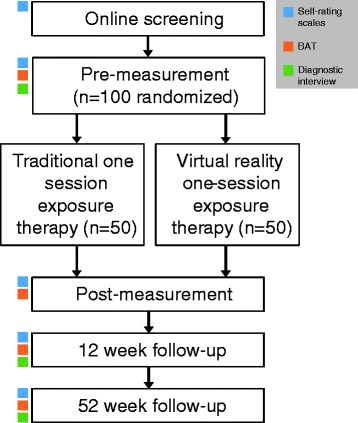
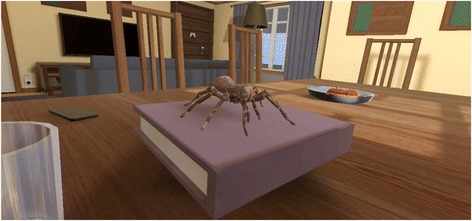
BACKGROUND: Traditional one-session exposure therapy (OST) in which a patient is gradually exposed to feared stimuli for up to 3 h in a one-session format has been found effective for the treatment of specific phobias. However, many individuals with specific phobia are reluctant to seek help, and access to care is lacking due to logistic challenges of accessing, collecting, storing, and/or maintaining stimuli. Virtual reality (VR) exposure therapy may improve upon existing techniques by facilitating access, decreasing cost, and increasing acceptability and effectiveness. The aim of this study is to compare traditional OST with in vivo spiders and a human therapist with a newly developed single-session gamified VR exposure therapy application with modern VR hardware, virtual spiders, and a virtual therapist. METHODS/DESIGN: Participants with specific phobia to spiders (N = 100) will be recruited from the general public, screened, and randomized to either VR exposure therapy (n = 50) or traditional OST (n = 50). A behavioral approach test using in vivo spiders will serve as the primary outcome measure. Secondary outcome measures will include spider phobia questionnaires and self-reported anxiety, depression, and quality of life. Outcomes will be assessed using a non-inferiority design at baseline and at 1, 12, and 52 weeks after treatment. DISCUSSION: VR exposure therapy has previously been evaluated as a treatment for specific phobias, but there has been a lack of high-quality randomized controlled trials. A new generation of modern, consumer-ready VR devices is being released that are advancing existing technology and have the potential to improve clinical availability and treatment effectiveness. The VR medium is also particularly suitable for taking advantage of recent phobia treatment research emphasizing engagement and new learning, as opposed to physiological habituation. This study compares a market-ready, gamified VR spider phobia exposure application, delivered using consumer VR hardware, with the current gold standard treatment. Implications are discussed. TRIAL REGISTRATION: ClinicalTrials.gov identifier NCT02533310. Registered on 25 August 2015.
Overview
The claims and statistics of this paper haven’t been checked yet.
Run the check — free, no account needed. It reads the open-access text and checks the sources it cites.
Integrity signals
Registry
Cites
Statistics
Figures
Verification
Claims the paper makes
The claims and statistics of this paper haven’t been checked yet.
Run the check — free, no account needed. It reads the open-access text and checks the sources it cites.
Claims other papers make about this one
Each is checked against this paper’s own text: does it say what the citing paper says it does?
The source backs part of the claim, not all of it — or backs it for a different population, condition or comparison.
In the citing paper
“and is more accessible, confidential, and resource-effective compared to traditional exposure in vivo (Carl et al., 2019; Emmelkamp, 2005; Miloff et al., 2016; Reeves et al., 2022).”
From Virtual Reality exposure therapy in the treatment of public speaking anxiety and social anxiety disorder (2024) · cites this paper as Miloff et al., 2016
Experimental — accuracy not yet measured
Self-check
Percentages, sums and reported differences re-computed from the paper’s own numbers.
The self-check needs the paper’s full text.
Citations
Cites
Diagnostic and Statistical Manual of Mental Disorders
American Psychiatric Association (2013) · doi:10.1176/appi.books.9780890425596 · Cited by 116,369
Diagnostic and Statistical Manual of Mental Disorders
Williams, J. B. W., & First, M. B. (2013) · Oxford University Press eBooks · doi:10.1093/acrefore/9780199975839.013.104 · Cited by 109,845
A Brief Measure for Assessing Generalized Anxiety Disorder: The GAD-7
Spitzer, R. L., Kroenke, K., Williams, J. B. W., & Löwe, B. (2006) · Archives of Internal Medicine · doi:10.1001/archinte.166.10.1092 · Cited by 31,765
CONSORT 2010 Statement: updated guidelines for reporting parallel group randomised trials
the CONSORT Group, Schulz, K. F., Altman, D. G., & Moher, D. (2010) · BMC Medicine · doi:10.1186/1741-7015-8-18 · Cited by 13,371
From game design elements to gamefulness: defining "gamification"
Deterding, S., Dixon, D., Khaled, R., & Nacke, L. (2011) · Proceedings of the 15th International Academic MindTrek Conference: Envisioning Future Media Environments · doi:10.1145/2181037.2181040 · Cited by 8,402 · cited 1×
“Serious games designed for purposes other than entertainment and allowing users to experience situations impossible or dangerous in real life [23], with gamified elements such as points and goals to increase engagement [24], may provide a particularly promising advancement in exposure therapy.”
BackgroundSPIRIT 2013 Statement: Defining Standard Protocol Items for Clinical Trials
Chan, A.-W., Tetzlaff, J. M., Altman, D. G., Laupacis, A., Gøtzsche, P. C., Krleža-Jerić, K., Hróbjartsson, A., Mann, H., Dickersin, K., Berlin, J. A., et al. (2013) · Annals of Internal Medicine · doi:10.7326/0003-4819-158-3-201302050-00583 · Cited by 7,363 · cited 1×
“All design, implementation, and reporting will be carried out in accordance with CONSORT and SPIRIT guidelines [49–51].”
MethodThe PHQ-9: A New Depression Diagnostic and Severity Measure
Kroenke, K., & Spitzer, R. L. (2002) · Psychiatric Annals · doi:10.3928/0048-5713-20020901-06 · Cited by 5,898 · cited 3×
“The Generalized Anxiety Disorder 7-item scale (GAD-7) [39] will be used to measure generic anxiety symptoms, and the Patient Health Questionnaire-9 (PHQ-9) [40] will be used to evaluate depression symptoms.”
MethodSimulator Sickness Questionnaire: An Enhanced Method for Quantifying Simulator Sickness
Kennedy, R. S., Lane, N. E., Berbaum, K. S., & Lilienthal, M. G. (1993) · The International Journal of Aviation Psychology · doi:10.1207/s15327108ijap0303_3 · Cited by 5,457 · cited 3×
“Immediately following treatment, VR-treated participants will answer the Simulator Sickness Questionnaire (SSQ) [43], a measure of participant discomfort during treatment.”
BackgroundAn Empirical Evaluation of the System Usability Scale
Bangor, A., Kortum, P. T., & Miller, J. T. (2008) · International Journal of Human–Computer Interaction · doi:10.1080/10447310802205776 · Cited by 5,181 · cited 3×
“At postmeasurement, VR-treated participants will further complete the iGroup Presence Questionnaire (IPQ) [44], a measure of the sense of actually being in the virtual environment, and the System Usability Scale (SUS) [45], which assesses product complexity and ease of use.”
MethodKessler, R. C., Petukhova, M., Sampson, N. A., Zaslavsky, A. M., & Wittchen, H. (2012) · International Journal of Methods in Psychiatric Research · doi:10.1002/mpr.1359 · Cited by 2,947
Research works printed but not linked: 1
- First MB, Spitzer RL, Gibbon M, Williams JBW. Structured Clinical Interview for DSM-IV-TR, Axis I Disorders, Research Version, Patient Edition (SCID-I/P). New York: Biometrics Research, New York State Psychiatric Institute; 2002.
Cited by
Sorted by citations
Carl, E., Stein, A. T., Levihn-Coon, A., Pogue, J. R., Rothbaum, B., Emmelkamp, P., Asmundson, G. J. G., Carlbring, P., & Powers, M. B. (2019) · Journal of Anxiety Disorders · doi:10.1016/j.janxdis.2018.08.003 · Cited by 889
Self-citationRecent Progress in Virtual Reality Exposure Therapy for Phobias: A Systematic Review
Botella, C., Fernández-Álvarez, J., Guillén, V., García-Palacios, A., & Baños, R. (2017) · Current Psychiatry Reports · doi:10.1007/s11920-017-0788-4 · Cited by 460
Fodor, L. A., Coteț, C. D., Cuijpers, P., Szamoskozi, Ș., David, D., & Cristea, I. A. (2018) · Scientific Reports · doi:10.1038/s41598-018-28113-6 · Cited by 284
Applying Modern Virtual and Augmented Reality Technologies to Medical Images and Models
Sutherland, J., Bélec, J., Sheikh, A. M., Chepelev, L. L., Althobaity, W., Chow, B. J. W., Mitsouras, D., Christensen, A. M., Rybicki, F. J., & Russa, D. J. L. (2018) · Journal of Imaging Informatics in Medicine · doi:10.1007/s10278-018-0122-7 · Cited by 311
Wechsler, T. F., Kümpers, F., & Mühlberger, A. (2019) · Frontiers in Psychology · doi:10.3389/fpsyg.2019.01758 · Cited by 282
Metadata
- Authors
- Miloff, A., Lindner, P., Hamilton, W., Reuterskiöld, L., Andersson, G., & Carlbring, P.
- Affiliations
- Stockholm University (SE)
- Linköping University (SE)
- Corresponding author
- Miloff, Alexander
- Venue
- Trials
- Published
- 2016-02-02
- Volume
- 17
- Issue
- 1
- Pages
- 60-60
- ISSN
- 1745-6215 (ISSN-L)
- PMC
- PMC4736108
- OpenAlex
- W2272558351
- Cited by
- 141
- References
- 61
- Citations by year
- 2026: 9 · 2025: 17 · 2024: 11 · 2023: 20 · 2022: 8 · 2021: 15 · 2020: 17 · 2019: 19 · 2018: 17 · 2017: 7 · 2016: 1
- FWCI
- 22.86
- Type
- journal article
- Language
- en
- Open access
- gold
- doi.org
- Licence
- cc-by
- Locations
- Trials (publishedVersion, cc-by)
- PubMed Central (publishedVersion, cc-by)
- PubMed (publishedVersion)
- KTH Publication Database DiVA (KTH Royal Institute of Technology) (submittedVersion, other-oa)
- Funders
- Vetenskapsrådet (2011-2913)
- Forskningsrådet om Hälsa, Arbetsliv och Välfärd (SE) (2011-2913)
- Topics
- Physical Sciences › Computer Science › Human-Computer Interaction › Virtual Reality Applications and Impacts
- Social Sciences › Psychology › Experimental and Cognitive Psychology › Anxiety, Depression, Psychometrics, Treatment, Cognitive Processes
- Social Sciences › Psychology › Applied Psychology › Digital Mental Health Interventions
- Keywords
- spider phobia, virtual reality exposure therapy, specific phobia, non-inferiority, anxiety, depression, quality of life
- MeSH terms
- Equivalence Trials as Topic, Adult, Animals, Clinical Protocols, Humans, Phobic Disorders, Spiders, Outcome Assessment, Health Care, Virtual Reality Exposure Therapy
About these checks
Registry, retraction, Cites and statistics results are computed, not judged, with one exception: a printed reference that no index lists is read once by a model before it counts as a citation error. Claims are extracted by a model and kept only when their quote appears verbatim in the text; each cited source is then checked, with a model’s help, for whether it says what the claim relies on. Those verdicts can be wrong — read the claim’s quote and the cited source before relying on one.
Statistics and arithmetic are recomputed, not judged.
Confidence bands are shown only for fields calibrated on our annotated test set. None is calibrated yet, so no band is shown.
What counts as a claim ›How we measure confidence ›How we check this ›
Are you an author, or do you see a problem with this page? Request a review
