

Exercise combined with Acceptance and Commitment Therapy (ExACT) compared to a supervised exercise programme for adults with chronic pain: study protocol for a randomised controlled trial.
Open accessThe DOI matches its Crossref record; 74 of the 75 references it cites were found in a registry or an index, and 1 are not checked yet; 21 of the 66 sources its claims cite were checked for support.
Abstract
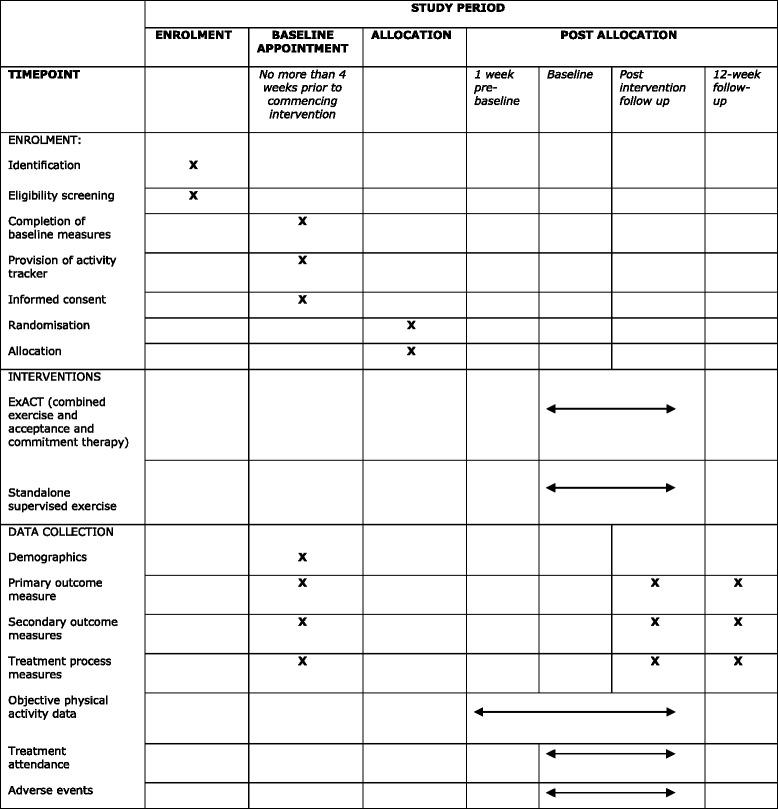
Background: Acceptance and Commitment Therapy (ACT) is a form of cognitive behavioural therapy, which may be beneficial for people with chronic pain. The approach aims to enhance daily functioning through increased psychological flexibility. Whilst the therapeutic model behind ACT appears well suited to chronic pain, there is a need for further research to test its effectiveness in clinical practice, particularly with regards to combining ACT with physical exercise.Methods/design: This prospective, two-armed, parallel-group, single-centre randomised controlled trial (RCT) will assess the effectiveness of a combined Exercise and ACT programme, in comparison to supervised exercise for chronic pain. One hundred and sixty patients, aged 18 years and over, who have been diagnosed with a chronic pain condition by a physician will be recruited to the trial. Participants will be individually randomised to one of two 8-week, group interventions. The combined group will take part in weekly psychology sessions based on the ACT approach, in addition to supervised exercise classes led by a physiotherapist. The control group will attend weekly supervised exercise classes but will not take part in an ACT programme. The primary outcome will be pain interference at 12-week follow-up, measured using the Brief Pain Inventory-Interference Scale. Secondary outcomes will include self-reported pain severity, self-perception of change, patient satisfaction, quality of life, depression, anxiety and healthcare utilisation. Treatment process measures will include self-efficacy, pain catastrophising, fear avoidance, pain acceptance and committed action. Physical activity will be measured using Fitbit ZipTM activity trackers. Both groups will be followed up post intervention and again after 12 weeks. Estimates of treatment effects at follow-up will be based on an intention-to-treat framework, implemented using a linear mixed-effects model. Individual and focus group qualitative interviews will be undertaken with a purposeful sample of participants to explore patient experiences of both treatments.Discussion: To our knowledge, this will be the first RCT to examine whether combining exercise with ACT produces greater benefit for patients with chronic pain, compared to a standalone supervised exercise programme.Trial Registration: www.ClinicalTrials.gov, ID: NCT03050528 . Registered on 13 February 2017.
Verified 2026-11-22 · 1 reference not checked yet
Overview
CoChat Summary
## TL;DR
This is a study protocol for a two-armed randomized controlled trial testing whether an 8-week group program combining exercise with Acceptance and Commitment Therapy (ExACT) reduces pain interference more than supervised exercise alone in adults with chronic pain. The trial will enroll 160 adults and use pain interference at 12 weeks as the primary outcome, with secondary outcomes including pain severity, quality of life, mood, healthcare use, and objectively measured physical activity.
## Key findings
- Not stated in the paper.
- The trial is designed to recruit 160 participants randomized to ExACT or supervised exercise, with 80 per group after allowing for 20% attrition.
- The primary outcome is pain interference at 12-week follow-up, measured by the Brief Pain Inventory-Interference Scale (BPIIS).
- Secondary outcomes include pain severity, self-perception of change, patient satisfaction, quality of life, depression, anxiety, healthcare costs, and treatment process measures such as self-efficacy, pain catastrophising, fear avoidance, pain acceptance, and committed action.
## Methods
- Design: Two-armed, single-centre, parallel-group, randomised controlled superiority trial.
- Sample/setting: Adults 18 years and older with physician-diagnosed chronic pain persisting >12 weeks, recruited from a consultant-led pain clinic and musculoskeletal outpatient clinics in a large academic teaching hospital in Dublin, Ireland; key inclusion required BPIIS ≥ 2 and English-language communication.
- Intervention and analysis: ExACT consists of eight weekly 3.5-hour group sessions combining ACT-based psychology and supervised exercise; control is eight weekly 1.5-hour supervised exercise sessions. Outcomes will be analyzed on an intention-to-treat basis using linear mixed models, with physical activity assessed via Fitbit Zip trackers and an embedded qualitative study using focus groups and interviews.
## Limitations
- The paper explicitly states that blinding of patients and treating health professionals will not be possible because of the nature of the interventions.
- The paper also notes the challenge of studying “complex interventions” and emphasizes efforts to reduce bias through randomization, allocation concealment, fidelity assessment, and handling missing data.
- Evident from the text: this is a protocol, so it reports planned methods and outcomes rather than trial results.
Model-written summary. Check it against the paper before relying on it.
Integrity signals
Registry
Cites
Statistics
Figures
Verification
Claims the paper makes
18 Valid · 2 Not valid · 30 Not checked · 42 Own results and interpretations
The cited sources support only part of this claim — read each source’s verdict below.
In the paper
“Furthermore, in the RCTs published to date, ACT as a standalone therapy has not been shown to be effective in enhancing physical activity [26, 27].”
§ Exercise combined with Acceptance and Commitment Therapy (ExACT) compared to a supervised exercise programme for adults with chronic pain: study protocol for a randomised controlled trial > Background
What the sources say
- Partly supportedcites [26] Kangasniemi AM Lappalainen R Kankaanpaa A Tolvanen A Tammelin T Towards a physically more active lifestyle based on one’s own values: the results of a randomized controlled trial among physically inactive adults BMC Public Health 2015 15 1 260 10.1186/s12889-015-1604-x 25848812 PMC4371624 sourceExperimental — accuracy not yet measured
The Discussion (page unavailable) reports no greater increase in mean physical activity for the ACT-based group than for the feedback-only group. But the Methods describe an ACT intervention combined with feedback and self-monitoring, not standalone ACT. This trial therefore does not establish the broader claim about standalone ACT across published RCTs. (LLM, conf=0.86)
- Not checked — no full text of the sourcecites [27] VanBuskirk K Roesch S Afari N Wetherell JL Physical activity of patients with chronic pain receiving Acceptance and Commitment Therapy or Cognitive Behavioural Therapy: 1 Behav Chang 2014 31 2 131 10.1017/bec.2014.6 source
plain- Asserted: passes — The authors put it forward as true.
- Checkable: passes — It can be checked against evidence.
- Load-bearing: passes — The paper’s conclusions depend on it.
- Based: passes — The paper gives a reason why it holds.
- Partly supported
The cited sources support only part of this claim — read each source’s verdict below.
In the paper
“No particular type of exercise has been shown to be superior to another [5, 18]”
§ Exercise combined with Acceptance and Commitment Therapy (ExACT) compared to a supervised exercise programme for adults with chronic pain: study protocol for a randomised controlled trial > Background
What the sources say
- Not checked — no full text of the sourcecites [5] van Middelkoop M Rubinstein SM Verhagen AP Ostelo RW Koes BW van Tulder MW Exercise therapy for chronic nonspecific low-back pain Best Pract Res Clin Rheumatol 2010 24 2 193 204 10.1016/j.berh.2010.01.002 20227641 source
- Partly supportedcites [18] Smith BE Littlewood C May S An update of stabilisation exercises for low back pain: a systematic review with meta-analysis BMC Musculoskelet Disord 2014 15 416 10.1186/1471-2474-15-416 25488399 PMC4295260 sourceExperimental — accuracy not yet measured
The Results > Pain section reports no clinically significant difference between stabilisation and other exercises, and the Discussion > Summary of main findings says stabilisation offers no long-term benefit over other exercise forms (page numbers unavailable). But the review concerns low back pain, not chronic pain generally, and it found a statistically significant short- and medium-term pain benefit for stabilisation exercises, albeit one it judged clinically insignificant. (LLM, conf=0.86)
plain- Asserted: passes — The authors put it forward as true.
- Checkable: passes — It can be checked against evidence.
- Load-bearing: passes — The paper’s conclusions depend on it.
- Based: passes — The paper gives a reason why it holds.
Every source the paper cites for this claim was checked and supports it.
In the paper
“A recent study comparing the reliability and validity of ten consumer activity trackers reported excellent test-retest reliability of the Fitbit ZipTM”
§ Exercise combined with Acceptance and Commitment Therapy (ExACT) compared to a supervised exercise programme for adults with chronic pain: study protocol for a randomised controlled trial > Methods/design > Physical activity outcomes
What the sources say
- Supportedcites [61] Kooiman TJ, Dontje ML, Sprenger SR, Krijnen WP, van der Schans CP, de Groot M. Reliability and validity of ten consumer activity trackers. BMC Sports Sci Med Rehabi. 2015;7(24). PMC4603296 26464801 source
The Results section (Test-retest reliability; page unavailable) explicitly calls the Fitbit Zip’s test-retest reliability excellent. Table 1 reports an ICC of 0.90 for the Fitbit Zip in the treadmill retest. (LLM, conf=0.95)
plain- Asserted: passes — The authors put it forward as true.
- Checkable: passes — It can be checked against evidence.
- Load-bearing: unclear — It is unclear whether the paper’s conclusions depend on it.
- Based: passes — The paper gives a reason why it holds.
- Supported
Every source the paper cites for this claim was checked and supports it.
In the paper
“The Fitbit ZipTM has been found to be a valid measure of free-living physical activity in healthy adults [60].”
§ Exercise combined with Acceptance and Commitment Therapy (ExACT) compared to a supervised exercise programme for adults with chronic pain: study protocol for a randomised controlled trial > Methods/design > Physical activity outcomes
What the sources say
- Supportedcites [60] Tully MA McBride C Heron L Hunter RF The validation of Fitbit Zip™ physical activity monitor as a measure of free-living physical activity BMC Res Notes 2014 7 1 952 10.1186/1756-0500-7-952 25539733 PMC4307145 source
The Findings conclusion explicitly calls the Fitbit Zip™ a valid measure of free-living physical activity in healthy adults. The Methods describe participants as eligible if they reported no disease or injury preventing regular physical activity. (LLM, conf=0.95)
plain- Asserted: passes — The authors put it forward as true.
- Checkable: passes — It can be checked against evidence.
- Load-bearing: passes — The paper’s conclusions depend on it.
- Based: passes — The paper gives a reason why it holds.
- Supported
The sources with a verdict support this claim; the rest weren’t checked yet, have no full text we could read, or their verdicts aren’t rated yet.
In the paper
“These baseline covariates have been selected based on studies that have examined predictors of outcome of multidisciplinary treatment in chronic pain [62, 63] .”
§ Exercise combined with Acceptance and Commitment Therapy (ExACT) compared to a supervised exercise programme for adults with chronic pain: study protocol for a randomised controlled trial > Methods/design > Statistical analysis
What the sources say
- Supportedcites [62] de Rooij A van der Leeden M Roorda LD Steultjens MP Dekker J Predictors of outcome of multidisciplinary treatment in chronic widespread pain: an observational study BMC Musculoskelet Disord 2013 14 133 10.1186/1471-2474-14-133 23577981 PMC3637493 source
The Abstract (Methods) identifies this as a study testing whether baseline variables predict outcomes of multidisciplinary treatment in chronic widespread pain. The Methods (Design and Statistical analyses) confirm that predictors were measured before treatment and evaluated against later outcomes, so the paper fits the kind of study cited. (LLM, conf=0.93)
- Not checked — no full text of the sourcecites [63] Boonstra AM Reneman MF Waaksma BR Schiphorst Preuper HR Stewart RE Predictors of multidisciplinary treatment outcome in patients with chronic musculoskeletal pain Disabil Rehabil 2015 37 14 1242 1250 10.3109/09638288.2014.961657 25228388 source
plain- Asserted: passes — The authors put it forward as true.
- Checkable: passes — It can be checked against evidence.
- Load-bearing: unclear — It is unclear whether the paper’s conclusions depend on it.
- Based: passes — The paper gives a reason why it holds.
- Supported
15 more claims
Create a free account to see all 92 claims and to verify the 1 reference still open.
- Probably not a substantial claim. 57
- It may state two separate claims as one. 28
Claims other papers make about this one
Each is checked against this paper’s own text: does it say what the citing paper says it does?
The cited source doesn’t support the claim as written.
In the citing paper
“To detect a medium effect size on the primary outcome (Brief Pain Inventory-Interference Scale, BPI-IS) 42 for either ACT or BATD versus TAU, a total of 63 participants were required for α = .05(2-tailed) and 1β = .80.Considering a possible attrition rate of 20%, 14,43 the stipulated minimum sample size was approximately 78 patients per group.”
From Efficacy of Videoconference Group Acceptance and Commitment Therapy (ACT) and Behavioral Activation Therapy for Depression (BATD) for Chronic Low Back Pain (CLBP) Plus Comorbid Depressive Symptoms: A Randomized Controlled Trial (IMPACT Study) (2023) · cites this paper as [42]
Checked by a reasoning model — may be wrong.
Experimental — accuracy not yet measuredThe source backs part of the claim, not all of it — or backs it for a different population, condition or comparison.
In the citing paper
“Sample size was estimated considering a target power of 80%, an alpha level of 0.05 and was calculated taking the primary outcome measure into account (Brief Pain Inventory-Interference Scale (BPI-IS)). The estimate was based on a one-way analysis of variance (followed by Dunn–Bonferroni post-hoc tests) for between-group differences in the change from baseline to subsequent assessment, assuming no”
From Efficacy, cost-utility and physiological effects of Acceptance and Commitment Therapy (ACT) and Behavioural Activation Treatment for Depression (BATD) in patients with chronic low back pain and depression: study protocol of a randomised, controlled trial including mobile-technology-based ecological momentary assessment (IMPACT study) (2020) · cites this paper as [34]
Experimental — accuracy not yet measuredIn the citing paper
“A reduction of 1 point on the BPI-IS is considered as a clinically meaningful change.”
From Efficacy, cost-utility and physiological effects of Acceptance and Commitment Therapy (ACT) and Behavioural Activation Treatment for Depression (BATD) in patients with chronic low back pain and depression: study protocol of a randomised, controlled trial including mobile-technology-based ecological momentary assessment (IMPACT study) (2020) · cites this paper as [34]
Self-check
Percentages, sums and reported differences re-computed from the paper’s own numbers.
Each contradiction between two passages listed here was confirmed by an independent check.
Rated minor: it would not touch a result — a value no result rests on, a p-value that stays on the same side of the significance level, or a conflict that is clerical, resolved elsewhere in the paper, or outside its own findings.
In the paper
§ Exercise combined with Acceptance and Commitment Therapy (ExACT) compared to a supervised exercise programme for adults with chronic pain: study protocol for a randomised controlled trial > Background > Research objectives
“The primary objective is to determine whether a combined Exercise and ACT group-based intervention is effective for reducing pain interference at 12-week follow-up, in patients with chronic pain, compared to a physiotherapy-led supervised exercise programme.”
§ Exercise combined with Acceptance and Commitment Therapy (ExACT) compared to a supervised exercise programme for adults with chronic pain: study protocol for a randomised controlled trial > Methods/design > Sample size
“Sample size was estimated using a target power of 80%, at a type I error rate of 0.05 and was calculated relative to the primary outcome measure; Pain severity subscale of the BPI.”
Citations
Cites
The PHQ-9: Validity of a brief depression severity measure
Kroenke, K., Spitzer, R. L., & Williams, J. B. W. (2001) · Journal of General Internal Medicine · doi:10.1046/j.1525-1497.2001.016009606.x · Cited by 44,910
Self-efficacy: Toward a unifying theory of behavioral change
Bandura, A. (1977) · Psychological Review · doi:10.1037/0033-295x.84.2.191 · Cited by 43,925
A Brief Measure for Assessing Generalized Anxiety Disorder: The GAD-7
Spitzer, R. L., Kroenke, K., Williams, J. B. W., & Löwe, B. (2006) · Archives of Internal Medicine · doi:10.1001/archinte.166.10.1092 · Cited by 31,765
CONSORT 2010 Statement: updated guidelines for reporting parallel group randomised trials
the CONSORT Group, Schulz, K. F., Altman, D. G., & Moher, D. (2010) · BMC Medicine · doi:10.1186/1741-7015-8-18 · Cited by 13,371
Developing and evaluating complex interventions: the new Medical Research Council guidance
Craig, P., Dieppe, P., Macintyre, S., Michie, S., Nazareth, I., & Petticrew, M. (2008) · BMJ · doi:10.1136/bmj.a1655 · Cited by 10,995
Self-efficacy: Toward a unifying theory of behavioral change
Bandura, A. (1978) · Advances in Behaviour Research and Therapy · doi:10.1016/0146-6402(78)90002-4 · Cited by 10,586
Hoffmann, T. C., Glasziou, P. P., Boutron, I., Milne, R., Perera, R., Moher, D., Altman, D. G., Barbour, V., Macdonald, H., Johnston, M., et al. (2014) · BMJ · doi:10.1136/bmj.g1687 · Cited by 10,548
The Pain Catastrophizing Scale: Development and validation.
Sullivan, M. J. L., Bishop, S. R., & Pivik, J. (1995) · Psychological Assessment · doi:10.1037//1040-3590.7.4.524 · Cited by 8,227 · cited 2×
“Catastrophisation is defined as an elevated negative cognitive response to painful stimuli [49].”
BackgroundInterpretative Phenomenological Analysis: Theory, Method and Research
(2010) · QMiP Bulletin · doi:10.53841/bpsqmip.2010.1.10.44 · Cited by 8,189 · cited 1×
“The approach is most often concerned with events that have significance to an individual, such as a major life experience, which would prompt a considerable amount of thinking and feeling as a person reflects on its meaning [65].”
BackgroundSPIRIT 2013 Statement: Defining Standard Protocol Items for Clinical Trials
Chan, A.-W., Tetzlaff, J. M., Altman, D. G., Laupacis, A., Gøtzsche, P. C., Krleža-Jerić, K., Hróbjartsson, A., Mann, H., Dickersin, K., Berlin, J. A., et al. (2013) · Annals of Internal Medicine · doi:10.7326/0003-4819-158-3-201302050-00583 · Cited by 7,363 · cited 2×
“This protocol has been written in accordance with the Standard Protocol Items: Recommendations for Interventional Trials (SPIRIT) Statement [35] (See Additional file 1: ExACT Trial SPIRIT 2013 Checklist).”
Research works printed but not linked: 2
- World Health Organisation Global recommendations on physical activity for health 2010 26180873
- Creswell J Qualitative inquiry and research design 1998 Thousand Oaks Sage
Cited by
The Role of Exercise in Management of Mental Health Disorders: An Integrative Review
Smith, P. J., & Merwin, R. M. (2021) · Annual Review of Medicine · doi:10.1146/annurev-med-060619-022943 · Cited by 360
“, exerting cognitive control over behavior, sustaining attention, and flexibly shifting attention and behavioral responses to match environmental demands) (76), which could influence mental health directly and through increased selfefficacy (77).”
BackgroundInfluentialIdentifying the factors affecting ‘patient engagement’ in exercise rehabilitation
Teo, J. L., Zheng, Z., & Bird, S. R. (2022) · BMC Sports Science, Medicine and Rehabilitation · doi:10.1186/s13102-022-00407-3 · Cited by 96
“Indeed, whilst there is little published research on the topic, there is a growing interest in combing ‘Acceptance and Commitment Therapy (ACT)’ with exercise in rehabilitation programs for chronic conditions [35].”
BackgroundLeaviss, J., Davis, S., Ren, S., Hamilton, J., Scope, A., Booth, A., Sutton, A., Parry, G., Buszewicz, M., Moss-Morris, R., et al. (2020) · Health Technology Assessment · doi:10.3310/hta24460 · Cited by 61
Sanabria-Mazo, J. P., Colomer-Carbonell, A., Borràs, X., Castaño-Asins, J. R., McCracken, L. M., Montero-Marin, J., Pérez-Aranda, A., Edo, S., Sanz, A., Feliu-Soler, A., et al. (2023) · The Journal of Pain · doi:10.1016/j.jpain.2023.04.008 · Cited by 40
Self-citationXu, W., Shen, W., & Wang, S. (2021) · Children and Youth Services Review · doi:10.1016/j.childyouth.2021.105960 · Cited by 22
Axmon, A., Ahlström, G., & Westergren, H. (2018) · Healthcare · doi:10.3390/healthcare6020067 · Cited by 25
Sanabria-Mazo, J. P., Forero, C. G., Cristobal-Narváez, P., Suso-Ribera, C., García-Palacios, A., Colomer-Carbonell, A., Pérez-Aranda, A., Andrés-Rodríguez, L., McCracken, L. M., D'Amico, F., et al. (2020) · BMJ Open · doi:10.1136/bmjopen-2020-038107 · Cited by 16
Self-citationCasey, M.-B., Murphy, D., Neary, R., Wade, C., Hearty, C., & Doody, C. (2020) · Journal of Contextual Behavioral Science · doi:10.1016/j.jcbs.2020.03.005 · Cited by 14
Self-citationCasey, M.-B., Smart, K. M., Segurado, R., Hearty, C., Gopal, H., Lowry, D., Flanagan, D., McCracken, L., & Doody, C. (2022) · Pain · doi:10.1097/j.pain.0000000000002487 · Cited by 12
Self-citationAdesão ao autocuidado de pessoas com Diabetes Mellitus na Atenção Primária: estudo de método misto
Suplici, S. E. R., Meirelles, B. H. S., da Silva, D. M. G. V., & Böell, J. E. W. (2021) · Escola Anna Nery · doi:10.1590/2177-9465-ean-2021-0032 · Cited by 12
Pirnia, B., & Golshani, G. (2019) · International Journal of Cancer Management · doi:10.5812/ijcm.88416 · Cited by 20
El Morr, C. (2019) · International Journal of Extreme Automation and Connectivity in Healthcare · doi:10.4018/ijeach.2019010102 · Cited by 10
Casey, M., Cotter, N., Kelly, C., Elchar, L. M., Dunne, C., Neary, R., Lowry, D., Hearty, C., & Doody, C. (2020) · Musculoskeletal Care · doi:10.1002/msc.1444 · Cited by 16
Self-citationDeegan, O., Fullen, B. M., Casey, M., Segurado, R., Hearty, C., & Doody, C. (2023) · Clinical Journal of Pain · doi:10.1097/ajp.0000000000001126 · Cited by 12
Self-citationBigliassi, M., Ocubaro, A. M., Lima‐Silva, A. E., Buzzachera, C. F., & Bertuzzi, R. (2021) · International Journal of Sport and Exercise Psychology · doi:10.1080/1612197x.2021.1919743 · Cited by 11
Psychosocial dimensions of hand transplantation: lessons learned from solid organ transplantation
Smith, P. J., & Cendales, L. C. (2019) · Current Opinion in Organ Transplantation · doi:10.1097/mot.0000000000000712 · Cited by 11
Deegan, O., Fullen, B. M., Casey, M., Segurado, R., Hearty, C., & Doody, C. (2022) · BMJ Open · doi:10.1136/bmjopen-2021-058265 · Cited by 8
Self-citationMatting, L., Pfeifer, K., Sudeck, G., Jung, A., Langhirt, F., & Geidl, W. (2025) · International Journal of Behavioral Nutrition and Physical Activity · doi:10.1186/s12966-025-01772-1 · Cited by 5
Casey, M. B., Takemasa, S., O'Reilly, T., Leamy, M., Mc Kearney, E., Buckley, M., Smart, K. M., Segurado, R., Lowry, D., Flanagan, D., et al. (2024) · European Journal of Pain · doi:10.1002/ejp.2229 · Cited by 4
Self-citationMorr, C. E. (2021) · IGI Global eBooks · doi:10.4018/978-1-7998-8544-3.ch022 · Cited by 2
Yu, L., Zhang, X., & Li, W. (2024) · Frontiers in Sports and Active Living · doi:10.3389/fspor.2024.1331586 · Cited by 3
Tatta, J. (2022) · Internet Journal of Allied Health Sciences and Practice · doi:10.46743/1540-580x/2022.2061 · Cited by 3
Liu, N., Yao, L., Li, F., Yin, H., & Zhang, A. (2026) · Research Square · doi:10.21203/rs.3.rs-8768115/v1
MULTIMODAL REHABILITATION TREATMENT OF PATIENTS WITH SCIATICA
Popović, D., Vojnović, L., Aleksandrić, T., Rapajić, M., Knežević, A., & Vasin, J. (2023) · Acta Medica Medianae · doi:10.5633/amm.2023.0405 · Cited by 1
Saracutu, M. M. (2019) · Cronfa (Swansea University) · doi:10.23889/suthesis.54524
Metadata
- Authors
- Casey, M.-B., Smart, K., Segurado, R., Hearty, C., Gopal, H., Lowry, D., Flanagan, D., McCracken, L., & Doody, C.
- Affiliations
- University College Dublin (IE)
- St. Vincent's University Hospital (IE)
- Mater Misericordiae University Hospital (IE)
- King's College London (GB)
- Corresponding author
- Casey, Máire-Bríd
- Venue
- Trials
- Published
- 2018-03-22
- Volume
- 19
- Issue
- 1
- Pages
- 194-194
- ISSN
- 1745-6215 (ISSN-L)
- PMC
- PMC5865382
- OpenAlex
- W2804108496
- Cited by
- 25
- References
- 74
- Citations by year
- 2026: 1 · 2025: 1 · 2024: 2 · 2023: 3 · 2022: 3 · 2021: 5 · 2020: 5 · 2019: 3 · 2018: 2
- FWCI
- 2.42
- Type
- journal article
- Language
- en
- Open access
- gold
- doi.org
- Licence
- cc-by
- creativecommons.org/licenses/by/4.0/ (tdm)
- Locations
- Trials (publishedVersion, cc-by)
- Europe PMC (PubMed Central) (publishedVersion, cc-by)
- PubMed Central (publishedVersion, cc-by)
- PubMed (publishedVersion)
- KTH Publication Database DiVA (KTH Royal Institute of Technology) (submittedVersion, other-oa)
- DOAJ (DOAJ: Directory of Open Access Journals) (submittedVersion, cc-by-sa)
- Research Portal (King's College London) (submittedVersion, other-oa)
- Funders
- Health Research Board (HPF 2016-1685)
- Topics
- Health Sciences › Health Professions › Physical Therapy, Sports Therapy and Rehabilitation › Musculoskeletal pain and rehabilitation
- Social Sciences › Psychology › Clinical Psychology › Mindfulness and Compassion Interventions
- Health Sciences › Medicine › Anesthesiology and Pain Medicine › Pain Management and Treatment
- Keywords
- acceptance and commitment therapy, chronic pain, supervised exercise, pain interference, psychological flexibility, pain catastrophizing, fear avoidance, self-efficacy, physical activity, quality of life, anxiety and depression, health care utilization, patient experience
- MeSH terms
- Adult, Data Collection, Data Interpretation, Statistical, Exercise Therapy, Humans, Quality of Life, Exercise, Cognitive Behavioral Therapy, Randomized Controlled Trials as Topic, Patient Satisfaction, Outcome Assessment, Health Care, Sample Size, Chronic Pain
About these checks
Registry, retraction, Cites and statistics results are computed, not judged, with one exception: a printed reference that no index lists is read once by a model before it counts as a citation error. Claims are extracted by a model and kept only when their quote appears verbatim in the text; each cited source is then checked, with a model’s help, for whether it says what the claim relies on. Those verdicts can be wrong — read the claim’s quote and the cited source before relying on one.
The claim verdicts this report counts are experimental: their accuracy is not yet measured.
A language model drew the claims from the paper on 2026-10-11, under version 3 of the claim definition (model deepseek-v4.1-flash, prompt extract-v3).
A second model labelled each claim on 2026-10-11 (model jev-1.13-20260917, definition revision gold-guideline-v0.2).
Cited sources are checked with a language model’s help (gpt-6-sol).
Statistics and arithmetic are recomputed, not judged.
Confidence bands are shown only for fields calibrated on our annotated test set. None is calibrated yet, so no band is shown.
What counts as a claim ›How we measure confidence ›How we check this ›
Are you an author, or do you see a problem with this page? Request a review
Data sources
Bibliographic data: Semantic Scholar, OpenAlex, Crossref.
Contains information from the Semantic Scholar Academic Graph Datasets, made available under the ODC Attribution License (ODC-BY 1.0).
Semantic Scholar’s data is described in: Kinney, R., et al. (2023). The Semantic Scholar Open Data Platform. arXiv:2301.10140.
