

Coping with Uncertainty in Everyday Situations (CUES©) to address intolerance of uncertainty in autistic children: study protocol for an intervention feasibility trial
Open accessThe DOI matches its Crossref record; 42 of the 44 references it cites were found in a registry or an index; 13 of the 62 sources its claims cite were checked for support.
Abstract
Background: Anxiety is a common diagnosis in children with autism spectrum disorder (ASD). One key mechanism underlying anxiety is intolerance of uncertainty, which is a tendency to react negatively on an emotional, cognitive, and behavioural level to uncertain situations and events. We developed the first intervention programme specifically targeting intolerance of uncertainty in children with ASD: Coping with Uncertainty in Everyday Situations (CUES). CUES is a parent group intervention providing parents of children with ASD with strategies to increase tolerance to uncertainty for their children in everyday situations. The principal aims of the current study are: 1) evaluate the acceptability and feasibility of delivering CUES to parents who have a child with ASD and anxiety; and 2) inform the design of a fully powered trial. Method: This is a feasibility and acceptability single-blind pilot randomised controlled trial comparing CUES (intervention) to a brief psychoeducation, emotional literacy, and relaxation programme (enhanced services as usual). Participants will be assessed at baseline and followed-up immediately post-treatment, and at 12 and 26 weeks post-treatment. Parents who have a child with ASD and anxiety (aged 6-16 years) will be invited to take part in the study and written parental informed consent and child assent will be obtained. Participants will be recruited from the National Health Service mental health teams in the UK. Sixty participants will be randomised to either intervention or enhanced services as usual in a 1:1 ratio. Discussion: The present study will provide evidence on the acceptability of the CUES intervention to parents and children, and the feasibility of recruitment and delivery to inform the design and sample size for a full-scale randomised controlled trial. Qualitative data will be obtained to understand how feasible CUES is for families, and the experiences of participants regarding their experiences of the intervention. Trial registration: ISRCTN, ISRCTN10139240. Registered on 14 May 2018. © 2019 The Author(s).
Overview
CoChat Summary
## TL;DR
This paper is a study protocol for a feasibility and acceptability randomised pilot trial of CUES, an 8-week parent group intervention designed to increase tolerance of uncertainty in autistic children aged 6–16 years with anxiety. It aims to assess feasibility, acceptability, fidelity, and preliminary signals of change against an active control, Understanding Autism.
## Key findings
- Not stated in the paper.
- The planned trial will randomise 60 participants in a 1:1 ratio to CUES or enhanced services as usual.
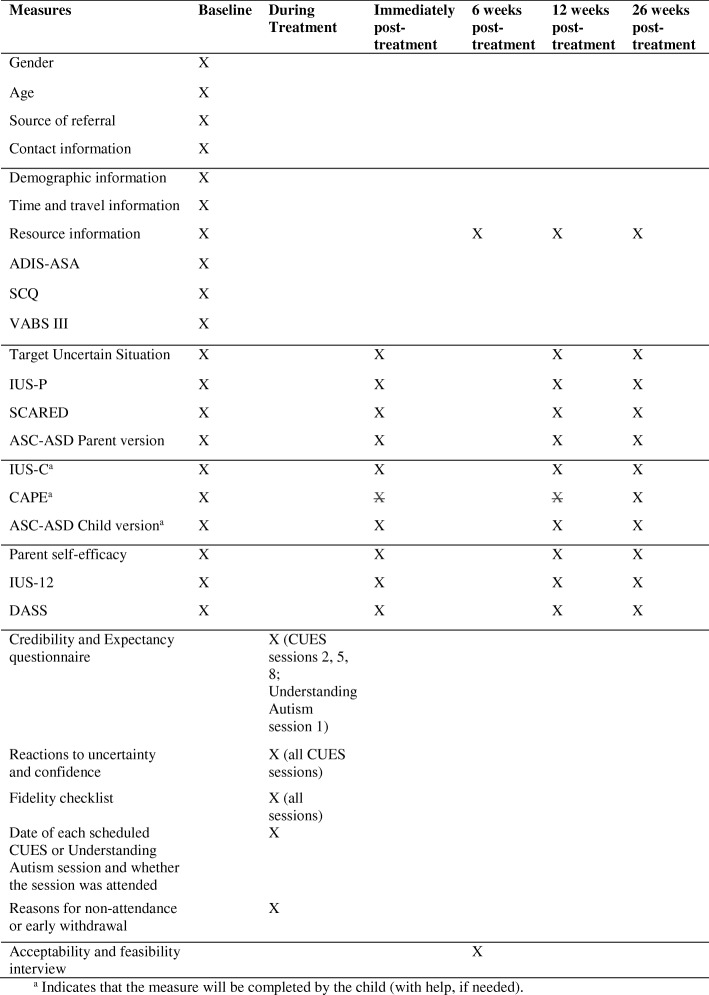
- Participants will be followed at baseline, immediately post-treatment, 12 weeks, and 26 weeks post-treatment; the paper specifies 26 weeks post-treatment as the primary endpoint.
- The paper cites prior work showing the CUES development project provided preliminary evidence that CUES was feasible and acceptable to families, but this protocol itself reports no trial results.
## Methods
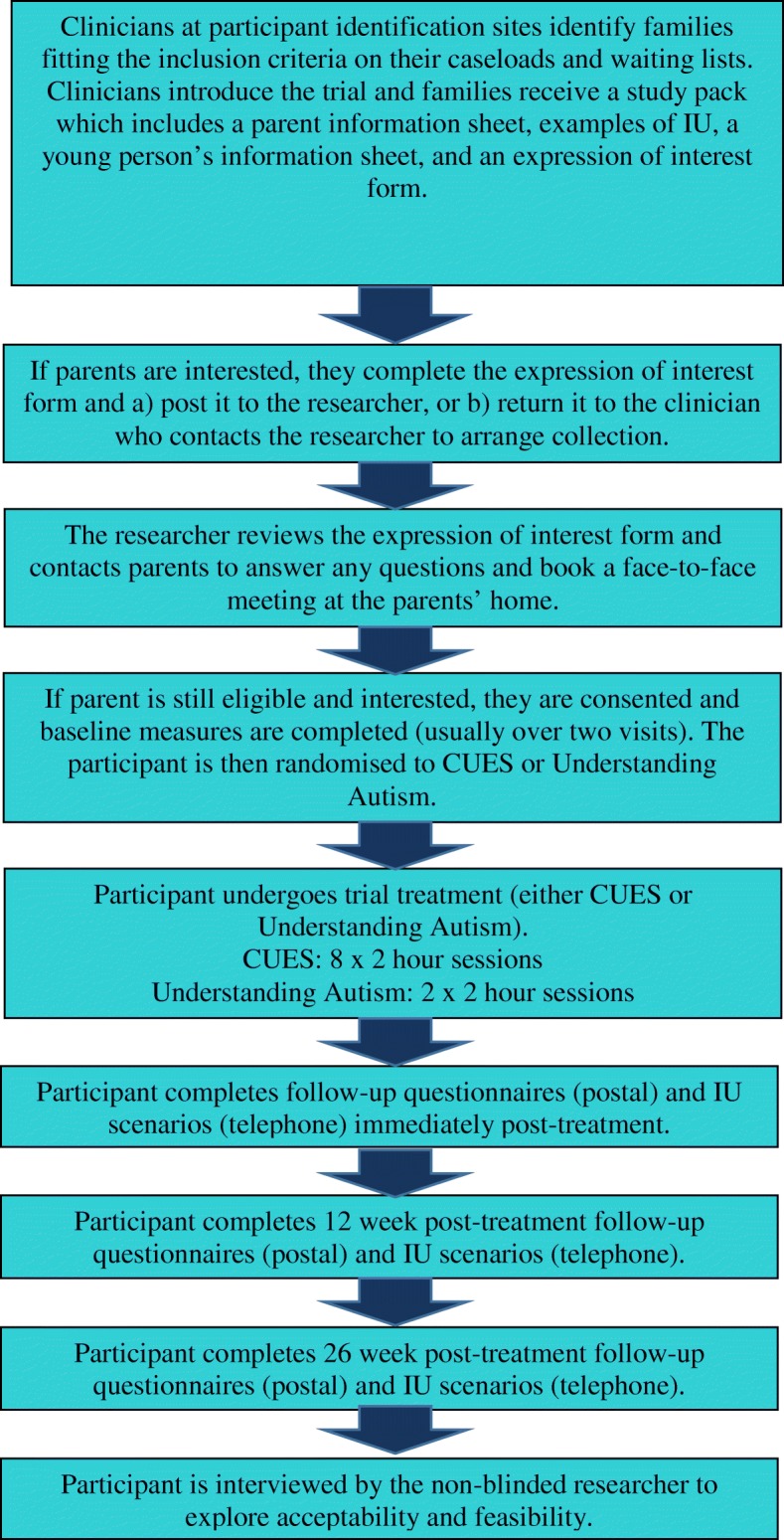
- Design: Feasibility and acceptability single-blind pilot randomised controlled trial comparing CUES with the active control Understanding Autism (enhanced services as usual).
- Sample/data: 60 parents of children with ASD and anxiety, with children aged 6–16 years, recruited via UK NHS services; written parental consent and child assent are obtained.
- Analysis: Planned analyses are mainly descriptive; feasibility will be assessed using consent, attendance, and completion rates, with some preliminary comparisons of change over time using intention-to-treat analysis and 95% confidence intervals.
## Limitations
- The paper states that this is a feasibility study, so formal power calculations are not appropriate and the study is not designed to test for a difference between treatments.
- The protocol notes that the primary outcome assessor is blind, but blinding could be broken if participants reveal intervention details at post-treatment assessment.
- Evident from the text: because this is a protocol, no outcome data or intervention effects are reported yet.
Model-written summary. Check it against the paper before relying on it.
Integrity signals
Registry
Cites
Statistics
Figures
Verification
Claims the paper makes
10 Valid · 1 Not valid · 41 Not checked · 14 Own results and interpretations
At least one cited source doesn’t support this claim or points to a different paper, and none confirmed it — see the verdicts below.
In the paper
“Based on the development study for CUES [5] adverse events or unintended effects are not anticipated.”
§ Coping with Uncertainty in Everyday Situations (CUES©) to address intolerance of uncertainty in autistic children: study protocol for an intervention feasibility trial > Methods/design > Harm
What the sources say
- Disputedcites [5] Rodgers J Hodgson A Shields K Wright C Honey E Freeston M Towards a treatment for intolerance of uncertainty in young people with autism spectrum disorder: development of the Coping with Uncertainty in Everyday Situations (CUES©) programme J Autism Dev Disord 2017 47 12 3959 3966 10.1007/s10803-016-2924-0 27796728 PMC5676830 sourceExperimental — accuracy not yet measured
The Discussion does not make a general prediction about adverse events. It does, however, explicitly anticipate a possible temporary increase in intolerance of uncertainty for some young people during CUES, contrary to the claim that no unintended effects are anticipated. No page number is available in our copy. (LLM, conf=0.81)
Checked by a reasoning model — may be wrong.
plain- Asserted: passes — The authors put it forward as true.
- Checkable: passes — It can be checked against evidence.
- Load-bearing: unclear — It is unclear whether the paper’s conclusions depend on it.
- Based: passes — The paper gives a reason why it holds.
- Disputed
The sources with a verdict support this claim; the rest weren’t checked yet, have no full text we could read, or their verdicts aren’t rated yet.
In the paper
“Recently, IU has been associated with some of the core characteristics of ASD [26–28].”
§ Coping with Uncertainty in Everyday Situations (CUES©) to address intolerance of uncertainty in autistic children: study protocol for an intervention feasibility trial > Background
What the sources say
- Supportedcites [26] South M, Rodgers J. Sensory, Emotional and cognitive contributions to anxiety in autism spectrum disorders. Front Hum Neurosci. 2017;11(20). 10.3389/fnhum.2017.00020. PMC5258728 28174531 source
The “Intolerance of Uncertainty in ASD” section reports associations between IU, sensory function, and repetitive/restricted behaviors in children with ASD. These include characteristics described as core ASD symptoms. No page number is provided in our copy. (LLM, conf=0.91)
- Supportedcites [27] Joyce C Honey E Leekam SR Barrett SL Rodgers J Anxiety, intolerance of uncertainty and restricted and repetitive behaviour: insights directly from young people with ASD J Autism Dev Disord 2017 47 12 3789 3802 10.1007/s10803-017-3027-2 28238024 source
The paper identifies restricted and repetitive behaviours (RRB) as a core feature of ASD (Introduction, p. 2). Its Discussion (p. 23) reports a significant positive association between parent-reported intolerance of uncertainty and RRB in young people with ASD. The corresponding self-report association was positive but not statistically significant. (LLM, conf=0.92)
- Not checked — no full text of the sourcecites [28] Rodgers J Glod M Connolly B McConachie H The relationship between anxiety and repetitive behaviours in autism spectrum disorder J Autism Dev Disord 2012 42 11 2404 2409 10.1007/s10803-012-1531-y 22527704 source
plainstates an association- Asserted: passes — The authors put it forward as true.
- Checkable: passes — It can be checked against evidence.
- Load-bearing: passes — The paper’s conclusions depend on it.
- Based: passes — The paper gives a reason why it holds.
- Supported
Every source the paper cites for this claim was checked and supports it.
In the paper
“CUES is an 8-week parent group intervention that provides parents of children with ASD with strategies to increase tolerance of uncertainty for their children in everyday situations.”
§ Coping with Uncertainty in Everyday Situations (CUES©) to address intolerance of uncertainty in autistic children: study protocol for an intervention feasibility trial > Background
What the sources say
- Supportedcites [5] Rodgers J Hodgson A Shields K Wright C Honey E Freeston M Towards a treatment for intolerance of uncertainty in young people with autism spectrum disorder: development of the Coping with Uncertainty in Everyday Situations (CUES©) programme J Autism Dev Disord 2017 47 12 3959 3966 10.1007/s10803-016-2924-0 27796728 PMC5676830 source
The Method sections “Phase 2” and “Content of the Programme” describe CUES as a parent-group intervention for young people with ASD, held weekly for eight weeks. They state that it teaches parents strategies to increase their child’s tolerance of uncertainty in everyday situations. Page numbers are not provided in our copy. (LLM, conf=0.94)
plainstates a cause- Asserted: passes — The authors put it forward as true.
- Checkable: passes — It can be checked against evidence.
- Load-bearing: passes — The paper’s conclusions depend on it.
- Based: passes — The paper gives a reason why it holds.
- Supported
Every source the paper cites for this claim was checked and supports it.
In the paper
“that parents found it helpful to work with clinicians to develop a range of strategies to tackle uncertainty in everyday contexts that they can support their child to utilise”
§ Coping with Uncertainty in Everyday Situations (CUES©) to address intolerance of uncertainty in autistic children: study protocol for an intervention feasibility trial > Background
What the sources say
- Supportedcites [5] Rodgers J Hodgson A Shields K Wright C Honey E Freeston M Towards a treatment for intolerance of uncertainty in young people with autism spectrum disorder: development of the Coping with Uncertainty in Everyday Situations (CUES©) programme J Autism Dev Disord 2017 47 12 3959 3966 10.1007/s10803-016-2924-0 27796728 PMC5676830 source
The Method (Content of the Programme; page not supplied) describes individual support for parents to identify and practise strategies tailored to their child’s everyday uncertainty. The Discussion (page not supplied) reports that parents valued the programme and found its strategies helpful, providing preliminary evidence for the claim. (LLM, conf=0.91)
plain- Asserted: passes — The authors put it forward as true.
- Checkable: passes — It can be checked against evidence.
- Load-bearing: passes — The paper’s conclusions depend on it.
- Based: passes — The paper gives a reason why it holds.
- Supported
The cited sources support only part of this claim — read each source’s verdict below.
In the paper
“Therefore, we developed the first intervention programme specifically targeting IU in children with ASD: Coping with Uncertainty in Everyday Situations (CUES) [5].”
§ Coping with Uncertainty in Everyday Situations (CUES©) to address intolerance of uncertainty in autistic children: study protocol for an intervention feasibility trial > Background
What the sources say
- Partly supportedcites [5] Rodgers J Hodgson A Shields K Wright C Honey E Freeston M Towards a treatment for intolerance of uncertainty in young people with autism spectrum disorder: development of the Coping with Uncertainty in Everyday Situations (CUES©) programme J Autism Dev Disord 2017 47 12 3959 3966 10.1007/s10803-016-2924-0 27796728 PMC5676830 sourceExperimental — accuracy not yet measured
The Method (Phase 2) identifies CUES as a programme developed to reduce intolerance of uncertainty in young people with ASD. The Discussion calls it novel and describes the study as a first step, but does not establish that CUES was the first intervention of its kind. (LLM, conf=0.82)
plain- Asserted: passes — The authors put it forward as true.
- Checkable: passes — It can be checked against evidence.
- Load-bearing: unclear — It is unclear whether the paper’s conclusions depend on it.
- Based: passes — The paper gives a reason why it holds.
- Partly supported
25 more claims · 3 with their cited sources checked
Create a free account to see all 66 claims and to verify the 1 reference still open.
- It may state two separate claims as one. 17
- Probably not a substantial claim. 26
Citations
Cites
Using thematic analysis in psychology
Braun, V., & Clarke, V. (2006) · Qualitative Research in Psychology · doi:10.1191/1478088706qp063oa · Cited by 194,414
Lovibond, P. F., & Lovibond, S. H. (1995) · Behaviour Research and Therapy · doi:10.1016/0005-7967(94)00075-u · Cited by 14,523
(1943) · The Nervous child · Cited by 8,870
Simonoff, E., Pickles, A., Charman, T., Chandler, S., Loucas, T., & Baird, G. (2008) · Journal of the American Academy of Child & Adolescent Psychiatry · doi:10.1097/chi.0b013e318179964f · Cited by 3,399
Autistic disturbances of affective contact.
Kanner, L. (1968) · PubMed · Cited by 3,143
BIRMAHER, B., KHETARPAL, S., BRENT, D., CULLY, M., BALACH, L., KAUFMAN, J., & NEER, S. M. (1997) · Journal of the American Academy of Child & Adolescent Psychiatry · doi:10.1097/00004583-199704000-00018 · Cited by 2,846
Design and analysis of pilot studies: recommendations for good practice
Lancaster, G. A., Dodd, S., & Williamson, P. R. (2004) · Journal of Evaluation in Clinical Practice · doi:10.1111/j..2002.384.doc.x · Cited by 2,572
Psychometric properties of the credibility/expectancy questionnaire
Devilly, G. J., & Borkovec, T. D. (2000) · Journal of Behavior Therapy and Experimental Psychiatry · doi:10.1016/s0005-7916(00)00012-4 · Cited by 2,295
Anxiety Disorders in Children and Adolescents with Autistic Spectrum Disorders: A Meta-Analysis
van Steensel, F. J. A., Bögels, S. M., & Perrin, S. (2011) · Clinical Child and Family Psychology Review · doi:10.1007/s10567-011-0097-0 · Cited by 1,463
Increasingly certain about uncertainty: Intolerance of uncertainty across anxiety and depression
Carleton, R. N., Mulvogue, M. K., Thibodeau, M. A., McCabe, R. E., Antony, M. M., & Asmundson, G. J. G. (2012) · Journal of Anxiety Disorders · doi:10.1016/j.janxdis.2012.01.011 · Cited by 775
Research works printed but not linked: 4
- Rutter M Bailey A Lord C The social communication questionnaire manual 2003 Los Angeles Western Psychological Services
- Sparrow SS Cicchetti DV Saulnier CA Vineland adaptive behavior scales third ed 2016 San Antonio Pearson
- Kerns CM, Silverman WK, Albano AM. Anxiety disorders interview schedule for autism spectrum and developmental disorders: child version: Oxford University Press. In press
- King G Law M King S Hurley P Hanna S Kertoy M Children’s Assessment of Participation and Enjoyment (CAPE) and Preferences for Activities of Children (PAC) 2004 San Antonio Harcourt Assessment, Inc
Cited by
Autistic Cognition: Charting Routes to Anxiety
Stark, E., Stacey, J., Mandy, W., Kringelbach, M. L., & Happé, F. (2021) · Trends in Cognitive Sciences · doi:10.1016/j.tics.2021.03.014 · Cited by 77
The Impact of Anxiety in Children on the Autism Spectrum
Adams, D., & Emerson, L. (2020) · Journal of Autism and Developmental Disorders · doi:10.1007/s10803-020-04673-3 · Cited by 72
Hollocks, M. J., Charman, T., Baird, G., Lord, C., Pickles, A., & Simonoff, E. (2022) · Autism · doi:10.1177/13623613211046160 · Cited by 50
“An example of this is intolerance of uncertainty for which specific intervention approaches have begun to be developed (Rodgers et al., 2019).”
BackgroundSensory Sensitivity and Intolerance of Uncertainty Influence Anxiety in Autistic Adults
Normansell-Mossa, K. M., Top, D. N., Russell, N., Freeston, M., Rodgers, J., & South, M. (2021) · Frontiers in Psychology · doi:10.3389/fpsyg.2021.731753 · Cited by 45
“New treatments that have been developed that target IU and underlying components, such as Coping with Uncertainty in Everyday Situations (CUES) by Rodgers and colleagues (Rodgers et al., 2018; Rodgers et al., 2019), have shown promising results for feasibility and preliminary effectiveness for use with autistic people…”
BackgroundInfluentialSelf-citationVanclooster, S., Bissell, S., van Eeghen, A. M., Chambers, N. J., Waele, L. D., Byars, A. W., Capal, J. K., Cukier, S., Davis, P. E., Flinn, J., et al. (2022) · Journal of Neurodevelopmental Disorders · doi:10.1186/s11689-022-09423-3 · Cited by 46
Rodgers, J., Goodwin, J., Garland, D., Grahame, V., Isard, L., Kernohan, A., Labus, M., Osborne, M. M., Parr, J. R., Rob, P., et al. (2023) · Journal of Autism and Developmental Disorders · doi:10.1007/s10803-022-05645-5 · Cited by 34
Self-citationBurnley, A., St Clair, M., Bedford, R., Wren, Y., & Dack, C. (2023) · Journal of Neurodevelopmental Disorders · doi:10.1186/s11689-023-09486-w · Cited by 33
Goodwin, J., Rob, P., Freeston, M. H., Garland, D., Grahame, V., Kernohan, A., Labus, M. B., Osborne, M., Parr, J. R., Wright, C., et al. (2021) · Autism · doi:10.1177/13623613211033757 · Cited by 33
“Data were collected as part of a feasibility and acceptability randomised pilot trial of a parent group-based intervention aimed at increasing tolerance to uncertainty in autistic young people: Coping with Uncertainty in Everyday Situations (CUES ©) (Rodgers et al., 2019).”
BackgroundMethodSelf-citationBaribeau, D. A., Vigod, S. N., Pullenayegum, E., Kerns, C. M., Vaillancourt, T., Duku, E., Smith, I. M., Volden, J., Zwaigenbaum, L., Bennett, T. A., et al. (2022) · European Child & Adolescent Psychiatry · doi:10.1007/s00787-022-02049-9 · Cited by 32
Larkin, F., Ralston, B., Dinsdale, S. J., Kimura, S., & Hayiou‐Thomas, M. E. (2022) · Autism · doi:10.1177/13623613221109717 · Cited by 27
“…(e.g. Personalised Anxiety Treatment-Autism: Huntjens et al., 2020; Parr et al., 2020) or IU (e.g. Coping with Uncertainty in Everyday Situations: Rodgers et al., 2019) may have beneficial effects on the physical as well as mental health of autistic people if they wish to pursue therapeutic…”
BackgroundFerguson, E. F., Spackman, E. K., Cai, R. Y., Hardan, A. Y., & Uljarević, M. (2024) · Autism Research · doi:10.1002/aur.3269 · Cited by 23
“…stimuli) and neurobiological functions (e.g., increased sensory input) of SIB to inform treatment development (Duerden et al., 2014; Frazier et al., 2023; Furniss & Biswas, 2020; Gotham et al., 2013; Hwang et al., 2020; Rodgers et al., 2012, 2017, 2019; Uljarevi (cid:1) c, Richdale, et al., 2017).”
Divergent presentation of anxiety in high-risk groups within the intellectual disability population
Groves, L., Moss, J. F., Oliver, C., Royston, R., Waite, J., & Crawford, H. (2022) · Journal of Neurodevelopmental Disorders · doi:10.1186/s11689-022-09462-w · Cited by 20
“Specifically, assessment of anxiety symptomatology should carefully consider whether this appears indicative of an intolerance to uncertainty, with interventions such as coping with uncertainty in everyday situations [39] considered where this is the case.”
BackgroundRaymond, C., Bilodeau-Houle, A., Zerroug, Y., Provencher, J., Beaudin, M., & Marin, M. (2022) · Psychoneuroendocrinology · doi:10.1016/j.psyneuen.2022.105888 · Cited by 13
Ong, C. S. Y., Magiati, I., Maybery, M. T., Rodgers, J., Uljarević, M., & Alvares, G. A. (2022) · Research in Autism · doi:10.1016/j.rasd.2022.102087 · Cited by 21
Self-citationMansoor, K. M. A. (2025) · Frontiers in Psychiatry · doi:10.3389/fpsyt.2025.1492304 · Cited by 13
Adams, D., Malone, S. A., Dargue, N., Keen, D., Rodgers, J., Simpson, K., Wicks, R., Bullot, A., & Rapee, R. M. (2024) · Journal of Autism and Developmental Disorders · doi:10.1007/s10803-024-06570-5 · Cited by 15
“Rodgers et al. ( 2019 ) has developed a parent-mediated intervention (Coping with Uncertainty in Everyday Situations; CUES) for anxiety in autistic children which specifically addresses the risk factor of IU.”
Self-citationSoh, C. P., Goh, T. J., Magiati, I., & Sung, M. (2020) · Journal of Autism and Developmental Disorders · doi:10.1007/s10803-020-04739-2 · Cited by 13
Momeñe, J., Estévez, A., García, A. M. P., & Maguregi, A. (2022) · Anales de Psicología · doi:10.6018/analesps.448821 · Cited by 26
“…y amenazantes, independientemente de la probabilidad de que ocurran, lo que les lleva a reaccionar ante ellas de manera intensa y negativa a nivel emocional, cognitivo y conductual, así como a evitarlas (Morriss y McSorley, 2019; Radell et al., 2018; Rodgers et al., 2019; Roma y Hope, 2017).”
BackgroundExploring the Symptom Profiles of Intolerance of Uncertainty in Autistic Children
Keefer, A. J., Singh, V., Jang, Y. S., Alon, L., Surmacz, M., Holingue, C., Mostofsky, S. H., & Vasa, R. A. (2022) · Journal of Autism and Developmental Disorders · doi:10.1007/s10803-022-05744-3 · Cited by 7
Adams, D., Malone, S. A., Simpson, K., Tucker, M. N., Rapee, R. M., Rodgers, J., & Keen, D. (2021) · PLoS ONE · doi:10.1371/journal.pone.0257223 · Cited by 7
Self-citationAyuso, D. M. R., Ortíz‐Rubio, A., Vidal-Ramírez, C., Pérez-Rodríguez, S., & Triviño-Juárez, J. M. (2022) · Occupational Therapy in Mental Health · doi:10.1080/0164212x.2022.2089435 · Cited by 7
“…show a more adaptive behavior, improving inhibitory control, cognitive flexibility and self-regulation (Diamond, 2012; Fern andez-Mart ınez et al., 2020; Frisch et al., 2020; Garland, 2014; Hahn-Markowitz et al., 2018; Hahn-Markowitz et al., 2020; Hannesdottir et al., 2017; Rodgers et al., 2019).”
BackgroundRob, P., Goodwin, J., Rogers, A. F., Carling, S., & Rodgers, J. (2025) · Psychology in the Schools · doi:10.1002/pits.70106 · Cited by 3
“Indeed, school ‐ related uncertainty not only impacts anxiety levels, but also the experiences of friendships and engagement in extracurricular activities (Goodwin et al. 2022; Rodgers et al. 2017, 2019).”
Self-citationAdams, D., Malone, S. A., Dargue, N., Rodgers, J., Simpson, K., Wicks, R., & Rapee, R. M. (2025) · Journal of Autism and Developmental Disorders · doi:10.1007/s10803-025-06828-6 · Cited by 3
Self-citationA systematic review of the treatments of anxiety in children with autism spectrum disorder
Khaleeq, H., Malik, M., & Harpwood, V. (2025) · Australasian Psychiatry · doi:10.1177/10398562251346614 · Cited by 3
“Storch, Wood 19 utilized a type of CBT called (cid:129) Cook, Donovan, 30 Klebanoff, Rosenau, 17 White, Schry, 29 Maddox, Miyazaki, 31 Luxford, Hadwin,and 33 Cervin, Storch 14 (cid:129) Frank, Kagan, 34 Kim, McKay, 32 Kim, McKay, and 35 Storch, Lewin 38 Subgroup 2: Adapted Vs TAU ( n = 2) (cid:129) Kerns, Collier and…”
InfluentialWhat Is Uncertainty? A Grounded Theory of the Role of Uncertainty in Anxiety in Autism
Lennuyeux-Comnene, L., Yates, J., & Gaigg, S. (2024) · Autism in Adulthood · doi:10.1089/aut.2022.0085 · Cited by 1
“12 Worry and, by extension, anxiety, then, are related to IoU, which is characterized by thinking that all unknown future events are by de fi nition distressing and that the preferred behavior is therefore to avoid situations where outcomes are unknown.”
Keefer, A. J., Perrin, J., Ferrara, I., & Vasa, R. A. (2025) · Journal of Autism and Developmental Disorders · doi:10.1007/s10803-025-06981-y · Cited by 1
Ferguson, E. F., Spackman, E. K., Hardan, A. Y., & Uljarević, M. (2025) · Autism · doi:10.1177/13623613251396036 · Cited by 1
“…links between IS and dysregulation in autism (Carrington et al., 2024; Rodgers et al., 2012; Spackman et al., 2024), it is possible that early emerging IS-distress levels may be a useful marker of physically harmful SIB or a target for SIB interventions (Rodgers et al., 2019; Wallace et al., 2016).”
The Anxiety Level of the Children with Autism and Its Relationship with Several Variables in Qatar
Fakhrou, A. A., & Ghareeb, S. A. (2020) · Journal of Education and Learning · doi:10.5539/jel.v9n4p118 · Cited by 1
“Several studies—e.g., Rodgers et al. (2019)—suggest that autistic children suffer from poor perceptual abilities.”
BackgroundResultInfluentialSome comments on "intolerance of uncertainty" for explaining anxiety in children with autism
Behzadpoor, S., & Pouretemad, H. (2022) · Asian Journal of Psychiatry · doi:10.1016/j.ajp.2022.103333
Gruner, M., Roessner, V., & Ring, M. (2025) · Autism Research · doi:10.1002/aur.70107
Metadata
- Authors
- Rodgers, J., Goodwin, J., Parr, J. R., Grahame, V., Wright, C., Padget, J., Garland, D., Osborne, M., Labus, M., Kernohan, A., & Freeston, M.
- Affiliations
- Royal Victoria Infirmary (GB)
- Cumbria Northumberland Tyne and Wear NHS Foundation Trust (GB)
- Northumbria Healthcare NHS Foundation Trust (GB)
- Newcastle University (GB)
- Corresponding author
- Rodgers, Jacqui
- ORCID
- Venue
- Trials
- Published
- 2019-06-27
- Volume
- 20
- Issue
- 1
- Pages
- 385-385
- ISSN
- 1745-6215 (ISSN-L)
- PMC
- PMC6598241
- OpenAlex
- W2953964257
- Cited by
- 30
- References
- 44
- Citations by year
- 2025: 7 · 2024: 3 · 2023: 1 · 2022: 11 · 2021: 5 · 2020: 3
- FWCI
- 2.76
- Type
- journal article
- Language
- en
- Open access
- gold
- doi.org
- Licence
- cc-by
- creativecommons.org/licenses/by/4.0/ (tdm)
- creativecommons.org/licenses/by/4.0/ (vor)
- Locations
- Trials (publishedVersion, cc-by)
- PubMed Central (publishedVersion, cc-by)
- PubMed (publishedVersion)
- DOAJ (DOAJ: Directory of Open Access Journals) (submittedVersion)
- Newcastle University ePrints (Newcastle Univesity) (cc-by)
- Funders
- Autistica (7250)
- Topics
- Life Sciences › Neuroscience › Cognitive Neuroscience › Autism Spectrum Disorder Research
- Social Sciences › Psychology › Clinical Psychology › Family and Disability Support Research
- Social Sciences › Psychology › Clinical Psychology › Child and Adolescent Psychosocial and Emotional Development
- Keywords
- intolerance of uncertainty, autism spectrum disorder, childhood anxiety, feasibility and acceptability, psychoeducation, emotional literacy, relaxation, children and adolescents
- MeSH terms
- Autism Spectrum Disorder, Emotional Regulation, Adaptation, Psychological, Adolescent, Adolescent Behavior, Age Factors, Anxiety, Child, Child Behavior, England, Feasibility Studies, Female, Humans, Male, Parents, Pilot Projects, Psychotherapy, Time Factors, Randomized Controlled Trials as Topic, Single-Blind Method, Parenting, Treatment Outcome, Uncertainty
About these checks
Registry, retraction, Cites and statistics results are computed, not judged, with one exception: a printed reference that no index lists is read once by a model before it counts as a citation error. Claims are extracted by a model and kept only when their quote appears verbatim in the text; each cited source is then checked, with a model’s help, for whether it says what the claim relies on. Those verdicts can be wrong — read the claim’s quote and the cited source before relying on one.
The claim verdicts this report counts are experimental: their accuracy is not yet measured.
A language model drew the claims from the paper on 2026-10-11, under version 3 of the claim definition (model deepseek-v4.1-flash, prompt extract-v3).
A second model labelled each claim on 2026-10-11 (model jev-1.13-20260917, definition revision gold-guideline-v0.2).
Cited sources are checked with a language model’s help (gpt-6-sol).
Statistics and arithmetic are recomputed, not judged.
Confidence bands are shown only for fields calibrated on our annotated test set. None is calibrated yet, so no band is shown.
What counts as a claim ›How we measure confidence ›How we check this ›
Are you an author, or do you see a problem with this page? Request a review
Data sources
Bibliographic data: Semantic Scholar, OpenAlex, Crossref.
Contains information from the Semantic Scholar Academic Graph Datasets, made available under the ODC Attribution License (ODC-BY 1.0).
Semantic Scholar’s data is described in: Kinney, R., et al. (2023). The Semantic Scholar Open Data Platform. arXiv:2301.10140.
