

The DOI matches its Crossref record; 151 of the 151 references it cites were found in a registry or an index.
Microalgae for the production of lipid and carotenoids: a review with focus on stress regulation and adaptation
Open accessAbstract
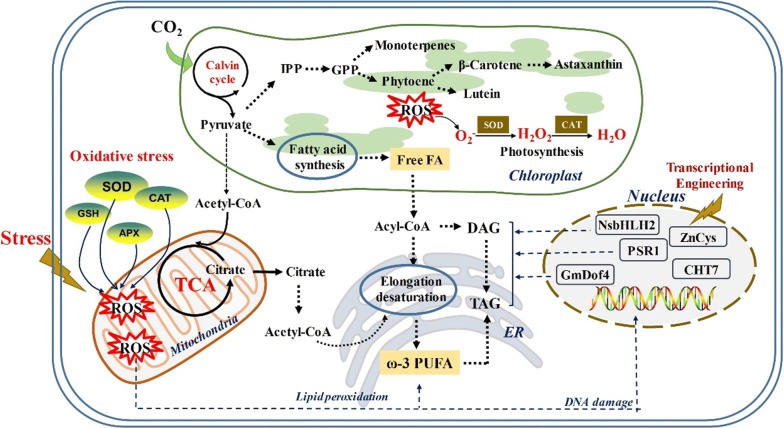
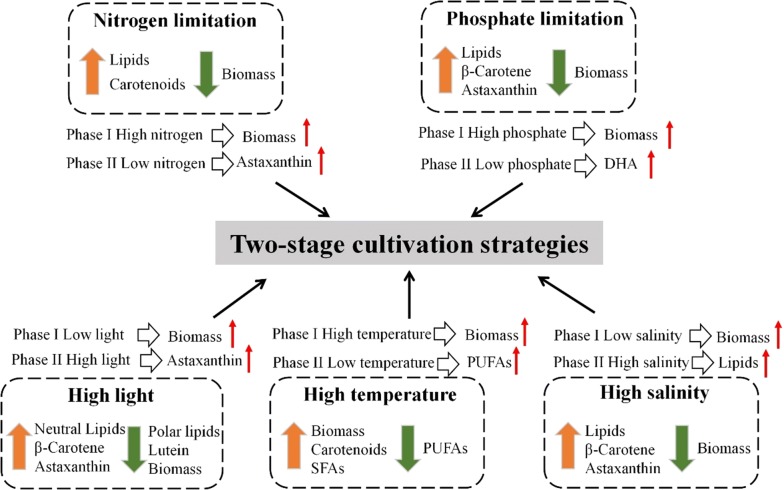
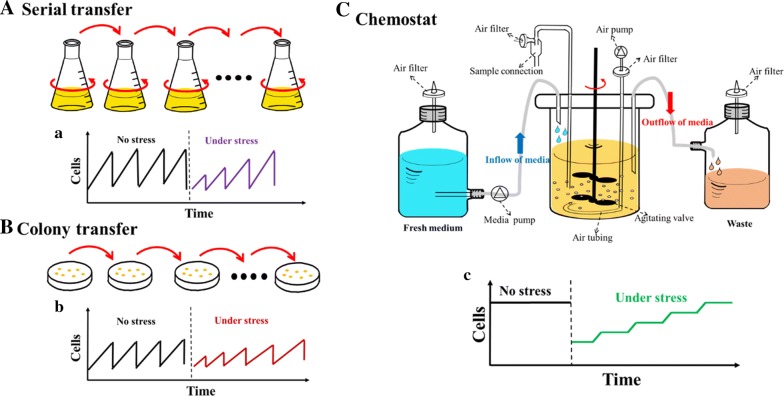
Microalgae have drawn great attention as promising sustainable source of lipids and carotenoids. Their lipid and carotenoids accumulation machinery can be trigged by the stress conditions such as nutrient limitation or exposure to the damaging physical factors. However, stressful conditions often adversely affect microalgal growth and cause oxidative damage to the cells, which can eventually reduce the yield of the desired products. To overcome these limitations, two-stage cultivation strategies and supplementation of growth-promoting agents have traditionally been utilized, but developing new highly adapted strains is theoretically the simplest strategy. In addition to genetic engineering, adaptive laboratory evolution (ALE) is frequently used to develop beneficial phenotypes in industrial microorganisms during long-term selection under specific stress conditions. In recent years, many studies have gradually introduced ALE as a powerful tool to improve the biological properties of microalgae, especially for improving the production of lipid and carotenoids. In this review, strategies for the manipulation of stress in microalgal lipids and carotenoids production are summarized and discussed. Furthermore, this review summarizes the overall state of ALE technology, including available selection pressures, methods, and their applications in microalgae for the improved production of lipids and carotenoids.
Overview
The claims and statistics of this paper haven’t been checked yet.
Run the check — free, no account needed. It reads the open-access text and checks the sources it cites.
Integrity signals
Registry
Cites
Statistics
Figures
Verification
Claims the paper makes
The claims and statistics of this paper haven’t been checked yet.
Run the check — free, no account needed. It reads the open-access text and checks the sources it cites.
Claims other papers make about this one
Each is checked against this paper’s own text: does it say what the citing paper says it does?
The cited source says what the claim attributes to it.
In the citing paper
“Under stresscondition, microalgae can produce an abundance of valueadded products such as lipids [5].”
From Microalgae Lipids Detection and Quantification Method Towards Online Real-Time Monitoring: A Review (2023) · cites this paper as [5]
Self-check
Percentages, sums and reported differences re-computed from the paper’s own numbers.
The self-check needs the paper’s full text.
Citations
Cites
Chisti, Y. (2007) · Biotechnology Advances · doi:10.1016/j.biotechadv.2007.02.001 · Cited by 9,524
Heterotrophic cultures of microalgae: Metabolism and potential products
Perez‐Garcia, O., Escalante, F. M. E., de‐Bashan, L. E., & Yoav Bashan, A. (2010) · Water Research · doi:10.1016/j.watres.2010.08.037 · Cited by 1,820
Cellular Defenses against Superoxide and Hydrogen Peroxide
Imlay, J. A. (2008) · Annual Review of Biochemistry · doi:10.1146/annurev.biochem.77.061606.161055 · Cited by 1,563
Functional analysis of oxidative stress-activated mitogen-activated protein kinase cascade in plants
Kovtun, Y., Chiu, W.-L., Tena, G., & Sheen, J. (2000) · Proceedings of the National Academy of Sciences · doi:10.1073/pnas.97.6.2940 · Cited by 1,532
Rubio, V., Linhares, F. S., Solano, R., Martin, A. C. B. M., Iglesias, J., Leyva, A., & Paz‐Ares, J. (2001) · Genes & Development · doi:10.1101/gad.204401 · Cited by 1,328
Increase in Chlorella strains calorific values when grown in low nitrogen medium
Illman, A. M., Scragg, A. H., & Shales, S. W. (2000) · Enzyme and Microbial Technology · doi:10.1016/s0141-0229(00)00266-0 · Cited by 1,008
Commercialization potential of microalgae for biofuels production
Singh, J., & Gu, S. (2010) · Renewable and Sustainable Energy Reviews · doi:10.1016/j.rser.2010.06.014 · Cited by 1,001
Designer synthetic media for studying microbial-catalyzed biofuel production
Tang, X., Sousa, L. D. C., Jin, M., Chundawat, S. P. S., Chambliss, C. K., Lau, M. W., Xiao, Z., Dale, B. E., & Balan, V. (2015) · Biotechnology for Biofuels · doi:10.1186/s13068-014-0179-6 · Cited by 889
Adaptive laboratory evolution—Principles and applications for biotechnology
Dragosits, M., & Mattanovich, D. (2013) · Microbial Cell Factories · doi:10.1186/1475-2859-12-64 · Cited by 827
Effect of iron on growth and lipid accumulation in Chlorella vulgaris
Liu, Z., Wang, G., & Zhou, B. (2007) · Bioresource Technology · doi:10.1016/j.biortech.2007.09.073 · Cited by 815
Cited by
Sorted by citations
Adaptive laboratory evolution principles and applications in industrial biotechnology
Mavrommati, M., Daskalaki, A., Papanikolaou, S., & Aggelis, G. (2021) · Biotechnology Advances · doi:10.1016/j.biotechadv.2021.107795 · Cited by 272
Ammonium Utilization in Microalgae: A Sustainable Method for Wastewater Treatment
Salbitani, G., & Carfagna, S. (2021) · Sustainability · doi:10.3390/su13020956 · Cited by 245
Algal cellulose, production and potential use in plastics: Challenges and opportunities
Zanchetta, E., Damergi, E., Patel, B., Borgmeyer, T., Pick, H. M., Pulgarin, A., & Ludwig, C. D. R. (2021) · Algal Research · doi:10.1016/j.algal.2021.102288 · Cited by 234
Dayana Priyadharshini, S., Suresh Babu, P., Manikandan, S., Subbaiya, R., Govarthanan, M., & Karmegam, N. (2021) · Environmental Pollution · doi:10.1016/j.envpol.2021.117989 · Cited by 232
Two-stage cultivation of microalgae for production of high-value compounds and biofuels: A review
Liyanaarachchi, V. C., Premaratne, M., Ariyadasa, T. U., Nimarshana, P. H. V., & Malik, A. (2021) · Algal Research · doi:10.1016/j.algal.2021.102353 · Cited by 231
Metadata
- Authors
- Sun, X.-M., Ren, L.-J., Zhao, Q.-Y., Ji, X.-J., & Huang, H.
- Affiliations
- Nanjing Tech University (CN)
- Venue
- Biotechnology for Biofuels
- Published
- 2018-10-04
- Volume
- 11
- Issue
- 1
- Pages
- 272-272
- ISSN
- 1754-6834 (ISSN-L)
- PMC
- PMC6171298
- OpenAlex
- W2895529302
- Cited by
- 470
- References
- 151
- Citations by year
- 2026: 49 · 2025: 56 · 2024: 73 · 2023: 56 · 2022: 79 · 2021: 66 · 2020: 61 · 2019: 29
- FWCI
- 2.09
- Type
- journal article
- Language
- en
- Open access
- gold
- doi.org
- Licence
- Locations
- Biotechnology for Biofuels (publishedVersion, cc-by)
- Europe PMC (PubMed Central) (publishedVersion, other-oa)
- PubMed Central (publishedVersion, cc-by)
- PubMed (publishedVersion)
- DOAJ (DOAJ: Directory of Open Access Journals) (submittedVersion, cc-by-sa)
- Funders
- Government of Jiangsu Province (XTE1829)
- Jiangsu National Synergistic Innovation Center for Advanced Materials (XTC1810, XTE1829)
- Topics
- Physical Sciences › Energy › Renewable Energy, Sustainability and the Environment › Algal biology and biofuel production
- Life Sciences › Biochemistry, Genetics and Molecular Biology › Molecular Biology › Microbial Metabolic Engineering and Bioproduction
- Life Sciences › Biochemistry, Genetics and Molecular Biology › Biochemistry › Lipid metabolism and biosynthesis
- Keywords
- microalgae, lipid production, carotenoid production, stress adaptation, adaptive laboratory evolution, oxidative stress, nutrient limitation, two-stage cultivation, genetic engineering, selection pressure, industrial microorganisms
About these checks
Registry, retraction, Cites and statistics results are computed, not judged, with one exception: a printed reference that no index lists is read once by a model before it counts as a citation error. Claims are extracted by a model and kept only when their quote appears verbatim in the text; each cited source is then checked, with a model’s help, for whether it says what the claim relies on. Those verdicts can be wrong — read the claim’s quote and the cited source before relying on one.
Statistics and arithmetic are recomputed, not judged.
Confidence bands are shown only for fields calibrated on our annotated test set. None is calibrated yet, so no band is shown.
What counts as a claim ›How we measure confidence ›How we check this ›
Are you an author, or do you see a problem with this page? Request a review
