

The DOI matches its Crossref record; 29 of the 29 references it cites were found in a registry or an index.
Effects of acids pre-treatment on the microbial fermentation process for bioethanol production from microalgae
Open accessAbstract
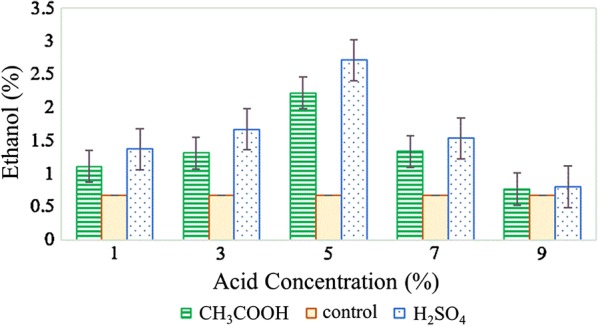
Microalgae are one of the promising feedstock that consists of high carbohydrate content which can be converted into bioethanol. Pre-treatment is one of the critical steps required to release fermentable sugars to be used in the microbial fermentation process. In this study, the reducing sugar concentration of Chlorella species was investigated by pre-treating the biomass with dilute sulfuric acid and acetic acid at different concentrations 1%, 3%, 5%, 7%, and 9% (v/v). 3,5-Dinitrosalicylic acid (DNS) method, FTIR, and GC-FID were employed to evaluate the reducing sugar concentration, functional groups of alcohol bonds and concentration of bioethanol, respectively. The two-way ANOVA results ( p < 0.05) indicated that there was a significant difference in the concentration and type of acids towards bioethanol production. The highest bioethanol yield obtained was 0.28 g ethanol/g microalgae which was found in microalgae sample pre-treated with 5% (v/v) sulfuric acid while 0.23 g ethanol/g microalgal biomass was presented in microalgae sample pre-treated with 5% (v/v) acetic acid. The application of acid pre-treatment on microalgae for bioethanol production will contribute to higher effectiveness and lower energy consumption compared to other pre-treatment methods. The findings from this study are essential for the commercial production of bioethanol from microalgae.
Overview
The claims and statistics of this paper haven’t been checked yet.
Run the check — free, no account needed. It reads the open-access text and checks the sources it cites.
Integrity signals
Registry
Cites
Statistics
Figures
Verification
Claims the paper makes
The claims and statistics of this paper haven’t been checked yet.
Run the check — free, no account needed. It reads the open-access text and checks the sources it cites.
Claims other papers make about this one
Each is checked against this paper’s own text: does it say what the citing paper says it does?
In the citing paper
“It also degrades polysaccharides, lowers energy consumption, and increases sugar yields, making it a cost-efficient option compared to other pretreatment technologies [197].”
From A Review of Algae-Based Carbon Capture, Utilization, and Storage (Algae-Based CCUS) (2024) · cites this paper as [197]
Self-check
Percentages, sums and reported differences re-computed from the paper’s own numbers.
The self-check needs the paper’s full text.
Citations
Cites
Use of Dinitrosalicylic Acid Reagent for Determination of Reducing Sugar
Miller, G. L. (1959) · Analytical Chemistry · doi:10.1021/ac60147a030 · Cited by 28,963
Features of promising technologies for pretreatment of lignocellulosic biomass
MOSIER, N. (2005) · Bioresource Technology · doi:10.1016/j.biortech.2004.06.025 · Cited by 6,251
Brennan, L., & Owende, P. (2010) · Renewable and Sustainable Energy Reviews · doi:10.1016/j.rser.2009.10.009 · Cited by 4,894
Microalgae biorefinery: High value products perspectives
Chew, K. W., Yap, J. Y., Show, P. L., Suan, N. H., Juan, J. C., Ling, T. C., Lee, D.-J., & Chang, J.-S. (2017) · Bioresource Technology · doi:10.1016/j.biortech.2017.01.006 · Cited by 1,336
Self-citationEnzymatic pretreatment of Chlamydomonas reinhardtii biomass for ethanol production
Choi, S. P., Nguyen, M. T., & Sim, S. J. (2010) · Bioresource Technology · doi:10.1016/j.biortech.2010.02.026 · Cited by 408
Influence of acid pre-treatment on microalgal biomass for bioethanol production
Harun, R., & Danquah, M. K. (2010) · Process Biochemistry · doi:10.1016/j.procbio.2010.08.027 · Cited by 369
Chemical Pretreatment Methods for the Production of Cellulosic Ethanol: Technologies and Innovations
Bensah, E. C., & Mensah, M. Y. (2013) · International Journal of Chemical Engineering · doi:10.1155/2013/719607 · Cited by 359
Sustainable approaches for algae utilisation in bioenergy production
Chia, S. R., Ong, H. C., Chew, K. W., Show, P. L., Phang, S.-M., Ling, T. C., Nagarajan, D., Lee, D.-J., & Chang, J.-S. (2018) · Renewable Energy · doi:10.1016/j.renene.2017.04.001 · Cited by 333
Chew, K. W., Chia, S. R., Show, P. L., Yap, Y. J., Ling, T. C., & Chang, J.-S. (2018) · Journal of the Taiwan Institute of Chemical Engineers · doi:10.1016/j.jtice.2018.05.039 · Cited by 324
Self-citationPre-treatment optimization of Scenedesmus obliquus microalga for bioethanol production
Miranda, J. R., Passarinho, P. C., & Gouveia, L. (2011) · Bioresource Technology · doi:10.1016/j.biortech.2011.10.059 · Cited by 307
Exploring alkaline pre-treatment of microalgal biomass for bioethanol production
Harun, R., Jason, W. S. Y., Cherrington, T., & Danquah, M. K. (2010) · Applied Energy · doi:10.1016/j.apenergy.2010.10.048 · Cited by 282
Jagadevan, S., Banerjee, A., Banerjee, C., Guria, C., Tiwari, R., Baweja, M., & Shukla, P. (2018) · Biotechnology for Biofuels · doi:10.1186/s13068-018-1181-1 · Cited by 275
Phwan, C. K., Ong, H. C., Chen, W., Ling, T. C., Ng, E., & Show, P. L. (2018) · Energy Conversion and Management · doi:10.1016/j.enconman.2018.07.054 · Cited by 192
Self-citationChia, S. R., Chew, K. W., Show, P. L., Yap, Y. J., Ong, H. C., Ling, T. C., & Chang, J. (2018) · Biotechnology Journal · doi:10.1002/biot.201700618 · Cited by 188
Self-citationDahnum, D., Tasum, S. O., Triwahyuni, E., Nurdin, M., & Abimanyu, H. (2015) · Energy Procedia · doi:10.1016/j.egypro.2015.03.238 · Cited by 180
Microalgae for economic applications: advantages and perspectives for bioethanol
Simas-Rodrigues, C., Villela, H., Martins, A. P., Marques, L. G., Colepicolo, P., & Tonon, Â. P. (2015) · Journal of Experimental Botany · doi:10.1093/jxb/erv130 · Cited by 105
Evaluation of dilute acid pretreatment for bioethanol fermentation from sugarcane bagasse pith
Sritrakul, N., Nitisinprasert, S., & Keawsompong, S. (2017) · Agriculture and Natural Resources · doi:10.1016/j.anres.2017.12.006 · Cited by 105 · cited 2×
“For example, pre-treatment method using dilute sulfuric acid has been reported to obtain a higher hydrolysis yield compared with hydrochloric, phosphoric, and nitric acid [11].”
BackgroundMethodHydrolysis of Chlorella biomass for fermentable sugars in the presence of HCl and MgCl2
Zhou, N., Zhang, Y., Wu, X., Gong, X., & Wang, Q. (2011) · Bioresource Technology · doi:10.1016/j.biortech.2011.08.051 · Cited by 99
Guo, H. J., Daroch, M., Liu, L., Qiu, G., Geng, S., & Wang, G. (2012) · Bioresource Technology · doi:10.1016/j.biortech.2012.10.006 · Cited by 90
Chng, L. M., Lee, K. T., & Chan, D. J. C. (2017) · Energy Conversion and Management · doi:10.1016/j.enconman.2016.10.026 · Cited by 85
Khan, M. I., Lee, M. G., Shin, J. H., & Kim, J. D. (2017) · AMB Express · doi:10.1186/s13568-016-0320-y · Cited by 78
Kassim, M. A., & Bhattacharya, S. (2015) · Process Biochemistry · doi:10.1016/j.procbio.2015.11.027 · Cited by 68
Pancha, I., Chokshi, K., Maurya, R., Bhattacharya, S., Bachani, P., & Mishra, S. (2016) · Bioresource Technology · doi:10.1016/j.biortech.2015.12.078 · Cited by 67
An On‐Line Approach To Monitor Ethanol Fermentation Using FTIR Spectroscopy
Veale, E. L., Irudayaraj, J., & Demırcı, A. (2007) · Biotechnology Progress · doi:10.1021/bp060306v · Cited by 61
Sebayang, A. H., Hassan, M. H., Ong, H. C., Dharma, S. H., Silitonga, A. S., Kusumo, F., Mahlia, T. M. I., & Aditiya, H. B. (2017) · Energies · doi:10.3390/en10010035 · Cited by 44
Self-citationEvaluation of the Potential of Chlorella vulgaris for Bioethanol Production
Kumar, V. B., Pulidindi, I. N., Kinel‐Tahan, Y., Yehoshua, Y., & Gedanken, A. (2016) · Energy & Fuels · doi:10.1021/acs.energyfuels.6b00253 · Cited by 35
Experimental investigations on bioethanol production from halophilic microalgal biomass
Karatay, S. E., Erdoğan, M., Dönmez, S., & Dönmez, G. (2016) · Ecological Engineering · doi:10.1016/j.ecoleng.2016.06.058 · Cited by 21
Pinho, D. R., Oliveira, R., dos Santos, V., Marques, W. F., Pinto, Â. D. C., Rezende, M. J. C., & Suarez, P. A. Z. (2017) · Journal of the Brazilian Chemical Society · doi:10.21577/0103-5053.20170097 · Cited by 14 · cited 1×
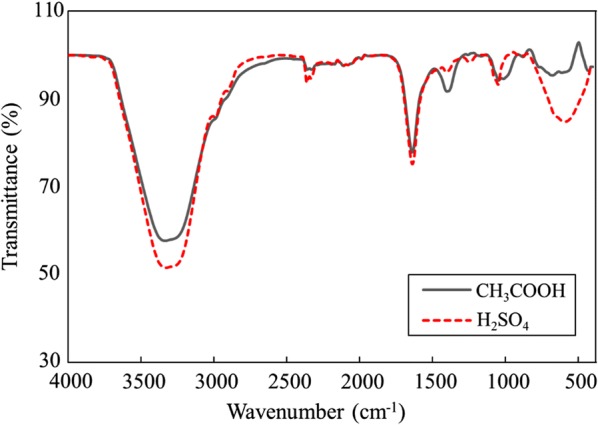
“FTIR characterization FTIR results obtained in this study showed some common peaks in both bioethanol from microalgal Chlorella pre-treated with acetic and sulfuric acid [20, 21].”
ResultBabujanarthanam, R., & Kavitha, P. (2014) · Energy Sources Part A Recovery Utilization and Environmental Effects · doi:10.1080/15567036.2011.551920 · Cited by 8
Cited by
Sorted by citations
Kumar, M., Sun, Y., Rathour, R., Pandey, A., Thakur, I. S., & Tsang, D. C. W. (2020) · Science of The Total Environment · doi:10.1016/j.scitotenv.2020.137116 · Cited by 472
Siddiki, S. Y. A., Mofijur, M., Kumar, P. S., Ahmed, S. F., Inayat, A., Kusumo, F., Badruddin, I. A., Khan, T. M. Y., Nghiem, L. D., Ong, H. C., et al. (2021) · Fuel · doi:10.1016/j.fuel.2021.121782 · Cited by 489
Self-citationBiofuel production from microalgae: challenges and chances
Hoang, A. T., Sirohi, R., Pandey, A., Nižetić, S., Lam, S. S., Chen, W., Luque, R., Thomas, S., Arıcı, M., & Pham, V. V. (2022) · Phytochemistry Reviews · doi:10.1007/s11101-022-09819-y · Cited by 296
“On the other hand, microalgae that have higher carbohydrate content are more suitable for the production of fermentative alcohol (Phwan et al. 2019).”
BackgroundMicroalgae: Sustainable resource of carbohydrates in third-generation biofuel production
Debnath, C., Bandyopadhyay, T. K., Bhunia, B., Mishra, U., Narayanasamy, S., & Muthuraj, M. (2021) · Renewable and Sustainable Energy Reviews · doi:10.1016/j.rser.2021.111464 · Cited by 171
Bhatt, P., Bhandari, G., Turco, R. F., Aminikhoei, Z., Bhatt, K., & Simsek, H. (2022) · Environmental Pollution · doi:10.1016/j.envpol.2022.119688 · Cited by 148
Metadata
- Authors
- Phwan, C. K., Chew, K. W., Sebayang, A. H., Ong, H. C., Ling, T. C., Malek, M. A., Ho, Y.-C., & Show, P. L.
- Affiliations
- University of Malaya (MY)
- University of Nottingham (GB)
- Universiti Teknologi Petronas (MY)
- Corresponding author
- Show, Pau Loke
- Venue
- Biotechnology for Biofuels
- Published
- 2019-07-31
- Volume
- 12
- Issue
- 1
- Pages
- 191-191
- ISSN
- 1754-6834 (ISSN-L)
- PMC
- PMC6668136
- OpenAlex
- W2966314663
- Cited by
- 143
- References
- 29
- Citations by year
- 2026: 14 · 2025: 21 · 2024: 18 · 2023: 22 · 2022: 27 · 2021: 22 · 2020: 18 · 2019: 1
- FWCI
- 5.99
- Type
- journal article
- Language
- en
- Open access
- gold
- doi.org
- Locations
- Biotechnology for Biofuels (publishedVersion, cc-by)
- Europe PMC (PubMed Central) (publishedVersion, cc-by)
- PubMed Central (publishedVersion, cc-by)
- PubMed (publishedVersion)
- The University of Malaya Research Repository (University of Malaya) (submittedVersion)
- DOAJ (DOAJ: Directory of Open Access Journals) (submittedVersion, cc-by-sa)
- UTS ePRESS (University of Technology Sydney) (submittedVersion, other-oa)
- Funders
- Fundamental Research Grant Scheme (FRGS/1/2015/SG05/UNIM/03/1)
- iRMC Bold 2025, Universiti Tenaga Nasional (RJO 1043 6494)
- Topics
- Physical Sciences › Engineering › Biomedical Engineering › Biofuel production and bioconversion
- Physical Sciences › Energy › Renewable Energy, Sustainability and the Environment › Algal biology and biofuel production
- Physical Sciences › Energy › Renewable Energy, Sustainability and the Environment › Anaerobic Digestion and Biogas Production
- Keywords
- microalgae, bioethanol production, acid pretreatment, sulfuric acid pretreatment, acetic acid pretreatment, Chlorella, reducing sugars, fermentable sugars, microbial fermentation, ethanol yield
About these checks
Registry, retraction, Cites and statistics results are computed, not judged, with one exception: a printed reference that no index lists is read once by a model before it counts as a citation error. Claims are extracted by a model and kept only when their quote appears verbatim in the text; each cited source is then checked, with a model’s help, for whether it says what the claim relies on. Those verdicts can be wrong — read the claim’s quote and the cited source before relying on one.
Statistics and arithmetic are recomputed, not judged.
Confidence bands are shown only for fields calibrated on our annotated test set. None is calibrated yet, so no band is shown.
What counts as a claim ›How we measure confidence ›How we check this ›
Are you an author, or do you see a problem with this page? Request a review
