

The DOI matches its Crossref record; 268 of the 268 references it cites were found in a registry or an index.
Recent advances on Dirofilaria repens in dogs and humans in Europe
Open accessAbstract
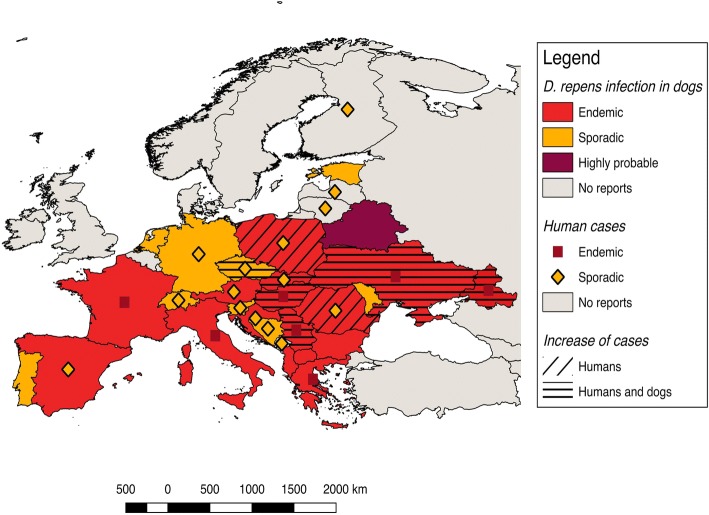
Dirofilaria repens is a nematode affecting domestic and wild canids, transmitted by several species of mosquitoes. It usually causes a non-pathogenic subcutaneous infection in dogs and is the principal agent of human dirofilariosis in the Old World. In the last decades, D. repens has increased in prevalence in areas where it has already been reported and its distribution range has expanded into new areas of Europe, representing a paradigmatic example of an emergent pathogen. Despite its emergence and zoonotic impact, D. repens has received less attention by scientists compared to Dirofilaria immitis. In this review we report the recent advances of D. repens infection in dogs and humans, and transmission by vectors, and discuss possible factors that influence the spread and increase of this zoonotic parasite in Europe. There is evidence that D. repens has spread faster than D. immitis from the endemic areas of southern Europe to northern Europe. Climate change affecting mosquito vectors and the facilitation of pet travel seem to have contributed to this expansion; however, in the authors' opinion, the major factor is likely the rate of undiagnosed dogs continuing to perpetuate the life-cycle of D. repens. Many infected dogs remain undetected due to the subclinical nature of the disease, the lack of rapid and reliable diagnostic tools and the poor knowledge and still low awareness of D. repens in non-endemic areas. Improved diagnostic tools are warranted to bring D. repens diagnosis to the state of D. immitis diagnosis, as well as improved screening of imported dogs and promotion of preventative measures among veterinarians and dog owners. For vector-borne diseases involving pets, veterinarians play a significant role in prevention and should be more aware of their responsibility in reducing the impact of the zoonotic agents. In addition, they should enhance multisectorial collaboration with medical entomologists and the public health experts, under the concept and the actions of One Health-One Medicine.
Overview
The claims and statistics of this paper haven’t been checked yet.
Run the check — free, no account needed. It reads the open-access text and checks the sources it cites.
Integrity signals
Registry
Cites
Statistics
Figures
Verification
Claims the paper makes
The claims and statistics of this paper haven’t been checked yet.
Run the check — free, no account needed. It reads the open-access text and checks the sources it cites.
Claims other papers make about this one
Each is checked against this paper’s own text: does it say what the citing paper says it does?
In the citing paper
“In Serbia, humidity and temperature conditions during a large proportion of the year allow for the transmission of dirofilariasis, with seroepidemiological data revealing noteworthy prevalence rates in the country's dog populations and human clinical cases caused by both D. immitis and D. repens (1, 3, 24).”
From Seroepidemiological Study of Canine and Human Dirofilariasis in the Endemic Region of Northern Serbia (2020) · cites this paper as [3]
In the citing paper
“Dirofilariasis is on the rise in the European population of dogs and humans (1, 3, 11, 12).”
From Seroepidemiological Study of Canine and Human Dirofilariasis in the Endemic Region of Northern Serbia (2020) · cites this paper as [3]
In the citing paper
“A possible explanation for the difference in diagnostic methods used between the two filarial species would be the lack of a rapid screening system designed specifically for D. repens, as there exists for D. immitis and other common travel diseases (Capelli et al. 2018).”
From Current trends in canine dirofilariosis in Austria-do we face a pre-endemic status? (2020) · cites this paper as Capelli et al. 2018
In the citing paper
“It also appears that D. immitis is establishing itself more slowly in areas where D. repens is already present (Genchi et al. 2005; Capelli et al. 2018).”
From Current trends in canine dirofilariosis in Austria-do we face a pre-endemic status? (2020) · cites this paper as Capelli et al. 2018
In the citing paper
“D repens is currently considered an emerging zoonotic agent in Europe.”
From Dirofilarioses in cats: European guidelines from the ABCD on prevention and management (2020) · cites this paper as [14]
Self-check
Percentages, sums and reported differences re-computed from the paper’s own numbers.
The self-check needs the paper’s full text.
Citations
Cites
World map of the Köppen-Geiger climate classification updated
Kottek, M., Grieser, J., Beck, C., Rudolf, B., & Rubel, F. (2006) · Meteorologische Zeitschrift · doi:10.1127/0941-2948/2006/0130 · Cited by 11,456
Human and animal dirofilariasis: The emergence of a zoonotic mosaic
Simón, F., Siles-Lucas, M., Morchón, R., González-Miguel, J., Mellado, I., Carretón, E., & Montoya-Alonso, J. A. (2012) · Clinical Microbiology Reviews · doi:10.1128/cmr.00012-12 · Cited by 834
The Biology of Mosquitoes, Volume 1: Development, Nutrition and Reproduction
Clements, A. N. (1992) · CABI eBooks · doi:10.1079/9780851993744.0000 · Cited by 715
Climate change and infectious diseases in Europe
Semenza, J. C., & Menne, B. (2009) · The Lancet Infectious Diseases · doi:10.1016/s1473-3099(09)70104-5 · Cited by 679
Chapter 4 Heartworm Disease in Animals and Humans
McCall, J. W., Genchi, C., Kramer, L. H., Guerrero, J., & Venco, L. (2008) · Advances in Parasitology · doi:10.1016/s0065-308x(08)00204-2 · Cited by 609
Self-citationClimate and Dirofilaria infection in Europe
Genchi, C., Rinaldi, L., Mortarino, M., Genchi, M., & Cringoli, G. (2009) · Veterinary parasitology · doi:10.1016/j.vetpar.2009.03.026 · Cited by 349
Self-citationMelanization immune responses in mosquito vectors
Christensen, B. M., Li, J., Chen, C.-C., & Nappi, A. J. (2005) · Trends in Parasitology · doi:10.1016/j.pt.2005.02.007 · Cited by 346
Vector-borne helminths of dogs and humans in Europe
Otranto, D., Dantas-Torres, F., Brianti, E., Traversa, D., Petrić, D., Genchi, C., & Capelli, G. (2013) · Parasites & Vectors · doi:10.1186/1756-3305-6-16 · Cited by 336
Self-citationDiscrimination between six species of canine microfilariae by a single polymerase chain reaction
Rishniw, M., Barr, S. C., Simpson, K. W., Frongillo, M. F., Franz, M., & Dominguez Alpizar, J. L. (2006) · Veterinary Parasitology · doi:10.1016/j.vetpar.2005.10.013 · Cited by 307
Dengue and dengue vectors in the WHO European region: past, present, and scenarios for the future
Schaffner, F., & Mathis, A. (2014) · The Lancet Infectious Diseases · doi:10.1016/s1473-3099(14)70834-5 · Cited by 271
Research works printed but not linked: 31
- Lusitano A. Curationum Medicinalium Centuria Septima. Venetiis: apud Vincentium Valgresium, curatio. 1566;63:106.
- Addario GG. A nematode of the human eye. Ann Ottalmol. 1885;14:133–7 (in Italian).
- Ercolani G. Helmintological observations on the dimorbiosis of nematodes: on the Filaria immitis and on a new species of dog’s distoma. Mem R Acad Sci Ist Bol. 1874;3:390–441 (in Italian).
- Fulleborn F. Über Versuche an Hundefilarien und deren übertrangung durch Müncken. Arch Schiffs Tropenhyg. 1908;8:313–59.
- Lanzillotti-Bonsanti A. On the alterations that produce the embryos of Filaria immitis and on a cyst with Filaria immitis in the intermuscular connective of a dog. Clin Vet. 1881;4:212–5 (In Italian).
- Bonvicini A. Of a case of filariasis in a dog suffering from demodectic mange. Mod Zoiatra Parte Sci. 1910;42:55 (In Italian).
- Bernard P, Bauche J. Conditions de propagation de la filariose sous-cutanée du chien. Stegomyia fasciata hote intermédiaire de Dirofilaria repems. Bull Soc Pathol Exot. 1913;7:89–99.
- Rivolta S. Herpes form in the dog produced by embryos of filaria. Med Vet G Teor. 1868;3:300–2 (In Italian).
- Rosso G. Dog’s cutaneous helminthiasis. A case of general pustular dermatitis caused by embryos of Filaria immitis. Mod Zooiatro. 1897;8:185–8 (In Italian).
- Mazzanti E. Two zooparasitological observations. Observation first on a herpetic affection in a dog produced by nematodes. G R Soc Vet. 1900;50:626–9 (In Italian).
- Balbo T, Panichi M. Filariosis in the dog. Nuova Vet. 1968;44:18–32 (In Italian).
- Locatelli A. On the animal filariosis in the province of Pavia. Parassitologia. 1971;13:197–202 (In Italian).
- Rojo-Vázquez F, Valcárcel F, Guerrero J, Gómez M. Prevalencia de la dirofilariosis canina en cuatro áreas geográficas de España. Med Vet Barcelona. 1990;7:297–305.
- Bourdeau P, Roussel A. Canine infection with Dirofilaria repens in France: distribution and prevalence from a national survey with veterinary clinics. Melbourne: Proceedings ICOPA XII; 2010.
- Fok É, Szaboó Z, Farkas R. The first autochthonous case of a dog infected with Dirofilaria repens. Kisállatorvoslás. 1998;4:218–9 (In Hungarian).
- Fok É, Kiss G, Majoros G, Jacsó O, Farkas R, Gyurkovszky M. Preliminary results of an epidemiological survey on dirofilariosis of dogs and cats in Hungary. Mappe Parassitol. 2007;8:195–6.
- Holler D, Racz A, Bošnir J, Petrak O. The prevalence of dirofilariasis in the hinterland of the Istrian Peninsula. Medica Jadertina. 2011;40:67–74.
- Jurhar-Pavlova M, Cvetković D, Duma H, Kochevski Z. Dirofilariasis in R. Macedonia - an overview of literature data and our expirience, vol. 2012. Niš: 46th Days of Preventive Medicine, International Congress, Book of Abstracts; 2012. p. 130–2.
- Kanev I, Kamenov I, Ganchev G, Prelezov P, Tzvetkov Y, Tomcheva V, et al. Dirofilaria repens and Dirofilaria immitis in animals and humans in Bulgaria. Parassitologia. 1996;38:358.
- Olteanu G. Dirofilariosis in man and animals in Romania. Parassitologia. 1996;38(Suppl. 1–2):360.
- Paşca S, Miron L, Acatrinei D, Mihalachi S. Both cardio-vasculary and subcutaneous forms of dirofilariosis in dog: a case report. Sci Papers Vet Med Iași. 2008;51:123–7.
- Popescu I, Tudose I, Racz P, Muntau B, Giurcaneanu C, Poppert S. Human Dirofilaria repens infection in Romania: a case report. Case Rep Infect Dis. 2012;2012:472976.
- Bain O. Développment en Camargue de la filaire du chien, Dirofilaria repens Railliet at Henry, 1911, chez les Aedes halophile. Bull Mus Nat Hist Nat. 1978;351:19–27.
- Cancrini G, Yanchang S, Della Torre A, Coluzzi M. Influence of temperature on the larval development of Dirofilaria repens in different species of mosquitoes. Parassitologia. 1988;30:38 (In Italian).
- Khudaverdiev T. The biology Dirofilaria repens repens Railliet and Henry, 1911, the causal agent of dirofilariasis of dogs in the Nakhichevan Republic, ASSR. Mater Nauchnoi Konf Vsesoyuznogo Obs Gelmintol Russ. 1976;28:163–9 (In Russian).
- Mišić S, Stajković N, Tešić M, Mišić Z, Lj L. Human dirofilariosis in Yugoslavia: report on three cases of Dirofilaria repens infection. Parassitologia. 1996;38:358.
- Sergiev V, Suprjaga V, Morozov E, LA J. Human dirofilariasis: diagnosis and character of the relationship between causative agent and host. Med Parasitol Parasit Dis. 2009;3:3–6.
- Euzeby J. Diagnostic expérimental des helminthoses animales: animaux domestiques, animaux de laboratoire, primates; travaux pratiques d'helminthologie vétérinaire: livre 1 généralités, diagnostic ante-mortem. Paris: Informations Techniques des Services Vétérinaires; 1981. p. 349.
- Orihel T, Ash L. Dirofilaria species - Parasites in Human Tissues. 1st ed. Chicago: American Society of Clinical Pathologists; 1995.
- Genchi C, Poglayen G, Kramer L, Casiraghi M, Venco L, Brianti E. Efficacia di selamectin nella profilassi delle infestazioni da Dirofilaria repens del cane. Veterinaria. 2002;16:69–71.
- Petrić D, Zgomba M, Bellini R, Becker N. Surveillance of mosquito populations - a key element to understanding the spread of invasive vector species and vector-borne diseases in Europe. In: Hauppauge MD, editor. Essays on Fundamental and Applied Environmental Topics. New York: Nova Science Publishers; 2012. p. 192–224.
Cited by
Sorted by citations
Overgaauw, P. A. M., Vinke, C. M., van Hagen, M. A. E., & Lipman, L. J. A. (2020) · International Journal of Environmental Research and Public Health · doi:10.3390/ijerph17113789 · Cited by 301
The prevalence of Dirofilaria immitis and D. repens in the Old World
Genchi, C., & Kramer, L. H. (2020) · Veterinary Parasitology · doi:10.1016/j.vetpar.2019.108995 · Cited by 187
Self-citationFuehrer, H.-P., Morelli, S., Unterköfler, M. S., Bajer, A., Bakran-Lebl, K., Dwużnik-Szarek, D., Farkas, R., Grandi, G., Heddergott, M., Jokelainen, P., et al. (2021) · Pathogens · doi:10.3390/pathogens10101268 · Cited by 96
Self-citationDirofilaria repens microfilaremia in humans: Case description and literature review
Pupić-Bakrač, A., Pupić-Bakrač, J., Beck, A., Jurković, D., Polkinghorne, A., & Beck, R. (2021) · One Health · doi:10.1016/j.onehlt.2021.100306 · Cited by 58
The current situation of canine dirofilariosis in Hungary
Farkas, R., Mag, V., Gyurkovszky, M., Takács, N., Vörös, K., & Solymosi, N. (2020) · Parasitology Research · doi:10.1007/s00436-019-06478-5 · Cited by 55
Metadata
- Authors
- Capelli, G., Genchi, C., Baneth, G., Bourdeau, P., Brianti, E., Cardoso, L., Danesi, P., Fuehrer, H.-P., Giannelli, A., Ionică, A. M., Maia, C., Modrý, D., Montarsi, F., Krücken, J., Papadopoulos, E., Petrić, D., Pfeffer, M., Savić, S., Otranto, D., Poppert, S., & Silaghi, C.
- Affiliations
- Istituto Zooprofilattico Sperimentale delle Venezie (IT)
- University of Milan (IT)
- Hebrew University of Jerusalem (IL)
- Université Nantes Angers Le Mans (FR)
- University of Messina (IT)
- University of Veterinary Medicine Vienna (AT)
- University of Bari Aldo Moro (IT)
- University of Agricultural Sciences and Veterinary Medicine of Cluj-Napoca (RO)
- Universidade Nova de Lisboa (PT)
- University of Veterinary Sciences Brno (CZ)
- Freie Universität Berlin (DE)
- Aristotle University of Thessaloniki (GR)
- University of Novi Sad (RS)
- Leipzig University (DE)
- Scientific Veterinary Institute "Novi Sad" (RS)
- Swiss Tropical and Public Health Institute (CH)
- Friedrich-Loeffler-Institut (DE)
- Corresponding author
- Capelli, Gioia
- ORCID
- Venue
- Parasites & Vectors
- Published
- 2018-12
- Volume
- 11
- Issue
- 1
- Pages
- 663-663
- ISSN
- 1756-3305 (ISSN-L)
- PMC
- PMC6299983
- OpenAlex
- W2905090683
- Cited by
- 298
- References
- 268
- Citations by year
- 2026: 20 · 2025: 60 · 2024: 33 · 2023: 42 · 2022: 42 · 2021: 45 · 2020: 41 · 2019: 13 · 2018: 1
- FWCI
- 3.67
- Type
- journal article
- Language
- en
- Open access
- gold
- doi.org
- Licence
- Locations
- Parasites & Vectors (publishedVersion, cc-by)
- Europe PMC (PubMed Central) (publishedVersion, other-oa)
- PubMed Central (publishedVersion, cc-by)
- PubMed (publishedVersion)
- edoc (University of Basel) (acceptedVersion)
- Zurich Open Repository and Archive (University of Zurich) (acceptedVersion, cc-by)
- Portuguese National Funding Agency for Science, Research and Technology (RCAAP Project by FCT) (submittedVersion, other-oa)
- DOAJ (DOAJ: Directory of Open Access Journals) (submittedVersion, cc-by-sa)
- Refubium (Universitätsbibliothek der Freien Universität Berlin) (submittedVersion, cc-by)
- CINECA IRIS Institutional Research Information System (University of Bari Aldo Moro) (submittedVersion, other-oa)
- Zurich Open Repository and Archive (University of Zurich) (submittedVersion, cc-by)
- Universitätsbibliothek der FU Berlin Hochschulschriftenstelle u. Dokumentenserver (cc-by)
- Zurich Open Repository and Archive (University of Zurich)
- edoc (University of Basel)
- Funders
- Regione del Veneto
- Topics
- Health Sciences › Medicine › Infectious Diseases › Parasitic Diseases Research and Treatment
- Life Sciences › Immunology and Microbiology › Parasitology › Helminth infection and control
- Health Sciences › Medicine › Public Health, Environmental and Occupational Health › Research on Leishmaniasis Studies
- Keywords
- Dirofilaria repens, canine dirofilariasis, zoonotic nematodes, emerging pathogens, geographic range expansion, mosquito vectors, climate change, imported dogs, asymptomatic infection, diagnostic tools, One Health, Dirofilaria immitis
- MeSH terms
- Animals, Dirofilariasis, Dog Diseases, Dogs, Europe, Humans, Insect Vectors, Culicidae, Dirofilaria repens
About these checks
Registry, retraction, Cites and statistics results are computed, not judged, with one exception: a printed reference that no index lists is read once by a model before it counts as a citation error. Claims are extracted by a model and kept only when their quote appears verbatim in the text; each cited source is then checked, with a model’s help, for whether it says what the claim relies on. Those verdicts can be wrong — read the claim’s quote and the cited source before relying on one.
Statistics and arithmetic are recomputed, not judged.
Confidence bands are shown only for fields calibrated on our annotated test set. None is calibrated yet, so no band is shown.
What counts as a claim ›How we measure confidence ›How we check this ›
Are you an author, or do you see a problem with this page? Request a review
