

EZH2 promotes DNA replication by stabilizing interaction of POLδ and PCNA via methylation-mediated PCNA trimerization
Open accessThe DOI matches its Crossref record; 66 of the 66 references it cites were found in a registry or an index.
Abstract
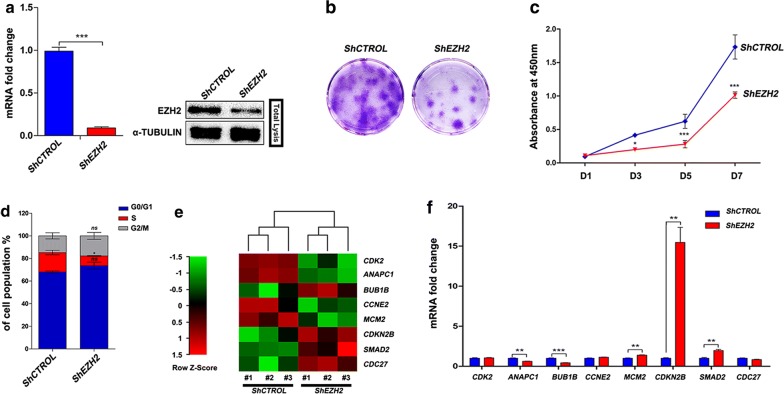
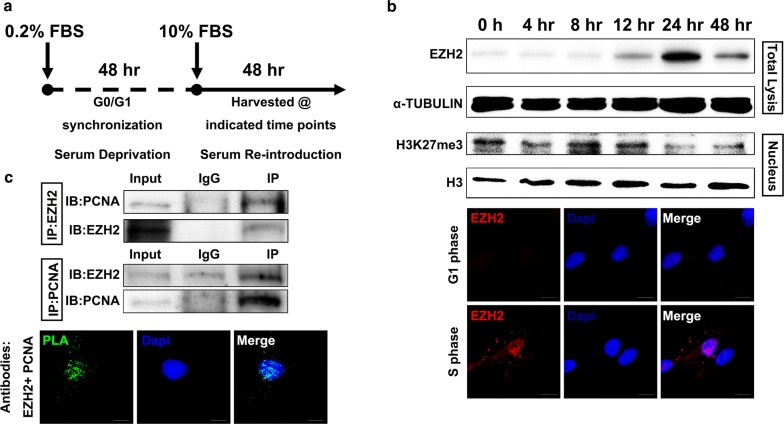
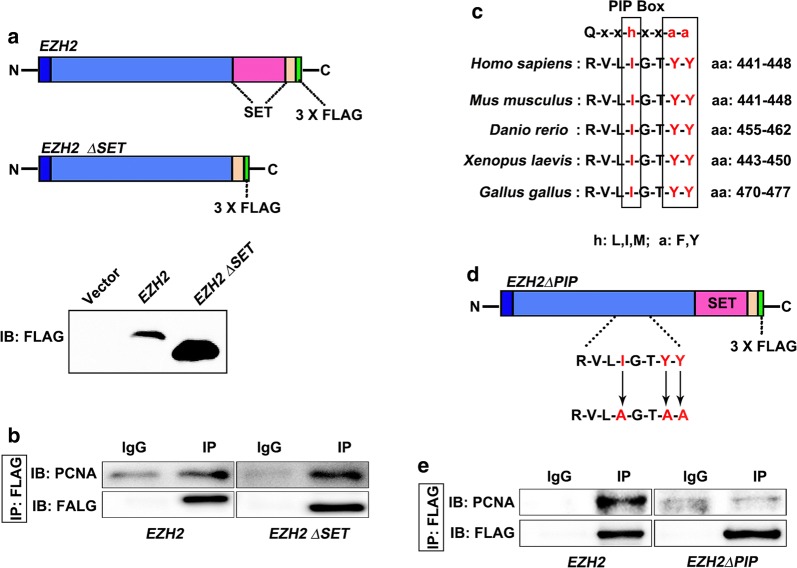
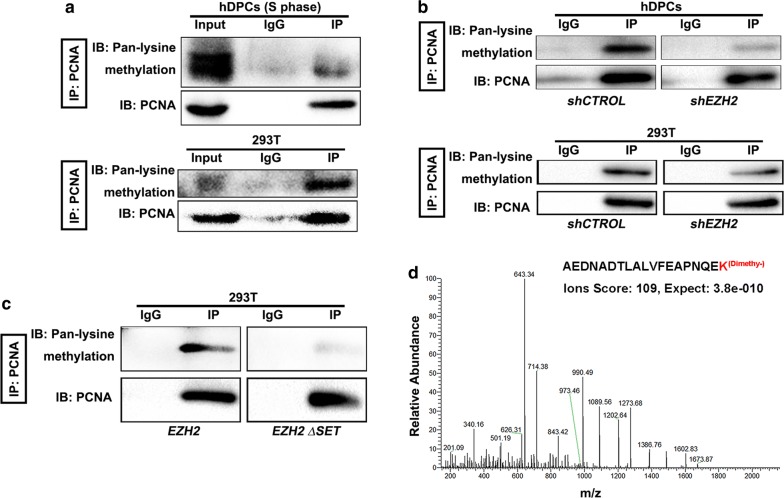
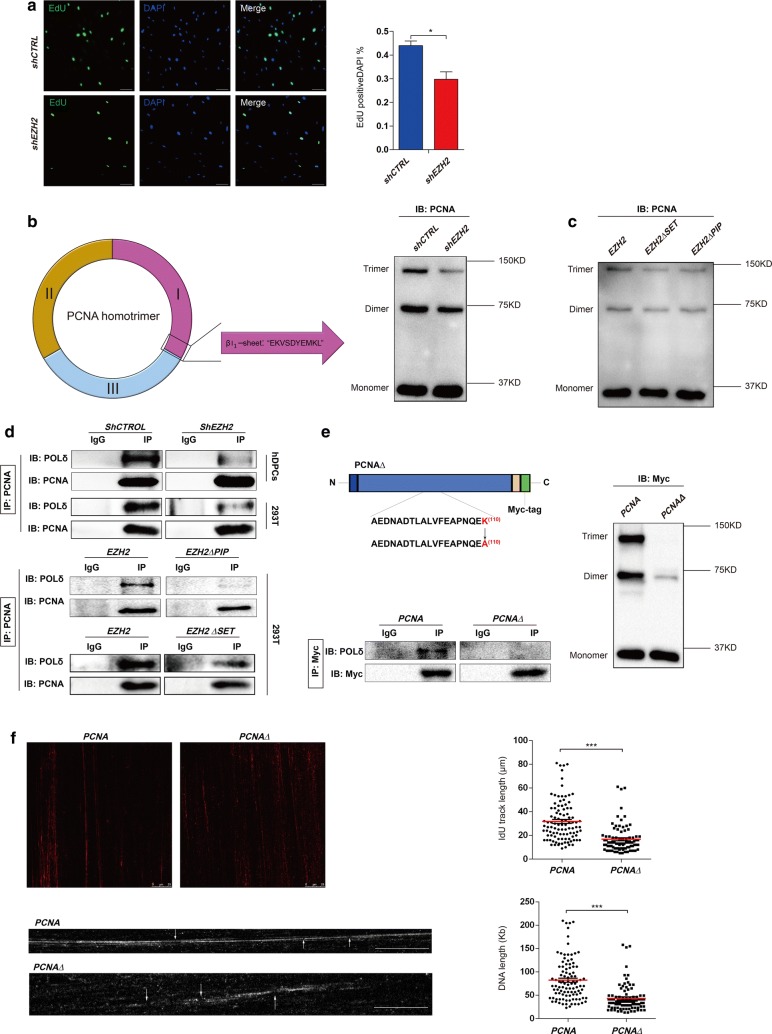
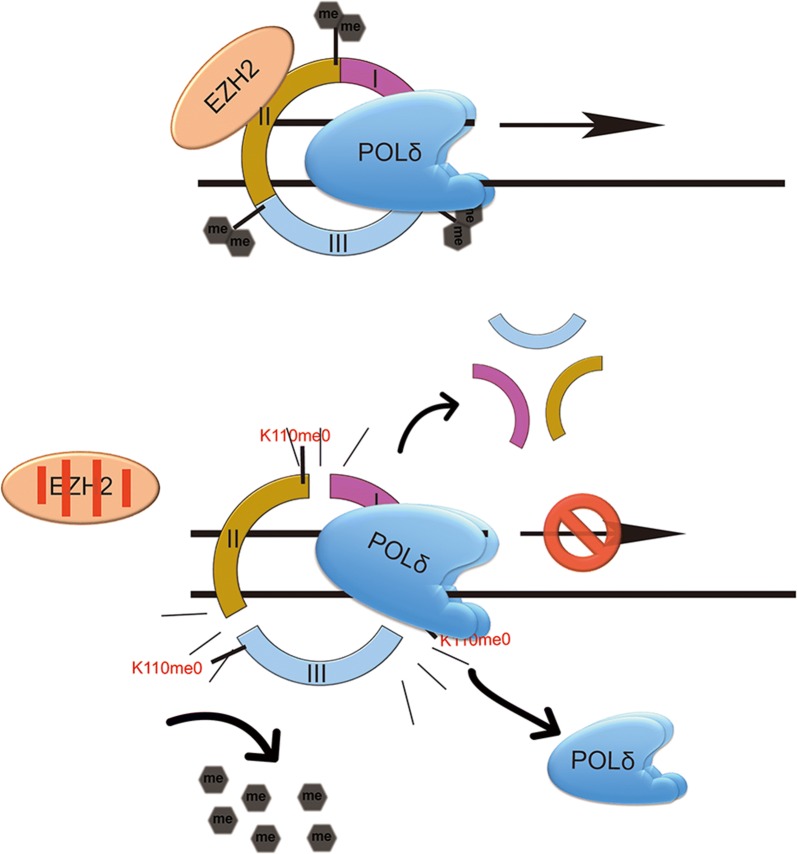
BACKGROUND: Proliferating cell nuclear antigen (PCNA), a ring-shaped homotrimer complex, promotes DNA replication via binding to DNA polymerase. Trimerized PCNA is critical for DNA replication. Enhancer of zeste homologue 2 (EZH2), which primarily acts as a histone methyltransferase, is essential for proliferation. However, how EZH2 promotes proliferation by controlling DNA replication through PCNA remains elusive. RESULTS: Here, we showed that low EZH2 levels repressed the proliferation of human dental pulp cells (hDPCs). The EZH2 protein level was dramatically upregulated in hDPCs at S phase in the absence of H3K27 trimethylation. Molecularly, EZH2 interacted with PCNA via the PIP box and dimethylated PCNA at lysine 110. Dimethylation of PCNA is essential for stabilization of the PCNA trimer and the binding of DNA polymerase δ to PCNA. CONCLUSIONS: Our data reveal the direct interaction between PCNA and EZH2 and a novel mechanism by which EZH2 orchestrates genome duplication.
Overview
The claims and statistics of this paper haven’t been checked yet.
Free: it reads the open-access text and checks the first 5 claims that cite a source we can check. Create a free account to check every claim.
Integrity signals
Registry
Cites
Statistics
Figures
Verification
Claims the paper makes
The claims and statistics of this paper haven’t been checked yet.
Free: it reads the open-access text and checks the first 5 claims that cite a source we can check. Create a free account to check every claim.
Claims other papers make about this one
Each is checked against this paper’s own text: does it say what the citing paper says it does?
In the citing paper
“Chromatin maturation factors, including DNMT1-UHRF1, EZH2 and HP1, use the proliferating cell nuclear antigen (PCNA; a DNA clamp that is essential for replication) or origin recognition complex (ORC) proteins as tethering components [31][32][33][34] (Fig. 2a).”
From Advances in epigenetics link genetics to the environment and disease (2019) · cites this paper as [33]
Self-check
Percentages, sums and reported differences re-computed from the paper’s own numbers.
The self-check needs the paper’s full text.
Citations
Cites
Hanahan, D., & Weinberg, R. A. (2000) · Cell · doi:10.1016/s0092-8674(00)81683-9 · Cited by 29,219
The language of covalent histone modifications
Strahl, B. D., & Allis, C. D. (2000) · Nature · doi:10.1038/47412 · Cited by 8,679
The Cancer Cell Line Encyclopedia enables predictive modelling of anticancer drug sensitivity
Barretina, J., Caponigro, G., Stransky, N., Venkatesan, K., Margolin, A. A., Kim, S., Wilson, C. J., Lehár, J., Kryukov, G. V., Sonkin, D., et al. (2012) · Nature · doi:10.1038/nature11003 · Cited by 7,950
Postnatal human dental pulp stem cells (DPSCs) in vitro and in vivo
Gronthos, S., Mankani, M., Brahim, J., Robey, P. G., & Shi, S. (2000) · Proceedings of the National Academy of Sciences · doi:10.1073/pnas.240309797 · Cited by 4,570
Histone demethylation mediated by the nuclear amine oxidase homolog LSD1
Shi, Y., Lan, F., Matson, C., Mulligan, P., Whetstine, J. R., Cole, P. A., Casero, R. A., & Shi, Y. (2004) · Cell · doi:10.1016/j.cell.2004.12.012 · Cited by 4,051 · cited 1×
“PCNA interacts with DNA replication cofactors during DNA replication via the evolutionarily conserved PIP box or APIM motif [4, 43, 54].”
BackgroundRole of Histone H3 Lysine 27 Methylation in Polycomb-Group Silencing
Cao, R., Wang, L., Wang, H., Xia, L., Erdjument-Bromage, H., Tempst, P., Jones, R. S., & Zhang, Y. (2002) · Science · doi:10.1126/science.1076997 · Cited by 3,775
The polycomb group protein EZH2 is involved in progression of prostate cancer
Varambally, S., Dhanasekaran, S. M., Zhou, M., Barrette, T. R., Kumar-Sinha, C., Sanda, M. G., Ghosh, D., Pienta, K. J., Sewalt, R. G. A. B., Otte, A. P., et al. (2002) · Nature · doi:10.1038/nature01075 · Cited by 2,717
Histone methylation: a dynamic mark in health, disease and inheritance
Greer, E. L., & Shi, Y. (2012) · Nature Reviews Genetics · doi:10.1038/nrg3173 · Cited by 2,241
RAD6-dependent DNA repair is linked to modification of PCNA by ubiquitin and SUMO
Hoege, C., Pfander, B., Moldovan, G.-L., Pyrowolakis, G., & Jentsch, S. (2002) · Nature · doi:10.1038/nature00991 · Cited by 2,198
PCNA, the Maestro of the Replication Fork
Moldovan, G.-L., Pfander, B., & Jentsch, S. (2007) · Cell · doi:10.1016/j.cell.2007.05.003 · Cited by 1,796
Cited by
Advances in epigenetics link genetics to the environment and disease
Cavalli, G., & Heard, E. (2019) · Nature · doi:10.1038/s41586-019-1411-0 · Cited by 1,509
Human PCNA Structure, Function and Interactions
González-Magaña, A., & Blanco, F. J. (2020) · Biomolecules · doi:10.3390/biom10040570 · Cited by 286
Mechanisms of DNA Damage Tolerance: Post-Translational Regulation of PCNA
Leung, W., Baxley, R. M., Moldovan, G., & Bielinsky, A. (2018) · Genes · doi:10.3390/genes10010010 · Cited by 104
Wang, J., & Wang, G. G. (2020) · International Journal of Molecular Sciences · doi:10.3390/ijms21249501 · Cited by 83
Lysine methylation signaling of non-histone proteins in the nucleus
Levy, D. (2019) · Cellular and Molecular Life Sciences · doi:10.1007/s00018-019-03142-0 · Cited by 63
Golubnitschaja, O., Topolčan, O., Kučera, R., Costigliola, V., EPMA, Akopyan, M., Akulov, S. N., Alexandrova, O., Alonso, A., Andrews, R. J., et al. (2020) · The EPMA Journal · doi:10.1007/s13167-020-00206-1 · Cited by 62
Zhang, S., Zhou, T., Wang, Z., Yi, F., Li, C., Guo, W., Xu, H., Cui, H., Dong, X. D., Liu, J., et al. (2021) · International Journal of Biological Sciences · doi:10.7150/ijbs.64628 · Cited by 57
Mitochondria: the epigenetic regulators of ovarian aging and longevity
Mani, S., Srivastava, V., Shandilya, C., Kaushik, A., & Singh, K. K. (2024) · Frontiers in Endocrinology · doi:10.3389/fendo.2024.1424826 · Cited by 49
The molecular mechanisms and therapeutic potential of EZH2 in breast cancer
Adibfar, S., Elveny, M., Kashikova, H. S., Mikhailova, M. V., Farhangnia, P., Vakili‐Samiani, S., Tarokhian, H., & Jadidi‐Niaragh, F. (2021) · Life Sciences · doi:10.1016/j.lfs.2021.120047 · Cited by 44
Biomimetic bioinks of nanofibrillar polymeric hydrogels for 3D bioprinting
Wang, Y., Li, J., Li, Y., & Yang, B. (2021) · Nano Today · doi:10.1016/j.nantod.2021.101180 · Cited by 35
Huang, R., Chen, Z., Li, W., Fan, C., & Liu, J. (2020) · International Journal of Oncology · doi:10.3892/ijo.2020.4998 · Cited by 32
ROS regulates circadian rhythms by modulating Ezh2 interactions with clock proteins
Zhang, H.-Y., Li, K.-Y., Wang, Y., Wei, C.-J., Gao, Y., Ren-Zhou, Zhong, Y., Yin, Z., & Ren, D. (2025) · Redox Biology · doi:10.1016/j.redox.2025.103526 · Cited by 28
PCNA, a focus on replication stress and the alternative lengthening of telomeres pathway
Shen, M. C., Young, A., & Autexier, C. (2021) · DNA repair · doi:10.1016/j.dnarep.2021.103055 · Cited by 24
Post-Translational Modifications of PCNA: Guiding for the Best DNA Damage Tolerance Choice
Bellí, G., Colomina, N., Castells‐Roca, L., & Lorite, N. P. (2022) · Journal of Fungi · doi:10.3390/jof8060621 · Cited by 24
Wang, T., & Wang, Z. (2025) · Journal of Medicinal Chemistry · doi:10.1021/acs.jmedchem.4c00526 · Cited by 22
Heat‐Shock protein A12A is a novel PCNA‐binding protein and promotes hepatocellular carcinoma growth
Cheng, H., Cao, X., Min, X., Zhang, X., Kong, Q., Mao, Q., Li, R., Xue, B., Fang, L., Liu, L., et al. (2020) · FEBS Journal · doi:10.1111/febs.15276 · Cited by 20
Zhang, Q., Yang, H., Feng, Q., Cao, J., Zhang, Y., Li, L., & Yu, L. (2022) · Pharmacological Research · doi:10.1016/j.phrs.2022.106159 · Cited by 19
ATXR5/6 Forms Alternative Protein Complexes with PCNA and the Nucleosome Core Particle
Davarinejad, H., Joshi, M., Ait-Hamou, N., Munro, K. A., & Couture, J. (2019) · Journal of Molecular Biology · doi:10.1016/j.jmb.2019.02.020 · Cited by 18
Zhang, C., Liu, C., Wang, Y., Zhu, N., Hu, Z., Liao, D., & Li, Q. (2019) · Vascular Pharmacology · doi:10.1016/j.vph.2019.02.005 · Cited by 18
CRdb: a comprehensive resource for deciphering chromatin regulators in human
Zhang, Y., Zhang, Y., Song, C., Zhao, X., Ai, B., Wang, Y., Zhou, L., Zhu, J., Feng, C., Xu, L., et al. (2022) · Nucleic Acids Research · doi:10.1093/nar/gkac960 · Cited by 13
Self-citationLi, Y., Ji, W., Wang, C., Chang, L., Zhang, Q., Gao, J., Wang, T., & Wu, W. (2024) · ACS Applied Materials & Interfaces · doi:10.1021/acsami.4c18625 · Cited by 11
Self-citationDynamic In Vivo Mapping of the Methylproteome Using a Chemoenzymatic Approach
Farhi, J., Emenike, B., Lee, R. S., Sad, K., Fawwal, D. V., Beusch, C. M., Jones, R. B., Verma, A. K., Jones, C. Y., Foroozani, M., et al. (2025) · Journal of the American Chemical Society · doi:10.1021/jacs.4c08175 · Cited by 7
Sharma, V., Pal, J., Dashora, V., Chattopadhyay, S., Kapoor, Y., Singha, B., Arimbasseri, G. A., & Saha, S. (2025) · Journal of Biological Chemistry · doi:10.1016/j.jbc.2025.108208 · Cited by 6
PCNA Ser46-Leu47 residues are crucial in preserving genomic integrity
Kim, S., Kim, Y., Kim, Y., Yoon, S., Lee, K., Lee, Y., Kang, S., Myung, K., & Oh, C. (2023) · PLoS ONE · doi:10.1371/journal.pone.0285337 · Cited by 3
Non-canonical transcriptional regulation of INHAT subunit SET/TAF-Iβ by EZH2
Hwang, I. J., Park, J., & Seo, S. (2022) · Biochemical and Biophysical Research Communications · doi:10.1016/j.bbrc.2022.10.041 · Cited by 3
Ramadan, W. S. H., Menon, V., Zein, R. A., Alqedra, S., El-Gharib, Y., Al-Shihabi, A. M., Alhamidi, R. S., İlçe, B. Y., Hamoudi, R., & El‐Awady, R. (2025) · Biochemical Pharmacology · doi:10.1016/j.bcp.2025.117535 · Cited by 2
刘承利, Ruan, P., Wang, Z., Huang, Y., Zhang, L., Yu, D., Huang, D., Ceccobelli, S., Gao, H., & Guangxin, E. (2026) · Communications Biology · doi:10.1038/s42003-026-10151-w · Cited by 2
Simsone, Z., Feivalds, T., Harju, L., Miķelsone, I., Blāķe, I., Bērziņš, J., & Buiķis, I. (2024) · Biomedicines · doi:10.3390/biomedicines12071576 · Cited by 1
Moshiri, A., Luff, M. K., Kim, S., Jiang, M., Dar, M. S., Patel, M. P., McKinnon, K. M., Edmondson, E. F., Bassel, L., Warner, A. C., et al. (2026) · Cell Death and Disease · doi:10.1038/s41419-026-09236-5 · Cited by 1
The Role of the DNA Helicase Rrm3 under Replication Stress
Muellner, J. (2023) · Digital Commons - University of South Florida (University of South Florida) · Cited by 1
Metabolic control of DNA replication: beyond biosynthetic and bioenergetic needs
Dong, K., Pei, J., Liu, J., Li, Y., Wang, Y., & Feng, Y. (2025) · Epigenetics Insights · doi:10.48130/epi-0025-0015
Xu, H., Cai, Y., Yang, H., Li, S., Chen, P., Wei, Z., Wang, F., Wang, Z., & Zhang, Y. (2024) · Animal Reproduction Science · doi:10.1016/j.anireprosci.2024.107457
Rôle de la protéine PCNA cytoplasmique dans la régulation de l'inflammasome NLRP3
Lopes, C. (2023) · theses.fr (ABES) · doi:10.70675/c70bad59zc90ez4574z8c7dze01c42dd514e
Liu, S., Ming, D., Xu, Y.-H., Li, B.-H., Shi, M., Xi, S., Cui, J., Yang, J., Xiong, X., He, S., et al. (2026) · Proceedings of the National Academy of Sciences · doi:10.1073/pnas.2600167123
Self-citationSimsone, Z. (2024) · E-resource repository of the University of Latvia (University of Latvia)
Dahlia, T. M. E. (2023) · Institutional Repositories DataBase (IRDB) · doi:10.15083/0002011690
Proliferating Cell Nuclear Antigen as New Therapeutic Target in Multiple Myeloma
Bao, B., Aboukameel, A., Bannoura, S. F., Khan, H. Y., Uddin, M. H., Shi, Y., Wan, Y., Sukkari, M. W., Mohammad, R. M., Kaddoura, M., et al. (2026) · Molecular Cancer Therapeutics · doi:10.1158/1535-7163.mct-25-1543
Metadata
- Authors
- A, P., Xu, X., Wang, C., Yang, J., Wang, S., Dai, J., & Ye, L.
- Affiliations
- Sichuan University (CN)
- Shanghai Jiao Tong University (CN)
- Corresponding author
- Ye, Ling
- Venue
- Epigenetics & Chromatin
- Published
- 2018-08-02
- Volume
- 11
- Issue
- 1
- Pages
- 44-44
- ISSN
- 1756-8935 (ISSN-L)
- PMC
- PMC6071395
- OpenAlex
- W2886681029
- Cited by
- 30
- References
- 66
- Citations by year
- 2026: 2 · 2025: 6 · 2024: 3 · 2023: 1 · 2022: 4 · 2021: 4 · 2020: 5 · 2019: 4 · 2018: 1
- FWCI
- 1.24
- Type
- journal article
- Language
- en
- Open access
- gold
- doi.org
- Licence
- cc-by
- creativecommons.org/licenses/by/4.0/ (tdm)
- Locations
- Epigenetics & Chromatin (publishedVersion, cc-by)
- Europe PMC (PubMed Central) (publishedVersion, cc-by)
- PubMed Central (publishedVersion, cc-by)
- PubMed (publishedVersion)
- DOAJ (DOAJ: Directory of Open Access Journals) (submittedVersion, cc-by-sa)
- Funders
- National High-tech R&D Program (863 Program) (2015AA020306)
- Sichuan Province Science and Technology Support Program (2016JY0022)
- National Natural Science Foundation of China (81271127, 81322013)
- Program of International Science and Technology Cooperation (2014DFA31990)
- Topics
- Life Sciences › Biochemistry, Genetics and Molecular Biology › Molecular Biology › Epigenetics and DNA Methylation
- Life Sciences › Biochemistry, Genetics and Molecular Biology › Molecular Biology › DNA Repair Mechanisms
- Life Sciences › Biochemistry, Genetics and Molecular Biology › Molecular Biology › Genomics and Chromatin Dynamics
- Keywords
- EZH2, PCNA, DNA polymerase delta, PIP box, DNA replication, histone methyltransferase, dental pulp cells, cell proliferation, H3K27me3, whole-genome duplication
- MeSH terms
- Enhancer of Zeste Homolog 2 Protein, Cells, Cultured, Dental Pulp, DNA Polymerase III, DNA Replication, Humans, Methylation, Protein Binding, Protein Processing, Post-Translational, Proliferating Cell Nuclear Antigen, Protein Multimerization, Young Adult
About these checks
Registry, retraction, Cites and statistics results are computed, not judged, with one exception: a printed reference that no index lists is read once by a model before it counts as a citation error. Claims are extracted by a model and kept only when their quote appears verbatim in the text; each cited source is then checked, with a model’s help, for whether it says what the claim relies on. Those verdicts can be wrong — read the claim’s quote and the cited source before relying on one.
Statistics and arithmetic are recomputed, not judged.
Confidence bands are shown only for fields calibrated on our annotated test set. None is calibrated yet, so no band is shown.
What counts as a claim ›How we measure confidence ›How we check this ›
Are you an author, or do you see a problem with this page? Request a review
Data sources
Bibliographic data: Semantic Scholar, OpenAlex, Crossref.
Contains information from the Semantic Scholar Academic Graph Datasets, made available under the ODC Attribution License (ODC-BY 1.0).
Semantic Scholar’s data is described in: Kinney, R., et al. (2023). The Semantic Scholar Open Data Platform. arXiv:2301.10140.
