

An assessment of sex bias in neurodevelopmental disorders
Open accessThe DOI matches its Crossref record; 66 of the 66 references it cites were found in a registry or an index.
Abstract
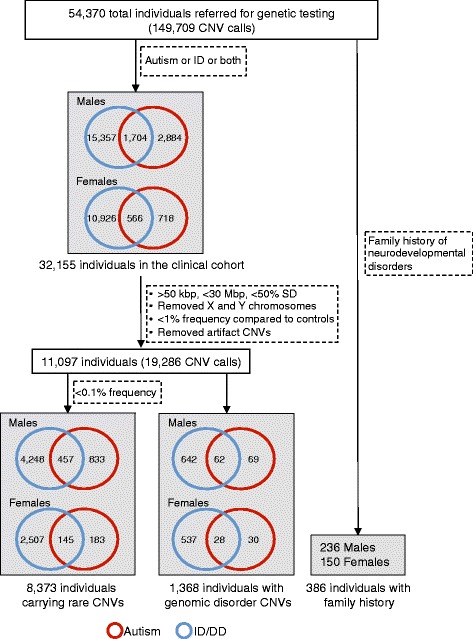
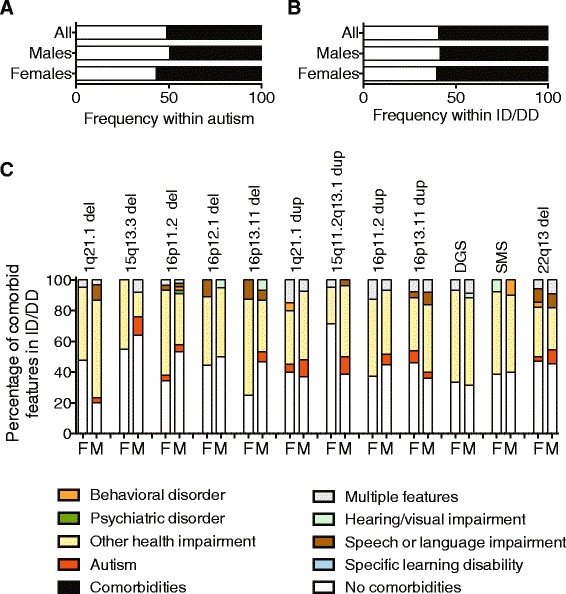
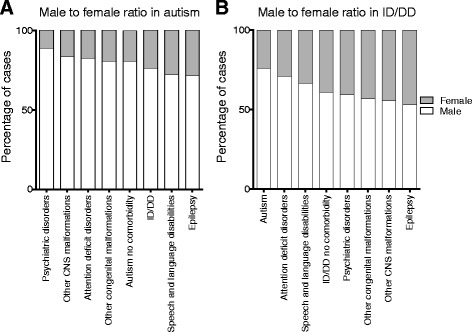
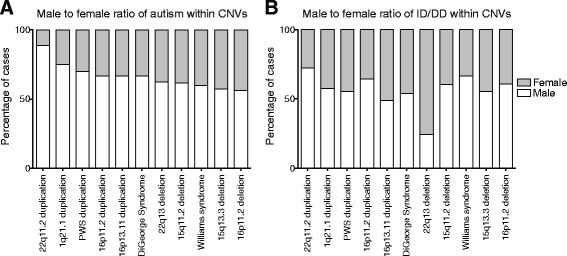
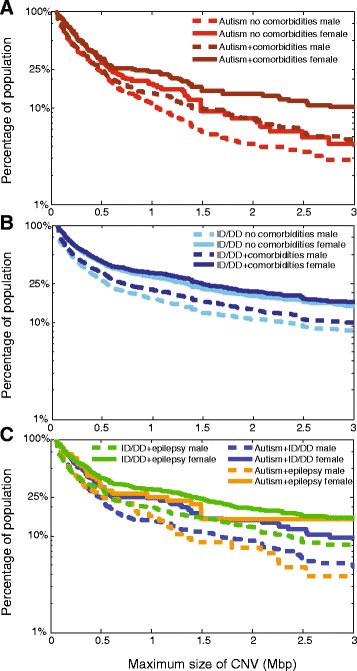
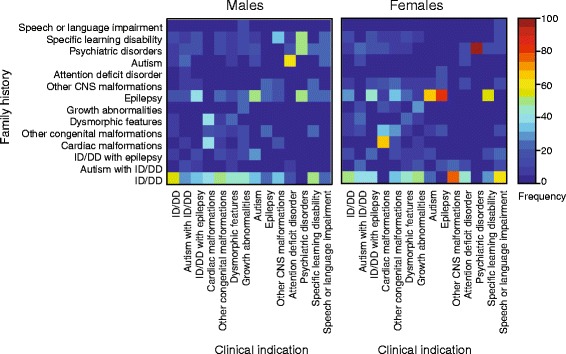
BACKGROUND: Neurodevelopmental disorders such as autism and intellectual disability have a sex bias skewed towards boys; however, systematic assessment of this bias is complicated by the presence of significant genetic and phenotypic heterogeneity of these disorders. METHODS: To assess the extent and characteristics of sex bias, we analyzed the frequency of comorbid features, the magnitude of genetic load, and the existence of family history within 32,155 individuals ascertained clinically for autism or intellectual disability/developmental delay (ID/DD), including a subset of 8,373 individuals carrying rare copy-number variants (CNVs). RESULTS: We find that girls were more likely than boys to show comorbid features within both autism (P = 2.9 × 10(-6), OR = 1.34) and ID/DD (P = 7.2 × 10(-4), OR = 1.08) cohorts. The frequency of comorbid features in ID/DD was higher in boys (1q21.1 deletion, 15q11.2q13.1 duplication) or girls (15q13.3 deletion, 16p11.2 deletion) carrying specific CNVs associated with variable expressivity while such differences were the smallest for syndromic CNVs (Smith-Magenis syndrome, DiGeorge syndrome). The extent of the male sex bias also varied according to the specific comorbid feature, being most extreme for autism with psychiatric comorbidities and least extreme for autism comorbid with epilepsy. The sex ratio was also specific to certain CNVs, from an 8:1 male:female ratio observed among autistic individuals carrying the 22q11.2 duplication to 1.3:1 male:female ratio in those carrying the 16p11.2 deletion. Girls carried a higher burden of large CNVs compared to boys for autism or ID/DD, and this difference diminished when severe comorbidities were considered. Affected boys showed a higher frequency of neuropsychiatric family histories such as autism (P = 0.01) or specific learning disability (P = 0.03), while affected girls showed a higher frequency of developmental family histories such as growth abnormalities (P = 0.02). CONCLUSIONS: The sex bias within neurodevelopmental disorders is influenced by the presence of specific comorbidities, specific CNVs, mutational burden, and pre-existing family history of neurodevelopmental phenotypes.
Overview
The claims and statistics of this paper haven’t been checked yet.
Free: it reads the open-access text and checks the first 5 claims that cite a source we can check. Create a free account to check every claim.
Integrity signals
Registry
Cites
Statistics
Figures
Verification
Claims the paper makes
The claims and statistics of this paper haven’t been checked yet.
Free: it reads the open-access text and checks the first 5 claims that cite a source we can check. Create a free account to check every claim.
Claims other papers make about this one
Each is checked against this paper’s own text: does it say what the citing paper says it does?
The source backs part of the claim, not all of it — or backs it for a different population, condition or comparison.
In the citing paper
“In relation to structural variants, some neurodevelopmental condition-related copy number variations display phenotypic sex differences; autism is more common in males with 22q11.2 duplication and 16p11.2 deletion syndromes than in females with these syndromes238.”
From Sex and gender in neurodevelopmental conditions (2023) · cites this paper as [238]
Experimental — accuracy not yet measuredThe check wasn’t confident either way, so it gives no verdict — never disputed.
In the citing paper
“Deafness or partial hearing loss was observed in 2.90% (2.40/4.90% in males/females) vs. 0.50% in the general population for the younger age group (0–15 years), and 3.90% (3.20/6.30% in males/females) vs. 0.80% for the older age group (16–24 years). The study concluded that hearing impairment was nine times more prevalent in the autistic individuals compared to the general population.”
From Prevalence of Autism Spectrum Disorder and Co-morbidities in Children and Adolescents: A Systematic Literature Review (2021) · cites this paper as [34]
Experimental — accuracy not yet measuredIn the citing paper
“Prevalence of hearing impairment ranged from ~0% (females) in Polyak et al. (31) a study investigating sex bias in ASD comorbidities to 4.90% in Rydzewska et al. (34) (Figure 8 and Supplementary Material 6).”
From Prevalence of Autism Spectrum Disorder and Co-morbidities in Children and Adolescents: A Systematic Literature Review (2021) · cites this paper as [34]
In the citing paper
“Prevalence for vision impairment ranged from ~0% (males and females) in Polyak et al. (34) study examining the impact of sex bias on comorbidities in ASD, to 14.9% in Aldinger et al. (51) (Figure 11 and Supplementary Material 6).”
From Prevalence of Autism Spectrum Disorder and Co-morbidities in Children and Adolescents: A Systematic Literature Review (2021) · cites this paper as [34]
In the citing paper
“In agreement with this, the ratio of males to females with either ASD or ID shows a male predominance in both 16p11.2 CNVs [57], suggesting that being female is a protective factor when predicting overall ASD severity in either 16p11.2 CNV [58].”
From 16p11.2 Copy Number Variations and Neurodevelopmental Disorders (2020) · cites this paper as [57]
Self-check
Percentages, sums and reported differences re-computed from the paper’s own numbers.
The self-check needs the paper’s full text.
Citations
Cites
Baio, J., Wiggins, L., Christensen, D. L., Maenner, M. J., Daniels, J., Warren, Z., Kurzius-Spencer, M., Zahorodny, W., Robinson, C., Rosenberg, et al. (2018) · MMWR. Surveillance Summaries · doi:10.15585/mmwr.ss6706a1 · Cited by 6,078
Large recurrent microdeletions associated with schizophrenia.
GROUP, Stefansson, H., Rujescu, D., Cichon, S., Pietiläinen, O. P. H., Ingason, A., Steinberg, S., Fossdal, R., Sigurdsson, E., Sigmundsson, T., et al. (2008) · Nature · doi:10.1038/nature07229 · Cited by 1,745 · cited 1×
“3 deletion [27–29], 22q11.”
Patterns and rates of exonic de novo mutations in autism spectrum disorders
Neale, B. M., Kou, Y., Liu, L., Ma’ayan, A., Samocha, K. E., Sabo, A., Lin, C.-F., Stevens, C., Wang, L.-S., Makarov, V., et al. (2012) · Nature · doi:10.1038/nature11011 · Cited by 1,734 · cited 1×
“2 deletion [30–32], and gene disruptive mutations in CHD2 [33–35] and SYNGAP1 [34–37] have all been significantly associated with ID/DD, autism, and schizophrenia phenotypes from independent cohort studies.”
Association between Microdeletion and Microduplication at 16p11.2 and Autism
Weiss, L. A., Shen, Y., Korn, J. M., Arking, D. E., Miller, D. T., Fossdal, R., Saemundsen, E., Stefansson, H., Ferreira, M. A. R., Green, T., et al. (2008) · New England Journal of Medicine · doi:10.1056/nejmoa075974 · Cited by 1,666 · cited 1×
“2 deletion [21–23], 17q12 deletion [24–26], 15q13.”
De novo mutations in schizophrenia implicate synaptic networks
Fromer, M., Pocklington, A. J., Kavanagh, D. H., Williams, H. J., Dwyer, S., Gormley, P., Georgieva, L., Rees, E., Palta, P., Ruderfer, D. M., et al. (2014) · Nature · doi:10.1038/nature12929 · Cited by 1,617 · cited 1×
“Second, hundreds of genes and genomic regions have been identified for each of these neurodevelopmental disorders from studies of copy number variants (CNVs) and exome sequencing, suggesting significant genetic heterogeneity [14–17].”
Diagnostic exome sequencing in persons with severe intellectual disability
de Ligt, J., Willemsen, M. H., van Bon, B. W. M., Kleefstra, T., Yntema, H. G., Kroes, T., Vulto-van Silfhout, A. T., Koolen, D. A., de Vries, P., Gilissen, C., et al. (2012) · New England Journal of Medicine · doi:10.1056/nejmoa1206524 · Cited by 1,546
De Novo Gene Disruptions in Children on the Autistic Spectrum
Iossifov, I., Ronemus, M., Levy, D., Wang, Z., Hakker, I., Rosenbaum, J., Yamrom, B., Lee, Y.-H., Narzisi, G., Leotta, A., et al. (2012) · Neuron · doi:10.1016/j.neuron.2012.04.009 · Cited by 1,446 · cited 1×
“2 deletion [30–32], and gene disruptive mutations in CHD2 [33–35] and SYNGAP1 [34–37] have all been significantly associated with ID/DD, autism, and schizophrenia phenotypes from independent cohort studies.”
A polygenic burden of rare disruptive mutations in schizophrenia
Purcell, S. M., Moran, J. L., Fromer, M., Ruderfer, D., Solovieff, N., Roussos, P., O’Dushlaine, C., Chambert, K., Bergen, S. E., Kähler, A., et al. (2014) · Nature · doi:10.1038/nature12975 · Cited by 1,385 · cited 1×
“2 deletion [30–32], and gene disruptive mutations in CHD2 [33–35] and SYNGAP1 [34–37] have all been significantly associated with ID/DD, autism, and schizophrenia phenotypes from independent cohort studies.”
Naarden Braun, K. V., Lopez, M., White, T., et al. (2023) · Carolina Digital Repository (University of North Carolina at Chapel Hill) · doi:10.17615/y3kk-5x30 · Cited by 1,381
Cited by
Items 101–149 of 149
dos Santos, A. (2017) · Digital Library of Theses and Dissertations (Universidade de São Paulo) · doi:10.11606/d.41.2017.tde-12072017-082102 · Cited by 1
Hamilton, A. (2020) · uO Research (University of Ottawa) · doi:10.20381/ruor-24515
Niedźwiecka, A. (2020) · Wydawnictwo Liberi Libri eBooks · doi:10.47943/lib.9788363487423.rozdzial08
Błaszczyk-Bębenek, E., & Bargiel-Matusiewicz, K. M. (2020) · Wydawnictwo Liberi Libri eBooks · doi:10.47943/lib.9788363487423.rozdzial06
Narzędzia inżynierii lingwistycznej w badaniu komunikacji społecznej w autyzmie
Chojnicka, I. (2020) · Wydawnictwo Liberi Libri eBooks · doi:10.47943/lib.9788363487423.rozdzial09
Doświadczanie zmian w życiu: pozytywne standardy Ja i styl przywiązania jako zasoby samoregulacji
Huflejt-Łukasik, M. (2020) · Wydawnictwo Liberi Libri eBooks · doi:10.47943/lib.9788363487423.rozdzial02 · Cited by 2
Oligogenic combinations of rare variants influence specific phenotypes in complex disordersPreprint
Pounraja, V. K., & Girirajan, S. (2021) · bioRxiv (Cold Spring Harbor Laboratory) · doi:10.1101/2021.10.01.462832
Self-citation(2020) · Wydawnictwo Liberi Libri eBooks · doi:10.47943/lib.9788363487423.rozdzial00
Singh, A., Garg, P., & Srivastava, P. (2023) · Informatics in Medicine Unlocked · doi:10.1016/j.imu.2023.101282 · Cited by 1
Khan, Z., Anjum, N., Reyazuddin, M., & Malsawmtluangi (2024) · Indian Journal of Clinical Psychiatry. · doi:10.54169/ijocp.v4i01.75
“28 It was anticipated that there were more male patients than female patients.”
BackgroundThe inquiry of association between intellectual disabilities and physical disabilities
Park, K., Eo, E., & Lee, J. (2024) · Theoretical and Natural Science · doi:10.54254/2753-8818/45/20240523
The role of progesterone receptor in the developing medial preoptic nucleus
Lalitsasivimol, D. (2019) · Scholars Archive - University at Albany (University at Albany, State University of New York) · doi:10.54014/b7ym-1zmm · Cited by 3
Kretz, P. F., Wagner, C., Mikhaleva, A., Montillot, C., Hugel, S., Morella, I., Kannan, M., Fischer, M., Milhau, M., Yalçın, İ., et al. (2024) · Figshare · doi:10.6084/m9.figshare.26640508
Kretz, P. F., Wagner, C., Mikhaleva, A., Montillot, C., Hugel, S., Morella, I., Kannan, M., Fischer, M., Milhau, M., Yalçın, İ., et al. (2024) · Figshare · doi:10.6084/m9.figshare.26640532
Kim, S.-W., Lee, H., Song, D. Y., Lee, G. Q., Ji, J., Park, J. W., Han, J. H., Lee, J. W., Byun, H. J., Son, J. H., et al. (2024) · Figshare · doi:10.6084/m9.figshare.27124237
Self-citationKretz, P. F., Wagner, C., Mikhaleva, A., Montillot, C., Hugel, S., Morella, I., Kannan, M., Fischer, M., Milhau, M., Yalçın, İ., et al. (2024) · Figshare · doi:10.6084/m9.figshare.26640514
Kretz, P. F., Wagner, C., Mikhaleva, A., Montillot, C., Hugel, S., Morella, I., Kannan, M., Fischer, M., Milhau, M., Yalçın, İ., et al. (2024) · Figshare · doi:10.6084/m9.figshare.26640520
Kretz, P. F., Wagner, C., Mikhaleva, A., Montillot, C., Hugel, S., Morella, I., Kannan, M., Fischer, M., Milhau, M., Yalçın, İ., et al. (2024) · Figshare · doi:10.6084/m9.figshare.26640502
Kretz, P. F., Wagner, C., Mikhaleva, A., Montillot, C., Hugel, S., Morella, I., Kannan, M., Fischer, M., Milhau, M., Yalçın, İ., et al. (2024) · Figshare · doi:10.6084/m9.figshare.24572204
Hall, M. B. (2024) · Library, Museums and Press - UDSpace (University of Delaware) · doi:10.58088/at11-n282
Kretz, P. F., Wagner, C., Mikhaleva, A., Montillot, C., Hugel, S., Morella, I., Kannan, M., Fischer, M., Milhau, M., Yalçın, İ., et al. (2024) · Figshare · doi:10.6084/m9.figshare.26640529
Kim, S.-W., Lee, H., Song, D. Y., Lee, G. Q., Ji, J., Park, J. W., Han, J. H., Lee, J. W., Byun, H. J., Son, J. H., et al. (2024) · Figshare · doi:10.6084/m9.figshare.27124240
Self-citationKim, S.-W., Lee, H., Song, D. Y., Lee, G. Q., Ji, J., Park, J. W., Han, J. H., Lee, J. W., Byun, H. J., Son, J. H., et al. (2024) · Figshare · doi:10.6084/m9.figshare.27124216
Self-citationKim, S.-W., Lee, H., Song, D. Y., Lee, G. Q., Ji, J., Park, J. W., Han, J. H., Lee, J. W., Byun, H. J., Son, J. H., et al. (2024) · Figshare · doi:10.6084/m9.figshare.27124213
Self-citationSegre, G., Clavenna, A., Roberti, E., Scarpellini, F., Cartabia, M., Pandolfini, C., Tessarollo, V., Costantino, I., & Bonati, M. R. (2024) · Figshare · doi:10.6084/m9.figshare.26684364
Kim, S.-W., Lee, H., Song, D. Y., Lee, G. Q., Ji, J., Park, J. W., Han, J. H., Lee, J. W., Byun, H. J., Son, J. H., et al. (2024) · Figshare · doi:10.6084/m9.figshare.27124228
Self-citationKim, S.-W., Lee, H., Song, D. Y., Lee, G. Q., Ji, J., Park, J. W., Han, J. H., Lee, J. W., Byun, H. J., Son, J. H., et al. (2024) · Figshare · doi:10.6084/m9.figshare.27124234
Self-citationKretz, P. F., Wagner, C., Mikhaleva, A., Montillot, C., Hugel, S., Morella, I., Kannan, M., Fischer, M., Milhau, M., Yalçın, İ., et al. (2024) · Figshare · doi:10.6084/m9.figshare.26640511
Kretz, P. F., Wagner, C., Mikhaleva, A., Montillot, C., Hugel, S., Morella, I., Kannan, M., Fischer, M., Milhau, M., Yalçın, İ., et al. (2024) · Figshare · doi:10.6084/m9.figshare.26640505
Kretz, P. F., Wagner, C., Mikhaleva, A., Montillot, C., Hugel, S., Morella, I., Kannan, M., Fischer, M., Milhau, M., Yalçın, İ., et al. (2024) · Figshare · doi:10.6084/m9.figshare.26640517
Kim, S.-W., Lee, H., Song, D. Y., Lee, G. Q., Ji, J., Park, J. W., Han, J. H., Lee, J. W., Byun, H. J., Son, J. H., et al. (2024) · Figshare · doi:10.6084/m9.figshare.27124219
Self-citationKretz, P. F., Wagner, C., Mikhaleva, A., Montillot, C., Hugel, S., Morella, I., Kannan, M., Fischer, M., Milhau, M., Yalçın, İ., et al. (2024) · Figshare · doi:10.6084/m9.figshare.26640523
Kretz, P. F., Wagner, C., Mikhaleva, A., Montillot, C., Hugel, S., Morella, I., Kannan, M., Fischer, M., Milhau, M., Yalçın, İ., et al. (2023) · Figshare · doi:10.6084/m9.figshare.24571899
Kim, S.-W., Lee, H., Song, D. Y., Lee, G. Q., Ji, J., Park, J. W., Han, J. H., Lee, J. W., Byun, H. J., Son, J. H., et al. (2024) · Figshare · doi:10.6084/m9.figshare.27124231
Self-citationKretz, P. F., Wagner, C., Mikhaleva, A., Montillot, C., Hugel, S., Morella, I., Kannan, M., Fischer, M., Milhau, M., Yalçın, İ., et al. (2024) · Figshare · doi:10.6084/m9.figshare.26640526
Kim, S.-W., Lee, H., Song, D. Y., Lee, G. Q., Ji, J., Park, J. W., Han, J. H., Lee, J. W., Byun, H. J., Son, J. H., et al. (2024) · Figshare · doi:10.6084/m9.figshare.27124222
Self-citationMaternal Allergic Asthma and the Impacts on Offspring Neurodevelopment
Tamayo, J. M. (2023) · eScholarship (California Digital Library)
Bulterys, M. A. (2023) · ResearchWorks at the University of Washington (University of Washington)
Pękała, M. (2024) · RCIN (Digital Repository of the Scientifics Institutes) (Institute of Archaeology and Ethnology of the Polish Academy of Sciences)
Neurodevelopmental Trajectories at 3 Years: Insights From the NASCITA Italian Birth Cohort
Segre, G., Roberti, E., Campi, R., Clavenna, A., & Bonati, M. R. (2026) · International Journal of Pediatrics · doi:10.1155/ijpe/9936886
“Considering the eight children with persistent WS, boys still had more WS, as reported in other studies [60, 61].”
User-centred Design of an Educational Cybersafety Application for Users with Intellectual Disability
McDonnell, M. (2025) · Dublin City University Open Access Institutional Repository (Dublin City University) · Cited by 1
Serce, G., Giri, T. K., Son, M., Wang, R., Laury, M. L., George, R., McCullough, K. B., Maloney, S. E., Tycksen, E., Goo, Y. A., et al. (2026) · bioRxiv (Cold Spring Harbor Laboratory) · doi:10.64898/2026.05.19.726042
Louw, N., Makay, P. B., Mpangase, P. T., Shingwenyana, B., Goliath, Z., Naicker, T., Yates, L. M., Honey, E. M., Mubungu, G. L., Bogaert, K. V. D., et al. (2026) · European Journal of Human Genetics · doi:10.1038/s41431-026-02179-7
Zehra, B., Mohamed, N., Tambi, R., Faizan, M., Satsangi, D., Giddey, A. D., Bru‐Mercier, G., Farhat, A., Al‐Jezawi, N. K., Kumail, M., et al. (2026) · Molecular Psychiatry · doi:10.1038/s41380-026-03818-7
Molecular mechanisms of neurodevelopmental disorders revealed by 16p11.2 hemideletion
Kelvington, B. A. (2026) · Iowa Research Online (The University of Iowa) · doi:10.25820/etd.008467
Trends in Parent-Reported Developmental Disabilities: 2019–2024
Zablotsky, B., Black, L. I., Ng, A. E., & Blumberg, S. J. (2026) · PEDIATRICS · doi:10.1542/peds.2025-073828
Köseoğlu, G. M., Ceylan, A. C., Çavdarlı, B., Ömercioğlu, E., Çöp, E., & Kılıç, E. (2026) · European Journal of Pediatrics · doi:10.1007/s00431-026-07511-3
“Polyak et al. [33] demonstrated that girls with neurodevel-opmental disorders, including those carrying specific CNVs, more frequently present with comorbid features compared with boys, and Edwards et al. [28] reported higher rates of microcephaly and cardiac defects among females with distal 1q21.”
Dose-dependent myelin g-ratio alterations in the white matter of 16p11.2 copy number variationsPreprint
Lu, W. D., Martin, C.-O., Jizi, K., Nelson, M. C., Draganski, B., Jacquemont, S., & Tardif, C. L. (2026) · bioRxiv (Cold Spring Harbor Laboratory) · doi:10.64898/2026.10.19.760158
“64,65 Furthermore, our cohort is weighted toward older participants; extending this multi-modal framework to younger participants would offer critical insights into how axonal and myelin alterations first emerge and for identifying potential windows for intervention.”
Metadata
- Authors
- Polyak, A., Rosenfeld, J. A., & Girirajan, S.
- Affiliations
- Pennsylvania State University (US)
- Baylor College of Medicine (US)
- Corresponding author
- Girirajan, Santhosh
- Venue
- Genome Medicine
- Published
- 2015-08-27
- Volume
- 7
- Issue
- 1
- Pages
- 94-94
- ISSN
- 1756-994X (ISSN-L)
- PMC
- PMC4549901
- OpenAlex
- W1950769362
- Cited by
- 129
- References
- 65
- Citations by year
- 2026: 8 · 2025: 11 · 2024: 20 · 2023: 18 · 2022: 11 · 2021: 12 · 2020: 18 · 2019: 13 · 2018: 8 · 2017: 5 · 2016: 5
- FWCI
- 4.12
- Type
- journal article
- Language
- en
- Open access
- gold
- doi.org
- Locations
- Genome Medicine (publishedVersion)
- PubMed Central (publishedVersion, cc-by)
- PubMed (publishedVersion)
- Funders
- March of Dimes Foundation (US) (#5-FY14-66)
- Brain and Behavior Research Foundation (US) (22535)
- Topics
- Life Sciences › Biochemistry, Genetics and Molecular Biology › Genetics › Genetics and Neurodevelopmental Disorders
- Life Sciences › Neuroscience › Cognitive Neuroscience › Autism Spectrum Disorder Research
- Life Sciences › Biochemistry, Genetics and Molecular Biology › Genetics › Genomic variations and chromosomal abnormalities
- Keywords
- sex bias, neurodevelopmental disorders, autism spectrum disorder, intellectual disability, developmental delay, copy number variation, comorbidities, psychiatric comorbidity, epilepsy, 1q21.1 deletion, 16p11.2 deletion, 22q11.2 duplication, variable expressivity, family history (medicine), genetic load, sex ratio
- MeSH terms
- Adolescent, Adult, Child, Child, Preschool, Female, Humans, Infant, Male, Phenotype, Sex Factors, Comorbidity, Odds Ratio, Young Adult, DNA Copy Number Variations, Neurodevelopmental Disorders
About these checks
Registry, retraction, Cites and statistics results are computed, not judged, with one exception: a printed reference that no index lists is read once by a model before it counts as a citation error. Claims are extracted by a model and kept only when their quote appears verbatim in the text; each cited source is then checked, with a model’s help, for whether it says what the claim relies on. Those verdicts can be wrong — read the claim’s quote and the cited source before relying on one.
Statistics and arithmetic are recomputed, not judged.
Confidence bands are shown only for fields calibrated on our annotated test set. None is calibrated yet, so no band is shown.
What counts as a claim ›How we measure confidence ›How we check this ›
Are you an author, or do you see a problem with this page? Request a review
Data sources
Bibliographic data: Semantic Scholar, OpenAlex, Crossref.
Contains information from the Semantic Scholar Academic Graph Datasets, made available under the ODC Attribution License (ODC-BY 1.0).
Semantic Scholar’s data is described in: Kinney, R., et al. (2023). The Semantic Scholar Open Data Platform. arXiv:2301.10140.
