

Host genetic variation and its microbiome interactions within the Human Microbiome Project
Open accessThe DOI matches its Crossref record; 61 of the 62 references it cites were found in a registry or an index.
Abstract
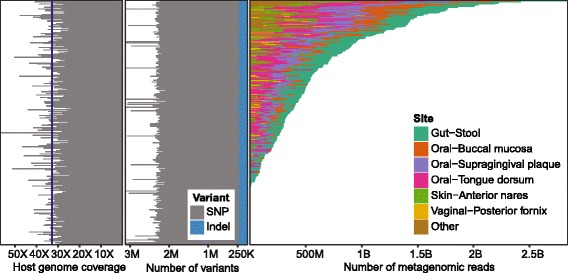
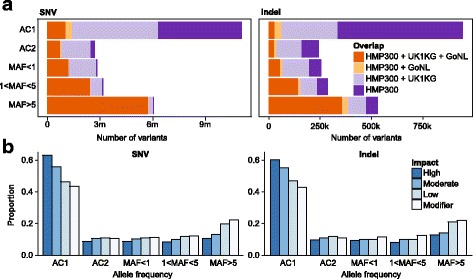
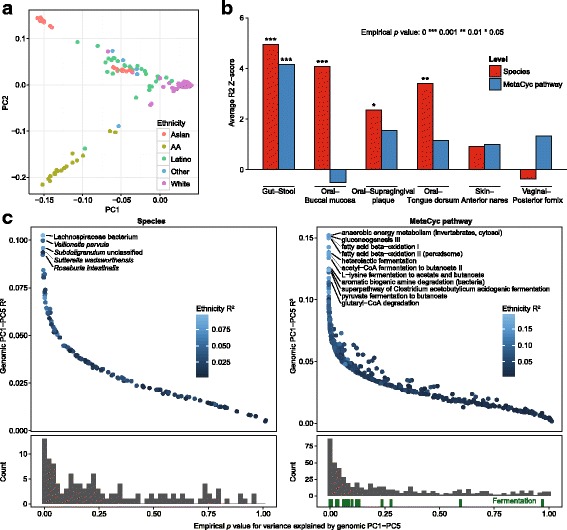
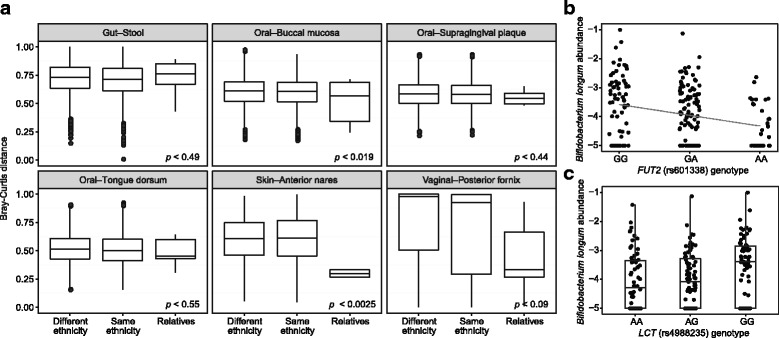
BACKGROUND: Despite the increasing recognition that microbial communities within the human body are linked to health, we have an incomplete understanding of the environmental and molecular interactions that shape the composition of these communities. Although host genetic factors play a role in these interactions, these factors have remained relatively unexplored given the requirement for large population-based cohorts in which both genotyping and microbiome characterization have been performed. METHODS: We performed whole-genome sequencing of 298 donors from the Human Microbiome Project (HMP) healthy cohort study to accompany existing deep characterization of their microbiomes at various body sites. This analysis yielded an average sequencing depth of 32x, with which we identified 27 million (M) single nucleotide variants and 2.3 M insertions-deletions. RESULTS: Taxonomic composition and functional potential of the microbiome covaried significantly with genetic principal components in the gastrointestinal tract and oral communities, but not in the nares or vaginal microbiota. Example associations included validation of known associations between FUT2 secretor status, as well as a variant conferring hypolactasia near the LCT gene, with Bifidobacterium longum abundance in stool. The associations of microbial features with both high-level genetic attributes and single variants were specific to particular body sites, highlighting the opportunity to find unique genetic mechanisms controlling microbiome properties in the microbial communities from multiple body sites. CONCLUSIONS: This study adds deep sequencing of host genomes to the body-wide microbiome sequences already extant from the HMP healthy cohort, creating a unique, versatile, and well-controlled reference for future studies seeking to identify host genetic modulators of the microbiome.
Overview
The claims and statistics of this paper haven’t been checked yet.
Free: it reads the open-access text and checks the first 5 claims that cite a source we can check. Create a free account to check every claim.
Integrity signals
Registry
Cites
Statistics
Figures
Verification
Claims the paper makes
The claims and statistics of this paper haven’t been checked yet.
Free: it reads the open-access text and checks the first 5 claims that cite a source we can check. Create a free account to check every claim.
Claims other papers make about this one
Each is checked against this paper’s own text: does it say what the citing paper says it does?
In the citing paper
“Host genetic influence15,16,1718, 19,20 on the gut microbiome is apparent from studies of monozygotic and dizygotic twin pairs that demonstrate shared community structures between related individuals21 and temporally stable heritable taxa17.”
From The gut Microbiome in adult and pediatric functional gastrointestinal disorders (2019) · cites this paper as [16]
Self-check
Percentages, sums and reported differences re-computed from the paper’s own numbers.
The self-check needs the paper’s full text.
Citations
Cites
Fast and accurate short read alignment with Burrows-Wheeler transform
Li, H., & Durbin, R. (2009) · Bioinformatics · doi:10.1093/bioinformatics/btp324 · Cited by 58,607
A global reference for human genetic variation
The 1000 Genomes Project Consortium, authors, C., Auton, A., Abecasis, G. R., Steering committee, Altshuler, D. M., Durbin, R. M., Abecasis, G. R., Bentley, D. R., Chakravarti, A., et al. (2015) · Nature · doi:10.1038/nature15393 · Cited by 18,247 · cited 10×
“Given that the HMP features broad biogeographic microbial sampling across the body, and the human sequencing data are of high quality and consistent with data from projects such as GoNL and 1000 Genomes, these data are well suited for such purposes.”
MethodResultInfluentialSecond-generation PLINK: rising to the challenge of larger and richer datasets
Chang, C. C., Chow, C. C., Tellier, L. C., Vattikuti, S., Purcell, S. M., & Lee, J. J. (2015) · Gigascience · doi:10.1186/s13742-015-0047-8 · Cited by 12,709
Structure, function and diversity of the healthy human microbiome
The Human Microbiome Project Consortium (2012) · Nature · doi:10.1038/nature11234 · Cited by 11,726
Self-citationThe Genotype-Tissue Expression (GTEx) pilot analysis: Multitissue gene regulation in humans
The GTEx Consortium, Ardlie, K. G., Deluca, D. S., Segrè, A. V., Sullivan, T. J., Young, T. R., Gelfand, E. T., Trowbridge, C. A., Maller, J. B., Tukiainen, T., et al. (2015) · Science · doi:10.1126/science.1262110 · Cited by 5,062
Host–microbe interactions have shaped the genetic architecture of inflammatory bowel disease
The International IBD Genetics Consortium (IIBDGC), Jostins, L., Ripke, S., Weersma, R. K., Duerr, R. H., McGovern, D. P., Hui, K. Y., Lee, J. C., Philip Schumm, L., Sharma, Y., et al. (2012) · Nature · doi:10.1038/nature11582 · Cited by 4,722 · cited 1×
“In addition, the endoplasmic reticulum aminopeptidase 1 (ERAP1) gene, which is involved in antigen presentation and associated with inflammatory bowel disease [54] and a number of other autoimmune diseases [55–57], appeared in two associations.”
BackgroundSelf-citationRobust relationship inference in genome-wide association studies
Manichaikul, A., Mychaleckyj, J. C., Rich, S. S., Daly, K., Sale, M., & Chen, W.-M. (2010) · Bioinformatics · doi:10.1093/bioinformatics/btq559 · Cited by 3,541 · cited 1×
“Kinship analysis was performed using the Kinshipbased INference for Genome-wide association studies (KING) algorithm [37].”
MethodCaspi, R., Billington, R., Ferrer, L., Foerster, H., Fulcher, C. A., Keseler, I. M., Kothari, A., Krummenacker, M., Latendresse, M., Mueller, L. A., et al. (2016) · Nucleic Acids Research · doi:10.1093/nar/gkv1164 · Cited by 3,395
The Treatment-Naive Microbiome in New-Onset Crohn’s Disease
Gevers, D., Kugathasan, S., Denson, L. A., Vázquez-Baeza, Y., Van Treuren, W., Ren, B., Schwager, E., Knights, D., Song, S. J., Yassour, M., et al. (2014) · Cell Host & Microbe · doi:10.1016/j.chom.2014.02.005 · Cited by 3,220
Self-citationHuman Genetics Shape the Gut Microbiome
Goodrich, J. K., Waters, J. L., Poole, A. C., Sutter, J. L., Koren, O., Blekhman, R., Beaumont, M., Van Treuren, W., Knight, R., Bell, J. T., et al. (2014) · Cell · doi:10.1016/j.cell.2014.09.053 · Cited by 3,164 · cited 1×
“Previous comparisons between monozygotic and dizygotic twins [22, 52] have identified a set of microbial taxa with higher than expected heritability coefficients.”
Cited by
Items 101–192 of 192
Human gut microbiome: A primer for the clinician
Kedia, S., & Ahuja, V. (2023) · JGH Open · doi:10.1002/jgh3.12902 · Cited by 13
Sternke‐Hoffmann, R., Pauly, T. A., Norrild, R. K., Hansen, J., Tucholski, F., Høie, M. H., Marcatili, P., Dupré, M., Duchateau, M., Rey, M., et al. (2023) · BMC Biology · doi:10.1186/s12915-022-01506-w · Cited by 12
Yan, W., Zhou, Q., Yuan, Z., Fu, L., Wen, C., Yang, N., & Sun, C. (2021) · BMC Microbiology · doi:10.1186/s12866-021-02353-5 · Cited by 14
The intestinal microflora diversity of aboriginal chickens in Jiangxi province, China
Li, J., Li, Y., Xiao, H., Li, W., Ye, F., Wang, L., Li, Y., Wang, C., Wu, Y., Xuan, R., et al. (2023) · Poultry Science · doi:10.1016/j.psj.2023.103198 · Cited by 16
“In the GWAS analysis of candidate genes, it was found that the intestinal microbiome was related to the genetic variation of the host (Goodrich et al., 2016; Kolde et al., 2018).”
BackgroundAnimalMetaOmics: a multi-omics data resources for exploring animal microbial genomes and microbiomes
Hu, R., Li, F., Chen, Y., Liu, C., Li, J., Ma, Z., Wang, Y., Cui, C., Luo, C., Zhou, P., et al. (2023) · Nucleic Acids Research · doi:10.1093/nar/gkad931 · Cited by 11
Nam, Y., Kim, M., Erdenebileg, S., Hyun, K., Ryu, D. H., Kim, H., Lee, S. H., Jung, J. H., & Nho, C. W. (2023) · Nutrients · doi:10.3390/nu15173779 · Cited by 11
“The p-values were adjusted using the Benjamini– Hochberg (BH) false discovery rate (FDR) procedure [30], and the correlation coefficients and adjusted p-value were visualized using the “heatmap” package [31].”
MethodThe road not taken: host genetics in shaping intergenerational microbiomes
Zeng, S., Wang, S., Ross, R. P., & Stanton, C. (2022) · Trends in Genetics · doi:10.1016/j.tig.2022.05.016 · Cited by 9
Izadifar, Z., Stejskalová, A., Gulati, A., Gutzeit, O., & Ingber, D. E. (2025) · BioEssays · doi:10.1002/bies.70014 · Cited by 9
Cherbunina, M. Y., Karaevskaya, E. S., Vasil'chuk, Y. K., Тананаев, Н. И., Shmelev, D., Budantseva, N. A., Merkel, A. Y., Rakitin, A. L., Mardanov, A. V., Brouchkov, A. V., et al. (2021) · Frontiers in Earth Science · doi:10.3389/feart.2021.739365 · Cited by 9
“Heatmaps were prepared using function pheatmap(), package “pheatmap” (Kolde, 2018).”
MethodTong, J., Chen, Y., He, M., Wang, W., Wang, Y., Li, N., & Xia, Q. (2023) · Frontiers in Microbiology · doi:10.3389/fmicb.2023.1190939 · Cited by 10
“Evidence suggests that genetics can influence GM (Blekhman et al., 2015; Kolde et al., 2018).”
BackgroundNurturing gut health: role of m6A RNA methylation in upholding the intestinal barrier
Wang, S., Yang, Y., Jiang, X., Zheng, X., Wei, Q., Dai, W., & Zhang, X. (2024) · Cell Death Discovery · doi:10.1038/s41420-024-02043-x · Cited by 11
“The reciprocal connection between the host and gut bacteria, in fl uencing gene expression and microbiome composition, underscores the presence of signaling molecules acting as mediators [175, 176].”
BackgroundIs There a Universal Endurance Microbiota?
Olbricht, H., Twadell, K., Sandel, B., Stephens, C. M., & Whittall, J. B. (2022) · Microorganisms · doi:10.3390/microorganisms10112213 · Cited by 9
“Furthermore, the dichotomy between human physiology and microbial metabolism is increasingly difficult to disentangle, as more human genotype/microbiome interactions continue to be discovered [5].”
BackgroundThe making of the oral microbiome in Agta hunter–gatherers
Dobón, B., Musciotto, F., Mira, Á., Greenacre, M. J., Schlaepfer, R., Aguileta, G., Astete, L. H., Ngales, M. L., Latora, V., Battiston, F., et al. (2023) · Evolutionary Human Sciences · doi:10.1017/ehs.2023.9 · Cited by 11
Hong, S., Nguyen, B. N., Min, H., Youn, H., Choi, S., Hitayezu, E., Cha, K.-H., Park, Y. T., Lee, C., Yoo, G., et al. (2024) · Microbiome · doi:10.1186/s40168-024-01971-1 · Cited by 8
“Correlations were visualized using the “heat-map” package [32].”
Asensio, E. M., Ortega‐Azorín, C., Barragán, R., Álvarez‐Sala, A., Sorlí, J. V., Pascual, E. C., Fernández-Carrión, R., Villamil, L. V., Corella, D., & Coltell, Ó. (2022) · Medicina · doi:10.3390/medicina58091238 · Cited by 8
Sequencing, Fast and Slow: Profiling Microbiomes in Human Samples with Nanopore Sequencing
Park, Y., Lee, J., & Shim, H. (2023) · Applied Biosciences · doi:10.3390/applbiosci2030028 · Cited by 9
Santoro, A., Tomino, C., Prinzi, G., Cardaci, V., Fini, M., Macera, L., Russo, P., & Maggi, F. (2019) · Current Medicinal Chemistry · doi:10.2174/0929867327666191213110551 · Cited by 8
Genomics of Serrasalmidae teleosts through the lens of microbiome fingerprinting
Sylvain, F., Normandeau, É., Holland, A., Val, A. L., & Derôme, N. (2022) · Molecular Ecology · doi:10.1111/mec.16574 · Cited by 9
Integrative analysis of taste genetics and the dental plaque microbiome in early childhood caries
Khan, M. W., Cruz de Jesus, V., Mittermuller, B.-A., Schroth, R. J., Hu, P., & Chelikani, P. (2025) · Cell Reports · doi:10.1016/j.celrep.2025.116245 · Cited by 7
Kim, M., Huda, M. N., Evans, L. W., Que, E. S., Gertz, E., Maeda-Smithies, N., & Bennett, B. J. (2023) · Scientific Reports · doi:10.1038/s41598-023-35917-8 · Cited by 8
Sweet, T., Sindi, S., & Sistrom, M. (2023) · Access Microbiology · doi:10.1099/acmi.0.000424 · Cited by 8
Nguyen, B. N., Hong, S., Choi, S., Lee, C., Yoo, G., & Kim, M. (2023) · Journal of Ginseng Research · doi:10.1016/j.jgr.2023.12.004 · Cited by 7
“The p-values were adjusted using the BH false discovery rate (FDR) procedure [37], and correlation coefficients and adjusted p-value were visualized using the ‘pheatmap ’ package [38].”
MethodMiller, A. K., Tavera, G., Domínguez, R. L., Camargo, M. C., Waterboer, T., Wilson, K. T., Williams, S. M., & Morgan, D. R. (2021) · Oncogene · doi:10.1038/s41388-021-01981-5 · Cited by 7
Kim, M., Huda, M. N., O’Connor, A., Albright, J., Durbin-Johnson, B. P., & Bennett, B. J. (2021) · Physiological Genomics · doi:10.1152/physiolgenomics.00140.2020 · Cited by 7
Tipping the Scale Towards Gastric Disease: a Host-Pathogen Genomic Mismatch?
Tavera, G., Morgan, D. R., & Williams, S. M. (2018) · Current Genetic Medicine Reports · doi:10.1007/s40142-018-0153-x · Cited by 7
The promising path of Oral MOFs: Redefining strategies for gastrointestinal detoxification
Quan, Y., Wu, Y., Wang, K., Ren, H., Zhang, G., Zhao, Y., & Miao, Y. (2025) · Coordination Chemistry Reviews · doi:10.1016/j.ccr.2025.217168 · Cited by 6
The role of microbiota in animal health and productivity: misinterpretations and limitations
Bajagai, Y. S., Trotter, M. G., WILLIAMS, T. M., Costa, D. F. A., Whitton, M. M., Ren, X., Wilson, C., & Stanley, D. (2022) · Animal Production Science · doi:10.1071/an21515 · Cited by 6
Li, Z., Liang, H., Zhang, S., & Luo, W. (2022) · Cancer Medicine · doi:10.1002/cam4.4717 · Cited by 6
Bi, Y., Liu, R. Z., Ji, W., Wei, H., Pan, L., Li, J. H., Li, X., Zhang, R. X., Liu, H. G., & Bao, J. (2021) · animal · doi:10.1016/j.animal.2021.100393 · Cited by 5
Yu, S. J., Bajagai, Y. S., Petranyi, F., & Stanley, D. (2022) · Applied and Environmental Microbiology · doi:10.1128/aem.00758-22 · Cited by 5
“environment, and temporal and spatial elements (37, 38).”
BackgroundGoldman, M., Zhang, J., Fonseca, N. A., Cortés‐Ciriano, I., Xiang, Q., Craft, B., Piñeiro-Yáñez, E., O’Connor, B. D., Bazant, W., Barrera, E., et al. (2017) · bioRxiv (Cold Spring Harbor Laboratory) · doi:10.1101/163907 · Cited by 5
Distinct trajectories of urbanization shape the human gut microbiome across South Asia
Ramachandran, S. L., Pasupuleti, N., Abdill, R. J., Adikari, G., Ahlawat, B., Blekhman, R., Burgo, V., Davenport, E., Dwivedi, A., Gupta, S., et al. (2026) · Gut Microbes · doi:10.1080/19490976.2026.2700042 · Cited by 5
Haque, S., Bantun, F., Jalal, N. A., Faidah, H. S., Babalghith, A. O., Alobaidy, M. A., Aldairi, A. F., & Ahmad, F. (2025) · Gut Pathogens · doi:10.1186/s13099-025-00712-5 · Cited by 4
Association between intestinal microflora and obesity
Savytska, M., Kozyk, M., Strubchevska, K., YOSYPENKO, K., Falalyeyeva, T. M., Kobyliak, N. M., Boccuto, L., Pellicano, R., Fagoonee, S., Scarpellini, E., et al. (2023) · Minerva Gastroenterology · doi:10.23736/s2724-5985.23.03379-x · Cited by 4
Structural and functional variation of human oral microbiome in health and disease
Khan, M. F., Khan, M. I., & Kato, I. (2023) · Elsevier eBooks · doi:10.1016/b978-0-323-98338-9.00002-5 · Cited by 4
Bowel function and inflammation: Is motility the other side of the coin?
Panarese, A. (2024) · World Journal of Gastroenterology · doi:10.3748/wjg.v30.i14.1963 · Cited by 4
“First, the host genomics has an impact on the gut microbiota/microbiome[15-17].”
Profiling of the intestinal microbiota of stunted children in Semarang, Indonesia
Susanti, R., ZAENAFREE, I., Christijanti, W., Mustikaningtyas, D., & Yuniastuti, A. (2024) · Biodiversitas Journal of Biological Diversity · doi:10.13057/biodiv/d250350 · Cited by 3
Relationship Between Gut Microbiota and Pancreatitis: A Systematic Review
Zhang, X., Armel, T. T., & Tyagi, G. (2024) · Apollo Medicine · doi:10.1177/09760016241262194 · Cited by 3
Genetic variation and function: revealing potential factors associated with microbial phenotypes
Liu, X., Ma, Y., & Wang, J. (2021) · Biophysics Reports · doi:10.52601/bpr.2021.200040 · Cited by 4
“Similarly, Kolde et al. investigated association between genetic principal components of hosts and microbiome compositional and functional traits and many associations were found and the known association between LCT gene and abundance of Bifidobacterium longum in feces was reappeared (Kolde et al. 2018).”
InfluentialManusha, S., Varsha, N., Varshini, R., Sivamani, Y., Pokkuluri, K. S., & Elayaperumal, S. (2025) · International review of neurobiology · doi:10.1016/bs.irn.2025.04.006 · Cited by 3
The Gut Microbiome and Ankylosing Spondylitis
Sternes, P. R., & Brown, M. A. (2019) · Elsevier eBooks · doi:10.1016/b978-0-323-56800-5.00006-0 · Cited by 3
Jegatheesan, T., & Eberl, H. J. (2020) · Lecture notes in computer science · doi:10.1007/978-3-030-50371-0_29 · Cited by 3
“The composition of gut microbial communities varies between individuals and may be altered by many factors such as diet, genetics, antibiotic treatment, and environmental factors [3,6,8].”
BackgroundGut fungi are associated with human genetic variation and disease risk
Syoc, E. P. V., Davenport, E., & Bordenstein, S. R. (2025) · PLoS Biology · doi:10.1371/journal.pbio.3003339 · Cited by 3
“Of these donors, fecal samples from 147 individuals were sequenced for ITS2 (mycobiome characterization) [14] and blood samples from 298 individuals were genotyped using whole-genome sequencing [15].”
InfluentialRen, X., Ma, J., Zhao, Y., Yang, M., Li, Y., Song, W., & Wang, N. (2026) · Ageing Research Reviews · doi:10.1016/j.arr.2026.103269 · Cited by 2
Liang, L., Zhou, H., Rao, E., Su, X., Liu, H., Su, Y., Zhang, X., & Xin, N. (2023) · ScienceAsia · doi:10.2306/scienceasia1513-1874.2023.028 · Cited by 2
“The human microbiome project data showed that host genetics may affect the α diversity of the gut microbiota and confirmed the association between LCT and Bifidobacterium abundance [37].”
BackgroundAbdurasulova, I. N. (2023) · Medical academic journal · doi:10.17816/maj115019 · Cited by 2
“В частности, было показано, что полиморфизм гена LCT, кодирующего лактазу, и гена FUT2, кодирующего галактозид2-альфа-L-фукозилтрансферазу 2, связан с численностью и разнообразием рода Bifidobacterium (p_Actionbacteria) [39, 40], а полиморфизм гена VDR (рецептор витамина D) — с численностью рода Parabacteroides (p_Bac…”
A distinct immunophenotype in children carrying the Blautia enterotype: The Generation R study
Großerichter-Wagener, C., Looman, K. I. M., Beth, S. A., Radjabzadeh, D., Gill, P. A., Smit, K. N., Duijts, L., Jong, J. C. K., Kraaij, R., Moll, H. A., et al. (2025) · Clinical Immunology · doi:10.1016/j.clim.2025.110426 · Cited by 2
Ko, H., Le, T. T., Nguyen, N. B., Kang, S. W., Hyun, K., Yang, N., Jung, S. H., & Kim, M. (2025) · Phytotherapy Research · doi:10.1002/ptr.8478 · Cited by 2
“Spearman's correlation analysis assessed relationships between microbial taxa abundance and other traits. p values were adjusted using the Benjamini–Hochberg method (Benjamini and Hochberg 1995), and correlations with adjusted p values were visualized using the “heatmap” package (Kolde et al. 2018).”
Sadiq, S., Shen, Z., Jiao, X., Zhang, N., Wang, L.-L., Xu, T., Wu, P., & Khan, I. (2025) · Insect Molecular Biology · doi:10.1111/imb.13008 · Cited by 2
“The correlation heatmap was generated using the pheatmap package in R (Kolde et al., 2018).”
Jung, Y., Kerfahi, D., Pham, H. Q., Son, H., Ibal, J. C., Park, M., Park, Y.-J., Park, C. E., Choi, S.-D., Jo, Y., et al. (2020) · bioRxiv (Cold Spring Harbor Laboratory) · doi:10.1101/2020.02.03.933317 · Cited by 2
“397 Further studies in large population-based cohorts are necessary to gain a greater 398 understanding of the relationship between the host genetic profile, gut microbiome 399 composition, and host health (39, 43).”
BackgroundNaseri, K., Shahrbaf, M. A., Olfatifar, M., Yadegar, A., Soheilian‐Khorzoghi, M., Dabiri, H., Rostami‐Nejad, M., Sadeghi, A., & Zali, M. R. (2021) · Research Square · doi:10.21203/rs.3.rs-948518/v1 · Cited by 2
Multiview Graph Learning for single-cell RNA sequencing dataPreprint
Karaaslanli, A., Saha, S., Aviyente, S., & Maiti, T. (2021) · bioRxiv (Cold Spring Harbor Laboratory) · doi:10.1101/2021.11.05.467476 · Cited by 2
Lecoutour, A., Mesa, V., Couturier, J., Delannoy, J., Pigneur, B., & Barbut, F. (2025) · Anaerobe · doi:10.1016/j.anaerobe.2025.102980 · Cited by 1
The event of multiomics in metagenomics
Mallick, H., Bardhan, M., Dagli, C. S., Liu, Z., & Gao, J. (2025) · Elsevier eBooks · doi:10.1016/b978-0-443-22376-1.00010-6 · Cited by 2
Langenfeld, K. L., Arts, P. J., Monahan, A., Criswell, A., Wigginton, K. R., & Duhaime, M. B. (2026) · mSphere · doi:10.1128/msphere.00113-26 · Cited by 1
“Given observed variations in the human microbiome across individuals (52, 68) and our finding that no single vOTU was present in every metagenome, it is unlikely that every person in a shared space over a given time frame will have a universally shared vOTU in their respiratory fluids.”
Heavy Metals, Gut Microbiota, and Biochemical Markers: Unraveling the Complexities of Obesity
Alamer, A. B. M., Komijani, M., & Shahrjerdi, S. (2025) · MicrobiologyOpen · doi:10.1002/mbo3.70071 · Cited by 1
Applying microbial ecology frameworks to microbial therapies for wildlife
Bornbusch, S. L., & Muletz‐Wolz, C. R. (2026) · mSystems · doi:10.1128/msystems.00598-25 · Cited by 1
“In humans, the effect of both high-level genetic patterns and single genetic variants on microbial communities varied across body sites, indicating that host genetic make-up exerts distinct colonization and maintenance pressures across specific communities (37).”
Microbiome yarns: The Global Phenotype‐Genotype Survey
Timmis, K. N., Jebok, F., Rohde, M., & Molinari, G. (2018) · Microbial Biotechnology · doi:10.1111/1751-7915.13341 · Cited by 3
Foster, J. A. (2019) · Elsevier eBooks · doi:10.1016/b978-0-12-813333-0.00013-5 · Cited by 2
Genomics for Food Security With Efficient and Sustainable Livestock Production
Sun, H., & Guan, L. L. (2020) · Elsevier eBooks · doi:10.1016/b978-0-08-100596-5.22703-0 · Cited by 1
Intestinal microbiota in children with obesity. Role of probiotics
Zakharova, I. N., Berezhnaya, I. V., Скоробогатова, Е. В., Aisanova, M. Р., & Bocharova, T. I. (2020) · Meditsinskiy sovet = Medical Council · doi:10.21518/2079-701x-2020-10-134-142 · Cited by 1
Commensal Microbes and Their Metabolites: Influence on Host Pathways in Health and Cancer
Méndez, R., Banerjee, S., & Banerjee, S. (2021) · Physiology in health and disease · doi:10.1007/978-3-030-67951-4_10 · Cited by 1
Relative contributions of the host genome, microbiome, and environment to the metabolic profile
Kim, K., Lee, Y., & Won, S. (2022) · Genes & Genomics · doi:10.1007/s13258-022-01277-2 · Cited by 1
“Recent studies have revealed associations among host genetics, the microbiome, and the environment; for example, a loss-offunction variant in the fucosyltransferase 2 is associated with Bifidobacterium longum abundance in stool (Kolde et al. 2018).”
BackgroundFigaschewski, M., Sürün, B., Tiede, T., & Kohlbacher, O. (2023) · BMC Bioinformatics · doi:10.1186/s12859-023-05194-3 · Cited by 2
Gene-environment factors influence microbiota composition, diversity, and function
Foster, J. A., & Clarke, G. A. (2024) · Elsevier eBooks · doi:10.1016/b978-0-12-814800-6.00005-4 · Cited by 1
DruID: Personalized Dru g Recommendations by I ntegrating Multiple Biomedical D atabases for CancerPreprint
Liany, H., Jeyasekharan, A. D. D., & Rajan, V. (2021) · bioRxiv (Cold Spring Harbor Laboratory) · doi:10.1101/2021.04.11.439315 · Cited by 4
Daele, E. V. (2024) · doi:10.18174/656497 · Cited by 1
Refurbishing Raw Denim to Reduce Bacterial Populations
Wakefield, M. (2019) · ERA: Education and Research Archive (University of Alberta) · doi:10.7939/r3-em4b-t125
Bacterial Vaginitis and Vaginosis
Seta, F. D., Comar, M., Guaschino, S., & Larsen, B. (2020) · Springer eBooks · doi:10.1007/978-3-030-02200-6_14
Dahiya, R., Mohammad, T., & Hassan, M. I. (2020) · Springer eBooks · doi:10.1007/978-981-15-8562-3_2
The effects of metal nanoparticles on the microbiome and immune responses of earthworms
Swart, E. (2020) · ORCA Online Research @Cardiff (Cardiff University) · Cited by 1
Leveraging the microbiome in host genome wide association studies
Awany, D. (2021) · Open University of Cape Town (University of Cape Town)
Bi, Y., Liu, R., Ji, W., Pan, L., Wei, H., Li, J., Li, X., Zhang, R., Liu, H., & Bao, J. (2020) · Research Square · doi:10.21203/rs.3.rs-79407/v1
“Many studies in humans [3], mice [4], beat cattle [5], pigs [6], and chickens [7] have shown that different genetic backgrounds can transform the composition of the microbiota.”
BackgroundAnka, I. Z. (2024) · Cronfa (Swansea University) · doi:10.23889/suthesis.67285
de Sosa, I., Turon, M., Taboada, S., Lorente-Sorolla, J. M., Fernández, R., Tilikj, N., Piris, A., Novo, M., Álvarez‐Campos, P., & Riesgo, A. (2025) · Molecular Ecology · doi:10.1111/mec.70010
“This has been reported previously in the human gut microbiome (Davenport 2016; Kolde et al. 2018; Spor et al. 2011), mouse lines (Benson et al. 2011), and plant genotypes (Bouffaud et al. 2014; Qian et al. 2018).”
Risk factors for recurrence of vulvovaginal infections
Kolesnikova, E. V., Osipova, L. K., & Жаров, А. В. (2024) · RUDN Journal of Medicine · doi:10.22363/2313-0245-2024-28-4-548-559
Shu, X.-L., Xie, J.-L., Li, X., Wang, G., & Tang, J. (2025) · World Journal of Microbiology and Biotechnology · doi:10.1007/s11274-025-04558-6
“Specifically, host genetic variations can modulate the composition and abundance of specific gut microbiota (Hughes et al. 2020; Kolde et al. 2018; Luca et al. 2018 ), while concurrently influencing the onset and pro - gression of various diseases.”
Mitochondrial diversity of Bwindi Impenetrable National Park Mountain Gorillas
Knox, M. A., Almeida, V. D. A., Kalema‐Zikusoka, G., Rubanga, S. V., Ngabirano, A., & Hayman, D. T. S. (2025) · Genome biology · doi:10.1186/s13059-025-03878-y
“…sequencing becomes increasingly commonplace, the incidental presence of host DNA in such datasets allows insight into host – microbiome interactions directly from metagenomic samples [11] but also creates valuable opportunities to study genetic diversity in samples from endangered species.”
Pérez-Enciso, M., Zingaretti, L. M., Ramayo‐Caldas, Y., & de los Campos, G. (2021) · Figshare · doi:10.6084/m9.figshare.15128421
Factors Influencing Microbiota Diversity and Composition During Early Postnatal Development
Francella, C. (2019) · MacSphere (McMaster University) · doi:10.71548/17455
Accurate Prediction of Post-mortem Interval via Integrating Microbial Community Dynamics
Sugich, J. A., & Sugich, J. A. (2022) · UA Campus Repository (The University of Arizona)
Taufer, C. R. (2024) · LA Referencia (Red Federada de Repositorios Institucionales de Publicaciones Científicas)
Effect of polymorhisms caused by gluten sensitivity on oral health
Şılar, Ç. (2024) · Dspace Repository (Marmara Üniversitesi)
Precision medicine in gastroenterology: applications and microbiome alterations
Ansari, M. A., Urooj, S., Draksha, Tamang, Y., & Rehman, A. (2026) · Elsevier eBooks · doi:10.1016/b978-0-443-40483-2.00007-8
Singh, S., Shahadab, M., Sachin, K., Pandey, R. K., Trivedi, P., Mishra, A. K., & Jha, H. C. (2026) · Mammalian Genome · doi:10.1007/s00335-026-10228-1
Liu, W., Xiao, C., Luo, Z., Zhu, Y. U. N. L. O. N., Li, W., Ren, H., Guo, Z., & Luo, J. (2026) · British Journal of Pharmacology · doi:10.1111/bph.70472
“Previous studies have confirmed that the strongest association between human genetics and the gut microbiome comes from the abundance of Bifidobacterium in adults with LCT/MCM6 SNPs (Blekhman et al., 2015; Bonder et al., 2016; Goodrich et al., 2016; Kolde et al., 2018).”
Interaction between host genetics and drug therapy in influencing gut bacterial diversity
Magadze, M. (2023) · Open University of Cape Town (University of Cape Town)
Becerra-Cervera, A., Jiménez-Ortega, R. F., Aparicio-Bautista, D. I., López-Pérez, T. V., Denova-Gutiérrez, E., Palacios-González, B., Hidalgo-Bravo, A., Canizales-Quinteros, S., Salmerón, J., Rivera-Paredez, B., et al. (2026) · Genes & Nutrition · doi:10.1186/s12263-026-00806-y
Microbiota and nutrigenomics: beneficial allies or hidden threats
Hazaimeh, R. A., Ogunkunle, N. F., Yakubu, M., & Boateng, J. (2026) · Food & Function · doi:10.1039/d5fo04705f
Kuo, P., Hsu, C., Lin, Y., Tsai, P.-J., Chu, S., & Chen, K. (2026) · Reproductive Medicine and Biology · doi:10.1002/rmb2.70098
“Although host genes have been implicated in microbiome composition in certain body niches, especially the gastrointestinal tract and oral cavity, the role of host genetics has emerged very recently in the female reproductive tract [28, 29].”
Heidari, H., Brimacombe, M., & Lawrence, D. A. (2026) · Frontiers in Neuroscience · doi:10.3389/fnins.2026.1952549
Metadata
- Authors
- Kolde, R., Franzosa, E. A., Rahnavard, G., Hall, A. B., Vlamakis, H., Stevens, C., Daly, M. J., Xavier, R. J., & Huttenhower, C.
- Affiliations
- Massachusetts General Hospital (US)
- Broad Institute (US)
- Corresponding author
- Xavier, Ramnik J.
- Huttenhower, Curtis
- ORCID
- Venue
- Genome Medicine
- Published
- 2018-01-29
- Volume
- 10
- Issue
- 1
- Pages
- 6-6
- ISSN
- 1756-994X (ISSN-L)
- PMC
- PMC5789541
- OpenAlex
- W2791877316
- Semantic Scholar
- 311da3ca2222dbddb49b64e6b921a32f228a75fd
- Cited by
- 182
- References
- 62
- Citations by year
- 2026: 10 · 2025: 17 · 2024: 17 · 2023: 16 · 2022: 25 · 2021: 40 · 2020: 28 · 2019: 14 · 2018: 15
- FWCI
- 8.63
- Type
- journal article
- Language
- en
- Open access
- gold
- doi.org
- Licence
- cc-by
- creativecommons.org/licenses/by/4.0/ (tdm)
- creativecommons.org/licenses/by/4.0/ (vor)
- Locations
- Genome Medicine (publishedVersion, cc-by)
- PubMed Central (publishedVersion, cc-by)
- PubMed (publishedVersion)
- Digital Access to Scholarship at Harvard (DASH) (Harvard University) (submittedVersion, cc-by)
- DOAJ (DOAJ: Directory of Open Access Journals) (submittedVersion)
- Funders
- National Human Genome Research Institute (5U54HG003067-13)
- Topics
- Life Sciences › Biochemistry, Genetics and Molecular Biology › Molecular Biology › Gut microbiota and health
- Life Sciences › Biochemistry, Genetics and Molecular Biology › Genetics › Genetic Associations and Epidemiology
- Health Sciences › Dentistry › Periodontics › Oral microbiology and periodontitis research
- Keywords
- host genetics, human microbiome, host-microbe interactions, single nucleotide variants, indels, LCT gene, lactase deficiency, Bifidobacterium longum, gut microbiota, oral microbiota, vaginal microbiota
- MeSH terms
- Genotype, Humans, Tissue Donors, Genetic Variation, Sequence Analysis, DNA, Principal Component Analysis, Metagenome, Microbiota
About these checks
Registry, retraction, Cites and statistics results are computed, not judged, with one exception: a printed reference that no index lists is read once by a model before it counts as a citation error. Claims are extracted by a model and kept only when their quote appears verbatim in the text; each cited source is then checked, with a model’s help, for whether it says what the claim relies on. Those verdicts can be wrong — read the claim’s quote and the cited source before relying on one.
Statistics and arithmetic are recomputed, not judged.
Confidence bands are shown only for fields calibrated on our annotated test set. None is calibrated yet, so no band is shown.
What counts as a claim ›How we measure confidence ›How we check this ›
Are you an author, or do you see a problem with this page? Request a review
Data sources
Bibliographic data: Semantic Scholar, OpenAlex, Crossref.
Contains information from the Semantic Scholar Academic Graph Datasets, made available under the ODC Attribution License (ODC-BY 1.0).
Semantic Scholar’s data is described in: Kinney, R., et al. (2023). The Semantic Scholar Open Data Platform. arXiv:2301.10140.
