

Host genetic variation and its microbiome interactions within the Human Microbiome Project
Open accessThe DOI matches its Crossref record; 61 of the 62 references it cites were found in a registry or an index.
Abstract
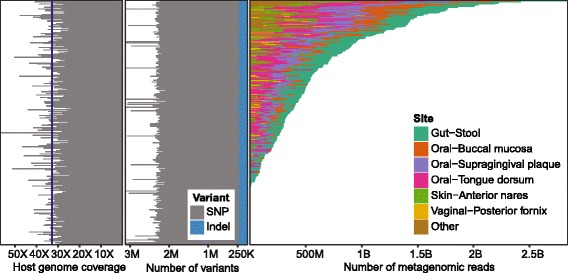
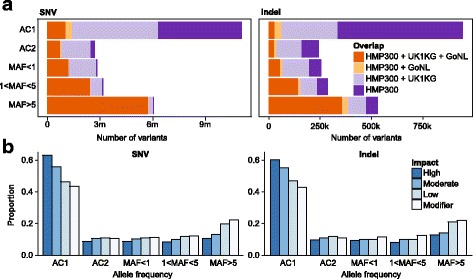
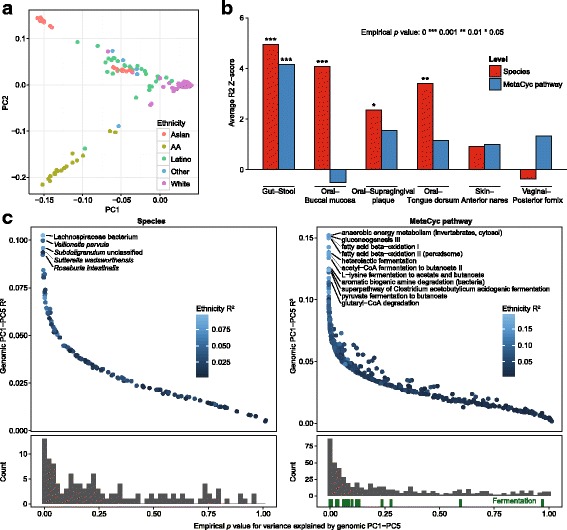
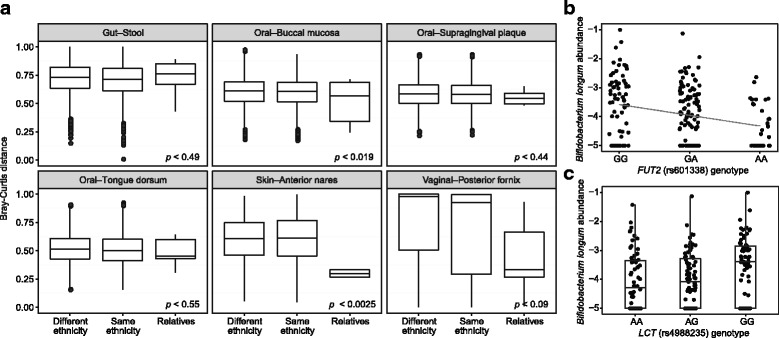
BACKGROUND: Despite the increasing recognition that microbial communities within the human body are linked to health, we have an incomplete understanding of the environmental and molecular interactions that shape the composition of these communities. Although host genetic factors play a role in these interactions, these factors have remained relatively unexplored given the requirement for large population-based cohorts in which both genotyping and microbiome characterization have been performed. METHODS: We performed whole-genome sequencing of 298 donors from the Human Microbiome Project (HMP) healthy cohort study to accompany existing deep characterization of their microbiomes at various body sites. This analysis yielded an average sequencing depth of 32x, with which we identified 27 million (M) single nucleotide variants and 2.3 M insertions-deletions. RESULTS: Taxonomic composition and functional potential of the microbiome covaried significantly with genetic principal components in the gastrointestinal tract and oral communities, but not in the nares or vaginal microbiota. Example associations included validation of known associations between FUT2 secretor status, as well as a variant conferring hypolactasia near the LCT gene, with Bifidobacterium longum abundance in stool. The associations of microbial features with both high-level genetic attributes and single variants were specific to particular body sites, highlighting the opportunity to find unique genetic mechanisms controlling microbiome properties in the microbial communities from multiple body sites. CONCLUSIONS: This study adds deep sequencing of host genomes to the body-wide microbiome sequences already extant from the HMP healthy cohort, creating a unique, versatile, and well-controlled reference for future studies seeking to identify host genetic modulators of the microbiome.
Overview
The claims and statistics of this paper haven’t been checked yet.
Free: it reads the open-access text and checks the first 5 claims that cite a source we can check. Create a free account to check every claim.
Integrity signals
Registry
Cites
Statistics
Figures
Verification
Claims the paper makes
The claims and statistics of this paper haven’t been checked yet.
Free: it reads the open-access text and checks the first 5 claims that cite a source we can check. Create a free account to check every claim.
Claims other papers make about this one
Each is checked against this paper’s own text: does it say what the citing paper says it does?
In the citing paper
“Host genetic influence15,16,1718, 19,20 on the gut microbiome is apparent from studies of monozygotic and dizygotic twin pairs that demonstrate shared community structures between related individuals21 and temporally stable heritable taxa17.”
From The gut Microbiome in adult and pediatric functional gastrointestinal disorders (2019) · cites this paper as [16]
Self-check
Percentages, sums and reported differences re-computed from the paper’s own numbers.
The self-check needs the paper’s full text.
Citations
Cites
Fast and accurate short read alignment with Burrows-Wheeler transform
Li, H., & Durbin, R. (2009) · Bioinformatics · doi:10.1093/bioinformatics/btp324 · Cited by 58,607
A global reference for human genetic variation
The 1000 Genomes Project Consortium, authors, C., Auton, A., Abecasis, G. R., Steering committee, Altshuler, D. M., Durbin, R. M., Abecasis, G. R., Bentley, D. R., Chakravarti, A., et al. (2015) · Nature · doi:10.1038/nature15393 · Cited by 18,247 · cited 10×
“Given that the HMP features broad biogeographic microbial sampling across the body, and the human sequencing data are of high quality and consistent with data from projects such as GoNL and 1000 Genomes, these data are well suited for such purposes.”
MethodResultInfluentialSecond-generation PLINK: rising to the challenge of larger and richer datasets
Chang, C. C., Chow, C. C., Tellier, L. C., Vattikuti, S., Purcell, S. M., & Lee, J. J. (2015) · Gigascience · doi:10.1186/s13742-015-0047-8 · Cited by 12,709
Structure, function and diversity of the healthy human microbiome
The Human Microbiome Project Consortium (2012) · Nature · doi:10.1038/nature11234 · Cited by 11,726
Self-citationThe Genotype-Tissue Expression (GTEx) pilot analysis: Multitissue gene regulation in humans
The GTEx Consortium, Ardlie, K. G., Deluca, D. S., Segrè, A. V., Sullivan, T. J., Young, T. R., Gelfand, E. T., Trowbridge, C. A., Maller, J. B., Tukiainen, T., et al. (2015) · Science · doi:10.1126/science.1262110 · Cited by 5,062
Host–microbe interactions have shaped the genetic architecture of inflammatory bowel disease
The International IBD Genetics Consortium (IIBDGC), Jostins, L., Ripke, S., Weersma, R. K., Duerr, R. H., McGovern, D. P., Hui, K. Y., Lee, J. C., Philip Schumm, L., Sharma, Y., et al. (2012) · Nature · doi:10.1038/nature11582 · Cited by 4,722 · cited 1×
“In addition, the endoplasmic reticulum aminopeptidase 1 (ERAP1) gene, which is involved in antigen presentation and associated with inflammatory bowel disease [54] and a number of other autoimmune diseases [55–57], appeared in two associations.”
BackgroundSelf-citationRobust relationship inference in genome-wide association studies
Manichaikul, A., Mychaleckyj, J. C., Rich, S. S., Daly, K., Sale, M., & Chen, W.-M. (2010) · Bioinformatics · doi:10.1093/bioinformatics/btq559 · Cited by 3,541 · cited 1×
“Kinship analysis was performed using the Kinshipbased INference for Genome-wide association studies (KING) algorithm [37].”
MethodCaspi, R., Billington, R., Ferrer, L., Foerster, H., Fulcher, C. A., Keseler, I. M., Kothari, A., Krummenacker, M., Latendresse, M., Mueller, L. A., et al. (2016) · Nucleic Acids Research · doi:10.1093/nar/gkv1164 · Cited by 3,395
The Treatment-Naive Microbiome in New-Onset Crohn’s Disease
Gevers, D., Kugathasan, S., Denson, L. A., Vázquez-Baeza, Y., Van Treuren, W., Ren, B., Schwager, E., Knights, D., Song, S. J., Yassour, M., et al. (2014) · Cell Host & Microbe · doi:10.1016/j.chom.2014.02.005 · Cited by 3,220
Self-citationHuman Genetics Shape the Gut Microbiome
Goodrich, J. K., Waters, J. L., Poole, A. C., Sutter, J. L., Koren, O., Blekhman, R., Beaumont, M., Van Treuren, W., Knight, R., Bell, J. T., et al. (2014) · Cell · doi:10.1016/j.cell.2014.09.053 · Cited by 3,164 · cited 1×
“Previous comparisons between monozygotic and dizygotic twins [22, 52] have identified a set of microbial taxa with higher than expected heritability coefficients.”
The NHGRI GWAS Catalog, a curated resource of SNP-trait associations
Welter, D., MacArthur, J., Morales, J., Burdett, T., Hall, P., Junkins, H., Klemm, A., Flicek, P., Manolio, T., Hindorff, L., et al. (2014) · Nucleic Acids Research · doi:10.1093/nar/gkt1229 · Cited by 2,707 · cited 5×
“For this reason, we first limited our analysis to SNVs found in the National Human Genome Research Institute (NHGRI) Genome-Wide Association Studies (GWAS) Catalog [50], hypothesizing that these SNVs were enriched with genomic variants that have potential impact on microbiome properties.”
MethodInfluentialA framework for human microbiome research
The Human Microbiome Project Consortium (2012) · Nature · doi:10.1038/nature11209 · Cited by 2,650
Self-citationPopulation-level analysis of gut microbiome variation
Falony, G., Joossens, M., Vieira-Silva, S., Wang, J., Darzi, Y., Faust, K., Kurilshikov, A., Bonder, M. J., Valles-Colomer, M., Vandeputte, D., et al. (2016) · Science · doi:10.1126/science.aad3503 · Cited by 2,400
MetaPhlAn2 for enhanced metagenomic taxonomic profiling
Truong, D. T., Franzosa, E. A., Tickle, T. L., Scholz, M., Weingart, G., Pasolli, E., Tett, A., Huttenhower, C., & Segata, N. (2015) · Nature Methods · doi:10.1038/nmeth.3589 · Cited by 2,185 · cited 6×
“identified taxonomic composition using MetaPhlan2 [40] and functional potential using HUMAnN2 [44].”
MethodInfluentialSelf-citationUniRef clusters: a comprehensive and scalable alternative for improving sequence similarity searches
Suzek, B. E., Wang, Y., Huang, H., McGarvey, P. B., Wu, C. H., & the UniProt Consortium (2015) · Bioinformatics · doi:10.1093/bioinformatics/btu739 · Cited by 1,928 · cited 1×
“reads against the corresponding sample-specific database to quantify gene presence and abundance on a per-species basis; reads that fail to map to one of the detected species (“unclassified reads”) are separately mapped by translated search against a reduced protein sequence catalog [42].”
Population-based metagenomics analysis reveals markers for gut microbiome composition and diversity
Zhernakova, A., Kurilshikov, A., Bonder, M. J., Tigchelaar, E. F., Schirmer, M., Vatanen, T., Mujagic, Z., Vila, A. V., Falony, G., Vieira-Silva, S., et al. (2016) · Science · doi:10.1126/science.aad3369 · Cited by 1,914 · cited 1×
“In addition to genetics, microbiome composition is strongly influenced by environmental factors such as diet, overall health status, and medication use [18, 19].”
BackgroundSelf-citationMatrix eQTL: ultra fast eQTL analysis via large matrix operations
Shabalin, A. A. (2012) · Bioinformatics · doi:10.1093/bioinformatics/bts163 · Cited by 1,694 · cited 1×
“For genome-wise associations we employed Matrix eQTL software [46] to fit ordinary linear models to predict microbiome features, taking originating site, sex, and ethnicity into account as covariates.”
MethodZhang, X., Zhang, D., Jia, H., Feng, Q., Wang, D., Liang, D., Wu, X., Li, J., Tang, L., Li, Y., et al. (2015) · Nature Medicine · doi:10.1038/nm.3914 · Cited by 1,690 · cited 1×
“Furthermore, clinically relevant associations might be discoverable only in cohorts with particular diseases, for example, in conditions such as inflammatory bowel disease or rheumatoid arthritis, which are both genetically complex and accompanied by microbial dysbioses [28, 29].”
BackgroundDeriving the consequences of genomic variants with the Ensembl API and SNP Effect Predictor
McLaren, W., Pritchard, B., Rios, D., Chen, Y., Flicek, P., & Cunningham, F. (2010) · Bioinformatics · doi:10.1093/bioinformatics/btq330 · Cited by 1,586
Benson, A. K., Kelly, S. A., Legge, R., Ma, F., Low, S. J., Kim, J., Zhang, M., Oh, P. L., Nehrenberg, D., Hua, K., et al. (2010) · Proceedings of the National Academy of Sciences · doi:10.1073/pnas.1007028107 · Cited by 1,314 · cited 1×
“The quantitative trait loci (QTLs) emerging from these studies included genes involved in immune function, for example, Irak3 [15] and Irak4 [17].”
BackgroundStrains, functions and dynamics in the expanded Human Microbiome Project
Lloyd-Price, J., Mahurkar, A., Rahnavard, G., Crabtree, J., Orvis, J., Hall, A. B., Brady, A., Creasy, H. H., McCracken, C., Giglio, M. G., et al. (2017) · Nature · doi:10.1038/nature23889 · Cited by 1,267 · cited 1×
“All metagenomic data underwent quality control according to the HMP protocol [38, 39].”
MethodSelf-citationRobust rank aggregation for gene list integration and meta-analysis
Kolde, R., Laur, S., Adler, P., & Vilo, J. (2012) · Bioinformatics · doi:10.1093/bioinformatics/btr709 · Cited by 1,191 · cited 1×
“For each superclass in the data, we extracted the rankings of its members and calculated a p value [45] showing how strongly the rankings were skewed towards the top.”
MethodSelf-citationBiogeography and individuality shape function in the human skin metagenome
Program, N. C. S., Oh, J., Byrd, A. L., Deming, C., Conlan, S., Kong, H. H., & Segre, J. A. (2014) · Nature · doi:10.1038/nature13786 · Cited by 1,148 · cited 1×
“prevalence of specific enzymes in human microbiome samples [7, 8], dissecting factors that shape skin microbial communities [9], contrasting ancient and modern oral microbiomes [10], and studying the gut antibiotic resistome [11].”
BackgroundMetabolic Reconstruction for Metagenomic Data and Its Application to the Human Microbiome
Abubucker, S., Segata, N., Goll, J., Schubert, A. M., Izard, J., Cantarel, B. L., Rodriguez-Mueller, B., Zucker, J., Thiagarajan, M., Henrissat, B., et al. (2012) · PLoS Computational Biology · doi:10.1371/journal.pcbi.1002358 · Cited by 1,056 · cited 8×
“Finally, we applied log10 transformation to the read-counts-per-million pathway abundance values returned by the HUMAnN2 pipeline.”
MethodInfluentialSelf-citationGenetic determinants of the gut microbiome in UK twins
Goodrich, J. K., Davenport, E. R., Beaumont, M., Jackson, M. A., Knight, R., Ober, C., Spector, T. D., Bell, J. T., Clark, A. G., & Ley, R. E. (2016) · Cell Host & Microbe · doi:10.1016/j.chom.2016.04.017 · Cited by 1,048 · cited 6×
“For example, the gut microbiomes of monozygotic twins are significantly more similar than those of dizygotic twins [21, 22].”
BackgroundResultInfluentialGenetic Analysis of Psoriasis Consortium & the Wellcome Trust Case Control Consortium 2 (2010) · Nature Genetics · doi:10.1038/ng.694 · Cited by 1,047
Temporal Stability of the Human Skin Microbiome
Oh, J., Byrd, A. L., Park, M., Kong, H. H., & Segre, J. A. (2016) · Cell · doi:10.1016/j.cell.2016.04.008 · Cited by 1,036
Identification of a variant associated with adult-type hypolactasia
Enattah, N. S., Sahi, T., Savilahti, E., Terwilliger, J. D., Peltonen, L., & Järvelä, I. (2002) · Nature Genetics · doi:10.1038/ng826 · Cited by 1,029 · cited 11×
“To study the influence of individual genetic variants on microbiome composition, we began with known associations of FUT2 and LCT. FUT2 is responsible for the transfer of terminal fucose residues to mucosal glycans [48].”
BackgroundInfluentialHost lifestyle affects human microbiota on daily timescales
David, L. A., Materna, A. C., Friedman, J., Campos-Baptista, M. I., Blackburn, M. C., Perrotta, A., Erdman, S. E., & Alm, E. J. (2014) · Genome biology · doi:10.1186/gb-2014-15-7-r89 · Cited by 950
The Australo-Anglo-American Spondyloarthritis Consortium (TASC), Evans, D. M., the Wellcome Trust Case Control Consortium 2 (WTCCC2), Spondyloarthritis Research Consortium of Canada (SPARCC), Spencer, C. C. A., Pointon, J. J., Su, Z., Harvey, D., Kochan, G., Oppermann, U., et al. (2011) · Nature Genetics · doi:10.1038/ng.873 · Cited by 893 · cited 7×
“Interestingly, Lachnospiraceae was the most differentially regulated microbial family in the terminal ileum of patients with ankylosing spondylitis [59], a disease associated with polymorphisms in ERAP1 [60].”
BackgroundInfluentialToward better understanding of artifacts in variant calling from high-coverage samples
Li, H. (2014) · Bioinformatics · doi:10.1093/bioinformatics/btu356 · Cited by 892
Dynamics and associations of microbial community types across the human body
Ding, T., & Schloss, P. D. (2014) · Nature · doi:10.1038/nature13178 · Cited by 885
The effect of host genetics on the gut microbiome
Bonder, M. J., Kurilshikov, A., Tigchelaar, E. F., Mujagic, Z., Imhann, F., Vila, A. V., Deelen, P., Vatanen, T., Schirmer, M., Smeekens, S. P., et al. (2016) · Nature Genetics · doi:10.1038/ng.3663 · Cited by 819 · cited 3×
“A recent finding that milk consumption and Bifidobacteria abundance is positively correlated only in people with the hypolactasia gene variant [26] supports this mechanism.”
BackgroundResultSelf-citationHost genetic variation impacts microbiome composition across human body sites
Blekhman, R., Goodrich, J. K., Huang, K., Sun, Q., Bukowski, R., Bell, J. T., Spector, T. D., Keinan, A., Ley, R. E., Gevers, D., et al. (2015) · Genome Biology · doi:10.1186/s13059-015-0759-1 · Cited by 745 · cited 6×
“Genetic variation in this cohort was previously inferred using “contaminant” human reads from 93 subjects’ WMS data [25, 30].”
BackgroundMethodResultInfluentialWilliams, B. B., Van Benschoten, A. H., Cimermancic, P., Donia, M. S., Zimmermann, M., Taketani, M., Ishihara, A., Kashyap, P. C., Fraser, J. S., & Fischbach, M. A. (2014) · Cell Host & Microbe · doi:10.1016/j.chom.2014.09.001 · Cited by 732 · cited 1×
“prevalence of specific enzymes in human microbiome samples [7, 8], dissecting factors that shape skin microbial communities [9], contrasting ancient and modern oral microbiomes [10], and studying the gut antibiotic resistome [11].”
BackgroundThe Genome of the Netherlands Consortium (2014) · Nature Genetics · doi:10.1038/ng.3021 · Cited by 659
Pathogens and host immunity in the ancient human oral cavity
Warinner, C., Rodrigues, J. F. M., Vyas, R., Trachsel, C., Shved, N., Grossmann, J., Radini, A., Hancock, Y., Tito, R. Y., Fiddyment, S., et al. (2014) · Nature Genetics · doi:10.1038/ng.2906 · Cited by 618 · cited 1×
“prevalence of specific enzymes in human microbiome samples [7, 8], dissecting factors that shape skin microbial communities [9], contrasting ancient and modern oral microbiomes [10], and studying the gut antibiotic resistome [11].”
BackgroundBaulieu, E.-E., Thomas, G., Legrain, S., Lahlou, N., Roger, M., Debuire, B., Faucounau, V., Girard, L., Hervy, M.-P., Latour, F., et al. (2000) · Proceedings of the National Academy of Sciences · doi:10.1073/pnas.97.8.4279 · Cited by 577
Kelly, R. J., Rouquier, S., Giorgi, D., Lennon, G. G., & Lowe, J. B. (1995) · Journal of Biological Chemistry · doi:10.1074/jbc.270.9.4640 · Cited by 568 · cited 1×
“FUT2 is responsible for the transfer of terminal fucose residues to mucosal glycans [48].”
BackgroundKirino, Y., Bertsias, G., Ishigatsubo, Y., Mizuki, N., Tugal-Tutkun, I., Seyahi, E., Ozyazgan, Y., Sacli, F. S., Erer, B., Inoko, H., et al. (2013) · Nature Genetics · doi:10.1038/ng.2520 · Cited by 556
Association of host genome with intestinal microbial composition in a large healthy cohort
GEM Project Research Consortium, Turpin, W., Espin-Garcia, O., Xu, W., Silverberg, M. S., Kevans, D., Smith, M. I., Guttman, D. S., Griffiths, A., Panaccione, R., et al. (2016) · Nature Genetics · doi:10.1038/ng.3693 · Cited by 460 · cited 3×
“, with a higher heritability among Firmicutes than Bacteroidetes [22, 23]).”
BackgroundMatrix eQTL: Ultra fast eQTL analysis via large matrix operations
Shabalin, A. A. (2011) · arXiv (Cornell University) · doi:10.17615/g28n-r219 · Cited by 452
Country-specific antibiotic use practices impact the human gut resistome
Forslund, K., Sunagawa, S., Kultima, J. R., Mende, D. R., Arumugam, M., Typas, A., & Bork, P. (2013) · Genome Research · doi:10.1101/gr.155465.113 · Cited by 442 · cited 1×
“prevalence of specific enzymes in human microbiome samples [7, 8], dissecting factors that shape skin microbial communities [9], contrasting ancient and modern oral microbiomes [10], and studying the gut antibiotic resistome [11].”
BackgroundBrief Report: Intestinal Dysbiosis in Ankylosing Spondylitis
Costello, M., Ciccia, F., Willner, D., Warrington, N., Robinson, P. C., Gardiner, B., Marshall, M., Kenna, T. J., Triolo, G., & Brown, M. A. (2015) · Arthritis & Rheumatology · doi:10.1002/art.38967 · Cited by 432
Complex host genetics influence the microbiome in inflammatory bowel disease
Knights, D., Silverberg, M. S., Weersma, R. K., Gevers, D., Dijkstra, G., Huang, H., Tyler, A. D., van Sommeren, S., Imhann, F., Stempak, J. M., et al. (2014) · Genome Medicine · doi:10.1186/s13073-014-0107-1 · Cited by 418 · cited 1×
“NOD2 were also associated with Enterobacteriaceae in patients with inflammatory bowel disease [24].”
BackgroundSelf-citationGenetic and environmental control of host-gut microbiota interactions
Org, E., Parks, B. W., Joo, J. W. J., Emert, B., Schwartzman, W., Kang, E. Y., Mehrabian, M., Pan, C., Knight, R., Gunsalus, R., et al. (2015) · Genome Research · doi:10.1101/gr.194118.115 · Cited by 381 · cited 1×
“The quantitative trait loci (QTLs) emerging from these studies included genes involved in immune function, for example, Irak3 [15] and Irak4 [17].”
BackgroundPham, T. A. N., Clare, S., Goulding, D., Arasteh, J. M., Stares, M. D., Browne, H. P., Keane, J. A., Page, A. J., Kumasaka, N., Kane, L., et al. (2014) · Cell Host & Microbe · doi:10.1016/j.chom.2014.08.017 · Cited by 305
Mobile genes in the human microbiome are structured from global to individual scales
Brito, I. L., Yilmaz, S., Huang, K., Xu, L., Jupiter, S. D., Jenkins, A. P., Naisilisili, W., Tamminen, M., Smillie, C. S., Wortman, J. R., et al. (2016) · Nature · doi:10.1038/nature18927 · Cited by 288
Self-citationWacklin, P., Mäkivuokko, H., Alakulppi, N., Nikkilä, J., Tenkanen, H., Räbinä, J., Partanen, J., Aranko, K., & Mättö, J. (2011) · PLoS ONE · doi:10.1371/journal.pone.0020113 · Cited by 285 · cited 2×
“sible for the transfer of the terminal fucose residues to the mucosal glycans [27].”
BackgroundMeta-analysis of shared genetic architecture across ten pediatric autoimmune diseases
Li, Y. R., Li, J., Zhao, S. D., Bradfield, J. P., Mentch, F. D., Maggadottir, S. M., Hou, C., Abrams, D. J., Chang, D., Gao, F., et al. (2015) · Nature Medicine · doi:10.1038/nm.3933 · Cited by 265
Genome-Wide Association Studies of the Human Gut Microbiota
Davenport, E. R., Cusanovich, D. A., Michelini, K., Barreiro, L. B., Ober, C., & Gilad, Y. (2015) · PLOS ONE · doi:10.1371/journal.pone.0140301 · Cited by 251 · cited 1×
“With the exception of research on special populations like the Hutterites [20], these factors are difficult to constrain in a human study.”
BackgroundHansen, E. E., Lozupone, C. A., Rey, F. E., Wu, M., Guruge, J. L., Narra, A., Goodfellow, J., Zaneveld, J. R., McDonald, D. T., Goodrich, J. A., et al. (2011) · Proceedings of the National Academy of Sciences · doi:10.1073/pnas.1000071108 · Cited by 229 · cited 1×
“For example, the gut microbiomes of monozygotic twins are significantly more similar than those of dizygotic twins [21, 22].”
BackgroundLeamy, L. J., Kelly, S. A., Nietfeldt, J., Legge, R. M., Ma, F., Hua, K., Sinha, R., Peterson, D. A., Walter, J., Benson, A. K., et al. (2014) · Genome Biology · doi:10.1186/s13059-014-0552-6 · Cited by 160
mtDNA haplogroup and single nucleotide polymorphisms structure human microbiome communities
Ma, J., Coarfa, C., Qin, X., Bonnen, P. E., Milosavljevic, A., Versalovic, J., & Aagaard, K. (2014) · BMC Genomics · doi:10.1186/1471-2164-15-257 · Cited by 99 · cited 3×
“proaches have been applied on subsets of the HMP cohort using haplogroups [30] and common variants [25].”
BackgroundMethodBioinformatics for the Human Microbiome Project
Gevers, D., Pop, M., Schloss, P. D., & Huttenhower, C. (2012) · PLoS Computational Biology · doi:10.1371/journal.pcbi.1002779 · Cited by 91 · cited 1×
“All metagenomic data underwent quality control according to the HMP protocol [38, 39].”
MethodSelf-citationKevans, D., Turpin, W., Madsen, K., Meddings, J., Shestopaloff, K., Xu, W., Moreno-Hagelsieb, G., Griffiths, A., Silverberg, M. S., Paterson, A., et al. (2015) · Inflammatory Bowel Diseases · doi:10.1097/mib.0000000000000323 · Cited by 61
MetaRef: a pan-genomic database for comparative and community microbial genomics
Huang, K., Brady, A., Mahurkar, A., White, O., Gevers, D., Huttenhower, C., & Segata, N. (2014) · Nucleic Acids Research · doi:10.1093/nar/gkt1078 · Cited by 58 · cited 1×
“the sample (species’ pangenomes are precomputed, reduced representations of the protein-coding sequences from isolates of a given species [41]).”
BackgroundSelf-citationIn vitro fermentation of fructooligosaccharides with human gut bacteria
Mao, B., Li, D., Zhao, J., Liu, X., Gu, Z., Chen, Y. Q., Zhang, H., & Chen, W. (2015) · Food & Function · doi:10.1039/c4fo01082e · Cited by 58 · cited 1×
“prevalence of specific enzymes in human microbiome samples [7, 8], dissecting factors that shape skin microbial communities [9], contrasting ancient and modern oral microbiomes [10], and studying the gut antibiotic resistome [11].”
BackgroundRodrigues, N. F., Kästle, J., Coutinho, T. J. D., Amorim, A. T., Campos, G. B., Santos, V. M., Marques, L. M., Timenetsky, J., & de Farías, S. T. (2015) · Genetics and Molecular Research · doi:10.4238/2015.june.12.4 · Cited by 57
Aujoulat, F., Bouvet, P., Jumas‐Bilak, E., Jean‐Pierre, H., & Marchandin, H. (2014) · INTERNATIONAL JOURNAL OF SYSTEMATIC AND EVOLUTIONARY MICROBIOLOGY · doi:10.1099/ijs.0.064451-0 · Cited by 41
Nagaoka, K., Izumikawa, K., Yamamoto, Y., Yanagihara, K., Ohkusu, K., & Kohno, S. (2012) · Journal of Clinical Microbiology · doi:10.1128/jcm.00761-12 · Cited by 22 · cited 1×
“9 × 10), a normal member of the oral microflora that can, under some circumstances, act as an opportunistic pathogen and cause pulmonary abscesses [58].”
Background
Cited by
Gut Microbiota and Obesity: A Role for Probiotics
Abenavoli, L., Scarpellini, E., Colica, C., Boccuto, L., Salehi, B., Sharifi-Rad, J., Aiello, V., Romano, B., De Lorenzo, A., Izzo, A. A., et al. (2019) · Nutrients · doi:10.3390/nu11112690 · Cited by 615
“HMP follows into the footsteps of the Human Genome Project, being constituted by multiple projects that bring together scientific experts worldwide to explore microbial communities to characterize the composition of the normal microbiome and the relationship with human organism [15].”
BackgroundQin, Y., Havulinna, A. S., Liu, Y., Jousilahti, P., Ritchie, S. C., Tokolyi, A., Sanders, J. G., Valsta, L., Brożyńska, M., Zhu, Q., et al. (2022) · Nature Genetics · doi:10.1038/s41588-021-00991-z · Cited by 586
Advancing functional and translational microbiome research using meta-omics approaches
Zhang, X., Li, L., Butcher, J., Stintzi, A., & Figeys, D. (2019) · Microbiome · doi:10.1186/s40168-019-0767-6 · Cited by 340
Gut microbiota diversity across ethnicities in the United States
Brooks, A. W., Priya, S., Blekhman, R., & Bordenstein, S. R. (2018) · PLOS Biology · doi:10.1371/journal.pbio.2006842 · Cited by 304
The gut microbiota is largely independent of host genetics in regulating fat deposition in chickens
Wen, C., Yan, W., Sun, C., Ji, C., Zhou, Q., Zhang, D., Zheng, J., & Yang, N. (2019) · The ISME Journal · doi:10.1038/s41396-019-0367-2 · Cited by 279
Metadata
- Authors
- Kolde, R., Franzosa, E. A., Rahnavard, G., Hall, A. B., Vlamakis, H., Stevens, C., Daly, M. J., Xavier, R. J., & Huttenhower, C.
- Affiliations
- Massachusetts General Hospital (US)
- Broad Institute (US)
- Corresponding author
- Xavier, Ramnik J.
- Huttenhower, Curtis
- ORCID
- Venue
- Genome Medicine
- Published
- 2018-01-29
- Volume
- 10
- Issue
- 1
- Pages
- 6-6
- ISSN
- 1756-994X (ISSN-L)
- PMC
- PMC5789541
- OpenAlex
- W2791877316
- Cited by
- 182
- References
- 62
- Citations by year
- 2026: 10 · 2025: 17 · 2024: 17 · 2023: 16 · 2022: 25 · 2021: 40 · 2020: 28 · 2019: 14 · 2018: 15
- FWCI
- 8.63
- Type
- journal article
- Language
- en
- Open access
- gold
- doi.org
- Licence
- cc-by
- creativecommons.org/licenses/by/4.0/ (tdm)
- creativecommons.org/licenses/by/4.0/ (vor)
- Locations
- Genome Medicine (publishedVersion, cc-by)
- PubMed Central (publishedVersion, cc-by)
- PubMed (publishedVersion)
- Digital Access to Scholarship at Harvard (DASH) (Harvard University) (submittedVersion, cc-by)
- DOAJ (DOAJ: Directory of Open Access Journals) (submittedVersion)
- Funders
- National Human Genome Research Institute (5U54HG003067-13)
- Topics
- Life Sciences › Biochemistry, Genetics and Molecular Biology › Molecular Biology › Gut microbiota and health
- Life Sciences › Biochemistry, Genetics and Molecular Biology › Genetics › Genetic Associations and Epidemiology
- Health Sciences › Dentistry › Periodontics › Oral microbiology and periodontitis research
- Keywords
- host genetics, human microbiome, host-microbe interactions, single nucleotide variants, indels, LCT gene, lactase deficiency, Bifidobacterium longum, gut microbiota, oral microbiota, vaginal microbiota
- MeSH terms
- Genotype, Humans, Tissue Donors, Genetic Variation, Sequence Analysis, DNA, Principal Component Analysis, Metagenome, Microbiota
About these checks
Registry, retraction, Cites and statistics results are computed, not judged, with one exception: a printed reference that no index lists is read once by a model before it counts as a citation error. Claims are extracted by a model and kept only when their quote appears verbatim in the text; each cited source is then checked, with a model’s help, for whether it says what the claim relies on. Those verdicts can be wrong — read the claim’s quote and the cited source before relying on one.
Statistics and arithmetic are recomputed, not judged.
Confidence bands are shown only for fields calibrated on our annotated test set. None is calibrated yet, so no band is shown.
What counts as a claim ›How we measure confidence ›How we check this ›
Are you an author, or do you see a problem with this page? Request a review
Data sources
Bibliographic data: Semantic Scholar, OpenAlex, Crossref.
Contains information from the Semantic Scholar Academic Graph Datasets, made available under the ODC Attribution License (ODC-BY 1.0).
Semantic Scholar’s data is described in: Kinney, R., et al. (2023). The Semantic Scholar Open Data Platform. arXiv:2301.10140.
