

The DOI matches its Crossref record; 37 of the 37 references it cites were found in a registry or an index.
Integrated proteotranscriptomics of breast cancer reveals globally increased protein-mRNA concordance associated with subtypes and survival
Open accessAbstract
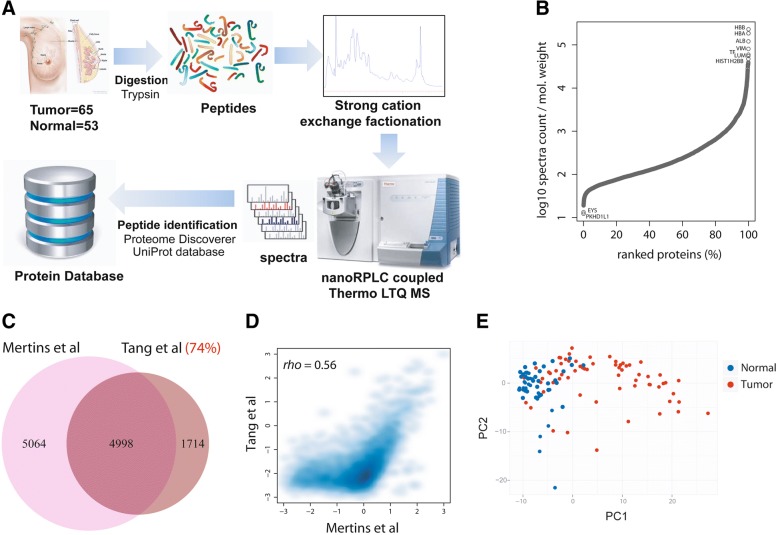
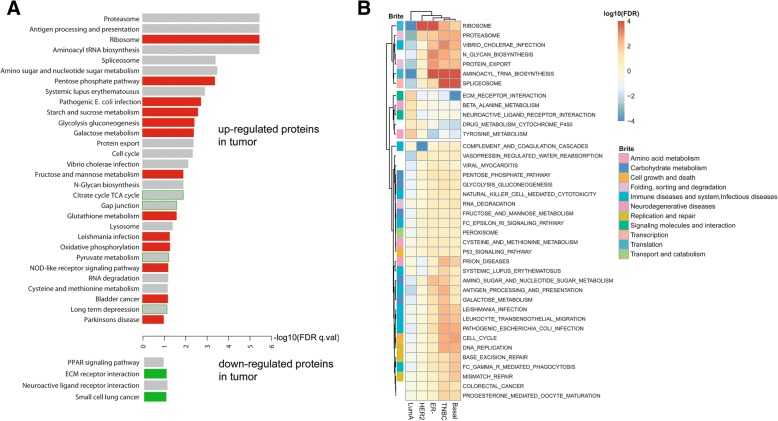
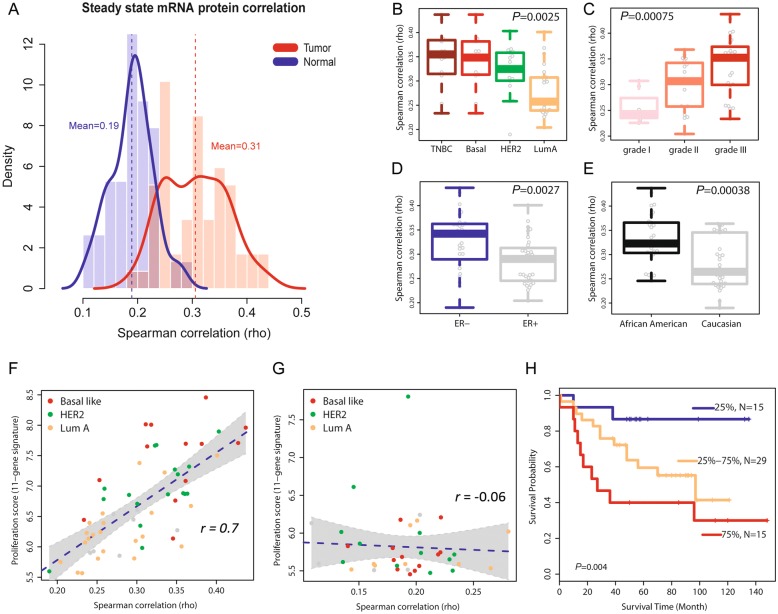
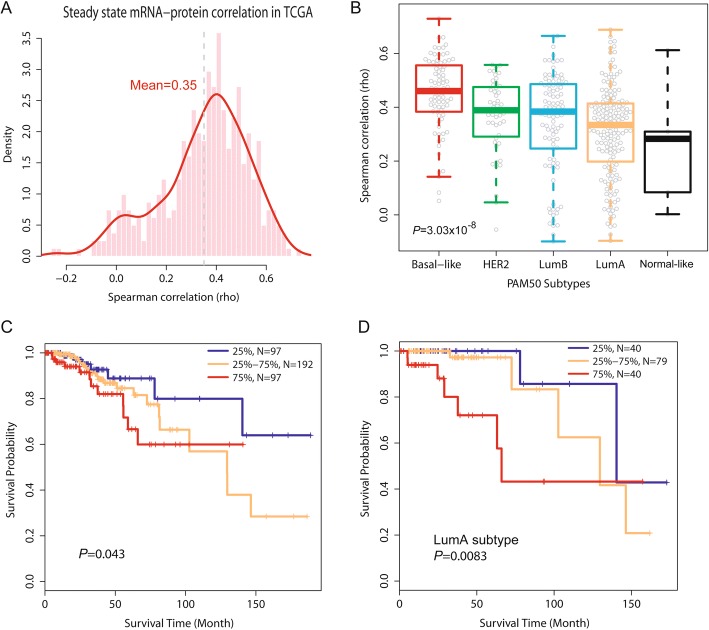
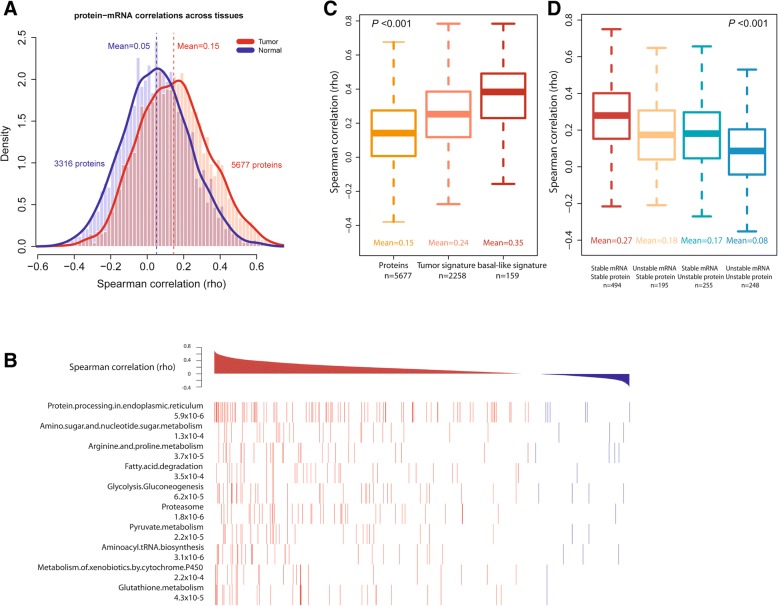
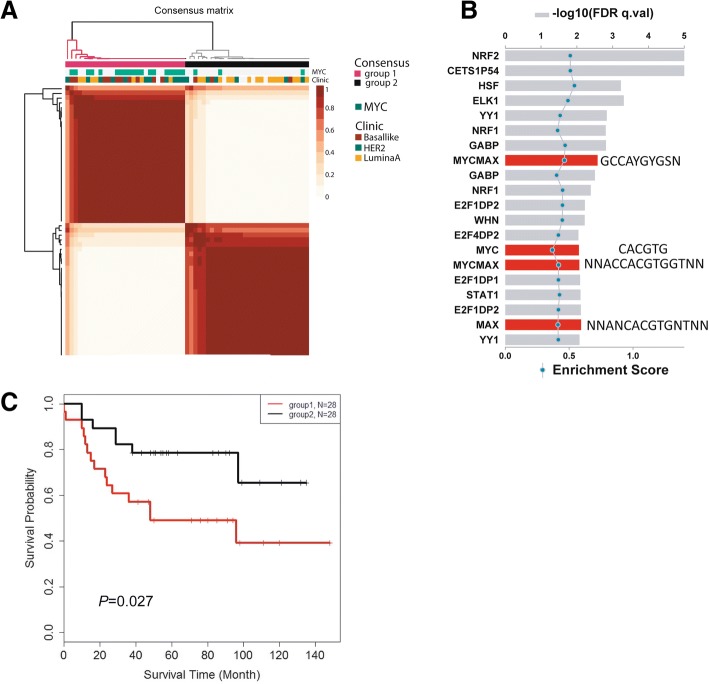
Background: Transcriptome analysis of breast cancer discovered distinct disease subtypes of clinical significance. However, it remains a challenge to define disease biology solely based on gene expression because tumor biology is often the result of protein function. Here, we measured global proteome and transcriptome expression in human breast tumors and adjacent non-cancerous tissue and performed an integrated proteotranscriptomic analysis. Methods: We applied a quantitative liquid chromatography/mass spectrometry-based proteome analysis using an untargeted approach and analyzed protein extracts from 65 breast tumors and 53 adjacent non-cancerous tissues. Additional gene expression data from Affymetrix Gene Chip Human Gene ST Arrays were available for 59 tumors and 38 non-cancerous tissues in our study. We then applied an integrated analysis of the proteomic and transcriptomic data to examine relationships between them, disease characteristics, and patient survival. Findings were validated in a second dataset using proteome and transcriptome data from “The Cancer Genome Atlas” and the Clinical Proteomic Tumor Analysis Consortium. Results: We found that the proteome describes differences between cancerous and non-cancerous tissues that are not revealed by the transcriptome. The proteome, but not the transcriptome, revealed an activation of infection-related signal pathways in basal-like and triple-negative tumors. We also observed that proteins rather than mRNAs are increased in tumors and show that this observation could be related to shortening of the 3′ untranslated region of mRNAs in tumors. The integrated analysis of the two technologies further revealed a global increase in protein-mRNA concordance in tumors. Highly correlated protein-gene pairs were enriched in protein processing and disease metabolic pathways. The increased concordance between transcript and protein levels was additionally associated with aggressive disease, including basal-like/triple-negative tumors, and decreased patient survival. We also uncovered a strong positive association between protein-mRNA concordance and proliferation of tumors. Finally, we observed that protein expression profiles co-segregate with a Myc activation signature and separate breast tumors into two subgroups with different survival outcomes. Conclusions: Our study provides new insights into the relationship between protein and mRNA expression in breast cancer and shows that an integrated analysis of the proteome and transcriptome has the potential of uncovering novel disease characteristics.
Overview
The claims and statistics of this paper haven’t been checked yet.
Run the check — free, no account needed. It reads the open-access text and checks the sources it cites.
Integrity signals
Registry
Cites
Statistics
Figures
Verification
Claims the paper makes
The claims and statistics of this paper haven’t been checked yet.
Run the check — free, no account needed. It reads the open-access text and checks the sources it cites.
Claims other papers make about this one
Each is checked against this paper’s own text: does it say what the citing paper says it does?
The source backs part of the claim, not all of it — or backs it for a different population, condition or comparison.
In the citing paper
“In a dataset of 61 unselected breast cancer patients [10], aggregate survival analysis showed no significant difference in overall survival (OS) between patients with high vs. low tumor SLFN11 expression (HR = 1.24, p = 0.608) (Fig 3A).”
From Integrated pan-cancer gene expression and drug sensitivity analysis reveals SLFN11 mRNA as a solid tumor biomarker predictive of sensitivity to DNA-damaging chemotherapy (2019) · cites this paper as [10]
Experimental — accuracy not yet measured
Self-check
Percentages, sums and reported differences re-computed from the paper’s own numbers.
The self-check needs the paper’s full text.
Citations
Cites
Controlling the False Discovery Rate: A Practical and Powerful Approach to Multiple Testing
Benjamini, Y., & Hochberg, Y. (1995) · Journal of the Royal Statistical Society Series B: Statistical Methodology · doi:10.1111/j.2517-6161.1995.tb02031.x · Cited by 109,482 · cited 1×
“Adjusted P values based on the analysis of 59 tumors and 38 non-cancerous tissues were computed by the Benjamini-Hochberg procedure [21].”
Molecular portraits of human breast tumours
Perou, C., Sørlie, T., Eisen, M., van de Rijn, M., Jeffrey, S., Rees, C. A., Pollack, J., Ross, D., Johnsen, H., Akslen, L., et al. (2000) · Nature · doi:10.1038/35021093 · Cited by 16,551 · cited 3×
“Gene expression profiling of breast tumors has led to the landmark discovery of disease subtypes and novel biomarkers for therapy response and disease survival [1 – 4].”
Comprehensive molecular portraits of human breast tumours
The Cancer Genome Atlas Network (2012) · Nature · doi:10.1038/nature11412 · Cited by 12,129 · cited 3×
“These findings were corroborated using proteome and transcriptome data for 404 breast tumors from “ The Cancer Genome Atlas ” (TCGA) and 77 breast tumors from the Clinical Proteomic Tumor Analysis Consortium (CPTAC) [13, 17].”
Bioconductor: open software development for computational biology and bioinformatics
Gentleman, R. C., Carey, V. J., Bates, D. M., Bolstad, B., Dettling, M., Dudoit, S., Ellis, B., Gautier, L., Ge, Y., Gentry, J., et al. (2004) · Genome biology · doi:10.1186/gb-2004-5-10-r80 · Cited by 12,082 · cited 1×
“Statistical analyses were performed using the R software developed by the R Development Core Team at R Foundation for Statistical Computing and packages in Bioconductor [24].”
Sørlie, T., Perou, C. M., Tibshirani, R. J., Aas, T., Geisler, S. B., Johnsen, H., Hastie, T. J., Eisen, M. B., van de Rijn, M., Jeffrey, S. S., et al. (2001) · Proceedings of the National Academy of Sciences · doi:10.1073/pnas.191367098 · Cited by 11,506
Global quantification of mammalian gene expression control
Schwanhäusser, B., Busse, D., Li, N., Dittmar, G., Schuchhardt, J., Wolf, J., Chen, W., & Selbach, M. (2011) · Nature · doi:10.1038/nature10098 · Cited by 6,566 · cited 2×
“5d), consistent with a previous observation [16, 27].”
InfluentialA Gene-Expression Signature as a Predictor of Survival in Breast Cancer
van de Vijver, M. J., He, Y. D., Veer, L. V. ‘., Dai, H. A., Hart, A. A. M., Voskuil, D. W., Schreiber, G. J., Peterse, J. L., Roberts, C., Marton, M. J., et al. (2002) · New England Journal of Medicine · doi:10.1056/nejmoa021967 · Cited by 6,474
A Multigene Assay to Predict Recurrence of Tamoxifen-Treated, Node-Negative Breast Cancer
Paik, S., Shak, S., Tang, G., Kim, C., Baker, J. B., Cronin, M. T., Baehner, F. L., Walker, M. G., Watson, D., Park, T., et al. (2004) · New England Journal of Medicine · doi:10.1056/nejmoa041588 · Cited by 6,321
Correlation of mRNA and protein in complex biological samples
Maier, T., Güell, M., & Serrano, L. (2009) · FEBS Letters · doi:10.1016/j.febslet.2009.10.036 · Cited by 1,802 · cited 1×
“We applied the Spearman rank correlation test for protein-mRNA correlations because protein and mRNA abundances do not strictly follow a normal distribution or a linear relationship, consistent with previous observations [25].”
Proteogenomics connects somatic mutations to signalling in breast cancer
CPTAC, N., Mertins, P., Mani, D. R., Ruggles, K. V., Gillette, M. A., Clauser, K. R., Wang, P., Wang, X., Qiao, J. W., Cao, S., et al. (2016) · Nature · doi:10.1038/nature18003 · Cited by 1,676 · cited 10×
“Concordances between protein-mRNA pairs in breast cancer cell lines have been examined, and a mean correlation score of ~ for 94 pairs can be estimated from the study by Kennedy et al. [7]. tumors and 0.47 for colorectal tumor [13, 16].”
InfluentialSelf-citation
Cited by
Sorted by citations
Proteogenomic data and resources for pan-cancer analysis
Li, Y., Dou, Y., Leprevost, F. D. V., Geffen, Y., Calinawan, A. P., Aguet, F., Akiyama, Y., Anand, S. K., Birger, C., Cao, S., et al. (2023) · Cancer Cell · doi:10.1016/j.ccell.2023.06.009 · Cited by 266
NEAT1 is essential for metabolic changes that promote breast cancer growth and metastasis
Park, M. K., Zhang, L., Min, K., Cho, J.-H., Yeh, C., Moon, H., Hormaechea‐Agulla, D., Mun, H., Ko, S., Lee, J. W., et al. (2021) · Cell Metabolism · doi:10.1016/j.cmet.2021.11.011 · Cited by 216
Mottini, C., Napolitano, F., Li, Z., Gao, X., & Cardone, L. (2019) · Seminars in Cancer Biology · doi:10.1016/j.semcancer.2019.09.023 · Cited by 125
Survival analysis in breast cancer using proteomic data from four independent datasets
Osz, Á., Lánczky, A., & Győrffy, B. (2020) · Scientific Reports · doi:10.1038/s41598-021-96340-5 · Cited by 69
Omics-Based Investigations of Breast Cancer
Neagu, A.-N., Whitham, D., Bruno, P. S., Morrissiey, H., Darie, C. A., & Darie, C. C. (2023) · Molecules · doi:10.3390/molecules28124768 · Cited by 81
Integration of Online Omics-Data Resources for Cancer Research
Das, T., Andrieux, G., Ahmed, M., & Chakraborty, S. (2020) · Frontiers in Genetics · doi:10.3389/fgene.2020.578345 · Cited by 77
“…datasets whereas the integrated analysis represents the integration of multi-omics datasets followed by the analysis of integrated datasets. between mRNA and protein levels was linked with aggressive BC, including basal-like/triple-negative BC, and decreased survival (Tang et al., 2018).”
BackgroundClinical Significance of SERPINA1 Gene and Its Encoded Alpha1-Antitrypsin Protein in NSCLC
Ercetin, E., Richtmann, S., Delgado, B. M., Gómez-Mariano, G., Wrenger, S., Korenbaum, E., Liu, B., DeLuca, D., Kühnel, M., Jonigk, D., et al. (2019) · Cancers · doi:10.3390/cancers11091306 · Cited by 61
“It is known that protein measurements are not necessarily mirrored by gene expression, and that protein and protein-coding gene can reflect different processes in tumor biology [29,30].”
BackgroundA machine learning approach to leveraging electronic health records for enhanced omics analysis
Mataraso, S. J., Espinosa, C. A., Seong, D., Reincke, S., Berson, E., Reiss, J., Kim, Y., Ghanem, M., Shu, C.-H., James, T., et al. (2025) · Nature Machine Intelligence · doi:10.1038/s42256-024-00974-9 · Cited by 53
“We used an external dataset consisting of proteomics from breast cancer patients to determine if the proteins identified as more important in the COMET models were more strongly correlated with cancer mortality in other patient cohorts 40 .”
THOC2 and THOC5 Regulate Stemness and Radioresistance in Triple‐Negative Breast Cancer
Bai, X., Ni, J., Beretov, J., Wang, S., Dong, X., Graham, P., & Li, Y. (2021) · Advanced Science · doi:10.1002/advs.202102658 · Cited by 59
Tang, W., Putluri, V., Ambati, C. R., Dorsey, T. H., Putluri, N., & Ambs, S. (2019) · Clinical Cancer Research · doi:10.1158/1078-0432.ccr-19-0094 · Cited by 68
“Clin Cancer Res; 25(19) October 1, 2019 Clinical Cancer Research 5978”
BackgroundMethodInfluentialSelf-citationShee, K., Wells, J. D., Jiang, A., & Miller, T. W. (2019) · PLOS ONE · doi:10.1371/journal.pone.0224267 · Cited by 43
“In a dataset of 61 unselected breast cancer patients [10], aggregate survival analysis showed no significant difference in overall survival (OS) between patients with high vs.”
BackgroundZhu, H., Lin, Y., Lu, D., Wang, S., Liu, Y., Dong, L., Meng, Q., Gao, J., Wang, Y., Song, N., et al. (2023) · National Science Review · doi:10.1093/nsr/nwad167 · Cited by 46
Oo, K. K., Kamolhan, T., Soni, A., Thongchot, S., Mitrpant, C., O-Charoenrat, P., Thuwajit, C., & Thuwajit, P. (2020) · BMC Cancer · doi:10.1186/s12885-020-07761-w · Cited by 39
The role of eIF4F-driven mRNA translation in regulating the tumour microenvironment
Bartish, M., Abraham, M. J., Gonçalves, C., Larsson, O. S., Rolny, C., & Rincon, S. V. D. (2023) · Nature reviews. Cancer · doi:10.1038/s41568-023-00567-5 · Cited by 42
DriverDBv4: a multi-omics integration database for cancer driver gene research
Liu, C.-H., Lai, Y.-L., Shen, P.-C., Liu, H.-C., Tsai, M.-H., Wang, Y. D., Lin, W.-J., Chen, F.-H., Li, C., Wang, S., et al. (2023) · Nucleic Acids Research · doi:10.1093/nar/gkad1060 · Cited by 39
“In addition, enrichment of highly correlated transcript and protein levels is associated with reduced patient survival and aggressive disease ( 21 ).”
BackgroundEngineering Breast Cancer On-chip—Moving Toward Subtype Specific Models
Moccia, C., & Haase, K. (2021) · Frontiers in Bioengineering and Biotechnology · doi:10.3389/fbioe.2021.694218 · Cited by 49
Sedano, M. J., Ramos, E., Choudhari, R., Harrison, A. L., Subramani, R., Lakshmanaswamy, R., Zilaie, M., & Gadad, S. S. (2020) · Cancers · doi:10.3390/cancers12061522 · Cited by 34
Pérez‐Benavente, B., Fathinajafabadi, A., de la Fuente, L., Gandía, C., Martínez-Férriz, A., Pardo-Sánchez, J. M., Milián, L., Conesa, A., Romero, O. A., Carretero, J., et al. (2022) · Genome biology · doi:10.1186/s13059-022-02800-0 · Cited by 39
“In silico analysis of available published protein breast cancer dataset [54] using the Kaplan-Meier plots website [55] also showed that high levels of JunB protein were associated with bad prognosis (Additional file 1: Fig.”
MethodPateras, I. S., Williams, C., Gianniou, D. D., Margetis, A. T., Avgeris, M., Rousakis, P., Legaki, A., Mirtschink, P., Zhang, W., Panoutsopoulou, K., et al. (2023) · Journal of Translational Medicine · doi:10.1186/s12967-023-03935-9 · Cited by 33
“In total 17 triple-negative tumors where the metabolic analysis was available were identified [18, 19].”
MethodSelf-citationSibilano, M., Tullio, V., Adorno, G., Savini, I., Gasperi, V., & Catani, M. V. (2022) · International Journal of Molecular Sciences · doi:10.3390/ijms23105484 · Cited by 33
“018, respectively] (Figure 7b–e); in addition, as emerged from the analysis of AKT2 protein levels [52,53], high AKT2 expression predicted a worse 5-year overall survival compared with low AKT2 expression [HR = 2.”
MethodMatson, D. R., Denu, R. A., Zasadil, L. M., Burkard, M. E., Weaver, B. A. A., Flynn, C. M., & Stukenberg, P. T. (2021) · BMC Cancer · doi:10.1186/s12885-021-07893-7 · Cited by 32
Casciello, F., Al-Ejeh, F., Miranda, M., Kelly, G., Baxter, E., Windloch, K., Gannon, F., & Lee, J. S. (2020) · Theranostics · doi:10.7150/thno.41453 · Cited by 31
“In addition, the correlation between G9a and CDH10 protein was investigated using a publicly available database of 65 breast tumors and 53 adjacent non-cancerous tissues analysed through quantitative liquid chromatography /mass spectrometry-based proteome analysis (Figure S9G) [39].”
MethodEvaluation of Extracellular Matrix Composition to Improve Breast Cancer Modeling
Byrne, C. E., Decombe, J.-B., Bingham, G. C., Remont, J., Miller, L. G., Khalif, L., King, C. T., Hamel, K. M., Bunnell, B. A., Burow, M. E., et al. (2021) · Tissue Engineering Part A · doi:10.1089/ten.tea.2020.0364 · Cited by 31
“Furthermore, fibronectin (FN), fibril-associated COL (COL12A1), and tenascin C were observed to be elevated in all breast cancers compared with proximal tissue.(15) An immunohistochemistry (IHC) analysis of 134 tumors isolated from breast cancer patients revealed that FN expression was found to positively correlate wi…”
BackgroundZhu, C., Kim, S.-J., Mooradian, A. D., Wang, F., Li, Z., Holohan, S., Collins, P. L., Wang, K., Guo, Z., Hoog, J., et al. (2021) · Cell Reports · doi:10.1016/j.celrep.2021.108749 · Cited by 25
“For overall survival analysis against proteomic data (Figures 1G and S6I), a published study (Tang et al., 2018) consisting of mass spectrometry data and clinical information of 65 breast cancer patients available at KM plotter was used.”
BackgroundMethodYan, Z., Wang, Q., Sun, X.-X., Ban, B.-B., Lu, Z., Dang, Y.-F., Xie, L.-X., Zhang, L., Li, Y.-Q., Zhu, W., et al. (2019) · Frontiers in Oncology · doi:10.3389/fonc.2019.01349 · Cited by 28
Lim, Y. X., Lin, H., Chu, T., & Lim, Y. (2021) · Molecular Oncology · doi:10.1002/1878-0261.13048 · Cited by 26
Kundu, S., Ali, M. A., Handin, N., Conway, L. P., Rendo, V., Artursson, P., He, L., Globisch, D., & Sjöblom, T. (2021) · Journal of Experimental & Clinical Cancer Research · doi:10.1186/s13046-021-02025-2 · Cited by 31
TSPLASSO: A Two-Stage Prior LASSO Algorithm for Gene Selection Using Omics Data
Yang, S.-J., Chen, S., Wang, P., Chen, A.-M., & Tian, T. (2023) · IEEE journal of biomedical and health informatics · doi:10.1109/jbhi.2023.3326485 · Cited by 22
Begolli, R., Chatziangelou, M., Samiotaki, M., Goutas, A., Barda, S., Goutzourelas, N., Kevrekidis, D., Malea, P., Trachana, V., Liu, M., et al. (2023) · Human Genomics · doi:10.1186/s40246-023-00517-0 · Cited by 22
“Low level of agreement between gene expression and protein abundance is not unusual and has been observed in previous studies with cancer cell lines [54, 55].”
ResultAlcaraz, A. J., Baraniuk, S., Mikulášek, K., Park, B., Lane, T., Burbridge, C., Ewald, J., Potěšil, D., Xia, J., Zdráhal, Z., et al. (2021) · Environmental Pollution · doi:10.1016/j.envpol.2021.118667 · Cited by 22
Xu, X., Zhang, M.-X., Zhang, X., Liu, Y., Cai, L.-F., Zhang, Q., Chen, Q., Lin, L., Lin, S., Song, Y.-L., et al. (2022) · Analytical Chemistry · doi:10.1021/acs.analchem.1c05312 · Cited by 21
Maarouf, A., Boissard, A., Henry, C., Leman, G., Coqueret, O., Guette, C., & Lelièvre, E. (2021) · International Journal of Oncology · doi:10.3892/ijo.2021.5295 · Cited by 34
“The cohort contained samples from the three molecular subtypes of breast cancer: Luminal A, HER2‐positive and triple nega‐ tive (36).”
BackgroundMethodInfluentialJansson, M., Lindberg, J. A., Rask, G., Svensson, J., Billing, O., Nazemroaya, A., Berglund, A., Wärnberg, F., & Sund, M. (2024) · Clinical Breast Cancer · doi:10.1016/j.clbc.2024.02.015 · Cited by 20
Principles of phosphoproteomics and applications in cancer research
Higgins, L., Gerdes, H., & Cutillas, P. R. (2023) · Biochemical Journal · doi:10.1042/bcj20220220 · Cited by 24
Hu, G.-S., Zheng, Z., He, Y., Wang, D.-C., Nie, R.-C., & Liu, W. (2025) · Molecular & Cellular Proteomics · doi:10.1016/j.mcpro.2025.100919 · Cited by 22
Molecular Responses Mechanism of Synechocystis sp. PCC 6803 to Cadmium Stress
Ruan, G., Mi, W., Yin, X., Song, G., & Bi, Y. (2022) · Water · doi:10.3390/w14244032 · Cited by 17
Multi-omics integration highlights the role of ubiquitination in endometriosis fibrosis
Yang, M., Jiang, H., Ding, X., Zhang, L., Zhang, H., Chen, J., Li, L., He, X., Huang, Z., & Chen, Q. (2024) · Journal of Translational Medicine · doi:10.1186/s12967-024-05245-0 · Cited by 23
“Studies show poor correlation between protein and transcript levels [18, 19], a discrepancy also observed in tubal endometriosis [20], emphasizing the importance of proteomics, particularly modified-proteomics, in discovering novel biomarkers and targets.”
BackgroundTGFβ-mediated MMP13 secretion drives myoepithelial cell dependent breast cancer progression
Gibson, S. V., Bort, E. T., Rodríguez‐Fernández, L., Allen, M. D., Gomm, J. J., Goulding, I., Keller, U. A. D., Agnoletto, A., Brisken, C., Peck, B., et al. (2023) · npj Breast Cancer · doi:10.1038/s41523-023-00513-6 · Cited by 18
Identification of an mRNA isoform switch for HNRNPA1 in breast cancers
Erdem, M., Ozgul, İ., Dioken, D. N., Gurcuoglu, I., Ergün, S. G., Çetin-Atalay, R., Can, T., & Erson-Bensan, A. E. (2021) · Scientific Reports · doi:10.1038/s41598-021-04007-y · Cited by 17
Zingone, A., Sinha, S., Ante, M., Nguyen, C. D., Daujotyte, D., Bowman, E. D., Sinha, N., Mitchell, K. A., Chen, Q., Yan, C., et al. (2021) · Nature Communications · doi:10.1038/s41467-021-25763-5 · Cited by 25
Self-citationRNA m6A Methylation Regulators Subclassify Luminal Subtype in Breast Cancer
Yang, L., Wu, S., Ma, C., Song, S., Jin, F., Niu, Y., & Tong, W. (2021) · Frontiers in Oncology · doi:10.3389/fonc.2020.611191 · Cited by 18
“The first proteomic study applied a quantitative liquid chromatography/mass spectrometry-based proteome analysis to 65 breast tumors and 53 adjacent noncancerous tissues (40).”
MethodChoi, E., Jeon, K., Lee, H., Mun, G., Kim, J., Shin, J., Kwon, Y., Na, Y., & Lee, Y. (2024) · Cancer Science · doi:10.1111/cas.16174 · Cited by 15
“…CTSS, we investigated a liquid chromatography–mass spectrometry (LC-MS)- based proteomic dataset from a cohort of 65 breast cancer patients provided by Tang et al. 24 The OS analysis revealed that a higher expression of CTSS was strongly associated with reduced survival ( P = 0.012) (Figure 1a ).”
MethodInfluentialTROP2 as Patient-Tailoring but Not Prognostic Biomarker for Breast Cancer
Liu, X., Zhou, T., Wang, Y., Pei, M., Wang, G., Chu, W., Wang, Q., Du, S., Wang, H., & Wang, C. (2022) · OncoTargets and Therapy · doi:10.2147/ott.s354048 · Cited by 16
HERC1 Regulates Breast Cancer Cells Migration and Invasion
Rossi, F. A., Roitberg, E. C. C., Steinberg, J. H. E., Joshi, M., Espinosa, J. M., & Rossi, M. (2020) · bioRxiv · doi:10.3390/cancers13061309 · Cited by 15
“The association between the HERC1 protein expression levels and OS was analyzed using an online KM-Plotter database(42) using the protein expression data and the survival information of patients with breast cancer downloaded from the GEO (43).”
MethodShi, J.-H., Zhu, T.-Y., Lin, H.-M., Liu, Z., Zhou, M., Yu, Z.-Q., Zhou, X., Song, X., Wang, Y.-F., Jia, R., et al. (2022) · Journal of experimental & clinical cancer research : CR · doi:10.1186/s13046-022-02445-8 · Cited by 14
“Consistent with previous observations in breast cancer, our findings showed that high concordance is a disease-specific characteristic in OABL and associated with poor prognosis [11].”
BackgroundMethodResultInfluentialSelf-citationReciprocal antagonism of PIN1-APC/CCDH1 governs mitotic protein stability and cell cycle entry
Ke, S., Dang, F., Wang, L., Chen, J.-Y., Naik, M. T., Li, W., Thavamani, A., Kim, N., Naik, N. M., Sui, H., et al. (2024) · Nature Communications · doi:10.1038/s41467-024-47427-w · Cited by 15
“37 that provided patient-level mRNA, protein and outcomes data.”
Self-citationLiu, X.-P., Hou, J., Chen, C., Guan, L., Hu, H., & Li, S. (2020) · Frontiers in Molecular Biosciences · doi:10.3389/fmolb.2020.00118 · Cited by 13
Hung, Y.-W., Ouyang, C., Ping, X., Qi, Y., Wang, Y.-C., Kung, H., & Ann, D. (2023) · Journal of Biomedical Sciences · doi:10.1186/s12929-023-00924-4 · Cited by 12
Sun, Z., Liu, Y.-F., He, X.-Y., Di, R., Wang, X.-Y., Ren, C.-H., Zhang, Z.-J., & Chu, M. (2022) · International Journal of Molecular Sciences · doi:10.3390/ijms232314888 · Cited by 10
“Recent advances in multi-omics have facilitated the generation of large datasets that can be used to investigate complex life activities [24,25].”
BackgroundSelf-citationPrakash, A., Taylor, L., Varkey, M., Hoxie, N., Mohammed, Y., Goo, Y. A., Peterman, S. M., Moghekar, A., Yuan, Y., Glaros, T., et al. (2021) · Cancers · doi:10.3390/cancers13205034 · Cited by 13
“studied 65 breast tumors and 53 adjacent noncancerous tissues with extensive fractionation, leading to 118 RAW files [20].”
BackgroundProteomic heterogeneity reveals SOAT1 as a potential biomarker for hepatocellular carcinoma
Khatib, S. A., & Wang, X. W. (2019) · Translational Gastroenterology and Hepatology · doi:10.21037/tgh.2019.05.09 · Cited by 11
Self-citationSari, A. I. P., Roytrakul, S., Chittavanich, P., Saengwimol, D., Laosillapacharoen, N., Khamjerm, J., Borwornpinyo, S., Jinawath, A., Suvikapakornkul, R., Lertsithichai, P., et al. (2025) · Biomedicine & pharmacotherapy = Biomedecine & pharmacotherapie · doi:10.1016/j.biopha.2025.118359 · Cited by 9
Li, X., Poire, A., Jeong, K. J., Zhang, D., Chen, G., Sun, C., & Mills, G. B. (2023) · Cell Death Discovery · doi:10.1038/s41420-023-01586-9 · Cited by 9
“4E) [38, 39].”
Adipose-Derived Stromal/Stem Cell Response to Tumors and Wounds: Evaluation of Patient Age
Hamel, K., Liimatta, K. Q., Belgodere, J. A., Bunnell, B., Gimble, J. M., & Martin, E. (2022) · Stem Cells and Development · doi:10.1089/scd.2021.0280 · Cited by 9
A glucocorticoid–FAS axis controls immune evasion during metastatic seeding
Cassandras, M., Sanchez, X., Hsu, L., huang, Y., Getzler, A. J., Ganguly, D., Baldominos, P., Codinachs, I., Chuong, J., Martin, E. E., et al. (2026) · Nature · doi:10.1038/s41586-026-10222-2 · Cited by 9
“Correlations between GR protein and patient outcome were analysed from a published proteomics dataset of patients with breast cancer 70 using the Kaplan–Meier Plotter (https://kmplot.com/analysis) breast protein database 71 .”
Restier-Verlet, J., Ferlazzo, M. L., Granzotto, A., Al-Choboq, J., Bellemou, C., Estavoyer, M., Lecomte, F., Bourguignon, M., Pujo-Menjouet, L., & Foray, N. (2024) · Cells · doi:10.3390/cells13201703 · Cited by 8
“However, similarly to the eye, such observations originate from the follow-up of breast cancer women treated by radiotherapy, i.e., from high and fractionated doses (more than 50% of patients elicit a significant risk of heart attack for 10 years post-radiotherapy against breast tumor [69–71]).”
BackgroundCerutti, C., Lucotti, S., Menéndez, S. T., Reymond, N., Garg, R., Romero, I. A., Muschel, R. J., & Ridley, A. J. (2024) · Cell Reports · doi:10.1016/j.celrep.2024.113989 · Cited by 10
“Kaplan-Meier plots (https://kmplot.com/analysis/) 37,38 on breast cancer patient samples (Tang 2018 dataset 39 ) showed that high NWASP (Figure S4R) and IQGAP1 (Figure S4S) protein expression correlated with shorter survival.”
Kao, H.-Y., Pai, C.-P., Wang, H., Agarwal, N., Adams, J. A., Liu, Z., Seachrist, D. D., Keri, R., & Schiemann, W. P. (2023) · Research Square · doi:10.21203/rs.3.rs-3266720/v1 · Cited by 8
Proteomic Analysis Identifies p62/SQSTM1 as a Critical Player in PARP Inhibitor Resistance
Uddin, M. H., Zhou, J., Pimentel, J. M., Patrick, S. M., Kim, S., Shekhar, M. P. V., & Wu, G. S. (2022) · Frontiers in Oncology · doi:10.3389/fonc.2022.908603 · Cited by 9
“(2018) (28) revealed a similar positive correlation between overall survival and p62 protein expression in 33 ER-negative breast cancer patients (HR, 0.”
BackgroundMethodResultInfluentialAndrieux, G., Chakraborty, S., Das, T., & Boerries, M. (2020) · Frontiers in Cell and Developmental Biology · doi:10.3389/fcell.2020.586479 · Cited by 9
“Interestingly, the authors utilized predicted mRNA and protein stability profiles and showed that the global mRNAto-protein correlation increased with the predicted stability of corresponding mRNA and protein molecules (Tang et al., 2018).”
BackgroundDing, N., Zhang, B.-T., Ying, W., Song, J., Feng, L., Zhang, K., Li, H., Xu, J., Xiao, T., & Cheng, S.-J. (2020) · Signal Transduction and Targeted Therapy · doi:10.1038/s41392-020-00224-5 · Cited by 8
Water as a reactant in the differential expression of proteins in cancer
Dick, J. M. (2020) · bioRxiv · doi:10.1101/2020.04.09.035022 · Cited by 8
Tovar-Hernández, K., Salinas-Vera, Y. M., Carlos-Reyes, Á., García-Hernández, A., Marchat, L., Mandujano-Lázaro, G., Ríos-Castro, E., Velasco-Suárez, A., Mendez-Gómez, I., Tecalco-Cruz, Á. C., et al. (2024) · Scientific Reports · doi:10.1038/s41598-024-76053-1 · Cited by 7
Behera, R. N., Bisht, V. S., Giri, K., & Ambatipudi, K. (2023) · PROTEOMICS - CLINICAL APPLICATIONS · doi:10.1002/prca.202300016 · Cited by 8
“…cancer complexities such as organ metastasis, immune evasion, cellular plasticity, cancer dormancy, chemoresistance, and BC reoccurrence at the molecular level by disclosing the cancer signaling, monitoring the disease progression, checking drug response, and neutralizing drug resistance [23–27].”
BackgroundFeng, X., Cao, A., Qin, T., Zhang, Q., Fan, S., Wang, B., Song, B., Yu, X., & Li, L. (2021) · Oncology Reports · doi:10.3892/or.2021.8187 · Cited by 17
“The analysis of data (n=118) from Tang et al (28) revealed that UBQLN1 protein expression was also associated with a poor prognosis (Fig.”
MethodRida, P. C. G., Andreae, R., Bikhazi, N., Wang, I., Jackson, B., & Jinna, N. (2026) · International Journal of Molecular Sciences · doi:10.3390/ijms27041823 · Cited by 6
The UFL1-AKT positive feedback loop promotes breast cancer progression by enhancing lipid synthesis
Meng, F., Du, Y., Liang, J., Li, H., Wang, J., Tang, K., Kong, R., Sun, H.-R., Yin, T., Qin, J., et al. (2026) · Nature Communications · doi:10.1038/s41467-026-68492-3 · Cited by 6
Zhao, P.-P., Zhang, Y.-Y., Yu, Y., Zhang, Q., Liu, X.-Y., Zhang, X.-D., Chen, S., de Bock, C., Thorne, R. F., & Shi, Y. (2025) · International Journal on Biological Sciences · doi:10.7150/ijbs.104921 · Cited by 6
“Nevertheless, not all genes display good correlation between mRNA and protein levels in breast cancer tissues [38], but importantly we found the subtype variations in FAT1 mRNA expression were maintained at the protein level with the highest levels in TNBC (Fig.”
Feng, D., Pu, D.-Q., Ren, J., Liu, M., Sun, X., Zhang, Z., & Li, J.-W. (2025) · Frontiers in Immunology · doi:10.3389/fimmu.2024.1443648 · Cited by 6
“Several factors contribute to this phenomenon, including the decoupling of gene and protein expression, post-transcriptional regulatory mechanisms, the impact of epigenetic modi fi cations, and discrepancies in protein stability and degradation rates (33 – 35).”
Evaluation of a Proteomics-Guided Protein Signature for Breast Cancer Detection in Breast Tissue
Moreno‐Ulloa, A., Zárate-Córdova, V. L., Ramírez‐Sánchez, I., Cruz-López, J. C., Perez-Ortiz, A. C., Villarreal-Garza, C. M., Díaz‐Chávez, J., Estrada-Mena, B., Antonio‐Aguirre, B., López-Almanza, P. X., et al. (2024) · Journal of Proteome Research · doi:10.1021/acs.jproteome.4c00295 · Cited by 8
Sholehrasa, H., & Jaberi-Douraki, M. (2024) · arXiv.org · doi:10.48550/arxiv.2410.01755 · Cited by 6
“…expression levels in breast cancer enables the construction of a biologically comprehensive representation of tumor biology, facilitating downstream analyses such as clustering tumors into proteomic subgroups and associating these clusters with patient survival outcomes and molecular subtypes [10].”
Recent Contributions of Mass Spectrometry-Based "Omics" in the Studies of Breast Cancer.
Banerjee, S., Hatimuria, M., Sarkar, K., Das, J., Pabbathi, A., & Sil, P. (2023) · Chemical Research in Toxicology · doi:10.1021/acs.chemrestox.3c00223 · Cited by 6
Cellular Transcriptomics of Carboplatin Resistance in a Metastatic Canine Osteosarcoma Cell Line
Hodge, M., Miller, T., Weinman, M. A., Wustefeld-Janssens, B. G., Bracha, S., & Davis, B. W. (2023) · Genes · doi:10.3390/genes14030558 · Cited by 6
“The transient nature of the expressed genes tends to be more dynamic, and the proteome more static [110,111].”
BackgroundRuhen, O., Qu, X.-Y., Jamaluddin, M. F. B., Salomon, C., Gandhi, A., Millward, M., Nixon, B., Dun, M. D., & Meehan, K. (2021) · Membranes · doi:10.3390/membranes11110880 · Cited by 6
“1, histone H2A type 2-A, alstrom syndrome protein 1, fibulin-1, titin, glyceraldehyde-3-phosphate dehydrogenase, tropomodulin-2, cofilin-1, and peroxiredoxin-2 were significantly associated with shorter overall survival (Figure 6) [22].”
BackgroundMethodIntegrated multi-omics analysis for lung adenocarcinoma in Xuanwei, China
Jiang, B., Yang, J., He, R., Wang, D., Huang, Y., Zhao, G., Ning, M., Zeng, T., & Li, G. (2023) · Aging · doi:10.18632/aging.205300 · Cited by 5
“Tang et al. found that protein-mRNA consistency in breast tumors was enhanced and could be used as a novel disease characteristic and prognostic factor [58].”
Jin, H., Wang, X., Li, L., Rui, C., Gan, H., Wang, Q., Tao, F., & Zhu, Y. (2024) · iScience · doi:10.1016/j.isci.2024.111423 · Cited by 5
“13,14 In particular, to our knowledge, none of the previous studies has used transcriptomic profiles and corresponding proteomic information in the placenta to systematically portray molecular explanations for the occurrence of SGA.”
Self-citationWu, Q., Tang, X., Zhu, W., Li, Q., Zhang, X., & Li, H. (2021) · Frontiers in Oncology · doi:10.3389/fonc.2021.751430 · Cited by 6
“In general, a comprehensive analysis of the proteome and transcriptome has the potential to reveal the characteristics of new diseases (9).”
BackgroundZhang, W., Fei, S., Tong, R., Liu, Y., He, J., Wan, B., & Xu, J. (2021) · Annals of Diagnostic Pathology · doi:10.1016/j.anndiagpath.2021.151834 · Cited by 6
Argininosuccinate lyase is a metabolic vulnerability in breast development and cancer
Karvelsson, S. T., Wang, Q., Hilmarsdóttir, B., Sigurdsson, A., Moestue, S. A., Mælandsmo, G. M., Halldórsson, S., Guðmundsson, S., & Rolfsson, Ó. (2021) · npj Systems Biology and Applications · doi:10.1038/s41540-021-00195-5 · Cited by 6
Alamukii, N. A., Kovács, A., Raghavan, S., Ilio, J., Karlsson, P., Helou, K., & Parris, T. (2025) · npj Breast Cancer · doi:10.1038/s41523-025-00881-1 · Cited by 4
Identification of candidate biomarkers correlated with the pathogenesis of breast cancer patients
Yu, S., Wang, C., Ouyang, J., Luo, T. L., Zeng, F., Zhang, Y., Gao, L., Huang, S., & Wang, X. (2025) · Scientific Reports · doi:10.1038/s41598-025-93208-w · Cited by 3
Self-citationComparative Analysis of Epididymis Cauda of Yak before and after Sexual Maturity
Ding, Z.-Q., Xiong, L., Wang, X.-D., Guo, S.-K., Cao, M.-L., Kang, Y., La, Y., Bao, P., Pei, J., & Guo, X. (2023) · Animals · doi:10.3390/ani13081355 · Cited by 4
“humans, cattle, and mice, which may be related to differences in experimental techniques, shortening of 3′UTR, and differences in spatiotemporal expression [16,33].”
BackgroundSelf-citationMonteiro, F., Stepanauskaitė, L., Williams, C., & Helguero, L. (2022) · Cancers · doi:10.3390/cancers14246029 · Cited by 4
“Analysis based on high SETD7 protein data [50] in KM plotter also showed that”
BackgroundMethodEngel, A. J., Samuel, K., Bass, I., Lin, S., Antoniou, I., Yagnik, R., Port, E., Feldman, S., Friedman, N. B., Boolbol, S., et al. (2026) · Journal of the Endocrine Society · doi:10.1210/jendso/bvag041 · Cited by 3
“It is important to note that the tumors used for this analysis were not from our cohort and were not all TNBC but were from protein analysis performed by liquid chromatography-mass spectrometry rather than IHC, as described by Tang et al [17].”
InfluentialPV-1: a novel molecular prognostic marker of distant metastases in various solid tumors
Pozzi, C., Sarti, R., Cascio, A. L., Bonovas, S., Tiraboschi, L., Lizier, M., Bertocchi, A., Torrisi, R., Fernandes, B., Colombo, P., et al. (2025) · EMBO Molecular Medicine · doi:10.1038/s44321-025-00277-5 · Cited by 3
“Only one dataset was available for this analysis (Tang et al, 2018), comprising 65 tumor samples.”
Stiphout, C. M. V., Kelly, G., Pallegar, N. K., Elbakry, E., Vilchis-Celis, A. V., Christian, S., & Viloria-Petit, A. (2023) · Exploration of Targeted Anti-tumor Therapy · doi:10.37349/etat.2024.00201 · Cited by 3
Zeki, Ö., Nenni, M., Çelebi̇er, M., Öncül, S., Ercan, A., Süslü, İ., & Haznedaroglu, I. (2021) · doi:10.1016/j.hermed.2021.100449 · Cited by 3
The RNA and protein landscape that could bring precision medicine to more people
Makin, S. (2020) · Nature · doi:10.1038/d41586-020-02676-9 · Cited by 3
An AGO2 adaptor expands the functional and evolutionary reach of microRNA targetingPreprint
Crozier, A. F. F., Shah, K. M., Grevitt, P., Thind, A., Maniati, E., Wang, J., Shen, K., Cox, D. C., Rajeeve, V., Cutillas, P. R., et al. (2025) · bioRxiv · doi:10.1101/2025.10.07.680889 · Cited by 2
“J ), consistent with loss of translational control ( 40 , 41 ).”
Multi-modal for the diagnosis and management of ocular adnexal lymphoma
Zhou, M., Tan, H., & Zhou, Y.-X. (2025) · Holistic Integrative Oncology · doi:10.1007/s44178-025-00148-6 · Cited by 2
“Pro-teotranscriptomics, which combines proteomic and transcriptomic data, has provided new insights into the development and progression of malignancies [36].”
Self-citationTakeda, M., Ito, H., Kitahata, K., Sato, S., Nishide, A., Gamo, K., Managi, S., Tezuka, T., Yoshizawa, A., & Kim, M. (2024) · Cells · doi:10.3390/cells13181572 · Cited by 2
“…contribute to poor prognosis in BC. 13 , 1572 Similarly, the high α -parvin expression group showed a trend toward worse overall survival in both datasets, with the data of Tang et al. [27] being significant (Figure 1e). curves for two groups according to high and low PARVA/ α -parvin expression.”
MethodResultIntegrative analysis of transcriptome and proteome profiles in primary and recurrent glioblastoma
Zhang, J., Wang, G., Yan, B., Yang, G., Yang, Q., Hu, Y.-Q., Guo, J.-R., Zhao, N., Wang, L., & Wang, H.-J. (2023) · PROTEOMICS - Clinical Applications · doi:10.1002/prca.202200085 · Cited by 2
“Thelowcorrelationbetweentranscriptionand proteome was reported in multiple tumors, such as breast cancer and lung cancer [19, 20].”
BackgroundKe, S., Dang, F., Wang, L., Chen, J.-Y., Naik, M., Thavamani, A., Liu, Y.-S., Li, W.-X., Kim, N., Naik, N., et al. (2023) · Research Square · doi:10.21203/rs.3.rs-2447544/v1 · Cited by 2
Self-citationHuang, A., Huang, S.-Y., SHAH, P. M., Ku, W., Huang, K., Liu, Y., Su, C., & Huang, R.-F. S. (2022) · The Journal of Nutritional Biochemistry · doi:10.1016/j.jnutbio.2022.109000 · Cited by 3
Paranthaman, P., Karuppasamy, R., & Veerappapillai, S. (2026) · BioMedicine · doi:10.37796/2211-8039.1708 · Cited by 1
“Four microarray datasets (GSE36295, GSE37751, GSE61724, GSE38959) and one RNA-seq dataset (GSE58135) were downloaded from the publicly available GEO database and analyzed using the GEO2R script [12 — 17].”
Savoie, J. J., Hebert, K., King, C., McConnell, E. C., Hoang, V. T., Monroe, W. T., Burow, M. E., Collins-Burow, B., Belgodere, J. A., & Martin, E. C. (2025) · Bioengineering · doi:10.3390/bioengineering13010047 · Cited by 1
“Further, when compared to prior work on non-metaplastic TNBC [6], the decellularized samples identified proteins not detected in non-metaplastic TNBC tumors, suggesting potential subtype-specific ECM features.”
Sun, T., Zhang, X., Liu, X., Li, X., Li, S., Yu, S., Xiao, Z., & Li, N. (2025) · Journal of Proteome Research · doi:10.1021/acs.jproteome.5c00087 · Cited by 1
A proteotranscriptomic approach to dissect the molecular landscape of human retinoblastoma
Wolf, J., Hajdú, R. I., Boneva, S., Godbole, I., Stürzbecher, L., Auw-Haedrich, C., Lagrèze, W., Agostini, H., Reinhard, T., Tholen, S., et al. (2025) · Frontiers in Oncology · doi:10.3389/fonc.2025.1571702 · Cited by 1
Liu, W., Chen, W., Tang, M., Liu, S., Gao, H., & Miao, C. (2025) · Cell Biochemistry and Biophysics · doi:10.1007/s12013-025-01733-2 · Cited by 1
Al-Omari, A. A., Cook, K. W., Symonds, P., Skinner, A., Wright, A., Zhu, Y., Coble, V. L., Mohammed, O. J., Choudhury, R. H., Uddin, N., et al. (2024) · npj Vaccines · doi:10.1038/s41541-024-01029-1
Metadata
- Authors
- Tang, W., Zhou, M., Dorsey, T. H., Prieto, D. A., Wang, X. W., Ruppin, E., Veenstra, T. D., & Ambs, S.
- Affiliations
- National Institutes of Health (US)
- Frederick National Laboratory for Cancer Research (US)
- National Cancer Institute (US)
- Corresponding author
- Ambs, Stefan
- Venue
- Genome Medicine
- Published
- 2018-12-03
- Volume
- 10
- Issue
- 1
- Pages
- 94-94
- ISSN
- 1756-994X (ISSN-L)
- PMC
- PMC6276229
- OpenAlex
- W2902072367
- Cited by
- 162
- References
- 37
- Citations by year
- 2026: 7 · 2025: 16 · 2024: 20 · 2023: 44 · 2022: 25 · 2021: 35 · 2020: 9 · 2019: 6
- FWCI
- 3.78
- Type
- journal article
- Language
- en
- Update notices
- correction (2025-06-24)
- Open access
- gold
- doi.org
- Locations
- Genome Medicine (publishedVersion, cc-by)
- Europe PMC (PubMed Central) (publishedVersion, other-oa)
- PubMed Central (publishedVersion, cc-by)
- PubMed (publishedVersion)
- DigitalCommons-Cedarville (Cedarville University) (submittedVersion)
- DOAJ (DOAJ: Directory of Open Access Journals) (submittedVersion, cc-by-sa)
- Funders
- National Cancer Institute (ZIA BC 010887)
- Topics
- Life Sciences › Biochemistry, Genetics and Molecular Biology › Cancer Research › Breast Cancer Treatment Studies
- Physical Sciences › Chemistry › Spectroscopy › Advanced Proteomics Techniques and Applications
- Life Sciences › Biochemistry, Genetics and Molecular Biology › Molecular Biology › Bioinformatics and Genomic Networks
- Keywords
- breast cancer, proteotranscriptomics, breast cancer subtypes, basal-like breast cancer, triple-negative breast cancer, tumor cell proliferation, patient survival
- MeSH terms
- Breast Neoplasms, Chromatography, Liquid, Female, Humans, Mass Spectrometry, Signal Transduction, Gene Expression Regulation, Neoplastic, Oligonucleotide Array Sequence Analysis, Gene Expression Profiling, Proteomics
About these checks
Registry, retraction, Cites and statistics results are computed, not judged, with one exception: a printed reference that no index lists is read once by a model before it counts as a citation error. Claims are extracted by a model and kept only when their quote appears verbatim in the text; each cited source is then checked, with a model’s help, for whether it says what the claim relies on. Those verdicts can be wrong — read the claim’s quote and the cited source before relying on one.
Statistics and arithmetic are recomputed, not judged.
Confidence bands are shown only for fields calibrated on our annotated test set. None is calibrated yet, so no band is shown.
What counts as a claim ›How we measure confidence ›How we check this ›
Are you an author, or do you see a problem with this page? Request a review
