

Restricting retrotransposons: a review
Open accessThe DOI matches its Crossref record; 531 of the 531 references it cites were found in a registry or an index.
Abstract
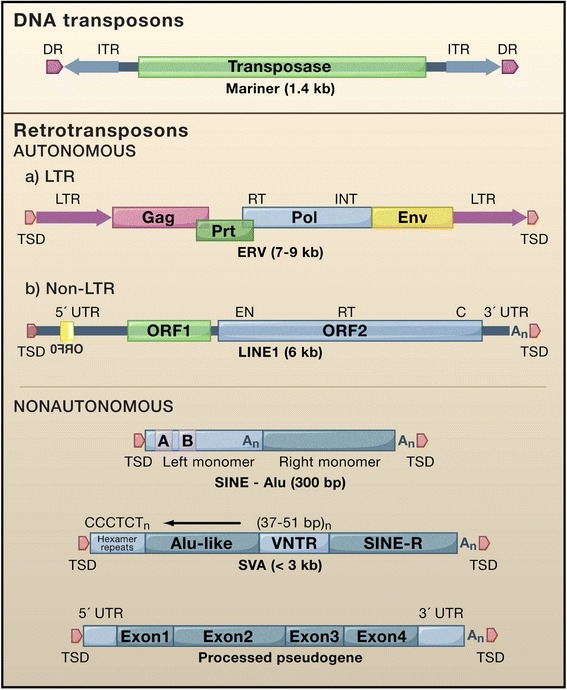
Retrotransposons have generated about 40 % of the human genome. This review examines the strategies the cell has evolved to coexist with these genomic "parasites", focussing on the non-long terminal repeat retrotransposons of humans and mice. Some of the restriction factors for retrotransposition, including the APOBECs, MOV10, RNASEL, SAMHD1, TREX1, and ZAP, also limit replication of retroviruses, including HIV, and are part of the intrinsic immune system of the cell. Many of these proteins act in the cytoplasm to degrade retroelement RNA or inhibit its translation. Some factors act in the nucleus and involve DNA repair enzymes or epigenetic processes of DNA methylation and histone modification. RISC and piRNA pathway proteins protect the germline. Retrotransposon control is relaxed in some cell types, such as neurons in the brain, stem cells, and in certain types of disease and cancer, with implications for human health and disease. This review also considers potential pitfalls in interpreting retrotransposon-related data, as well as issues to consider for future research.
Overview
The claims and statistics of this paper haven’t been checked yet.
Free: it reads the open-access text and checks the first 5 claims that cite a source we can check. Create a free account to check every claim.
Integrity signals
Registry
Cites
Statistics
Figures
Verification
Claims the paper makes
The claims and statistics of this paper haven’t been checked yet.
Free: it reads the open-access text and checks the first 5 claims that cite a source we can check. Create a free account to check every claim.
Claims other papers make about this one
Each is checked against this paper’s own text: does it say what the citing paper says it does?
In the citing paper
“Retrotransposons are the majority class of TEs present in the human genome, and are themselves divided into two types: LTR retrotransposons, which comprise long terminal repeats (LTRs) on both ends, and non-LTRs that do not contain these repeats and are subdivided into long-interspersed nuclear elements (LINEs) and short-interspersed nuclear elements (SINEs) (Goodier, 2016).”
From Cytoplasmic DNA: sources, sensing, and role in aging and disease (2021) · cites this paper as Goodier, 2016
Self-check
Percentages, sums and reported differences re-computed from the paper’s own numbers.
The self-check needs the paper’s full text.
Citations
Cites
Initial sequencing and analysis of the human genome
International Human Genome Sequencing Consortium, Whitehead Institute for Biomedical Research, C. F. G. R., Lander, E. S., Linton, L. M., Birren, B., Nusbaum, C., Zody, M. C., Baldwin, J., Devon, K., Dewar, K., et al. (2001) · Nature · doi:10.1038/35057062 · Cited by 24,216 · cited 1×
“and L3 family elements comprise an additional 4 % [21].”
Isolation of a human gene that inhibits HIV-1 infection and is suppressed by the viral Vif protein
Sheehy, A. M., Gaddis, N. C., Choi, J. D., & Malim, M. H. (2002) · Nature · doi:10.1038/nature00939 · Cited by 2,327
Arms races between and within species
Dawkins, R., & Krebs, J. R. (1979) · Proceedings of the Royal Society of London. Series B. Biological Sciences · doi:10.1098/rspb.1979.0081 · Cited by 2,180
Ancient DNA and the rewriting of human history: be sparing with Occam’s razor
Haber, M., Mezzavilla, M., Xue, Y., & Tyler-Smith, C. (2016) · Genome Biology · doi:10.1186/s13059-015-0866-z · Cited by 1,924
The origin and behavior of mutable loci in maize
McClintock, B. (1950) · Proceedings of the National Academy of Sciences · doi:10.1073/pnas.36.6.344 · Cited by 1,747
Cytosine methylation and the ecology of intragenomic parasites
Yoder, J. A., Walsh, C. P., & Bestor, T. H. (1997) · Trends in Genetics · doi:10.1016/s0168-9525(97)01181-5 · Cited by 1,562
UHRF1 Plays a Role in Maintaining DNA Methylation in Mammalian Cells
Bostick, M., Kim, J. K., Estève, P.-O., Clark, A., Pradhan, S., & Jacobsen, S. E. (2007) · Science · doi:10.1126/science.1147939 · Cited by 1,455
Origin and evolution of retroelements based upon their reverse transcriptase sequences
Xiong, Y., & Eickbush, T. H. (1990) · The EMBO Journal · doi:10.1002/j.1460-2075.1990.tb07536.x · Cited by 1,374 · cited 1×
“Phylogenetic analyses suggest that eukaryote non-LTR retrotransposons predate LTR retrotransposons, which in turn gave rise to retroviruses through the acquisition of an envelope (env) gene [73–76].”
BackgroundPIWI-interacting small RNAs: the vanguard of genome defence
Siomi, M. C., Sato, K., Pezic, D., & Aravin, A. A. (2011) · Nature Reviews Molecular Cell Biology · doi:10.1038/nrm3089 · Cited by 1,319 · cited 2×
“A large number of endogenous retrotransposon-related small RNAs of a size consistent with siRNAs, miRNAs and piRNAs have been detected in cells [179, 184–188] (reviewed in [189]).”
BackgroundThe SRA protein Np95 mediates epigenetic inheritance by recruiting Dnmt1 to methylated DNA
Sharif, J., Muto, M., Takebayashi, S.-I., Suetake, I., Iwamatsu, A., Endo, T. A., Shinga, J., Mizutani-Koseki, Y., Toyoda, T., Okamura, K., et al. (2007) · Nature · doi:10.1038/nature06397 · Cited by 1,304
Cited by
Items 401–500 of 504
Retrotransposons: Silent Architects of Vascular Aging and Disease
Paul, S. K., & Takayama, N. (2025) · Epigenetics and human health · doi:10.1007/978-3-032-04125-8_12
Restriction Factor Control of Ty1 Family LTR-Retrotransposons in Saccharomyces cerevisiae
Beckwith, S. L., & Streeter, M. J. S. (2026) · Viruses · doi:10.3390/v18101154
Recent Progress in Understanding the Mechanism and Consequences of Retrotransposon Movement
Garfinkel, D. J., & Purzycka, K. J. (2017) · MDPI eBooks · doi:10.3390/books978-3-03842-541-0
Cellular factors controlling human L1 retrotransposition
Galantonu, R. N. (2017) · theses.fr (ABES) · doi:10.70675/f24810a8z4f50z444fz84f0z11863b900b95
Etude des éléments régulateurs de l'expression des gènes chez l'humain
Bessière, C. (2018) · theses.fr (ABES) · doi:10.70675/0b26676ez90bfz4f47zba59z90853f19d510
3’-tRNA Fragments Target Domesticated LTR-RetrotransposonsPreprint
Peacey, M., Steinberg, J. I., & Schorn, A. J. (2026) · bioRxiv (Cold Spring Harbor Laboratory) · doi:10.64898/2026.01.22.698655
Ferrasa, A., & Herai, R. H. (2026) · Human Gene · doi:10.1016/j.humgen.2026.201529
Additional file 1 of Endogenous retroviruses in the origins and treatment of cancer
Jansz, N., & Faulkner, G. J. (2021) · Figshare · doi:10.6084/m9.figshare.14570381
The interplay between recombination hotspots, GC-biased gene conversion and natural selection
Joseph, J. (2023) · theses.fr (ABES) · doi:10.70675/99f388fezf548z434az8ca0ze321e7c030e6
Expanding Hippocampal Ensembles through LINE-1 RNA Downregulation Enhances CognitionPreprint
Politowska, N., Toth, J. G., Hámor, P. U., Pigulevskiy, I., Welday, J. P., Taki, F., Nawaid, H., Sciortino, R. K., Pleil, K. E., & Tóth, M. (2026) · bioRxiv (Cold Spring Harbor Laboratory) · doi:10.64898/2026.10.14.758979
Yan, J., Zhao, Y., Du, J., Wang, Y., Wang, S., Wang, Q., Zhao, X., Xu, W., & Zhao, K. (2022) · Figshare · doi:10.6084/m9.figshare.19588821
Mukherjee, K., Sur, D., Singh, A., Rai, S., Das, N., Sekar, R., Narindi, S., Dhingra, V. K., Jat, B., Balraam, K. V. V., et al. (2021) · Figshare · doi:10.6084/m9.figshare.14691817
Identification de facteurs cellulaires régulant la rétrotransposition de Ty1 chez S. cerevisiae
Barkova, A. (2019) · theses.fr (ABES) · doi:10.70675/d3dce78az48e8z4209zb2afzd31c32c110b1
Sarkar, G., Kundu, S., Mukherjee, S. P., Goodier, J. L., & Mandal, P. K. (2025) · FEBS Journal · doi:10.1111/febs.70375
Self-citationThe role of DNA methylation on transcription factor occupancy and transcriptional activity
Cusack, M. (2017) · Oxford University Research Archive (ORA) (University of Oxford) · doi:10.5287/ora-o55arbk81
Tang, W., & Liang, P. (2020) · bioRxiv (Cold Spring Harbor Laboratory) · doi:10.1101/2020.03.19.999144
Ruggiero, R. P., & Boissinot, S. (2020) · Figshare · doi:10.6084/m9.figshare.12096807
Ruggiero, R. P., & Boissinot, S. (2020) · Figshare · doi:10.6084/m9.figshare.12096798
Ruggiero, R. P., & Boissinot, S. (2020) · Figshare · doi:10.6084/m9.figshare.12096801
Ruggiero, R. P., & Boissinot, S. (2020) · Figshare · doi:10.6084/m9.figshare.12096816
Ruggiero, R. P., & Boissinot, S. (2020) · Figshare · doi:10.6084/m9.figshare.12096810
Shademan, M., Zare, K., ZAHEDI, M., Mozaffari, H. M., Hosseini, H. B., Ghaffarzadegan, K., Goshayeshi, L., & Dehghani, H. (2020) · Research Square · doi:10.21203/rs.3.rs-28838/v1
Mobile genetic elements in the pathogenesis of human reproductive disorders
Babovskaya, A. A., Trifonova, E. A., & Степанов, В. А. (2026) · Vavilov Journal of Genetics and Breeding · doi:10.18699/vjgb-26-69
Kavaklıoğlu, G., Podhornik, A., Vcelkova, T., Marjanović, J., Beck, M. A., Phan-Canh, T., Mair, T., Miccolo, C., Drino, A., Doni, M., et al. (2024) · eLife · doi:10.7554/elife.96850.2
Kavaklıoğlu, G., Podhornik, A., Vcelkova, T., Marjanović, J., Beck, M. A., Phan-Canh, T., Mair, T., Miccolo, C., Drino, A., Doni, M., et al. (2025) · eLife · doi:10.7554/elife.96850.3
Shrinidhi, S., Jansi, R. S., & Khusro, A. (2026) · Computational Biology and Chemistry · doi:10.1016/j.compbiolchem.2026.108942
Epigenetic Profiling of Mammalian Retrotransposons
Bakshi, A. (2017) · Louisiana State University · doi:10.31390/gradschool_dissertations.4357
Aljebure, S. H. J. (2019) · Figshare · doi:10.25392/leicester.data.10303838
Du, J., Li, Q., Wang, S.-H., Zhao, Y., & Zhao, K. (2026) · Frontiers in Microbiology · doi:10.3389/fmicb.2026.1971957
El código del genoma humano por fin está completo
Hartley, G. A. (2022) · The Conversation · doi:10.64628/aao.v6d4axhuf
Hartley, G. A. (2022) · The Conversation · doi:10.64628/aai.3jpcshy3a
Les scientifiques ont complété le casse-tête du génome humain
Hartley, G. A. (2022) · The Conversation · doi:10.64628/aap.fgy5j6mxu
In celebration of women in developmental epigenetics
(2024) · Frontiers research topics · doi:10.3389/978-2-8325-5657-3
Inhibiting LINE-1 retrotransposons therapeutically in diseasePreprint
Brandler, W. M. (2026) · ChemRxiv · doi:10.26434/chemrxiv.15011180/v1
Novel chromatin pathway controlling transposable elements and impact on genome stability
Roger, E. (2023) · theses.fr (ABES) · doi:10.70675/80078cf6ze212z4da8za1f5z8f816e50858f
Investigation of the pluripotency-specific response to LINE1 transposons in early development
Garcia-Llagostera, F. (2023) · Spiral (Imperial College London) · doi:10.25560/148730
Znaidi, R. (2023) · theses.fr (ABES) · doi:10.70675/fc5affbdz1b90z4faaza5eczde1aaa097238
Ali, R. A. (2023) · PEARL (University of Plymouth) · doi:10.24382/1020
Analyses bioinformatiques de la régulation des éléments transposables chez les mammifères
Teissandier, A. (2018) · theses.fr (ABES) · doi:10.70675/18461772z08d7z479ezae2azeb2a9e0f828e
Modenini, G. (2024) · AMS Dottorato Institutional Doctoral Theses Repository (University of Bologna) · doi:10.48676/unibo/amsdottorato/11602
Domjanič, G. G. (2026) · Repository of the University of Ljubljana (University of Ljubljana)
Regulation of Transposable Elements by microRNAs in Cancer
Tristán-Ramos, P. (2020) · Institutional Repository of the University of Granada (University of Granada)
The molecular evolution of DEDDh exonucleases reveals novel functions in innate immune signalling
Mathavarajah, S. (2023) · DalSpace (Dalhousie University)
An RLTR11B element regulates gene expression at the imprinted Sfmbt2/Gm13261 locus
Jones, C. (2026) · Apollo (University of Cambridge) · doi:10.17863/cam.133582
In vivo analysis of L1 retrotransposition in Huntington’s disease mouse brain
Floreani, L. (2017) · SDL
The detection of polymorphism of RecKoRV Loci within the Victorian koala population
Dudeja, S. (2022) · Nottingham ePrints (University of Nottingham)
Analysis of Chromatin and Proteins in Cancer
Tabaro, F. (2020) · Tampere University Institutional Repository (Tampere University)
Intron retention dysregulation in Aicardi-Goutières syndrome
Gualandi, N. (2023) · SDL
Retrotransposons as a Genomic Risk Factor in Psychiatric Diseases
Yeğin, Z., Avşar, C., & Sarísoy, G. (2018) · Journal of Clinical & Medical Genomics · doi:10.4172/2472-128x.1000150
Femenias, M. M. (2023) · Repositorio Digital de la UNC (National University of Cordoba)
LINE-1 dysregulation: driving autoimmune disorders
Hu, Y., Zhao, Y., Wang, S.-H., Du, J., & Zhao, K. (2026) · Frontiers in Immunology · doi:10.3389/fimmu.2026.1972542
Frisbie, T. J. (2022) · Deep Blue (University of Michigan) · doi:10.7302/4692
Retrotransposon-mediated Gene Transfer for Animal Cells
Zheng, F., Kawabe, Y., Murakami, M., Takahashi, M., Yoshida, S., Itô, A., & Kamihira, M. (2021) · MATEC Web of Conferences · doi:10.1051/matecconf/202133307002
D'Costa, A. V. (2024) · TSpace (University of Toronto)
LINE-1 transposition into murine Thyroglobulin results in congenital thyroid dysplasia
Bailey, W. J., Smits, B. M. G., Erdos, Z., Gaspar, J. M., Lane, P., Kuruvilla, S., Rosahl, T. W., Thudium, D. T., Wang, J., Glaab, W. E., et al. (2025) · PLoS ONE · doi:10.1371/journal.pone.0325493
L’hélicase à ARN DDX42 : un inhibiteur antiviral à large spectre
Bonaventure, B., & Goujon, C. (2023) · médecine/sciences · doi:10.1051/medsci/2023039
Contribution of Lsh to DNA methylation during neurodevelopment
Duthie, L. (2019) · ERA
Mikhalkevich, N., Russ, E., & Iordanskiy, S. (2023) · doi:10.3389/fimmu.2023.1235936.s001
Die Rolle der humanen RNase H2 bei der Mobilisierung von non-LTR-Retrotransposonen
Knittler, K. (2017) · MACAU: Open Access Repository of Kiel University
Navigating memory and neuron identity with the COMPASS complexes
Raun, N. (2023) · DalSpace (Dalhousie University)
The role of SAMHD1 in restriction and immune sensing of retroviruses and retroelements
Herrmann, A. (2018) · OPUS FAU (Kooperativer Bibliotheksverbund Berlin-Brandenburg (KOBV), on behalf of the Universitätsbibliothek Erlangen-Nürnberg)
Rostami, M. R., & Bradić, M. (2021) · Research Square · doi:10.21203/rs.3.rs-80034/v2
Kavaklıoğlu, G., Podhornik, A., Vcelkova, T., Marjanović, J., Beck, M. A., Phan-Canh, T., Mair, T., Miccolo, C., Drino, A., Doni, M., et al. (2024) · eLife · doi:10.7554/elife.96850.2.sa0
Kavaklıoğlu, G., Podhornik, A., Vcelkova, T., Marjanović, J., Beck, M. A., Phan-Canh, T., Mair, T., Miccolo, C., Drino, A., Doni, M., et al. (2025) · eLife · doi:10.7554/elife.96850.3.sa0
Paternal epigenetic inheritance of small RNA-mediated gene silencing in Caenorhabditis elegans
Schreier, J. (2022) · Gutenberg Open Science · doi:10.25358/openscience-6584
RECURRENT EVOLUTION OF VERTEBRATE TRANSCRIPTION FACTORS VIA TRANSPOSASE CAPTURE
Cosby, R. L. (2019) · eCommons (Cornell University) · doi:10.7298/x5s4-rj78
Evolution of soft-shell clam transmissible cancer
Hart, S. F. M. (2023) · ResearchWorks at the University of Washington (University of Washington)
トランスポゾン抑制性piRNAの生合成には多価性相互作用によるYbタンパク質の相分離が必要である
Hirakata, S. (2019) · Institutional Repositories DataBase (IRDB) · doi:10.15083/0002004259
The role of TRIM proteins in retrovirus and retroelement restriction
Volkmann, B. (2020) · OPUS FAU (Kooperativer Bibliotheksverbund Berlin-Brandenburg (KOBV), on behalf of the Universitätsbibliothek Erlangen-Nürnberg)
RNA Interference in Mouse Embryonic Stem Cells: Guardian of the Genome Integrity.
Bodak, M. (2017) · Repository for Publications and Research Data (ETH Zurich) · doi:10.3929/ethz-b-000246304
Kawakami, S., Kitao, K., Ikeda, S., & Honda, S. (2026) · bioRxiv (Cold Spring Harbor Laboratory) · doi:10.64898/2026.05.25.727629
Xia, Z. (2019) · cIRcle (University of British Columbia) · doi:10.14288/1.0372373
SAMHD1 functions as a repressor of LINE-1 retrotransposons in human germ cell development
Li, Z., Liu, X., Tang, Y., Wang, L., Xu, J., Kang, H.-F., Chen, D., & Li-ping, H. (2026) · Asian Journal of Andrology · doi:10.4103/aja202636
Identifying novel molecular mechanisms of healthspan using multi-omics
Smith, M., LaRocca, T. J., Hamilton, K. L., Broussard, J. L., & Ehrhart, N. P. (2023) · Digital Collections of Colorado (Colorado State University) · doi:10.25675/3.03909
Novel transcriptomic mechanisms of brain aging
Cavalier, A. N., LaRocca, T. J., Lark, D., Hamilton, K. L., & Weir, T. (2023) · Digital Collections of Colorado (Colorado State University) · doi:10.25675/3.03412
Strategies and Advances in Site-Specific Integration of Exogenous Large Genes
Wu, Z., Chen, J., Huang, M., Hu, W., Liu, Y., 邵红伟, & Zhang, W. (2026) · Human Gene Therapy · doi:10.1177/10430342261445050
Liou, A., Raju, P., & Adams, P. D. (2026) · Expert Opinion on Therapeutic Targets · doi:10.1080/14728222.2026.2762560
TREX1 variants in Sjogren's syndrome related lymphomagenesis
Nezos, A., Makri, P., Gandolfo, S., Salvatore, D. V., Voulgarelis, M., Mary, C., & Clio, M. (2020) · Zenodo (CERN European Organization for Nuclear Research) · doi:10.5281/zenodo.4394002
Hassan, N. T., & Adelson, D. L. (2024) · Figshare · doi:10.6084/m9.figshare.24558201
Waldern, J. M., Smith, D., Piazza, C. L., Bailey, E. J., Schiraldi, N. J., Nemati, R., Fabris, D., Belfort, M., & Novikova, O. (2021) · Figshare · doi:10.6084/m9.figshare.14177103
Hassan, N. T., & Adelson, D. L. (2024) · Figshare · doi:10.6084/m9.figshare.26639055
Hassan, N. T., & Adelson, D. L. (2024) · Figshare · doi:10.6084/m9.figshare.26639052
Hassan, N. T., & Adelson, D. L. (2024) · Figshare · doi:10.6084/m9.figshare.26639058
Metadata
- Authors
- Goodier, J. L.
- Affiliations
- Johns Hopkins University (US)
- Corresponding author
- Goodier, John L.
- ORCID
- Goodier, John L.
- Venue
- Mobile DNA
- Published
- 2016-08-11
- Volume
- 7
- Issue
- 1
- Pages
- 16-16
- ISSN
- 1759-8753 (ISSN-L)
- PMC
- PMC4982230
- OpenAlex
- W2516620605
- Cited by
- 436
- References
- 531
- Citations by year
- 2026: 23 · 2025: 27 · 2024: 40 · 2023: 36 · 2022: 56 · 2021: 59 · 2020: 59 · 2019: 47 · 2018: 51 · 2017: 32 · 2016: 6
- FWCI
- 4.41
- Type
- journal article
- Language
- en
- Open access
- gold
- doi.org
- Licence
- cc-by
- creativecommons.org/licenses/by/4.0/ (tdm)
- creativecommons.org/licenses/by/4.0/ (vor)
- Locations
- Mobile DNA (publishedVersion, cc-by)
- PubMed Central (publishedVersion, cc-by)
- PubMed (publishedVersion)
- Funders
- ALS Therapy Alliance
- National Institute of Neurological Disorders and Stroke (1R03NS087290-01)
- Topics
- Life Sciences › Biochemistry, Genetics and Molecular Biology › Genetics › Chromosomal and Genetic Variations
- Life Sciences › Biochemistry, Genetics and Molecular Biology › Molecular Biology › Epigenetics and DNA Methylation
- Life Sciences › Immunology and Microbiology › Virology › HIV Research and Treatment
- Keywords
- retrotransposons, host restriction factors, non-LTR retrotransposons, APOBEC, MOV10, RNase L, SAMHD1, TREX1, ZAP, intrinsic immunity, retrovirus restriction, HIV, RNA degradation, DNA methylation, histone modifications, DNA repair, piRNA pathway, germline, neurons, stem cells, cancer, epigenetics
About these checks
Registry, retraction, Cites and statistics results are computed, not judged, with one exception: a printed reference that no index lists is read once by a model before it counts as a citation error. Claims are extracted by a model and kept only when their quote appears verbatim in the text; each cited source is then checked, with a model’s help, for whether it says what the claim relies on. Those verdicts can be wrong — read the claim’s quote and the cited source before relying on one.
Statistics and arithmetic are recomputed, not judged.
Confidence bands are shown only for fields calibrated on our annotated test set. None is calibrated yet, so no band is shown.
What counts as a claim ›How we measure confidence ›How we check this ›
Are you an author, or do you see a problem with this page? Request a review
Data sources
Bibliographic data: Semantic Scholar, OpenAlex, Crossref.
Contains information from the Semantic Scholar Academic Graph Datasets, made available under the ODC Attribution License (ODC-BY 1.0).
Semantic Scholar’s data is described in: Kinney, R., et al. (2023). The Semantic Scholar Open Data Platform. arXiv:2301.10140.
