

Effect of free-weight vs. machine-based strength training on maximal strength, hypertrophy and jump performance—a systematic review and meta-analysis.
Open accessThe DOI matches its Crossref record; 67 of the 67 references it cites were found in a registry or an index.
Abstract
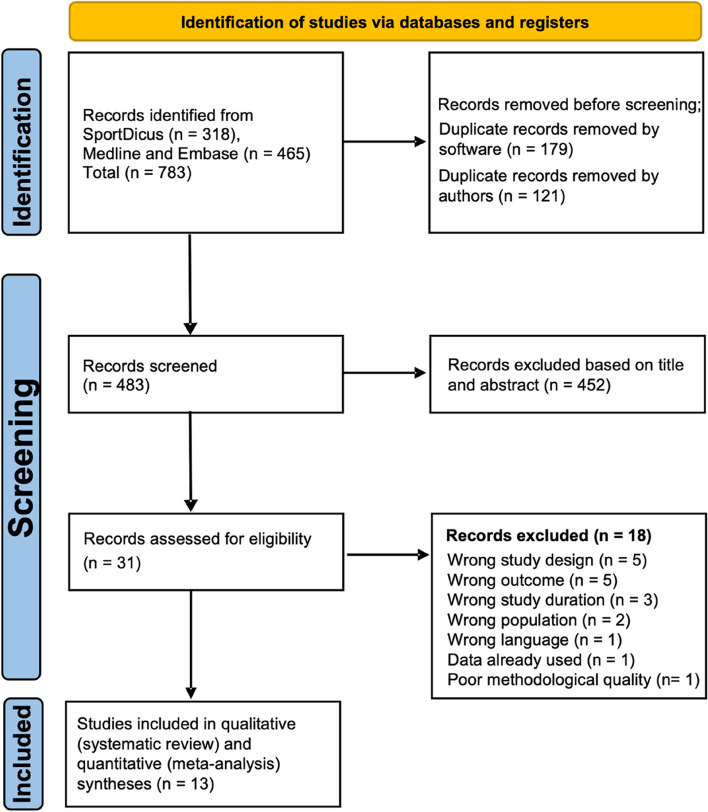
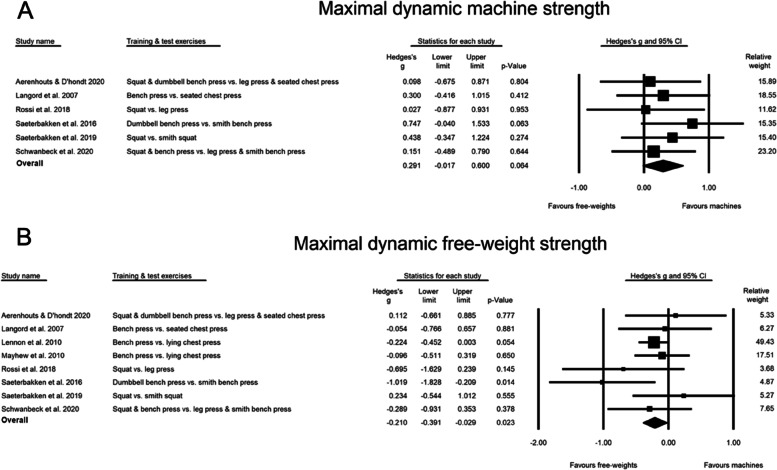
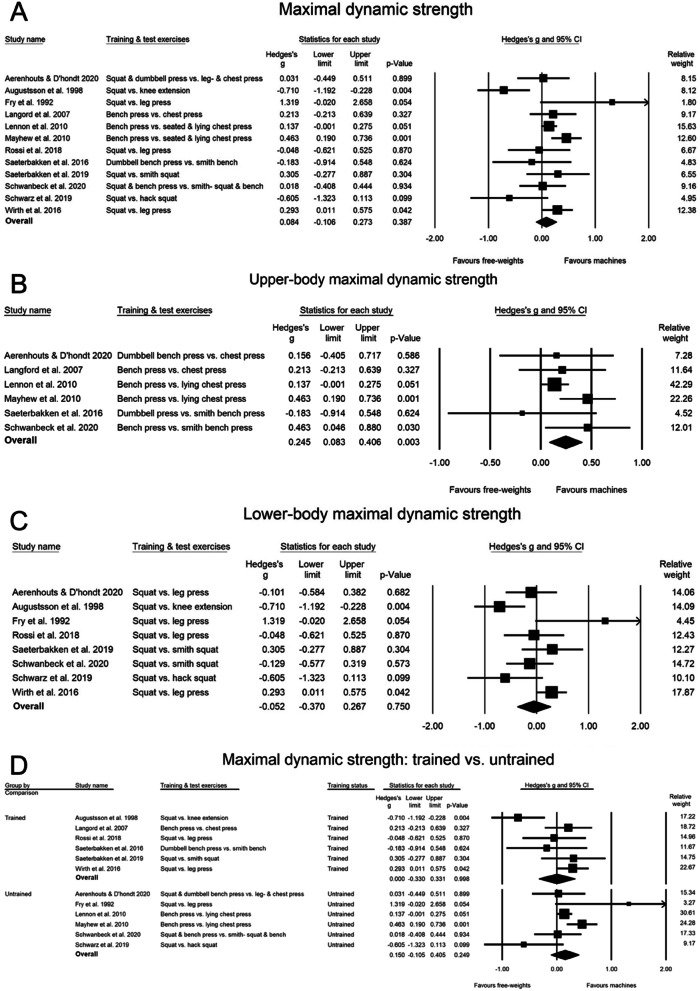
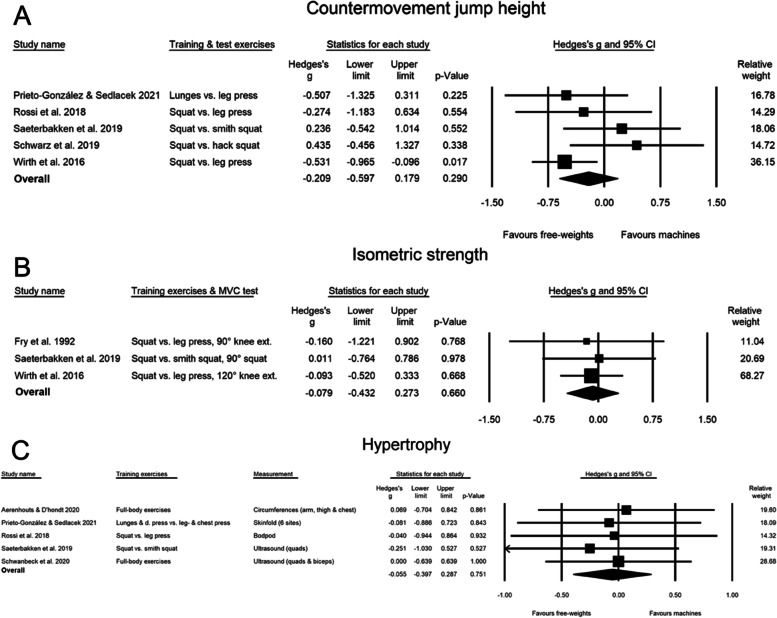
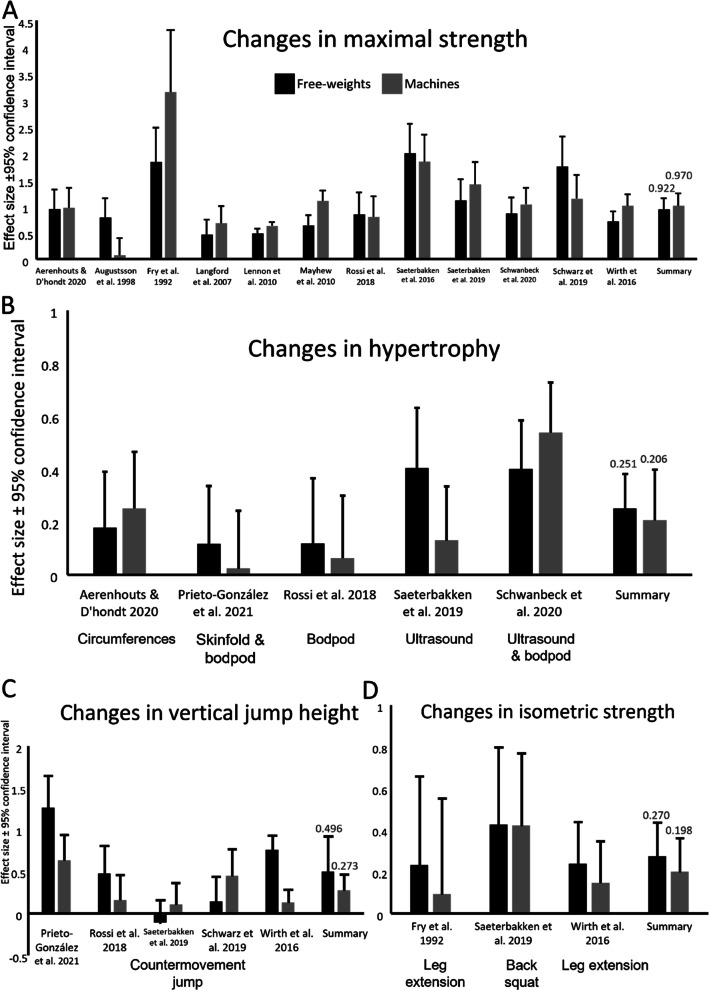
Background: The effectiveness of strength training with free-weight vs. machine equipment is heavily debated. Thus, the purpose of this meta-analysis was to summarize the data on the effect of free-weight versus machine-based strength training on maximal strength, jump height and hypertrophy. Methods: The review was conducted in accordance with the preferred reporting items for systematic reviews and meta-analyses (PRISMA) guidelines, and the systematic search of literature was conducted up to January 1 st, 2023. Studies that directly compared free-weight vs. machine-based strength training for a minimum of 6 weeks in adults (18–60 yrs.) were included. Results: Thirteen studies (outcomes: maximal strength [n = 12], jump performance [n = 5], muscle hypertrophy [n = 5]) with a total sample of 1016 participants (789 men, 219 women) were included. Strength in free-weight tests increased significantly more with free-weight training than with machines (SMD: -0.210, CI: -0.391, -0.029,p = 0.023), while strength in machine-based tests tended to increase more with machine training than with free-weights (SMD: 0.291, CI: -0.017, 0.600,p = 0.064). However, no differences were found between modalities in direct comparison (free-weight strength vs. machine strength) for dynamic strength (SMD: 0.084, CI: -0.106, 0.273,p = 0.387), isometric strength (SMD: -0.079, CI: -0.432, 0.273,p = 0.660), countermovement jump (SMD: -0.209, CI: -0.597, 0.179,p = 0.290) and hypertrophy (SMD: -0.055, CI: -0.397, 0.287,p = 0.751). Conclusion: No differences were detected in the direct comparison of strength, jump performance and muscle hypertrophy. Current body of evidence indicates that strength changes are specific to the training modality, and the choice between free-weights and machines are down to individual preferences and goals.
Overview
The claims and statistics of this paper haven’t been checked yet.
Free: it reads the open-access text and checks the first 5 claims that cite a source we can check. Create a free account to check every claim.
Integrity signals
Registry
Cites
Statistics
Figures
Verification
Claims the paper makes
The claims and statistics of this paper haven’t been checked yet.
Free: it reads the open-access text and checks the first 5 claims that cite a source we can check. Create a free account to check every claim.
Claims other papers make about this one
Each is checked against this paper’s own text: does it say what the citing paper says it does?
The cited source says what the claim attributes to it.
In the citing paper
“There were insufficient data to determine if jumping performance was affected by load (81), eccentric flywheel RT versus standard RT (85), or machine versus free-weight RT (100).”
Self-check
Percentages, sums and reported differences re-computed from the paper’s own numbers.
The self-check needs the paper’s full text.
Citations
Cites
The PRISMA 2020 statement: An updated guideline for reporting systematic reviews
Page, M. J., McKenzie, J. E., Bossuyt, P. M., Boutron, I., Hoffmann, T. C., Mulrow, C. D., Shamseer, L., Tetzlaff, J. M., Akl, E. A., Brennan, S. E., et al. (2021) · BMJ · doi:10.1136/bmj.n71 · Cited by 108,283
The Measurement of Observer Agreement for Categorical Data
Landis, J. R., & Koch, G. G. (1977) · Biometrics · doi:10.2307/2529310 · Cited by 81,148 · cited 1×
“00]: very good [33] Measurements of agreement”
Cochrane Handbook for Systematic Reviews of Interventions: Cochrane Book Series
(2008) · doi:10.1002/9780470712184 · Cited by 25,048
Cochrane Handbook for Systematic Reviews of Interventions
(2019) · doi:10.1002/9781119536604 · Cited by 14,828
Borenstein, M., Hedges, L. V., Higgins, J. P. T., & Rothstein, H. R. (2009) · doi:10.1002/9780470743386 · Cited by 14,225 · cited 1×
“Forest plots were generated with random effects modeling to present test statistics as standardized mean differences (SMD) from the continuous values expressed as Hedges’g to adjust for possible small sample bias [41].”
MethodCumpston, M., Li, T., Page, M. J., Chandler, J., Welch, V. A., Higgins, J. P., & Thomas, J. (2019) · Cochrane Database of Systematic Reviews · doi:10.1002/14651858.ed000142 · Cited by 7,218
The Handbook of Research Synthesis and Meta-Analysis
(2019) · doi:10.7758/9781610448864 · Cited by 4,553 · cited 1×
“Thus, the SMDs from the pre-post within group analysis was used as a standardized value and a subsequent single SMD estimate “synthetic effect-size” was calculated where SMDs machine were subtracted with SMDs free-weight and the variance from the two initial pre-post analysis were merged [43].”
MethodAmerican College of Sports Medicine position stand
Otis, C. L. (1997) · Medical Entomology and Zoology · Cited by 4,407
Progression Models in Resistance Training for Healthy Adults
(2009) · Medicine & Science in Sports & Exercise · doi:10.1249/mss.0b013e3181915670 · Cited by 4,332 · cited 8×
“American College of Sports Medicine argue that machines may be safer to use than free-weights based on skill requirements [1].”
BackgroundMethodInfluentialThe co-ordination and regulation of movements
Foley, J. (1968) · Journal of the Neurological Sciences · doi:10.1016/0022-510x(68)90166-4 · Cited by 3,420
Research works printed but not linked: 4
- Haff GG Roundtable Discussion: Machines Versus Free Weights Strength Cond J 2000 22 18 30
- Lennon E Mathis E Ratermann A Comparison of Strength Changes Following Resistance Training Using Free Weights and Machine Weights Mo J Health, Physical Education, Recreation and Dance 2010 20 29 35
- Cohen J. Statistical Power Analysis for the Behavioral Sciences. 2nd Ed. Routledge; 1988.
- Lander JE Bates BT Sawhill JA Hmill J A comparison between free-weight and isokinetic bench pressing Med Sci Sports Exerc. 1985 17 344???353 4021780
Cited by
CURRIER, B. S., D’SOUZA, A. C., SINGH, M. A. F., LOWISZ, C. V., RAWSON, E. S., SCHOENFELD, B. J., SMITH-RYAN, A. E., STEEN, J. P., THOMAS, G. A., TRIPLETT, N. T., et al. (2026) · Medicine & Science in Sports & Exercise · doi:10.1249/mss.0000000000003897 · Cited by 105
Sæterbakken, A. H., Stien, N., Paulsen, G., Behm, D. G., Andersen, V. S., Solstad, T. E. J., & Prieske, O. (2025) · Sports Medicine · doi:10.1007/s40279-025-02225-2 · Cited by 30
“…that dynamic RT exercises (e.g., squats with free weights) are more dependent on neuromuscular adaptations, muscle coordination, and stability requirement owing to their complexity, rather than the muscle cross-sectional area, which has been associated with greater isometric strength [43–45].”
Čurović, I. (2025) · Frontiers in Physiology · doi:10.3389/fphys.2025.1549609 · Cited by 26
Loturco, I., Zabaloy, S., Pereira, L. A., Moura, T. B. M. A., Mercer, V. P., Fernandes, V. M. C., Zając, A., Matusiński, A., Freitas, T. T., & Bishop, C. J. (2024) · Journal of Human Kinetics · doi:10.5114/jhk/182888 · Cited by 17
Ioannidou, P., Dóró, Z., Schalla, J., Wätjen, W., Diel, P. R., & Isenmann, E. (2024) · The journal of nutrition health & aging · doi:10.1016/j.jnha.2024.100349 · Cited by 18
“Free weight exercises are close to functional and everyday movements and can effectively simulate applied scientific principles [12].”
Metadata
- Authors
- Haugen, M. E., Vårvik, F. T., Larsen, S., Haugen, A. S., van den Tillaar, R., & Bjørnsen, T.
- Affiliations
- Nord University (NO)
- University of Agder (NO)
- OsloMet – Oslo Metropolitan University (NO)
- Corresponding author
- Haugen, Markus E.
- Venue
- BMC Sports Science, Medicine and Rehabilitation
- Published
- 2023-08-15
- Volume
- 15
- Issue
- 1
- Pages
- 103-103
- ISSN
- 2052-1847 (ISSN-L)
- PMC
- PMC10426227
- OpenAlex
- W4385836537
- Semantic Scholar
- 6c1c3c6cdf627bf6f4a5f1b7eeef228295c3acd0
- Cited by
- 32
- References
- 66
- Citations by year
- 2026: 10 · 2025: 15 · 2024: 7
- FWCI
- 1.77
- Type
- journal article
- Language
- en
- Open access
- gold
- doi.org
- Licence
- cc-by
- creativecommons.org/licenses/by/4.0 (tdm)
- creativecommons.org/licenses/by/4.0 (vor)
- Locations
- BMC Sports Science Medicine and Rehabilitation (publishedVersion, cc-by)
- PubMed Central (publishedVersion, cc-by)
- PubMed (publishedVersion)
- NORA - Norwegian Open Research Archives (submittedVersion, cc-by)
- DOAJ (DOAJ: Directory of Open Access Journals) (submittedVersion, cc-by-sa)
- Topics
- Health Sciences › Medicine › Orthopedics and Sports Medicine › Sports Performance and Training
- Health Sciences › Medicine › Physiology (medical) › Cardiovascular and exercise physiology
- Health Sciences › Health Professions › Physical Therapy, Sports Therapy and Rehabilitation › Physical Education and Training Studies
- Keywords
- free weight training, maximal strength, muscle hypertrophy, jump performance, countermovement jump, dynamic strength, isometric strength, resistance training
About these checks
Registry, retraction, Cites and statistics results are computed, not judged, with one exception: a printed reference that no index lists is read once by a model before it counts as a citation error. Claims are extracted by a model and kept only when their quote appears verbatim in the text; each cited source is then checked, with a model’s help, for whether it says what the claim relies on. Those verdicts can be wrong — read the claim’s quote and the cited source before relying on one.
Statistics and arithmetic are recomputed, not judged.
Confidence bands are shown only for fields calibrated on our annotated test set. None is calibrated yet, so no band is shown.
What counts as a claim ›How we measure confidence ›How we check this ›
Are you an author, or do you see a problem with this page? Request a review
Data sources
Bibliographic data: Semantic Scholar, OpenAlex, Crossref.
Contains information from the Semantic Scholar Academic Graph Datasets, made available under the ODC Attribution License (ODC-BY 1.0).
Semantic Scholar’s data is described in: Kinney, R., et al. (2023). The Semantic Scholar Open Data Platform. arXiv:2301.10140.
