

Effect of free-weight vs. machine-based strength training on maximal strength, hypertrophy and jump performance—a systematic review and meta-analysis.
Open accessThe DOI matches its Crossref record; 67 of the 67 references it cites were found in a registry or an index.
Abstract
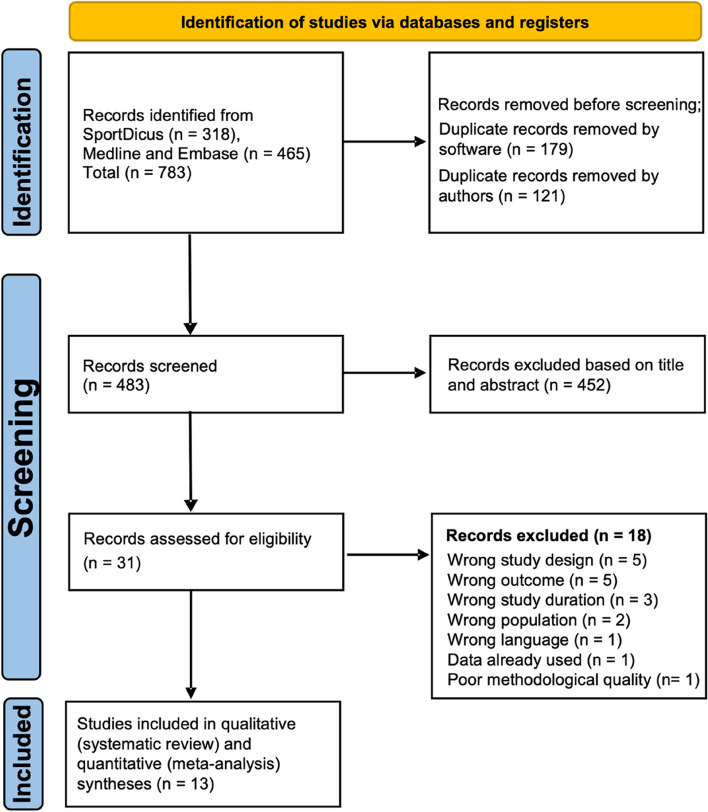
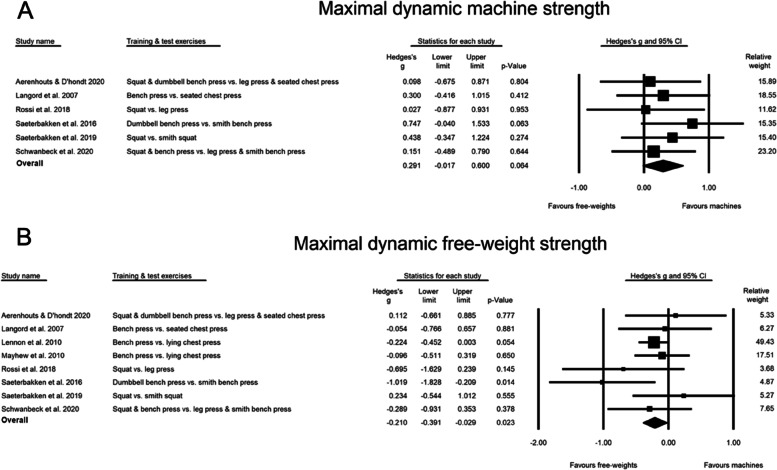
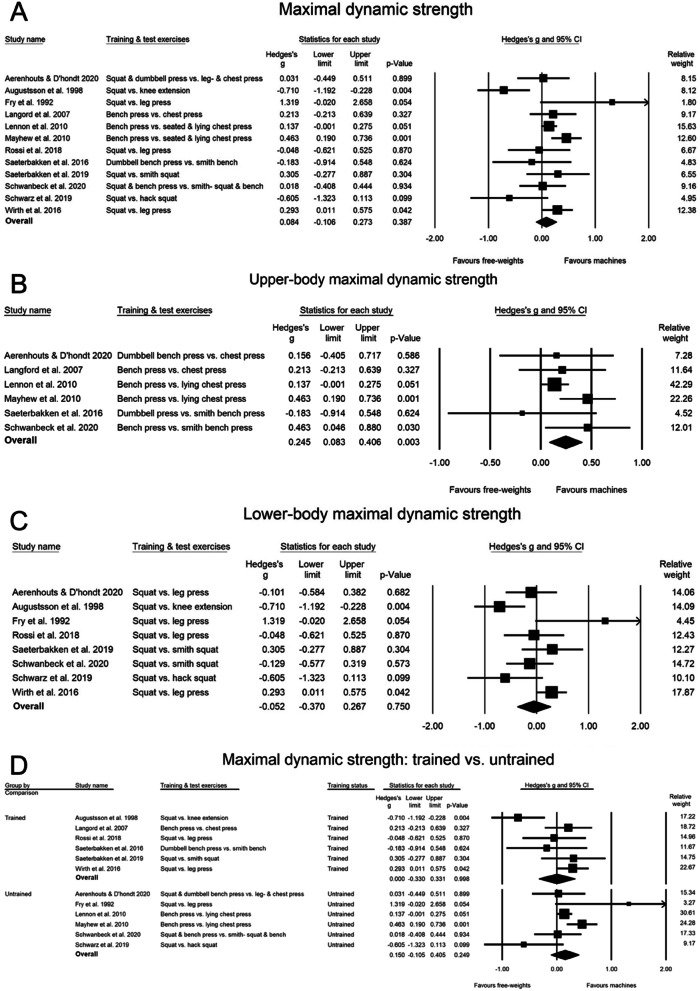
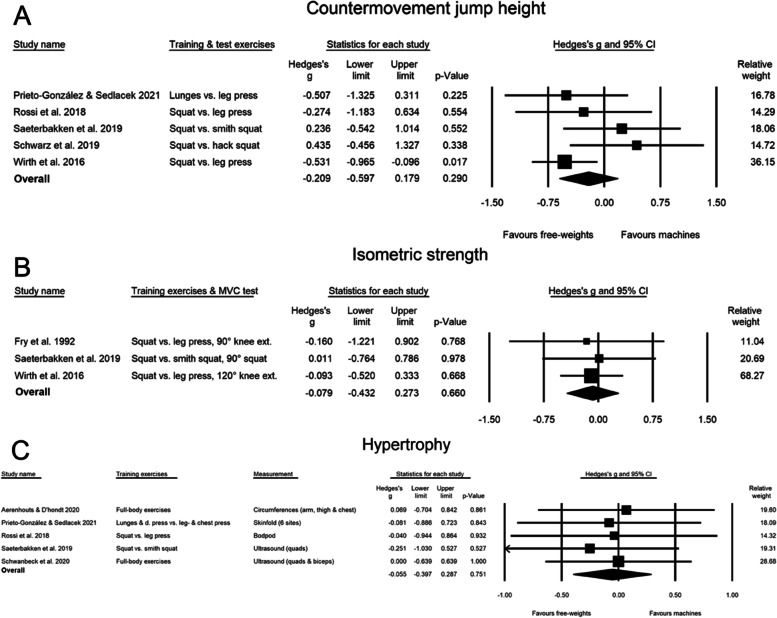
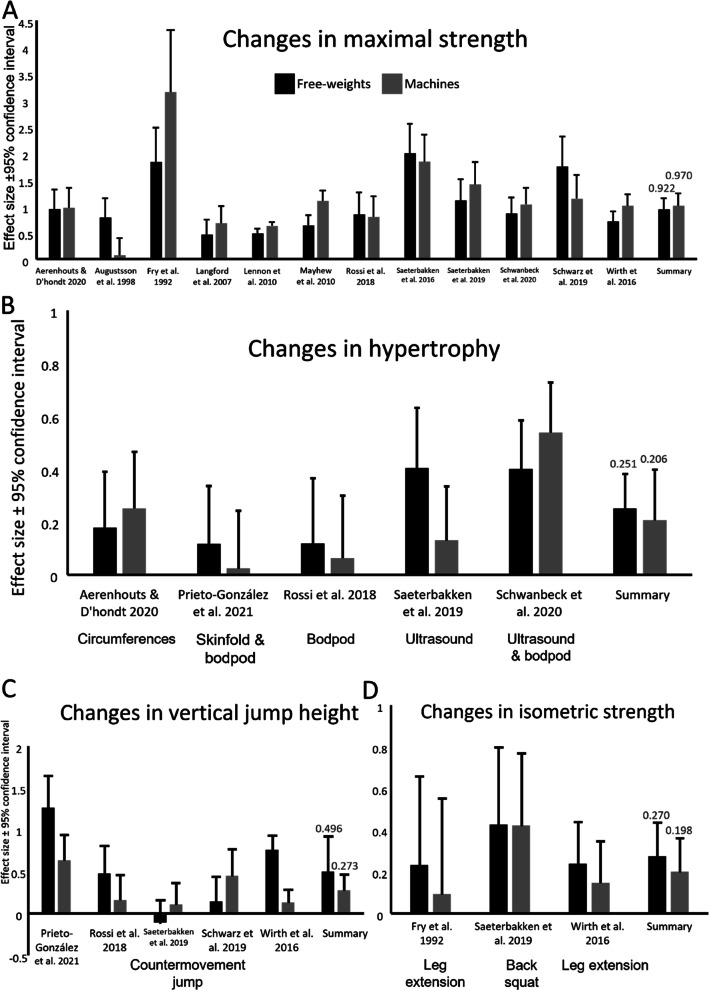
Background: The effectiveness of strength training with free-weight vs. machine equipment is heavily debated. Thus, the purpose of this meta-analysis was to summarize the data on the effect of free-weight versus machine-based strength training on maximal strength, jump height and hypertrophy. Methods: The review was conducted in accordance with the preferred reporting items for systematic reviews and meta-analyses (PRISMA) guidelines, and the systematic search of literature was conducted up to January 1 st, 2023. Studies that directly compared free-weight vs. machine-based strength training for a minimum of 6 weeks in adults (18–60 yrs.) were included. Results: Thirteen studies (outcomes: maximal strength [n = 12], jump performance [n = 5], muscle hypertrophy [n = 5]) with a total sample of 1016 participants (789 men, 219 women) were included. Strength in free-weight tests increased significantly more with free-weight training than with machines (SMD: -0.210, CI: -0.391, -0.029,p = 0.023), while strength in machine-based tests tended to increase more with machine training than with free-weights (SMD: 0.291, CI: -0.017, 0.600,p = 0.064). However, no differences were found between modalities in direct comparison (free-weight strength vs. machine strength) for dynamic strength (SMD: 0.084, CI: -0.106, 0.273,p = 0.387), isometric strength (SMD: -0.079, CI: -0.432, 0.273,p = 0.660), countermovement jump (SMD: -0.209, CI: -0.597, 0.179,p = 0.290) and hypertrophy (SMD: -0.055, CI: -0.397, 0.287,p = 0.751). Conclusion: No differences were detected in the direct comparison of strength, jump performance and muscle hypertrophy. Current body of evidence indicates that strength changes are specific to the training modality, and the choice between free-weights and machines are down to individual preferences and goals.
Overview
The claims and statistics of this paper haven’t been checked yet.
Free: it reads the open-access text and checks the first 5 claims that cite a source we can check. Create a free account to check every claim.
Integrity signals
Registry
Cites
Statistics
Figures
Verification
Claims the paper makes
The claims and statistics of this paper haven’t been checked yet.
Free: it reads the open-access text and checks the first 5 claims that cite a source we can check. Create a free account to check every claim.
Claims other papers make about this one
Each is checked against this paper’s own text: does it say what the citing paper says it does?
The cited source says what the claim attributes to it.
In the citing paper
“There were insufficient data to determine if jumping performance was affected by load (81), eccentric flywheel RT versus standard RT (85), or machine versus free-weight RT (100).”
Self-check
Percentages, sums and reported differences re-computed from the paper’s own numbers.
The self-check needs the paper’s full text.
Citations
Cites
The PRISMA 2020 statement: An updated guideline for reporting systematic reviews
Page, M. J., McKenzie, J. E., Bossuyt, P. M., Boutron, I., Hoffmann, T. C., Mulrow, C. D., Shamseer, L., Tetzlaff, J. M., Akl, E. A., Brennan, S. E., et al. (2021) · BMJ · doi:10.1136/bmj.n71 · Cited by 108,283
The Measurement of Observer Agreement for Categorical Data
Landis, J. R., & Koch, G. G. (1977) · Biometrics · doi:10.2307/2529310 · Cited by 81,148 · cited 1×
“00]: very good [33] Measurements of agreement”
Cochrane Handbook for Systematic Reviews of Interventions: Cochrane Book Series
(2008) · doi:10.1002/9780470712184 · Cited by 25,048
Cochrane Handbook for Systematic Reviews of Interventions
(2019) · doi:10.1002/9781119536604 · Cited by 14,828
Borenstein, M., Hedges, L. V., Higgins, J. P. T., & Rothstein, H. R. (2009) · doi:10.1002/9780470743386 · Cited by 14,225 · cited 1×
“Forest plots were generated with random effects modeling to present test statistics as standardized mean differences (SMD) from the continuous values expressed as Hedges’g to adjust for possible small sample bias [41].”
MethodCumpston, M., Li, T., Page, M. J., Chandler, J., Welch, V. A., Higgins, J. P., & Thomas, J. (2019) · Cochrane Database of Systematic Reviews · doi:10.1002/14651858.ed000142 · Cited by 7,218
The Handbook of Research Synthesis and Meta-Analysis
(2019) · doi:10.7758/9781610448864 · Cited by 4,553 · cited 1×
“Thus, the SMDs from the pre-post within group analysis was used as a standardized value and a subsequent single SMD estimate “synthetic effect-size” was calculated where SMDs machine were subtracted with SMDs free-weight and the variance from the two initial pre-post analysis were merged [43].”
MethodAmerican College of Sports Medicine position stand
Otis, C. L. (1997) · Medical Entomology and Zoology · Cited by 4,407
Progression Models in Resistance Training for Healthy Adults
(2009) · Medicine & Science in Sports & Exercise · doi:10.1249/mss.0b013e3181915670 · Cited by 4,332 · cited 8×
“American College of Sports Medicine argue that machines may be safer to use than free-weights based on skill requirements [1].”
BackgroundMethodInfluentialThe co-ordination and regulation of movements
Foley, J. (1968) · Journal of the Neurological Sciences · doi:10.1016/0022-510x(68)90166-4 · Cited by 3,420
The mechanisms of muscle hypertrophy and their application to resistance training
Schoenfeld, B. J. (2010) · Journal of Strength and Conditioning Research · doi:10.1519/jsc.0b013e3181e840f3 · Cited by 1,214 · cited 1×
“The higher load in the machine-based exercise could possibly affect strength gains beneficially after a period of training through load dependant mechanisms such as mechanical tension and neural adaptations [20], However, it will likely not lead to more muscle growth as varying load ranges seems to affect hypertrophy…”
BackgroundSchoenfeld, B. J., Grgic, J., Ogborn, D., & Krieger, J. W. (2017) · Journal of Strength and Conditioning Research · doi:10.1519/jsc.0000000000002200 · Cited by 851 · cited 2×
“The higher load in the machine-based exercise could possibly affect strength gains beneficially after a period of training through load dependant mechanisms such as mechanical tension and neural adaptations [20], However, it will likely not lead to more muscle growth as varying load ranges seems to affect hypertrophy…”
BackgroundSchoenfeld, B. J., Ogborn, D., & Krieger, J. W. (2017) · Journal of Sports Sciences · doi:10.1080/02640414.2016.1210197 · Cited by 671 · cited 1×
“This paper in combination with summary on range of motion [60–62], resting intervals [64, 65], exercise order [31], volume [66], intensity as proximity to failure [67] and different loading schemes [22, 68] and frequency [69], could provide great insight to the literature as a whole.”
BackgroundResistance exercise load does not determine training-mediated hypertrophic gains in young men
Mitchell, C. J., Churchward-Venne, T. A., West, D. W. D., Burd, N. A., Breen, L., Baker, S. K., & Phillips, S. M. (2012) · Journal of Applied Physiology · doi:10.1152/japplphysiol.00307.2012 · Cited by 627 · cited 1×
“For example, Mitchell and colleagues [53] found that 30% and 80% of one-repetition maximum (1 RM) knee extensions elicit similar muscle growth.”
BackgroundVigotsky, A. D., Halperin, I., Lehman, G. J., Trajano, G. S., & Vieira, T. M. (2018) · Frontiers in Physiology · doi:10.3389/fphys.2017.00985 · Cited by 503
Smart, N. A., Waldron, M., Ismail, H., Giallauria, F., Vigorito, C., Cornelissen, V., & Dieberg, G. (2015) · International Journal of Evidence-Based Healthcare · doi:10.1097/xeb.0000000000000020 · Cited by 499 · cited 3×
“In case of uncertainty, no points were awarded [30].”
BackgroundMethodInfluentialThe role of learning and coordination in strength training
Rutherford, O. M., & Jones, D. A. (1986) · European Journal of Applied Physiology and Occupational Physiology · doi:10.1007/bf00422902 · Cited by 477 · cited 1×
“This could imply that less degrees of freedom could yield the best results, but a study by Rutherford & Jones found the largest relative increase in leg extension for the group who had the most degrees of freedom [47].”
ResultMorton, R. W., Oikawa, S. Y., Wavell, C. G., Mazara, N., McGlory, C., Quadrilatero, J., Baechler, B. L., Baker, S. K., & Phillips, S. M. (2016) · Journal of Applied Physiology · doi:10.1152/japplphysiol.00154.2016 · Cited by 404 · cited 1×
“Importantly, muscle growth seems to be similar even with large variations in load (> 30% of 1RM) if it is performed in proximity to failure [52].”
BackgroundWilk, K. E., Escamilla, R. F., Fleisig, G. S., Barrentine, S. W., Andrews, J. R., & Boyd, M. L. (1996) · The American Journal of Sports Medicine · doi:10.1177/036354659602400418 · Cited by 370
Schoenfeld, B. J., Grgic, J., Van Every, D. W., & Plotkin, D. L. (2021) · Sports · doi:10.3390/sports9020032 · Cited by 334 · cited 1×
“…beneficially after a period of training through load dependant mechanisms such as mechanical tension and neural adaptations [20], However, it will likely not lead to more muscle growth as varying load ranges seems to affect hypertrophy similarly if training is performed close to failure [21, 22].”
BackgroundThe effectiveness of resistance training using unstable surfaces and devices for rehabilitation.
Behm, D. G., & Colado, J. C. (2012) · Repository of Digital Objects for Teaching Research and Culture (University of Valencia) · Cited by 331
Schoenfeld, B. J., Ogborn, D., & Krieger, J. W. (2016) · Sports Medicine · doi:10.1007/s40279-016-0543-8 · Cited by 308 · cited 1×
“This paper in combination with summary on range of motion [60–62], resting intervals [64, 65], exercise order [31], volume [66], intensity as proximity to failure [67] and different loading schemes [22, 68] and frequency [69], could provide great insight to the literature as a whole.”
BackgroundTrunk Muscle Activity Increases With Unstable Squat Movements
Anderson, K., & Behm, D. G. (2005) · Canadian Journal of Applied Physiology · doi:10.1139/h05-103 · Cited by 267 · cited 2×
“A possible explanation is that it seems that the muscles prioritize stability over force production in the direction of the desired exercise movement [18, 19].”
BackgroundTHE ROLE OF INSTABILITY WITH RESISTANCE TRAINING
BEHM, D. G., & ANDERSON, K. G. (2006) · Journal of Strength and Conditioning Research · doi:10.1519/00124278-200608000-00039 · Cited by 245 · cited 1×
“In line with increased demands for stability, the brain starts to focus more on stability at the expense of force production [18, 48].”
BackgroundOranchuk, D. J., Storey, A. G., Nelson, A. R., & Cronin, J. B. (2019) · Scandinavian Journal of Medicine & Science in Sports · doi:10.1111/sms.13375 · Cited by 210 · cited 2×
“This paper in combination with summary on range of motion [60–62], resting intervals [64, 65], exercise order [31], volume [66], intensity as proximity to failure [67] and different loading schemes [22, 68] and frequency [69], could provide great insight to the literature as a whole.”
BackgroundGrgic, J., Schoenfeld, B. J., Orazem, J., & Sabol, F. (2022) · Journal of Sport and Health Science · doi:10.1016/j.jshs.2021.01.007 · Cited by 206
Grgić, J., Schoenfeld, B. J., Skrepnik, M., Davies, T. B., & Mikulić, P. (2017) · Sports Medicine · doi:10.1007/s40279-017-0788-x · Cited by 190 · cited 1×
“This paper in combination with summary on range of motion [60–62], resting intervals [64, 65], exercise order [31], volume [66], intensity as proximity to failure [67] and different loading schemes [22, 68] and frequency [69], could provide great insight to the literature as a whole.”
BackgroundA Comparison of Free Weight Squat to Smith Machine Squat Using Electromyography
Schwanbeck, S., Chilibeck, P. D., & Binsted, G. (2009) · Journal of Strength and Conditioning Research · doi:10.1519/jsc.0b013e3181b1b181 · Cited by 188 · cited 4×
“In addition, the two ultrasound measurements of biceps and quadriceps by Schwanbeck et al. were pooled into one SMD estimate.”
BackgroundResultInfluentialEffects of squat training with different depths on lower limb muscle volumes
Kubo, K., Ikebukuro, T., & Yata, H. (2019) · European Journal of Applied Physiology · doi:10.1007/s00421-019-04181-y · Cited by 183 · cited 2×
“For example, the barbell back squat does not seem to induce hypertrophy of the rectus femoris muscle [55–57].”
BackgroundInhomogeneous architectural changes of the quadriceps femoris induced by resistance training
Ema, R., Wakahara, T., Miyamoto, N., Kanehisa, H., & Kawakami, Y. (2013) · European Journal of Applied Physiology · doi:10.1007/s00421-013-2700-1 · Cited by 170 · cited 1×
“In contrast, leg extension seems to induce robust hypertrophy in the rectus femoris [58, 63].”
BackgroundEvidence-Based Resistance Training Recommendations
Fisher, J., Steele, J., Bruce-Low, S., & Smith, D. (2011) · Medicina Sportiva · doi:10.2478/v10036-011-0025-x · Cited by 156 · cited 2×
“However, Fisher [9] and ACSM [1] mainly refer to injury risk in cross-sectional studies, and only a few longitudinal experimental studies, making it questionable if a causal relationship exists between modalities/stability and injury risk.”
BackgroundMethodKerr, Z. Y., Collins, C. L., & Dawn Comstock, R. (2010) · The American Journal of Sports Medicine · doi:10.1177/0363546509351560 · Cited by 145 · cited 2×
“This is further supported by Kerr [8] who reported a higher injury rate with free-weights, but most of the injuries were related to weights falling on people, and not the execution of the modality [8].”
BackgroundResultCOTTERMAN, M. L., DARBY, L. A., & SKELLY, W. A. (2005) · Journal of Strength and Conditioning Research · doi:10.1519/00124278-200502000-00029 · Cited by 144 · cited 1×
“For example, some researchers have shown that more loads can be lifted with a Smith machine squat compared to a freeweight squat [14, 17].”
BackgroundPracticing the Test Produces Strength Equivalent to Higher Volume Training
MATTOCKS, K. T., BUCKNER, S. L., JESSEE, M. B., DANKEL, S. J., MOUSER, J. G., & LOENNEKE, J. P. (2017) · Medicine & Science in Sports & Exercise · doi:10.1249/mss.0000000000001300 · Cited by 137 · cited 1×
“This follows the “specific adaptations to imposed demands” (SAID) principle [45].”
BackgroundSchoenfeld, B. J., & Grgić, J. (2020) · SAGE Open Medicine · doi:10.1177/2050312120901559 · Cited by 126 · cited 2×
“This paper in combination with summary on range of motion [60–62], resting intervals [64, 65], exercise order [31], volume [66], intensity as proximity to failure [67] and different loading schemes [22, 68] and frequency [69], could provide great insight to the literature as a whole.”
BackgroundGrgic, J., Lazinica, B., Mikulic, P., Krieger, J. W., & Schoenfeld, B. J. (2017) · European Journal of Sport Science · doi:10.1080/17461391.2017.1340524 · Cited by 125 · cited 1×
“This paper in combination with summary on range of motion [60–62], resting intervals [64, 65], exercise order [31], volume [66], intensity as proximity to failure [67] and different loading schemes [22, 68] and frequency [69], could provide great insight to the literature as a whole.”
BackgroundAugustsson, J., Esko, A., Thomeé, R., & Svantesson, U. (1998) · Journal of Orthopaedic & Sports Physical Therapy · doi:10.2519/jospt.1998.27.1.3 · Cited by 122
Iversen, V. M., Norum, M., Schoenfeld, B. J., & Fimland, M. S. (2021) · Sports Medicine · doi:10.1007/s40279-021-01490-1 · Cited by 122 · cited 1×
“Therefore, free-weight exercises are often suggested to be more “functional” than machine-based exercises [1] with a better transfer to improvements in daily physical function [11].”
BackgroundA comparison between free-weight and isokinetic bench pressing
LANDER, J. E., BATES, B. T., SAWHILL, J. A., & HAMILL, J. (1985) · Medicine & Science in Sports & Exercise · doi:10.1249/00005768-198506000-00008 · Cited by 116 · cited 1×
“Based on studies showing more myoelectrical activity in synergist muscles with free-weight exercises than machine-based strength training [6, 14, 51], one could speculate that free-weights could lead to more total muscle growth due to an increased activation of the synergists.”
BackgroundMuscle Force Output and Electromyographic Activity in Squats With Various Unstable Surfaces
Saeterbakken, A. H., & Fimland, M. S. (2013) · Journal of Strength and Conditioning Research · doi:10.1519/jsc.0b013e3182541d43 · Cited by 101 · cited 1×
“Free-weight exercises demand greater coordination between muscles to execute the exercises properly due to higher instability of the movement [7, 10], and the movements are often more similar to daily life activities than machine-based exercises.”
BackgroundClassification and Determination Model of Resistance Training Status
Santos Junior, E. R. T., de Salles, B. F., Dias, I., Ribeiro, A. S., Simão, R., & Willardson, J. M. (2021) · Strength & Conditioning Journal · doi:10.1519/ssc.0000000000000627 · Cited by 100 · cited 2×
“Classification of training status To classify participants as “experienced resistance trained”, we used free-weight strength data from Santos Junior [29] where the threshold was set from their advanced training status estimate.”
BackgroundMethodInhomogeneous Quadriceps Femoris Hypertrophy in Response to Strength and Power Training
EARP, J. E., NEWTON, R. U., CORMIE, P., & BLAZEVICH, A. J. (2015) · Medicine & Science in Sports & Exercise · doi:10.1249/mss.0000000000000669 · Cited by 96 · cited 2×
“Moreover, Earp [56] saw a significant increase in all parts of the vastus lateralis muscle whereas Zabaleta-Korta [63] did not reach a significant increase in the vastus lateralis for the leg extension group.”
BackgroundChanges in Exercises Are More Effective Than in Loading Schemes to Improve Muscle Strength
Fonseca, R. M., Roschel, H., Tricoli, V., de Souza, E. O., Wilson, J. M., Laurentino, G. C., Aihara, A. Y., de Souza Leão, A. R., & Ugrinowitsch, C. (2014) · Journal of Strength and Conditioning Research · doi:10.1519/jsc.0000000000000539 · Cited by 88 · cited 1×
“For example, the barbell back squat does not seem to induce hypertrophy of the rectus femoris muscle [55–57].”
BackgroundNunes, J. P., Grgic, J., Cunha, P. M., Ribeiro, A. S., Schoenfeld, B. J., de Salles, B. F., & Cyrino, E. S. (2021) · European Journal of Sport Science · doi:10.1080/17461391.2020.1733672 · Cited by 86 · cited 2×
“This paper in combination with summary on range of motion [60–62], resting intervals [64, 65], exercise order [31], volume [66], intensity as proximity to failure [67] and different loading schemes [22, 68] and frequency [69], could provide great insight to the literature as a whole.”
BackgroundAn Overview of Strength Training Injuries: Acute and Chronic
Lavallee, M. E., & Balam, T. (2010) · Current Sports Medicine Reports · doi:10.1249/jsr.0b013e3181f3ed6d · Cited by 82 · cited 3×
“Furthermore, as mentioned by ACSM [1], Lav-allee & Balam [25] and Fisher [9], training experience could influence the outcome but is yet to be explored.”
BackgroundMethodPallarés, J. G., Hernández‐Belmonte, A., Martínez‐Cava, A., Vetrovsky, T., Steffl, M., & Courel‐Ibáñez, J. (2021) · Scandinavian Journal of Medicine & Science in Sports · doi:10.1111/sms.14006 · Cited by 80
Vigotsky, A. D., Halperin, I., Trajano, G. S., & Vieira, T. (2022) · Sports Medicine · doi:10.1007/s40279-021-01619-2 · Cited by 70 · cited 1×
“However, the relationship between acute myoelectrical activity and long-term musculoskeletal hypertrophy is uncertain [15, 16], and the higher myoelectrical activity may also be due to greater stability demands.”
BackgroundSchwanbeck, S. R., Cornish, S. M., Barss, T., & Chilibeck, P. D. (2020) · Journal of Strength and Conditioning Research · doi:10.1519/jsc.0000000000003349 · Cited by 64 · cited 8×
“The aforementioned meta-analysis included three studies [4, 37, 38], but we included two more studies [23, 24].”
MethodResultInfluentialWirth, K., Keiner, M., Hartmann, H., Sander, A., & Mickel, C. (2016) · Journal of Human Kinetics · doi:10.1515/hukin-2016-0023 · Cited by 61 · cited 5×
“Five studies were rated as fair quality [12, 24, 34, 35, 40].”
BackgroundMethodInfluentialStrength, body composition, and functional outcomes in the squat versus leg press exercises
Rossi, F. E., Schoenfeld, B. J., Ocetnik, S., Young, J. S., Vigotsky, A. D., Contreras, B. M., Krieger, J. W., Miller, M. G., & Cholewa, J. M. (2018) · The Journal of Sports Medicine and Physical Fitness · doi:10.23736/s0022-4707.16.06698-6 · Cited by 49 · cited 7×
“The aforementioned meta-analysis included three studies [4, 37, 38], but we included two more studies [23, 24].”
BackgroundMethodResultInfluentialGrgic, J. (2020) · Journal of Human Kinetics · doi:10.2478/hukin-2020-0013 · Cited by 45 · cited 1×
“This paper in combination with summary on range of motion [60–62], resting intervals [64, 65], exercise order [31], volume [66], intensity as proximity to failure [67] and different loading schemes [22, 68] and frequency [69], could provide great insight to the literature as a whole.”
BackgroundThe role of exercise selection in regional Muscle Hypertrophy: A randomized controlled trial
Zabaleta-Korta, A., Fernández-Peña, E., Torres‐Unda, J., Garbisu-Hualde, A., & Santos‐Concejero, J. (2021) · Journal of Sports Sciences · doi:10.1080/02640414.2021.1929736 · Cited by 45 · cited 3×
“Moreover, Earp [56] saw a significant increase in all parts of the vastus lateralis muscle whereas Zabaleta-Korta [63] did not reach a significant increase in the vastus lateralis for the leg extension group.”
BackgroundUsing Machines or Free Weights for Resistance Training in Novice Males? A Randomized Parallel Trial
Aerenhouts, D., & D’Hondt, E. (2020) · International Journal of Environmental Research and Public Health · doi:10.3390/ijerph17217848 · Cited by 38 · cited 10×
“Other lower-body exercise comparisons were excluded [23, 32, 34].”
BackgroundMethodResultInfluentialThe short- and long-term effects of resistance training with different stability requirements
Sæterbakken, A. H., Olsen, A., Behm, D. G., Bårdstu, H. B., & Andersen, V. S. (2019) · PLoS ONE · doi:10.1371/journal.pone.0214302 · Cited by 38 · cited 10×
“Variation of the true effect size was presented with 95% In addition, given that the analyses require pre-post correlation coefficients (r), we used the open dataset in one of the included studies Saeterbakken [4] and applied the calculated r in all analyses.”
BackgroundMethodResultInfluentialHEIDEL, K. A., NOVAK, Z. J., & Dankel, S. J. (2021) · The Journal of Sports Medicine and Physical Fitness · doi:10.23736/s0022-4707.21.12929-9 · Cited by 33 · cited 4×
“To provide greater understanding of the differences between free-weights and machine-based strength training, Heidel and colleagues performed a meta-analysis in which they pooled studies comparing the two modalities [5].”
BackgroundMethodResultInfluentialCosta, B. D. D. V., Kassiano, W., Nunes, J. P., Kunevaliki, G., Castro-e-Souza, P., Rodacki, A. L. F., Cyrino, L. T., Cyrino, E. S., & Fortes, L. D. S. (2021) · International Journal of Sports Medicine · doi:10.1055/a-1308-3674 · Cited by 31
Resistance-training exercises with different stability requirements: time course of task specificity
Sæterbakken, A. H., Andersen, V. S., Behm, D. G., Krohn-Hansen, E. K., Smaamo, M., & Fimland, M. S. (2016) · European Journal of Applied Physiology · doi:10.1007/s00421-016-3470-3 · Cited by 29 · cited 7×
“For the studies from Saeterbakken [27] and Augustsson [32], there were a few minor disagreements on the Tes-tex quality assessment of items 1, 4 and 6.”
BackgroundMethodResultInfluentialLANGFORD, G. A., McCurdy, K. W., Ernest, J. M., Doscher, M., & Walters, S. D. (2007) · The Journal of Strength and Conditioning Research · doi:10.1519/r-21446.1 · Cited by 24 · cited 7×
“Five studies were rated as fair quality [12, 24, 34, 35, 40].”
BackgroundMethodInfluentialThe influence of improvement in one mental function upon the efficiency of other functions.
Woodworth, R. S. (2011) · Columbia University Press eBooks · doi:10.1037/13498-022 · Cited by 23
Kinematic and EMG Comparison Between Variations of Unilateral Squats Under Different Stabilities
van den Tillaar, R., & Larsen, S. (2020) · Sports Medicine International Open · doi:10.1055/a-1195-1039 · Cited by 17
Self-citationSchwarz, N. A., Harper, S., Waldhelm, A., McKinley-Barnard, S. K., Holden, S. L., & Kovaleski, J. E. (2019) · Sports · doi:10.3390/sports7100215 · Cited by 16 · cited 6×
“There was an even split between trained [4, 12, 27, 32, 37, 40] and untrained athletes [23, 34–36, 38, 39].”
BackgroundMethodResultInfluentialFry, A. C., Powell, D. R., & Kraemer, W. J. (1992) · Journal of Sport Rehabilitation · doi:10.1123/jsr.1.4.275 · Cited by 13 · cited 6×
“Other lower-body exercise comparisons were excluded [23, 32, 34].”
BackgroundMethodInfluentialLyons, S., McLester, J. R., Arnett, S. W., & Thoma, M. J. (2010) · The Journal of Strength and Conditioning Research · doi:10.1519/jsc.0b013e3181e726c6 · Cited by 12 · cited 1×
“The debate is whether one should perform resistance exercises with free-weights, which demands more stability and higher stability requirements, or machines with lower stability requirements which require less stabilization, to maximize long-term strength and hypertrophy [2, 3].”
BackgroundThe Kansas Squat Test Modality Comparison: Free Weights vs. Smith Machine
Luebbers, P. E., & Fry, A. C. (2016) · The Journal of Strength and Conditioning Research · doi:10.1519/jsc.0000000000001404 · Cited by 12 · cited 1×
“The debate is whether one should perform resistance exercises with free-weights, which demands more stability and higher stability requirements, or machines with lower stability requirements which require less stabilization, to maximize long-term strength and hypertrophy [2, 3].”
BackgroundPrieto-González, P., & Sedláček, J. (2021) · Apunts Educación Física y Deportes · doi:10.5672/apunts.2014-0983.es.(2021/3).145.02 · Cited by 9
The effects of ten weeks resistance training on sticking region in chest-press exercises
Sæterbakken, A. H., Andersen, V. S., van den Tillaar, R., Joly, F., Stien, N., Pedersen, H., Shaw, M. P., & Solstad, T. E. J. (2020) · PLoS ONE · doi:10.1371/journal.pone.0235555 · Cited by 8 · cited 2×
“…analysis would have adjusted the point estimate from significant to non-significant (SMD: -0.207 [CI: -0.490, 0.077], p = 0.153), and removal of each of the two studies by Saeterbakken et al. [4, 28] from the machine test analysis adjusted the Table 3 Quality assessment using the TESTEX checklist.”
MethodInfluentialMayhew, J. L., Smith‐Ryan, A. E., Arabas, J. L., & Roberts, B. S. (2010) · The Journal of Strength and Conditioning Research · doi:10.1519/jsc.0b013e3181e38233 · Cited by 6 · cited 5×
“There was an even split between trained [4, 12, 27, 32, 37, 40] and untrained athletes [23, 34–36, 38, 39].”
BackgroundMethodInfluential
Research works printed but not linked: 4
- Haff GG Roundtable Discussion: Machines Versus Free Weights Strength Cond J 2000 22 18 30
- Lennon E Mathis E Ratermann A Comparison of Strength Changes Following Resistance Training Using Free Weights and Machine Weights Mo J Health, Physical Education, Recreation and Dance 2010 20 29 35
- Cohen J. Statistical Power Analysis for the Behavioral Sciences. 2nd Ed. Routledge; 1988.
- Lander JE Bates BT Sawhill JA Hmill J A comparison between free-weight and isokinetic bench pressing Med Sci Sports Exerc. 1985 17 344???353 4021780
Cited by
CURRIER, B. S., D’SOUZA, A. C., SINGH, M. A. F., LOWISZ, C. V., RAWSON, E. S., SCHOENFELD, B. J., SMITH-RYAN, A. E., STEEN, J. P., THOMAS, G. A., TRIPLETT, N. T., et al. (2026) · Medicine & Science in Sports & Exercise · doi:10.1249/mss.0000000000003897 · Cited by 105
Sæterbakken, A. H., Stien, N., Paulsen, G., Behm, D. G., Andersen, V. S., Solstad, T. E. J., & Prieske, O. (2025) · Sports Medicine · doi:10.1007/s40279-025-02225-2 · Cited by 30
“…that dynamic RT exercises (e.g., squats with free weights) are more dependent on neuromuscular adaptations, muscle coordination, and stability requirement owing to their complexity, rather than the muscle cross-sectional area, which has been associated with greater isometric strength [43–45].”
Čurović, I. (2025) · Frontiers in Physiology · doi:10.3389/fphys.2025.1549609 · Cited by 26
Loturco, I., Zabaloy, S., Pereira, L. A., Moura, T. B. M. A., Mercer, V. P., Fernandes, V. M. C., Zając, A., Matusiński, A., Freitas, T. T., & Bishop, C. J. (2024) · Journal of Human Kinetics · doi:10.5114/jhk/182888 · Cited by 17
Ioannidou, P., Dóró, Z., Schalla, J., Wätjen, W., Diel, P. R., & Isenmann, E. (2024) · The journal of nutrition health & aging · doi:10.1016/j.jnha.2024.100349 · Cited by 18
“Free weight exercises are close to functional and everyday movements and can effectively simulate applied scientific principles [12].”
Metadata
- Authors
- Haugen, M. E., Vårvik, F. T., Larsen, S., Haugen, A. S., van den Tillaar, R., & Bjørnsen, T.
- Affiliations
- Nord University (NO)
- University of Agder (NO)
- OsloMet – Oslo Metropolitan University (NO)
- Corresponding author
- Haugen, Markus E.
- Venue
- BMC Sports Science, Medicine and Rehabilitation
- Published
- 2023-08-15
- Volume
- 15
- Issue
- 1
- Pages
- 103-103
- ISSN
- 2052-1847 (ISSN-L)
- PMC
- PMC10426227
- OpenAlex
- W4385836537
- Cited by
- 32
- References
- 66
- Citations by year
- 2026: 10 · 2025: 15 · 2024: 7
- FWCI
- 1.77
- Type
- journal article
- Language
- en
- Open access
- gold
- doi.org
- Licence
- cc-by
- creativecommons.org/licenses/by/4.0 (tdm)
- creativecommons.org/licenses/by/4.0 (vor)
- Locations
- BMC Sports Science Medicine and Rehabilitation (publishedVersion, cc-by)
- PubMed Central (publishedVersion, cc-by)
- PubMed (publishedVersion)
- NORA - Norwegian Open Research Archives (submittedVersion, cc-by)
- DOAJ (DOAJ: Directory of Open Access Journals) (submittedVersion, cc-by-sa)
- Topics
- Health Sciences › Medicine › Orthopedics and Sports Medicine › Sports Performance and Training
- Health Sciences › Medicine › Physiology (medical) › Cardiovascular and exercise physiology
- Health Sciences › Health Professions › Physical Therapy, Sports Therapy and Rehabilitation › Physical Education and Training Studies
- Keywords
- free weight training, maximal strength, muscle hypertrophy, jump performance, countermovement jump, dynamic strength, isometric strength, resistance training
About these checks
Registry, retraction, Cites and statistics results are computed, not judged, with one exception: a printed reference that no index lists is read once by a model before it counts as a citation error. Claims are extracted by a model and kept only when their quote appears verbatim in the text; each cited source is then checked, with a model’s help, for whether it says what the claim relies on. Those verdicts can be wrong — read the claim’s quote and the cited source before relying on one.
Statistics and arithmetic are recomputed, not judged.
Confidence bands are shown only for fields calibrated on our annotated test set. None is calibrated yet, so no band is shown.
What counts as a claim ›How we measure confidence ›How we check this ›
Are you an author, or do you see a problem with this page? Request a review
Data sources
Bibliographic data: Semantic Scholar, OpenAlex, Crossref.
Contains information from the Semantic Scholar Academic Graph Datasets, made available under the ODC Attribution License (ODC-BY 1.0).
Semantic Scholar’s data is described in: Kinney, R., et al. (2023). The Semantic Scholar Open Data Platform. arXiv:2301.10140.
