

Multiple imputation of multiple multi-item scales when a full imputation model is infeasible
Open accessThe DOI matches its Crossref record; 115 of the 115 references it cites were found in a registry or an index.
Abstract
BACKGROUND: Missing data in a large scale survey presents major challenges. We focus on performing multiple imputation by chained equations when data contain multiple incomplete multi-item scales. Recent authors have proposed imputing such data at the level of the individual item, but this can lead to infeasibly large imputation models. METHODS: We use data gathered from a large multinational survey, where analysis uses separate logistic regression models in each of nine country-specific data sets. In these data, applying multiple imputation by chained equations to the individual scale items is computationally infeasible. We propose an adaptation of multiple imputation by chained equations which imputes the individual scale items but reduces the number of variables in the imputation models by replacing most scale items with scale summary scores. We evaluate the feasibility of the proposed approach and compare it with a complete case analysis. We perform a simulation study to compare the proposed method with alternative approaches: we do this in a simplified setting to allow comparison with the full imputation model. RESULTS: For the case study, the proposed approach reduces the size of the prediction models from 134 predictors to a maximum of 72 and makes multiple imputation by chained equations computationally feasible. Distributions of imputed data are seen to be consistent with observed data. Results from the regression analysis with multiple imputation are similar to, but more precise than, results for complete case analysis; for the same regression models a 39% reduction in the standard error is observed. The simulation shows that our proposed method can perform comparably against the alternatives. CONCLUSIONS: By substantially reducing imputation model sizes, our adaptation makes multiple imputation feasible for large scale survey data with multiple multi-item scales. For the data considered, analysis of the multiply imputed data shows greater power and efficiency than complete case analysis. The adaptation of multiple imputation makes better use of available data and can yield substantively different results from simpler techniques.
Overview
The claims and statistics of this paper haven’t been checked yet.
Free: it reads the open-access text and checks the first 5 claims that cite a source we can check. Create a free account to check every claim.
Integrity signals
Registry
Cites
Statistics
Figures
Verification
Claims the paper makes
The claims and statistics of this paper haven’t been checked yet.
Free: it reads the open-access text and checks the first 5 claims that cite a source we can check. Create a free account to check every claim.
Claims other papers make about this one
Each is checked against this paper’s own text: does it say what the citing paper says it does?
The cited source says what the claim attributes to it.
In the citing paper
“Although we were fully aware that item-level imputation is often the preferred method, 45,55 a simplified approach using the subscale total for imputation has been suggested, 45 which we used.”
From Mindful attention is inversely associated with pain via mediation by psychological distress in orthopedic patients. (2024) · cites this paper as [45]
Self-check
Percentages, sums and reported differences re-computed from the paper’s own numbers.
The self-check needs the paper’s full text.
Citations
Cites
1 retracted
Retracted: Predictive Validity of a Medication Adherence Measure in an Outpatient Setting
Morisky, D. E., Ang, A., Krousel‐Wood, M., & Ward, H. J. (2008) · The Journal of Clinical Hypertension · doi:10.1111/j.1751-7176.2008.07572.x · Cited by 2,877
RetractedR: A Language and Environment for Statistical Computing
R Core Team (2025) · doi:10.32614/r.manuals · Cited by 352,181
Multiple Imputation for Nonresponse in Surveys
Rubin, D. B. (1987) · Wiley Series in Probability and Statistics · doi:10.1002/9780470316696 · Cited by 20,701
Multiple imputation using chained equations: Issues and guidance for practice
White, I. R., Royston, P., & Wood, A. M. (2011) · Statistics in Medicine · doi:10.1002/sim.4067 · Cited by 9,792 · cited 6×
“For this data set 26 % of response values were missing, so the number of imputations was set at M = 25, closely reflecting the suggestion of one imputation per percent missing data [1].”
BackgroundMethodSelf-citationSterne, J. A. C., White, I. R., Carlin, J. B., Spratt, M., Royston, P., Kenward, M. G., Wood, A. M., & Carpenter, J. R. (2009) · BMJ · doi:10.1136/bmj.b2393 · Cited by 7,299 · cited 1×
“Whilst many theoretical works suggest MI to be an appropriate method, it has only recently been widely applied in practice [9].”
Self-citationAn introduction to modern missing data analyses
Baraldi, A. N., & Enders, C. K. (2010) · Journal of School Psychology · doi:10.1016/j.jsp.2009.10.001 · Cited by 1,452 · cited 11×
“It is acknowledged that a gap still exists between techniques recommended by methodological literature and those employed in practice; traditional ad-hoc techniques such as deletion and single imputation techniques are still applied routinely [3, 5, 6].”
MethodInfluentialPeugh, J. L., & Enders, C. K. (2004) · Review of Educational Research · doi:10.3102/00346543074004525 · Cited by 1,112 · cited 2×
“Reviews on handling missing data across different fields indicate that it is relatively rare that missing data, and how it is handled, are reported explicitly: in cost-effectiveness analysis 22 % of studies did not explicitly report missing data [10]; in education the corresponding figure is 31 % [11]; in cohort studi…”
BackgroundMethodMissing-Data Adjustments in Large Surveys
Little, R. J. A. (1988) · Journal of Business & Economic Statistics · doi:10.1080/07350015.1988.10509663 · Cited by 1,101 · cited 1×
“Also, when the MCAR assumption does not hold, the data is no longer representative of the target population, compromising external generalisability [7].”
BackgroundMultiple Imputation of Missing Values: Update of Ice
Royston, P. (2005) · The Stata Journal: Promoting communications on statistics and Stata · doi:10.1177/1536867x0500500404 · Cited by 1,041
MISSING DATA: A CONCEPTUAL REVIEW FOR APPLIED PSYCHOLOGISTS
ROTH, P. L. (1994) · Personnel Psychology · doi:10.1111/j.1744-6570.1994.tb01736.x · Cited by 901 · cited 2×
“Roth, in 1994, stated that despite its importance, conspicuously little research on missing data analysis appeared within the social sciences literature [4].”
BackgroundMethodMultiple Imputation of Missing Values: Update
Royston, P. (2005) · The Stata Journal: Promoting communications on statistics and Stata · doi:10.1177/1536867x0500500204 · Cited by 754 · cited 2×
“MI was conducted using the -ice- routine in Stata 10 [19, 24, 25].”
A stroll through the worlds of animals and men: A picture book of invisible worlds
VON UEXKÜLL, J. (1992) · Semiotica · doi:10.1515/semi.1992.89.4.319 · Cited by 721
Yee, N., Bailenson, J. N., Urbanek, M., Chang, F., & Merget, D. (2007) · CyberPsychology & Behavior · doi:10.1089/cpb.2006.9984 · Cited by 681
The Importance of Timing in Segregated Theta Phase-Coupling for Cognitive Performance
Polanía, R., Nitsche, M. A., Korman, C., Batsikadze, G., & Paulus, W. (2012) · Current Biology · doi:10.1016/j.cub.2012.05.021 · Cited by 591
The use of multiple imputation for the analysis of missing data.
Sinharay, S., Stern, H. S., & Russell, D. (2001) · Psychological Methods · doi:10.1037/1082-989x.6.4.317 · Cited by 560 · cited 1×
“With complete outcome variables, MI is typically less computationally expensive than MLE, and MLE tends to be problem-specific with a different model being required for each analysis [8].”
MethodEquilibrium Theory Revisited: Mutual Gaze and Personal Space in Virtual Environments
Bailenson, J. N., Blascovich, J., Beall, A. C., & Loomis, J. M. (2001) · Presence: Teleoperators and Virtual Environments · doi:10.1162/105474601753272844 · Cited by 547
Wood, A. M., White, I. R., & Thompson, S. G. (2004) · Clinical Trials · doi:10.1191/1740774504cn032oa · Cited by 543 · cited 1×
“It is acknowledged that a gap still exists between techniques recommended by methodological literature and those employed in practice; traditional ad-hoc techniques such as deletion and single imputation techniques are still applied routinely [3, 5, 6].”
MethodSelf-citationEmotions Are Expressed More Intensely on the Left Side of the Face
Sackeim, H. A., Gur, R. C., & Saucy, M. C. (1978) · Science · doi:10.1126/science.705335 · Cited by 489
How should variable selection be performed with multiply imputed data?
Wood, A. M., White, I. R., & Royston, P. (2008) · Statistics in Medicine · doi:10.1002/sim.3177 · Cited by 485 · cited 1×
“We also compared variable selection using complete case data with variable selection procedure using Rubin’s rules in the pooled MI data, using unadjusted or ageadjusted analyses as described above [20, 26].”
MethodSelf-citationPersonal space regulation by the human amygdala
Kennedy, D. P., Gläscher, J., Tyszka, J. M., & Adolphs, R. (2009) · Nature Neuroscience · doi:10.1038/nn.2381 · Cited by 450
Royston, P. (2009) · The Stata Journal: Promoting communications on statistics and Stata · doi:10.1177/1536867x0900900308 · Cited by 428 · cited 2×
“MI was conducted using the -ice- routine in Stata 10 [19, 24, 25].”
MethodHandling missing data in RCTs; a review of the top medical journals
Bell, M. L., Fiero, M., Horton, N. J., & Hsu, C.-H. (2014) · BMC Medical Research Methodology · doi:10.1186/1471-2288-14-118 · Cited by 395 · cited 1×
“Of these articles, 45 % performed complete case analysis, 27 % performed simple imputation (linear interpolation, worst case imputation or last observation carried forward) and only 8 % used multiple imputation [14].”
BackgroundNöth, W. (1990) · Indiana University Press eBooks · doi:10.2307/j.ctv14npk46 · Cited by 377
Selfie posting behaviors are associated with narcissism among men.
Sorokowski, P., Sorokowska, A., Oleszkiewicz, A., Frackowiak, T., Huk, A., & Pisanski, K. (2015) · Personality and Individual Differences · doi:10.1016/j.paid.2015.05.004 · Cited by 376
Why we post selfies: Understanding motivations for posting pictures of oneself
Sung, Y., Lee, J.-A., Kim, E., & Choi, S. M. (2016) · Personality and Individual Differences · doi:10.1016/j.paid.2016.03.032 · Cited by 312
Eekhout, I., de Vet, H. C. W., Twisk, J. W. R., Brand, J. P. L., de Boer, M. R., & Heymans, M. W. (2014) · Journal of Clinical Epidemiology · doi:10.1016/j.jclinepi.2013.09.009 · Cited by 302 · cited 2×
“This result is consistent with a previous study on multiitem imputation, where mean imputation and single imputation were shown to have larger bias and worse coverage than item level multiple imputation, and complete case analysis was shown to overestimate standard error and reduce power [16].”
MethodResultRhythmic Fluctuations in Evidence Accumulation during Decision Making in the Human Brain
Wyart, V., de Gardelle, V., Scholl, J., & Summerfield, C. (2012) · Neuron · doi:10.1016/j.neuron.2012.09.015 · Cited by 278
Do age and gender differences exist in selfie-related behaviours?
Dhir, A., Pallesen, S., Torsheim, T., & Andreassen, C. S. (2016) · Computers in Human Behavior · doi:10.1016/j.chb.2016.05.053 · Cited by 270
Polanía, R., Krajbich, I., Grueschow, M., & Ruff, C. C. (2014) · Neuron · doi:10.1016/j.neuron.2014.03.014 · Cited by 265
#Me: narcissism and its facets as predictors of selfie-posting frequency.
Weiser, E. B. (2015) · Personality and Individual Differences · doi:10.1016/j.paid.2015.07.007 · Cited by 258
Face-ism: Five studies of sex differences in facial prominence.
Archer, D., Iritani, B., Kimes, D. D., & Barrios, M. (1983) · Journal of Personality and Social Psychology · doi:10.1037/0022-3514.45.4.725 · Cited by 257
Missing Data: A Systematic Review of How They Are Reported and Handled
Eekhout, I., de Boer, R. M., Twisk, J. W. R., de Vet, H. C. W., & Heymans, M. W. (2012) · Epidemiology · doi:10.1097/ede.0b013e3182576cdb · Cited by 235
Avoiding bias due to perfect prediction in multiple imputation of incomplete categorical variables
White, I. R., Daniel, R., & Royston, P. (2010) · Computational Statistics & Data Analysis · doi:10.1016/j.csda.2010.04.005 · Cited by 231 · cited 1×
“Sparsity may cause nonconvergence errors during multinomial logistic regression, a recognised problem [1, 18].”
BackgroundSelf-citationWhat does your selfie say about you?
Qiu, L., Lu, J., Yang, S., Qu, W., & Zhu, T. (2015) · Computers in Human Behavior · doi:10.1016/j.chb.2015.06.032 · Cited by 229
Caruana, F., Jezzini, A., Sbriscia-Fioretti, B., Rizzolatti, G., & Gallese, V. (2011) · Current Biology · doi:10.1016/j.cub.2010.12.042 · Cited by 204
MCMANUS, I. C., & HUMPHREY, N. K. (1973) · Nature · doi:10.1038/243271a0 · Cited by 204
Eitivipart, A. C., Viriyarojanakul, S., & Redhead, L. (2018) · Hong Kong Physiotherapy Journal · doi:10.1142/s1013702518300010 · Cited by 198
Karahalios, A., Baglietto, L., Carlin, J. B., English, D. R., & Simpson, J. A. (2012) · BMC Medical Research Methodology · doi:10.1186/1471-2288-12-96 · Cited by 194
Blaker, N. M., Rompa, I., Dessing, I. H., Vriend, A. F., Herschberg, C., & van Vugt, M. (2013) · Group Processes & Intergroup Relations · doi:10.1177/1368430212437211 · Cited by 176
Selfies and personality: Who posts self-portrait photographs?
Sorokowska, A., Oleszkiewicz, A., Frackowiak, T., Pisanski, K., Chmiel, A., & Sorokowski, P. (2016) · Personality and Individual Differences · doi:10.1016/j.paid.2015.10.037 · Cited by 169
Personal space invasions in the lavatory: Suggestive evidence for arousal.
Middlemist, R. D., Knowles, E. S., & Matter, C. F. (1976) · Journal of Personality and Social Psychology · doi:10.1037//0022-3514.33.5.541 · Cited by 168
Handling “Don't Know” Survey Responses: The Case of the Slovenian Plebiscite
Rubin, D. B., Stern, H. S., & Vehovar, V. (1995) · Journal of the American Statistical Association · doi:10.1080/01621459.1995.10476580 · Cited by 160 · cited 1×
“conclude that whilst assuming MAR may be inadequate if there are high levels of missingness or insufficient relevant covariates, “the evidence seems to be that at least in some carefully designed survey contexts, modelling observed data under MAR can provide acceptable answers” [27].”
BackgroundDiefenbach, S., & Christoforakos, L. (2017) · Frontiers in Psychology · doi:10.3389/fpsyg.2017.00007 · Cited by 152
Selfies: Why We Love (and Hate) Them
Tiidenberg, K. (2018) · Emerald Group Publishing Limited eBooks · doi:10.1108/9781787543577 · Cited by 141
Pawlowski, B. (2003) · Proceedings of the Royal Society of London. Series B: Biological Sciences · doi:10.1098/rspb.2002.2294 · Cited by 140
Bodily Communication Dimensions of Expression and Content
Allwood, J. S. (2002) · Text, speech and language technology · doi:10.1007/978-94-017-2367-1_2 · Cited by 137
Selfies beyond self-representation: the (theoretical) f(r)ictions of a practice
Cruz, E. G., & Thornham, H. (2015) · Journal of AESTHETICS & CULTURE · doi:10.3402/jac.v7.28073 · Cited by 136
Laterality of expression in portraiture: putting your best cheek forward
Nicholls, M. E. R., Clode, D., Wood, S. J., & WOOD, A. G. (1999) · Proceedings of the Royal Society B Biological Sciences · doi:10.1098/rspb.1999.0809 · Cited by 131
MATE CHOICE AND HUMAN STATURE: HOMOGAMY AS A UNIFIED FRAMEWORK FOR UNDERSTANDING MATING PREFERENCES
Courtiol, A., Raymond, M., Godelle, B., & Ferdy, J.-B. (2010) · Evolution · doi:10.1111/j.1558-5646.2010.00985.x · Cited by 116
Self in Art/Self As Art: Museum Selfies As Identity Work
Kozinets, R. V., Gretzel, U., & Dinhopl, A. (2017) · Frontiers in Psychology · doi:10.3389/fpsyg.2017.00731 · Cited by 113
Morrison, V. L., Holmes, E. A. F., Parveen, S., Plumpton, C., Clyne, W., Geest, S. D., Dobbels, F., Vrijens, B., Kardas, P., & Hughes, D. A. (2015) · Value in Health · doi:10.1016/j.jval.2014.12.013 · Cited by 112
Self-citationHide-and-Seek: Narcissism and “Selfie”-Related Behavior
Lee, J.-A., & Sung, Y. (2016) · Cyberpsychology, Behavior, and Social Networking · doi:10.1089/cyber.2015.0486 · Cited by 112
BODY HEIGHT AND ROMANTIC ATTRACTION: A META-ANALYTIC TEST OF THE MALE-TALLER NORM
Pierce, C. A. (1996) · Social Behavior and Personality: an international journal · doi:10.2224/sbp.1996.24.2.143 · Cited by 105
Simons, C., Rivero‐Arias, O., Yu, L., & Simon, J. (2014) · Quality of Life Research · doi:10.1007/s11136-014-0837-y · Cited by 102 · cited 1×
“A recent study considered imputing at item level rather than imputing scale totals [15].”
BackgroundClassifying the narrated #selfie: genre typing human-branding activity
Eagar, T., & Dann, S. (2016) · European Journal of Marketing · doi:10.1108/ejm-07-2015-0509 · Cited by 102
The selfie as a global discourse
Veum, A., & Undrum, L. V. M. (2017) · Discourse & Society · doi:10.1177/0957926517725979 · Cited by 89
SIMULATION‐BASED ASSESSMENT OF MANAGERIAL COMPETENCE: RELIABILITY AND VALIDITY
STREUFERT, S., POGASH, R., & PIASECKI, M. (1988) · Personnel Psychology · doi:10.1111/j.1744-6570.1988.tb00643.x · Cited by 87
Missing data in trial‐based cost‐effectiveness analysis: the current state of play
Noble, S. M., Hollingworth, W., & Tilling, K. (2012) · Health Economics · doi:10.1002/hec.1693 · Cited by 82 · cited 1×
“Reviews on handling missing data across different fields indicate that it is relatively rare that missing data, and how it is handled, are reported explicitly: in cost-effectiveness analysis 22 % of studies did not explicitly report missing data [10]; in education the corresponding figure is 31 % [11]; in cohort studi…”
BackgroundUnderstanding the selfie phenomenon: current insights and future research directions
Lim, W. M. (2016) · European Journal of Marketing · doi:10.1108/ejm-07-2015-0484 · Cited by 79
Fink, B., Neave, N., Brewer, G., & Pawłowski, B. (2007) · Personality and Individual Differences · doi:10.1016/j.paid.2007.07.014 · Cited by 78
Fernandes-Taylor, S., Hyun, J. K., Reeder, R. N., & Harris, A. H. (2011) · BMC Research Notes · doi:10.1186/1756-0500-4-304 · Cited by 75 · cited 1×
“Poor handling and reporting of missing data may result in misleading conclusions and are one of the main reasons for publication rejections [28, 29].”
BackgroundWomen want taller men more than men want shorter women
Stulp, G., Buunk, A. P., & Pollet, T. V. (2013) · Personality and Individual Differences · doi:10.1016/j.paid.2012.12.019 · Cited by 75
Krämer, N. C., Feurstein, M., Kluck, J. P., Meier, Y., Rother, M., & Winter, S. (2017) · Frontiers in Psychology · doi:10.3389/fpsyg.2017.00188 · Cited by 74
Etgar, S., & Amichai-Hamburger, Y. (2017) · Frontiers in Psychology · doi:10.3389/fpsyg.2017.00842 · Cited by 71
‘Selfies’ Reveal Systematic Deviations from Known Principles of Photographic Composition
Bruno, N., Gabriele, V., Tasso, T., & Bertamini, M. (2014) · Art & Perception · doi:10.1163/22134913-00002027 · Cited by 69
Do Online Privacy Concerns Predict Selfie Behavior among Adolescents, Young Adults and Adults?
Dhir, A., Torsheim, T., Pallesen, S., & Andreassen, C. S. (2017) · Frontiers in Psychology · doi:10.3389/fpsyg.2017.00815 · Cited by 69
Does Height Matter? An Examination of Height Preferences in Romantic Coupling
Yancey, G., & Emerson, M. O. (2014) · Journal of Family Issues · doi:10.1177/0192513x13519256 · Cited by 68
Asymmetrical facial expressions in portraits and hemispheric laterality: A literature review
Powell, W. R., & Schirillo, J. A. (2009) · Laterality Asymmetries of Body Brain and Cognition · doi:10.1080/13576500802680336 · Cited by 67
Gustafsson, E., Coenen, P., Campbell, A., & Straker, L. M. (2018) · Applied Ergonomics · doi:10.1016/j.apergo.2018.03.003 · Cited by 65
What's in a picture? The impact of face‐ism on trait attribution
Schwarz, N., & Kurz, E. (1989) · European Journal of Social Psychology · doi:10.1002/ejsp.2420190405 · Cited by 62
Personality correlates of physical height
Melamed, T. (1992) · Personality and Individual Differences · doi:10.1016/0191-8869(92)90179-s · Cited by 61
Presenting Your Best Self(ie): The Influence of Gender on Vertical Orientation of Selfies on Tinder
Sedgewick, J. R., Flath, M. E., & Elias, L. J. (2017) · Frontiers in Psychology · doi:10.3389/fpsyg.2017.00604 · Cited by 56
Selfies and the (Creative) Self: A Diary Study
Karwowski, M., & Brzeski, A. (2017) · Frontiers in Psychology · doi:10.3389/fpsyg.2017.00172 · Cited by 52
Bruno, N., Bertamini, M., & Protti, F. (2015) · PLoS ONE · doi:10.1371/journal.pone.0124999 · Cited by 47
Painters centre one eye in portraits
Tyler, C. W. (1998) · Nature · doi:10.1038/31833 · Cited by 46
A Facial-Action Imposter: How Head Tilt Influences Perceptions of Dominance From a Neutral Face
Witkower, Z., & Tracy, J. L. (2019) · Psychological Science · doi:10.1177/0956797619838762 · Cited by 46
Turning the Left Cheek Examined using Modern Photography
LaBar, M. (1973) · Nature · doi:10.1038/245338a0 · Cited by 44
Self-Portraits: Smartphones Reveal a Side Bias in Non-Artists
Bruno, N., & Bertamini, M. (2013) · PLoS ONE · doi:10.1371/journal.pone.0055141 · Cited by 39
Matthews, J. L. (2007) · Sex Roles · doi:10.1007/s11199-007-9276-3 · Cited by 37
Baiocco, R., Chirumbolo, A., Bianchi, D., Ioverno, S., Morelli, M., & Nappa, M. R. (2017) · Frontiers in Psychology · doi:10.3389/fpsyg.2016.02080 · Cited by 37
Face‐ism and primetime television
Copeland, G. A. (1989) · Journal of Broadcasting & Electronic Media · doi:10.1080/08838158909364075 · Cited by 35
On the meaning and implications of facial prominence
Zuckerman, M. (1986) · Journal of Nonverbal Behavior · doi:10.1007/bf00987481 · Cited by 33
What Is Seen Is Who You Are: Are Cues in Selfie Pictures Related to Personality Characteristics?
Musil, B., Preglej, A., Ropert, T., Klasinc, L., & Babić, N. Č. (2017) · Frontiers in Psychology · doi:10.3389/fpsyg.2017.00082 · Cited by 30
Cavalli-Sforza, L. L. (1986) · American Zoologist · doi:10.1093/icb/26.3.845 · Cited by 30
Face-Ism and Facial Expressions of Women in Magazine Photos
Dodd, D. K., Harcar, V., Foerch, B. J., & Anderson, H. T. (1989) · The Psychological Record · doi:10.1007/bf03395884 · Cited by 29
Harris, A. H. S., Reeder, R. N., & Hyun, J. K. (2011) · The Journal of Psychology · doi:10.1080/00223980.2011.555431 · Cited by 28 · cited 1×
“Poor handling and reporting of missing data may result in misleading conclusions and are one of the main reasons for publication rejections [28, 29].”
BackgroundInternational Faces: An Analysis of Self-Inflicted Face-ism in Online Profile Pictures
Smith, L. R., & Cooley, S. C. (2012) · Journal of Intercultural Communication Research · doi:10.1080/17475759.2012.728771 · Cited by 28
Carbon, C. (2017) · Frontiers in Psychology · doi:10.3389/fpsyg.2017.00245 · Cited by 28
Face-ism Effect and Head Canting in One's Own and Others' Photographs
Costa, M., & Bitti, P. E. R. (2000) · European Psychologist · doi:10.1027//1016-9040.5.4.293 · Cited by 27
Bruno, N., Bode, C., & Bertamini, M. (2016) · Laterality Asymmetries of Body Brain and Cognition · doi:10.1080/1357650x.2016.1185108 · Cited by 27
O’Neill, F., & Corner, S. P. (2016) · Journal of Optics · doi:10.1088/2040-8978/18/8/080401 · Cited by 26
Consistently Showing Your Best Side? Intra-individual Consistency in #Selfie Pose Orientation
Lindell, A. K. (2017) · Frontiers in Psychology · doi:10.3389/fpsyg.2017.00246 · Cited by 25
Selfie-Takers Prefer Left Cheeks: Converging Evidence from the (Extended) selfiecity Database
Манович, Л., Ferrari, V., & Bruno, N. (2017) · Frontiers in Psychology · doi:10.3389/fpsyg.2017.01460 · Cited by 25
Left cheek poses garner more likes: the effect of pose orientation on Instagram engagement
Lindell, A. K. (2018) · Laterality Asymmetries of Body Brain and Cognition · doi:10.1080/1357650x.2018.1556278 · Cited by 25
Prieler, M., & Kohlbacher, F. (2017) · Sex Roles · doi:10.1007/s11199-017-0745-z · Cited by 23
Schneider, T. M., & Carbon, C. (2017) · Frontiers in Psychology · doi:10.3389/fpsyg.2017.00971 · Cited by 23
Turning the Other Cheek: Profile Direction in Self-Portraiture
Latto, R. (1996) · Empirical Studies of the Arts · doi:10.2190/198m-911x-pr9g-u18e · Cited by 22
Reporting missing data: a study of selected articles published from 2003–2007
Rousseau, M., Simon, M., Bertrand, R., & Hachey, K. K. (2011) · Quality & Quantity · doi:10.1007/s11135-011-9452-y · Cited by 21 · cited 1×
“Reviews on handling missing data across different fields indicate that it is relatively rare that missing data, and how it is handled, are reported explicitly: in cost-effectiveness analysis 22 % of studies did not explicitly report missing data [10]; in education the corresponding figure is 31 % [11]; in cohort studi…”
BackgroundAttitude toward Selfie Taking and its Relation to Body Image and Narcissism in Medical Students
Dutta, E., Sharma, P., Shah, N., Bharati, A. S., Sonavane, S., & Desousa, A. (2018) · Indian Journal of Psychological Medicine · doi:10.4103/ijpsym.ijpsym_169_17 · Cited by 20
Warfield, K. (2017) · Media and Communication · doi:10.17645/mac.v5i4.1057 · Cited by 19
Editorial: Understanding Selfies
Bruno, N., Pisanski, K., Sorokowska, A., & Sorokowski, P. (2018) · Frontiers in Psychology · doi:10.3389/fpsyg.2018.00044 · Cited by 19
Comparison of two methods of eliciting time preference for future health states
Pol, M. M. V. D., & Cairns, J. (2008) · Social Science & Medicine · doi:10.1016/j.socscimed.2008.05.011 · Cited by 18 · cited 1×
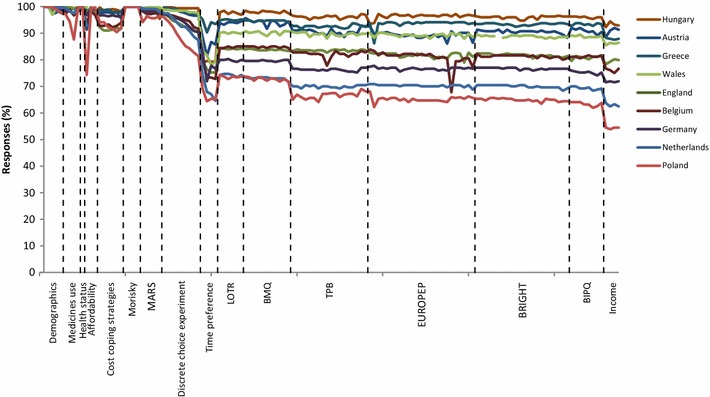
“A dip is seen at the open ended time preference measure, which may be perceived as cognitively challenging [23].”
BackgroundLindell, A. K. (2013) · Laterality Asymmetries of Body Brain and Cognition · doi:10.1080/1357650x.2012.673622 · Cited by 17
Proxemics Revisited: Similar Effects of Arms Length on Men's and Women's Personal Distances
Bruno, N., & Muzzolini, M. (2013) · Universal Journal of Psychology · doi:10.13189/ujp.2013.010204 · Cited by 17
Selfies reflect actual personality – Just like photos or short videos in standardized lab conditions
Kaurin, A., Heil, L. F., Wessa, M., Egloff, B., & Hirschmüller, S. (2018) · Journal of Research in Personality · doi:10.1016/j.jrp.2018.08.007 · Cited by 15
Changes in the Facial Prominence of Women and Men Over the Last Decade
Nigro, G. N., Hill, D. E., Gelbein, M. E., & Clark, C. L. (1988) · Psychology of Women Quarterly · doi:10.1111/j.1471-6402.1988.tb00938.x · Cited by 14
Motor biases do not influence posing orientation in selfies
Lindell, A. K. (2015) · Laterality Asymmetries of Body Brain and Cognition · doi:10.1080/1357650x.2015.1109649 · Cited by 13
Revealing faces: Gender and cultural differences in facial prominence of selfies
Babić, N. Č., Ropert, T., & Musil, B. (2018) · PLoS ONE · doi:10.1371/journal.pone.0205893 · Cited by 11
Where is Here? An Issue of Deictic Projection in Recorded Song
Moore, A. F. (2010) · Journal of the Royal Musical Association · doi:10.1080/02690401003597813 · Cited by 8
Eye centring in selfies posted on Instagram
Bruno, N., Bertamini, M., & Tyler, C. W. (2019) · PLoS ONE · doi:10.1371/journal.pone.0218663 · Cited by 8
Vahedi, Z., Mazlomi, A., Sharifnezhad, A., & Azam, K. (2019) · Iranian Journal of Ergonomics · doi:10.30699/jergon.6.4.58 · Cited by 7
‘Being on Trend’: Selfie as a Social Phenomenon
Орех, Е. А., & Богомягкова, Е. С. (2017) · International Journal for Digital Society · doi:10.20533/ijds.2040.2570.2017.0152 · Cited by 6
Face-ism and Objectification in Mainstream and LGBT Magazines
Cheek, N. N. (2016) · PLoS ONE · doi:10.1371/journal.pone.0153592 · Cited by 5
Kim, D., Chae, W.-S., Jung, J.-H., & Lee, H.-S. (2014) · Korean Journal of Sport Biomechanics · doi:10.5103/kjsb.2014.24.3.301 · Cited by 4
Face-ism as a Media Stereotype: A Case Study of the Newsweek Magazine 211
Hinner, M. B. (2016) · Peter Lang eBooks · doi:10.3726/978-3-653-01168-5/10 · Cited by 2
Research works printed but not linked: 1
- Wayman JC. Multiple imputation for missing data: What is it and how can I use it? In Proceedings of the Annual meeting of the American Educational Research Association Chicago, Il. 2003.
Cited by
Handling missing items in the Hospital Anxiety and Depression Scale (HADS): a simulation study
Bell, M. L., Fairclough, D. L., Fiero, M. H., & Butow, P. N. (2016) · BMC Research Notes · doi:10.1186/s13104-016-2284-z · Cited by 182
“Multiple imputation is an approach that has been investigated and found to have good properties [10, 11], although implementation for outcomes research can be challenging [10, 12], and it could not be used for most screening situations.”
Couper, K., Murrells, T., Sanders, J., Anderson, J. E., Blake, H., Kelly, D. M., Kent, B., Maben, J., Rafferty, A. M., Taylor, R. M., et al. (2021) · International Journal of Nursing Studies · doi:10.1016/j.ijnurstu.2021.104155 · Cited by 149
Betancourt, T. S., Thomson, D. L., Brennan, R. T., Antonaccio, C. M., Gilman, S. E., & VanderWeele, T. J. (2019) · Journal of the American Academy of Child & Adolescent Psychiatry · doi:10.1016/j.jaac.2019.05.026 · Cited by 107
Betancourt, T. S., Jensen, S. K. G., Barnhart, D. A., Brennan, R. T., Murray, S. M., Yousafzai, A. K., Farrar, J., Godfroid, K., Bazubagira, S. M., Rawlings, L. B., et al. (2020) · BMC Public Health · doi:10.1186/s12889-020-08693-7 · Cited by 95
“Following intention-totreat analysis, we used chained equation imputations in STATA to account for missing data [26].”
MethodBetancourt, T. S., Berent, J. M., Freeman, J. A., Frounfelker, R. L., Brennan, R. T., Abdi, S. M., Maalim, A., Abdi, A., Mishra, T., Gautam, B., et al. (2019) · Journal of Adolescent Health · doi:10.1016/j.jadohealth.2019.08.023 · Cited by 78
“We used a chained equations method in STATA 15 (StataCorp, College Station, TX) [36] to impute missing data [37] and generate 20 complete datasets for the 262 participants separately by community.”
Metadata
- Authors
- Plumpton, C. O., Morris, T., Hughes, D. A., & White, I. R.
- Affiliations
- Bangor University (GB)
- London School of Hygiene & Tropical Medicine (GB)
- MRC Biostatistics Unit (GB)
- Corresponding author
- Plumpton, Catrin O.
- Venue
- BMC Research Notes
- Published
- 2016-01-26
- Volume
- 9
- Issue
- 1
- Pages
- 45-45
- ISSN
- 1756-0500 (ISSN-L)
- PMC
- PMC4727289
- OpenAlex
- W2258617858
- Cited by
- 76
- References
- 28
- Citations by year
- 2026: 6 · 2025: 11 · 2024: 4 · 2023: 8 · 2022: 7 · 2021: 6 · 2020: 12 · 2019: 9 · 2018: 8 · 2017: 3 · 2016: 2
- FWCI
- 7.43
- Type
- journal article
- Language
- en
- Open access
- gold
- doi.org
- Licence
- cc-by
- Locations
- BMC Research Notes (publishedVersion, cc-by)
- PubMed Central (publishedVersion, cc-by)
- PubMed (publishedVersion)
- Bangor University Research Portal (Bangor University) (acceptedVersion)
- LSHTM Research Online (London School of Hygiene and Tropical Medicine) (acceptedVersion)
- UCL Discovery (University College London) (submittedVersion)
- Bangor University Research Portal (Bangor University) (submittedVersion, other-oa)
- Funders
- Seventh Framework Programme (FP7/2007-2013)
- Medical Research Council North-West Hub in Trials Methodology Research (G0800792)
- Medical Research Council (U105260558)
- Topics
- Physical Sciences › Mathematics › Statistics and Probability › Statistical Methods and Bayesian Inference
- Social Sciences › Sociology and Political Science › Survey Methodology and Nonresponse
- Physical Sciences › Mathematics › Statistics and Probability › Survey Sampling and Estimation Techniques
- Keywords
- multiple imputation by chained equations, multi-item scales, missing data, computational feasibility, complete case analysis, multinational survey
- MeSH terms
- Adult, Antihypertensive Agents, Computer Simulation, Data Interpretation, Statistical, Employment, Europe, Female, Humans, Hypertension, Health Knowledge, Attitudes, Practice, Male, Middle Aged, Patient Compliance, Surveys and Questionnaires, Sex Factors, Socioeconomic Factors, Multivariate Analysis, Logistic Models, Marital Status
About these checks
Registry, retraction, Cites and statistics results are computed, not judged, with one exception: a printed reference that no index lists is read once by a model before it counts as a citation error. Claims are extracted by a model and kept only when their quote appears verbatim in the text; each cited source is then checked, with a model’s help, for whether it says what the claim relies on. Those verdicts can be wrong — read the claim’s quote and the cited source before relying on one.
Statistics and arithmetic are recomputed, not judged.
Confidence bands are shown only for fields calibrated on our annotated test set. None is calibrated yet, so no band is shown.
What counts as a claim ›How we measure confidence ›How we check this ›
Are you an author, or do you see a problem with this page? Request a review
Data sources
Bibliographic data: Semantic Scholar, OpenAlex, Crossref.
Contains information from the Semantic Scholar Academic Graph Datasets, made available under the ODC Attribution License (ODC-BY 1.0).
Semantic Scholar’s data is described in: Kinney, R., et al. (2023). The Semantic Scholar Open Data Platform. arXiv:2301.10140.
