

Older patients are still under-represented in clinical trials of Alzheimer's disease
Open accessThe DOI matches its Crossref record; 33 of the 33 references it cites were found in a registry or an index.
Abstract
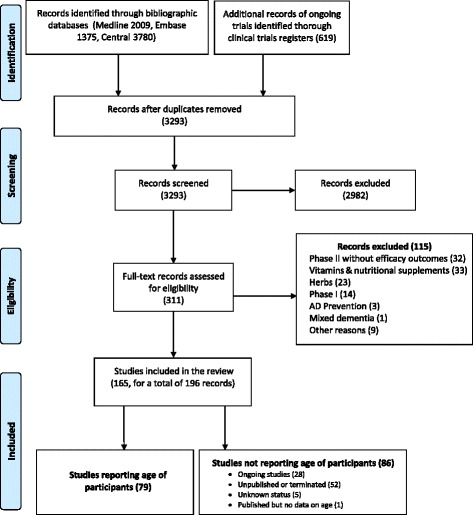
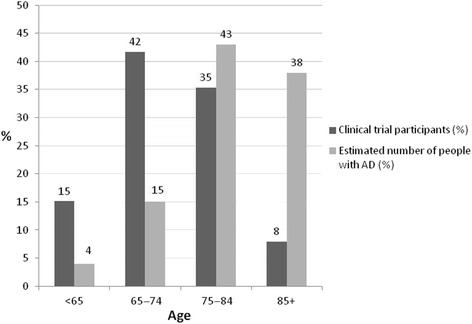
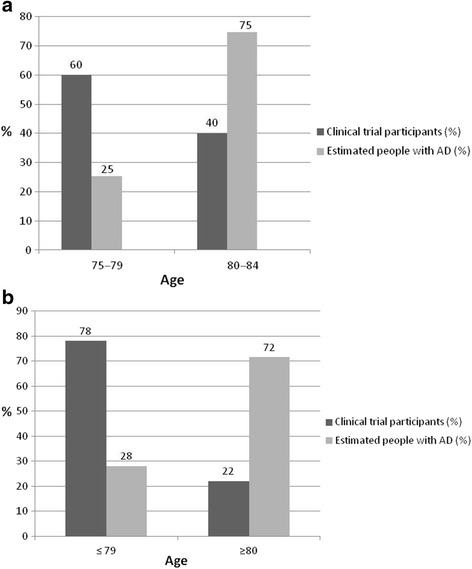
BACKGROUND: The age gap between participants in trials and patients who could benefit from the drugs studied has been widely documented across different clinical areas. Patients with dementia included in clinical research are systematically younger than those in the general population. We examined the age gap between participants in recent clinical trials testing interventions for Alzheimer's disease and epidemiological data. METHODS: We systematically searched literature databases (MedLine, EMBASE, the Cochrane Library) and ClinicalTrials.gov from 2000 to July 2015 to retrieve clinical trials testing pharmacologic treatments for Alzheimer's disease, other than cholinesterase inhibitors and memantine. We included ongoing and completed phase II/III randomized clinical trials, irrespective of their publication status. From each study reporting the participants' ages, we extracted size of sample, mean age, and standard deviation, and estimated the proportions of participants in different age classes. The number of patients with Alzheimer's disease by age class in the USA population was used for comparison. RESULTS: We included 165 clinical trials testing almost 100 different compounds, which enrolled or planned to enroll about 74,300 participants. Seventy-nine of these trials, accounting for about 26,800 participants, reported the age of the participants. The weighted mean age was 73.6 years (standard deviation, 8.2). People younger than 80 years were highly represented in clinical trials (78 %), despite the fact that those aged 80 and older form the majority (72 %) of patients with Alzheimer's disease. Only 8 % of clinical trial participants were 85 years or older. CONCLUSIONS: Patients enrolled in clinical trials on Alzheimer's disease are far from being representative of actual distribution of the patients in the general population. Clinical research should not be designed and conducted overlooking the fact that the majority of individuals with Alzheimer's disease are likely to be 80 or older.
Overview
The claims and statistics of this paper haven’t been checked yet.
Free: it reads the open-access text and checks the first 5 claims that cite a source we can check. Create a free account to check every claim.
Integrity signals
Registry
Cites
Statistics
Figures
Verification
Claims the paper makes
The claims and statistics of this paper haven’t been checked yet.
Free: it reads the open-access text and checks the first 5 claims that cite a source we can check. Create a free account to check every claim.
Claims other papers make about this one
Each is checked against this paper’s own text: does it say what the citing paper says it does?
The cited source says what the claim attributes to it.
In the citing paper
“older patients–particularly the oldest-old–remained disproportionally under-represented in clinical trials of Alzheimer’s disease [129–131].”
From Global reach of ageism on older persons' health: a systematic review (2020) · cites this paper as [129]
Self-check
Percentages, sums and reported differences re-computed from the paper’s own numbers.
The self-check needs the paper’s full text.
Citations
Cites
McKhann, G., Drachman, D., Folstein, M., Katzman, R., Price, D., & Stadlan, E. M. (1984) · Neurology · doi:10.1212/wnl.34.7.939 · Cited by 27,915
2016 Alzheimer's disease facts and figures
Alzheimer's Association (2016) · Alzheimer's & Dementia · doi:10.1016/j.jalz.2016.03.001 · Cited by 5,069
The global prevalence of dementia: a systematic review and metaanalysis.
Prince, M., Bryce, R., Albanese, E., Wimo, A., Ribeiro, W., & Ferri, C. P. (2013) · Alzheimer's & Dementia · doi:10.1016/j.jalz.2012.11.007 · Cited by 4,941 · cited 1×
“Several studies reported prevalence data on dementia [32], while a few focused specifically on Alzheimer’s disease.”
BackgroundAlzheimer disease in the United States (2010–2050) estimated using the 2010 census
Hebert, L. E., Weuve, J., Scherr, P. A., & Evans, D. A. (2013) · Neurology · doi:10.1212/wnl.0b013e31828726f5 · Cited by 2,642 · cited 5×
“This is because the most recent figures we found indicated only the number of people with Alzheimer’s disease by 10 year classes of age [14].”
BackgroundInfluentialPrevalence of Dementia in the United States: The Aging, Demographics, and Memory Study
Plassman, B. L., Langa, K. M., Fisher, G. G., Heeringa, S. G., Weir, D. R., Ofstedal, M. B., Burke, J. R., Hurd, M. D., Potter, G. G., Rodgers, W. L., et al. (2007) · Neuroepidemiology · doi:10.1159/000109998 · Cited by 1,932 · cited 4×
“Thus, to retrieve Alzheimer’s disease prevalence estimates by 5 year classes, we referred to published and unpublished data from previous cohort studies [17, 18].”
BackgroundMethodInfluentialDefeating Alzheimer's disease and other dementias: a priority for European science and society
Winblad, B., Amouyel, P., Andrieu, S., Ballard, C., Brayne, C., Brodaty, H., Cedazo-Minguez, A., Dubois, B., Edvardsson, D., Feldman, H., et al. (2016) · The Lancet Neurology · doi:10.1016/s1474-4422(16)00062-4 · Cited by 1,676
2015 Alzheimer's disease facts and figures
Alzheimer's Association (2015) · Alzheimer's & Dementia · doi:10.1016/j.jalz.2015.02.003 · Cited by 1,635
Alzheimer’s disease: Clinical trials and drug development
Mangialasche, F., Solomon, A., Winblad, B., Mecocci, P., & Kivipelto, M. (2010) · The Lancet Neurology · doi:10.1016/s1474-4422(10)70119-8 · Cited by 1,217 · cited 9×
“The number of patients with Alzheimer’s disease by age class in the USA population was used for comparison.”
InfluentialVan Spall, H. G. C., Toren, A., Kiss, A., & Fowler, R. A. (2007) · JAMA · doi:10.1001/jama.297.11.1233 · Cited by 1,055 · cited 2×
“This concept, known as external validity, applicability, or generalizability, is often neglected, especially in industrysponsored research [10], which selects the best possible experimental conditions to highlight the efficacy of new treatments, often disregarding their effectiveness in the real world.”
BackgroundAge, Neuropathology, and Dementia
Savva, G. M., Wharton, S. B., Ince, P. G., Forster, G., Matthews, F. E., & Brayne, C. (2009) · New England Journal of Medicine · doi:10.1056/nejmoa0806142 · Cited by 900 · cited 1×
“Older people have different pharmacokinetics and pharmacodynamics from people in their 60s or 70s [30].”
Background
Cited by
Global reach of ageism on older persons' health: a systematic review
Chang, E.-S., Kannoth, S., Levy, S., Wang, S.-Y., Lee, J. E., & Levy, B. R. (2020) · PLOS ONE · doi:10.1371/journal.pone.0220857 · Cited by 912
“To illustrate, in the context of dementia on a structural level, older patients–particularly the oldest-old–remained disproportionally under-represented in clinical trials of Alzheimer’s disease [129–131].”
Recruitment and Retention of Older People in Clinical Research: A Systematic Literature Review
Forsat, N. D., Palmowski, A., Palmowski, Y., Boers, M., & Buttgereit, F. (2020) · Journal of the American Geriatrics Society · doi:10.1111/jgs.16875 · Cited by 213
Duara, R., & Barker, W. (2022) · Neurotherapeutics · doi:10.1007/s13311-022-01185-z · Cited by 187
Reimagining cholinergic therapy for Alzheimer’s disease
Giacobini, E., Cuello, A. C., & Fisher, A. (2022) · Brain · doi:10.1093/brain/awac096 · Cited by 187
Recommendations to address key recruitment challenges of Alzheimer's disease clinical trials
Langbaum, J. B. S., Zissimopoulos, J., Au, R., Bose, N., Edgar, C. J., Ehrenberg, E., Fillit, H. M., Hill, C. V., Hughes, L., Irizarry, M. C., et al. (2022) · Alzheimer s & Dementia · doi:10.1002/alz.12737 · Cited by 131
Metadata
- Authors
- Banzi, R., Camaioni, P., Tettamanti, M., Bertele’, V., & Lucca, U.
- Affiliations
- Mario Negri Institute for Pharmacological Research (IT)
- Corresponding author
- Banzi, Rita
- Venue
- Alzheimer's Research & Therapy
- Published
- 2016-08-12
- Volume
- 8
- Issue
- 1
- Pages
- 32-32
- ISSN
- 1758-9193 (ISSN-L)
- PMC
- PMC4982205
- OpenAlex
- W2509751368
- Cited by
- 74
- References
- 33
- Citations by year
- 2026: 7 · 2025: 7 · 2024: 10 · 2023: 8 · 2022: 12 · 2021: 6 · 2020: 14 · 2019: 4 · 2018: 4 · 2017: 2
- FWCI
- 0.48
- Type
- journal article
- Language
- en
- Open access
- gold
- doi.org
- Licence
- cc-by
- creativecommons.org/licenses/by/4.0 (tdm)
- creativecommons.org/licenses/by/4.0 (vor)
- Locations
- Alzheimer s Research & Therapy (publishedVersion, cc-by)
- PubMed Central (publishedVersion, cc-by)
- PubMed (publishedVersion)
- Funders
- Fondazione Alberto e Mariele Tessiore
- Topics
- Health Sciences › Medicine › Psychiatry and Mental health › Dementia and Cognitive Impairment Research
- Health Sciences › Medicine › Public Health, Environmental and Occupational Health › Ethics in Clinical Research
- Life Sciences › Neuroscience › Cellular and Molecular Neuroscience › Alzheimer's disease research and treatments
- Keywords
- Alzheimer's disease, age gap, older adults, underrepresentation in clinical trials, trial representativeness, dementia pharmacotherapy, age distribution of patients
- MeSH terms
- Age Factors, Aged, Aged, 80 and over, Alzheimer Disease, Humans, Middle Aged, Randomized Controlled Trials as Topic, Clinical Trials, Phase I as Topic, Clinical Trials, Phase II as Topic
About these checks
Registry, retraction, Cites and statistics results are computed, not judged, with one exception: a printed reference that no index lists is read once by a model before it counts as a citation error. Claims are extracted by a model and kept only when their quote appears verbatim in the text; each cited source is then checked, with a model’s help, for whether it says what the claim relies on. Those verdicts can be wrong — read the claim’s quote and the cited source before relying on one.
Statistics and arithmetic are recomputed, not judged.
Confidence bands are shown only for fields calibrated on our annotated test set. None is calibrated yet, so no band is shown.
What counts as a claim ›How we measure confidence ›How we check this ›
Are you an author, or do you see a problem with this page? Request a review
How to cite
Cite CoChat for the checks on this page, and the paper for its own findings.
- This page
- CoChat. (2026). Citation check: Older patients are still under-represented in clinical trials of Alzheimer's disease. https://app.cochat.ai/papers/10.1186/s13195-016-0201-2
- The paper
- Banzi, R., Camaioni, P., Tettamanti, M., Bertele’, V., & Lucca, U. (2016). Older patients are still under-represented in clinical trials of Alzheimer's disease. Alzheimer's Research & Therapy. https://doi.org/10.1186/s13195-016-0201-2
Data sources
Bibliographic data: Semantic Scholar, OpenAlex, Crossref.
Contains information from the Semantic Scholar Academic Graph Datasets, made available under the ODC Attribution License (ODC-BY 1.0).
Semantic Scholar’s data is described in: Kinney, R., et al. (2023). The Semantic Scholar Open Data Platform. arXiv:2301.10140.
