

Global reach of ageism on older persons' health: a systematic review
Open accessThe DOI matches its Crossref record; 166 of the 169 references it cites were found in a registry or an index; 18 of the 61 sources its claims cite were checked for support.
Abstract
OBJECTIVE: Although there is anecdotal evidence of ageism occurring at both the structural level (in which societal institutions reinforce systematic bias against older persons) and individual level (in which older persons take in the negative views of aging of their culture), previous systematic reviews have not examined how both levels simultaneously influence health. Thus, the impact of ageism may be underestimated. We hypothesized that a comprehensive systematic review would reveal that these ageism levels adversely impact the health of older persons across geography, health outcomes, and time. METHOD: A literature search was performed using 14 databases with no restrictions on region, language, and publication type. The systematic search yielded 13,691 papers for screening, 638 for full review, and 422 studies for analyses. Sensitivity analyses that adjusted for sample size and study quality were conducted using standardized tools. The study protocol is registered (PROSPERO CRD42018090857). RESULTS: Ageism led to significantly worse health outcomes in 95.5% of the studies and 74.0% of the 1,159 ageism-health associations examined. The studies reported ageism effects in all 45 countries, 11 health domains, and 25 years studied, with the prevalence of significant findings increasing over time (p < .0001). A greater prevalence of significant ageism-health findings was found in less-developed countries than more-developed countries (p = .0002). Older persons who were less educated were particularly likely to experience adverse health effects of ageism. Evidence of ageism was found across the age, sex, and race/ethnicity of the targeters (i.e., persons perpetrating ageism). CONCLUSION: The current analysis which included over 7 million participants is the most comprehensive review of health consequences of ageism to date. Considering that the analysis revealed that the detrimental impact of ageism on older persons' health has been occurring simultaneously at the structural and individual level in five continents, our systematic review demonstrates the pernicious reach of ageism.
Overview
CoChat Summary
TL;DR
This systematic review of 422 studies and 1,159 ageism-health associations found that ageism predicted significantly worse health in 95.5% of studies and 74.0% of associations across 45 countries, 11 health domains, and 25 years. It concludes that ageism operates at both structural and individual levels and is a global social determinant of older persons’ health.
Key findings
- Ageism was significantly associated with worse health in 95.5% of the 422 studies and 74.0% of the 1,159 associations; evidence appeared in all 11 health domains, all 45 countries, six continents, and every year studied. The proportion of significant associations increased over time: 51.3% (1970–1989), 69.6% (1990–2009), and 85.3% (2010–2017), p < .0001.
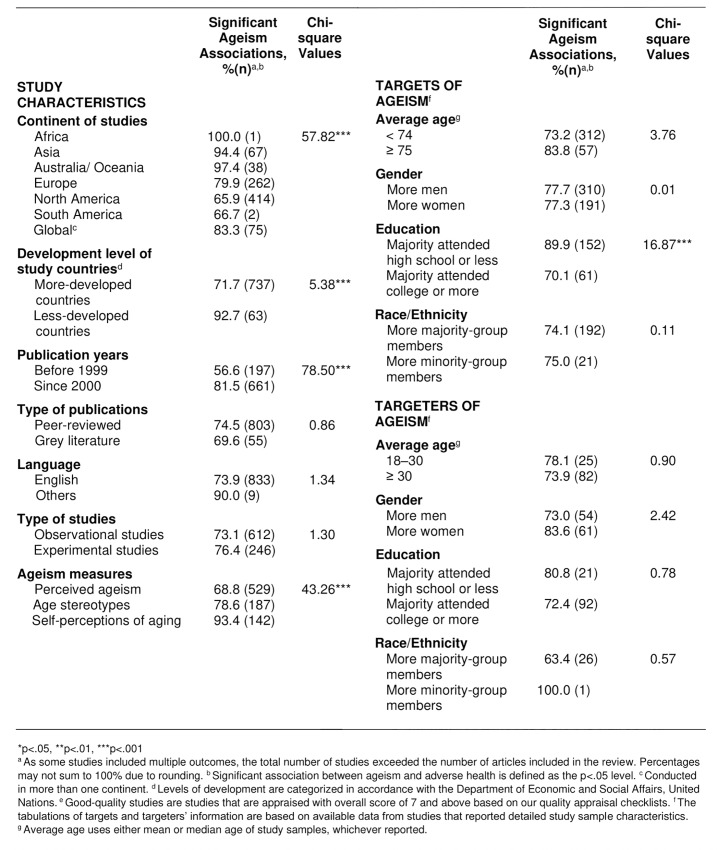
- Significant associations were more prevalent in less-developed than more-developed countries (92.7% vs. 71.7%, p = .0002). Less-educated targets were more likely to experience adverse health effects of ageism (89.8% vs. 70.1%, p < .0001), and findings were highest when ageism was operationalized as self-perceptions of aging (93.4%) compared with age stereotypes (78.6%) and perceived ageism (68.8%), p < .0001.
- A secondary model estimated 6.33 million global cases of depression attributable to ageism among persons aged 50 and over: 831,041 in more-developed countries and 5.6 million in less-developed countries.
- Mediation analyses in 25 studies across eight countries found significant pathways; the psychological pathway was supported by the most studies (9 longitudinal, 8 cross-sectional, 2 experimental priming), followed by behavioral (4 studies) and physiological (2 studies).
Methods
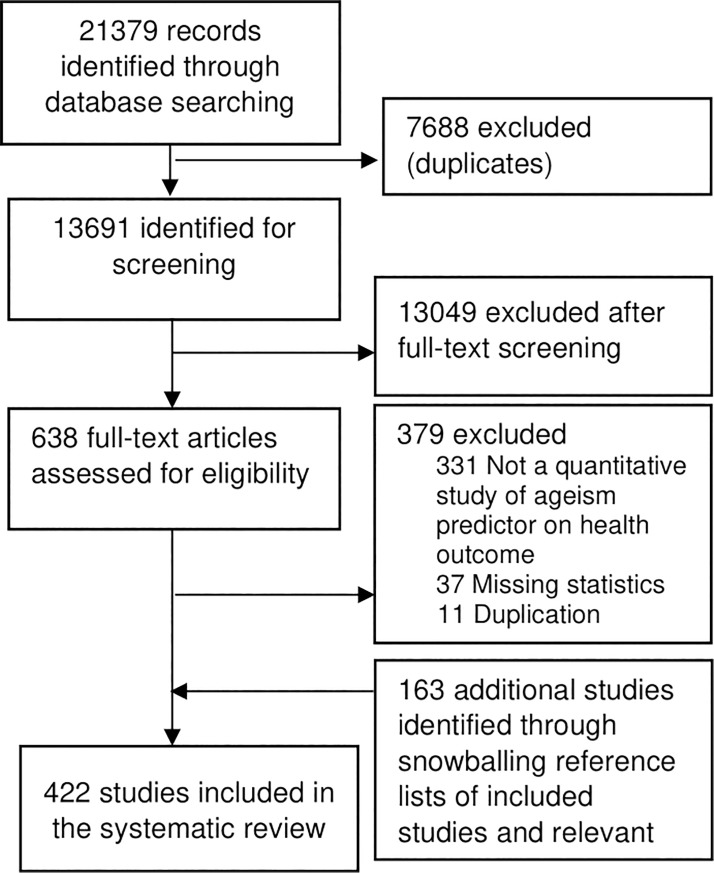
- Systematic review conducted per PRISMA, registered as PROSPERO CRD42018090857. Searches used 14 databases with no restrictions on region, language, or publication type, covering records after 1969 through December 2017; 21,379 citations were retrieved, reduced to 13,691 after duplicates, then 638 full-text reviews and 422 included studies.
- Inclusion criteria required quantitative analysis of ageism effects on health, control for age and relevant covariates or an age-matched design, and ageism targets aged 50 years or older. Data were extracted independently by two investigators; quality was appraised with Newcastle-Ottawa for observational studies and Downs and Black for experimental studies.
- Analyses were descriptive and bivariate chi-squared at study and association levels; evidence of ageism was defined as more than 50% of ageism-health associations being significant. Sensitivity analyses used good-quality studies scoring 7 or above (n = 317; 75.1%) and multivariate logistic regression controlling for study size; the depression estimate used the most homogeneous outcome subset (n = 17, 82.4% using CES-D).
Limitations
- The paper states that significant heterogeneity of study outcomes made a meta-analysis infeasible, and that qualitative studies were not included.
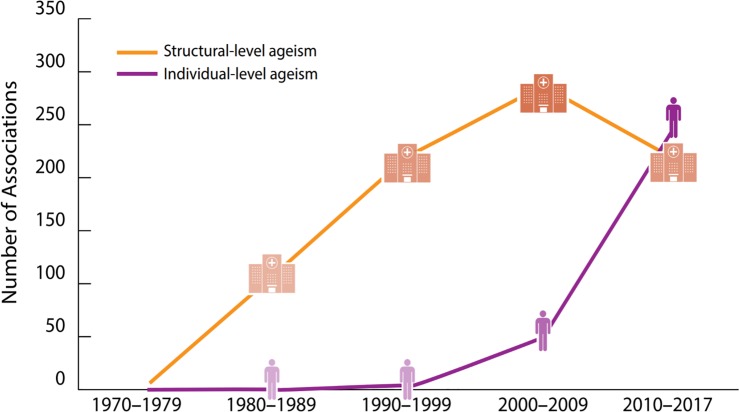
- The paper also notes gaps evident in the literature: only one study took place in Africa, only 8.6% of studies were conducted in less-developed countries despite 92.7% of associations there being significant, few studies (n = 18) formally tested effect modifiers, only four studies examined ageism within dyads, and research attention to structural-level ageism declined since 2010.
Model-written summary. Check it against the paper before relying on it.
Integrity signals
Registry
Cites
Statistics
Figures
Verification
Claims the paper makes
16 Valid · 0 Not valid · 15 Not checked · 79 Own results and interpretations
The cited sources support only part of this claim — read each source’s verdict below.
In the paper
“previous systematic reviews have not examined how both levels simultaneously influence health”
- Also stated in: § Introduction · plain
“Yet, previous ageism studies, and the reviews based on them, have focused on the consequences of ageism operating at the individual level, without assessing the structural sources of ageism.”
§ Global reach of ageism on older persons’ health: A systematic review > Abstract > Objective
What the sources say
- Not checked yetcites [11] Levy BR, Slade MD, Chang ES, Kannoth S, Wang SY. Ageism amplifies cost and prevalence of health conditions. Gerontologist 2018; published online November 13. 10.1093/geront/gny131 30423119 PMC7182003
- Not checked yetcites [12] Horton S, Baker J, Pearce G, Deakin JM. On the malleability of performance- implications for seniors. J Appl Gerontol. 2008; 27: 446– 65. source
- Not checked yetcites [13] Westerhof GJ, Miche M, Brothers AF, et al The influence of subjective aging on health and longevity: a meta-analysis of longitudinal data. Psychol Aging. 2014; 29: 793– 802. 10.1037/a0038016 25365689 source
- Partly supportedcites [14] Lamont RA, Swift HJ, Abrams D. A review and meta-analysis of age-based stereotype threat: negative stereotypes, not facts, do the damage. Psychol Aging. 2015; 30: 180– 93. 10.1037/a0038586 25621742 PMC4360754 sourceExperimental — accuracy not yet measured
The Method sections (Literature Search and Article Selection Criteria; page unavailable) show that this is a review of age-based stereotype threat that selected studies with objective performance measures, not a review of structural and individual ageism jointly influencing health. It therefore serves as an example of a review that did not examine both levels together, but it does not establish the claim about previous systematic reviews generally. (LLM, conf=0.78)
- Not checked yetcites [15] Meisner BA. A meta-analysis of positive and negative age stereotype priming effects on behavior among older adults. J Gerontol B Psychol Sci Soc Sci. 2012; 67: 13– 17. 10.1093/geronb/gbr062 21746872 source
plain- Asserted: passes — The authors put it forward as true.
- Checkable: passes — It can be checked against evidence.
- Load-bearing: passes — The paper’s conclusions depend on it.
- Based: passes — The paper gives a reason why it holds.
- Also stated in: § Introduction · plain
The cited sources support only part of this claim — read each source’s verdict below.
In the paper
“According to SET, these three components of ageism deleteriously influence the health of older persons through psychological, behavioral, and physiological pathways [10].”
§ Global reach of ageism on older persons’ health: A systematic review > Introduction
What the sources say
- Partly supportedcites [10] Levy BR. Stereotype embodiment: a psychosocial approach to aging. Curr Dir Psychol Sci. 2009; 18: 332– 36. 10.1111/j.1467-8721.2009.01662.x 20802838 PMC2927354 sourceExperimental — accuracy not yet measured
The pathway half of the claim is squarely in our copy: 'Utilization of Multiple Pathways' states that 'Age stereotypes appear to exert their influence along three tracks: psychological, behavioral, and physiological,' with examples of detrimental effects on older individuals' health (expectations/self-fulfilling prophecies, reduced healthy practices and self-efficacy, heightened cardiovascular response and events). However, the source nowhere describes 'three components of ageism'; the abstract of Levy (2009) specifies that the theory has FOUR components (internalization across the life span, unconscious operation, salience gain from self-relevance, utilization of multiple pathways), and its object is age stereotypes held by older individuals rather than a tripartite structure of ageism — the only ageism material is the 'Salience Gain From Self-relevance' section on interpersonal/institutional cues. Additionally, the paper hedges ('appear to,' 'likely involves'), which the citing sentence renders as flat causation. (LLM, conf=0.72)
plainstates a cause- Asserted: passes — The authors put it forward as true.
- Checkable: passes — It can be checked against evidence.
- Load-bearing: passes — The paper’s conclusions depend on it.
- Based: passes — The paper gives a reason why it holds.
- Partly supported
The cited sources support only part of this claim — read each source’s verdict below.
In the paper
“five meta-analyses that showed negative age beliefs can adversely affect the health of older persons [11–15]”
§ Global reach of ageism on older persons’ health: A systematic review > Introduction
What the sources say
- Not checked yetcites [11] Levy BR, Slade MD, Chang ES, Kannoth S, Wang SY. Ageism amplifies cost and prevalence of health conditions. Gerontologist 2018; published online November 13. 10.1093/geront/gny131 30423119 PMC7182003
- Not checked yetcites [12] Horton S, Baker J, Pearce G, Deakin JM. On the malleability of performance- implications for seniors. J Appl Gerontol. 2008; 27: 446– 65. source
- Not checked yetcites [13] Westerhof GJ, Miche M, Brothers AF, et al The influence of subjective aging on health and longevity: a meta-analysis of longitudinal data. Psychol Aging. 2014; 29: 793– 802. 10.1037/a0038016 25365689 source
- Partly supportedcites [14] Lamont RA, Swift HJ, Abrams D. A review and meta-analysis of age-based stereotype threat: negative stereotypes, not facts, do the damage. Psychol Aging. 2015; 30: 180– 93. 10.1037/a0038586 25621742 PMC4360754 sourceExperimental — accuracy not yet measured
Lamont, Swift & Abrams (2015) is indeed a meta-analysis showing that negative age stereotypes harm older adults, but the harm it measures is underperformance on stereotype-relevant tasks, not health: the Coding Procedure (Method) defines the outcome set as memory, cognitive, physical, skill-acquisition and driving performance, and the Conclusions state the supported effects are on memory (d = .21) and cognitive performance (d = .68), with the Discussion (Stereotyped Performance Domains) reporting nonsignificant effects for physical performance, driving and skill acquisition. No passage in our copy reports a health outcome (morbidity, mortality, physiological or clinical health) as an effect size or conclusion; health appears only as an unmeasured sample characteristic in the Limitations and as a cited reference (Auman et al., 2005) not pooled here. So the 'adversely affect the health of older persons' element attributed to this source is not supported by it, while the meta-analytic demonstration of harm to cognitive/memory performance is. (LLM, conf=0.70)
- Not checked yetcites [15] Meisner BA. A meta-analysis of positive and negative age stereotype priming effects on behavior among older adults. J Gerontol B Psychol Sci Soc Sci. 2012; 67: 13– 17. 10.1093/geronb/gbr062 21746872 source
plainstates a cause- Asserted: passes — The authors put it forward as true.
- Checkable: passes — It can be checked against evidence.
- Load-bearing: passes — The paper’s conclusions depend on it.
- Based: passes — The paper gives a reason why it holds.
The cited sources support only part of this claim — read each source’s verdict below.
In the paper
“Our current study draws on stereotype embodiment theory (SET) [10], which explains how three distinct, yet interrelated, components of ageism can impact health: age discrimination (i.e., detrimental treatment of older persons); negative age stereotypes (i.e., beliefs about older persons in general); and negative self-perceptions of aging (i.e., beliefs held by older persons about their own aging).”
§ Global reach of ageism on older persons’ health: A systematic review > Introduction
What the sources say
- Partly supportedcites [10] Levy BR. Stereotype embodiment: a psychosocial approach to aging. Curr Dir Psychol Sci. 2009; 18: 332– 36. 10.1111/j.1467-8721.2009.01662.x 20802838 PMC2927354 sourceExperimental — accuracy not yet measured
Our copy of Levy (2009) supports two of the three components the citing sentence attributes to SET: the Abstract defines the approach as 'based on age stereotypes (i.e., beliefs about older people in general)' and reports that negative age stereotypes held earlier in life predict worse health (cardiovascular events over 38 years, Internalization of Stereotypes Across the Life Span), and that stereotypes directed at oneself in old age 'can be classified as self-perceptions of aging' with long-term functional-health and 7.5-year longevity effects (Abstract, Salience Gain From Self-relevance). However, the paper presents the theory as having four components — internalization across the life span, unconscious operation, salience gain from self-relevance, and utilization of multiple pathways (psychological, behavioral, physiological) — not three components of ageism. Age discrimination is discussed only as a source of societal cues (patronizing speech; denial of employment or appropriate medical treatment on the institutional level, Salience Gain From Self-relevance) and as a form of prejudice alongside racism and sexism; no passage treats detrimental treatment itself as a distinct pathway by which ageism impacts health. That element of the claim is therefore not supported by this source. (LLM, conf=0.72)
plainstates a cause- Asserted: passes — The authors put it forward as true.
- Checkable: passes — It can be checked against evidence.
- Load-bearing: passes — The paper’s conclusions depend on it.
- Based: passes — The paper gives a reason why it holds.
- Partly supported
Every source the paper cites for this claim was checked and supports it.
In the paper
“The structural-level and individual-level ageism are inextricably linked because disparaging views of aging, that are propagated by word and deed at the structural level, are assimilated at the individual level [10].”
§ Global reach of ageism on older persons’ health: A systematic review > Introduction
What the sources say
- Supportedcites [10] Levy BR. Stereotype embodiment: a psychosocial approach to aging. Curr Dir Psychol Sci. 2009; 18: 332– 36. 10.1111/j.1467-8721.2009.01662.x 20802838 PMC2927354 source
The Abstract section of Levy (2009) states the core of stereotype embodiment theory: 'stereotypes are embodied when their assimilation from the surrounding culture leads to self-definitions,' and that the process runs 'top-down (from society to the individual) and over time' — i.e., structural/societal propagation and individual assimilation are one linked process. The 'Internalization of Stereotypes Across the Life Span' and 'Salience Gain From Self-relevance' sections elaborate it, describing the 'age stereotypes that permeate society' and pejorative societal cues encountered on interpersonal and institutional levels that individuals absorb. The citing sentence is a faithful paraphrase; only the vocabulary ('structural-level/individual-level ageism') differs from the source's 'surrounding culture/society' and 'institutional level'. (LLM, conf=0.86)
plainstates an association- Asserted: passes — The authors put it forward as true.
- Checkable: passes — It can be checked against evidence.
- Load-bearing: unclear — It is unclear whether the paper’s conclusions depend on it.
- Based: passes — The paper gives a reason why it holds.
- Supported
77 more claims · 10 with their cited sources checked
Create a free account to see all 110 claims and to verify the 43 references still open.
- Probably not a substantial claim. 13
- It may state two separate claims as one. 17
Claims other papers make about this one
Each is checked against this paper’s own text: does it say what the citing paper says it does?
The cited source says what the claim attributes to it.
In the citing paper
“The negative consequences of both structural and individual level ageism on older adults' health have been extensively documented (Chang et al., 2020).”
From Algorithmic harms and digital ageism in the use of surveillance technologies in nursing homes (2022) · cites this paper as Chang et al., 2020
Self-check
Percentages, sums and reported differences re-computed from the paper’s own numbers.
Rated major: it would touch a result — a value a result rests on, reported and recomputed p-values on opposite sides of the significance level, two passages that conflict with no sign which is right, or a cited work retracted before this paper was published.
In the paper
“In 84.6% of the studies and 63.0% of the associations, age dictated whom receives certain procedures or treatments.”
§ Global reach of ageism on older persons’ health: A systematic review > Results > Impact of ageism on health of older persons: Structural level
Reported 63 · recomputed 68.990826
Citations
Cites
The CES-D Scale: A Self-Report Depression Scale for Research in the General Population
Radloff, L. S. (1977) · Applied Psychological Measurement · doi:10.1177/014662167700100306 · Cited by 53,267
Liberati, A., Altman, D. G., Tetzlaff, J., Mulrow, C., Gøtzsche, P. C., Ioannidis, J. P. A., Clarke, M., Devereaux, P. J., Kleijnen, J., & Moher, D. (2009) · PLoS Medicine · doi:10.1371/journal.pmed.1000100 · Cited by 28,164
Liberati, A., Altman, D. G., Tetzlaff, J., Mulrow, C., Gotzsche, P. C., Ioannidis, J. P. A., Clarke, M., Devereaux, P. J., Kleijnen, J., & Moher, D. (2009) · BMJ · doi:10.1136/bmj.b2700 · Cited by 17,648
(2014) · Medical Entomology and Zoology · Cited by 17,633
Methods for the thematic synthesis of qualitative research in systematic reviews
Thomas, J., & Harden, A. (2008) · BMC Medical Research Methodology · doi:10.1186/1471-2288-8-45 · Cited by 9,312
Downs, S. H., & Black, N. (1998) · Journal of Epidemiology and Community Health · doi:10.1136/jech.52.6.377 · Cited by 8,252
Racial Differences in Physical and Mental Health: Socio-economic Status, Stress and Discrimination
Williams, D. R., Yu, Y., Jackson, J. S., & Anderson, N. B. (1997) · Journal of Health Psychology · doi:10.1177/135910539700200305 · Cited by 4,786
Evaluating non-randomised intervention studies
Deeks, J., Dinnes, J., D'Amico, R., Sowden, A., Sakarovitch, C., Song, F., Petticrew, M., & Altman, D. (2003) · Health Technology Assessment · doi:10.3310/hta7270 · Cited by 2,907
Intersectionality and research in psychology
Cole, E. R. (2009) · American Psychologist · doi:10.1037/a0014564 · Cited by 2,722 · cited 1×
“Second, in line with intersectional research [163,164], there is a need to better understand how intersecting systems of power reinforce ageism directed at marginalized groups within older populations.”
Cohort Profile: the Health and Retirement Study (HRS)
Sonnega, A., Faul, J. D., Ofstedal, M. B., Langa, K. M., Phillips, J. W., & Weir, D. R. (2014) · International Journal of Epidemiology · doi:10.1093/ije/dyu067 · Cited by 2,318
Research works printed but not linked: 6
- Levy B. Unconscious ageism In: Palmore EB, Branch LG, Harris DK, editors. Encyclopedia of ageism. New York: Haworth Pastoral Press; 2005 p. 335– 9.
- Butler RN. Ageism. Generations. 2005; 29(3): 84– 6.
- Organisation for Economic Cooperation and Development. Live longer, work longer: A synthesis report. Paris, France: OECD Publishing 2006.
- Higgins J, Green S. Cochrane handbook for systematic reviews for interventions, version 5.1.0. London: The Cochrane Collaboration, 2011.
- Gupta P, Shekhar R, O'Mahony MS. Ageism and sexism in clinical research: are we making any progress? Age Ageing. 2013; 42S3: 12.
- United Nations, Department of Economic and Social Affairs, Population Division. World population ageing 2015.
Cited by
Karlsen, T. H., Sheron, N., Zelber-Sagi, S., Carrieri, P., Dusheiko, G., Bugianesi, E., Pryke, R., Hutchinson, S. J., Sangro, B., Martin, N. K., et al. (2022) · The Lancet · doi:10.1016/s0140-6736(21)01701-3 · Cited by 652
Determinants of Ageism against Older Adults: A Systematic Review
Marques, S., Mariano, J., Mendonça, J., De Tavernier, W., Hess, M., Naegele, L., Peixeiro, F., & Martins, D. (2020) · International Journal of Environmental Research and Public Health · doi:10.3390/ijerph17072560 · Cited by 313
COVID-19 and ageism: How positive and negative responses impact older adults and society.
Monahan, C., Macdonald, J., Lytle, A., Apriceno, M., & Levy, S. R. (2020) · American Psychologist · doi:10.1037/amp0000699 · Cited by 256
Self-citationOlder adults can use technology: why healthcare professionals must overcome ageism in digital health
Mace, R. A., Mattos, M. K., & Vranceanu, A.-M. (2022) · Translational Behavioral Medicine · doi:10.1093/tbm/ibac070 · Cited by 231
“Ageism has deep roots in our society, and it negatively impacts older patients [16].”
BackgroundUnderstanding unequal ageing: towards a synthesis of intersectionality and life course analyses
Holman, D., & Walker, A. (2021) · European Journal of Ageing · doi:10.1007/s10433-020-00582-7 · Cited by 200
Metadata
- Authors
- Chang, E.-S., Kannoth, S., Levy, S., Wang, S.-Y., Lee, J. E., & Levy, B. R.
- Affiliations
- Yale University (US)
- Corresponding author
- Levy, Becca R.
- Venue
- PLOS ONE
- Publisher
- Public Library of Science (PLoS)
- Published
- 2020-01-15
- Volume
- 15
- Issue
- 1
- Pages
- e0220857
- ISSN
- 1932-6203 (ISSN-L)
- PMC
- PMC6961830
- OpenAlex
- W3000728195
- Semantic Scholar
- b947b2885089ddf627a4c02d71c7653a95809b0e
- Cited by
- 912
- References
- 169
- Citations by year
- 2026: 158 · 2025: 200 · 2024: 157 · 2023: 134 · 2022: 127 · 2021: 91 · 2020: 43
- FWCI
- 17.40
- Type
- journal article
- Language
- en
- Open access
- gold
- doi.org
- Licence
- Locations
- PLoS ONE (publishedVersion, cc-by)
- Europe PMC (PubMed Central) (publishedVersion, cc-by)
- PubMed Central (publishedVersion, cc-by)
- PubMed (publishedVersion)
- RePEc: Research Papers in Economics (submittedVersion)
- DOAJ (DOAJ: Directory of Open Access Journals) (submittedVersion, cc-by-sa)
- Figshare (submittedVersion, cc-by)
- Funders
- World Health Organization
- Yale University
- National Institutes of Health (5u01ag032284-08, UL1TR001863)
- Agency for Healthcare Research and Quality (1K01HS023900, K01 HS023900)
- Yale School of Public Health, Yale University
- National Institute on Aging (#U01AG032284, P30AG021342)
- National Center for Advancing Translational Sciences
- Topics
- Social Sciences › Psychology › Developmental and Educational Psychology › Aging and Gerontology Research
- Social Sciences › Demography › Retirement, Disability, and Employment
- Social Sciences › Health › Health disparities and outcomes
- Keywords
- ageism, health outcomes, educational attainment, developed and developing countries
- MeSH terms
- Aged, Aged, 80 and over, Aging, Depression, Female, Humans, Male, Peer Review, Social Behavior, Databases, Factual, Ageism, Social Discrimination
About these checks
Registry, retraction, Cites and statistics results are computed, not judged, with one exception: a printed reference that no index lists is read once by a model before it counts as a citation error. Claims are extracted by a model and kept only when their quote appears verbatim in the text; each cited source is then checked, with a model’s help, for whether it says what the claim relies on. Those verdicts can be wrong — read the claim’s quote and the cited source before relying on one.
The claim verdicts this report counts are experimental: their accuracy is not yet measured.
A language model drew the claims from the paper on 2026-10-10, under version 3 of the claim definition (model deepseek-v4.1-flash, prompt extract-v3).
A second model labelled each claim on 2026-10-10 (model jev-1.13-20260917, definition revision gold-guideline-v0.2).
Cited sources are checked with a language model’s help (gpt-6-sol and qwen3.8-omni-flash).
Statistics and arithmetic are recomputed, not judged.
Confidence bands are shown only for fields calibrated on our annotated test set. None is calibrated yet, so no band is shown.
What counts as a claim ›How we measure confidence ›How we check this ›
Are you an author, or do you see a problem with this page? Request a review
How to cite
Cite CoChat for the checks on this page, and the paper for its own findings.
- This page
- CoChat. (2026). Citation check: Global reach of ageism on older persons' health: a systematic review. https://app.cochat.ai/papers/10.1371/journal.pone.0220857
- The paper
- Chang, E.-S., Kannoth, S., Levy, S., Wang, S.-Y., Lee, J. E., & Levy, B. R. (2020). Global reach of ageism on older persons' health: a systematic review. PLOS ONE. https://doi.org/10.1371/journal.pone.0220857
Data sources
Bibliographic data: Semantic Scholar, OpenAlex, Crossref.
Contains information from the Semantic Scholar Academic Graph Datasets, made available under the ODC Attribution License (ODC-BY 1.0).
Semantic Scholar’s data is described in: Kinney, R., et al. (2023). The Semantic Scholar Open Data Platform. arXiv:2301.10140.
