

PKR involvement in Alzheimer’s disease
The DOI matches its Crossref record; 80 of the 80 references it cites were found in a registry or an index.
Abstract
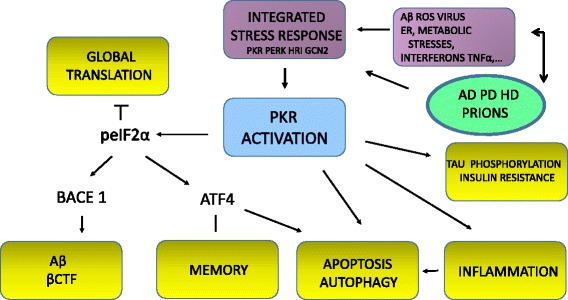
BACKGROUND: Brain lesions in Alzheimer's disease (AD) are characterized by Aβ accumulation, neurofibrillary tangles, and synaptic and neuronal vanishing. According to the amyloid cascade hypothesis, Aβ1-42 oligomers could trigger a neurotoxic cascade with kinase activation that leads to tau phosphorylation and neurodegeneration. Detrimental pathways that are associated with kinase activation could also be linked to the triggering of direct neuronal death, the production of free radicals, and neuroinflammation. RESULTS: Among these kinases, PKR (eukaryotic initiation factor 2α kinase 2) is a pro-apoptotic enzyme that inhibits translation and that has been implicated in several molecular pathways that lead to AD brain lesions and disturbed memory formation. PKR accumulates in degenerating neurons and is activated by Aβ1-42 neurotoxicity. It might modulate Aβ synthesis through BACE 1 induction. PKR is increased in cerebrospinal fluid from patients with AD and mild cognitive impairment and can induce the activation of pro-inflammatory pathways leading to TNFα and IL1-β production. In addition, experimentally, PKR seems to down-regulate the molecular processes of memory consolidation. This review highlights the major findings linking PKR and abnormal brain metabolism associated with AD lesions. CONCLUSIONS: Studying the detrimental role of PKR signaling in AD could pave the way for a neuroprotective strategy in which PKR inhibition could reduce neuronal demise and alleviate cognitive decline as well as the cumbersome burden of AD for patients.
Overview
The claims and statistics of this paper haven’t been checked yet.
Free: it reads the open-access text and checks the first 5 claims that cite a source we can check. Create a free account to check every claim.
Integrity signals
Registry
Cites
Statistics
Figures
Verification
Claims the paper makes
The claims and statistics of this paper haven’t been checked yet.
Free: it reads the open-access text and checks the first 5 claims that cite a source we can check. Create a free account to check every claim.
Claims other papers make about this one
Each is checked against this paper’s own text: does it say what the citing paper says it does?
In the citing paper
“These findings are consistent with previous reports that cellular detectors of dsRNA such as protein kinase RNA-activated (PKR) are elevated in brains of patients with Alzheimer’s disease (42–45).”
From Pathogenic tau–induced transposable element–derived dsRNA drives neuroinflammation (2023) · cites this paper as [44]
Self-check
Percentages, sums and reported differences re-computed from the paper’s own numbers.
The self-check needs the paper’s full text.
Citations
Cites
The amyloid hypothesis of Alzheimer's disease at 25 years
Selkoe, D. J., & Hardy, J. (2016) · EMBO Molecular Medicine · doi:10.15252/emmm.201606210 · Cited by 6,164 · cited 1×
“The cause of AD is not known, but the Aβ peptide could be toxic according to the “amyloid cascade hypothesis” [3].”
BackgroundStrittmatter, W. J., Saunders, A. M., Schmechel, D., Pericak-Vance, M., Enghild, J., Salvesen, G. S., & Roses, A. D. (1993) · Proceedings of the National Academy of Sciences · doi:10.1073/pnas.90.5.1977 · Cited by 4,268
Scheltens, P., Blennow, K., Breteler, M. M. B., de Strooper, B., Frisoni, G. B., Salloway, S., & Van der Flier, W. M. (2016) · The Lancet · doi:10.1016/s0140-6736(15)01124-1 · Cited by 3,125
Montine, T. J., Phelps, C. H., Beach, T. G., Bigio, E. H., Cairns, N. J., Dickson, D. W., Duyckaerts, C., Frosch, M. P., Masliah, E., Mirra, S. S., et al. (2012) · Acta Neuropathologica · doi:10.1007/s00401-011-0910-3 · Cited by 2,894 · cited 1×
“The pathology of AD involves senile plaques made of accumulated Aβ peptide, neurofibrillary tangles with abnormally phosphorylated tau protein, and synaptic and neuronal losses [2].”
BackgroundThe integrated stress response
Pakos‐Zebrucka, K., Koryga, I., Mnich, K., Ljujic, M., Samali, A., & Gorman, A. M. (2016) · The EMBO Reports · doi:10.15252/embr.201642195 · Cited by 2,659 · cited 1×
“Integrated stress response Various stresses can be induced, and eukaryotic cells have an adaptive response called the integrated stress response (ISR) that can restore cell homeostasis [10].”
BackgroundScreening for dementia by memory testing
Grober, E., Buschke, H., Crystal, H., Bang, S., & Dresner, R. (1988) · Neurology · doi:10.1212/wnl.38.6.900 · Cited by 961
Tau and neurodegenerative disease: the story so far
Iqbal, K., Liu, F., & Gong, C.-X. (2016) · Nature Reviews Neurology · doi:10.1038/nrneurol.2015.225 · Cited by 806 · cited 1×
“Many pathogenic mechanisms have been assessed in AD, and the role of kinases has often been linked to tau phosphorylation [5, 6].”
BackgroundNovel role of PKR in inflammasome activation and HMGB1 release
Lu, B., Nakamura, T., Inouye, K., Li, J., Tang, Y., Lundbäck, P., Valdes-Ferrer, S. I., Olofsson, P. S., Kalb, T., Roth, J., et al. (2012) · Nature · doi:10.1038/nature11290 · Cited by 757
The dsRNA protein kinase PKR: Virus and cell control
García, M. A., Meurs, E. F., & Esteban, M. (2007) · Biochimie · doi:10.1016/j.biochi.2007.03.001 · Cited by 644 · cited 2×
“It is a stress and proapoptotic kinase that can be activated by interferons, TNFα, endoplasmic reticulum (ER) stress, reactive oxygen species (ROS), and calcium [8].”
BackgroundNakamura, T., Furuhashi, M., Li, P., Cao, H., Tuncman, G., Sonenberg, N., Gorgun, C. Z., & Hotamisligil, G. S. (2010) · Cell · doi:10.1016/j.cell.2010.01.001 · Cited by 505
Cited by
The integrated stress response: From mechanism to disease
Costa-Mattioli, M., & Walter, P. (2020) · Science · doi:10.1126/science.aat5314 · Cited by 1,617
“In the brain, PKR is activated in a variety of neurological disorders (38, 39); however, the underlying molecular mechanism of this activation remains poorly understood.”
BackgroundCellular origins of dsRNA, their recognition and consequences
Chen, Y. G., & Hur, S. (2022) · Nature Reviews Molecular Cell Biology · doi:10.1038/s41580-021-00430-1 · Cited by 433
Endoplasmic Reticulum Stress and Unfolded Protein Response in Neurodegenerative Diseases
Ghemrawi, R., & Khair, M. (2020) · International Journal of Molecular Sciences · doi:10.3390/ijms21176127 · Cited by 398
Gal-Ben-Ari, S., Barrera, I., Ehrlich, M., & Rosenblum, K. (2019) · Frontiers in Molecular Neuroscience · doi:10.3389/fnmol.2018.00480 · Cited by 254
Pathogenic tau–induced transposable element–derived dsRNA drives neuroinflammation
Ochoa, E., Ramirez, P., Gonzalez, E., De Mange, J., Ray, W. J., Bieniek, K. F., & Frost, B. (2023) · Science Advances · doi:10.1126/sciadv.abq5423 · Cited by 73
TDP-43 knockdown causes innate immune activation via protein kinase R in astrocytes
LaRocca, T. J., Mariani, A., Watkins, L. R., & Link, C. D. (2019) · Neurobiology of Disease · doi:10.1016/j.nbd.2019.104514 · Cited by 63
Alzheimer’s Disease: Advances in Drug Development
Piton, M., Hirtz, C., Desmetz, C., Milhau, J., Lajoix, A. D., Bennys, K., Lehmann, S., & Gabelle, A. (2018) · Journal of Alzheimer s Disease · doi:10.3233/jad-180145 · Cited by 60
Metadata
- Authors
- Hugon, J., Mouton-Liger, F., Dumurgier, J., & Paquet, C.
- Venue
- Alzheimer's Research & Therapy
- Published
- 2017-10-05
- Volume
- 9
- Issue
- 1
- ISSN
- 1758-9193
- PMC
- PMC5629792
- Semantic Scholar
- e65f56776528e4113f6133b2777993a1c569a4bb
- Cited by
- 82
- References
- 80
- Language
- en
- Funders
- Agence Nationale de la Recherche (NeurobioPKR 2013)
About these checks
Registry, retraction, Cites and statistics results are computed, not judged, with one exception: a printed reference that no index lists is read once by a model before it counts as a citation error. Claims are extracted by a model and kept only when their quote appears verbatim in the text; each cited source is then checked, with a model’s help, for whether it says what the claim relies on. Those verdicts can be wrong — read the claim’s quote and the cited source before relying on one.
Statistics and arithmetic are recomputed, not judged.
Confidence bands are shown only for fields calibrated on our annotated test set. None is calibrated yet, so no band is shown.
What counts as a claim ›How we measure confidence ›How we check this ›
Are you an author, or do you see a problem with this page? Request a review
Data sources
Bibliographic data: Semantic Scholar, OpenAlex, Crossref.
Contains information from the Semantic Scholar Academic Graph Datasets, made available under the ODC Attribution License (ODC-BY 1.0).
Semantic Scholar’s data is described in: Kinney, R., et al. (2023). The Semantic Scholar Open Data Platform. arXiv:2301.10140.
