

Safety, tolerability and efficacy of the glutaminyl cyclase inhibitor PQ912 in Alzheimer’s disease: results of a randomized, double-blind, placebo-controlled phase 2a study
Open accessThe DOI matches its Crossref record; 38 of the 38 references it cites were found in a registry or an index.
Abstract
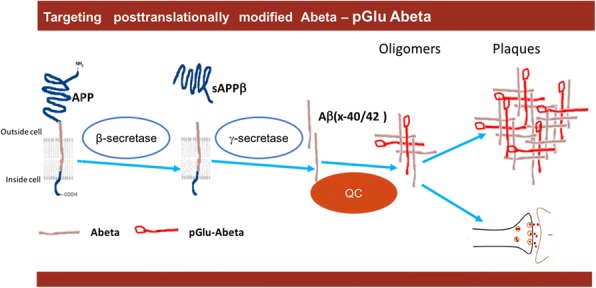
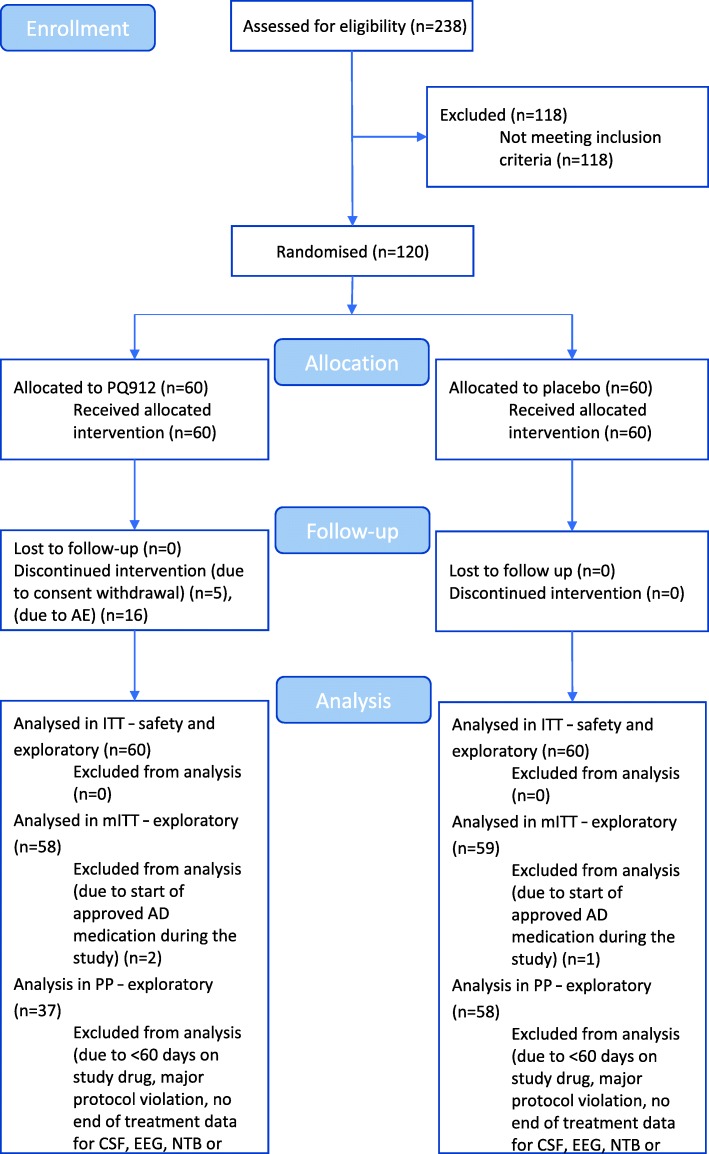
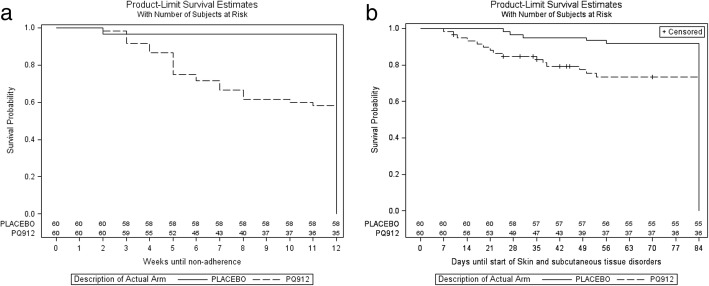
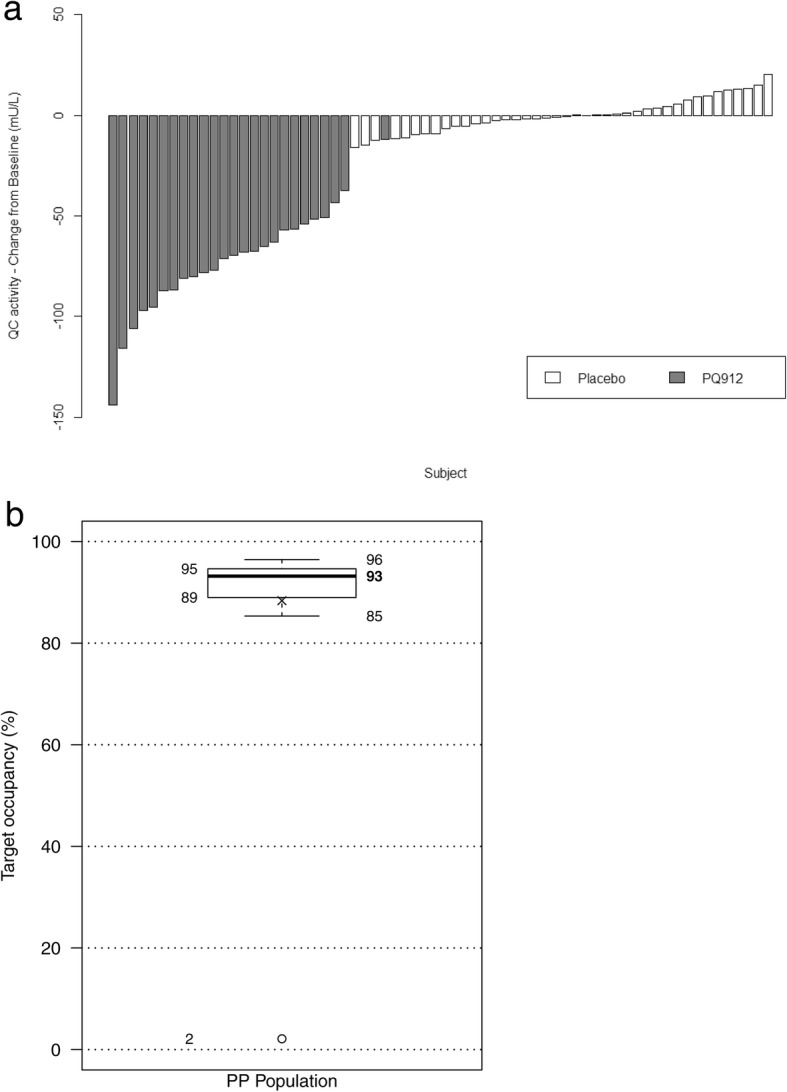
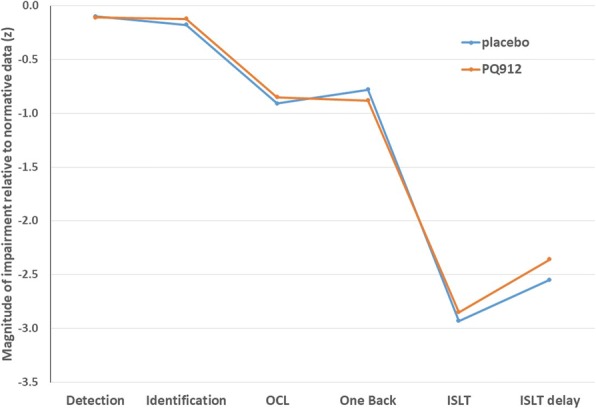
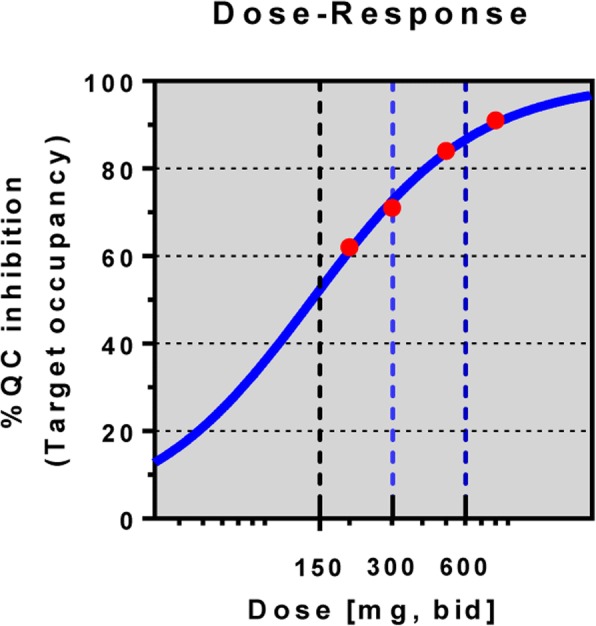
BACKGROUND: PQ912 is an inhibitor of the glutaminyl cyclase enzyme that plays a central role in the formation of synaptotoxic pyroglutamate-A-beta oligomers. We report on the first clinical study with PQ912 in subjects with biomarker-proven Alzheimer's disease (AD). The aim was to determine the maximal tolerated dose, target occupancy and treatment-related pharmacodynamic effects. The exploratory efficacy readouts selected were tailored to the patient population with early AD. The therapeutic approach focuses on synaptic dysfunction as captured by various measures such as electroencephalography (EEG), synaptic biomarkers and sensitive cognitive tests. METHODS: This was a randomized, double-blind, placebo-controlled trial evaluating the safety, tolerability and efficacy of PQ912 800 mg twice daily (bid) for 12 weeks in subjects with mild cognitive impairment or mild dementia due to AD. The 120 enrolled subjects were treatment-naïve at the start of the study, had confirmed AD biomarkers in their cerebrospinal fluid at screening and had a Mini Mental State Examination score between 21 and 30. After 1 week of treatment with 400 mg bid, patients were up-titrated to 800 mg bid for 11 weeks. Patients were randomized 1:1 to either PQ912 or placebo. The primary composite endpoints were to assess safety and tolerability based on the number of patients who discontinued due to (serious) adverse events (safety), and based on dose adjustment during the treatment period and/or nonadherence to randomized treatment (tolerability). All randomized subjects who took at least one dose of the study treatment or placebo were used for safety analyses. RESULTS: There was no significant difference between treatments in the number of subjects with (serious) adverse events, although there were slightly more patients with a serious adverse event in the PQ912 group compared to placebo. More subjects treated with PQ912 discontinued treatment due to adverse events, mostly related to gastrointestinal and skin/subcutaneous tissue disorders. PQ912 treatment resulted in a significant reduction in glutaminyl cyclase activity, which resulted in an average target occupancy of > 90%. A significant reduction of theta power in the EEG frequency analysis and a significant improvement in the One Back test of our Neuropsychological Test Battery was observed. The exploratory biomarker readouts, neurogranin for synaptic toxicity and YKL-40 as a marker of inflammation, appear to be sensitive enough to serve as efficacy markers in the next phase 2b study. CONCLUSIONS: The maximal tolerated dose of PQ912 has been identified and the results support future studies at still lower doses reaching > 50% target occupancy, a longer up-titration phase to potentially induce adaptation and longer treatment periods to confirm the early signals of efficacy as seen in this study. TRIAL REGISTRATION: Clinicaltrials.gov, NCT 02389413 . Registered on 17 March 2015.
Overview
The claims and statistics of this paper haven’t been checked yet.
Free: it reads the open-access text and checks the first 5 claims that cite a source we can check. Create a free account to check every claim.
Integrity signals
Registry
Cites
Statistics
Figures
Verification
Claims the paper makes
The claims and statistics of this paper haven’t been checked yet.
Free: it reads the open-access text and checks the first 5 claims that cite a source we can check. Create a free account to check every claim.
Claims other papers make about this one
Each is checked against this paper’s own text: does it say what the citing paper says it does?
The source backs part of the claim, not all of it — or backs it for a different population, condition or comparison.
In the citing paper
“In its phase IIa study (NCT03919162), varoglutamstat (17, formerly PQ912) demonstrated acceptable safety and tolerability, as well as a reduction in working memory decline.454”
From Recent advances in Alzheimer's disease: Mechanisms, clinical trials and new drug development strategies. (2024) · cites this paper as [454]
Experimental — accuracy not yet measured
Self-check
Percentages, sums and reported differences re-computed from the paper’s own numbers.
The self-check needs the paper’s full text.
Citations
Cites
McKhann, G. M., Knopman, D. S., Chertkow, H., Hyman, B. T., Jack, C. R., Kawas, C. H., Klunk, W. E., Koroshetz, W. J., Manly, J. J., Mayeux, R., et al. (2011) · Alzheimer's & Dementia · doi:10.1016/j.jalz.2011.03.005 · Cited by 18,657
Self-citationAmyloid oligomers exacerbate tau pathology in a mouse model of tauopathy
Selenica, M.-L. B., Brownlow, M., Jimenez, J. P., Lee, D. C., Pena, G., Dickey, C. A., Gordon, M. N., & Morgan, D. (2013) · Neurodegenerative Diseases · doi:10.1159/000337230 · Cited by 10,359
Albert, M. S., DeKosky, S. T., Dickson, D., Dubois, B., Feldman, H. H., Fox, N. C., Gamst, A., Holtzman, D. M., Jagust, W. J., Petersen, R. C., et al. (2011) · Alzheimer's & Dementia · doi:10.1016/j.jalz.2011.03.008 · Cited by 10,152 · cited 1×
“A total of 120 treatment-naïve men (n = 56) and women (n = 64), aged 51–85 years, with a diagnosis of mild cognitive impairment due to AD or mild dementia due to AD, according to the Alzheimer Association–National Institute on Aging criteria [14, 15], were included in the study.”
MethodNeuroinflammation in Alzheimer's disease
Heneka, M. T., Carson, M. J., Khoury, J. E., Landreth, G. E., Brosseron, F., Feinstein, D. L., Jacobs, A. H., Wyss-Coray, T., Vitorica, J., Ransohoff, R. M., et al. (2015) · The Lancet Neurology · doi:10.1016/s1474-4422(15)70016-5 · Cited by 6,226
2016 Alzheimer's disease facts and figures
Alzheimer's Association (2016) · Alzheimer's & Dementia · doi:10.1016/j.jalz.2016.03.001 · Cited by 5,069
Hypothetical model of dynamic biomarkers of the Alzheimer's pathological cascade
Jack, C. R., Knopman, D. S., Jagust, W. J., Shaw, L. M., Aisen, P. S., Weiner, M. W., Petersen, R. C., & Trojanowski, J. Q. (2010) · The Lancet Neurology · doi:10.1016/s1474-4422(09)70299-6 · Cited by 4,806
Alzheimer's Disease Is a Synaptic Failure
Selkoe, D. J. (2002) · Science · doi:10.1126/science.1074069 · Cited by 4,420
Albert, M. S., DeKosky, S. T., Dickson, D., Dubois, B., Feldman, H. H., Fox, N. C., Gamst, A., Holtzman, D. M., Jagust, W. J., Petersen, R. C., et al. (2013) · Focus · doi:10.1176/appi.focus.11.1.96 · Cited by 2,621
Villemagne, V. L., Burnham, S., Bourgeat, P., Brown, B., Ellis, K. A., Salvado, O., Szoeke, C., Macaulay, S. L., Martins, R., Maruff, P., et al. (2013) · The Lancet Neurology · doi:10.1016/s1474-4422(13)70044-9 · Cited by 2,279
Self-citationBloom (2014) · doi:10.1001/jamaneurol.2013.5847 · Cited by 2,194
Cited by
Items 101–136 of 136
Höfling, C., Ulrich, L., Burghardt, S., Donkersloot, P., Opitz, M., Geißler, S., Schilling, S., Cynis, H., Michalski, D., & Roßner, S. (2024) · Cells · doi:10.3390/cells13171412 · Cited by 2
PROSPECTS FOR USE OF SHORT PEPTIDES IN PHARMACOTHERAPEUTIC CORRECTION OF ALZHEIMER’S DISEASE
Ilina, A., Popovich, I. G., Ryzhak, G. A., & Хавинсон, В. Х. (2024) · Успехи геронтологии · doi:10.34922/ae.2024.37.1-2.001 · Cited by 2
Li, W., Zhang, X., Yu, L., Huang, D., Di, X., Du, X., Zhou, K., Wang, P., Xu, S., Zhang, J., et al. (2025) · European Journal of Medicinal Chemistry · doi:10.1016/j.ejmech.2025.118060 · Cited by 1
Eldaly, A. B. M., Agadagba, S. K., Verma, A., Li, K., Lim, L. W., & Chan, L. L.-H. (2025) · Neuroscience · doi:10.1016/j.neuroscience.2025.12.035 · Cited by 1
Treatment options for Alzheimer’s Disease: An overview of the amyloid, tau, and alternate hypotheses
Eroltu, K. (2023) · Journal of High School Science · doi:10.64336/001c.89250 · Cited by 1
Hwang, H., Park, D., & Kim, J. (2026) · Cell Biochemistry and Biophysics · doi:10.1007/s12013-025-01982-1 · Cited by 1
“Another strategy to treat the AD was to destabilize the amyloid-β aggregates or inhibits their assembly [14 – 17].”
Molecular insights into SEN177 binding to human glutaminyl cyclase: a combined MD and DFT study
Li, J., Zhang, H., Zhou, X., Wang, Y., Wei, C., Yan, H., & Wang, J. (2026) · Journal of Molecular Graphics and Modelling · doi:10.1016/j.jmgm.2026.109372 · Cited by 2
Belavadi, S., & Kadiri, S. K. (2026) · European Journal of Pharmacology · doi:10.1016/j.ejphar.2026.178913 · Cited by 1
Advances in the treatment of Alzheimer’s disease
Goceroglu, R. T., & Hacımüftüoğlu, A. (2026) · Frontiers in Pharmacology · doi:10.3389/fphar.2026.1819165 · Cited by 2
“The findings demonstrated a favorable safety and tolerability profile (Scheltens et al., 2018).”
The Use and Development of Clinical Measures of Alzheimer’s Disease Trials
Harrison, J. (2022) · Cambridge University Press eBooks · doi:10.1017/9781108975759.025 · Cited by 1
Self-citationTherapieentwicklungen bei der Alzheimer-Krankheit
Grimmer, T. (2022) · Fortschritte der Neurologie · Psychiatrie · doi:10.1055/a-1802-4837 · Cited by 2
“Varoglutamstat wurde in einer Phase IIa-Studie an 120 Patienten mit beginnender bis leichtgradiger Demenz über 12 Wochen untersucht [41] bei der Signale auf verschiedenen Endpunkten (Ko-gnition Aktuell liegt der Schwerpunkt der Anti-Tau-Therapie-Entwick-lung auf aktiven und passiven Immunisierungen…”
BackgroundSelf-citationBagri, K., Kumar, A., Kumar, P. P., Kapoor, A., & Verma, V. (2023) · Neuromethods · doi:10.1007/978-1-0716-3311-3_13 · Cited by 1
Baron, S. K. V. (2024) · theses.fr (ABES) · doi:10.70675/652f012dz5154z4a59z9326zdc0fca7e4638 · Cited by 3
Application of Cognitive Test Outcomes for Clinical Drug Development
Edgar, C. J. (2021) · Springer eBooks · doi:10.1007/978-3-030-62351-7_12 · Cited by 1
The Role of Electroencephalography in Alzheimer’s Disease Drug Development
de Haan, W., & Prins, N. D. (2022) · Cambridge University Press eBooks · doi:10.1017/9781108975759.037
Self-citationThe Importance of Phase 2 in Drug Development for Alzheimer’s Disease
Scheltens, P., de Haan, W., Jutten, R. J., Vijverberg, E., de Wilde, A., & Prins, N. D. (2022) · Cambridge University Press eBooks · doi:10.1017/9781108975759.013
Self-citationMeta-Analysis of Natural vs Pharmaceutical Interventions for Alzheimer's Disease
Vrublevskaya, T. (2021) · San José State University ScholarWorks (San Jose State University) · doi:10.31979/etd.b494-dcd5
Application of Cognitive Test Outcomes for Clinical Drug Development
Edgar, C. J. (2024) · Springer eBooks · doi:10.1007/978-3-031-61992-2_16
Lei, H., Jiang, Y., Liu, J., Zhang, W., Meng, F., Mou, J., Liu, W., Lei, P., Xiong, R., Xu, Z., et al. (2025) · Chinese Chemical Letters · doi:10.1016/j.cclet.2025.111511
Crook, H., Swann, P., Fye, H. K. S., Kigar, S. L., Savulich, G., McKeever, A., Herrero, E. V., Turner, L., Aimola, L., Grey, G., et al. (2025) · BMJ Open · doi:10.1136/bmjopen-2025-107399
Li, J., Wei, C., Zhang, X., Zhong, Q., Yan, H., & Wang, J. (2025) · Chemical Papers · doi:10.1007/s11696-025-04530-6
Goossens, J., González, A. C., Dewit, N., Lidón, L., Fortea, J., Alcolea, D. A., Lleó, A., Belbin, O., & Vanmechelen, E. (2024) · Figshare · doi:10.6084/m9.figshare.26633556
Scheijbeler, E. P., de Haan, W., Stam, C. J., Twisk, J. W. R., & Gouw, A. A. (2023) · Figshare · doi:10.6084/m9.figshare.24406679
Self-citationGoossens, J., González, A. C., Dewit, N., Lidón, L., Fortea, J., Alcolea, D. A., Lleó, A., Belbin, O., & Vanmechelen, E. (2024) · Figshare · doi:10.6084/m9.figshare.26633550
Goossens, J., González, A. C., Dewit, N., Lidón, L., Fortea, J., Alcolea, D. A., Lleó, A., Belbin, O., & Vanmechelen, E. (2024) · Figshare · doi:10.6084/m9.figshare.26633553
Scheijbeler, E. P., de Haan, W., Stam, C. J., Twisk, J. W. R., & Gouw, A. A. (2024) · Figshare · doi:10.6084/m9.figshare.24406887
Self-citationPharmacological Advances in Targeting Neuroinflammation for Alzheimer’s Disease
., K. (2026) · Journal of Pharmaceutical Technology Research and Management · doi:10.15415/jptrm.2025.131010
Identification of a novel Aβ(pGlu3-x) targeting pathway in Alzheimer’s diseasePreprint
Roßner, S., Schrempel, S., Höfling, C., Minister, C., Liepold, T., Naumann, M., Kottwitz, A. K., Schau, M., Fricke, M., Hartlage‐Rübsamen, M., et al. (2026) · Research Square · doi:10.21203/rs.3.rs-8850276/v1
Shaik, N. S., Balya, H., Ramamurthy, S., Pandiyan, B., Mart, E. J., & Gunturu, S. L. (2026) · Dementia & Neuropsychologia · doi:10.1590/1980-5764-dn-2025-0472
Validation of MID1 as a drug target
Kettunen, A. (2023) · UEF eRepo (University of Eastern Finland)
Handschuh, S., Reindl, S., Binder, F. P. C., Dahmann, G., Hamilton, J. Y., Winter, M., Mracek, P., Beck, B., & Willwacher, J. (2026) · ACS Medicinal Chemistry Letters · doi:10.1021/acsmedchemlett.6c00390
Poonam, Rana, R., Thakur, M., Sharma, A., Pannu, S., Sharma, S., Naman, S., Rani, S., Devi, D., Kumar, V., et al. (2026) · Frontiers in Oncology · doi:10.3389/fonc.2026.1908830
BindingDB Entry 50023043: Targeting QPCTL: An Emerging Therapeutic Opportunity.
BindingDB (2026) · UC San Diego · doi:10.7270/q2nk3kxn
BindingDB (2024) · UC San Diego · doi:10.7270/q2sn0f5x
Metadata
- Authors
- Scheltens, P., Hallikainen, M., Grimmer, T., Duning, T., Gouw, A. A., Teunissen, C. E., Wink, A. M., Maruff, P., Harrison, J., van Baal, C. M., Bruins, S., Lues, I., & Prins, N. D.
- Affiliations
- Amsterdam Neuroscience (NL)
- University of Eastern Finland (FI)
- TUM Klinikum (DE)
- University of Münster (DE)
- King's College London (GB)
- Probiodrug (Germany) (DE)
- Corresponding author
- Scheltens, Philip
- ORCID
- Venue
- Alzheimer's Research & Therapy
- Published
- 2018-10-12
- Volume
- 10
- Issue
- 1
- Pages
- 107-107
- ISSN
- 1758-9193 (ISSN-L)
- PMC
- PMC6182869
- OpenAlex
- W2895816045
- Semantic Scholar
- e93d3d743b2f085d8e0f7cc4618066dfcc81badd
- Cited by
- 129
- References
- 38
- Citations by year
- 2026: 10 · 2025: 17 · 2024: 21 · 2023: 18 · 2022: 15 · 2021: 24 · 2020: 12 · 2019: 9 · 2018: 1
- FWCI
- 7.88
- Type
- journal article
- Language
- en
- Open access
- gold
- doi.org
- Licence
- cc-by
- creativecommons.org/licenses/by/4.0/ (tdm)
- Locations
- Alzheimer s Research & Therapy (publishedVersion, cc-by)
- Europe PMC (PubMed Central) (publishedVersion, other-oa)
- PubMed Central (publishedVersion, cc-by)
- PubMed (publishedVersion)
- Minerva Access (University of Melbourne) (submittedVersion, cc-by)
- Pure Amsterdam UMC (submittedVersion, cc-by)
- DOAJ (DOAJ: Directory of Open Access Journals) (submittedVersion, cc-by-sa)
- mediaTUM – the media and publications repository of the Technical University Munich (Technical University Munich) (submittedVersion)
- Amsterdam UMC (VU Amsterdam) - Institutional Repository (submittedVersion, other-oa)
- Data Archiving and Networked Services (DANS) (submittedVersion, other-oa)
- Funders
- Probiodrug AG
- Topics
- Life Sciences › Neuroscience › Cellular and Molecular Neuroscience › Alzheimer's disease research and treatments
- Health Sciences › Medicine › Psychiatry and Mental health › Dementia and Cognitive Impairment Research
- Health Sciences › Medicine › Pharmacology (medical) › Cholinesterase and Neurodegenerative Diseases
- Keywords
- Alzheimer's disease, synaptic dysfunction, mild cognitive impairment, mild dementia, EEG theta power, neurogranin, YKL-40, neuroinflammation, target occupancy, drug safety and tolerability, cerebrospinal fluid biomarkers
- MeSH terms
- Aged, Aged, 80 and over, Alzheimer Disease, Benzimidazoles, Double-Blind Method, Female, Humans, Male, Middle Aged, Biomarkers, Treatment Outcome, Maximum Tolerated Dose, Imidazolines
About these checks
Registry, retraction, Cites and statistics results are computed, not judged, with one exception: a printed reference that no index lists is read once by a model before it counts as a citation error. Claims are extracted by a model and kept only when their quote appears verbatim in the text; each cited source is then checked, with a model’s help, for whether it says what the claim relies on. Those verdicts can be wrong — read the claim’s quote and the cited source before relying on one.
Statistics and arithmetic are recomputed, not judged.
Confidence bands are shown only for fields calibrated on our annotated test set. None is calibrated yet, so no band is shown.
What counts as a claim ›How we measure confidence ›How we check this ›
Are you an author, or do you see a problem with this page? Request a review
Data sources
Bibliographic data: Semantic Scholar, OpenAlex, Crossref.
Contains information from the Semantic Scholar Academic Graph Datasets, made available under the ODC Attribution License (ODC-BY 1.0).
Semantic Scholar’s data is described in: Kinney, R., et al. (2023). The Semantic Scholar Open Data Platform. arXiv:2301.10140.
