

The DOI matches its Crossref record; 41 of the 41 references it cites were found in a registry or an index.
Comparative safety and effectiveness of cholinesterase inhibitors and memantine for Alzheimer’s disease: a network meta-analysis of 41 randomized controlled trials
Open accessAbstract
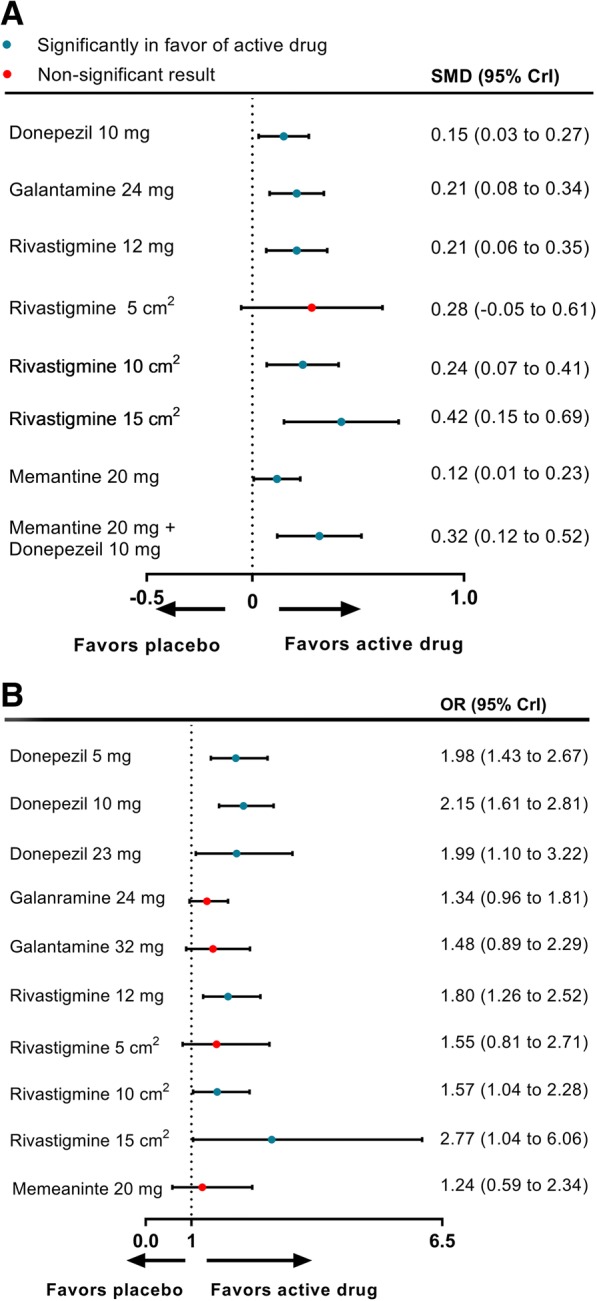
Cholinesterase inhibitors and memantine have been approved for management of Alzheimer’s disease (AD), but there has been no consensus about the choice of various types and doses of drugs at different stages. Hence, we compared and ranked the efficacy and tolerability of these available drugs. We searched PubMed, the Cochrane Central Register of Controlled Trials, and Embase for randomized controlled trials (RCTs) published from database inception to July 21, 2017. The primary outcomes were the mean overall changes in cognitive function and responders who had any adverse events. We conducted a random-effects network meta-analysis. Forty-one RCTs were included in this study. Compared with placebo, galantamine 32 mg daily (standardized mean difference – 0.51, 95% credible interval – 0.67 to − 0.35), galantamine 24 mg daily (− 0.50, − 0.61 to − 0.40), and donepezil 10 mg daily (− 0.40, − 0.51 to − 0.29) were probably the most effective agents on cognition for mild to moderate AD, and memantine 20 mg combined with donepezil 10 mg (0.76, 0.39 to 1.11) was recommended for moderate to severe patients. Memantine showed the best profile of acceptability. Rivastigmine transdermal 15-cm 2 patch was the best optional treatment both in function and global changes. None of the medicines was likely to improve neuropsychiatric symptoms through this analysis. Pharmacological interventions have beneficial effects on cognition, function, and global changes, but not on neuropsychiatric symptoms, through current network meta-analysis. The choice of drugs may mainly depend on the disease severity and clinical symptoms.
Overview
The claims and statistics of this paper haven’t been checked yet.
Run the check — free, no account needed. It reads the open-access text and checks the sources it cites.
Integrity signals
Registry
Cites
Statistics
Figures
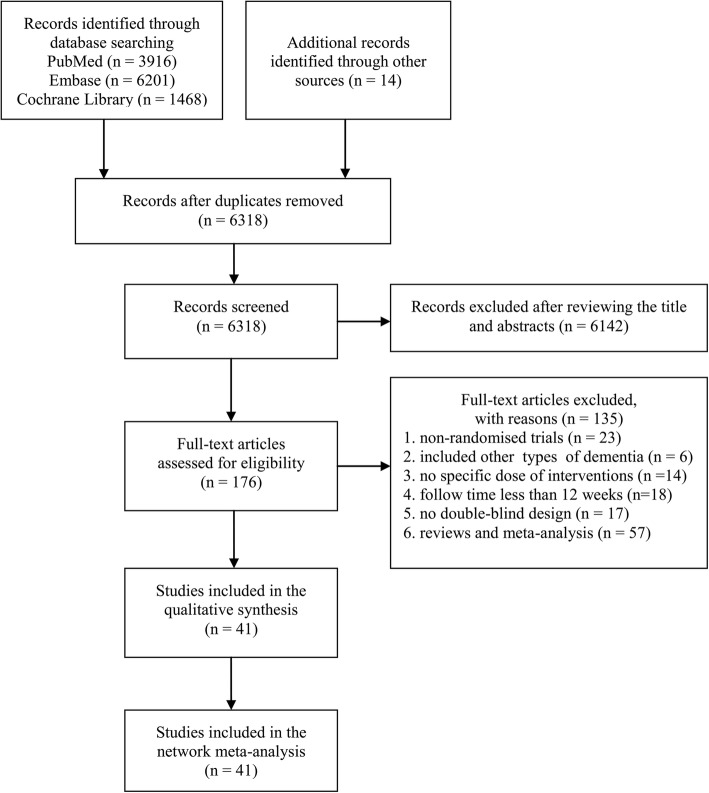
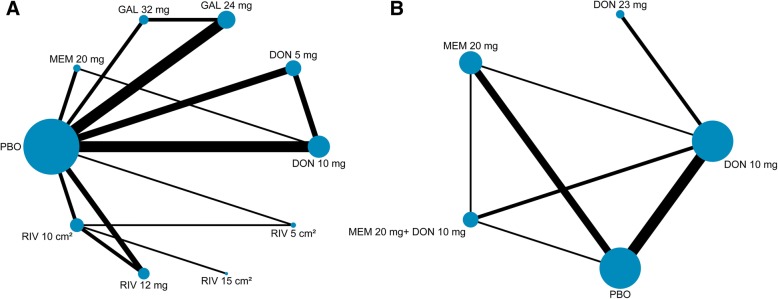
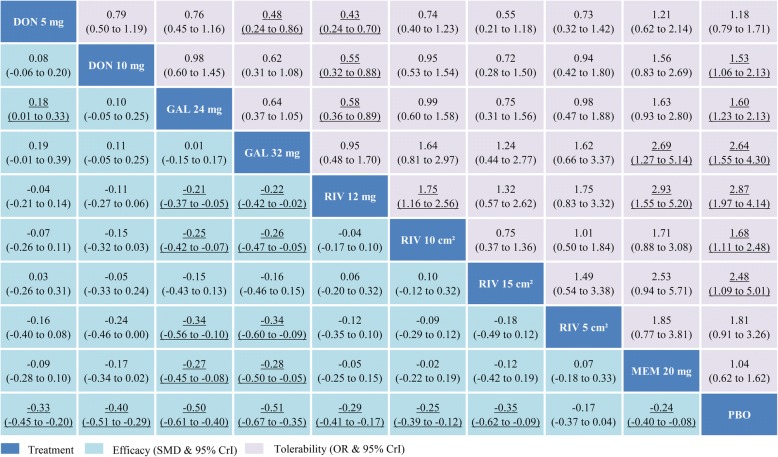
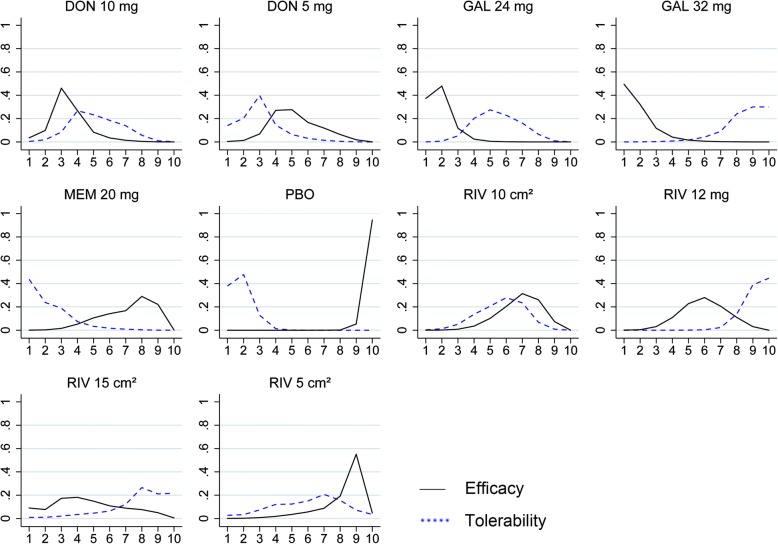
Verification
Claims the paper makes
The claims and statistics of this paper haven’t been checked yet.
Run the check — free, no account needed. It reads the open-access text and checks the sources it cites.
Claims other papers make about this one
Each is checked against this paper’s own text: does it say what the citing paper says it does?
In the citing paper
“Cholinesterase inhibitors provide only symptomatic relief of behavioral deficits without modifying the complex pathologies in mild to moderate AD patients [20].”
From Indian Medicinal Herbs and Formulations for Alzheimer’s Disease, from Traditional Knowledge to Scientific Assessment (2020) · cites this paper as [20]
In the citing paper
“However, memantine is mainly recommended for moderate to severe AD cases [20].”
From Indian Medicinal Herbs and Formulations for Alzheimer’s Disease, from Traditional Knowledge to Scientific Assessment (2020) · cites this paper as [20]
Self-check
Percentages, sums and reported differences re-computed from the paper’s own numbers.
The self-check needs the paper’s full text.
Citations
Cites
McKhann, G., Drachman, D., Folstein, M., Katzman, R., Price, D., & Stadlan, E. M. (1984) · Neurology · doi:10.1212/wnl.34.7.939 · Cited by 27,915
Dementia prevention, intervention, and care
Livingston, G., Sommerlad, A., Orgeta, V., Costafreda, S. G., Huntley, J., Ames, D., Ballard, C., Banerjee, S., Burns, A., Cohen-Mansfield, J., et al. (2017) · The Lancet · doi:10.1016/s0140-6736(17)31363-6 · Cited by 6,072
Salanti, G., Ades, A. E., & Ioannidis, J. P. A. (2011) · Journal of Clinical Epidemiology · doi:10.1016/j.jclinepi.2010.03.016 · Cited by 3,766
Checking consistency in mixed treatment comparison meta-analysis
Dias, S., Welton, N. J., Caldwell, D. M., & Ades, A. E. (2010) · Statistics in Medicine · doi:10.1002/sim.3767 · Cited by 2,521
Graphical tools for network meta-analysis in STATA
Chaimani, A., Higgins, J. P. T., Mavridis, D., Spyridonos, P., & Salanti, G. (2013) · PLoS ONE · doi:10.1371/journal.pone.0076654 · Cited by 2,473
(2015) · HAL · Cited by 2,238
Cholinesterase inhibitors for Alzheimer's disease
Birks, J. S. (2006) · Cochrane Database of Systematic Reviews · doi:10.1002/14651858.cd005593 · Cited by 1,906
Simultaneous comparison of multiple treatments: Combining direct and indirect evidence.
Caldwell, D. M., Ades, A. E., & Higgins, J. P. T. (2005) · BMJ · doi:10.1136/bmj.331.7521.897 · Cited by 1,600
Alzheimer’s disease: Clinical trials and drug development
Mangialasche, F., Solomon, A., Winblad, B., Mecocci, P., & Kivipelto, M. (2010) · The Lancet Neurology · doi:10.1016/s1474-4422(10)70119-8 · Cited by 1,217
Neuropsychiatric symptoms in Alzheimer's disease
Lyketsos, C. G., Carrillo, M. C., Ryan, J. M., Khachaturian, A. S., Trzepacz, P., Amatniek, J., Cedarbaum, J., Brashear, R., & Miller, D. S. (2011) · Alzheimer's & Dementia · doi:10.1016/j.jalz.2011.05.2410 · Cited by 1,139
Research works printed but not linked: 1
- NICE. Donepezil, galantamine, rivastigmine and memantine for the treatment of Alzheimer’s disease. London: National Institute for Health and Care Excellence; 2011.
Cited by
Sorted by citations
Cognitive impairment in schizophrenia: aetiology, pathophysiology, and treatment
McCutcheon, R. A., Keefe, R. S. E., & McGuire, P. K. (2023) · Molecular Psychiatry · doi:10.1038/s41380-023-01949-9 · Cited by 861
Alzheimer’s Disease Pharmacotherapy in Relation to Cholinergic System Involvement
Stanciu, G. D., Luca, A., Rusu, R.-N., Bild, V., Chiriac, S. I. B., Solcan, C., Bild, W., & Ababei, D. C. (2019) · Biomolecules · doi:10.3390/biom10010040 · Cited by 307
New approaches to symptomatic treatments for Alzheimer’s disease
Cummings, J. (2021) · Molecular Neurodegeneration · doi:10.1186/s13024-021-00424-9 · Cited by 226
Safiri, S., Jolfayi, A. G., Fazlollahi, A., Morsali, S., Sarkesh, A., Sorkhabi, A. D., Golabi, B., Aletaha, R., Asghari, K. M., Hamidi, S., et al. (2024) · Frontiers in Medicine · doi:10.3389/fmed.2024.1474043 · Cited by 273
Gąsiorowska, A., Wydrych, M., Drapich, P., Zadrożny, M., Steczkowska, M., Niewiadomski, W., & Niewiadomska, G. (2021) · Frontiers in Aging Neuroscience · doi:10.3389/fnagi.2021.654931 · Cited by 199
Metadata
- Authors
- Dou, K.-X., Tan, M.-S., Tan, C.-C., Cao, X.-P., Hou, X.-H., Guo, Q.-H., Tan, L., Mok, V., & Yu, J.-T.
- Affiliations
- Qingdao University (CN)
- Fudan University (CN)
- Chinese University of Hong Kong (HK)
- Corresponding author
- Tan, Lan
- Yu, Jin-Tai
- Venue
- Alzheimer's Research & Therapy
- Published
- 2018-12
- Volume
- 10
- Issue
- 1
- Pages
- 126-126
- ISSN
- 1758-9193 (ISSN-L)
- PMC
- PMC6309083
- OpenAlex
- W2907817008
- Cited by
- 171
- References
- 41
- Citations by year
- 2026: 15 · 2025: 24 · 2024: 24 · 2023: 31 · 2022: 28 · 2021: 22 · 2020: 16 · 2019: 11
- FWCI
- 1.86
- Type
- journal article
- Language
- en
- Open access
- gold
- doi.org
- Licence
- Locations
- Alzheimer s Research & Therapy (publishedVersion, cc-by)
- Europe PMC (PubMed Central) (publishedVersion, other-oa)
- PubMed Central (publishedVersion, cc-by)
- PubMed (publishedVersion)
- DOAJ (DOAJ: Directory of Open Access Journals) (submittedVersion, cc-by-sa)
- Topics
- Health Sciences › Medicine › Psychiatry and Mental health › Dementia and Cognitive Impairment Research
- Health Sciences › Medicine › Pharmacology (medical) › Cholinesterase and Neurodegenerative Diseases
- Life Sciences › Neuroscience › Cellular and Molecular Neuroscience › Alzheimer's disease research and treatments
- Keywords
- Alzheimer's disease, cholinesterase inhibitors, memantine, galantamine, donepezil, rivastigmine, cognitive function, drug efficacy, drug safety, tolerability, neuropsychiatric symptoms, disease severity, combination therapy
- MeSH terms
- Network Meta-Analysis, Alzheimer Disease, Cholinesterase Inhibitors, Female, Humans, Male, Memantine, Randomized Controlled Trials as Topic, Treatment Outcome, Nootropic Agents
About these checks
Registry, retraction, Cites and statistics results are computed, not judged, with one exception: a printed reference that no index lists is read once by a model before it counts as a citation error. Claims are extracted by a model and kept only when their quote appears verbatim in the text; each cited source is then checked, with a model’s help, for whether it says what the claim relies on. Those verdicts can be wrong — read the claim’s quote and the cited source before relying on one.
Statistics and arithmetic are recomputed, not judged.
Confidence bands are shown only for fields calibrated on our annotated test set. None is calibrated yet, so no band is shown.
What counts as a claim ›How we measure confidence ›How we check this ›
Are you an author, or do you see a problem with this page? Request a review
