

Repurposed agents in the Alzheimer’s disease drug development pipeline
Open accessThe DOI matches its Crossref record; 55 of the 55 references it cites were found in a registry or an index.
Abstract
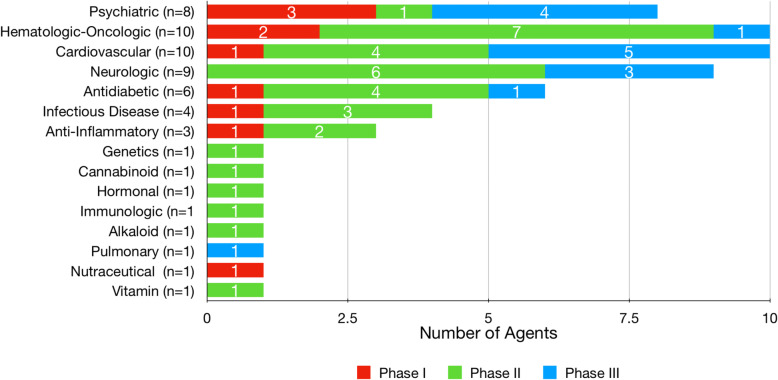
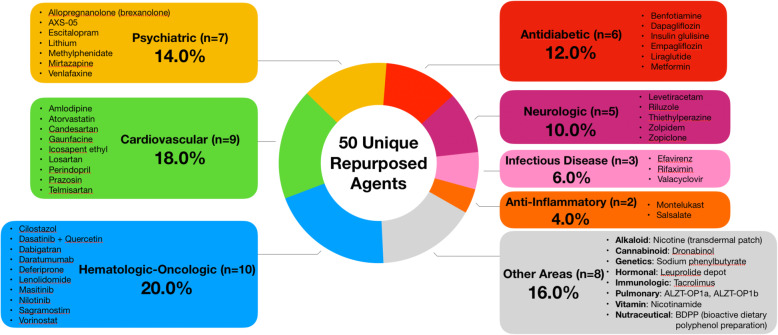
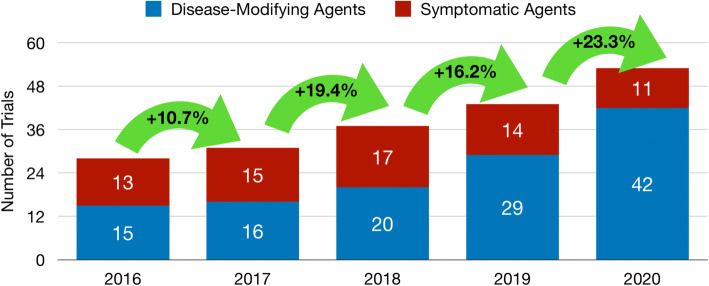
Background: Treatments are needed to address the growing prevalence of Alzheimer’s disease (AD). Clinical trials have failed to produce any AD drugs for Food and Drug Administration (FDA) approval since 2003, and the pharmaceutical development process is both time-consuming and costly. Drug repurposing provides an opportunity to accelerate this process by investigating the AD-related effects of agents approved for other indications. These drugs have known safety profiles, pharmacokinetic characterization, formulations, doses, and manufacturing processes. Methods: We assessed repurposed AD therapies represented in Phase I, Phase II, and Phase III of the current AD pipeline as registered on ClinicalTrials.gov as of February 27, 2020. Results: We identified 53 clinical trials involving 58 FDA-approved agents. Seventy-eight percent of the agents in trials had putative disease-modifying mechanisms of action. Of the repurposed drugs in the pipeline 20% are hematologic-oncologic agents, 18% are drugs derived from cardiovascular indications, 14% are agents with psychiatric uses, 12% are drug used to treat diabetes, 10% are neurologic agents, and the remaining 26% of drugs fall under other conditions. Intellectual property strategies utilized in these programs included using the same drug but altering doses, routes of administration, or formulations. Most repurposing trials were supported by Academic Medical Centers and were not funded through the biopharmaceutical industry. We compared our results to a European trial registry and found results similar to those derived from ClinicalTrials.gov. Conclusions: Drug repurposing is a common approach to AD drug development and represents 39% of trials in the current AD pipeline. Therapies from many disease areas provide agents potentially useful in AD. Most of the repurposed agents are generic and a variety of intellectual property strategies have been adopted to enhance their economic value.
Overview
The claims and statistics of this paper haven’t been checked yet.
Free: it reads the open-access text and checks the first 5 claims that cite a source we can check. Create a free account to check every claim.
Integrity signals
Registry
Cites
Statistics
Figures

Verification
Claims the paper makes
The claims and statistics of this paper haven’t been checked yet.
Free: it reads the open-access text and checks the first 5 claims that cite a source we can check. Create a free account to check every claim.
Claims other papers make about this one
Each is checked against this paper’s own text: does it say what the citing paper says it does?
The cited source says what the claim attributes to it.
In the citing paper
“These drugs are noted for their extensive safety and tolerance profiles, as well as their potential for multiple uses.428,430”
From Recent advances in Alzheimer's disease: Mechanisms, clinical trials and new drug development strategies. (2024) · cites this paper as [428]
The cited source says what the claim attributes to it.
In the citing paper
“The long, high-cost, and resource-heavy process of developing AD medications, coupled with their high rate of failure, has led to growing interest in repurposing medications originally designed for other conditions, including cancer, cardiovascular diseases, psychiatric disorders, diabetes, and other neurological diseases.428,429”
From Recent advances in Alzheimer's disease: Mechanisms, clinical trials and new drug development strategies. (2024) · cites this paper as [428]
In the citing paper
“A recent study assessing the repurposed AD therapies represented in Phase I, II, and III since February 2020 identified 53 clinical trials investigating 58 total repurposed drugs with the various initial clinical application (20% hematologic-oncologic, 18% cardiovascular, 14% psychiatric, 12% diabetes, 10% are neurologic, 26% other conditions) [41].”
From Multi-Target Mechanisms of Phytochemicals in Alzheimer’s Disease: Effects on Oxidative Stress, Neuroinflammation and Protein Aggregation (2022) · cites this paper as [41]
In the citing paper
“comparisons show that only a few agents registered in the European Union Clinical Trial Register, for example, are not found on ClinicalTrials.gov.”
From Alzheimer’s disease drug development pipeline: 2021 (2021) · cites this paper as [18]
Self-check
Percentages, sums and reported differences re-computed from the paper’s own numbers.
The self-check needs the paper’s full text.
Citations
Cites
Forecasting the global burden of Alzheimer's disease
Brookmeyer, R., Johnson, E., Ziegler‐Graham, K., & Arrighi, H. M. (2007) · Alzheimer's & Dementia · doi:10.1016/j.jalz.2007.04.381 · Cited by 3,370
Masters, C. L., Bateman, R., Blennow, K., Rowe, C. C., Sperling, R. A., & Cummings, J. L. (2015) · Nature Reviews Disease Primers · doi:10.1038/nrdp.2015.56 · Cited by 1,853
Self-citationNeuroinflammation in Alzheimer's disease: current evidence and future directions
Calsolaro, V., & Edison, P. (2016) · Alzheimer's & Dementia · doi:10.1016/j.jalz.2016.02.010 · Cited by 1,726
Cummings, J., Isaacson, S., Mills, R., Williams, H., Chi-Burris, K., Corbett, A., Dhall, R., & Ballard, C. (2014) · The Lancet · doi:10.1016/s0140-6736(13)62106-6 · Cited by 954
Self-citationAlzheimer's disease drug development pipeline: 2019
Cummings, J., Lee, G., Ritter, A., Sabbagh, M., & Zhong, K. (2019) · Alzheimer's & Dementia: Translational Research & Clinical Interventions · doi:10.1016/j.trci.2019.05.008 · Cited by 762
Self-citationAlzheimer's disease drug development pipeline: 2018
Cummings, J., Lee, G., Ritter, A., & Zhong, K. (2018) · Alzheimer's & Dementia: Translational Research & Clinical Interventions · doi:10.1016/j.trci.2018.03.009 · Cited by 697
Self-citationAlzheimer’s disease drug development pipeline: 2020
Cummings, J., Lee, G., Ritter, A., Sabbagh, M., & Zhong, K. (2020) · Alzheimer's & Dementia: Translational Research & Clinical Interventions · doi:10.1002/trc2.12050 · Cited by 557
Self-citationAlzheimer's disease drug development pipeline: 2017
Cummings, J., Lee, G., Mortsdorf, T., Ritter, A., & Zhong, K. (2017) · Alzheimer's & Dementia: Translational Research & Clinical Interventions · doi:10.1016/j.trci.2017.05.002 · Cited by 549
Self-citationCompliance with Results Reporting at ClinicalTrials.gov
Anderson, M. L., Chiswell, K., Peterson, E. D., Tasneem, A., Topping, J., & Califf, R. M. (2015) · New England Journal of Medicine · doi:10.1056/nejmsa1409364 · Cited by 380 · cited 1×
“By US law, all clinical trials conducted within the US must be registered within 21 days of the enrollment of the first participant [15, 16].”
Cummings, J., Mintzer, J., Brodaty, H., Sano, M., Banerjee, S., Devanand, D. P., Gauthier, S., Howard, R., Lanctôt, K., Lyketsos, C. G., et al. (2015) · International Psychogeriatrics · doi:10.1017/s1041610214001963 · Cited by 355
Self-citationKoenig, A. M., Mechanic-Hamilton, D., Xie, S. X., Combs, M. F., Cappola, A. R., Xie, L., Detre, J. A., Wolk, D. A., & Arnold, S. E. (2017) · Alzheimer Disease & Associated Disorders · doi:10.1097/wad.0000000000000202 · Cited by 350
Boguski, M. S., Mandl, K. D., & Sukhatme, V. P. (2009) · Science · doi:10.1126/science.1169920 · Cited by 220
Nilvadipine in mild to moderate Alzheimer disease: A randomised controlled trial
Lawlor, B., Segurado, R., Kennelly, S., Olde Rikkert, M. G. M., Howard, R., Pasquier, F., Börjesson-Hanson, A., Tsolaki, M., Lucca, U., Molloy, D. W., et al. (2018) · PLOS Medicine · doi:10.1371/journal.pmed.1002660 · Cited by 193
Thomas, T., Miners, S., & Love, S. (2015) · Brain · doi:10.1093/brain/awv025 · Cited by 190
Grossberg, G. T., Kohegyi, E., Mergel, V., Josiassen, M. K., Meulien, D., Hobart, M., Slomkowski, M., Baker, R. A., McQuade, R. D., & Cummings, J. L. (2020) · The American Journal of Geriatric Psychiatry · doi:10.1016/j.jagp.2019.09.009 · Cited by 169
Self-citationKehoe, P. G. (2018) · Journal of Alzheimer’s Disease · doi:10.3233/jad-171119 · Cited by 133
Cerovic, M., Forloni, G., & Balducci, C. (2019) · Frontiers in Aging Neuroscience · doi:10.3389/fnagi.2019.00284 · Cited by 128
Drug Discovery and Development
(2006) · Chemical & Engineering News · doi:10.1021/cen-v084n039.p020 · Cited by 127
Alzheimer's drug‐development pipeline: 2016
Cummings, J., Morstorf, T., & Lee, G. (2016) · Alzheimer's & Dementia: Translational Research & Clinical Interventions · doi:10.1016/j.trci.2016.07.001 · Cited by 108
Self-citationDrug repositioning for Alzheimer’s disease based on systematic “omics” data mining
Zhang, M., Schmitt-Ulms, G., Sato, C., Xi, Z., Zhang, Y., Zhou, Y., St George-Hyslop, P., & Rogaeva, E. (2016) · PLOS ONE · doi:10.1371/journal.pone.0168812 · Cited by 108
In silico repurposing of antipsychotic drugs for Alzheimer’s disease
Kumar, S., Chowdhury, S., & Kumar, S. (2017) · BMC Neuroscience · doi:10.1186/s12868-017-0394-8 · Cited by 103
Harnessing endophenotypes and network medicine for Alzheimer's drug repurposing
Fang, J., Pieper, A. A., Nussinov, R., Lee, G., Bekris, L., Leverenz, J. B., Cummings, J., & Cheng, F. (2020) · Medicinal Research Reviews · doi:10.1002/med.21709 · Cited by 94 · cited 1×
“Electronic health records may provide evidence of beneficial effects on AD or other neurodegenerative disorders by therapies approved for other indications and represent another means for discovering repurposing agents [39, 40].”
BackgroundSelf-citationBoada, M., López, O., Núñez, L., Szczepiorkowski, Z. M., Torres, M., Grifols, C., & Páez, A. (2019) · Alzheimer's & Dementia: Translational Research & Clinical Interventions · doi:10.1016/j.trci.2019.01.001 · Cited by 91
Verbaanderd, C., Rooman, I., Meheus, L., & Huys, I. (2020) · Frontiers in Pharmacology · doi:10.3389/fphar.2019.01664 · Cited by 91
A Review: Treatment of Alzheimer’s Disease Discovered in Repurposed Agents
Appleby, B. S., Nacopoulos, D., Milano, N., Zhong, K., & Cummings, J. L. (2013) · Dementia and Geriatric Cognitive Disorders · doi:10.1159/000345791 · Cited by 90
Self-citationSakurai, H., Hanyu, H., Sato, T., Kume, K., Hirao, K., Kanetaka, H., & Iwamoto, T. (2013) · Geriatrics & Gerontology International · doi:10.1111/j.1447-0594.2012.00866.x · Cited by 90
Economic analysis of opportunities to accelerate Alzheimer's disease research and development
Scott, T. J., O'Connor, A. C., Link, A. N., & Beaulieu, T. J. (2014) · Annals of the New York Academy of Sciences · doi:10.1111/nyas.12417 · Cited by 87
Metabolic Dysfunction in Alzheimer’s Disease: From Basic Neurobiology to Clinical Approaches
Clarke, J. R., Ribeiro, F. C., Frozza, R. L., De Felice, F. G., & Lourenco, M. V. (2018) · Journal of Alzheimer's Disease · doi:10.3233/jad-179911 · Cited by 87
Bioinformatics methods in drug repurposing for Alzheimer’s disease
Siavelis, J. C., Bourdakou, M. M., Athanasiadis, E. I., Spyrou, G. M., & Nikita, K. S. (2016) · Briefings in Bioinformatics · doi:10.1093/bib/bbv048 · Cited by 87
Pimavanserin: Potential Treatment For Dementia-Related Psychosis
Cummings, J., Ballard, C., Tariot, P., Owen, R., Foff, E., Youakim, J., Norton, J., & Stankovic, S. (2018) · The Journal of Prevention of Alzheimer's Disease · doi:10.14283/jpad.2018.29 · Cited by 85
Self-citationMustapic, M., Tran, J., Craft, S., & Kapogiannis, D. (2019) · Journal of Alzheimer's Disease · doi:10.3233/jad-180578 · Cited by 76
Insights into Computational Drug Repurposing for Neurodegenerative Disease
Paranjpe, M. D., Taubes, A., & Sirota, M. (2019) · Trends in Pharmacological Sciences · doi:10.1016/j.tips.2019.06.003 · Cited by 70
Kile, S., Au, W., Parise, C., Rose, K., Donnel, T., Hankins, A., Chan, M., & Ghassemi, A. (2017) · Journal of Neurology, Neurosurgery & Psychiatry · doi:10.1136/jnnp-2015-311486 · Cited by 67
Fleminger, J., & Goldacre, B. M. (2018) · PLoS ONE · doi:10.1371/journal.pone.0193088 · Cited by 64
Repurpose terbutaline sulfate for amyotrophic lateral sclerosis using electronic medical records
Paik, H., Chung, A.-Y., Park, H.-C., Park, R. W., Suk, K., Kim, J., Kim, H., Lee, K., & Butte, A. J. (2015) · Scientific Reports · doi:10.1038/srep08580 · Cited by 59
Drug Repositioning: An Opportunity to Develop Novel Treatments for Alzheimer’s Disease
Corbett, A., Williams, G., & Ballard, C. (2013) · Pharmaceuticals · doi:10.3390/ph6101304 · Cited by 50
Gągało, I., Rusiecka, I., & Kocić, I. (2015) · Current Neuropharmacology · doi:10.2174/1570159x13666150518235504 · Cited by 46
Complementary new approaches enable repositioning of failed drug candidates
Tartaglia, L. A. (2006) · Expert Opinion on Investigational Drugs · doi:10.1517/13543784.15.11.1295 · Cited by 44
Drug Repositioning for Alzheimer’s Disease: Finding Hidden Clues in Old Drugs
Ihara, M., & Saito, S. (2020) · Journal of Alzheimer’s Disease · doi:10.3233/jad-200049 · Cited by 44
Pillamarapu, M., Mohan, A., & Saberwal, G. (2019) · Trials · doi:10.1186/s13063-019-3592-0 · Cited by 43
Lee, J. H., Park, S. Y., Shin, H. K., Kim, C. D., Lee, W. S., & Hong, K. W. (2008) · CNS Neuroscience & Therapeutics · doi:10.1111/j.1527-3458.2008.00042.x · Cited by 42
The biology of Alzheimer's disease
Edelberg, H. K., & Wei, J. Y. (1996) · Mechanisms of Ageing and Development · doi:10.1016/0047-6374(96)01778-2 · Cited by 41
Lassman, S. M., Shopshear, O. M., Jazic, I., Ulrich, J., & Francer, J. (2017) · BMJ Open · doi:10.1136/bmjopen-2016-015110 · Cited by 40 · cited 1×
“By US law, all clinical trials conducted within the US must be registered within 21 days of the enrollment of the first participant [15, 16].”
Do Cancer Drugs Counteract Neurodegeneration? Repurposing for Alzheimer’s Disease
Monacelli, F., Cea, M., Borghi, R., Odetti, P., & Nencioni, A. (2016) · Journal of Alzheimer's Disease · doi:10.3233/jad-160840 · Cited by 30
Pharmacological Potential of Cilostazol for Alzheimer’s Disease
Ono, K., & Tsuji, M. (2019) · Frontiers in Pharmacology · doi:10.3389/fphar.2019.00559 · Cited by 30
Type 3 diabetes (Alzheimer's disease): new insight for promising therapeutic avenues
Candasamy, M., Elhassan, S. A. M., Bhattamisra, S. K., Hua, W. Y., Sern, L. M., Busthamin, N. A. B., Ilni, N. B. M., Shun, N. S., Baohong, L., Ya, N. S., et al. (2020) · Panminerva Medica · doi:10.23736/s0031-0808.20.03879-3 · Cited by 27
Drug Discovery and Development
(2006) · Wiley eBooks · doi:10.1002/0470085223 · Cited by 25
Repurposed Drugs as Potential Therapeutic Candidates for the Management of Alzheimer's Disease
Shoaib, M., Kamal, M. A., & Rizvi, S. M. D. (2017) · Current Drug Metabolism · doi:10.2174/1389200218666170607101622 · Cited by 25
Parsons, C. G. (2019) · Neuropharmacology · doi:10.1016/j.neuropharm.2018.08.027 · Cited by 22
Novel insight into drug repositioning: Methylthiouracil as a case in point
Baek, M., Jung, B., Kang, H., Lee, H., & Bae, J. (2015) · Pharmacological Research · doi:10.1016/j.phrs.2015.06.008 · Cited by 21
Clyne, B., Boland, F., Murphy, N., Murphy, E., Moriarty, F., Barry, A., Wallace, E., Devine, T., Smith, S. M., Devane, D., et al. (2020) · Trials · doi:10.1186/s13063-020-04396-x · Cited by 21
Strzebońska, K., Wasylewski, M. T., Zaborowska, Ł., Riedel, N., Wieschowski, S., Strech, D., & Waligóra, M. (2020) · BMJ Open · doi:10.1136/bmjopen-2019-034666 · Cited by 18
Medical genetics-based drug repurposing for Alzheimer's disease
Zhang, X., Quan, Y., & Tang, G.-Y. (2014) · Brain Research Bulletin · doi:10.1016/j.brainresbull.2014.11.003 · Cited by 8
Lorazepam Challenge for Individuals at Varying Genetic Risk for Alzheimer Disease
Stonnington, C. M., Harel, B., Locke, D. E. C., Hentz, J. G., Zhang, N., Maruff, P. T., & Caselli, R. J. (2017) · Alzheimer Disease & Associated Disorders · doi:10.1097/wad.0000000000000200 · Cited by 4
Pandolfini, C., & Bonati, M. R. (2018) · Trials · doi:10.1186/s13063-018-2910-2 · Cited by 4
Cited by
Zhang, J., Zhang, Y., Wang, J., Xia, Y., Zhang, J., & Chen, L. (2024) · Signal Transduction and Targeted Therapy · doi:10.1038/s41392-024-01911-3 · Cited by 1,138
Alzheimer’s disease drug development pipeline: 2021
Cummings, J., Lee, G., Zhong, K., Fonseca, J., & Taghva, K. (2021) · Alzheimer's & Dementia: Translational Research & Clinical Interventions · doi:10.1002/trc2.12179 · Cited by 539
Self-citationChallenges and hopes for Alzheimer’s disease
Tatulian, S. A. (2022) · Drug Discovery Today · doi:10.1016/j.drudis.2022.01.016 · Cited by 291
Recent advances on drug development and emerging therapeutic agents for Alzheimer’s disease
Athar, T., Al Balushi, K., & Khan, S. A. (2021) · Molecular Biology Reports · doi:10.1007/s11033-021-06512-9 · Cited by 247
Alzheimer’s Disease: Exploring the Landscape of Cognitive Decline
Tenchov, R., Sasso, J. M., & Zhou, Q. A. (2024) · ACS Chemical Neuroscience · doi:10.1021/acschemneuro.4c00339 · Cited by 170
Metadata
- Authors
- Bauzon, J., Lee, G., & Cummings, J.
- Affiliations
- University of Nevada, Las Vegas (US)
- Cleveland Clinic (US)
- Corresponding author
- Cummings, Jeffrey
- Venue
- Alzheimer's Research & Therapy
- Published
- 2020-08-17
- Volume
- 12
- Issue
- 1
- Pages
- 98-98
- ISSN
- 1758-9193 (ISSN-L)
- PMC
- PMC7433208
- OpenAlex
- W3049299998
- Cited by
- 77
- References
- 55
- Citations by year
- 2026: 8 · 2025: 9 · 2024: 11 · 2023: 12 · 2022: 16 · 2021: 20 · 2020: 1
- FWCI
- 7.37
- Type
- journal article
- Language
- en
- Update notices
- correction (2023-08-21)
- Open access
- gold
- doi.org
- Licence
- cc-by
- creativecommons.org/licenses/by/4.0 (tdm)
- creativecommons.org/licenses/by/4.0 (vor)
- Locations
- Alzheimer s Research & Therapy (publishedVersion, cc-by)
- PubMed Central (publishedVersion, cc-by)
- PubMed (publishedVersion)
- Digital Scholarship - UNLV (University of Nevada Reno) (submittedVersion, cc-by)
- DOAJ (DOAJ: Directory of Open Access Journals) (submittedVersion, cc-by-sa)
- Funders
- National Institute of General Medical Sciences (P20GM109025)
- National Institute of Neurological Disorders and Stroke (U01NS093334)
- National Institute on Aging (R01AG053798)
- Topics
- Life Sciences › Neuroscience › Cellular and Molecular Neuroscience › Alzheimer's disease research and treatments
- Health Sciences › Medicine › Psychiatry and Mental health › Dementia and Cognitive Impairment Research
- Health Sciences › Medicine › Pharmacology (medical) › Cholinesterase and Neurodegenerative Diseases
- Keywords
- Alzheimer's disease, drug repurposing, clinical trials, drug development pipeline, FDA-approved drugs, disease-modifying therapy, intellectual property strategy, clinical trial funding, ClinicalTrials.gov
- MeSH terms
- Alzheimer Disease, Humans, United States, United States Food and Drug Administration, Drug Repositioning
About these checks
Registry, retraction, Cites and statistics results are computed, not judged, with one exception: a printed reference that no index lists is read once by a model before it counts as a citation error. Claims are extracted by a model and kept only when their quote appears verbatim in the text; each cited source is then checked, with a model’s help, for whether it says what the claim relies on. Those verdicts can be wrong — read the claim’s quote and the cited source before relying on one.
Statistics and arithmetic are recomputed, not judged.
Confidence bands are shown only for fields calibrated on our annotated test set. None is calibrated yet, so no band is shown.
What counts as a claim ›How we measure confidence ›How we check this ›
Are you an author, or do you see a problem with this page? Request a review
Data sources
Bibliographic data: Semantic Scholar, OpenAlex, Crossref.
Contains information from the Semantic Scholar Academic Graph Datasets, made available under the ODC Attribution License (ODC-BY 1.0).
Semantic Scholar’s data is described in: Kinney, R., et al. (2023). The Semantic Scholar Open Data Platform. arXiv:2301.10140.
