

The DOI matches its Crossref record; 156 of the 157 references it cites were found in a registry or an index.
Machine learning methods for predicting progression from mild cognitive impairment to Alzheimer’s disease dementia: a systematic review
Open accessAbstract
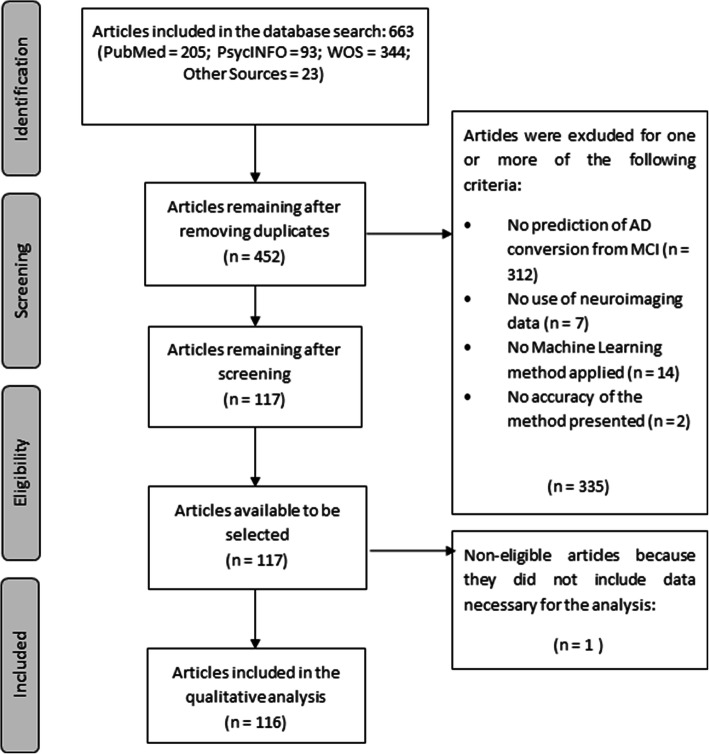
Background: An increase in lifespan in our society is a double-edged sword that entails a growing number of patients with neurocognitive disorders, Alzheimer’s disease being the most prevalent. Advances in medical imaging and computational power enable new methods for the early detection of neurocognitive disorders with the goal of preventing or reducing cognitive decline. Computer-aided image analysis and early detection of changes in cognition is a promising approach for patients with mild cognitive impairment, sometimes a prodromal stage of Alzheimer’s disease dementia. Methods: We conducted a systematic review following PRISMA guidelines of studies where machine learning was applied to neuroimaging data in order to predict whether patients with mild cognitive impairment might develop Alzheimer’s disease dementia or remain stable. After removing duplicates, we screened 452 studies and selected 116 for qualitative analysis. Results: Most studies used magnetic resonance image (MRI) and positron emission tomography (PET) data but also magnetoencephalography. The datasets were mainly extracted from the Alzheimer’s disease neuroimaging initiative (ADNI) database with some exceptions. Regarding the algorithms used, the most common was support vector machine with a mean accuracy of 75.4%, but convolutional neural networks achieved a higher mean accuracy of 78.5%. Studies combining MRI and PET achieved overall better classification accuracy than studies that only used one neuroimaging technique. In general, the more complex models such as those based on deep learning, combined with multimodal and multidimensional data (neuroimaging, clinical, cognitive, genetic, and behavioral) achieved the best performance. Conclusions: Although the performance of the different methods still has room for improvement, the results are promising and this methodology has a great potential as a support tool for clinicians and healthcare professionals.
Overview
The claims and statistics of this paper haven’t been checked yet.
Run the check — free, no account needed. It reads the open-access text and checks the sources it cites.
Integrity signals
Registry
Cites
Statistics
Figures
Verification
Claims the paper makes
The claims and statistics of this paper haven’t been checked yet.
Run the check — free, no account needed. It reads the open-access text and checks the sources it cites.
Claims other papers make about this one
Each is checked against this paper’s own text: does it say what the citing paper says it does?
In the citing paper
“By integrating neuroimaging, genetic, and clinical data, researchers have developed models that can identify individuals at high risk of developing Alzheimer’s disease [15–18].”
From Integrating machine learning and artificial intelligence in life-course epidemiology: pathways to innovative public health solutions (2024) · cites this paper as [15]
Self-check
Percentages, sums and reported differences re-computed from the paper’s own numbers.
The self-check needs the paper’s full text.
Citations
Cites
Diagnostic and Statistical Manual of Mental Disorders
American Psychiatric Association (2013) · doi:10.1176/appi.books.9780890425596 · Cited by 116,369
Diagnostic and Statistical Manual of Mental Disorders
Williams, J. B. W., & First, M. B. (2013) · Oxford University Press eBooks · doi:10.1093/acrefore/9780199975839.013.104 · Cited by 109,845
Preferred Reporting Items for Systematic Reviews and Meta-Analyses: the PRISMA statement
Moher, D., Liberati, A., Tetzlaff, J., Altman, D. G., & for the PRISMA Group (2009) · BMJ · doi:10.1136/bmj.b2535 · Cited by 83,823
Preferred reporting items for systematic reviews and meta-analyses: the PRISMA Statement.
(2009) · PubMed Central · Cited by 44,859
Liberati, A., Altman, D. G., Tetzlaff, J., Mulrow, C., Gøtzsche, P. C., Ioannidis, J. P. A., Clarke, M., Devereaux, P. J., Kleijnen, J., & Moher, D. (2009) · PLoS Medicine · doi:10.1371/journal.pmed.1000100 · Cited by 28,164
The meaning and use of the area under a receiver operating characteristic (ROC) curve.
Hanley, J. A., & McNeil, B. J. (1982) · Radiology · doi:10.1148/radiology.143.1.7063747 · Cited by 21,856
Preferred Reporting Items for Systematic Reviews and Meta-Analyses: The PRISMA Statement
Moher, D., Liberati, A., Tetzlaff, J., & Altman, D. G. (2009) · Journal of Clinical Epidemiology · doi:10.1016/j.jclinepi.2009.06.005 · Cited by 19,575
McKhann, G. M., Knopman, D. S., Chertkow, H., Hyman, B. T., Jack, C. R., Kawas, C. H., Klunk, W. E., Koroshetz, W. J., Manly, J. J., Mayeux, R., et al. (2011) · Alzheimer's & Dementia · doi:10.1016/j.jalz.2011.03.005 · Cited by 18,657
Liberati, A., Altman, D. G., Tetzlaff, J., Mulrow, C., Gotzsche, P. C., Ioannidis, J. P. A., Clarke, M., Devereaux, P. J., Kleijnen, J., & Moher, D. (2009) · BMJ · doi:10.1136/bmj.b2700 · Cited by 17,648
Neuropathological stageing of Alzheimer-related changes.
Braak, H., & Braak, E. (1991) · Acta Neuropathologica · doi:10.1007/bf00308809 · Cited by 16,123
Research works printed but not linked: 2
- Menéndez G. La revolución de la longevidad:cambio tecnológico, envejecimiento poblacional y transformación cultural. Rev Ciencias Soc [Internet]. 2017;30(41):159–78. [cited 2021 Feb 9]. Available from: http://www.scielo.edu.uy/scielo.php?script=sci_arttext&pid=S0797-55382017000200159&lng=es&nrm=iso&tlng=es.
- Çitak-Er F, Goularas D, Ormeci B. A novel convolutional neural network model based on voxel-based morphometry of imaging data in predicting the prognosis of patients with mild cognitive impairment. J Neurol Sci. 2017;34(1):52–69.
Cited by
Sorted by citations
Items 101–200 of 303
Cirincione, A., Lynch, K. M., Bennett, J., Choupan, J., Varghese, B. A., Sheikh‐Bahaei, N., & Pandey, G. S. (2024) · Heliyon · doi:10.1016/j.heliyon.2024.e36728 · Cited by 7
Chang, C., Slowiejko, D. M., & Win, N. (2024) · Scientific Reports · doi:10.1038/s41598-024-77829-1 · Cited by 7
Cabanillas-Carbonell, M., & Zapata-Paulini, J. E. (2025) · Brain Behavior & Immunity - Health · doi:10.1016/j.bbih.2025.100957 · Cited by 15
Enhanced NeuroX: Advanced Algorithms for Neurological Cognitive Dysfunction
Lahari, B., Himaja, A., & Rajalakshmi, R. (2025) · International Conference on Electronics and Renewable Systems (ICEARS) · doi:10.1109/icears64219.2025.10940276 · Cited by 7
Wu, X., Yao, X., Shi, J., Tang, M., Zhou, Q., & Chen, K. (2025) · International Journal of Medical Informatics · doi:10.1016/j.ijmedinf.2025.106030 · Cited by 7
A vision–language foundation model for Alzheimer's disease diagnosis using MRI and clinical data
Lin, P.-J., Jiang, Z., Liu, Y., Li, W., Qi, Y., Sun, J., Ni, S., Shu, L., Xia, M., Toga, A. W., et al. (2025) · Alzheimer s & Dementia · doi:10.1002/alz.71029 · Cited by 7
Qin, R., Song, Z., Ren, H., Pei, Z., Zhu, L., Shi, X., Guo, Y., Liu, H., Zhang, M., & Zhang, Z. (2024) · IEEE International Conference on Acoustics Speech and Signal Processing · doi:10.1109/icassp48485.2024.10447106 · Cited by 8
Giannouli, V., & Kampakis, S. (2024) · Journal of Neuropsychology · doi:10.1111/jnp.12409 · Cited by 7
Lee, E. (2023) · Journal of Clinical Medicine · doi:10.3390/jcm12144594 · Cited by 7
Ensemble Learning-based Alzheimer’s Disease Diagnosis Using Magnetic Resonance Imaging
Al-Rawashdeh, H. S., Usman, A. B., Dutta, A. K., & Sait, A. R. W. (2024) · Journal of Disability Research · doi:10.57197/jdr-2024-0067 · Cited by 7
Correlates of Subjective Cognitive Decline in Black American Men
Esiaka, D. K., Nwakasi, C. C., Briggs, A. Q., Conserve, D. F., & Thorpe, R. J. (2024) · The Journal of Prevention of Alzheimer s Disease · doi:10.14283/jpad.2024.162 · Cited by 6
Chattopadhyay, T., Senthilkumar, P., Ankarath, R. H., Patterson, C., Gleave, E. J., Thomopoulos, S. I., Huang, H., Shen, L., You, L., Zhi, D., et al. (2026) · Frontiers in Neuroimaging · doi:10.3389/fnimg.2026.1726037 · Cited by 6
Zhou, W., Wang, Y., Yz, W., Li, X., Liu, H., Wang, H., Zhang, Z., & Huang, H. (2026) · Digital Health · doi:10.1177/20552076251412649 · Cited by 9
Progress in Machine Learning-Assisted Biosensors for Alzheimer’s Disease
Feng, Y., & Chen, C. (2026) · Biosensors · doi:10.3390/bios16030161 · Cited by 6
Sorino, P., Paparella, V., Lofù, D., Colafiglio, T., Sciascio, E. D., Narducci, F., Sardone, R., & Noia, T. D. (2023) · Conference proceedings/Conference proceedings - IEEE International Conference on Systems, Man, and Cybernetics · doi:10.1109/smc53992.2023.10394057 · Cited by 6
Yu, M., Liu, Y., Wu, J., Bozoki, A., Qiu, S., Yue, L., & Liu, M. (2023) · Lecture notes in computer science · doi:10.1007/978-3-031-47425-5_24 · Cited by 6
Almatrafi, S., Abbas, Q., & Ibrahim, M. E. A. (2024) · Multimedia Tools and Applications · doi:10.1007/s11042-024-19104-z · Cited by 6
Zhang, Y.-H., Zhao, P., Gao, H., Zhong, M., & Li, J. (2024) · Journal of Alzheimer s Disease · doi:10.3233/jad-231389 · Cited by 6
Molcho, L., Maimon, N. B., Zeimer, T., Chibotero, O., Rabinowicz, S., Armoni, V., On, N. B., Intrator, N., & Sasson, A. (2025) · Scientific Reports · doi:10.1038/s41598-025-10983-2 · Cited by 6
Park, C., Jang, J., Joo, G., Kim, Y., Kim, S., Byeon, G., Park, S. W., Kasani, P. H., Yum, S., Pyun, J., et al. (2022) · Frontiers in Neurology · doi:10.3389/fneur.2022.906257 · Cited by 6
Cullina, S., Wojcik, G. L., Shemirani, R., Klarin, D. M., Gorman, B. R., Sorokin, E. P., Gignoux, C. R., Belbin, G. M., Pyarajan, S., Asgari, S., et al. (2023) · Frontiers in Genetics · doi:10.3389/fgene.2023.1181167 · Cited by 8
Predicting Progression to Clinical Alzheimer’s Disease Dementia Using the Random Survival Forest
Song, S., Initiative, A. D. N., Asken, B. M., Armstrong, M. J., Yang, Y., & Li, Z. (2023) · Journal of Alzheimer s Disease · doi:10.3233/jad-230208 · Cited by 6
Multimodal dementia identification using lifestyle and brain lesions, a machine learning approach
Akbarifar, A., Maghsoudpour, A., Mohammadian, F., Mohammadzaheri, M., & Ghaemi, O. (2024) · AIP Advances · doi:10.1063/5.0211527 · Cited by 6
Jolad, B., Rao, M. V., Kamdi, S. Y., Patil, R. N., & Maguluri, L. P. (2025) · Multiscale and Multidisciplinary Modeling Experiments and Design · doi:10.1007/s41939-025-00731-4 · Cited by 5
Mohammed, S., & Malhotra, N. (2025) · Computer Methods and Programs in Biomedicine Update · doi:10.1016/j.cmpbup.2025.100209 · Cited by 6
Dementia Detection from Speech Using Cogni-Wave
Govindarajan, P., T., S., Menon, A. U., Das, A. K., R., A. K., & Tesfahun, A. (2025) · International Conference on Computing for Sustainable Global Development · doi:10.23919/indiacom66777.2025.11115424 · Cited by 5
Ceyhan, B., Bek, S. A., & Önal-Süzek, T. (2024) · Journal of Aging Research and Lifestyle · doi:10.14283/jarlife.2024.6 · Cited by 5
Arvidsson, I., Strandberg, O. T., Palmqvist, S., Stomrud, E., Cullen, N. C., Janelidze, S., Tideman, P., Heyden, A., Åström, K., Hansson, O., et al. (2024) · Alzheimer s Research & Therapy · doi:10.1186/s13195-024-01428-5 · Cited by 7
Zhou, B., Zhao, Q., Kojima, S., Ding, D., Higashide, S., Fukushima, M., & Hong, Z. (2023) · Current Alzheimer Research · doi:10.2174/1567205020666230914161034 · Cited by 5
Systematic Reviews of Machine Learning in Healthcare: A Literature ReviewPreprint
Kolasa, K., Admassu, B. Y., Hołownia-Voloskova, M. E., Kędzior, K. J., Poirrier, J., & Perni, S. (2023) · Research Square · doi:10.21203/rs.3.rs-3035548/v1 · Cited by 5
A limbic-predominant amnestic neurodegenerative syndrome associated with TDP-43 pathologyPreprint
Corriveau‐Lecavalier, N., Botha, H., Graff‐Radford, J., Switzer, A. R., Przybelski, S. A., Wiste, H. J., Murray, M. E., Reichard, R. R., Dickson, D. W., Nguyen, A. T., et al. (2023) · medRxiv · doi:10.1101/2023.11.19.23298314 · Cited by 5
Karako, K., Hata, T., Inoue, A., Oyama, K., Ueda, E., & Sakatani, K. (2024) · Frontiers in Neurology · doi:10.3389/fneur.2024.1362560 · Cited by 6
Vecchio, D., Piras, F., Natalizi, F., Banaj, N., Pellicano, C., & Piras, F. (2024) · Brain Communications · doi:10.1093/braincomms/fcaf027 · Cited by 4
Comparative Analysis of Machine Learning Algorithms for Predicting Alzheimer's Disease
Jose, C., Preety, & Vidushi (2024) · International Conference on Ubiquitous Computing and Intelligent Information Systems (ICUIS) · doi:10.1109/icuis64676.2024.10867186 · Cited by 5
Fan, X., Cai, Y., Zhao, L., Liu, W., Luo, Y., Au, L. W. C., Shi, L., & Mok, V. (2024) · Journal of Alzheimer s Disease · doi:10.3233/jad-230574 · Cited by 4
Cui, X., Zheng, X., & Lu, Y. (2024) · Healthcare · doi:10.3390/healthcare12101028 · Cited by 4
Yang, X., Xu, X., & Ying, J. (2024) · IEEE International Conference on Big Data and Artificial Intelligence (BDAI) · doi:10.1109/bdai62182.2024.10692826 · Cited by 4
Zhang, C., Chen, S., Wang, Y., Xue, P., Song, Y., Ren, J., Zhou, D., & Chen, Z. (2025) · Artificial Intelligence in Medicine · doi:10.1016/j.artmed.2025.103140 · Cited by 4
Rabie, S. H. M., Ghofrani, S., Barghamadi, H., & Eslami, M. (2025) · Annals of Biomedical Engineering · doi:10.1007/s10439-025-03898-6 · Cited by 4
Torres, A. P., Roncero-Parra, C., Borja, A. L., & Mateo-Sotos, J. (2023) · Journal of Alzheimer s Disease · doi:10.3233/jad-230525 · Cited by 5
Booth, S., & Ko, J. H. (2024) · Nuclear Medicine and Molecular Imaging · doi:10.1007/s13139-024-00842-9 · Cited by 4
Sanjay, V., & Swarnalatha, P. (2024) · Alexandria Engineering Journal · doi:10.1016/j.aej.2024.07.123 · Cited by 4
Li, T., Li, B.-L., Zhong, J., Xu, X., Wang, T., Liu, F., & Initiative, A. D. N. (2024) · CNS Neuroscience & Therapeutics · doi:10.1111/cns.70051 · Cited by 6
Marcolini, S., Mondragón, J. D., Dominguez‐Vega, Z. T., Deyn, P. P. D., Maurits, N. M., & Initiative, A. D. N. (2024) · European Journal of Neurology · doi:10.1111/ene.16235 · Cited by 3
Neurophysiological consequences of synapse loss in progressive supranuclear palsyPreprint
Adams, N., Jafarian, A., Perry, A., Rouse, M. A., Shaw, A. D., Murley, A. G., Cope, T., Bevan-Jones, W. R., Passamonti, L., Street, D., et al. (2022) · medRxiv · doi:10.1101/2022.06.22.22276697 · Cited by 4
Hybrid Model based on ANFIS with Gray Level Co-occurrence Matrix for Dementia Prediction
Kour, H., Sharma, R., Manhas, J., & Sharma, V. (2023) · Journal of Scientific Research · doi:10.3329/jsr.v15i2.61672 · Cited by 3
Yu, M., Fang, Y., Liu, Y., Bozoki, A., Xiao, S., Yue, L., & Liu, M. (2025) · Neural Networks · doi:10.1016/j.neunet.2025.107263 · Cited by 3
Ortiz-Pérez, D., Benavent-Lledó, M., Garcia-Rodriguez, J., Tomás, D., & Vizcaya-Moreno, M. F. (2025) · Applied Soft Computing · doi:10.1016/j.asoc.2025.113787 · Cited by 6
Honey, M. I. J., van Maurik, I. S., van Harten, A. C., Gouda, M., van Leeuwenstijn, M. S. S. A., Mank, A., Trieu, C., Bouteloup, V., Chêne, G., Pellegrin, I., et al. (2025) · Alzheimer s Research & Therapy · doi:10.1186/s13195-025-01925-1 · Cited by 5
Chang, T.-A., Yu, C.-C., Wang, Y.-H., Lei, Z., & Chang, C. (2026) · Electronics · doi:10.3390/electronics15020367 · Cited by 3
Anandarao, S., Devarakonda, N., Kamarajugadda, R., & Sekhar, K. R. (2026) · Knowledge-Based Systems · doi:10.1016/j.knosys.2026.116058 · Cited by 3
Yin, C. Y., Scott, M., Talarico, R., Hakimjavadi, R., Kierulf, J., Webber, C., Hawken, S., Moledina, A., Manuel, D. G., Hsu, A. T., et al. (2025) · BMJ Open · doi:10.1136/bmjopen-2024-086932 · Cited by 3
Li, N., Wang, Z., Ren, W., Zheng, H., Liu, S., Zhou, Y., Ju, K., & Chen, Z. (2025) · Biomedicines · doi:10.3390/biomedicines13030738 · Cited by 3
Adams, R., Leoutsakos, J., Nowrangi, M. A., Oh, E. S., Rosenberg, P. B., Skolariki, K., Yaşar, S., Zandi, P. P., & Lyketsos, C. G. (2025) · Alzheimer s & Dementia Translational Research & Clinical Interventions · doi:10.1002/trc2.70070 · Cited by 4
Shin, H.-J., Yoon, H., Kim, S., & Kang, D. (2022) · Applied Sciences · doi:10.3390/app12157355 · Cited by 3
Designing an effective semantic fluency test for early MCI diagnosis with machine learning
Gomez-Valadés, A., Martínez, R., & Rincón, M. (2024) · Comput. Biol. Medicine · doi:10.1016/j.compbiomed.2024.108955 · Cited by 4
A Data-Driven Cognitive Composite Sensitive to Amyloid-β for Preclinical Alzheimer’s Disease
Liu, S., Maruff, P. T., Fedyashov, V., Masters, C. L., & Goudey, B. (2024) · Journal of Alzheimer s Disease · doi:10.3233/jad-231319 · Cited by 4
A comparative study of ML based predictive models for Alzheimer disease prediction
Dai, Z., & Huang, T. (2025) · Multiscale and Multidisciplinary Modeling Experiments and Design · doi:10.1007/s41939-025-00931-y · Cited by 3
Diagnostic and prognostic multimodal prediction models in Alzheimer's disease: A scoping review
Xia, X., Duffner, L. A., Bintener, C., Bradshaw, A. C., Lamirel, D., & Jönsson, L. (2025) · Journal of Alzheimer s Disease · doi:10.1177/13872877251351630 · Cited by 3
Cerebral perivascular spaces as predictors of dementia risk and accelerated brain atrophy
Barisano, G., Iv, M., Choupan, J., & Gephart, M. H. (2025) · Proceedings on CD-ROM - International Society for Magnetic Resonance in Medicine. Scientific Meeting and Exhibition/Proceedings of the International Society for Magnetic Resonance in Medicine, Scientific Meeting and Exhibition · doi:10.58530/2025/4721 · Cited by 3
A Novel Approach to Dementia Prediction Leveraging Recursive Feature Elimination and Decision TreePreprint
Akbarifar, A., Maghsoudpour, A., Mohammadian, F., Mohammadzaheri, M., & Ghaemi, O. (2024) · Research Square · doi:10.21203/rs.3.rs-4114596/v1 · Cited by 3
Machine learning in solid organ transplantation: Charting the evolving landscape
Rawashdeh, B., Al‐Abdallat, H., Arpalı, E., Thomas, B. S., Dunn, T. B., & COOPER, M. M. (2024) · World Journal of Transplantation · doi:10.5500/wjt.v15.i1.99642 · Cited by 2
He, Z., Ma, H., Zhang, Y., Chen, L., Pang, Y., Ding, X., Wang, Y., Liu, Y., Li, L., & Li, J. (2025) · Experimental Neurology · doi:10.1016/j.expneurol.2025.115290 · Cited by 2
Prediction of mild cognitive impairment using blood multi-omics data
Zhang, D. F., Bayrak, Ç. S., Zeng, Q., Wang, M., & Zhang, B. (2025) · Frontiers in Genetics · doi:10.3389/fgene.2025.1552063 · Cited by 2
Zhong, X., Zhao, T., Lv, S., Zhang, G., Li, J., Liu, D., & Jiao, H. (2025) · Frontiers in Cardiovascular Medicine · doi:10.3389/fcvm.2025.1477185 · Cited by 2
Ma, Y., Tian, H., Xiao, W., Ma, Y., Su, H., Zhu, L., Jiang, Y. L., Li, G., Li, Y., Yuan, M., et al. (2025) · ACS Omega · doi:10.1021/acsomega.5c07349 · Cited by 4
Advancing CNS Drug Development: the Transformative Role of Neuroimaging in Translational Medicine
Evangeline, S. I., & Darwin, S. (2026) · Regenerative Engineering and Translational Medicine · doi:10.1007/s40883-025-00539-1 · Cited by 2
Tirado, G. M., Conde, P. M., Sapienza, S., Fröhlich, H., Pauly, C., Schröder, V. E., Jónsdóttir, S. R., Tsurkalenko, O., Krüger, R., Klucken, J., et al. (2026) · npj Parkinson s Disease · doi:10.1038/s41531-025-01222-6 · Cited by 2
Derivation of an intrinsic brain activity biomarker for the earliest prediction of cognitive decline
Prichep, L. S., Zaidi, S. N., Brink, K., Kanakia, S., Liang, B., Jiang, Y., & Armañanzas, R. (2026) · Scientific Reports · doi:10.1038/s41598-026-35144-x · Cited by 2
Bloch, L., Borys, K., Nensa, F., & Friedrich, C. M. (2026) · NeuroImage · doi:10.1016/j.neuroimage.2026.121813 · Cited by 2
Chatzidimitriou, E., Styliadis, C., Rankin, K. P., Moraitou, D., Ioannidis, P., & Bamidis, P. D. (2026) · Frontiers in Dementia · doi:10.3389/frdem.2026.1743627 · Cited by 2
Predicting categorical and continuous Alzheimer’s disease outcomes from a single MRI scan
Ma, D., Pabalan, C., Rajagopal, A., Akanksha, A., Interian, Y., Yang, Y., & Raj, A. (2026) · Nature Aging · doi:10.1038/s43587-026-01121-2 · Cited by 4
A Comparitive Evaluation Of Custom CNN, Sequential CNN & Dense-Net Models to forecast Dementia
Sobhana, M., Hindu, K., Girishma, N., Bhavani, P. S., & Rajeswari, S. (2023) · International Conference on Augmented Intelligence and Sustainable Systems (ICAISS) · doi:10.1109/icaiss58487.2023.10250476 · Cited by 2
Platero, C. A., Tohka, J., & Strange, B. A. (2023) · Current Alzheimer Research · doi:10.2174/0115672050295317240223162312 · Cited by 2
Rawashdeh, B. (2024) · Artificial intelligence · doi:10.5772/intechopen.114356 · Cited by 2
Ostovaneh, M. R., Hughes, T. M., Wu, C. O., McClelland, R. L., Casanova, R., Bluemke, D. A., Tracy, R. P., Shea, S., Heckbert, S. R., Lima, J. A. C., et al. (2024) · PLoS ONE · doi:10.1371/journal.pone.0298952 · Cited by 3
Akbarifar, A., Maghsoudpour, A., Mohammadian, F., Mohammadzaheri, M., & Ghaemi, O. (2024) · The European Physical Journal Plus · doi:10.1140/epjp/s13360-024-05367-w · Cited by 2
Bhat, R., Santhanam, V., Sekar, K., Gite, S., Naik, N., & Talyshinskii, A. (2024) · Elsevier eBooks · doi:10.1016/b978-0-443-32892-3.00002-6 · Cited by 3
Cullina, S., Shemirani, R., Asgari, S., & Kenny, E. E. (2024) · medRxiv · doi:10.1101/2024.11.18.24317494 · Cited by 2
Revankar, G. S., Salian, A. C., Ozono, T., Maki, S., Kanemoto, H., Shigenobu, K., Nishio, Y., Yoshiyama, K., Yamamoto, Y., Revankar, S. S., et al. (2025) · medRxiv · doi:10.1101/2025.03.31.25324871 · Cited by 2
Budoff, M. J., Kinninger, A., Manubolu, V. S., Norwitz, N. G., Feldman, D., & Soto-Mota, A. (2026) · medRxiv · doi:10.64898/2026.01.15.26343955 · Cited by 2
Lee, W., Hinrichs, C., Chen, Y.-L., Wang, P.-S., Guo, W., & Wu, Y. (2024) · Progress in brain research · doi:10.1016/bs.pbr.2024.07.005 · Cited by 1
Gaspari, S. D., Giglioli, I. A. C., Capriotti, A., & Riva, G. (2025) · Cyberpsychology Behavior and Social Networking · doi:10.1089/cyber.2025.0042 · Cited by 1
Sonth, M. V., Aparna, S. V. S., Pingili, M., Sravanthi, G., Rao, E. N. V. P. C., & Krishnaveni, S. (2025) · Lecture notes in networks and systems · doi:10.1007/978-3-031-81080-0_37 · Cited by 1
Leveraging Insights from KNN and LSTM Models for Alzheimer’s Disease Early Detection
Bakare, R., Shete, V., Tsolaki, M., & Kompatsiaris, I. Y. (2025) · International Conference on Artificial Intelligence and Data Engineering (AIDE) · doi:10.1109/aide64228.2025.10986896 · Cited by 1
Ishikawa, K. M., Taira, D. A., Kaholokula, J. K., Uechi, M., Davis, J., & Lim, E. (2025) · Machine Learning with Applications · doi:10.1016/j.mlwa.2025.100694 · Cited by 1
Wu, Q., Zhang, J., Peng, L., Zhang, Z., Zhu, X., & Huang, C. (2025) · Neuroscience · doi:10.1016/j.neuroscience.2025.09.021 · Cited by 1
Rao, D. M., Biswas, S. K., & Bordoloi, M. (2025) · Archives of Computational Methods in Engineering · doi:10.1007/s11831-025-10440-3 · Cited by 2
CTGAN-Augmented Ensemble Learning Models for Classifying Dementia and Heart Failure
Phanbua, P., Arwatchananukul, S., Hristov, G., & Temdee, P. (2025) · Inventions · doi:10.3390/inventions10060101 · Cited by 1
Effects of artificial intelligence on the elderly care: A scoping review
Khalafehnilsaz, M., Rahnama, R., Abhari, M. B., Shameli, R., & Hosseinian-sarajehloo, F. (2025) · Payesh (Health Monitor) Journal · doi:10.61882/payesh.24.5.641 · Cited by 1
Machine learning-based risk prediction model for cognitive dysfunction in elderly individuals
Zhang, L., Xiang, X., Chen, W., Miao, H., Zou, T., Wu, R., & Zhou, X. (2025) · PLoS ONE · doi:10.1371/journal.pone.0336058 · Cited by 1
Sun, R., Wang, L., Wang, Y., Feng, J., Wu, X., Li, J., Wang, M., Chen, W., Lai, H., Wang, H., et al. (2026) · Frontiers in Aging Neuroscience · doi:10.3389/fnagi.2025.1753016 · Cited by 1
Xu, J., Kang, H., Li, H., Sun, W., Sun, G., & Li, J. (2026) · Information Processing & Management · doi:10.1016/j.ipm.2026.104686 · Cited by 1
Yin, C. Y., Scott, M., Talarico, R., Hakimjavadi, R., Kierulf, J., Webber, C., Hawken, S., Moledina, A., Manuel, D. G., Hsu, A. T., et al. (2026) · Age and Ageing · doi:10.1093/ageing/afag066 · Cited by 1
Tsiakiri, A., Kokkotis, C., Tsiptsios, D., Panos, L. D., Aggelousis, N., Vadikolias, Κ., & Christidi, F. (2026) · Biomedicines · doi:10.3390/biomedicines14040880 · Cited by 1
Manjato, R. R. T., & Haibo, X. (2023) · International Journal of Radiology and Imaging Technology · doi:10.23937/2572-3235.1510104 · Cited by 1
Using Machine Learning to Forecast Progression from Cognitively Normal to Alzheimer's Disease
Song, A. (2023) · Journal of Student Research · doi:10.47611/jsrhs.v12i2.4347 · Cited by 1
Early Detection of Alzheimer's Using Artificial Intelligence for Effective Emotional Support Systems
Sivasangari, A., Sonti, V. J. K. K., Helen, L. S., Deepa, D., & Lawrence, T. S. (2023) · Advances in systems analysis, software engineering, and high performance computing book series · doi:10.4018/978-1-6684-8531-6.ch009 · Cited by 1
Harshini, V., Sweatha, S. M., Senthil Shunmugam, K., & Saraswathi Meena, R. (2024) · Advances in medical technologies and clinical practice book series · doi:10.4018/979-8-3693-7462-7.ch004 · Cited by 1
Metadata
- Authors
- Grueso, S., & Viejo-Sobera, R.
- Affiliations
- Universitat Oberta de Catalunya (ES)
- Corresponding author
- Grueso, Sergio
- Venue
- Alzheimer's Research & Therapy
- Published
- 2021-09-28
- Volume
- 13
- Issue
- 1
- Pages
- 162-162
- ISSN
- 1758-9193 (ISSN-L)
- PMC
- PMC8480074
- OpenAlex
- W3202902530
- Cited by
- 303
- References
- 157
- Citations by year
- 2026: 60 · 2025: 84 · 2024: 77 · 2023: 48 · 2022: 33 · 2021: 1
- FWCI
- 7.10
- Type
- journal article
- Language
- en
- Open access
- gold
- doi.org
- Locations
- Alzheimer s Research & Therapy (publishedVersion, cc-by)
- Europe PMC (PubMed Central) (publishedVersion, other-oa)
- PubMed Central (publishedVersion, cc-by)
- PubMed (publishedVersion)
- DOAJ (DOAJ: Directory of Open Access Journals) (submittedVersion, cc-by-sa)
- O2 - Repositori Institucional (Universitat Oberta de Catalunya) (submittedVersion, cc-by)
- Funders
- Universitat Oberta de Catalunya
- Topics
- Health Sciences › Medicine › Psychiatry and Mental health › Dementia and Cognitive Impairment Research
- Health Sciences › Health Professions › Health Information Management › Artificial Intelligence in Healthcare
- Life Sciences › Neuroscience › Cellular and Molecular Neuroscience › Alzheimer's disease research and treatments
- Keywords
- mild cognitive impairment, Alzheimer's dementia, progression prediction, machine learning, neuroimaging, magnetic resonance imaging, PET, magnetoencephalography, multimodal data, convolutional neural networks, support vector machine, deep learning, early detection, ADNI
- MeSH terms
- Machine Learning, Alzheimer Disease, Brain, Humans, Magnetic Resonance Imaging, Disease Progression, Neuroimaging, Cognitive Dysfunction
About these checks
Registry, retraction, Cites and statistics results are computed, not judged, with one exception: a printed reference that no index lists is read once by a model before it counts as a citation error. Claims are extracted by a model and kept only when their quote appears verbatim in the text; each cited source is then checked, with a model’s help, for whether it says what the claim relies on. Those verdicts can be wrong — read the claim’s quote and the cited source before relying on one.
Statistics and arithmetic are recomputed, not judged.
Confidence bands are shown only for fields calibrated on our annotated test set. None is calibrated yet, so no band is shown.
What counts as a claim ›How we measure confidence ›How we check this ›
Are you an author, or do you see a problem with this page? Request a review
