

The DOI matches its Crossref record; 156 of the 157 references it cites were found in a registry or an index.
Machine learning methods for predicting progression from mild cognitive impairment to Alzheimer’s disease dementia: a systematic review
Open accessAbstract
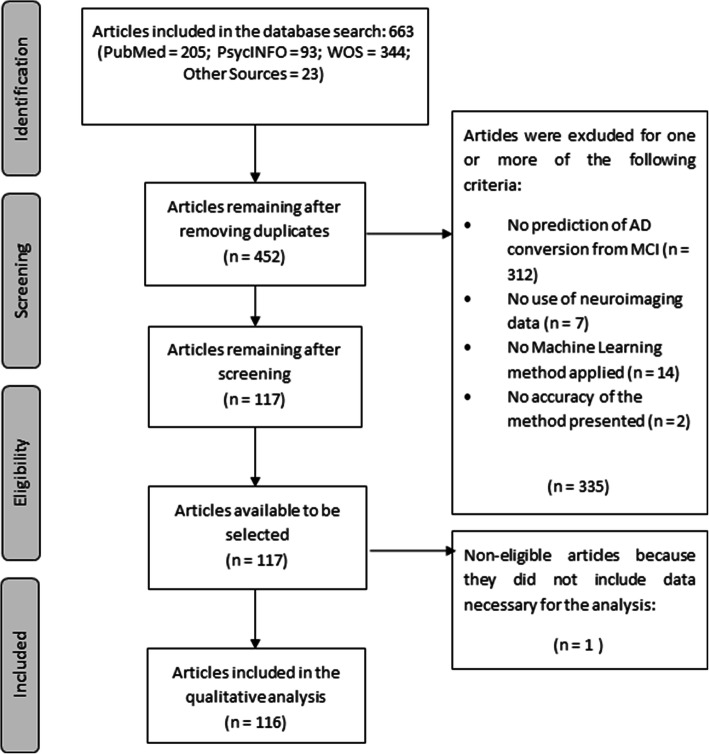
Background: An increase in lifespan in our society is a double-edged sword that entails a growing number of patients with neurocognitive disorders, Alzheimer’s disease being the most prevalent. Advances in medical imaging and computational power enable new methods for the early detection of neurocognitive disorders with the goal of preventing or reducing cognitive decline. Computer-aided image analysis and early detection of changes in cognition is a promising approach for patients with mild cognitive impairment, sometimes a prodromal stage of Alzheimer’s disease dementia. Methods: We conducted a systematic review following PRISMA guidelines of studies where machine learning was applied to neuroimaging data in order to predict whether patients with mild cognitive impairment might develop Alzheimer’s disease dementia or remain stable. After removing duplicates, we screened 452 studies and selected 116 for qualitative analysis. Results: Most studies used magnetic resonance image (MRI) and positron emission tomography (PET) data but also magnetoencephalography. The datasets were mainly extracted from the Alzheimer’s disease neuroimaging initiative (ADNI) database with some exceptions. Regarding the algorithms used, the most common was support vector machine with a mean accuracy of 75.4%, but convolutional neural networks achieved a higher mean accuracy of 78.5%. Studies combining MRI and PET achieved overall better classification accuracy than studies that only used one neuroimaging technique. In general, the more complex models such as those based on deep learning, combined with multimodal and multidimensional data (neuroimaging, clinical, cognitive, genetic, and behavioral) achieved the best performance. Conclusions: Although the performance of the different methods still has room for improvement, the results are promising and this methodology has a great potential as a support tool for clinicians and healthcare professionals.
Overview
The claims and statistics of this paper haven’t been checked yet.
Run the check — free, no account needed. It reads the open-access text and checks the sources it cites.
Integrity signals
Registry
Cites
Statistics
Figures
Verification
Claims the paper makes
The claims and statistics of this paper haven’t been checked yet.
Run the check — free, no account needed. It reads the open-access text and checks the sources it cites.
Claims other papers make about this one
Each is checked against this paper’s own text: does it say what the citing paper says it does?
In the citing paper
“By integrating neuroimaging, genetic, and clinical data, researchers have developed models that can identify individuals at high risk of developing Alzheimer’s disease [15–18].”
From Integrating machine learning and artificial intelligence in life-course epidemiology: pathways to innovative public health solutions (2024) · cites this paper as [15]
Self-check
Percentages, sums and reported differences re-computed from the paper’s own numbers.
The self-check needs the paper’s full text.
Citations
Cites
Diagnostic and Statistical Manual of Mental Disorders
American Psychiatric Association (2013) · doi:10.1176/appi.books.9780890425596 · Cited by 116,369
Diagnostic and Statistical Manual of Mental Disorders
Williams, J. B. W., & First, M. B. (2013) · Oxford University Press eBooks · doi:10.1093/acrefore/9780199975839.013.104 · Cited by 109,845
Preferred Reporting Items for Systematic Reviews and Meta-Analyses: the PRISMA statement
Moher, D., Liberati, A., Tetzlaff, J., Altman, D. G., & for the PRISMA Group (2009) · BMJ · doi:10.1136/bmj.b2535 · Cited by 83,823
Preferred reporting items for systematic reviews and meta-analyses: the PRISMA Statement.
(2009) · PubMed Central · Cited by 44,859
Liberati, A., Altman, D. G., Tetzlaff, J., Mulrow, C., Gøtzsche, P. C., Ioannidis, J. P. A., Clarke, M., Devereaux, P. J., Kleijnen, J., & Moher, D. (2009) · PLoS Medicine · doi:10.1371/journal.pmed.1000100 · Cited by 28,164
The meaning and use of the area under a receiver operating characteristic (ROC) curve.
Hanley, J. A., & McNeil, B. J. (1982) · Radiology · doi:10.1148/radiology.143.1.7063747 · Cited by 21,856
Preferred Reporting Items for Systematic Reviews and Meta-Analyses: The PRISMA Statement
Moher, D., Liberati, A., Tetzlaff, J., & Altman, D. G. (2009) · Journal of Clinical Epidemiology · doi:10.1016/j.jclinepi.2009.06.005 · Cited by 19,575
McKhann, G. M., Knopman, D. S., Chertkow, H., Hyman, B. T., Jack, C. R., Kawas, C. H., Klunk, W. E., Koroshetz, W. J., Manly, J. J., Mayeux, R., et al. (2011) · Alzheimer's & Dementia · doi:10.1016/j.jalz.2011.03.005 · Cited by 18,657
Liberati, A., Altman, D. G., Tetzlaff, J., Mulrow, C., Gotzsche, P. C., Ioannidis, J. P. A., Clarke, M., Devereaux, P. J., Kleijnen, J., & Moher, D. (2009) · BMJ · doi:10.1136/bmj.b2700 · Cited by 17,648
Neuropathological stageing of Alzheimer-related changes.
Braak, H., & Braak, E. (1991) · Acta Neuropathologica · doi:10.1007/bf00308809 · Cited by 16,123
Research works printed but not linked: 2
- Menéndez G. La revolución de la longevidad:cambio tecnológico, envejecimiento poblacional y transformación cultural. Rev Ciencias Soc [Internet]. 2017;30(41):159–78. [cited 2021 Feb 9]. Available from: http://www.scielo.edu.uy/scielo.php?script=sci_arttext&pid=S0797-55382017000200159&lng=es&nrm=iso&tlng=es.
- Çitak-Er F, Goularas D, Ormeci B. A novel convolutional neural network model based on voxel-based morphometry of imaging data in predicting the prognosis of patients with mild cognitive impairment. J Neurol Sci. 2017;34(1):52–69.
Cited by
Sorted by citations
Sharma, S., Guleria, K., Tiwari, S., & Kumar, S. (2022) · Measurement Sensors · doi:10.1016/j.measen.2022.100506 · Cited by 193
Urolithin A improves Alzheimer's disease cognition and restores mitophagy and lysosomal functions
Hou, Y., Chu, X., Park, J., Zhu, Q., Hussain, M., Li, Z., Madsen, H. B., Yang, B., Wei, Y., Wang, Y., et al. (2024) · Alzheimer's & Dementia · doi:10.1002/alz.13847 · Cited by 145
Veitch, D. P., Weiner, M. W., Miller, M., Aisen, P. S., Ashford, M. A., Beckett, L. A., Green, R. C., Harvey, D., Jack, C. R., Jagust, W., et al. (2024) · Alzheimer's & Dementia · doi:10.1002/alz.13449 · Cited by 113
Diabetes and cognitive function: An evidence-based current perspective
Sebastian, M. J., Khan, S. K. A., Pappachan, J. M., & Jeeyavudeen, M. S. (2023) · World Journal of Diabetes · doi:10.4239/wjd.v14.i2.92 · Cited by 115
Rallabandi, V. P. S., & Seetharaman, K. (2022) · Biomedical Signal Processing and Control · doi:10.1016/j.bspc.2022.104312 · Cited by 82
Systematic reviews of machine learning in healthcare: a literature review
Kolasa, K., Admassu, B. Y., Hołownia-Voloskova, M. E., Kędzior, K. J., Poirrier, J., & Perni, S. (2023) · Expert Review of Pharmacoeconomics & Outcomes Research · doi:10.1080/14737167.2023.2279107 · Cited by 95
Raza, M. L., Hassan, S. T., Jamil, S., Hyder, N., Batool, K., Walji, S., & Abbas, M. K. (2025) · Frontiers in Neuroinformatics · doi:10.3389/fninf.2025.1557177 · Cited by 74
Chen, S., Yu, J., Chamouni, S., Wang, Y., & Li, Y. (2024) · BMC Medicine · doi:10.1186/s12916-024-03566-x · Cited by 73
“By integrating neuroimaging, genetic, and clinical data, researchers have developed models that can identify individuals at high risk of developing Alzheimer’s disease [15–18].”
BackgroundMachine learning, artificial intelligence and the prediction of dementia
Merkin, A., Krishnamurthi, R., & Medvedev, O. N. (2021) · Current Opinion in Psychiatry · doi:10.1097/yco.0000000000000768 · Cited by 60
Multimodal Neuroimaging Based Alzheimer's Disease Diagnosis Using Evolutionary RVFL Classifier
Goel, T., Sharma, R., Tanveer, M., Suganthan, P. N., Maji, K., & Pilli, R. (2023) · IEEE Journal of Biomedical and Health Informatics · doi:10.1109/jbhi.2023.3242354 · Cited by 59
Kaur, A., Mittal, M., Bhatti, J. S., Thareja, S., & Singh, S. (2024) · Artificial Intelligence in Medicine · doi:10.1016/j.artmed.2024.102928 · Cited by 54
Avilés, M., Sánchez, L.-M., Álvarez-Alvarado, J. M., & Rodríguez‐Reséndiz, J. (2024) · Eng—Advances in Engineering · doi:10.3390/eng5030078 · Cited by 42
Asaduzzaman, M., Alom, M. K., & Karim, M. E. (2025) · Telematics and Informatics Reports · doi:10.1016/j.teler.2025.100189 · Cited by 42
Artificial intelligence for dementia research methods optimization
Bucholc, M., James, C. R., Khleifat, A. A., Badhwar, A., Clarke, N., Dehsarvi, A., Madan, C. R., Marzi, S. J., Shand, C., Schilder, B. M., et al. (2023) · Alzheimer s & Dementia · doi:10.1002/alz.13441 · Cited by 49
Predicting cognitive decline in Parkinson’s disease using FDG-PET–based supervised learning
Booth, S., Park, K. W., Lee, C. S., & Ko, J. H. (2022) · Journal of Clinical Investigation · doi:10.1172/jci157074 · Cited by 39
Deep Learning for Brain MRI Confirms Patterned Pathological Progression in Alzheimer's Disease
Pan, D., Zeng, A., Yang, B., Lai, G., Hu, B., Song, X., Jiang, T., & Initiative, A. D. N. (2022) · Advanced Science · doi:10.1002/advs.202204717 · Cited by 39
Epigenetic Peripheral Biomarkers for Early Diagnosis of Alzheimer’s Disease
Villa, C., & Stoccoro, A. (2022) · Genes · doi:10.3390/genes13081308 · Cited by 40
Peng, J., Wang, W., Song, Q., Hou, J., Jin, H., Qin, X., Yuan, Z., Wei, Y., & Shu, Z. (2022) · Academic Radiology · doi:10.1016/j.acra.2022.12.033 · Cited by 36
A Logistic Regression and Decision Tree Based Hybrid Approach to Predict Alzheimer's Disease
Tushar, T., Patel, R. K., Aggarwal, E., Solanki, K., Dahiya, O., & Yadav, S. A. (2023) · International Conference on Computational Intelligence and Sustainable Engineering Solutions (CISES) · doi:10.1109/cises58720.2023.10183466 · Cited by 38
Current State of Community-Driven Radiological AI Deployment in Medical Imaging
Gupta, V., Erdal, B. S., Ramirez, C., Floca, R. O., Genereaux, B. W., Bryson, S., Bridge, C. P., Kleesiek, J., Nensa, F., Braren, R., et al. (2024) · JMIR AI · doi:10.2196/55833 · Cited by 35
Machine learning in Alzheimer’s disease drug discovery and target identification
Geng, C., Wang, Z., & Tang, Y. (2024) · Ageing Research Reviews · doi:10.1016/j.arr.2023.102172 · Cited by 34
Hatami, M., Yaghmaee, F., & Ebrahimpour, R. (2024) · Neurocomputing · doi:10.1016/j.neucom.2024.128119 · Cited by 34
Akter, S., Liu, Z., Simões, E. J., & Rao, P. R. (2025) · The Journal of Prevention of Alzheimer s Disease · doi:10.1016/j.tjpad.2025.100169 · Cited by 37
Karaman, B. K., Mormino, E. C., Sabuncu, M. R., & Initiative, A. D. N. (2022) · PLoS ONE · doi:10.1371/journal.pone.0277322 · Cited by 36
Novel methodology for detection and prediction of mild cognitive impairment using resting‐state EEG
Deng, J., Sun, B., Kavcic, V., Liu, M., Giordani, B., & Li, T. (2023) · Alzheimer s & Dementia · doi:10.1002/alz.13411 · Cited by 31
Hassen, S. B., Néji, M., Hussain, Z., Hussain, A., Alimi, A. M., & Frikha, M. (2024) · Neurocomputing · doi:10.1016/j.neucom.2024.127325 · Cited by 32
The Feasibility of Early Alzheimer’s Disease Diagnosis Using a Neural Network Hybrid Platform
Yu, X., Srivastava, S., Huang, S., Hayden, E. Y., Teplow, D. B., & Xie, Y. (2022) · Biosensors · doi:10.3390/bios12090753 · Cited by 29
Dementia prediction with multimodal clinical and imaging data
Kubi, N. N. B. A., & Nazir, S. (2024) · International Journal of Information Technology · doi:10.1007/s41870-024-02326-7 · Cited by 29
Gkintoni, E., Vassilopoulos, S. P., Νικολάου, Γ., & Vantarakis, A. (2025) · Brain Sciences · doi:10.3390/brainsci15060582 · Cited by 33
Vyas, A., Aisopos, F., Vidal, M.-E., Garrard, P., & Παλιούρας, Γ. (2022) · BMC Medical Informatics and Decision Making · doi:10.1186/s12911-022-02004-3 · Cited by 28
Parsaei, M., Taghavizanjani, F., Cattarinussi, G., Moghaddam, H. S., Camillo, F. D., Akhondzadeh, S., Sambataro, F., Brambilla, P., & Delvecchio, G. (2023) · Journal of Affective Disorders · doi:10.1016/j.jad.2023.08.034 · Cited by 29
Muhammad, A., Qi, J., Elwasila, O., & Gulzar, Y. (2025) · Brain Sciences · doi:10.3390/brainsci15060612 · Cited by 33
Gao, Y., Zhao, X., Huang, J., Wang, S., Chen, X., Li, M., Sun, F., Wang, G., & Zhong, Y. (2022) · Frontiers in Aging Neuroscience · doi:10.3389/fnagi.2022.979183 · Cited by 27
Aghajanian, S., Mohammadifard, F., Mohammadi, I., Firouzabadi, S. R., Bagheri, A. B., Ghaffary, E. M., & Mirmosayyeb, O. (2025) · Alzheimer s Research & Therapy · doi:10.1186/s13195-025-01827-2 · Cited by 25
Adherence to a healthy lifestyle and brain structural imaging markers
Pan, Y., Shen, J., Cai, X., Chen, H., Zong, G., Zhu, W., Jing, J., Liu, T., Jin, A., Wang, Y., et al. (2023) · European Journal of Epidemiology · doi:10.1007/s10654-023-00992-8 · Cited by 25
Cáceres, C., Heusser, B., Garnham, A., & Moczko, E. (2023) · Cells · doi:10.3390/cells12232669 · Cited by 26
Chen, Z., Bi, S., Shan, Y., Cui, B., Yang, H., Qi, Z., Zhao, Z., Han, Y., Yan, S., & Lu, J. (2023) · CNS Neuroscience & Therapeutics · doi:10.1111/cns.14539 · Cited by 22
Haq, E. U., Qin, Y., Zhou, Y., Xu, H., & Haq, R. U. (2025) · Biomedical Signal Processing and Control · doi:10.1016/j.bspc.2025.107545 · Cited by 27
Improving Alzheimer’s disease classification using novel rewards in deep reinforcement learning
Hatami, M., Yaghmaee, F., & Ebrahimpour, R. (2024) · Biomedical Signal Processing and Control · doi:10.1016/j.bspc.2024.106920 · Cited by 22
Xiao, Y., Hou, Y., Zhou, H., Diallo, G., Marcelo Fiszman, B., Wolfson, J. A., Zhou, L., Halil Kilicoglu, B., Chen, Y., Su, C., et al. (2024) · Scientific Reports · doi:10.1038/s41598-024-58604-8 · Cited by 25
Machine learning‐based radiomics in neurodegenerative and cerebrovascular disease
Shi, M., Feng, X., Zhi, H., Hou, L., & Feng, D. (2024) · MedComm · doi:10.1002/mco2.778 · Cited by 22
Kim, S., Ma, X., Jeon, M. J., Song, S., Lee, J. S., Lee, J. U., Lee, C., Choi, S. H., & Sim, S. J. (2024) · Biosensors and Bioelectronics · doi:10.1016/j.bios.2024.116085 · Cited by 21
Wang, W.-E., Chen, R., Mayrand, R. P., Adjouadi, M., Fang, R., DeKosky, S. T., Duara, R., Coombes, S. A., & Vaillancourt, D. E. (2023) · Neurobiology of Aging · doi:10.1016/j.neurobiolaging.2022.10.013 · Cited by 20
Bortty, J. C., Chakraborty, G. S., Noman, I. R., Batra, S., Das, J., Bishnu, K. K., Tarafder, M. T. R., & Islam, A. (2025) · Diagnostics · doi:10.3390/diagnostics15060789 · Cited by 21
Luppi, J. J., Schoonhoven, D. N., van Nifterick, A. M., Gouw, A. A., Hillebrand, A., Scheltens, P., Stam, C. J., & de Haan, W. (2022) · Journal of Alzheimer s Disease · doi:10.3233/jad-215464 · Cited by 20
D'Amore, F. M., Moscatelli, M. E. M., Malvaso, A., D’Antonio, F., Rodini, M., Panigutti, M., Mirino, P., Carlesimo, G. A., Guariglia, C., & Caligiore, D. (2024) · Journal of the Neurological Sciences · doi:10.1016/j.jns.2024.123361 · Cited by 19
Kim, H., Jung, J., & Lee, S. (2022) · Vision · doi:10.3390/vision6040068 · Cited by 18
Mazzeo, S., Lassi, M., Padiglioni, S., Vergani, A. A., Moschini, V., Scarpino, M., Giacomucci, G., Burali, R., Morinelli, C., Fabbiani, C., et al. (2023) · BMC Neurology · doi:10.1186/s12883-023-03347-8 · Cited by 19
Fehr, J., Piccininni, M., Kurth, T., Konigorski, S., & Initiative, T. A. D. N. (2023) · BMC Medical Research Methodology · doi:10.1186/s12874-023-02003-6 · Cited by 22
Towards cascading genetic risk in Alzheimer’s disease
Altmann, A., Aksman, L. M., Oxtoby, N. P., Young, A. L., ADNI, Weiner, M., Aisen, P., Petersen, R., Weiner, M., Aisen, P., et al. (2024) · Brain · doi:10.1093/brain/awae176 · Cited by 18
Cao, E., Ma, D., Nayak, S., & Duong, T. Q. (2023) · Neurobiology of Disease · doi:10.1016/j.nbd.2023.106310 · Cited by 17
Ten years of image analysis and machine learning competitions in dementia
Bron, E. E., Klein, S., Reinke, A., Papma, J. M., Maier-Hein, L., Alexander, D. C., & Oxtoby, N. P. (2022) · NeuroImage · doi:10.1016/j.neuroimage.2022.119083 · Cited by 17
Srinivasan, S., Butters, E., Collins-Jones, L. H., Su, L., O'Brien, J. T., & Bale, G. M. (2023) · Neurophotonics · doi:10.1117/1.nph.10.2.023514 · Cited by 17
Agarwal, D., Berbis, M. A., Martín‐Noguerol, T., Luna, A., Garcia, S. C. P., & Díez, I. D. L. T. (2022) · Mathematics · doi:10.3390/math10152575 · Cited by 16
Significant Acceleration of Regional Brain Aging and Atrophy After Mild Traumatic Brain Injury
Shida, A. F., Massett, R. J., Imms, P. E., Vegesna, R. V., Amgalan, A., & Andrei Irimia, A. (2023) · The Journals of Gerontology Series A · doi:10.1093/gerona/glad079 · Cited by 16
Saeed, F. (2024) · American Journal of Biomedical Science & Research · doi:10.34297/ajbsr.2024.22.003014 · Cited by 18
Fırat, M., Çınar, A., Çankaya, C., Firat, I., & Tuncer, T. (2022) · Comput. Biol. Medicine · doi:10.1016/j.compbiomed.2022.105541 · Cited by 15
Detection of Different Stages of Alzheimer’s Disease Using CNN Classifier
Mahmud, S. M. H., Ali, M. M., Shahriar, M. F., Al-Zahrani, F. A., Ahmed, K., Nandi, D., & Bui, F. M. (2023) · Computers, materials & continua/Computers, materials & continua (Print) · doi:10.32604/cmc.2023.039020 · Cited by 15
Sadeghi, M. A., Stevens, D., Kundu, S., Sanghera, R., Dagher, R., Yedavalli, V. S., Jones, C., Sair, H. I., Luna, L., & Initiative, A. D. N. (2024) · Journal of Imaging Informatics in Medicine · doi:10.1007/s10278-024-01101-1 · Cited by 18
Wu, Y., Wang, X., Gu, C., Zhu, J., & Fang, Y. (2023) · Age and Ageing · doi:10.1093/ageing/afad182 · Cited by 16
Fakoya, A., & Parkinson, S. (2024) · IEEE Access · doi:10.1109/access.2024.3412850 · Cited by 14
Predicting Conversion Time from Mild Cognitive Impairment to Dementia with Interval-Censored Models
Zhang, Y., Li, Y., Song, S., Li, Z., Lu, M., & Shan, G. (2024) · Journal of Alzheimer s Disease · doi:10.3233/jad-240285 · Cited by 15
Hiraga, T., Hata, T., Soya, S., Shimoda, R., Takahashi, K., Soya, M., Inoue, K., Johansen, J. P., Okamoto, M., & Soya, H. (2024) · The FASEB Journal · doi:10.1096/fj.202400418rrr · Cited by 15
Electromyography Signals in Embedded Systems: A Review of Processing and Classification Techniques
Castruita-López, J. F., Avilés, M., Toledo-Pérez, D. C., Macías-Socarrás, I., & Rodríguez‐Reséndiz, J. (2025) · Biomimetics · doi:10.3390/biomimetics10030166 · Cited by 19
McCombe, N., Bamrah, J., Sánchez‐Bornot, J. M., Finn, D. P., McClean, P. L., Wong‐Lin, K., & Initiative, A. D. N. (2022) · Healthcare Technology Letters · doi:10.1049/htl2.12037 · Cited by 14
Ren, H., Zheng, Y., Li, C., Jing, F., Wang, Q., Luo, Z., Li, D., Liang, D., Tang, W., Liu, L., et al. (2025) · JMIR Aging · doi:10.2196/67437 · Cited by 15
Subha, R., Nayana, B. R., & Selvadass, M. (2022) · International Conference on Circuits, Control, Communication and Computing (I4C) · doi:10.1109/i4c57141.2022.10057948 · Cited by 13
Huang, S., Hsiao, F., Tsai, T.-H., Chen, P.-J., Peng, L., & Chen, L. (2023) · Journal of Medical Internet Research · doi:10.2196/41858 · Cited by 13
Zhao, Y., Li, L., He, X., Yin, S., Zhou, Y., Márquez-Chin, C., Yang, W., Rao, J., Xiang, W., Liu, B., et al. (2023) · Computer Methods and Programs in Biomedicine · doi:10.1016/j.cmpb.2023.107779 · Cited by 13
Bit, S., Dey, P., Maji, A., Initiative, A. D. N., & Khan, T. K. (2024) · Journal of Alzheimer s Disease Reports · doi:10.1177/25424823241290694 · Cited by 14
Portela, A. S. D., Saxena, V., Rosenn, E. H., Wang, S., Masieri, S., Palmieri, J., & Pasinetti, G. M. (2024) · Molecular Nutrition & Food Research · doi:10.1002/mnfr.202300605 · Cited by 12
Prediction of cognitive conversion within the Alzheimer’s disease continuum using deep learning
Yang, S., Zhang, X., Du, X., Yan, P., Zhang, J., Wang, W., Wang, J., Zhang, L., Sun, H., Liu, Y., et al. (2025) · Alzheimer s Research & Therapy · doi:10.1186/s13195-025-01686-x · Cited by 12
Gu, Z., Ge, B., Wang, Y., Gong, Y., & Qi, M. (2025) · Frontiers in Aging Neuroscience · doi:10.3389/fnagi.2025.1609063 · Cited by 12
Wang, R., Peng, S., Zhu, J., Xu, Y., Wang, M., Zhang, L., Qiu, Y., Hou, D., Wang, Q., & Liu, R. (2025) · Frontiers in Neurology · doi:10.3389/fneur.2025.1651708 · Cited by 11
Chen, Z., Yang, Y., Zhang, D., Guo, J. S., Guo, Y. M., Hu, X., Chen, Y., & Bian, J. (2023) · Informatics · doi:10.3390/informatics10020046 · Cited by 9
Daou, L., Alayli, A. E., Constantinos, F., Dib, G., & Barakat, M. (2023) · Biomarkers in Neuropsychiatry · doi:10.1016/j.bionps.2023.100069 · Cited by 11
Jung, W., Kim, S. E., Kim, J. P., Jang, H., Park, C. J., Kim, H. J., Na, D. L., Seo, S. W., & Suk, H. (2024) · Frontiers in Aging Neuroscience · doi:10.3389/fnagi.2024.1356745 · Cited by 12
Taran, N., Gatenyo, R., Hadjadj, E., Farah, R., & Horowitz‐Kraus, T. (2024) · Cortex · doi:10.1016/j.cortex.2024.08.012 · Cited by 13
Oh, S. S., Kang, B., Hong, D., Kim, J. I., Jeong, H., Song, J., & Jeon, M. (2024) · JMIR Medical Informatics · doi:10.2196/59396 · Cited by 11
AI-powered model for accurate prediction of MCI-to-AD progression
Abdelhameed, A. M., Feng, J., Hu, X., Li, F., Lundin, S. K., Schulz, P. E., & Tao, C. (2025) · Acta Pharmaceutica Sinica B · doi:10.1016/j.apsb.2025.01.027 · Cited by 12
Dong, N., Fu, C., Li, R., Zhang, W., Liu, M., Xiao, W., Taylor, H. M., Nicholas, P. J., Tanglay, O., Young, I. M., et al. (2022) · Frontiers in Aging Neuroscience · doi:10.3389/fnagi.2022.854733 · Cited by 11
A multi-expert ensemble system for predicting Alzheimer transition using clinical features
Merone, M., D’Addario, S. L., Mirino, P., Bertino, F., Guariglia, C., Ventura, R., Capirchio, A., Baldassarre, G., Silvetti, M., & Caligiore, D. (2022) · Brain Informatics · doi:10.1186/s40708-022-00168-2 · Cited by 12
From pixels to prognosis: radiomics and AI in Alzheimer’s disease management
Peng, D., Huang, W., Liu, R. P., & Zhong, W. (2025) · Frontiers in Neurology · doi:10.3389/fneur.2025.1536463 · Cited by 12
Advancing Alzheimer's Therapy: Computational strategies and treatment innovations
Paul, J. K., Malik, A., Azmal, M., Gulzar, T., Afghan, M. T. R., Talukder, O. F., Shahzadi, S., & Ghosh, A. (2025) · IBRO Neuroscience Reports · doi:10.1016/j.ibneur.2025.02.002 · Cited by 10
Thakur, M., & Umapathy, S. (2022) · Physical and Engineering Sciences in Medicine · doi:10.1007/s13246-022-01196-2 · Cited by 10
Wu, Y., Wang, X., & Fang, Y. (2023) · Geriatrics and gerontology international/Geriatrics & gerontology international · doi:10.1111/ggi.14670 · Cited by 10
An Explainable Deep Learning Model for Prediction of Severity of Alzheimer’s Disease
Ekuma, G., Hier, D. B., & Obafemi-Ajayi, T. (2023) · IEEE Conference on Computational Intelligence in Bioinformatics and Computational Biology (CIBCB) · doi:10.1109/cibcb56990.2023.10264880 · Cited by 11
Ho, S. Y.-C., Chien, T., Lin, M.-L., & Tsai, K. (2023) · Medicine · doi:10.1097/md.0000000000032670 · Cited by 10
Main, L. R., Song, Y. E., Lynn, A., Laux, R. A., Miskimen, K. L. S., Osterman, M. D., Cuccaro, M. L., Ogrocki, P. K., Lerner, A. J., Vance, J. M., et al. (2024) · Alzheimer s & Dementia · doi:10.1002/alz.14045 · Cited by 8
Li, S., Lin, S., Tu, Y., Qiao, J., & Xiao, S. (2025) · Biomedical Signal Processing and Control · doi:10.1016/j.bspc.2025.107660 · Cited by 9
Mieling, M., Yousuf, M., Bunzeck, N., Initiative, A. D. N., Weiner, M. W., Aisen, P., Petersen, R. C., Jack, C. R., Jagust, W., Landau, S., et al. (2025) · GeroScience · doi:10.1007/s11357-025-01626-5 · Cited by 11
Kadri, R., Bouaziz, B., Tmar, M., & Gargouri, F. (2022) · International Journal of Hybrid Intelligent Systems · doi:10.3233/his-220002 · Cited by 9
An Interpretable PyCaret Approach for Alzheimer's Disease Prediction
P., A., & GUNASUNDARI, R. (2024) · International Journal of Computational and Experimental Science and Engineering · doi:10.22399/ijcesen.655 · Cited by 11
Brasser, M., Frühholz, S., Schneeberger, A. R., Ruschetti, G. G., Schaerli, R., Häner, M., & Studer-Luethi, B. (2022) · Frontiers in Psychology · doi:10.3389/fpsyg.2022.866613 · Cited by 9
Torres-Simón, L., del Cerro‐León, A., Yus, M., Bruña, R., Gil‐Martínez, L., Dolado, A. M., Maestú, F., Arrazola, J., & Cuesta, P. (2024) · GeroScience · doi:10.1007/s11357-024-01238-5 · Cited by 8
Hossain, M. K., Ashraf, A., Islam, M. M., Sourav, S., & Shimul, M. M. H. (2025) · Alzheimer s & Dementia Diagnosis Assessment & Disease Monitoring · doi:10.1002/dad2.70162 · Cited by 15
Shankar, V. G., Sisodia, D. S., & Chandrakar, P. (2023) · Computational Intelligence · doi:10.1111/coin.12594 · Cited by 9
A machine learning approach for identifying anatomical biomarkers of early mild cognitive impairment
Ahmad, A. L., Sánchez‐Bornot, J. M., Sotero, R. C., Coyle, D., Idris, Z., & Faye, I. (2024) · PeerJ · doi:10.7717/peerj.18490 · Cited by 10
Wang, X., Ezeana, C. F., Wang, L., Puppala, M., Huang, Y., He, Y., Yu, X., Yin, Z., Zhao, H., Lai, E. C., et al. (2022) · Alzheimer s & Dementia Translational Research & Clinical Interventions · doi:10.1002/trc2.12351 · Cited by 7
Türkmen, G., & Sezen, A. (2024) · International Journal of Computational and Experimental Science and Engineering · doi:10.22399/ijcesen.329 · Cited by 12
Metadata
- Authors
- Grueso, S., & Viejo-Sobera, R.
- Affiliations
- Universitat Oberta de Catalunya (ES)
- Corresponding author
- Grueso, Sergio
- Venue
- Alzheimer's Research & Therapy
- Published
- 2021-09-28
- Volume
- 13
- Issue
- 1
- Pages
- 162-162
- ISSN
- 1758-9193 (ISSN-L)
- PMC
- PMC8480074
- OpenAlex
- W3202902530
- Cited by
- 303
- References
- 157
- Citations by year
- 2026: 60 · 2025: 84 · 2024: 77 · 2023: 48 · 2022: 33 · 2021: 1
- FWCI
- 7.10
- Type
- journal article
- Language
- en
- Open access
- gold
- doi.org
- Locations
- Alzheimer s Research & Therapy (publishedVersion, cc-by)
- Europe PMC (PubMed Central) (publishedVersion, other-oa)
- PubMed Central (publishedVersion, cc-by)
- PubMed (publishedVersion)
- DOAJ (DOAJ: Directory of Open Access Journals) (submittedVersion, cc-by-sa)
- O2 - Repositori Institucional (Universitat Oberta de Catalunya) (submittedVersion, cc-by)
- Funders
- Universitat Oberta de Catalunya
- Topics
- Health Sciences › Medicine › Psychiatry and Mental health › Dementia and Cognitive Impairment Research
- Health Sciences › Health Professions › Health Information Management › Artificial Intelligence in Healthcare
- Life Sciences › Neuroscience › Cellular and Molecular Neuroscience › Alzheimer's disease research and treatments
- Keywords
- mild cognitive impairment, Alzheimer's dementia, progression prediction, machine learning, neuroimaging, magnetic resonance imaging, PET, magnetoencephalography, multimodal data, convolutional neural networks, support vector machine, deep learning, early detection, ADNI
- MeSH terms
- Machine Learning, Alzheimer Disease, Brain, Humans, Magnetic Resonance Imaging, Disease Progression, Neuroimaging, Cognitive Dysfunction
About these checks
Registry, retraction, Cites and statistics results are computed, not judged, with one exception: a printed reference that no index lists is read once by a model before it counts as a citation error. Claims are extracted by a model and kept only when their quote appears verbatim in the text; each cited source is then checked, with a model’s help, for whether it says what the claim relies on. Those verdicts can be wrong — read the claim’s quote and the cited source before relying on one.
Statistics and arithmetic are recomputed, not judged.
Confidence bands are shown only for fields calibrated on our annotated test set. None is calibrated yet, so no band is shown.
What counts as a claim ›How we measure confidence ›How we check this ›
Are you an author, or do you see a problem with this page? Request a review
