

Cholinesterase inhibitors and memantine are associated with a reduced mortality in nursing home residents with dementia: a longitudinal observational study
Open accessThe DOI matches its Crossref record; 47 of the 47 references it cites were found in a registry or an index; none of the 66 sources its claims cite is checked for support yet.
Abstract
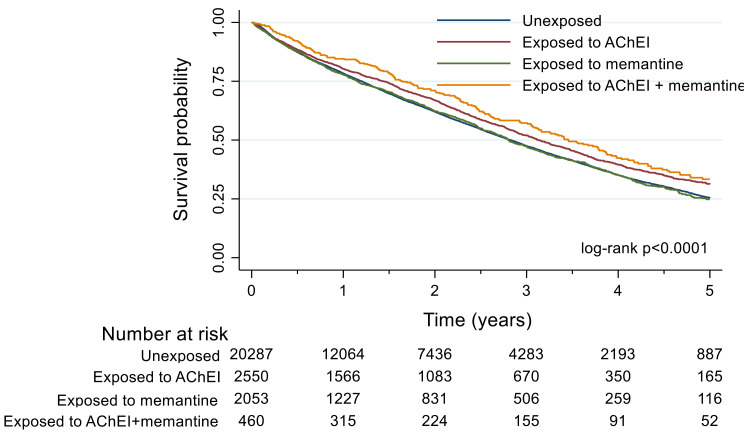
Background: A large proportion of nursing home (NH) residents suffer from dementia and effects of conventional anti-dementia drugs on their health is poorly known. We aimed to investigate the associations between exposure to anti-dementia drugs and mortality among NH residents. Methods: This retrospective longitudinal observational study involved 229 French NH and the residents admitted in these facilities since 2014 and having major neurocognitive disorder. From their electronic health records, we obtained their age, sex, level of dependency, Charlson comorbidity index, and Mini mental examination score at admission. Exposure to anti-dementia drugs was determined using their prescription into 4 categories: none, exposure to acetylcholinesterase inhibitors (AChEI) alone, exposure to memantine alone, exposure to AChEI and memantine. Survival until the end of 2019 was studied in the entire cohort by Cox proportional hazards. To alleviate bias related to prescription of anti-dementia drugs, we formed propensity-score matched cohorts for each type of anti-dementia drug exposure, and studied survival by the same method. Results: We studied 25,358 NH residents with major neurocognitive disorder. Their age at admission was 87.1 + 7.1 years and 69.8% of them were women. Exposure to anti-dementia drugs occurred in 2,550 (10.1%) for AChEI alone, in 2,055 (8.1%) for memantine alone, in 460 (0.2%) for AChEI plus memantine, whereas 20,293 (80.0%) had no exposure to anti-dementia drugs. Adjusted hazard ratios for mortality were significantly reduced for these three groups exposed to anti-dementia drugs, as compared to reference group: HR: 0.826, 95%CI 0.769 to 0.888 for AChEI; 0.857, 95%CI 0.795 to 0.923 for memantine; 0.742, 95%CI 0.640 to 0.861 for AChEI plus memantine. Results were consistent in propensity-score matched cohorts. Conclusion: The use of conventional anti-dementia drugs is associated with a lower mortality in nursing home residents with dementia and should be widely used in this population.
Overview
CoChat Summary
TL;DR
In a retrospective cohort of 25,358 French nursing home residents with major neurocognitive disorder, exposure to acetylcholinesterase inhibitors (AChEI), memantine, or both was associated with lower all-cause mortality than no anti-dementia drug exposure. The associations persisted in propensity-score matched cohorts, though the study is observational and cannot establish causality.
Key findings
- Among 25,358 residents (mean age 87.1 ± 7.1 years; 69.8% women), 2,550 (10.1%) received AChEI alone, 2,055 (8.1%) memantine alone, 460 (0.2% as reported) AChEI plus memantine, and 20,293 (80.0%) no anti-dementia drugs.
- Adjusted hazard ratios for mortality in the entire cohort were 0.826 (95% CI 0.769–0.888) for AChEI alone, 0.857 (95% CI 0.795–0.923) for memantine alone, and 0.742 (95% CI 0.640–0.861) for AChEI plus memantine, versus no exposure.
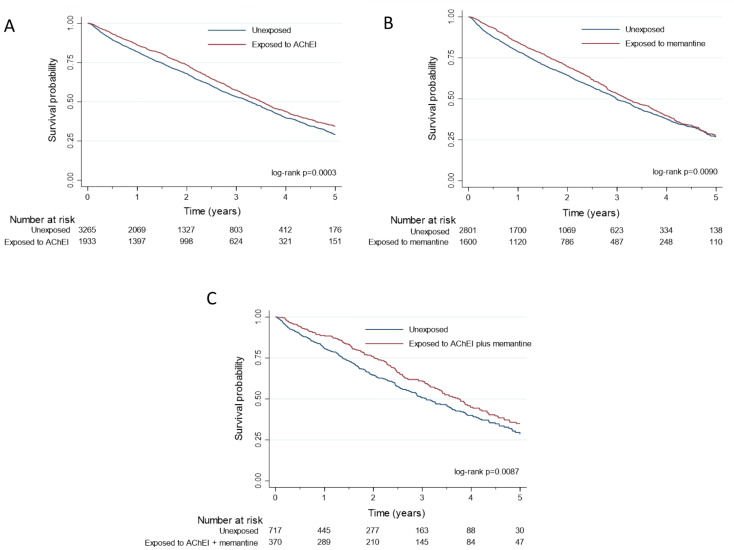
- In propensity-score matched cohorts, adjusted hazard ratios were 0.870 (95% CI 0.799–0.949) for AChEI alone, 0.882 (95% CI 0.806–0.966) for memantine alone, and 0.778 (95% CI 0.643–0.936) for AChEI plus memantine.
- Mean survival time among residents who died was 3.33 months longer with AChEI, 4.65 months longer with memantine, and 8.88 months longer with AChEI plus memantine; the adjusted hazard ratio for combination therapy did not differ significantly from AChEI alone (p = 0.191) or memantine alone (p = 0.083).
Methods
- Retrospective longitudinal observational cohort using electronic health records from 229 French private nursing homes, including residents admitted after January 1, 2014 with an explicit diagnosis of Alzheimer’s disease, dementia, or major neurocognitive disorder, or MMSE < 20 on at least two occasions; vital status was recorded until December 31, 2019.
- Exposure was categorized as none, AChEI alone, memantine alone, or AChEI plus memantine, based on prescriptions entered into the electronic health record; mean follow-up was 18.8 months with no loss of follow-up.
- Mortality was analyzed with Cox proportional hazards models adjusted for age, sex, dependency level, MMSE score, and Charlson index (model 1) or individual comorbidities (model 2), and in three propensity-score matched cohorts using nearest-neighbor matching within a caliper of 0.005 SD.
Limitations
- The authors state that routinely collected clinical records may contain errors, underreporting, and missing information, particularly for comorbidities and dementia diagnosis/type; dementia is under-diagnosed or under-reported in nursing homes, and dementia subtype is often missing, which matters because mortality differs by subtype and vascular dementia may be more common in unexposed residents.
- The authors state that observational results may be influenced by biases including unobserved confounders, and that the decision to prescribe dementia medication was not random, with baseline differences between exposure groups; they attempted to minimize this with adjusted analyses and propensity-score matching.
- Evident from the text: exposure was defined by any prescription irrespective of duration, median exposure was 7.1 months (IQR 2.8–17.5), and 13.1% had exposure of less than 30 days, which may limit inference about dose or duration effects.
Model-written summary. Check it against the paper before relying on it.
Integrity signals
Registry
Cites
Statistics
Figures
Verification
Claims the paper makes
0 Valid · 0 Not valid · 29 Not checked · 43 Own results and interpretations
A result the paper reports from its own data — it cites no other source for it, so there is none to check. The quote shows it is in the paper.
In the paper
“One-year mortality rate in the three cohorts was significantly reduced in residents exposed to the anti-dementia drugs (Supplementary material, Table S2).”
§ Cholinesterase inhibitors and memantine are associated with a reduced mortality in nursing home residents with dementia: a longitudinal observational study > Results > Propensity-score matched cohorts
plainstates a cause- Asserted: passes — The authors put it forward as true.
- Checkable: passes — It can be checked against evidence.
- Load-bearing: passes — The paper’s conclusions depend on it.
- Based: passes — The paper gives a reason why it holds.
A result the paper reports from its own data — it cites no other source for it, so there is none to check. The quote shows it is in the paper.
In the paper
“Severe dependency was significantly more frequent in residents exposed to memantine only or to the association AChEI plus memantine.”
§ Cholinesterase inhibitors and memantine are associated with a reduced mortality in nursing home residents with dementia: a longitudinal observational study > Results > Entire cohort
plainstates an association- Asserted: passes — The authors put it forward as true.
- Checkable: passes — It can be checked against evidence.
- Load-bearing: unclear — It is unclear whether the paper’s conclusions depend on it.
- Based: passes — The paper gives a reason why it holds.
A result the paper reports from its own data — it cites no other source for it, so there is none to check. The quote shows it is in the paper.
In the paper
“Memantine only | 0.882 | (0.806 to 0.966) | 0.007”
§ Cholinesterase inhibitors and memantine are associated with a reduced mortality in nursing home residents with dementia: a longitudinal observational study > Results > Propensity-score matched cohorts
plainstates an association- Asserted: passes — The authors put it forward as true.
- Checkable: passes — It can be checked against evidence.
- Load-bearing: passes — The paper’s conclusions depend on it.
- Based: passes — The paper gives a reason why it holds.
A result the paper reports from its own data — it cites no other source for it, so there is none to check. The quote shows it is in the paper.
In the paper
“Adjusted hazard ratios for mortality were significantly reduced for these three groups exposed to anti-dementia drugs, as compared to reference group: HR: 0.826, 95%CI 0.769 to 0.888 for AChEI; 0.857, 95%CI 0.795 to 0.923 for memantine; 0.742, 95%CI 0.640 to 0.861 for AChEI plus memantine.”
§ Cholinesterase inhibitors and memantine are associated with a reduced mortality in nursing home residents with dementia: a longitudinal observational study > Abstract > Results
plainstates an association- Asserted: passes — The authors put it forward as true.
- Checkable: passes — It can be checked against evidence.
- Load-bearing: passes — The paper’s conclusions depend on it.
- Based: passes — The paper gives a reason why it holds.
A result the paper reports from its own data — it cites no other source for it, so there is none to check. The quote shows it is in the paper.
In the paper
“Cholinesterase inhibitors plus memantine | 0.778 | (0.643 to 0.936) | 0.008”
§ Cholinesterase inhibitors and memantine are associated with a reduced mortality in nursing home residents with dementia: a longitudinal observational study > Results > Propensity-score matched cohorts
plainstates an association- Asserted: passes — The authors put it forward as true.
- Checkable: passes — It can be checked against evidence.
- Load-bearing: passes — The paper’s conclusions depend on it.
- Based: passes — The paper gives a reason why it holds.
25 more claims
Create a free account to see all 72 claims and to verify the 66 references still open.
- Probably not a substantial claim. 25
- It may state two separate claims as one. 27
Claims other papers make about this one
Each is checked against this paper’s own text: does it say what the citing paper says it does?
In the citing paper
“Some observational studies suggest that memantine may reduce mortality. 14 , 15 , 16”
From Effect of long‐term treatment with memantine on mortality in patients with major cognitive disorders: A systematic review and meta‐analysis (2025) · cites this paper as [15]
In the citing paper
“Among the seven observational studies, three had a low risk of bias assessed by the ROBIN I tool, 15 , 32 , 33 two had a moderate risk, 16 , 31 and two were considered at serious risk of bias. 14 , 34”
From Effect of long‐term treatment with memantine on mortality in patients with major cognitive disorders: A systematic review and meta‐analysis (2025) · cites this paper as [15]
Self-check
Percentages, sums and reported differences re-computed from the paper’s own numbers.
Each contradiction between two passages listed here was confirmed by an independent check.
Rated minor: it would not touch a result — a value no result rests on, a p-value that stays on the same side of the significance level, or a conflict that is clerical, resolved elsewhere in the paper, or outside its own findings.
In the paper
“in 460 (0.2%) for AChEI plus memantine”
§ Cholinesterase inhibitors and memantine are associated with a reduced mortality in nursing home residents with dementia: a longitudinal observational study > Abstract > Results
Reported 0.2 · recomputed 1.814023
Rated minor: it would not touch a result — a value no result rests on, a p-value that stays on the same side of the significance level, or a conflict that is clerical, resolved elsewhere in the paper, or outside its own findings.
In the paper
§ Cholinesterase inhibitors and memantine are associated with a reduced mortality in nursing home residents with dementia: a longitudinal observational study > Results > Entire cohort
“The MMSE score of the residents exposed to both AChEI and memantine was significantly higher than those of the other groups (Table 1).”
§ Cholinesterase inhibitors and memantine are associated with a reduced mortality in nursing home residents with dementia: a longitudinal observational study > Results > Entire cohort
“| MMSE score, m (sd) | 16.0 (7.3) | 17.2 (8.6) | 16.0 (9.5) | 15.5 (9.6) | < 0.001 |”
Rated minor: it would not touch a result — a value no result rests on, a p-value that stays on the same side of the significance level, or a conflict that is clerical, resolved elsewhere in the paper, or outside its own findings.
In the paper
§ Cholinesterase inhibitors and memantine are associated with a reduced mortality in nursing home residents with dementia: a longitudinal observational study > Background
“(hazard ratio: 0.90; 95% CI, 0.84–0.96) [14].”
§ Cholinesterase inhibitors and memantine are associated with a reduced mortality in nursing home residents with dementia: a longitudinal observational study > Discussion
“with a hazard ratio of 0.89 (95% CI, 0.83–0.95) close to that observed in our study for AChEI [14].”
Cited works that were retracted
Works this paper cites that were later retracted, from the retraction notices publishers deposit. Major when the notice came out before this paper was published.
Rated major: it would touch a result — a value a result rests on, reported and recomputed p-values on opposite sides of the significance level, two passages that conflict with no sign which is right, or a cited work retracted before this paper was published.
In the paper
“In addition, Alzheimer’s disease and other M-NCDs are responsible for increased mortality, and a recent meta-analysis revealed that all-cause mortality was multiplied by 5.9 in patients with M-NCDs compared to age-matched individuals without these diseases [1–3].”
Cited work 10.1016/s0140-6736(20)30367-6 · retracted 2023-05-01 · notice 10.1016/s2468-2667(23)00083-x · this paper published 2024-05-29
Citations
Cites
1 retracted
Dementia prevention, intervention, and care: 2020 report of the Lancet Commission
Livingston, G., Huntley, J., Sommerlad, A., Ames, D., Ballard, C., Banerjee, S., Brayne, C., Burns, A., Cohen-Mansfield, J., Cooper, C., et al. (2020) · The Lancet · doi:10.1016/s0140-6736(20)30367-6 · Cited by 10,430 · cited 3×
“In addition, Alzheimer’s disease and other M-NCDs are responsible for increased mortality, and a recent meta-analysis revealed that all-cause mortality was multiplied by 5.9 in patients with M-NCDs compared to age-matched individuals without these diseases [1–3].”
BackgroundInfluentialRetractedDonepezil for dementia due to Alzheimer’s disease.
Birks, J. S., & Harvey, R. J. (2018) · Cochrane Database of Systematic Reviews · doi:10.1002/14651858.cd001190.pub3 · Cited by 1,200
McShane, R., Areosa Sastre, A., & Minakaran, N. (2006) · Cochrane Database of Systematic Reviews · doi:10.1002/14651858.cd003154.pub5 · Cited by 1,155
Donepezil and memantine for moderate-to-severe Alzheimer's disease
Howard, R., McShane, R., Lindesay, J., Ritchie, C., Baldwin, A., Barber, R., Burns, A., Dening, T., Findlay, D., Holmes, C., et al. (2012) · New England Journal of Medicine · doi:10.1056/nejmoa1106668 · Cited by 782 · cited 2×
“In fact, their effects on the decline of cognition and independence are modest, and randomized trials did not show any reduction in mortality [4–8].”
BackgroundResultRivastigmine for Alzheimer’s disease.
Birks, J. S., Chong, L.-Y., & Grimley Evans, J. (2015) · Cochrane Database of Systematic Reviews · doi:10.1002/14651858.cd001191.pub4 · Cited by 534
Anti-Amyloid Monoclonal Antibodies for the Treatment of Alzheimer’s Disease
Cummings, J., Osse, A. M. L., Cammann, D., Powell, J., & Chen, J. (2024) · BioDrugs · doi:10.1007/s40259-023-00633-2 · Cited by 368 · cited 1×
“More recently, the anti-amyloid antibodies aducanumab and lecanemab have been approved in the USA but not in Europe, and their clinical value is also controversial due to their very high price and moderate efficacy/tolerance profile [9, 10].”
BackgroundClinical pharmacokinetics and pharmacodynamics of cholinesterase inhibitors
Jann, M. W., Shirley, K. L., & Small, G. W. (2002) · Clinical Pharmacokinetics · doi:10.2165/00003088-200241100-00003 · Cited by 365 · cited 1×
“AChEI increase vagotonic tone and slow heart rate [11, 24–26], and resting heart rate has been shown to be an independent risk factor for cardio-vascular and all-cause mortality [27].”
BackgroundZhang, D., Shen, X., & Qi, X. (2016) · Canadian Medical Association Journal · doi:10.1503/cmaj.150535 · Cited by 322
Galantamine for Alzheimer's disease and mild cognitive impairment
Loy, C., & Schneider, L. (2006) · Cochrane Database of Systematic Reviews · doi:10.1002/14651858.cd001747.pub3 · Cited by 322
McShane, R., Westby, M. J., Roberts, E., Minakaran, N., Schneider, L., Farrimond, L. E., Maayan, N., Ware, J., & Debarros, J. (2019) · Cochrane Database of Systematic Reviews · doi:10.1002/14651858.cd003154.pub6 · Cited by 310
Research works printed but not linked: 1
- Chih-Sung Liang CS, Li DJ, Yang FC, et al. Mortality rates in Alzheimer’s disease and non-alzheimer’s dementias: a systematic review and meta-analysis. Lancet Healthy Longev. 2021;2(8):e479–88. 36097997 10.1016/S2666-7568(21)00140-9 · DOI · Paper page
Cited by
Memantine: updates from the past decade and implications for future novel therapeutic applications
Danysz, W., Hansen, N., Wiltfang, J., Kornhuber, J., Scheschonka, A., & Gravius, A. (2025) · Journal of Neural Transmission · doi:10.1007/s00702-025-03017-8 · Cited by 11
Zolnowski‐Kolp, V., Oquendo, B., Havreng‐Théry, C., Lafuente‐Lafuente, C., & Belmin, J. (2025) · Alzheimer's & Dementia: Translational Research & Clinical Interventions · doi:10.1002/trc2.70071 · Cited by 9
Self-citationGe, W., Yan, Y., Hu, Y., Lin, S., & Mao, P. (2025) · Journal of Alzheimer s Disease · doi:10.1177/13872877241307246 · Cited by 7
“4,5 While lecanemab targets amyloid-β , a key pathological hallmark of AD, its ef fi cacy in improving clinical outcomes is modest, with only a 0.45-point difference on the 18-point Clinical Dementia Rating Scale Sum of Boxes (CDR-SB) after 18 months of treatment.”
InfluentialPersistence with anti-dementia medications: a systematic review and meta-analysis
Sistanizad, M., Peterson, G. M., Ling, T. R., Salahudeen, M. S., Akondi, V., & Bezabhe, W. M. M. (2025) · Age and Ageing · doi:10.1093/ageing/afaf151 · Cited by 6
“Furthermore, previous reviews indicated that treatment with ChEIs lowered the risk of mortality associated with dementia by a quarter during follow-up conducted between 6 and 36 months [30, 31].”
Kurkinen, M. T., & Daly, T. P. (2024) · Advances in Clinical and Experimental Medicine · doi:10.17219/acem/194003 · Cited by 6
“25 Interestingly, a causal inference study using data from electronic health records suggests that combination use of donepezil and memantine (an NMDA receptor inhibitor) creates “a significant beneficial additive drug-drug interaction” leading to significantly improved (ST) in AD patients.”
InfluentialZuliani, G., Brombo, G., Romagnoli, T., Polastri, M., Dario, F. D. P., & Zuin, M. (2025) · GeroScience · doi:10.1007/s11357-025-02052-3 · Cited by 4
Abdel-Lah, E. S., Hamad, N., Taha, A. F., Mohamed, W. H., Fawy, M. A., Attaai, A., Abbas, F. Y. A., Sherkawy, H. S., Abdelwarith, A. M., & Gamea, M. G. (2025) · Drug Development Research · doi:10.1002/ddr.70180 · Cited by 3
Que sait-on de la mémantine comme traitement de la maladie d’Alzheimer en 2024 ?
Oquendo, B., Zolnowski‐Kolp, V., & Belmin, J. (2024) · NPG. Neurologie, psychiatrie, gériatrie/NPG · doi:10.1016/j.npg.2024.08.003 · Cited by 2
Self-citationCarabine, F., Hughes, C. M., & Barry, H. E. (2026) · Research in Social and Administrative Pharmacy · doi:10.1016/j.sapharm.2026.07.011
Alzheimer’s Disease: Molecular Pathophysiology and Current Therapeutic Management
Shingade, S. S., Mandhare, T. A., Mujumale, J. S., Kashid, P., & Otari, K. V. (2026) · Biosciences Biotechnology Research Asia · doi:10.13005/bbra/3523
Safety and effectiveness of Donepezil and Memantine in Alzheimer's Disease
Ghosh, A. (2025) · International Journal of Pharmaceutical Sciences and Drug Research · doi:10.25004/ijpsdr.2025.170310
Ghozali, M. T. (2025) · Research Journal of Pharmacy and Technology · doi:10.52711/0974-360x.2025.00824
Cardiovascular Effect of Drugs Used to Treat Alzheimer’s Disease
Eng, S., Aifuwa, E., Frishman, W. H., & Aronow, W. S. (2024) · Cardiology in Review · doi:10.1097/crd.0000000000000831
Svintozelskiy, P., Wahlert, A. J., Harrod, C., Kay, D. G., Grady, K. P., & Grossberg, G. T. (2026) · Sage Open Aging · doi:10.1177/30495334261485634
“…reduced behavioral symptoms (Lim et al., 2024), potential postponement of nursing home placement (Feldman et al., 2009; Hager et al., 2014; Lopez et al., 2002, 2009), and lower mortality (Carney et al., 2019; Hager et al., 2014; Havreng-Théry et al., 2024; Nordström et al., 2013; Xu et al., 2021).”
McMackin, R., Price, S., Slator, G. R., Hardiman, O., & Kelly, J. (2026) · Brain Communications · doi:10.1093/braincomms/fcag006
“This therapeutic approach has been used to attenuate cognitive decline and is symptomatic treatment for cognitive impairment in Alzheimer’s disease 2,91 and Parkinson’s disease.”
Kwon, H. S., Shin, J.-O., Park, G. U., Kim, G. H., Yang, Y., Lee, C., & Choi, H. (2026) · Dementia and Neurocognitive Disorders · doi:10.12779/dnd.2026.25.4.253
“23 Nationwide registry studies from Finland and Denmark have also reported associations between anti-dementia treatment and lower mortality.”
Alotaibi, T. A. (2025) · ORCA Online Research @Cardiff (Cardiff University)
Yen, C.-H., Chan, H., Chiu, Y., & Yen, Y. (2026) · American Journal of Geriatric Psychiatry · doi:10.1016/j.jagp.2026.11.008
Journey to Alzheimer’s Disease Diagnosis and Beyond Through Different PerspectivesPreprint
Potakamuri, D. (2025) · doi:10.58445/rars.2411
Havreng‐Théry, C., Oquendo, B., Zolnowski‐Kolp, V., Krolak‐Salmon, P., Bertin‐Hugault, F., Lafuente‐Lafuente, C., & Belmin, J. (2024) · Alzheimer s Research & Therapy · doi:10.1186/s13195-024-01548-y
Self-citationRirie, A. K. (2024) · Journal of Population Therapeutics and Clinical Pharmacology · doi:10.53555/jptcp.v31i6.7163
Metadata
- Authors
- Havreng-Théry, C., Oquendo, B., Zolnowski-Kolp, V., Krolak-Salmon, P., Bertin-Hugault, F., Lafuente-Lafuente, C., & Belmin, J.
- Affiliations
- Hôpital Charles-Foix (FR)
- Sorbonne Université (FR)
- Corresponding author
- Belmin, Joël
- Venue
- Alzheimer's Research & Therapy
- Published
- 2024-05-29
- Volume
- 16
- Issue
- 1
- Pages
- 117-117
- ISSN
- 1758-9193 (ISSN-L)
- PMC
- PMC11134888
- OpenAlex
- W4399139767
- Semantic Scholar
- 08d84821fa3a10f9e4c9233595db823002acbd37
- Cited by
- 21
- References
- 45
- Citations by year
- 2026: 6 · 2025: 10 · 2024: 5
- FWCI
- 3.91
- Type
- journal article
- Language
- en
- Update notices
- correction (2024-08-05)
- Open access
- gold
- doi.org
- Licence
- cc-by
- creativecommons.org/licenses/by/4.0 (tdm)
- creativecommons.org/licenses/by/4.0 (vor)
- Locations
- Alzheimer s Research & Therapy (publishedVersion, cc-by)
- PubMed Central (publishedVersion, cc-by)
- PubMed (publishedVersion)
- HAL (submittedVersion, cc-by)
- DOAJ (DOAJ: Directory of Open Access Journals) (submittedVersion)
- Topics
- Health Sciences › Medicine › Psychiatry and Mental health › Dementia and Cognitive Impairment Research
- Health Sciences › Medicine › Geriatrics and Gerontology › Geriatric Care and Nursing Homes
- Health Sciences › Medicine › Geriatrics and Gerontology › Pharmaceutical Practices and Patient Outcomes
- Keywords
- cholinesterase inhibitors, memantine, dementia, nursing home residents, mortality, anti-dementia drugs, major neurocognitive disorder, long-term care, drug exposure
- MeSH terms
- Aged, Aged, 80 and over, Cholinesterase Inhibitors, Dementia, Female, France, Homes for the Aged, Humans, Longitudinal Studies, Male, Memantine, Nursing Homes, Retrospective Studies
About these checks
Registry, retraction, Cites and statistics results are computed, not judged, with one exception: a printed reference that no index lists is read once by a model before it counts as a citation error. Claims are extracted by a model and kept only when their quote appears verbatim in the text; each cited source is then checked, with a model’s help, for whether it says what the claim relies on. Those verdicts can be wrong — read the claim’s quote and the cited source before relying on one.
A language model drew the claims from the paper on 2026-11-27, under version 3 of the claim definition (model deepseek-v4.1-flash, prompt extract-v3).
A second model labelled each claim on 2026-11-27 (model jev-1.13-20260917, definition revision gold-guideline-v0.2).
Statistics and arithmetic are recomputed, not judged.
Confidence bands are shown only for fields calibrated on our annotated test set. None is calibrated yet, so no band is shown.
What counts as a claim ›How we measure confidence ›How we check this ›
Are you an author, or do you see a problem with this page? Request a review
Data sources
Bibliographic data: Semantic Scholar, OpenAlex, Crossref.
Contains information from the Semantic Scholar Academic Graph Datasets, made available under the ODC Attribution License (ODC-BY 1.0).
Semantic Scholar’s data is described in: Kinney, R., et al. (2023). The Semantic Scholar Open Data Platform. arXiv:2301.10140.
