

The DOI matches its Crossref record; 30 of the 30 references it cites were found in a registry or an index.
Ketogenic diet modifies the gut microbiota in a murine model of autism spectrum disorder
Open accessAbstract
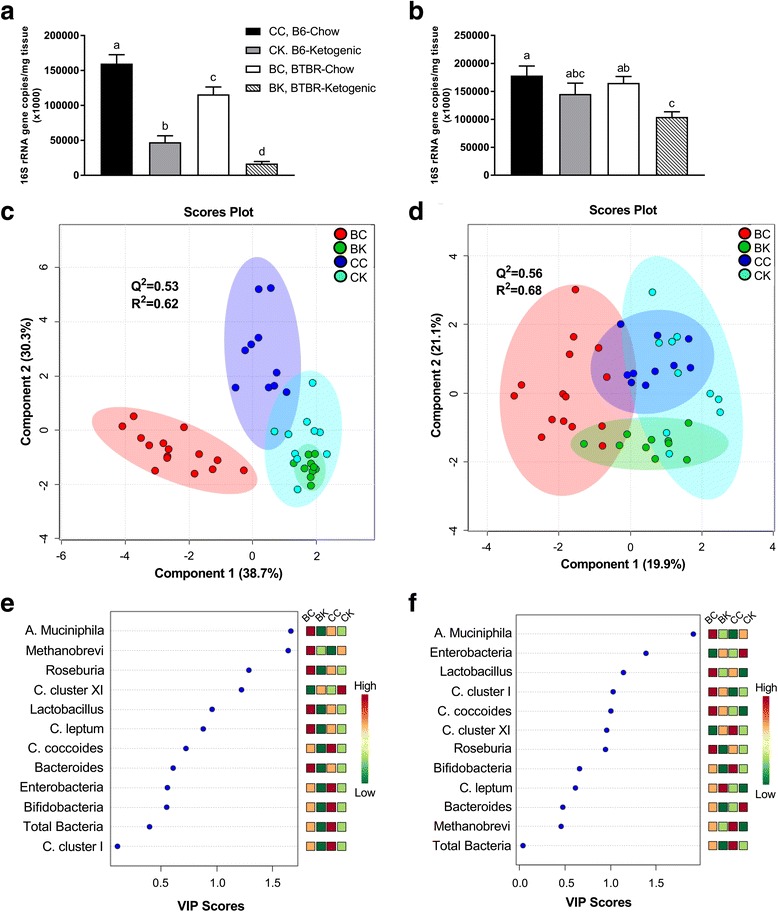
BACKGROUND: Gastrointestinal dysfunction and gut microbial composition disturbances have been widely reported in autism spectrum disorder (ASD). This study examines whether gut microbiome disturbances are present in the BTBR(T + tf/j) (BTBR) mouse model of ASD and if the ketogenic diet, a diet previously shown to elicit therapeutic benefit in this mouse model, is capable of altering the profile. FINDINGS: Juvenile male C57BL/6 (B6) and BTBR mice were fed a standard chow (CH, 13 % kcal fat) or ketogenic diet (KD, 75 % kcal fat) for 10-14 days. Following diets, fecal and cecal samples were collected for analysis. Main findings are as follows: (1) gut microbiota compositions of cecal and fecal samples were altered in BTBR compared to control mice, indicating that this model may be of utility in understanding gut-brain interactions in ASD; (2) KD consumption caused an anti-microbial-like effect by significantly decreasing total host bacterial abundance in cecal and fecal matter; (3) specific to BTBR animals, the KD counteracted the common ASD phenotype of a low Firmicutes to Bacteroidetes ratio in both sample types; and (4) the KD reversed elevated Akkermansia muciniphila content in the cecal and fecal matter of BTBR animals. CONCLUSIONS: Results indicate that consumption of a KD likely triggers reductions in total gut microbial counts and compositional remodeling in the BTBR mouse. These findings may explain, in part, the ability of a KD to mitigate some of the neurological symptoms associated with ASD in an animal model.
Overview
The claims and statistics of this paper haven’t been checked yet.
Run the check — free, no account needed. It reads the open-access text and checks the sources it cites.
Integrity signals
Registry
Cites
Statistics
Figures
Verification
Claims the paper makes
The claims and statistics of this paper haven’t been checked yet.
Run the check — free, no account needed. It reads the open-access text and checks the sources it cites.
Claims other papers make about this one
Each is checked against this paper’s own text: does it say what the citing paper says it does?
In the citing paper
“Additionally BTBR mice was characterized by a gut microbiota profile that was different from that of controls [110].”
From Autism, Gastrointestinal Symptoms and Modulation of Gut Microbiota by Nutritional Interventions (2019) · cites this paper as [110]
Self-check
Percentages, sums and reported differences re-computed from the paper’s own numbers.
The self-check needs the paper’s full text.
Citations
Cites
Changes of Intestinal Functions in Liver Cirrhosis
Fukui, H., & Wiest, R. (2016) · Inflammatory Intestinal Diseases · doi:10.1159/000444436 · Cited by 6,820
Gut microbiota in health and disease
Sekirov, I., Russell, S. L., Antunes, L. C. M., & Finlay, B. B. (2010) · Physiological Reviews · doi:10.1152/physrev.00045.2009 · Cited by 4,182
Role of the gut microbiota in immunity and inflammatory disease
Kamada, N., Seo, S.-U., Chen, G. Y., & Núñez, G. (2013) · Nature reviews. Immunology · doi:10.1038/nri3430 · Cited by 2,256
Microbiota-Generated Metabolites Promote Metabolic Benefits via Gut-Brain Neural Circuits
De Vadder, F., Kovatcheva-Datchary, P., Goncalves, D., Vinera, J., Zitoun, C., Duchampt, A., Bäckhed, F., & Mithieux, G. (2014) · Cell · doi:10.1016/j.cell.2013.12.016 · Cited by 2,200
Dietary emulsifiers impact the mouse gut microbiota promoting colitis and metabolic syndrome
Chassaing, B., Koren, O., Goodrich, J. K., Poole, A. C., Srinivasan, S., Ley, R. E., & Gewirtz, A. T. (2015) · Nature · doi:10.1038/nature14232 · Cited by 2,055
Stoddard, S. F., Smith, B. J., Hein, R., Roller, B. R. K., & Schmidt, T. M. (2014) · Nucleic Acids Research · doi:10.1093/nar/gku1201 · Cited by 1,142
Nau, R., Sörgel, F., & Eiffert, H. (2010) · Clinical Microbiology Reviews · doi:10.1128/cmr.00007-10 · Cited by 1,063
Pyrosequencing study of fecal microflora of autistic and control children
Finegold, S. M., Dowd, S. E., Gontcharova, V., Liu, C., Henley, K. E., Wolcott, R. D., Youn, E., Summanen, P. H., Granpeesheh, D., Dixon, D., et al. (2010) · Anaerobe · doi:10.1016/j.anaerobe.2010.06.008 · Cited by 977
De Angelis, M., Piccolo, M., Vannini, L., Siragusa, S., De Giacomo, A., Serrazzanetti, D. I., Cristofori, F., Guerzoni, M. E., Gobbetti, M., & Francavilla, R. (2013) · PLoS ONE · doi:10.1371/journal.pone.0076993 · Cited by 887
Autism‐like behavioral phenotypes in BTBR T+tf/J mice
McFarlane, H. G., Kusek, G. K., Yang, M., Phoenix, J. L., Bolivar, V. J., & Crawley, J. N. (2008) · Genes, Brain and Behavior · doi:10.1111/j.1601-183x.2007.00330.x · Cited by 812
Parracho, H. M., Bingham, M. O., Gibson, G. R., & McCartney, A. L. (2005) · Journal of Medical Microbiology · doi:10.1099/jmm.0.46101-0 · Cited by 784
Short-Term Benefit From Oral Vancomycin Treatment of Regressive-Onset Autism
Sandler, R. H., Finegold, S. M., Bolte, E. R., Buchanan, C. P., Maxwell, A. P., Väisänen, M.-L., Nelson, M. N., & Wexler, H. M. (2000) · Journal of Child Neurology · doi:10.1177/088307380001500701 · Cited by 614
Interaction of dietary compounds, especially polyphenols, with the intestinal microbiota: a review
Duda-Chodak, A., Tarko, T., Satora, P., & Sroka, P. (2015) · European Journal of Nutrition · doi:10.1007/s00394-015-0852-y · Cited by 599
de Magistris, L., Familiari, V., Pascotto, A., Sapone, A., Frolli, A., Iardino, P., Carteni, M., De Rosa, M., Francavilla, R., Riegler, G., et al. (2010) · Journal of Pediatric Gastroenterology and Nutrition · doi:10.1097/mpg.0b013e3181dcc4a5 · Cited by 546
Ganesh, B. P., Klopfleisch, R., Loh, G., & Blaut, M. (2013) · PLoS ONE · doi:10.1371/journal.pone.0074963 · Cited by 522 · cited 2×
“muciniphila—the predominant representative of the Verrucomicrobia phylum within the GI tract [27].”
Altered gut microbiota and activity in a murine model of autism spectrum disorders
de Theije, C. G. M., Wopereis, H., Ramadan, M., van Eijndthoven, T., Lambert, J., Knol, J., Garssen, J., Kraneveld, A. D., & Oozeer, R. (2014) · Brain Behavior and Immunity · doi:10.1016/j.bbi.2013.12.005 · Cited by 433
Mucins in the gastrointestinal tract in health and disease
Anthony, P. P. (2001) · Frontiers in bioscience · doi:10.2741/corfield · Cited by 343
Scattoni, M. L., Ricceri, L., & Crawley, J. N. (2010) · Genes Brain & Behavior · doi:10.1111/j.1601-183x.2010.00623.x · Cited by 340
Voices from within: gut microbes and the CNS
Forsythe, P., & Kunze, W. A. (2013) · Cellular and Molecular Life Sciences · doi:10.1007/s00018-012-1028-z · Cited by 336
Ketogenic diets, mitochondria, and neurological diseases
Gano, L. B., Patel, M., & Rho, J. M. (2014) · Journal of Lipid Research · doi:10.1194/jlr.r048975 · Cited by 291
Ismail, N. A., Ragab, S. H., ElBaky, A. A., Shoeib, A. R. S., Alhosary, Y., & Fekry, D. (2011) · Archives of Medical Science · doi:10.5114/aoms.2011.23418 · Cited by 277
The role of the gut microbiota in metabolic health
Janssen, A. W. F., & Kersten, S. (2015) · The FASEB Journal · doi:10.1096/fj.14-269514 · Cited by 209
Ketogenic Diet Improves Core Symptoms of Autism in BTBR Mice
Ruskin, D. N., Svedova, J., Cote, J. L., Sandau, U., Rho, J. M., Kawamura, M., Boison, D., & Masino, S. A. (2013) · PLoS ONE · doi:10.1371/journal.pone.0065021 · Cited by 173
Self-citationBomhof, M. R., Saha, D. C., Reid, D. T., Paul, H. A., & Reimer, R. A. (2013) · Obesity · doi:10.1002/oby.20632 · Cited by 150
Autism and nutrition: the role of the gut–brain axis
Sande, M. M. H. V. D., van Buul, V. J., & Brouns, F. J. P. H. (2014) · Nutrition Research Reviews · doi:10.1017/s0954422414000110 · Cited by 148
The BTBR T+tf/J mouse model for autism spectrum disorders–in search of biomarkers
Meyza, K. Z., Defensor, E. B., Jensen, A. L., Corley, M. J., Pearson, B. L., Pobbe, R. L. H., Bolivar, V. J., Blanchard, D. C., & Blanchard, R. J. (2013) · Behavioural Brain Research · doi:10.1016/j.bbr.2012.07.021 · Cited by 147
Mucins in the gastrointestinal tract in health and disease
Corfield, A. P. (2001) · Frontiers in bioscience · doi:10.2741/a684 · Cited by 135
Puberty Is Delayed in Male Growth Hormone Receptor Gene—Disrupted Mice
KEENE, D. E., Suescun, M. O., BOSTWICK, M. G., Chandrashekar, V., Bartke, A., & Kopchick, J. J. (2002) · Journal of Andrology · doi:10.1002/j.1939-4640.2002.tb02308.x · Cited by 75
Gastrointestinal Microbiota and Metabolite Biomarkers in Children With Autism Spectrum Disorders
Wang, L., Conlon, M. A., Christophersen, C. T., Sorich, M. J., & Angley, M. T. (2014) · Biomarkers in Medicine · doi:10.2217/bmm.14.12 · Cited by 72
Klein, M. S., Newell, C., Bomhof, M. R., Reimer, R. A., Hittel, D. S., Rho, J. M., Vogel, H. J., & Shearer, J. (2016) · Journal of Proteome Research · doi:10.1021/acs.jproteome.5b01025 · Cited by 52
Cited by
Sorted by citations
Cryan, J. F., O'Riordan, K. J., Cowan, C. S. M., Sandhu, K. V., Bastiaanssen, T. F. S., Boehme, M., Codagnone, M. G., Cussotto, S., Fulling, C., Golubeva, A. V., et al. (2019) · Physiological Reviews · doi:10.1152/physrev.00018.2018 · Cited by 5,286
The gut microbiome in neurological disorders
Cryan, J. F., O'Riordan, K. J., Sandhu, K., Peterson, V., & Dinan, T. G. (2020) · The Lancet Neurology · doi:10.1016/s1474-4422(19)30356-4 · Cited by 1,336
Human Gut Microbiota from Autism Spectrum Disorder Promote Behavioral Symptoms in Mice
Sharon, G., Cruz, N. J., Kang, D.-W., Gandal, M. J., Wang, B., Kim, Y.-M., Zink, E. M., Casey, C. P., Taylor, B. C., Lane, C. J., et al. (2019) · Cell · doi:10.1016/j.cell.2019.05.004 · Cited by 1,182
The Gut Microbiota Mediates the Anti-Seizure Effects of the Ketogenic Diet
Olson, C. A., Vuong, H. E., Yano, J. M., Liang, Q. Y., Nusbaum, D. J., & Hsiao, E. Y. (2018) · Cell · doi:10.1016/j.cell.2018.04.027 · Cited by 1,057
Zheng, P., Zeng, B., Liu, M., Chen, J., Pan, J., Han, Y., Liu, Y., Cheng, K., Zhou, C., Wang, H., et al. (2019) · Science Advances · doi:10.1126/sciadv.aau8317 · Cited by 704
Metadata
- Authors
- Newell, C., Bomhof, M. R., Reimer, R. A., Hittel, D. S., Rho, J. M., & Shearer, J.
- Affiliations
- University of Calgary (CA)
- Corresponding author
- Newell, Christopher
- Venue
- Molecular Autism
- Published
- 2016-09-01
- Volume
- 7
- Issue
- 1
- Pages
- 37-37
- ISSN
- 2040-2392 (ISSN-L)
- PMC
- PMC5009541
- OpenAlex
- W2509638174
- Cited by
- 272
- References
- 30
- Citations by year
- 2026: 13 · 2025: 30 · 2024: 23 · 2023: 31 · 2022: 41 · 2021: 33 · 2020: 40 · 2019: 29 · 2018: 20 · 2017: 10 · 2016: 2
- FWCI
- 10.56
- Type
- journal article
- Language
- en
- Open access
- gold
- doi.org
- Licence
- cc-by
- Locations
- Molecular Autism (publishedVersion, cc-by)
- PubMed Central (publishedVersion, cc-by)
- PubMed (publishedVersion)
- eScholarship (California Digital Library) (submittedVersion)
- eScholarship (California Digital Library) (submittedVersion, cc-by)
- Funders
- Alberta Children's Hospital Foundation
- Canadian Institutes of Health Research
- MitoCanada
- Topics
- Life Sciences › Biochemistry, Genetics and Molecular Biology › Molecular Biology › Gut microbiota and health
- Life Sciences › Neuroscience › Cognitive Neuroscience › Autism Spectrum Disorder Research
- Health Sciences › Medicine › Physiology (medical) › Diet and metabolism studies
- Keywords
- ketogenic diet, autism spectrum disorder, gut microbiota, gut-brain axis, Akkermansia muciniphila, Firmicutes/Bacteroidetes ratio, cecal microbiota, fecal microbiota, dietary fat, gastrointestinal dysfunction
- MeSH terms
- Autism Spectrum Disorder, Gastrointestinal Microbiome, Animals, Bacteria, Behavior, Animal, Cecum, Disease Models, Animal, Feces, Male, Mice, Inbred C57BL, Social Behavior, Mice, Diet, Ketogenic
About these checks
Registry, retraction, Cites and statistics results are computed, not judged, with one exception: a printed reference that no index lists is read once by a model before it counts as a citation error. Claims are extracted by a model and kept only when their quote appears verbatim in the text; each cited source is then checked, with a model’s help, for whether it says what the claim relies on. Those verdicts can be wrong — read the claim’s quote and the cited source before relying on one.
Statistics and arithmetic are recomputed, not judged.
Confidence bands are shown only for fields calibrated on our annotated test set. None is calibrated yet, so no band is shown.
What counts as a claim ›How we measure confidence ›How we check this ›
Are you an author, or do you see a problem with this page? Request a review
