

Neural circuitry at age 6 months associated with later repetitive behavior and sensory responsiveness in autism
Open accessThe DOI matches its Crossref record; 75 of the 75 references it cites were found in a registry or an index.
Abstract
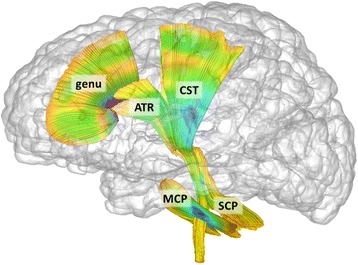
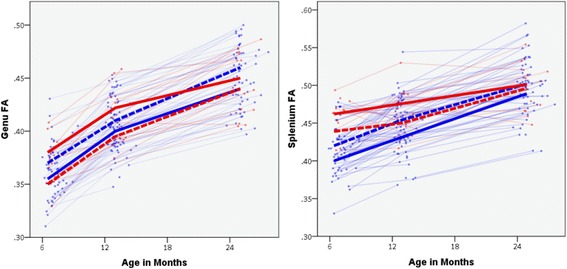
BACKGROUND: Restricted and repetitive behaviors are defining features of autism spectrum disorder (ASD). Under revised diagnostic criteria for ASD, this behavioral domain now includes atypical responses to sensory stimuli. To date, little is known about the neural circuitry underlying these features of ASD early in life. METHODS: Longitudinal diffusion tensor imaging data were collected from 217 infants at high familial risk for ASD. Forty-four of these infants were diagnosed with ASD at age 2. Targeted cortical, cerebellar, and striatal white matter pathways were defined and measured at ages 6, 12, and 24 months. Dependent variables included the Repetitive Behavior Scale-Revised and the Sensory Experiences Questionnaire. RESULTS: Among children diagnosed with ASD, repetitive behaviors and sensory response patterns were strongly correlated, even when accounting for developmental level or social impairment. Longitudinal analyses indicated that the genu and cerebellar pathways were significantly associated with both repetitive behaviors and sensory responsiveness but not social deficits. At age 6 months, fractional anisotropy in the genu significantly predicted repetitive behaviors and sensory responsiveness at age 2. Cerebellar pathways significantly predicted later sensory responsiveness. Exploratory analyses suggested a possible disordinal interaction based on diagnostic status for the association between fractional anisotropy and repetitive behavior. CONCLUSIONS: Our findings suggest that restricted and repetitive behaviors contributing to a diagnosis of ASD at age 2 years are associated with structural properties of callosal and cerebellar white matter pathways measured during infancy and toddlerhood. We further identified that repetitive behaviors and unusual sensory response patterns co-occur and share common brain-behavior relationships. These results were strikingly specific given the absence of association between targeted pathways and social deficits.
Overview
The claims and statistics of this paper haven’t been checked yet.
Free: it reads the open-access text and checks the first 5 claims that cite a source we can check. Create a free account to check every claim.
Integrity signals
Registry
Cites
Statistics
Figures
Verification
Claims the paper makes
The claims and statistics of this paper haven’t been checked yet.
Free: it reads the open-access text and checks the first 5 claims that cite a source we can check. Create a free account to check every claim.
Claims other papers make about this one
Each is checked against this paper’s own text: does it say what the citing paper says it does?
The check wasn’t confident either way, so it gives no verdict — never disputed.
In the citing paper
“Task-based fMRI studies investigate circuits that are responsible for core challenges in ASD (such as language production and comprehension 75 ), and have demonstrated hyper-activation of the superior temporal gyrus and inferior frontal gyrus and hypoactivation of the bilateral middle temporal gyrus 72”
From Autism spectrum disorder (2020) · cites this paper as [75]
Experimental — accuracy not yet measuredThe check wasn’t confident either way, so it gives no verdict — never disputed.
In the citing paper
“In addition, these studies have demonstrated challenges in processing emotions in faces and the 'social brain' 74 , and deficits in attention 75”
From Autism spectrum disorder (2020) · cites this paper as [75]
Experimental — accuracy not yet measured
Self-check
Percentages, sums and reported differences re-computed from the paper’s own numbers.
The self-check needs the paper’s full text.
Citations
Cites
Lord, C., Rutter, M., & Le Couteur, A. (1994) · Journal of Autism and Developmental Disorders · doi:10.1007/bf02172145 · Cited by 9,065 · cited 2×
“Familial high-risk status was defined by having an older sibling with a community diagnosis of the ASD confirmed by the Autism Diagnostic InterviewRevised (ADI-R) [40] and Social Communication Questionnaire [41].”
BackgroundParallel organization of functionally segregated circuits linking basal ganglia and cortex
Alexander, G. E., DeLong, M. R., & Strick, P. L. (1986) · Annual Review of Neuroscience · doi:10.1146/annurev.ne.09.030186.002041 · Cited by 8,527 · cited 1×
“Preclinical work has implicated components of cortico-striatal-thalamo-cortical circuitry [8] as the neurobiological basis of RRBs [9–11].”
BackgroundLord, C., Risi, S., Lambrecht, L., Cook, E. H., Leventhal, B. L., DiLavore, P. C., Pickles, A., & Rutter, M. (2000) · Journal of Autism and Developmental Disorders · doi:10.1023/a:1005592401947 · Cited by 7,520 · cited 9×
“All participants in our study sample had a completed ADOS administration.”
MethodInfluentialAdaptive linear step-up procedures that control the false discovery rate
Benjamini, Y., Krieger, A. M., & Yekutieli, D. (2006) · Biometrika · doi:10.1093/biomet/93.3.491 · Cited by 3,228
Mullen Scales of Early Learning
Bradley-Johnson, S. (1997) · Psychology in the Schools · doi:10.1002/(sici)1520-6807(199710)34:4<379::aid-pits14>3.0.co;2-e · Cited by 2,325 · cited 8×
“This relationship remained when controlling for MSEL composite score (prs = 0.47, p 0.001) or social affect score (prs = 0.48, p 0.001).”
MethodInfluentialPositron emission tomography study of human brain functional development
Chugani, H. T., Phelps, M. E., & Mazziotta, J. C. (1987) · Annals of Neurology · doi:10.1002/ana.410220408 · Cited by 1,548 · cited 2×
“It is less clear what role striatal circuitry plays during infant development or how such circuitry might interact with cerebellar circuits during this period to support emerging function [39], such as the transition from reflexive to instrumental behavior [67].”
BackgroundAnatomical evidence for cerebellar and basal ganglia involvement in higher cognitive function
Middleton, F. A., & Strick, P. L. (1994) · Science · doi:10.1126/science.7939688 · Cited by 1,356 · cited 1×
“Cerebellar and striatal circuits innervate similar frontal cortical regions [70, 71], which are in turn connected by the genu of the corpus callosum.”
BackgroundVarieties of Repetitive Behavior in Autism: Comparisons to Mental Retardation
Bodfish, J. W., Symons, F. J., Parker, D. E., & Lewis, M. H. (2000) · Journal of Autism and Developmental Disorders · doi:10.1023/a:1005596502855 · Cited by 1,223 · cited 1×
“Assessment data included the Repetitive Behavior ScaleRevised (RBS-R) [45] and the Sensory Experiences Questionnaire v2.”
MethodConsensus Paper: The Cerebellum's Role in Movement and Cognition
Koziol, L. F., Budding, D., Andreasen, N., D’Arrigo, S., Bulgheroni, S., Imamizu, H., Ito, M., Manto, M., Marvel, C., Parker, K., et al. (2014) · The Cerebellum · doi:10.1007/s12311-013-0511-x · Cited by 1,133
A clinicopathological study of autism
Bailey, A. (1998) · Brain · doi:10.1093/brain/121.5.889 · Cited by 1,083
Research works printed but not linked: 1
- Oishi K, Faria AV, Zijl PCM van, Mori S. MRI Atlas of Human White Matter. Volume 12. Cambridge: Academic Press; 2010.
Cited by
Items 101–153 of 153
Family history of psychiatric conditions and development of siblings of children with autism
Bellia, G., Chang, J. T., Liew, Z., Vernetti, A., Macari, S. L., Powell, K. K., & Chawarska, K. (2024) · Autism Research · doi:10.1002/aur.3175 · Cited by 4
“…et al., 2011; Zwaigenbaum et al., 2012), the number of the affected siblings, presence of rare genetic copy number variations, (D ’ Abate et al., 2019) and alteration in brain structure and connectivity in infancy (Hazlett et al., 2017; Wolff et al., 2017), associate with odds of autism diagnosis.”
Farmer, A. L., Febo, M., Wilkes, B. J., & Lewis, M. H. (2024) · Cells · doi:10.3390/cells13231933 · Cited by 3
“This study identifies multiple brain regions and networks with altered functional connectivity in relation to strain, EE, and RRB associations that may serve as useful targets for future pharmacological and behavioral interventions.”
Zhang, Y., Li, M., Zhao, R., Liu, T., Wu, J., Xu, X., Chen, R., Chen, Y., Zhao, Z., Lai, C., et al. (2025) · Radiology · doi:10.1148/radiol.251251 · Cited by 3
Infant Word Learning and Emerging Syntax
Levine, D., Hirsh‐Pasek, K., & Golinkoff, R. M. (2020) · Cambridge University Press eBooks · doi:10.1017/9781108351959.023 · Cited by 3
Embodied Brain Model for Understanding Functional Neural Development of Fetuses and Infants
Yamada, Y., Kanazawa, H., & Kuniyoshi, Y. (2020) · Cambridge University Press eBooks · doi:10.1017/9781108351959.001 · Cited by 5
Guo, S., Zhou, K.-L., Dong, S., Xue, X., Wei, P.-D., Yang, J., Fu, G.-B., Liu, Z.-B., & Cui, X. (2021) · Medicine · doi:10.1097/md.0000000000025874 · Cited by 3
Maurer, D. M. (2020) · Cambridge University Press eBooks · doi:10.1017/9781108351959.006 · Cited by 4
Adaptive Functioning Development in Infants With Agenesis of the Corpus Callosum
Haisley, L. D., Hantzsch, L., Glick, A., Turner, J., Sung, S., Swanson, M. R., Wolff, J. J., Burrows, C. A., Botteron, K. N., Dager, S. R., et al. (2025) · PEDIATRICS · doi:10.1542/peds.2024-066555 · Cited by 3
Self-citationInfant Learning in the Digital Age
Rusnak, S. N., & Barr, R. (2020) · Cambridge University Press eBooks · doi:10.1017/9781108351959.016 · Cited by 4
Hayne, H., & Herbert, J. S. (2020) · Cambridge University Press eBooks · doi:10.1017/9781108351959.012 · Cited by 2
Santamarina-Siurana, C., Ballester, V. C., Berenguer, C., & Fuentes-Albero, M. (2022) · BMJ Case Reports · doi:10.1136/bcr-2022-252181 · Cited by 2
Le, H., Bonthrone, A. F., Uus, A. U., Fenchel, D., Lautarescu, A., Dimitrakopoulou, K., Edwards, A. D., Hajnal, J. V., Counsell, S. J., Cordero‐Grande, L., et al. (2025) · Translational Psychiatry · doi:10.1038/s41398-025-03252-3 · Cited by 2
The Infant’s Visual World: The Everyday Statistics for Visual Learning
Jayaraman, S., & Smith, L. B. (2020) · Cambridge University Press eBooks · doi:10.1017/9781108351959.020 · Cited by 4
King, C., Maze, T., & Plakke, B. (2024) · Experimental Brain Research · doi:10.1007/s00221-024-06902-y · Cited by 2
“Individuals with ASD have altered major white matter structures within the cerebellum (Sivaswamy et al. 2010; Mosconi et al. 2015; Wolff et al. 2017), Purkinje cell loss (Bailey et al. 1998; Kern 2003; Whitney et al. 2008, 2009), and reduced cerebellar cortex volume (Courchesne et al. 1988, 1994a;…”
Informative Feature-Guided Siamese Network for Early Diagnosis of Autism
Gao, K., Sun, Y., Niu, S., & Wang, L. (2020) · Lecture notes in computer science · doi:10.1007/978-3-030-59861-7_68 · Cited by 3
Robotic assistance for autism: a literature review
Ferrão, I. G., Romero, R. A. F., Ramos, J. J. G., & Azevêdo, H. (2020) · Latin American Robotics Symposium, Brazilian Symposium on Robotics and Workshop on Robotics in Education (LARS/SBR/WRE) · doi:10.1109/lars/sbr/wre51543.2020.9306942 · Cited by 2
“People diagnosed with autism tend to feel, hear, and visualize the universe differently from others, reproducing repetitive and stereotyped behaviors [3].”
BackgroundReiersen, A. M. (2018) · Journal of the American Academy of Child & Adolescent Psychiatry · doi:10.1016/j.jaac.2017.12.002 · Cited by 2
“In support of this concept, neuroimaging studies of infants at high genetic risk for ASD (due to having an older sibling with the diagnosis) demonstrate early signs of atypical brain circuitry/networks related to sensory and motor functions as early as six months of age, and these brain imaging findings are associated…”
ResultSocial and Communication Development in Infants with Isolated Agenesis of the Corpus Callosum
Paul, L. K., Turner, J., Sung, S., & Elison, J. T. (2024) · The Journal of Pediatrics Clinical Practice · doi:10.1016/j.jpedcp.2024.200118 · Cited by 1
Self-citationVisegrády, A. (2025) · International Journal of Molecular Sciences · doi:10.3390/ijms26104483 · Cited by 1
“…from those in global developmental delay [155] and ADHD [156] and as diagnosis stability of ASD is relatively high, it can be reasoned that this early period of brain overgrowth and probably overconnectivity is specific to autism and might form the pathomechanistic basis of idiopathic ASD [157].”
Ruiz, M., Arranz, M. J., Pérez, V., & Hervas, A. (2025) · European Archives of Psychiatry and Clinical Neuroscience · doi:10.1007/s00406-025-02171-0 · Cited by 1
“The association between SS and RSM has been reported by other authors [ 46, 54, 60, 62 ], although Boyd et al. [ 10] did not find such a link.”
Infants’ Perception of Auditory Patterns
Cirelli, L. K., & Trehub, S. E. (2020) · Cambridge University Press eBooks · doi:10.1017/9781108351959.008 · Cited by 1
Amso, D., & Tummeltshammer, K. S. (2020) · Cambridge University Press eBooks · doi:10.1017/9781108351959.007 · Cited by 2
Early Knowledge About Space and Quantity
Newcombe, N. S. (2020) · Cambridge University Press eBooks · doi:10.1017/9781108351959.015 · Cited by 1
The Mirror Neuron System and Social Cognition
Fox, N. A., Salo, V. C., Debnath, R., Morales, S., & Smith, E. G. (2020) · Cambridge University Press eBooks · doi:10.1017/9781108351959.018 · Cited by 1
Oakes, L. M. (2020) · Cambridge University Press eBooks · doi:10.1017/9781108351959.014 · Cited by 1
Movement Disorders and Neuropsychiatric Conditions
Singer, H. S., Mink, J. W., Gilbert, D. L., & Jankovic, J. J. (2022) · Elsevier eBooks · doi:10.1016/b978-0-12-820552-5.00016-4 · Cited by 1
Mechanisms Conferring Risk versus Resilience for Autism Spectrum Disorder in Early Infancy
Tsang, T. (2018) · eScholarship (California Digital Library) · Cited by 1
Ryan, S. (2018) · Griffith Research Online · doi:10.25904/1912/1760 · Cited by 3
Murakami, M. M., Hoexter, M. Q., & Shephard, E. (2019) · Revista de Medicina · doi:10.11606/issn.1679-9836.v98i4p259-266
Brain-Behavior Links in Autism Spectrum Disorder Across the Lifespan
Taylor, L. J., & Whitehouse, A. (2020) · Elsevier eBooks · doi:10.1016/b978-0-12-819641-0.00003-7
Lampl, M. (2020) · Cambridge University Press eBooks · doi:10.1017/9781108351959.002
Hespos, S. J., & Anderson, E. M. (2020) · Cambridge University Press eBooks · doi:10.1017/9781108351959.013 · Cited by 1
Dual Language Exposure and Early Learning
Brito, N. H. (2020) · Cambridge University Press eBooks · doi:10.1017/9781108351959.024
Reh, R. K., & Werker, J. F. (2020) · Cambridge University Press eBooks · doi:10.1017/9781108351959.021 · Cited by 1
Development During Infancy in Children Later Diagnosed with Autism Spectrum Disorder
Falck‐Ytter, T., & Jones, E. J. H. (2020) · Cambridge University Press eBooks · doi:10.1017/9781108351959.005
Dynamic Epigenetic Impact of the Environment on the Developing Brain
Champagne, F. A. (2020) · Cambridge University Press eBooks · doi:10.1017/9781108351959.003 · Cited by 1
Chegwin, S. T. (2018) · Repository@Hull (Worktribe) (University of Hull)
Testing Candidate Cerebellar Presymptomatic Biomarkers for Autism Spectrum Disorder
Hawks, Z. (2021) · Open Scholarship Institutional Repository (Washington University in St. Louis) · doi:10.7936/72xs-kv80
“Finally, cerebellar contributions to ASD may be more evident during different developmental epochs (e.g., prior to 6 months) or using different imaging modalities (such as diffusion tensor imaging) (Wolff et al., 2017), cautioning against over-interpretation of null results.”
BackgroundLockman, J. J., & Tamis‐LeMonda, C. S. (2020) · Cambridge University Press eBooks · doi:10.1017/9781108351959.031
Lockman, J. J., & Tamis‐LeMonda, C. S. (2020) · Cambridge University Press eBooks · doi:10.1017/9781108351959.030
Onemli, E., Mahmood, A., Azrak, O., Garic, D., Swanson, M. R., Grzadzinski, R., Mata, K., Shen, M. D., Girault, J. B., John, T. S., et al. (2025) · Lecture notes in computer science · doi:10.1007/978-3-032-04937-7_45 · Cited by 1
Self-citationAn Overview of Secondary Stereotypies
Mendonça, C. A. D. N. (2022) · Portuguese National Funding Agency for Science, Research and Technology (RCAAP Project by FCT) · doi:10.34626/mqsd-6x34
Surgent, O. J., Riaz, A., Ausderau, K., Adluru, N., Kirk, G. R., Guerrero-Gonzalez, J. M., Skaletski, E. C., Kecskemeti, S., Dean III, D. C., Weismer, S. E., et al. (2024) · Figshare · doi:10.6084/m9.figshare.26555786
Early Neurodevelopmental Trajectories Underlying Typical and Atypical Behavioral Development
Wagner, L. (2025) · eScholarship (California Digital Library)
Hurtado Ruiz, M. G. (2023) · Dipòsit Digital de Documents de la UAB (Universitat Autònoma de Barcelona) · Cited by 1
Functional connectivity in infants’ visual cortex and its links to motion processing and autism
Hardiansyah, I., Bussu, G., Bölte, S., Jones, E. J. H., & Falck‐Ytter, T. (2026) · Scientific Reports · doi:10.1038/s41598-026-42048-3
Rothärmel, M. (2019) · theses.fr (ABES) · doi:10.70675/e8883013z1f99z4729z9f22z3ebbd6f1586a · Cited by 2
Altérations sexe-dépendantes de la nociception dans un modèle d’autisme induit par le valproate
Glaunec, L. R. (2023) · theses.fr (ABES) · doi:10.70675/3d445796ze7caz426ezaafaza54d2130e2a3
Gait variability development in autistic individuals across childhood and adulthoodPreprint
Shafer, R. L., Wang, J., Qu, H., Simpson, J. P., Terza, M. J., Shirley, D. J., McKinney, W. S., Pulver, S. L., Orlando, A., Romero, R. A. A., et al. (2026) · Research Square · doi:10.21203/rs.3.rs-9622252/v1
“Separate studies also have found associations between repetitive behavior and the structure and function of the cerebellum 99,101,102 .”
Chiem, E., Wagner, L., Hernandez, L. M., Green, S. A., & Dapretto, M. (2026) · Journal of Neurodevelopmental Disorders · doi:10.1186/s11689-026-09721-0
Bertaccini, R. (2026) · AMS Dottorato Institutional Doctoral Theses Repository (University of Bologna) · doi:10.48676/unibo/amsdottorato/13177
Network analysis of anxiety and related factors in preschool children with autism spectrum disorder
Lu, M., Zou, Q., Duan, T., Zhao, J., & He, H. (2026) · Research in Developmental Disabilities · doi:10.1016/j.ridd.2026.105412
Metadata
- Authors
- The IBIS Network, Wolff, J. J., Swanson, M. R., Elison, J. T., Gerig, G., Pruett, J. R., Styner, M. A., Vachet, C., Botteron, K. N., Dager, S. R., Estes, A. M., Hazlett, H. C., Schultz, R. T., Shen, M. D., Zwaigenbaum, L., & Piven, J.
- Affiliations
- University of North Carolina at Chapel Hill (US)
- University of Minnesota (US)
- Washington University in St. Louis (US)
- University of Washington (US)
- Corresponding author
- Wolff, Jason J.
- ORCID
- Venue
- Molecular Autism
- Published
- 2017-03-04
- Volume
- 8
- Issue
- 1
- Pages
- 8-8
- ISSN
- 2040-2392 (ISSN-L)
- PMC
- PMC5351210
- OpenAlex
- W2593611050
- Semantic Scholar
- fe006df5729e528e645cb56481f540b7accb3d7d
- Cited by
- 142
- References
- 74
- Citations by year
- 2026: 4 · 2025: 14 · 2024: 14 · 2023: 8 · 2022: 15 · 2021: 15 · 2020: 47 · 2019: 10 · 2018: 11 · 2017: 4
- FWCI
- 11.30
- Type
- journal article
- Language
- en
- Open access
- gold
- doi.org
- Licence
- cc-by
- creativecommons.org/licenses/by/4.0/ (tdm)
- creativecommons.org/licenses/by/4.0/ (vor)
- Locations
- Molecular Autism (publishedVersion, cc-by)
- Europe PMC (PubMed Central) (publishedVersion, cc-by)
- PubMed Central (publishedVersion, cc-by)
- PubMed (publishedVersion)
- Digital Commons@Becker (Washington University School of Medicine) (submittedVersion)
- Libraries and Cultural Resources (University of Calgary) (submittedVersion)
- Funders
- National Institute of Mental Health (k01MH101653, R01MH093510)
- National Institute of Child Health and Human Development (T32HD40127, P30HD03110)
- Topics
- Life Sciences › Neuroscience › Cognitive Neuroscience › Autism Spectrum Disorder Research
- Life Sciences › Biochemistry, Genetics and Molecular Biology › Genetics › Genetics and Neurodevelopmental Disorders
- Health Sciences › Medicine › Psychiatry and Mental health › Child Nutrition and Feeding Issues
- Keywords
- autism spectrum disorder, restricted and repetitive behaviors, sensory responsiveness, infant brain development, white matter microstructure, corpus callosum, cerebellar white matter, fractional anisotropy, longitudinal neuroimaging, Repetitive Behavior Scale-Revised, social dysfunction
- MeSH terms
- Autism Spectrum Disorder, Brain, Brain Mapping, Child, Preschool, Female, Humans, Infant, Longitudinal Studies, Male, Stereotyped Behavior, Diffusion Tensor Imaging
About these checks
Registry, retraction, Cites and statistics results are computed, not judged, with one exception: a printed reference that no index lists is read once by a model before it counts as a citation error. Claims are extracted by a model and kept only when their quote appears verbatim in the text; each cited source is then checked, with a model’s help, for whether it says what the claim relies on. Those verdicts can be wrong — read the claim’s quote and the cited source before relying on one.
Statistics and arithmetic are recomputed, not judged.
Confidence bands are shown only for fields calibrated on our annotated test set. None is calibrated yet, so no band is shown.
What counts as a claim ›How we measure confidence ›How we check this ›
Are you an author, or do you see a problem with this page? Request a review
Data sources
Bibliographic data: Semantic Scholar, OpenAlex, Crossref.
Contains information from the Semantic Scholar Academic Graph Datasets, made available under the ODC Attribution License (ODC-BY 1.0).
Semantic Scholar’s data is described in: Kinney, R., et al. (2023). The Semantic Scholar Open Data Platform. arXiv:2301.10140.
