

Latent trajectories of adaptive behaviour in infants at high and low familial risk for autism spectrum disorder
Open accessThe DOI matches its Crossref record; 45 of the 45 references it cites were found in a registry or an index.
Abstract
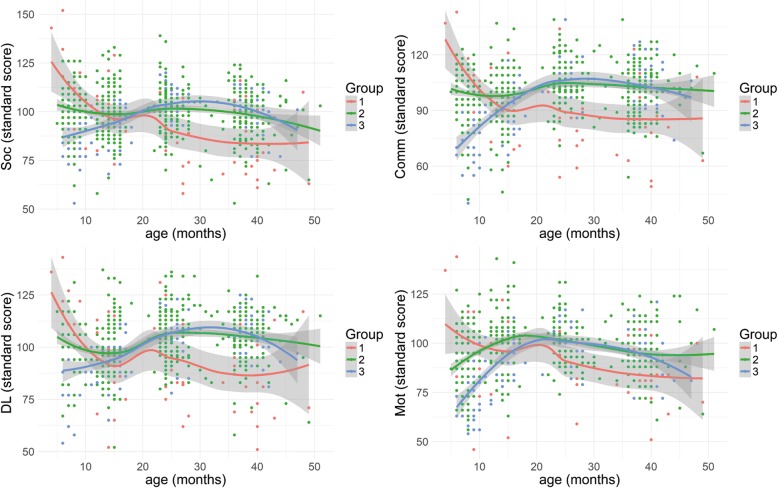
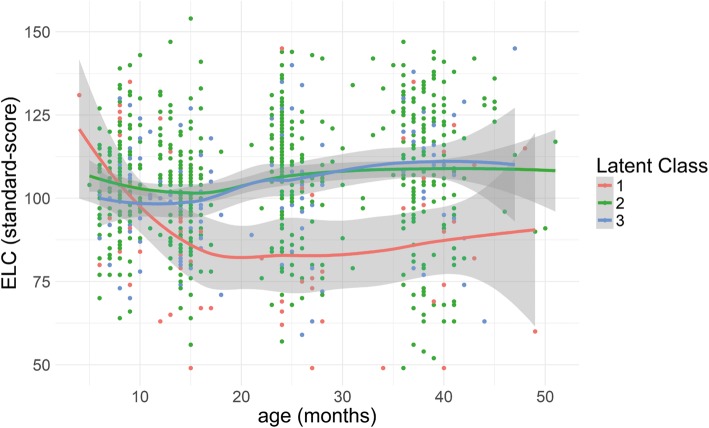
Background: Autism spectrum disorder (ASD) is characterised by persisting difficulties in everyday functioning. Adaptive behaviour is heterogeneous across individuals with ASD, and it is not clear to what extent early development of adaptive behaviour relates to ASD outcome in toddlerhood. This study aims to identify subgroups of infants based on early development of adaptive skills and investigate their association with later ASD outcome. Methods: = 74) familial risk for ASD between 8 and 36 months using the Vineland Adaptive Behavior Scales (VABS-II). The four domains of VABS-II were modelled in parallel using growth mixture modelling to identify distinct classes of infants based on adaptive behaviour. Then, we associated class membership with clinical outcome and ASD symptoms at 36 months and longitudinal measures of cognitive development. Results: We observed three classes characterised by decreasing trajectories below age-appropriate norms (8.3%), stable trajectories around age-appropriate norms (73.8%), and increasing trajectories reaching average scores by age 2 (17.9%). Infants with declining adaptive behaviour had a higher risk (odds ratio (OR) = 4.40; confidence interval (CI) 1.90; 12.98) for ASD and higher parent-reported symptoms in the social, communication, and repetitive behaviour domains at 36 months. Furthermore, there was a discrepancy between adaptive and cognitive functioning as the class with improving adaptive skills showed stable cognitive development around average scores. Conclusions: Findings confirm the heterogeneity of trajectories of adaptive functioning in infancy, with a higher risk for ASD in toddlerhood linked to a plateau in the development of adaptive functioning after the first year of life.
Overview
The claims and statistics of this paper haven’t been checked yet.
Free: it reads the open-access text and checks the first 5 claims that cite a source we can check. Create a free account to check every claim.
Integrity signals
Registry
Cites
Statistics
Figures
Verification
Claims the paper makes
The claims and statistics of this paper haven’t been checked yet.
Free: it reads the open-access text and checks the first 5 claims that cite a source we can check. Create a free account to check every claim.
Claims other papers make about this one
Each is checked against this paper’s own text: does it say what the citing paper says it does?
The check wasn’t confident either way, so it gives no verdict — never disputed.
In the citing paper
“The potential for early testing to prospectively identify children with ASD at a young age has considerable interest, and several studies have evaluated the performance of parent-report instruments between 14 and 24 months of age, such as the”
From Autism spectrum disorder (2020) · cites this paper as [144]
Experimental — accuracy not yet measured
Self-check
Percentages, sums and reported differences re-computed from the paper’s own numbers.
The self-check needs the paper’s full text.
Citations
Cites
Diagnostic and Statistical Manual of Mental Disorders
American Psychiatric Association (2013) · doi:10.1176/appi.books.9780890425596 · Cited by 116,369
Fitting Linear Mixed-Effects Models Using lme4
Bates, D., Mächler, M., Bolker, B., & Walker, S. (2015) · Journal of Statistical Software · doi:10.18637/jss.v067.i01 · Cited by 86,835
Muthén, B., & Muthén, L. K. (2000) · Alcoholism: Clinical and Experimental Research · doi:10.1111/j.1530-0277.2000.tb02070.x · Cited by 3,149 · cited 2×
“instead of latent class growth curve modelling [29], allowing variation within class to capture heterogeneity”
Group-Based Trajectory Modeling in Clinical Research
Nagin, D. S., & Odgers, C. L. (2010) · Annual Review of Clinical Psychology · doi:10.1146/annurev.clinpsy.121208.131413 · Cited by 2,708 · cited 1×
“The best model was determined in terms of data fitting and parsimony based on having lower values of Bayesian information criterion (BIC), Akaike information criterion (AIC), negative log-likelihood, and higher average class posterior probability [30].”
Autism Diagnostic Observation Schedule
Lord, C., Rutter, M., Goode, S., Heemsbergen, J., Jordan, H., Mawhood, L., & Schopler, E. (2016) · PsycTESTS Dataset · doi:10.1037/t54175-000 · Cited by 1,678
Finite Mixture Modeling with Mixture Outcomes Using the EM Algorithm
Muthén, B., & Shedden, K. (1999) · Biometrics · doi:10.1111/j.0006-341x.1999.00463.x · Cited by 1,486 · cited 3×
“GMM is a data-driven approach which allows one to identify distinct mixtures of trajectories within population defining classes of individual growth curves [7].”
BackgroundMethodAutism spectrum disorders: developmental disconnection syndromes
Geschwind, D. H., & Levitt, P. (2007) · Current Opinion in Neurobiology · doi:10.1016/j.conb.2007.01.009 · Cited by 1,411
Estimating latent structure models with categorical variables: one-step versus three-step estimators
Bolck, A., Croon, M., & Hagenaars, J. (2004) · Political Analysis · doi:10.1093/pan/mph001 · Cited by 1,406 · cited 5×
“TC has received research grant support from the Medical Research Council (UK), the National Institute of Health Research, Horizon 2020 and the Innovative Medicines Initiative (both European Commission), MQ, Autistica, FP7 (European Commission), the Charles Hawkins Fund, and the Waterloo Foundation.”
MethodInfluentialJudd, C. M., Westfall, J., & Kenny, D. A. (2012) · Journal of Personality and Social Psychology · doi:10.1037/a0028347 · Cited by 1,236 · cited 2×
“Then, we examined the association of class membership with trajectories of cognitive development, as measured by the MSEL ELC score between 8 and 36 months, through hierarchical mixture modelling [32].”
Early brain development in infants at high risk for autism spectrum disorder
The IBIS Network, Hazlett, H. C., Gu, H., Munsell, B. C., Kim, S. H., Styner, M., Wolff, J. J., Elison, J. T., Swanson, M. R., Zhu, H., et al. (2017) · Nature · doi:10.1038/nature21369 · Cited by 1,128 · cited 1×
“There, higher fractional anisotropy and volume in the development of fibre tracts [40, 41], accelerated expansion of cortical surface area, and brain volume overgrowth [42] in the first year of life were linked to later ASD outcome.”
Sex/Gender Differences and Autism: Setting the Scene for Future Research
Lai, M.-C., Lombardo, M. V., Auyeung, B., Chakrabarti, B., & Baron-Cohen, S. (2015) · Journal of the American Academy of Child & Adolescent Psychiatry · doi:10.1016/j.jaac.2014.10.003 · Cited by 1,120 · cited 1×
“prevalence of ASD [45] and with previous findings in children with ASD showing higher daily living scores in females than males [46].”
Estimation of Extended Mixed Models Using Latent Classes and Latent Processes: The R Package lcmm
Proust-Lima, C., Philipps, V., & Liquet, B. (2017) · Journal of Statistical Software · doi:10.18637/jss.v078.i02 · Cited by 1,106 · cited 1×
“Analyses were performed using the multlcmm function from the lcmm package in R [31].”
A Prospective Study of the Emergence of Early Behavioral Signs of Autism
Ozonoff, S., Iosif, A.-M., Baguio, F., Cook, I. C., Hill, M. M., Hutman, T., Rogers, S. J., Rozga, A., Sangha, S., Sigman, M., et al. (2010) · Journal of the American Academy of Child & Adolescent Psychiatry · doi:10.1016/j.jaac.2009.11.009 · Cited by 1,011
Vineland Adaptive Behavior Scales, Second Edition
Sparrow, S. S., Cicchetti, D., & Balla, D. A. (2012) · PsycTESTS Dataset · doi:10.1037/t15164-000 · Cited by 978
Zwaigenbaum, L., Bauman, M. L., Choueiri, R., Kasari, C., Carter, A., Granpeesheh, D., Mailloux, Z., Smith Roley, S., Wagner, S., Fein, D., et al. (2015) · Pediatrics · doi:10.1542/peds.2014-3667e · Cited by 856 · cited 1×
“Early access to personalised interventions can, in turn, be crucial to improve later functioning in different environments of everyday life through learning of adaptive skills [13].”
Estimation of extended mixed models using latent classes and latent processes: the R package lcmm
Proust‐Lima, C., Philipps, V., & Liquet, B. (2015) · RePEc: Research Papers in Economics · doi:10.48550/arxiv.1503.00890 · Cited by 764 · cited 1×
“Analyses were performed using the multlcmm function from the lcmm package in R [31].”
Young Adult Outcome of Autism Spectrum Disorders
Eaves, L. C., & Ho, H. H. (2008) · Journal of Autism and Developmental Disorders · doi:10.1007/s10803-007-0441-x · Cited by 683 · cited 1×
“The resulting long-term outcome is mixed, but many children diagnosed with ASD will have a suboptimal quality of life in adulthood [2–4], with persisting impairments in everyday functioning [5].”
Wolff, J. J., Gu, H., Gerig, G., Elison, J. T., Styner, M., Gouttard, S., Botteron, K. N., Dager, S. R., Dawson, G., Estes, A. M., et al. (2012) · American Journal of Psychiatry · doi:10.1176/appi.ajp.2011.11091447 · Cited by 671 · cited 1×
“There, higher fractional anisotropy and volume in the development of fibre tracts [40, 41], accelerated expansion of cortical surface area, and brain volume overgrowth [42] in the first year of life were linked to later ASD outcome.”
Developmental pathways to autism: A review of prospective studies of infants at risk
Jones, E. J. H., Gliga, T., Bedford, R., Charman, T., & Johnson, M. H. (2014) · Neuroscience & Biobehavioral Reviews · doi:10.1016/j.neubiorev.2013.12.001 · Cited by 607
Self-citationIQ in children with autism spectrum disorders: Data from the special needs and autism project (SNAP)
Charman, T., Pickles, A., Simonoff, E., Chandler, S., Loucas, T., & Baird, G. (2011) · Psychological Medicine · doi:10.1017/s0033291710000991 · Cited by 599 · cited 1×
“Discrepancy between adaptive and cognitive skills has been found before [14, 47], showing lower and more divergent adaptive skills compared to cognitive level.”
Self-citationKlin, A., Saulnier, C. A., Sparrow, S. S., Cicchetti, D. V., Volkmar, F. R., & Lord, C. (2007) · Journal of Autism and Developmental Disorders · doi:10.1007/s10803-006-0229-4 · Cited by 585 · cited 1×
“However, the profile of good cognitive abilities with poor adaptive skills, which has been reported before in older children with ASD [18, 20], has not emerged from our study.”
The Role of Adaptive Behavior in Autism Spectrum Disorders: Implications for Functional Outcome
Kanne, S. M., Gerber, A. J., Quirmbach, L. M., Sparrow, S. S., Cicchetti, D. V., & Saulnier, C. A. (2011) · Journal of Autism and Developmental Disorders · doi:10.1007/s10803-010-1126-4 · Cited by 494 · cited 1×
“Cognitive impairment has been shown to have a negative effect on everyday functioning and the development of adaptive behaviour, even beyond the effect of ASD symptoms [19].”
Early Identification of Autism Spectrum Disorder: Recommendations for Practice and Research
Zwaigenbaum, L., Bauman, M. L., Stone, W. L., Yirmiya, N., Estes, A., Hansen, R. L., McPartland, J. C., Natowicz, M. R., Choueiri, R., Fein, D., et al. (2015) · Pediatrics · doi:10.1542/peds.2014-3667c · Cited by 487
Autism spectrum disorder: outcomes in adulthood
Howlin, P., & Magiati, I. (2017) · Current Opinion in Psychiatry · doi:10.1097/yco.0000000000000308 · Cited by 457
Howlin, P., Moss, P., Savage, S., & Rutter, M. (2013) · Journal of the American Academy of Child & Adolescent Psychiatry · doi:10.1016/j.jaac.2013.02.017 · Cited by 456 · cited 1×
“Differences in gender were not significant, while the proportion of missing data at 24 months was significantly dependent on clinical outcome at 36 months (χ(2) [3] = 8.”
Infant neural sensitivity to dynamic eye gaze is associated with later emerging autism
Elsabbagh, M., Mercure, E., Hudry, K., Chandler, S., Pasco, G., Charman, T., Pickles, A., Baron-Cohen, S., Bolton, P., & Johnson, M. H. (2012) · Current Biology · doi:10.1016/j.cub.2011.12.056 · Cited by 429 · cited 1×
“Fifty-four high-risk and 50 low-risk infants participated to phase 1 [22], while an independent cohort of 116 HR and 27 LR participated to phase 2.”
Self-citationIBIS network, Estes, A., Zwaigenbaum, L., Gu, H., St. John, T., Paterson, S., Elison, J. T., Hazlett, H., Botteron, K., Dager, S. R., et al. (2015) · Journal of Neurodevelopmental Disorders · doi:10.1186/s11689-015-9117-6 · Cited by 363 · cited 1×
“These findings extend previous work on the same dataset [15] and independent work from Estes and colleagues [16] on trajectories of adaptive behaviour between 8 and 36 months.”
Subgrouping the Autism Spectrum: Reflections on DSM-5
Lai, M.-C., Lombardo, M. V., Chakrabarti, B., & Baron-Cohen, S. (2013) · PLoS Biology · doi:10.1371/journal.pbio.1001544 · Cited by 330
Szatmari, P., Georgiades, S., Duku, E., Bennett, T. A., Bryson, S., Fombonne, E., Mirenda, P., Roberts, W., Smith, I. M., Vaillancourt, T., et al. (2015) · JAMA Psychiatry · doi:10.1001/jamapsychiatry.2014.2463 · Cited by 322 · cited 7×
“Evidence suggests that adaptive behaviour in ASD is heterogeneous across individuals and even within the same individual over time [6].”
InfluentialDaily living skills in individuals with autism spectrum disorder from 2 to 21 years of age
Bal, V. H., Kim, S.-H., Cheong, D., & Lord, C. (2015) · Autism · doi:10.1177/1362361315575840 · Cited by 306
Cognitive and language skills in adults with autism: a 40‐year follow‐up
Howlin, P., Savage, S., Moss, P., Tempier, A., & Rutter, M. (2014) · Journal of Child Psychology and Psychiatry · doi:10.1111/jcpp.12115 · Cited by 255
Meredith, R. M. (2015) · Neuroscience & Biobehavioral Reviews · doi:10.1016/j.neubiorev.2014.12.001 · Cited by 232 · cited 1×
“A recent framework for neurodevelopmental disorders suggests, in fact, that good synaptic compensation to overcome initial impairment at an earlier developmental stage might have more severe consequences later in development [44].”
Bölte, S., & Poustka, F. (2002) · Child Psychiatry and Human Development · doi:10.1023/a:1020734325815 · Cited by 216 · cited 1×
“However, the profile of good cognitive abilities with poor adaptive skills, which has been reported before in older children with ASD [18, 20], has not emerged from our study.”
BackgroundBaghdadli, A., Assouline, B., Sonié, S., Pernon, E., Darrou, C., Michelon, C., Picot, M.-C., Aussilloux, C., & Pry, R. (2012) · Journal of Autism and Developmental Disorders · doi:10.1007/s10803-011-1357-z · Cited by 165
Toward a conceptual framework for early brain and behavior development in autism
Piven, J., Elison, J. T., & Zylka, M. J. (2017) · Molecular Psychiatry · doi:10.1038/mp.2017.131 · Cited by 163 · cited 1×
“In particular, hyper-expansion of cortical surface area may compromise the development of proper neural connectivity [43] and have downstream effects on behaviour, leading to the emergence of symptoms characteristic of ASD in toddlerhood.”
Solso, S., Xu, R., Proudfoot, J., Hagler, D. J., Campbell, K., Venkatraman, V., Carter Barnes, C., Ahrens-Barbeau, C., Pierce, K., Dale, A., et al. (2016) · Biological Psychiatry · doi:10.1016/j.biopsych.2015.06.029 · Cited by 160 · cited 1×
“There, higher fractional anisotropy and volume in the development of fibre tracts [40, 41], accelerated expansion of cortical surface area, and brain volume overgrowth [42] in the first year of life were linked to later ASD outcome.”
the BASIS Team, Bussu, G., Jones, E. J. H., Charman, T., Johnson, M. H., & Buitelaar, J. K. (2018) · Journal of Autism and Developmental Disorders · doi:10.1007/s10803-018-3509-x · Cited by 134 · cited 2×
“These findings extend previous work on the same dataset [15] and independent work from Estes and colleagues [16] on trajectories of adaptive behaviour between 8 and 36 months.”
Self-citationGammer, I., Bedford, R., Elsabbagh, M., Garwood, H., Pasco, G., Tucker, L., Volein, A., Johnson, M. H., & Charman, T. (2015) · Infant Behavior and Development · doi:10.1016/j.infbeh.2014.12.017 · Cited by 118 · cited 1×
“Data were collected from 247 infants from the British Autism Study of Infant Siblings [21], across two phases of the study based on time of recruitment.”
Self-citationVarcin, K. J., & Jeste, S. (2016) · Current Opinion in Psychiatry · doi:10.1097/yco.0000000000000312 · Cited by 99
Kim, S. H., Thurm, A., Shumway, S., & Lord, C. (2013) · Journal of Autism and Developmental Disorders · doi:10.1007/s10803-012-1696-4 · Cited by 98
Farmer, C., Swineford, L., Swedo, S. E., & Thurm, A. (2018) · Journal of Neurodevelopmental Disorders · doi:10.1186/s11689-017-9222-9 · Cited by 69 · cited 3×
“From age 2 onwards, the identified classes mainly showed one relatively stable trajectory around average scores and a below-average decreasing trajectory, consistent with previous findings on older children with ASD [6, 8, 9].”
Flanagan, H. E., Smith, I. M., Vaillancourt, T., Duku, E., Szatmári, P., Bryson, S. E., Fombonne, E. J., Mirenda, P., Roberts, W., Volden, J., et al. (2015) · Journal of Autism and Developmental Disorders · doi:10.1007/s10803-015-2433-6 · Cited by 58 · cited 2×
“From age 2 onwards, the identified classes mainly showed one relatively stable trajectory around average scores and a below-average decreasing trajectory, consistent with previous findings on older children with ASD [6, 8, 9].”
Mandic-Maravic, V., Pejovic-Milovancevic, M., Mitkovic-Voncina, M., Kostic, M., Aleksic-Hil, O., Radosavljev-Kircanski, J., Mincic, T., & Lecic-Tosevski, D. (2015) · Scientific Reports · doi:10.1038/srep10418 · Cited by 51 · cited 1×
“prevalence of ASD [45] and with previous findings in children with ASD showing higher daily living scores in females than males [46].”
Sacrey, L.-A. R., Zwaigenbaum, L., Bryson, S. E., Brian, J. A., Smith, I. M., Raza, S., Roberts, W., Szatmári, P., Vaillancourt, T., Roncadin, C., et al. (2018) · Journal of Child Psychology and Psychiatry · doi:10.1111/jcpp.12985 · Cited by 47 · cited 2×
“Only one recent study has investigated latent trajectories of adaptive functioning in a high-risk cohort [17].”
The BASIS Team, Salomone, E., Shephard, E., Milosavljevic, B., Johnson, M. H., & Charman, T. (2018) · Journal of Autism and Developmental Disorders · doi:10.1007/s10803-018-3554-5 · Cited by 37 · cited 5×
“Yet, it is in contrast with our previous work on group comparisons, showing significantly lower adaptive skills in HR-ASD siblings compared to HR-Typical or LR controls and overall stable-low or decreasing trajectories of adaptive behaviour in infancy [14, 15].”
InfluentialSelf-citation
Research works printed but not linked: 2
- Mullen EM Mullen scale of early learning: AGS edition 1995 Circle Pines, MN American Guidance Service Publishing
- World Health Organization The ICD-10 classification of mental and behavioural disorders: diagnostic criteria for research 1993 Geneva World Health Organization
Cited by
Lord, C., Brugha, T. S., Charman, T., Cusack, J., Dumas, G., Frazier, T., Jones, E. J. H., Jones, R. M., Pickles, A., State, M. W., et al. (2020) · Nature Reviews Disease Primers · doi:10.1038/s41572-019-0138-4 · Cited by 1,859
Self-citationResilience in Development and Psychopathology: Multisystem Perspectives
Masten, A. S., Lucke, C. M., Nelson, K. M., & Stallworthy, I. C. (2021) · Annual Review of Clinical Psychology · doi:10.1146/annurev-clinpsy-081219-120307 · Cited by 794
Nguena Nguefack, H. L., Pagé, M. G., Katz, J., Choinière, M., Vanasse, A., Dorais, M., Samb, O. M., & Lacasse, A. (2020) · Clinical Epidemiology · doi:10.2147/clep.s265287 · Cited by 527
“8,13,28,47,48 Type of Data Handled The GMM is a model for longitudinal data that has been developed for the study of continuous data.”
Linking risk factors and outcomes in autism spectrum disorder: is there evidence for resilience?
Elsabbagh, M. (2020) · BMJ · doi:10.1136/bmj.l6880 · Cited by 98
Clinical and Translational Implications of an Emerging Developmental Substructure for Autism
Constantino, J. N., Charman, T., & Jones, E. J. H. (2021) · Annual Review of Clinical Psychology · doi:10.1146/annurev-clinpsy-081219-110503 · Cited by 60
Self-citation
Metadata
- Authors
- BASIS Team, Bussu, G., Jones, E. J. H., Charman, T., Johnson, M. H., & Buitelaar, J. K.
- Affiliations
- Radboud University Medical Center (NL)
- University of London (GB)
- King's College London (GB)
- Radboud University Nijmegen (NL)
- Corresponding author
- Bussu, Giorgia
- Venue
- Molecular Autism
- Published
- 2019-03-15
- Volume
- 10
- Issue
- 1
- Pages
- 13-13
- ISSN
- 2040-2392 (ISSN-L)
- PMC
- PMC6420730
- OpenAlex
- W2941331649
- Cited by
- 27
- References
- 45
- Citations by year
- 2026: 3 · 2025: 3 · 2024: 1 · 2023: 1 · 2022: 7 · 2021: 3 · 2020: 9
- FWCI
- 2.76
- Type
- journal article
- Language
- en
- Open access
- gold
- doi.org
- Licence
- cc-by
- creativecommons.org/licenses/by/4.0/ (tdm)
- Locations
- Molecular Autism (publishedVersion, cc-by)
- Europe PMC (PubMed Central) (publishedVersion, cc-by)
- PubMed Central (publishedVersion, cc-by)
- PubMed (publishedVersion)
- Goldsmiths (University of London) (acceptedVersion)
- BIROn (Birkbeck, University of London) (acceptedVersion)
- BOA (University of Milano-Bicocca) (submittedVersion, cc-by)
- Research Portal (King's College London) (submittedVersion, cc-by)
- Radboud Repository (Radboud University) (submittedVersion, other-oa)
- DOAJ (DOAJ: Directory of Open Access Journals) (submittedVersion, cc-by-sa)
- UCL Discovery (University College London) (submittedVersion)
- Radboud Repository (Radboud University) (submittedVersion)
- Apollo (University of Cambridge) (submittedVersion, cc-by)
- Zenodo (CERN European Organization for Nuclear Research) (submittedVersion, cc-by)
- Apollo (cc-by)
- Funders
- H2020 Marie Skłodowska-Curie Actions (642996)
- Innovative Medicines Initiative (115300)
- UK Medical Research Council (G0701484, MR/K021389/1)
- Seventh Framework Programme (FP7/2007-2013)
- Topics
- Life Sciences › Neuroscience › Cognitive Neuroscience › Autism Spectrum Disorder Research
- Health Sciences › Medicine › Psychiatry and Mental health › Child Nutrition and Feeding Issues
- Life Sciences › Biochemistry, Genetics and Molecular Biology › Genetics › Genetics and Neurodevelopmental Disorders
- Keywords
- autism spectrum disorder, adaptive behavior, infants, familial risk, developmental trajectories, Vineland Adaptive Behavior Scales, cognitive development, social communication, repetitive behavior
- MeSH terms
- Autism Spectrum Disorder, Adaptation, Psychological, Female, Humans, Infant, Male, Infant Behavior, Genetic Predisposition to Disease
About these checks
Registry, retraction, Cites and statistics results are computed, not judged, with one exception: a printed reference that no index lists is read once by a model before it counts as a citation error. Claims are extracted by a model and kept only when their quote appears verbatim in the text; each cited source is then checked, with a model’s help, for whether it says what the claim relies on. Those verdicts can be wrong — read the claim’s quote and the cited source before relying on one.
Statistics and arithmetic are recomputed, not judged.
Confidence bands are shown only for fields calibrated on our annotated test set. None is calibrated yet, so no band is shown.
What counts as a claim ›How we measure confidence ›How we check this ›
Are you an author, or do you see a problem with this page? Request a review
Data sources
Bibliographic data: Semantic Scholar, OpenAlex, Crossref.
Contains information from the Semantic Scholar Academic Graph Datasets, made available under the ODC Attribution License (ODC-BY 1.0).
Semantic Scholar’s data is described in: Kinney, R., et al. (2023). The Semantic Scholar Open Data Platform. arXiv:2301.10140.
