

Common and unique multimodal covarying patterns in autism spectrum disorder subtypes
Open accessThe DOI matches its Crossref record; 60 of the 60 references it cites were found in a registry or an index.
Abstract
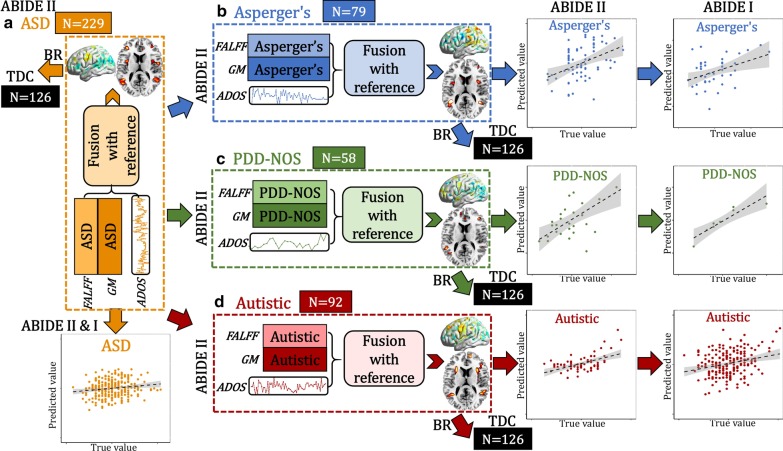
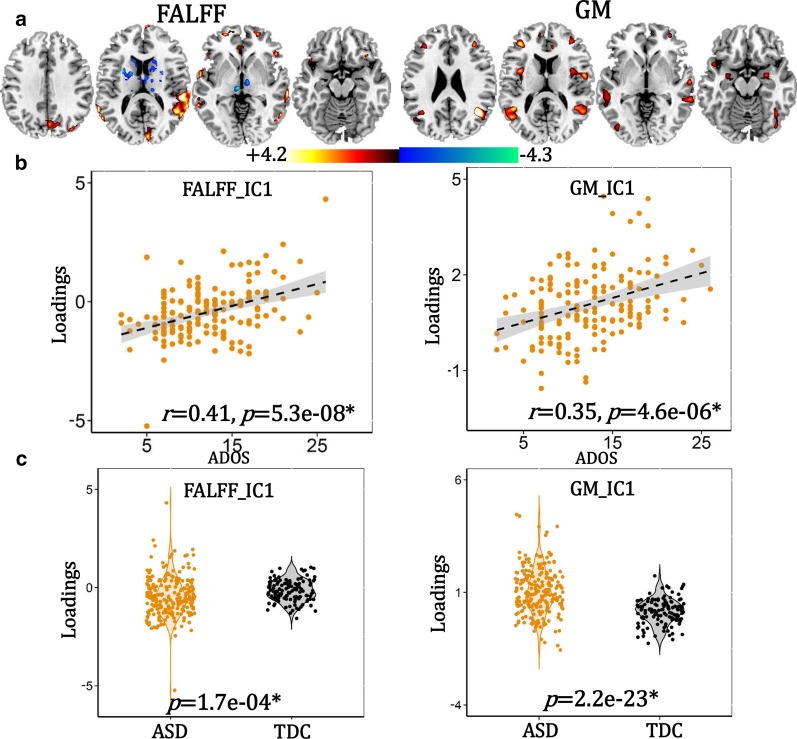
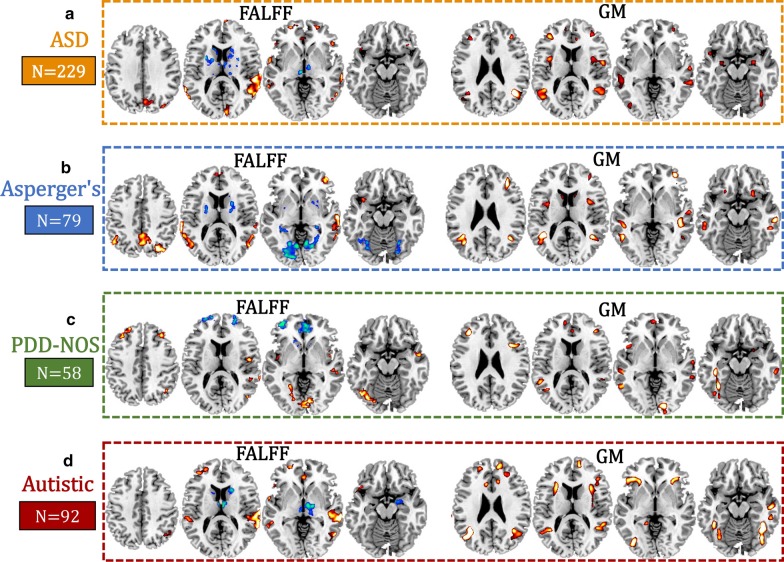
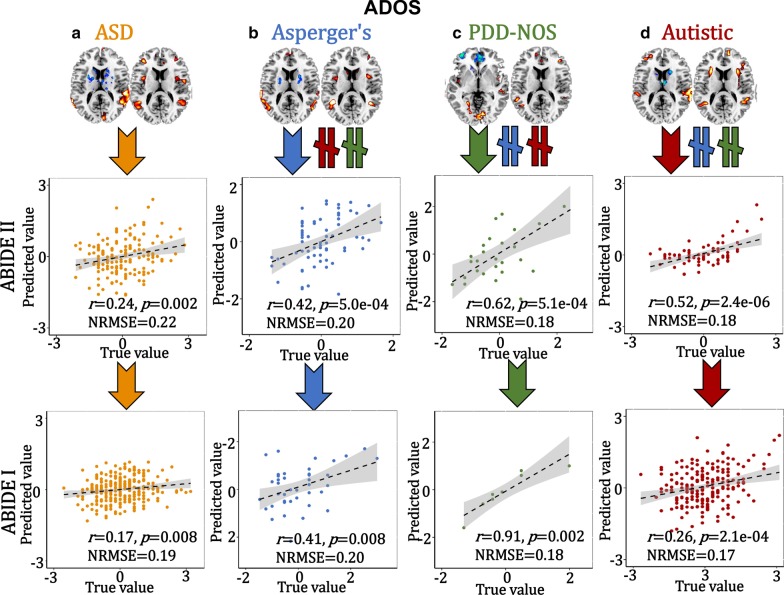
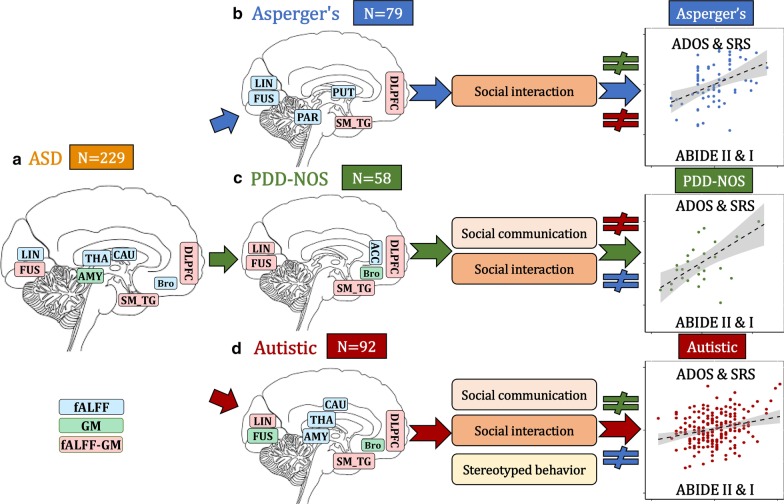
Background: The heterogeneity inherent in autism spectrum disorder (ASD) presents a substantial challenge to diagnosis and precision treatment. Heterogeneity across biological etiologies, genetics, neural systems, neurocognitive attributes and clinical subtypes or phenotypes has been observed across individuals with ASD. Methods: In this study, we aim to investigate the heterogeneity in ASD from a multimodal brain imaging perspective. The Autism Diagnostic Observation Schedule (ADOS) was used as a reference to guide functional and structural MRI fusion. DSM-IV-TR diagnosed Asperger’s disorder (n = 79), pervasive developmental disorder-not otherwise specified [PDD-NOS] (n = 58) and Autistic disorder (n = 92) from ABIDE II were used as discovery cohort, and ABIDE I (n = 400) was used for replication. Results: Dorsolateral prefrontal cortex and superior/middle temporal cortex are the primary common functional–structural covarying cortical brain areas shared among Asperger’s, PDD-NOS and Autistic subgroups. Key differences among the three subtypes are negative functional features within subcortical brain areas, including negative putamen–parahippocampus fractional amplitude of low-frequency fluctuations (fALFF) unique to the Asperger’s subtype; negative fALFF in anterior cingulate cortex unique to PDD-NOS subtype; and negative thalamus–amygdala–caudate fALFF unique to the Autistic subtype. Furthermore, each subtype-specific brain pattern is correlated with different ADOS subdomains, with social interaction as the common subdomain. The identified subtype-specific patterns are only predictive for ASD symptoms manifested in the corresponding subtypes, but not the other subtypes. Conclusions: Although ASD has a common neural basis with core deficits linked to social interaction, each ASD subtype is strongly linked to unique brain systems and subdomain symptoms, which may help to better understand the underlying mechanisms of ASD heterogeneity from a multimodal neuroimaging perspective. Limitations: This study is male based, which cannot be generalized to the female or the general ASD population.
Overview
The claims and statistics of this paper haven’t been checked yet.
Free: it reads the open-access text and checks the first 5 claims that cite a source we can check. Create a free account to check every claim.
Integrity signals
Registry
Cites
Statistics
Figures
Verification
Claims the paper makes
The claims and statistics of this paper haven’t been checked yet.
Free: it reads the open-access text and checks the first 5 claims that cite a source we can check. Create a free account to check every claim.
Claims other papers make about this one
Each is checked against this paper’s own text: does it say what the citing paper says it does?
The source backs part of the claim, not all of it — or backs it for a different population, condition or comparison.
In the citing paper
“Moreover, typical symptoms presented in neurodevelopmental disorders might be driven by alterations of both brain structure and function [48, 49].”
From Confound Controlled Multimodal Neuroimaging Data Fusion and Its Application to Developmental Disorders (2025) · cites this paper as [48]
Experimental — accuracy not yet measured
Self-check
Percentages, sums and reported differences re-computed from the paper’s own numbers.
The self-check needs the paper’s full text.
Citations
Cites
Lord, C., Risi, S., Lambrecht, L., Cook, E. H., Leventhal, B. L., DiLavore, P. C., Pickles, A., & Rutter, M. (2000) · Journal of Autism and Developmental Disorders · doi:10.1023/a:1005592401947 · Cited by 7,520
Ashburner, J., & Friston, K. J. (2005) · NeuroImage · doi:10.1016/j.neuroimage.2005.02.018 · Cited by 7,507
A New Initiative on Precision Medicine
Collins, F. S., & Varmus, H. (2015) · New England Journal of Medicine · doi:10.1056/nejmp1500523 · Cited by 5,202
Lord, C., Elsabbagh, M., Baird, G., & Veenstra-Vanderweele, J. (2018) · The Lancet · doi:10.1016/s0140-6736(18)31129-2 · Cited by 2,819
What Is the Male-to-Female Ratio in Autism Spectrum Disorder? A Systematic Review and Meta-Analysis
Loomes, R., Hull, L., & Mandy, W. P. L. (2017) · Journal of the American Academy of Child & Adolescent Psychiatry · doi:10.1016/j.jaac.2017.03.013 · Cited by 2,804
Di Martino, A., Yan, C.-G., Li, Q., Denio, E., Castellanos, F. X., Alaerts, K., Anderson, J. S., Assaf, M., Bookheimer, S. Y., Dapretto, M., et al. (2014) · Molecular Psychiatry · doi:10.1038/mp.2013.78 · Cited by 2,780
Lai, M.-C., Lombardo, M. V., & Baron-Cohen, S. (2014) · The Lancet · doi:10.1016/s0140-6736(13)61539-1 · Cited by 2,371
Zou, Q.-H., Zhu, C.-Z., Yang, Y., Zuo, X.-N., Long, X.-Y., Cao, Q.-J., Wang, Y.-F., & Zang, Y.-F. (2008) · Journal of Neuroscience Methods · doi:10.1016/j.jneumeth.2008.04.012 · Cited by 2,161
Gaze fixation and the neural circuitry of face processing in autism
Dalton, K. M., Nacewicz, B. M., Johnstone, T., Schaefer, H. S., Gernsbacher, M. A., Goldsmith, H. H., Alexander, A. L., & Davidson, R. J. (2005) · Nature Neuroscience · doi:10.1038/nn1421 · Cited by 1,543
Amaral, D. G., Schumann, C. M., & Nordahl, C. W. (2008) · Trends in Neurosciences · doi:10.1016/j.tins.2007.12.005 · Cited by 1,492
Sex/Gender Differences and Autism: Setting the Scene for Future Research
Lai, M.-C., Lombardo, M. V., Auyeung, B., Chakrabarti, B., & Baron-Cohen, S. (2015) · Journal of the American Academy of Child & Adolescent Psychiatry · doi:10.1016/j.jaac.2014.10.003 · Cited by 1,120
Schultz, R. T. (2005) · International Journal of Developmental Neuroscience · doi:10.1016/j.ijdevneu.2004.12.012 · Cited by 1,071
The social brain in psychiatric and neurological disorders
Kennedy, D. P., & Adolphs, R. (2012) · Trends in Cognitive Sciences · doi:10.1016/j.tics.2012.09.006 · Cited by 791
Enhancing studies of the connectome in autism using the autism brain imaging data exchange II
Di Martino, A., O’Connor, D., Chen, B., Alaerts, K., Anderson, J. S., Assaf, M., Balsters, J. H., Baxter, L., Beggiato, A., Bernaerts, S., et al. (2017) · Scientific Data · doi:10.1038/sdata.2017.10 · Cited by 710 · cited 2×
“Participants Subjects with ASD (n = 229) and the corresponding TDCs (n = 126) were selected from the ABIDE II [29, 30], which is hosted by the 1000 Functional Connectome Project/International Neuroimaging Data-sharing Initiative (INDI) from multiple international sites (9 sites, Additional file 1: Table S1).”
MethodDisentangling the heterogeneity of autism spectrum disorder through genetic findings
Jeste, S. S., & Geschwind, D. H. (2014) · Nature Reviews Neurology · doi:10.1038/nrneurol.2013.278 · Cited by 644
Halladay, A. K., Bishop, S., Constantino, J. N., Daniels, A. M., Koenig, K., Palmer, K., Messinger, D., Pelphrey, K., Sanders, S. J., Singer, A. T., et al. (2015) · Molecular Autism · doi:10.1186/s13229-015-0019-y · Cited by 574
Big data approaches to decomposing heterogeneity across the autism spectrum
Lombardo, M. V., Lai, M.-C., & Baron-Cohen, S. (2019) · Molecular Psychiatry · doi:10.1038/s41380-018-0321-0 · Cited by 537
Gene hunting in autism spectrum disorder: on the path to precision medicine
Geschwind, D. H., & State, M. W. (2015) · The Lancet Neurology · doi:10.1016/s1474-4422(15)00044-7 · Cited by 471
The idiosyncratic brain: distortion of spontaneous connectivity patterns in autism spectrum disorder
Hahamy, A., Behrmann, M., & Malach, R. (2015) · Nature Neuroscience · doi:10.1038/nn.3919 · Cited by 416
Between a ROC and a hard place: decision making and making decisions about using the SCQ
Corsello, C., Hus, V., Pickles, A., Risi, S., Cook, E. H., Leventhal, B. L., & Lord, C. (2007) · Journal of Child Psychology and Psychiatry · doi:10.1111/j.1469-7610.2007.01762.x · Cited by 353
Pickles, A., Anderson, D. K., & Lord, C. (2014) · Journal of Child Psychology and Psychiatry · doi:10.1111/jcpp.12269 · Cited by 318
Anterior cingulate cortex dysfunction underlies social deficits in Shank3 mutant mice
Guo, B., Chen, J., Chen, Q., Ren, K., Feng, D., Mao, H., Yao, H., Yang, J., Liu, H., Liu, Y., et al. (2019) · Nature Neuroscience · doi:10.1038/s41593-019-0445-9 · Cited by 287
Self-citationNaviaux, J. C., Wang, L., Li, K., Bright, A., Alaynick, W. A., Williams, K. R., Powell, S. B., & Naviaux, R. K. (2015) · Molecular Autism · doi:10.1186/2040-2392-6-1 · Cited by 285
Li, X., Chiu, C.-Y., Wang, H.-J., Kassemeyer, S., Botha, S., Shoeman, R. L., Lawrence, R. M., Kupitz, C., Kirian, R., James, D., et al. (2017) · Scientific Data · doi:10.1038/sdata.2017.154 · Cited by 251
Heterogeneity within Autism Spectrum Disorders: What have We Learned from Neuroimaging Studies?
Lenroot, R. K., & Yeung, P. K. (2013) · Frontiers in Human Neuroscience · doi:10.3389/fnhum.2013.00733 · Cited by 228
Diagnostic Evaluation of Autism Spectrum Disorders
Huerta, M., & Lord, C. (2012) · Pediatric Clinics of North America · doi:10.1016/j.pcl.2011.10.018 · Cited by 198
Developmental trajectories as autism phenotypes
Lord, C., Bishop, S., & Anderson, D. (2015) · American Journal of Medical Genetics Part C: Seminars in Medical Genetics · doi:10.1002/ajmg.c.31440 · Cited by 197
MRC AIMS Consortium, Bedford, S. A., Park, M. T. M., Devenyi, G. A., Tullo, S., Germann, J., Patel, R., Anagnostou, E., Baron-Cohen, S., Bullmore, E. T., et al. (2020) · Molecular Psychiatry · doi:10.1038/s41380-019-0420-6 · Cited by 193
Catarino, A., Andrade, A., Churches, O., Wagner, A. P., Baron-Cohen, S., & Ring, H. (2013) · Molecular Autism · doi:10.1186/2040-2392-4-1 · Cited by 183
Subtyping cognitive profiles in Autism Spectrum Disorder using a Functional Random Forest algorithm
Feczko, E., Balba, N. M., Miranda-Dominguez, O., Cordova, M., Karalunas, S. L., Irwin, L., Demeter, D. V., Hill, A. P., Langhorst, B. H., Grieser Painter, J., et al. (2018) · NeuroImage · doi:10.1016/j.neuroimage.2017.12.044 · Cited by 173
Toward Neurosubtypes in Autism
Hong, S.-J., Vogelstein, J. T., Gozzi, A., Bernhardt, B. C., Yeo, B. T. T., Milham, M. P., & Di Martino, A. (2020) · Biological Psychiatry · doi:10.1016/j.biopsych.2020.03.022 · Cited by 171
Multimodal neuromarkers in schizophrenia via cognition-guided MRI fusion
Sui, J., Qi, S., van Erp, T. G. M., Bustillo, J., Jiang, R., Lin, D., Turner, J. A., Damaraju, E., Mayer, A. R., Cui, Y., et al. (2018) · Nature Communications · doi:10.1038/s41467-018-05432-w · Cited by 164
Self-citationAberrant Dynamic Functional Network Connectivity and Graph Properties in Major Depressive Disorder
Zhi, D., Calhoun, V. D., Lv, L., Ma, X., Ke, Q., Fu, Z., Du, Y., Yang, Y., Yang, X., Pan, M., et al. (2018) · Frontiers in Psychiatry · doi:10.3389/fpsyt.2018.00339 · Cited by 150
Self-citationTang, S., Sun, N., Floris, D. L., Zhang, X., Di Martino, A., & Yeo, B. T. T. (2020) · Biological Psychiatry · doi:10.1016/j.biopsych.2019.11.009 · Cited by 144
Autism in DSM-5: progress and challenges
Volkmar, F. R., & Reichow, B. (2013) · Molecular Autism · doi:10.1186/2040-2392-4-13 · Cited by 141
Multidimensional Neuroanatomical Subtyping of Autism Spectrum Disorder
Hong, S.-J., Valk, S. L., Di Martino, A., Milham, M. P., & Bernhardt, B. C. (2018) · Cerebral Cortex · doi:10.1093/cercor/bhx229 · Cited by 128
Jiang, R., Calhoun, V. D., Fan, L., Zuo, N., Jung, R., Qi, S., Lin, D., Li, J., Zhuo, C., Song, M., et al. (2020) · Cerebral Cortex · doi:10.1093/cercor/bhz134 · Cited by 126
Self-citationResting-state abnormalities in Autism Spectrum Disorders: A meta-analysis
Lau, W. K., Leung, M.-K., & Lau, B. W.-M. (2019) · Scientific Reports · doi:10.1038/s41598-019-40427-7 · Cited by 122
MicroRNA132 associated multimodal neuroimaging patterns in unmedicated major depressive disorder
Qi, S., Yang, X., Zhao, L., Calhoun, V. D., Perrone-Bizzozero, N., Liu, S., Jiang, R., Jiang, T., Sui, J., & Ma, X. (2018) · Brain · doi:10.1093/brain/awx366 · Cited by 106
Self-citationItahashi, T., Yamada, T., Watanabe, H., Nakamura, M., Ohta, H., Kanai, C., Iwanami, A., Kato, N., & Hashimoto, R.-I. (2015) · Molecular Autism · doi:10.1186/s13229-015-0026-z · Cited by 100
Qi, S., Calhoun, V. D., van Erp, T. G. M., Bustillo, J., Damaraju, E., Turner, J. A., Du, Y., Yang, J., Chen, J., Yu, Q., et al. (2018) · IEEE Transactions on Medical Imaging · doi:10.1109/tmi.2017.2725306 · Cited by 99
Self-citationDefining Precision Medicine Approaches to Autism Spectrum Disorders: Concepts and Challenges
Loth, E., Murphy, D. G., & Spooren, W. (2016) · Frontiers in Psychiatry · doi:10.3389/fpsyt.2016.00188 · Cited by 86
Connectome-based individualized prediction of temperament trait scores
Jiang, R., Calhoun, V. D., Zuo, N., Lin, D., Li, J., Fan, L., Qi, S., Sun, H., Fu, Z., Song, M., et al. (2018) · NeuroImage · doi:10.1016/j.neuroimage.2018.08.038 · Cited by 81 · cited 1×
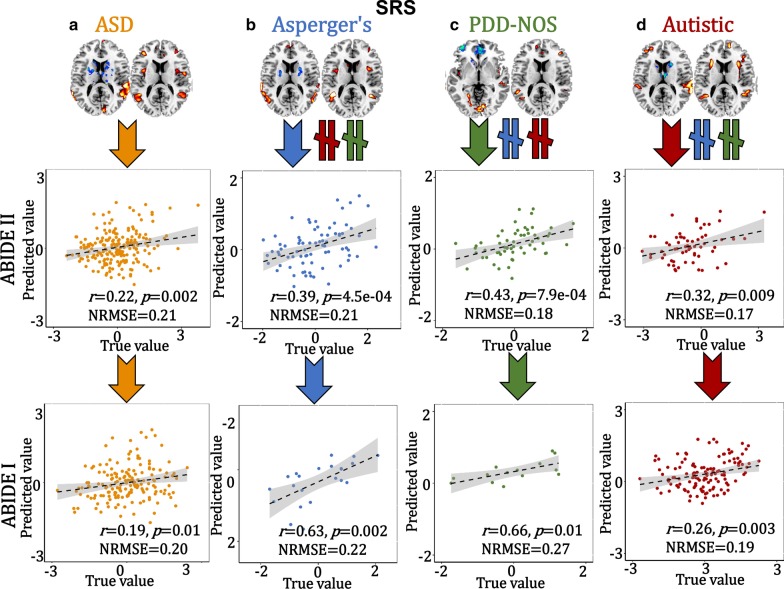
“Cross-cohort prediction To verify the predictability [43, 44] of these specific multimodal brain features identified within ASD and the subtypes, the extracted ROIs (positive and negative brain networks in fMRI_IC, and positive brain networks in sMRI_IC, details can be found in Supplementary “Predictive feature extrac…”
MethodSelf-citationLee, J. M., Kyeong, S., Kim, E., & Cheon, K.-A. (2016) · Frontiers in Neuroscience · doi:10.3389/fnins.2016.00191 · Cited by 76 · cited 1×
“Dysfunction of putamen found in high-functioning adults with ASD [51] and decreased inter- and intrahemispheric functional connectivity density in parahippocampus [52] may underlie the pathologies of ASD.”
BackgroundNeuropsychological heterogeneity in executive functioning in autism spectrum disorders
Geurts, H., Sinzig, J., Booth, R., & HappÉ, F. (2014) · International Journal of Developmental Disabilities · doi:10.1179/2047387714y.0000000047 · Cited by 74
He, Y., Byrge, L., & Kennedy, D. P. (2020) · Human Brain Mapping · doi:10.1002/hbm.24879 · Cited by 71
Berman, J. I., Edgar, J. C., Blaskey, L., Kuschner, E. S., Levy, S. E., Ku, M., Dell, J., & Roberts, T. P. L. (2016) · Frontiers in Neuroanatomy · doi:10.3389/fnana.2016.00030 · Cited by 68
Silva, F. D. O., Ferreira, J. V., Plácido, J. D. S. S., Chagas, D. D. V., Praxedes, J., Guimarães, C., Batista, L. A., Marinho, V., Laks, J., & Deslandes, A. C. (2019) · Archives of Gerontology and Geriatrics · doi:10.1016/j.archger.2019.103941 · Cited by 61
Increased Putamen Volume in Adults with Autism Spectrum Disorder
Sato, W., Kubota, Y., Kochiyama, T., Uono, S., Yoshimura, S., Sawada, R., Sakihama, M., & Toichi, M. (2014) · Frontiers in Human Neuroscience · doi:10.3389/fnhum.2014.00957 · Cited by 56 · cited 1×
“Dysfunction of putamen found in high-functioning adults with ASD [51] and decreased inter- and intrahemispheric functional connectivity density in parahippocampus [52] may underlie the pathologies of ASD.”
BackgroundWesteinde, A. V., Cauvet, É., Toro, R., Kuja‐Halkola, R., Neufeld, J., Mevel, K., & Bölte, S. (2019) · Molecular Autism · doi:10.1186/s13229-019-0309-x · Cited by 53
Mazurek, M. O., Lu, F., Symecko, H., Butter, E., Bing, N. M., Hundley, R. J., Poulsen, M., Kanne, S. M., Macklin, E. A., & Handen, B. L. (2017) · Journal of Autism and Developmental Disorders · doi:10.1007/s10803-017-3200-7 · Cited by 49
Behavioral, Cognitive and Neural Markers of Asperger Syndrome
Faridi, F., & Khosrowabadi, R. (2017) · Basic and Clinical Neuroscience Journal · doi:10.18869/nirp.bcn.8.5.349 · Cited by 48
Hawco, C. S., Buchanan, R. W., Calarco, N., Mulsant, B. H., Viviano, J. D., Dickie, E. W., Árgyelán, M., Gold, J. M., Iacoboni, M., DeRosse, P., et al. (2019) · American Journal of Psychiatry · doi:10.1176/appi.ajp.2018.17091020 · Cited by 48
Diagnosis and Management of Autism Spectrum Disorder in the Era of Genomics
Baker, E., & Jeste, S. S. (2015) · Pediatric Clinics of North America · doi:10.1016/j.pcl.2015.03.003 · Cited by 39
Electroconvulsive therapy treatment responsive multimodal brain networks
Qi, S., Abbott, C., Narr, K. L., Jiang, R., Upston, J., McClintock, S. M., Espinoza, R. T., Jones, T., Zhi, D., Sun, H., et al. (2020) · Human Brain Mapping · doi:10.1002/hbm.24910 · Cited by 35 · cited 1×
“In this study, multimodal [28] brain imaging data from the Autism Brain Imaging Data Exchange (ABIDE) [29, 30] were used as the discovery (ABIDE II) and replication (ABIDE I) cohorts.”
MethodSelf-citationQi, S., Sui, J., Chen, J., Liu, J., Jiang, R., Silva, R. F., Iraji, A., Damaraju, E., Salman, M. S., Lin, D., et al. (2019) · Human Brain Mapping · doi:10.1002/hbm.24632 · Cited by 34 · cited 1×
“Although this study used static brain function (fALFF) approaches, dynamic functional network connectivity matrices [55, 56] can also be used to capture both temporal and spatial co-alterations in a future study, which could provide an even richer understanding of both the core and unique aspects of ASD on temporal pe…”
MethodSelf-citationQi, S., Bustillo, J., Turner, J. A., Jiang, R., Zhi, D., Fu, Z., Deramus, T. P., Vergara, V., Ma, X., Yang, X., et al. (2020) · Translational Psychiatry · doi:10.1038/s41398-020-0834-6 · Cited by 32
Self-citationBuxbaum, J. D., & Baron-Cohen, S. (2013) · Molecular Autism · doi:10.1186/2040-2392-4-11 · Cited by 29
Resting-state brain activity in Chinese boys with low functioning autism spectrum disorder
Li, G., Rossbach, K., Jiang, W., & Du, Y. (2018) · Annals of General Psychiatry · doi:10.1186/s12991-018-0217-z · Cited by 26
Multimodal Imaging in Autism: an Early Review of Comprehensive Neural Circuit Characterization
Yerys, B. E., & Herrington, J. D. (2014) · Current Psychiatry Reports · doi:10.1007/s11920-014-0496-2 · Cited by 18
Cited by
Lakhan, A. R., Mohammed, M. A., Abdulkareem, K. H., Hamouda, H. N., & Alyahya, S. (2023) · Computers in Biology and Medicine · doi:10.1016/j.compbiomed.2023.107539 · Cited by 114
Brain imaging-based machine learning in autism spectrum disorder: methods and applications
Xu, M., Calhoun, V. D., Jiang, R., Yan, W., & Sui, J. (2021) · Journal of Neuroscience Methods · doi:10.1016/j.jneumeth.2021.109271 · Cited by 81
“Furthermore, combining multimodal brain imaging data could give comprehensive views of brain organizations, and facilitate to reveal complex, cross-modal alterations associated with the intrinsic pathology of disorders (Jiang et al., 2020a, 2020c; Qi et al., 2020a).”
BackgroundMethodSelf-citationData-driven multimodal fusion: approaches and applications in psychiatric research
Sui, J., Zhi, D., & Calhoun, V. D. (2023) · Psychoradiology · doi:10.1093/psyrad/kkad026 · Cited by 64
“…in ASD by mC-C AR + jIC A with the Autism Diagnostic Observation Schedule as a r efer ence to guide m ultimodal fusion on Asper ger’s, perv a-siv e de v elopmental disorder-not otherwise specified (PDD-NOS), and autistic subtype from the ABIDE I/II datasets (Qi, Morris, et al. , 2020 ).”
MethodSelf-citationQi, S., Sui, J., Pearlson, G. D., Bustillo, J., Perrone‐Bizzozero, N. I., Kochunov, P., Turner, J. A., Fu, Z., Shao, W., Jiang, R., et al. (2022) · Nature Communications · doi:10.1038/s41467-022-32513-8 · Cited by 60
Self-citationGuo, X., Zhai, G., Liu, J., Cao, Y., Zhang, X., Cui, D., & Gao, L. (2022) · Molecular Autism · doi:10.1186/s13229-022-00535-0 · Cited by 56
“A previous study classified ASD into three subtypes: Asperger’s, Pervasive Developmental Disorder-Not otherwise Specified, and Autism, and each subtype-specific brain pattern is correlated with different ADOS subdomains [51].”
Metadata
- Authors
- Qi, S., Morris, R., Turner, J. A., Fu, Z., Jiang, R., Deramus, T. P., Zhi, D., Calhoun, V. D., & Sui, J.
- Affiliations
- Georgia Institute of Technology (US)
- Georgia State University (US)
- Chinese Academy of Sciences (CN)
- Corresponding author
- Calhoun, Vince D.
- ORCID
- Venue
- Molecular Autism
- Published
- 2020-11-18
- Volume
- 11
- Issue
- 1
- Pages
- 90-90
- ISSN
- 2040-2392 (ISSN-L)
- PMC
- PMC7673101
- OpenAlex
- W3100119277
- Cited by
- 58
- References
- 60
- Citations by year
- 2026: 8 · 2025: 16 · 2024: 10 · 2023: 7 · 2022: 11 · 2021: 6
- FWCI
- 3.22
- Type
- journal article
- Language
- en
- Open access
- gold
- doi.org
- Licence
- cc-by
- creativecommons.org/licenses/by/4.0/ (tdm)
- creativecommons.org/licenses/by/4.0/ (vor)
- Locations
- Molecular Autism (publishedVersion, cc-by)
- PubMed Central (publishedVersion, cc-by)
- PubMed (publishedVersion)
- DOAJ (DOAJ: Directory of Open Access Journals) (submittedVersion, cc-by-sa)
- Funders
- National Institute of Health (1R01MH117107, R01EB020407, 1R01EB005846, 1R01MH094524, P20GM103472, P30GM122734)
- National Science Foundation (1539067)
- Strategic Priority Research Program of the Chinese Academy of Sciences (XDBS32040100)
- China Natural Science Foundation (61773380)
- Beijing Municipal Science and Technology Commission (Z181100001518005)
- Topics
- Life Sciences › Neuroscience › Cognitive Neuroscience › Autism Spectrum Disorder Research
- Life Sciences › Neuroscience › Cognitive Neuroscience › Functional Brain Connectivity Studies
- Life Sciences › Biochemistry, Genetics and Molecular Biology › Genetics › Genetics and Neurodevelopmental Disorders
- Keywords
- autism spectrum disorder, ASD subtypes, Asperger syndrome, pervasive developmental disorder not otherwise specified, autistic disorder, fractional amplitude of low-frequency fluctuations, dorsolateral prefrontal cortex, anterior cingulate cortex, social interaction, brain heterogeneity
- MeSH terms
- Autism Spectrum Disorder, Adolescent, Brain Mapping, Child, Female, Humans, Magnetic Resonance Imaging, Male, Models, Biological, Reproducibility of Results, Cohort Studies, Case-Control Studies
About these checks
Registry, retraction, Cites and statistics results are computed, not judged, with one exception: a printed reference that no index lists is read once by a model before it counts as a citation error. Claims are extracted by a model and kept only when their quote appears verbatim in the text; each cited source is then checked, with a model’s help, for whether it says what the claim relies on. Those verdicts can be wrong — read the claim’s quote and the cited source before relying on one.
Statistics and arithmetic are recomputed, not judged.
Confidence bands are shown only for fields calibrated on our annotated test set. None is calibrated yet, so no band is shown.
What counts as a claim ›How we measure confidence ›How we check this ›
Are you an author, or do you see a problem with this page? Request a review
Data sources
Bibliographic data: Semantic Scholar, OpenAlex, Crossref.
Contains information from the Semantic Scholar Academic Graph Datasets, made available under the ODC Attribution License (ODC-BY 1.0).
Semantic Scholar’s data is described in: Kinney, R., et al. (2023). The Semantic Scholar Open Data Platform. arXiv:2301.10140.
