

The potency of mesenchymal stem/stromal cells: does donor sex matter?
Open accessThe DOI matches its Crossref record; 63 of the 63 references it cites were found in a registry or an index.
Abstract
Mesenchymal stem/stromal cells (MSCs) are a promising therapeutic tool in cell therapy and tissue engineering because of their multi-lineage differentiation capacity, immunomodulatory effects, and tissue protective potential. To achieve optimal results as a therapeutic tool, factors affecting MSC potency, including but not limited to cell source, donor age, and cell batch, have been investigated. Although the sex of the donor has been attributed as a potential factor that can influence MSC potency and efficacy, the impact of donor sex on MSC characteristics has not been carefully investigated. In this review, we summarize published studies demonstrating donor-sex-related MSC heterogeneity and emphasize the importance of disclosing donor sex as a key factor affecting MSC potency in cell therapy.
Overview
The claims and statistics of this paper haven’t been checked yet.
Free: it reads the open-access text and checks the first 5 claims that cite a source we can check. Create a free account to check every claim.
Integrity signals
Registry
Cites
Statistics
Figures
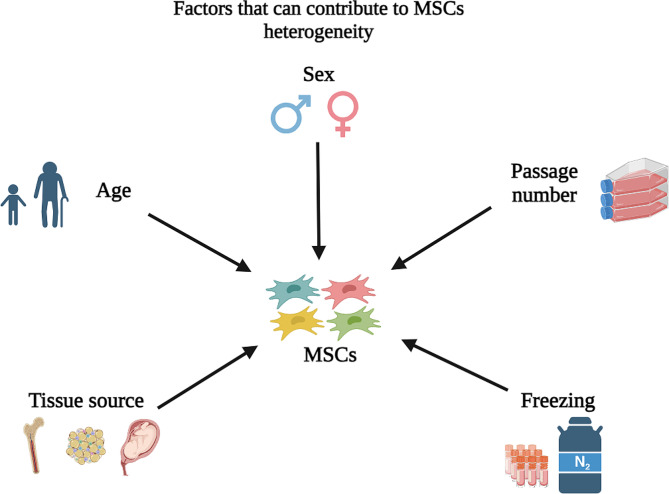
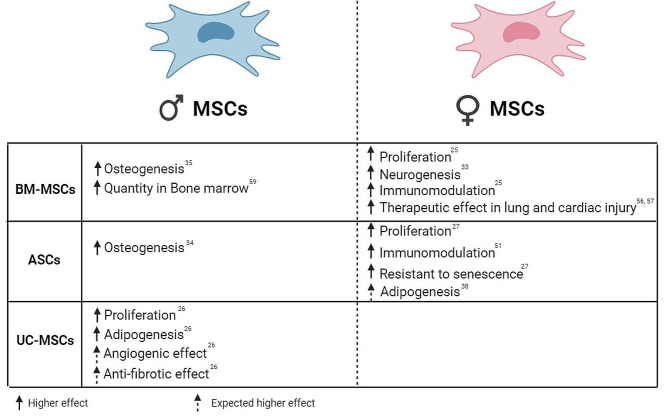
Verification
Claims the paper makes
The claims and statistics of this paper haven’t been checked yet.
Free: it reads the open-access text and checks the first 5 claims that cite a source we can check. Create a free account to check every claim.
Claims other papers make about this one
Each is checked against this paper’s own text: does it say what the citing paper says it does?
The source backs part of the claim, not all of it — or backs it for a different population, condition or comparison.
In the citing paper
“Rigorous donor selection and characterization, including consideration of age, sex, health status, and specific biomarkers, further enhance the uniformity of cell populations (Carp and Liang 2022;Maged et al. 2024).”
From Primary cell cultures versus immortalized cell lines: critical comparative insights into biological fidelity and translational applications (2026) · cites this paper as Maged et al. 2024
Experimental — accuracy not yet measured
Self-check
Percentages, sums and reported differences re-computed from the paper’s own numbers.
The self-check needs the paper’s full text.
Citations
Cites
1 retracted
Markov, A., Thangavelu, L., Aravindhan, S., Zekiy, A. O., Jarahian, M., Chartrand, M. S., Pathak, Y., Marofi, F., Shamlou, S., & Hassanzadeh, A. (2021) · Stem Cell Research & Therapy · doi:10.1186/s13287-021-02265-1 · Cited by 257
RetractedDominici, M., Le Blanc, K., Mueller, I., Slaper-Cortenbach, I., Marini, F. C., Krause, D. S., Deans, R. J., Keating, A., Prockop, D. J., & Horwitz, E. M. (2006) · Cytotherapy · doi:10.1080/14653240600855905 · Cited by 17,766 · cited 2×
“In vitro differentiation is one of the defining features of MSCs and can be measured by their ability to differentiate into osteogenic, chondrogenic, and adipogenic lineages under specific circumstances [4].”
BackgroundMesenchymal stem cell perspective: cell biology to clinical progress
Pittenger, M. F., Discher, D. E., Péault, B. M., Phinney, D. G., Hare, J. M., & Caplan, A. I. (2019) · npj Regenerative Medicine · doi:10.1038/s41536-019-0083-6 · Cited by 2,008
The X-files in immunity: sex-based differences predispose immune responses
Fish, E. N. (2008) · Nature Reviews Immunology · doi:10.1038/nri2394 · Cited by 1,162 · cited 1×
“HIV infection also showed genetic disparities between males and females, and unequally affects women more than men [62, 63].”
BackgroundMesenchymal Stem Cell Immunomodulation: Mechanisms and Therapeutic Potential
Song, N., Scholtemeijer, M., & Shah, K. (2020) · Trends in Pharmacological Sciences · doi:10.1016/j.tips.2020.06.009 · Cited by 948
Ren, G., Zhao, X., Zhang, L., Zhang, J., L'Huillier, A., Ling, W., Roberts, A. I., Le, A. D., Shi, S., Shao, C., et al. (2010) · The Journal of Immunology · doi:10.4049/jimmunol.0902023 · Cited by 656 · cited 1×
“…also been shown to produce several immunomodulatory factors including IL-10, IL-1 receptor antagonist (IL-1Ra), TGF-β and the cell adhesive molecules intercellular adhesion molecule-1 (ICAM-1) and vascular cell adhesion molecule 1 (VCAM-1) [48, 50] that mediate their immunosuppressive properties.”
BackgroundMechanisms underlying the protective effects of mesenchymal stem cell-based therapy
Fan, X.-L., Zhang, Y., Li, X., & Fu, Q.-L. (2020) · Cellular and Molecular Life Sciences · doi:10.1007/s00018-020-03454-6 · Cited by 535
Choudhery, M. S., Badowski, M., Muise, A., Pierce, J., & Harris, D. T. (2014) · Journal of Translational Medicine · doi:10.1186/1479-5876-12-8 · Cited by 529 · cited 2×
“Therefore, strategies such as licensing might be needed to enhance the yield, cell proliferation, and expansion capabilities of MSCs from aged donors if autologous cells are used [11].”
BackgroundHarrell, C., Fellabaum, C., Jovicic, N., Djonov, V., Arsenijevic, N., & Volarevic, V. (2019) · Cells · doi:10.3390/cells8050467 · Cited by 501 · cited 2×
“…also been shown to produce several immunomodulatory factors including IL-10, IL-1 receptor antagonist (IL-1Ra), TGF-β and the cell adhesive molecules intercellular adhesion molecule-1 (ICAM-1) and vascular cell adhesion molecule 1 (VCAM-1) [48, 50] that mediate their immunosuppressive properties.”
BackgroundSiegel, G., Kluba, T., Hermanutz-Klein, U., Bieback, K., Northoff, H., & Schäfer, R. (2013) · BMC Medicine · doi:10.1186/1741-7015-11-146 · Cited by 493
Cited by
Patel, J. C., Shukla, M., & Shukla, M. (2025) · Frontiers in Bioengineering and Biotechnology · doi:10.3389/fbioe.2025.1639439 · Cited by 59
Wang, X., He, W., Huang, H., Han, J., Wang, R., Li, H., Long, Y., Wang, G., & Han, X. (2024) · Biomolecules · doi:10.3390/biom14070858 · Cited by 29
Boysen, A. T., Whitehead, B. J., Revenfeld, A. L., Gupta, D., Petersen, T., & Nejsum, P. L. (2024) · Stem Cell Research & Therapy · doi:10.1186/s13287-024-03903-0 · Cited by 18
“In a wider context, donor age and sex have been proposed to affect the therapeutic potential of MSC-based therapies, however, this subject has not been systematically addressed yet [60, 61].”
BackgroundShin, K., Lee, J. H., Chae, S., Goto, K., An, H., Wakefield, J. S., Ha, D. H., Lee, H., Lee, K., Lee, H., et al. (2025) · Journal of Extracellular Vesicles · doi:10.1002/jev2.70121 · Cited by 16
Tschon, M., Codispoti, G., Cabras, P., Cafarelli, A., Trucco, D., Vannozzi, L., Manferdini, C., Carniato, M., Cassiolas, G., Martini, L., et al. (2025) · Biomaterials · doi:10.1016/j.biomaterials.2025.123728 · Cited by 18
Metadata
- Authors
- Maged, G., Abdelsamed, M. A., Wang, H., & Lotfy, A.
- Affiliations
- Alexandria University (EG)
- Beni-Suef University (EG)
- Medical University of South Carolina (US)
- Corresponding author
- Wang, Hongjun
- Lotfy, Ahmed
- Venue
- Stem Cell Research & Therapy
- Published
- 2024-04-22
- Volume
- 15
- Issue
- 1
- Pages
- 112-112
- ISSN
- 1757-6512 (ISSN-L)
- PMC
- PMC11034072
- OpenAlex
- W4395007314
- Cited by
- 42
- References
- 63
- Citations by year
- 2026: 19 · 2025: 18 · 2024: 5
- FWCI
- 3.19
- Type
- journal article
- Language
- en
- Open access
- gold
- doi.org
- Licence
- cc-by
- creativecommons.org/licenses/by/4.0 (tdm)
- creativecommons.org/licenses/by/4.0 (vor)
- Locations
- Stem Cell Research & Therapy (publishedVersion, cc-by)
- PubMed Central (publishedVersion, cc-by)
- PubMed (publishedVersion)
- DOAJ (DOAJ: Directory of Open Access Journals) (submittedVersion, cc-by-sa)
- Funders
- National Institute of Diabetes and Digestive and Kidney Diseases (1R01DK105183, DK120394, DK118529)
- U.S. Department of Veterans Affairs (I01BX004536)
- Topics
- Life Sciences › Biochemistry, Genetics and Molecular Biology › Cell Biology › Mesenchymal stem cell research
- Health Sciences › Medicine › Hematology › Hematopoietic Stem Cell Transplantation
- Life Sciences › Biochemistry, Genetics and Molecular Biology › Molecular Biology › Pluripotent Stem Cells Research
- Keywords
- mesenchymal stem cells, donor sex, sex differences, MSC heterogeneity, cell therapy, immunomodulation, multilineage differentiation, tissue protection, cell sources
- MeSH terms
- Cell Differentiation, Female, Humans, Male, Sex Factors, Tissue Donors, Mesenchymal Stem Cell Transplantation, Immunomodulation, Mesenchymal Stem Cells, Cell- and Tissue-Based Therapy
About these checks
Registry, retraction, Cites and statistics results are computed, not judged, with one exception: a printed reference that no index lists is read once by a model before it counts as a citation error. Claims are extracted by a model and kept only when their quote appears verbatim in the text; each cited source is then checked, with a model’s help, for whether it says what the claim relies on. Those verdicts can be wrong — read the claim’s quote and the cited source before relying on one.
Statistics and arithmetic are recomputed, not judged.
Confidence bands are shown only for fields calibrated on our annotated test set. None is calibrated yet, so no band is shown.
What counts as a claim ›How we measure confidence ›How we check this ›
Are you an author, or do you see a problem with this page? Request a review
Data sources
Bibliographic data: Semantic Scholar, OpenAlex, Crossref.
Contains information from the Semantic Scholar Academic Graph Datasets, made available under the ODC Attribution License (ODC-BY 1.0).
Semantic Scholar’s data is described in: Kinney, R., et al. (2023). The Semantic Scholar Open Data Platform. arXiv:2301.10140.
