

The DOI matches its Crossref record; 82 of the 82 references it cites were found in a registry or an index.
Sex and estrogens alter the action of glucagon-like peptide-1 on reward
Open accessAbstract
BACKGROUND: Feeding behavior is regulated through an intricate array of anorexic and orexigenic hormones acting on the central nervous system (CNS). Some of these hormones may have differential effects in males and females, effects potentially attributed to actions of gonadal steroids, especially estrogens. Central stimulation of the glucagon-like peptide-1 (GLP-1) receptors reduces feeding and food-reward behavior by acting on CNS regions important for the anorexic actions of estrogens. Thus, we propose that the action of GLP-1 on food intake and reward may differ between sexes. METHODS: Male and female rats were centrally injected with the GLP-1 analog exendin-4 (Ex4) in a non-deprived or food-restricted state; reward behavior was measured in a progressive ratio operant conditioning task. Intake of chow and palatable food were also measured. To determine if sex differences in the actions of Ex4 are due to interactions with estrogens, Ex4 treatment was preceded by treatment with a nonselective estrogen receptor-α (ERα) and ERβ or ERα-selective antagonist. RESULTS: Central injection of Ex4 revealed increased reward behavior suppression in females, compared to males, in the operant conditioning task. This increase was present in both non-deprived and food-restricted animals with larger differences in the fed state. Intake of chow and palatable food, after Ex4, were similar in males and females. Food reward, but not food intake, effect of Ex4 was attenuated by pretreatment with ER antagonist in both sexes, suggesting that estrogens may modulate effects of Ex4 in both sexes. Furthermore, central pretreatment with ERα-selective antagonist was sufficient to attenuate effects of Ex4 on reward. CONCLUSIONS: Collectively, these data reveal that females display much higher sensitivity to the food reward impact of central GLP-1 receptor activation. Surprisingly, they also demonstrate that central ERα signaling is necessary for the actions of GLP-1 on food-reward behavior in both sexes.
Overview
The claims and statistics of this paper haven’t been checked yet.
Run the check — free, no account needed. It reads the open-access text and checks the sources it cites.
Integrity signals
Registry
Cites
Statistics
Figures
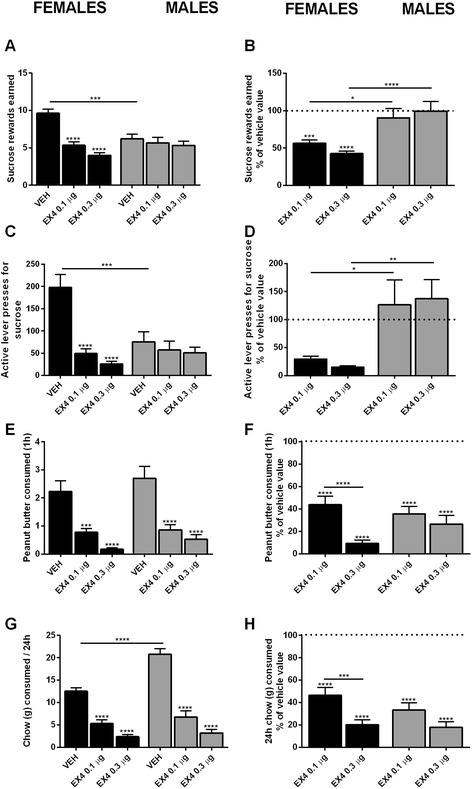
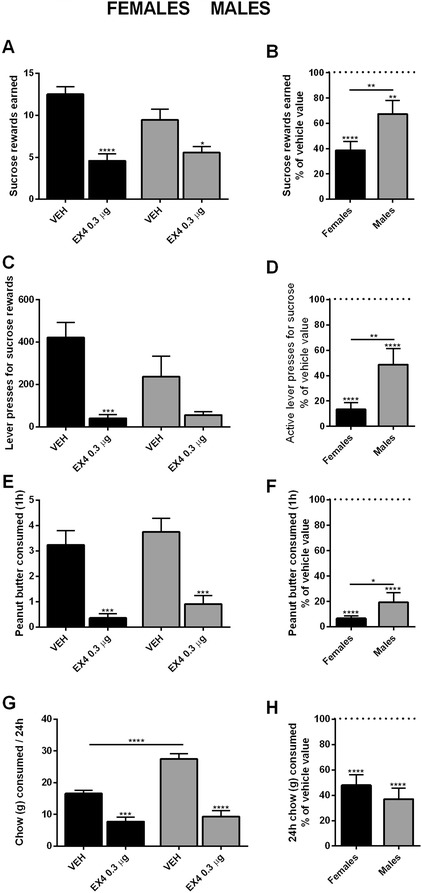
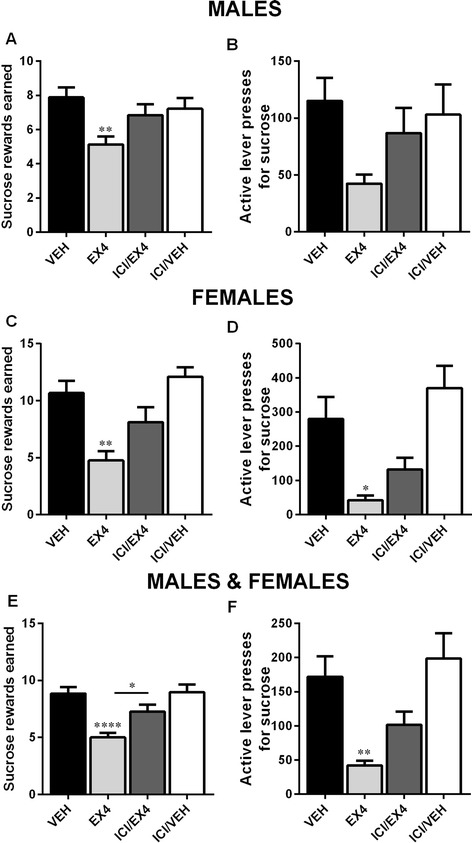
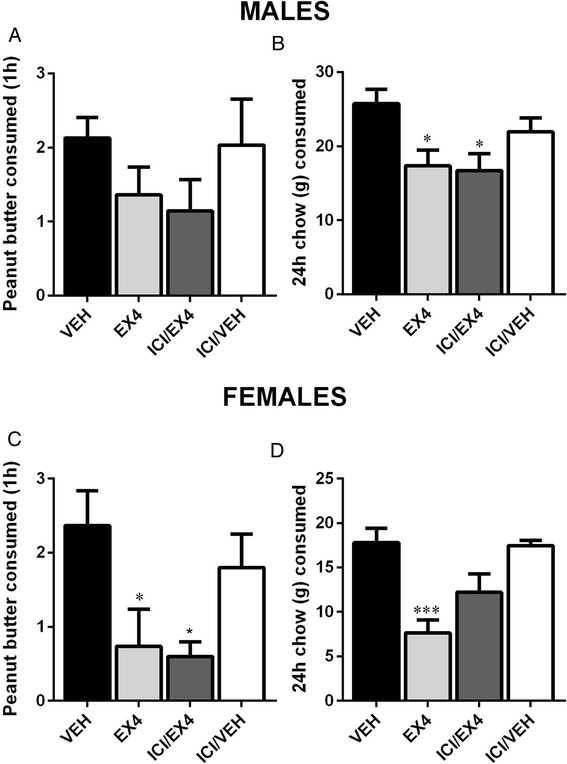
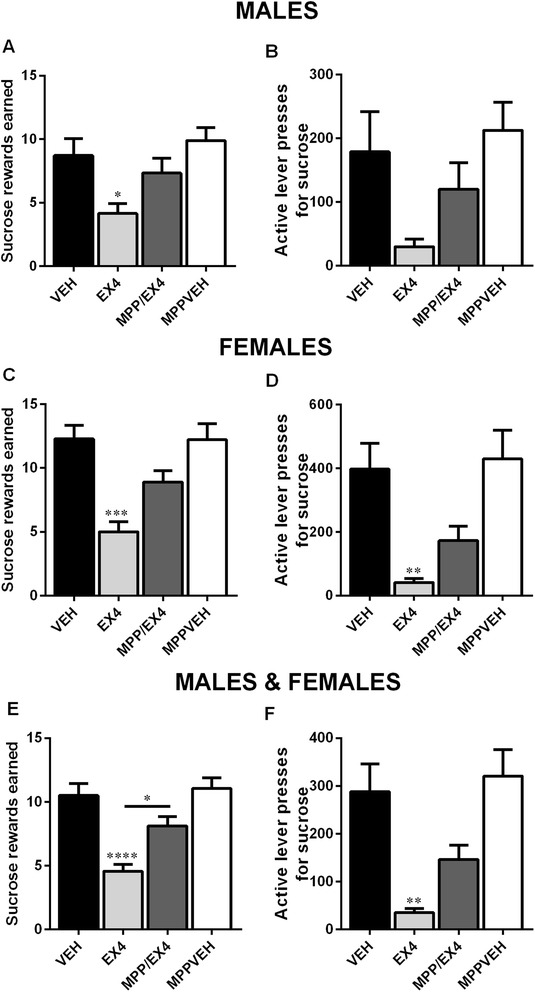
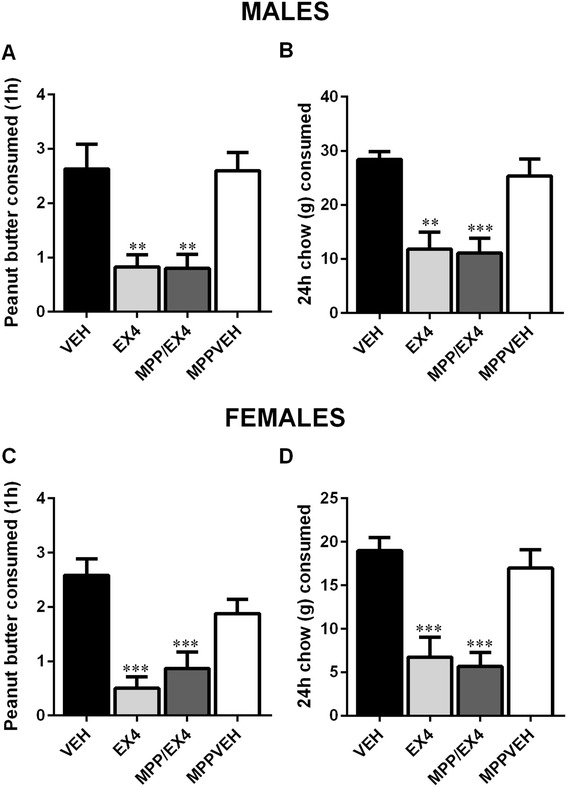
Verification
Claims the paper makes
The claims and statistics of this paper haven’t been checked yet.
Run the check — free, no account needed. It reads the open-access text and checks the sources it cites.
Claims other papers make about this one
Each is checked against this paper’s own text: does it say what the citing paper says it does?
The source backs part of the claim, not all of it — or backs it for a different population, condition or comparison.
In the citing paper
“Animal studies examining the impact of sex on the anorexigenic effects of GLP-1 RAs have demonstrated that, at least in part, sex hormones are responsible for the differential responses between males and females.”
From Sex Differences in Response to Treatment with Glucagon-like Peptide 1 Receptor Agonists: Opportunities for a Tailored Approach to Diabetes and Obesity Care (2022) · cites this paper as [85]
Experimental — accuracy not yet measuredThe cited source says what the claim attributes to it.
In the citing paper
“More specifically, it has been shown that estrogen signaling is a crucial component via which GLP-1 RAs modify the food-reward aspect of food seeking.”
From Sex Differences in Response to Treatment with Glucagon-like Peptide 1 Receptor Agonists: Opportunities for a Tailored Approach to Diabetes and Obesity Care (2022) · cites this paper as [85]
The cited source says what the claim attributes to it.
In the citing paper
“In this sense, higher estrogen concentrations in females, especially during their premenopausal years, could potentially serve as an explanation for why women may respond better to GLP-1 RAs [85].”
From Sex Differences in Response to Treatment with Glucagon-like Peptide 1 Receptor Agonists: Opportunities for a Tailored Approach to Diabetes and Obesity Care (2022) · cites this paper as [85]
In the citing paper
“Finally, referring to sexual dimorphism in weight loss from another point of view, it has been highlighted that estrogen signaling plays a crucial role in the food-reward aspect of food seeking induced by GLP-1 RAs [91].”
From Adipose Tissue: A Novel Target of the Incretin Axis? A Paradigm Shift in Obesity-Linked Insulin Resistance (2024) · cites this paper as [91]
Self-check
Percentages, sums and reported differences re-computed from the paper’s own numbers.
The self-check needs the paper’s full text.
Citations
Cites
The Physiology of Glucagon-like Peptide 1
Holst, J. J. (2007) · Physiological Reviews · doi:10.1152/physrev.00034.2006 · Cited by 3,371
A role for glucagon-like peptide-1 in the central regulation of feeding
Turton, M. D., O'Shea, D., Gunn, I., Beak, S. A., Edwards, C. M. B., Meeran, K., Choi, S. J., Taylor, G. M., Heath, M. M., Lambert, P. D., et al. (1996) · Nature · doi:10.1038/379069a0 · Cited by 1,950
Dissecting components of reward: ‘liking’, ‘wanting’, and learning
Berridge, K. C., Robinson, T. E., & Aldridge, J. W. (2009) · Current Opinion in Pharmacology · doi:10.1016/j.coph.2008.12.014 · Cited by 1,942
Food reward: brain substrates of wanting and liking
Berridge, K. C. (1996) · Neuroscience & Biobehavioral Reviews · doi:10.1016/0149-7634(95)00033-b · Cited by 1,901
Estrogen Actions in the Central Nervous System
McEwen, B. S., & Alves, S. E. (1999) · Endocrine Reviews · doi:10.1210/edrv.20.3.0365 · Cited by 1,504
Increased adipose tissue in male and female estrogen receptor-α knockout mice
Heine, P. A., Taylor, J. A., Iwamoto, G. A., Lubahn, D. B., & Cooke, P. S. (2000) · Proceedings of the National Academy of Sciences · doi:10.1073/pnas.97.23.12729 · Cited by 1,282
Immunolocalization of Estrogen Receptor β in the Mouse Brain: Comparison with Estrogen Receptor α
Mitra, S. W., Hoskin, E., Yudkovitz, J., Pear, L., Wilkinson, H. A., Hayashi, S., Pfaff, D. W., Ogawa, S., Rohrer, S. P., Schaeffer, J. M., et al. (2003) · Endocrinology · doi:10.1210/en.2002-221069 · Cited by 856
Gender Difference in the Prevalence of Eating Disorder Symptoms
Striegel-Moore, R., Rosselli, F., Perrin, N., DeBar, L., Wilson, G., May, A. M., & Kraemer, H. (2009) · International Journal of Eating Disorders · doi:10.1002/eat.20625 · Cited by 680
Larsen, P. J., Tang-Christensen, M., Holst, J. J., & Ørskov, C. (1997) · Neuroscience · doi:10.1016/s0306-4522(96)00434-4 · Cited by 663
Estrogen Actions in the Central Nervous System
McEwen, B. S. (1999) · Endocrine Reviews · doi:10.1210/er.20.3.279 · Cited by 640
Research works printed but not linked: 1
- Shirazi RH, Dickson SL, Skibicka KP. Gut peptide GLP-1 and its analogue, exendin-4, decrease alcohol intake and reward. Plos One. 2013;8(4). doi: 10.1371/journal.pone.0061965 . · DOI
Cited by
Sorted by citations
Items 101–102 of 102
Edvardsson, C. E., Emous, T. A., Witley, S., Ericson, M., Adermark, L., & Jerlhag, E. (2026) · British Journal of Pharmacology · doi:10.1111/bph.70678
Byun, S., Sotzen, M. R., Bento, M. T., Knappenberger, M. A., Asker, M., Wright, J., Lamendella, R., Mu, C., & Skibicka, K. P. (2026) · Comprehensive physiology · doi:10.1002/cph4.70286
Self-citation
Metadata
- Authors
- Richard, J. E., Anderberg, R. H., López-Ferreras, L., Olandersson, K., & Skibicka, K. P.
- Affiliations
- University of Gothenburg (SE)
- Corresponding author
- Skibicka, Karolina P.
- Venue
- Biology of Sex Differences
- Published
- 2016-01-16
- Volume
- 7
- Issue
- 1
- Pages
- 6-6
- ISSN
- 2042-6410 (ISSN-L)
- PMC
- PMC4715328
- OpenAlex
- W2272001501
- Cited by
- 102
- References
- 82
- Citations by year
- 2026: 21 · 2025: 19 · 2024: 11 · 2023: 8 · 2022: 14 · 2021: 8 · 2020: 5 · 2019: 6 · 2018: 3 · 2017: 5 · 2016: 2
- FWCI
- 3.39
- Type
- journal article
- Language
- en
- Open access
- gold
- doi.org
- Licence
- cc-by
- Locations
- Biology of Sex Differences (publishedVersion, cc-by)
- PubMed Central (publishedVersion, cc-by)
- PubMed (publishedVersion)
- Funders
- Svenska Forskningsrådet Formas (2014-2945 and 2013-7107)
- Novo Nordisk Foundation Excellence project grant
- Ragnar Söderberg Foundation
- Harald Jeanssons Stiftelse
- Greta Jeanssons Stiftelse
- Magnus Bergvalls Stiftelse
- Topics
- Life Sciences › Neuroscience › Endocrine and Autonomic Systems › Regulation of Appetite and Obesity
- Health Sciences › Medicine › Reproductive Medicine › Hypothalamic control of reproductive hormones
- Life Sciences › Neuroscience › Cellular and Molecular Neuroscience › Neurotransmitter Receptor Influence on Behavior
- Keywords
- glucagon-like peptide-1, exendin-4, food reward, sex differences, estrogen receptor alpha, estrogen receptor beta, sex steroids, feeding behavior, dietary intake, palatable food, dietary restriction
About these checks
Registry, retraction, Cites and statistics results are computed, not judged, with one exception: a printed reference that no index lists is read once by a model before it counts as a citation error. Claims are extracted by a model and kept only when their quote appears verbatim in the text; each cited source is then checked, with a model’s help, for whether it says what the claim relies on. Those verdicts can be wrong — read the claim’s quote and the cited source before relying on one.
Statistics and arithmetic are recomputed, not judged.
Confidence bands are shown only for fields calibrated on our annotated test set. None is calibrated yet, so no band is shown.
What counts as a claim ›How we measure confidence ›How we check this ›
Are you an author, or do you see a problem with this page? Request a review
