

Gender score development in the Berlin Aging Study II: a retrospective approach
Open accessPublished version of a preprint
The DOI matches its Crossref record; 35 of the 36 references it cites were found in a registry or an index.
Abstract
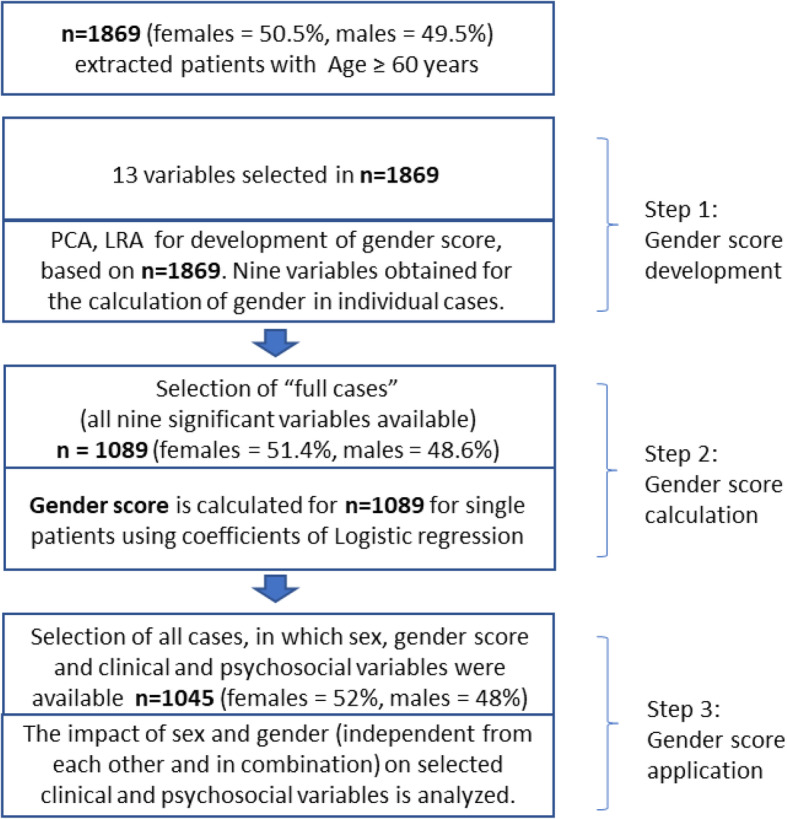
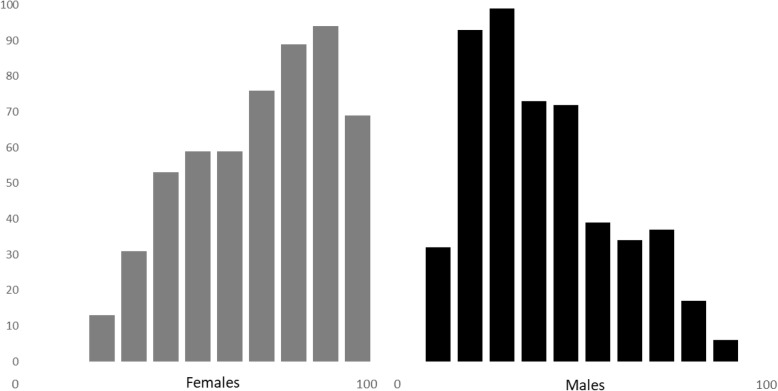
In addition to biological sex, gender, defined as the sociocultural dimension of being a woman or a man, plays a central role in health. However, there are so far few approaches to quantify gender in a retrospective manner in existing study datasets. We therefore aimed to develop a methodology that can be retrospectively applied to assess gender in existing cohorts. We used baseline data from the Berlin Aging Study II (BASE-II), obtained in 2009–2014 from 1869 participants aged 60 years and older. We identified 13 gender-related variables and used them to construct a gender score by using primary component and logistic regression analyses. Of these, nine variables contributed to a gender score: chronic stress, marital status, risk-taking behaviour, personality attributes: agreeableness, neuroticism, extraversion, loneliness, conscientiousness, and level of education. Females and males differed significantly in the distribution of the gender score, but a significant overlap was also found. Thus, we were able to develop a gender score in a retrospective manner from already collected data that characterized participants in addition to biological sex. This approach will allow researchers to introduce the notion of gender retrospectively into a large number of studies.
Overview
The claims and statistics of this paper haven’t been checked yet.
Free: it reads the open-access text and checks the first 5 claims that cite a source we can check. Create a free account to check every claim.
Integrity signals
Registry
Cites
Statistics
Figures
Verification
Claims the paper makes
The claims and statistics of this paper haven’t been checked yet.
Free: it reads the open-access text and checks the first 5 claims that cite a source we can check. Create a free account to check every claim.
Claims other papers make about this one
Each is checked against this paper’s own text: does it say what the citing paper says it does?
The cited source says what the claim attributes to it.
In the citing paper
“This approach is supported by peer-reviewed health research in which logistic regression with biological sex as the dependent variable is employed to identify variables that differ systematically between male and female participants (38–40).”
From Health misinformation, digital health literacy, and attitudes toward science among university students: an exploratory cross-sectional survey (2026) · cites this paper as [39]
Self-check
Percentages, sums and reported differences re-computed from the paper’s own numbers.
The self-check needs the paper’s full text.
Citations
Cites
The central role of the propensity score in observational studies for causal effects
ROSENBAUM, P. R., & RUBIN, D. B. (1983) · Biometrika · doi:10.1093/biomet/70.1.41 · Cited by 31,241
Principal component analysis: A review and recent developments
Jolliffe, I. T., & Cadima, J. (2016) · Philosophical Transactions of the Royal Society A: Mathematical, Physical and Engineering Sciences · doi:10.1098/rsta.2015.0202 · Cited by 10,117 · cited 1×
“dataset, increase interpretability, and minimize information loss which is done by creating new uncorrelated variables and maximize variance, principal component analysis (PCA) was conducted with a varimax rotation method to further confirm it, where component represents the linear combinations of the entered variable…”
Method(1999) · Cited by 7,995
Sex and gender: modifiers of health, disease, and medicine
Mauvais-Jarvis, F., Bairey Merz, N., Barnes, P. J., Brinton, R. D., Carrero, J.-J., DeMeo, D. L., De Vries, G. J., Epperson, C. N., Govindan, R., Klein, S. L., et al. (2020) · The Lancet · doi:10.1016/s0140-6736(20)31561-0 · Cited by 2,001
Self-citationDIFFERENTIATING AMONG INTERNALITY, POWERFUL OTHERS, AND CHANCE
Levenson, H. (1981) · Research with the Locus of Control Construct · doi:10.1016/b978-0-12-443201-7.50006-3 · Cited by 1,078
(2015) · Choice Reviews Online · doi:10.5860/choice.191867 · Cited by 742
Social and emotional loneliness: An examination of Weiss's typology of loneliness.
Russell, D., Cutrona, C. E., Rose, J., & Yurko, K. (1984) · Journal of Personality and Social Psychology · doi:10.1037//0022-3514.46.6.1313 · Cited by 708
(2007) · Choice Reviews Online · doi:10.5860/choice.44-3029 · Cited by 691
Patient–physician gender concordance and increased mortality among female heart attack patients
Greenwood, B. N., Carnahan, S., & Huang, L. (2018) · Proceedings of the National Academy of Sciences · doi:10.1073/pnas.1800097115 · Cited by 627
Sex and gender differences in health: Science & Society Series on Sex and Science
Regitz‐Zagrosek, V. (2012) · The EMBO Reports · doi:10.1038/embor.2012.87 · Cited by 572
Self-citation
Research works printed but not linked: 4
- Research CIoH How to integrate sex and gender into research 2018 2020
- Research CIoH Online training modules:integrating sex & gender in health research - sex and gender in theanalysis of data from human participants 2017
- Kühn S, Düzel S, Drewelies J, Gerstorf D, Lindenberger U, Gallinat J. Psychological and neural correlates of embitterment in old age. Psychol Trauma. 2018;10(1):51–57. 10.1037/tra0000287. PMID: 29323526. 29323526 · DOI
- Berg RG SPSS Factor Analysis – Beginners Tutorial 2020 2020
Cited by
Gender medicine: effects of sex and gender on cardiovascular disease manifestation and outcomes
Regitz-Zagrosek, V., & Gebhard, C. (2023) · Nature Reviews Cardiology · doi:10.1038/s41569-022-00797-4 · Cited by 386
Self-citationSex and gender in health research: Intersectionality matters
Subramaniapillai, S., Galea, L. A. M., Einstein, G., & de Lange, A. G. (2023) · Frontiers in Neuroendocrinology · doi:10.1016/j.yfrne.2023.101104 · Cited by 69
“Some studies have probed the relative influence of sex and gender on health by estimating ‘gender scores ’ based on data reflecting aspects of gender roles and identities (Hart et al., 2019; Levinsson et al., 2022; Nauman et al., 2021; Pelletier et al., 2015).”
BackgroundDemuth, I., Banszerus, V. L., Drewelies, J., Düzel, S., Seeland, U., Spira, D., Tse, E., Braun, J., Bertram, L., Thiel, A., et al. (2021) · BMJ Open · doi:10.1136/bmjopen-2020-045576 · Cited by 52
Self-citationGender scores in epidemiological research: methods, advantages and implications
Ballering, A., Hartman, T. O., & Rosmalen, J. G. M. (2024) · The Lancet Regional Health - Europe · doi:10.1016/j.lanepe.2024.100962 · Cited by 26
Differentiating Sex and Gender Among Older Men and Women
Pohrt, A., Kendel, F., Demuth, I., Drewelies, J., Nauman, T., Behlouli, H., Stadler, G., Pilote, L., Regitz‐Zagrosek, V., & Gerstorf, D. (2022) · Psychosomatic Medicine · doi:10.1097/psy.0000000000001056 · Cited by 16
Self-citationYuan, J., Sang, S., Pham, J., & Kong, W. (2021) · Frontiers in Public Health · doi:10.3389/fpubh.2021.751828 · Cited by 15
Kraus, U., Jacke, K., Dandolo, L., Dębiak, M., Fichter, S., Groth, K., Kolossa‐Gehring, M., Hartig, C., Horstmann, S., Schneider, A. E., et al. (2023) · Frontiers in Public Health · doi:10.3389/fpubh.2023.1128918 · Cited by 15
“Thereby, continuous gender-rating scales (13), gender scores (20, 21) or individual gender-related variables (19) are used.”
MethodVader, S. S., Lewis, S. M., Verdonk, P., Verschuren, W. M. M., & Picavet, H. S. J. (2023) · Preventive Medicine Reports · doi:10.1016/j.pmedr.2023.102202 · Cited by 14
Sex and gender differences in periodontal disease: a cross-sectional study in Switzerland
Liechti, L., Regitz‐Zagrosek, V., Gebert, P., Schmidlin, P. R., & Campus, G. (2025) · BMC Oral Health · doi:10.1186/s12903-025-06719-3 · Cited by 17
“To classify gender, a gender score (GS) was constructed [7, 9], which ranged from 0 (purely masculine) to 100 (purely feminine).”
Self-citationvan den Hurk, L., Hiltner, S., & Oertelt‐Prigione, S. (2022) · International Journal of Environmental Research and Public Health · doi:10.3390/ijerph192114299 · Cited by 10
Karim, N. A. H. A., Osman, M. A., Abdelmonaem, Y. M. M., & El‐Ashry, A. M. (2025) · BMC Nursing · doi:10.1186/s12912-025-02918-z · Cited by 16
“Excessive internet use, particularly for passive activities like pornography consumption, may exacerbate stress and anxiety, reinforcing the importance of digital literacy education in universities [36, 37].”
The operationalization of gender in medicine
Oertelt‐Prigione, S. (2023) · Principles of Gender-Specific Medicine · doi:10.1016/b978-0-323-88534-8.00017-1 · Cited by 12
Integrating gender medicine into modern healthcare: Progress and barriers
Artiles, R. F., Gebhard, C. E., & Gebhard, C. (2025) · European Journal of Clinical Investigation · doi:10.1111/eci.70089 · Cited by 11
“The gender score incorporates variables that historically differ between men and women, 71,72 including education, parental and marital status, income, household responsibilities, perceived stress levels, childcare responsibilities and self-assessed masculinity or femininity using the BEM Sex-Role…”
Raparelli, V., Santilli, F., Marra, A. M., Romiti, G. F., Succurro, E., Licata, A., Buzzetti, E., Piano, S. S., Masala, M. S., Suppressa, P., et al. (2022) · Internal and Emergency Medicine · doi:10.1007/s11739-022-03049-y · Cited by 7
Closing the gap: How women can benefit more from science, research, policies, and health services
Samaei, M., Jenkins, M., & McGregor, A. J. (2022) · Med · doi:10.1016/j.medj.2022.04.012 · Cited by 7
Bohn, L., Han, A. Y., McFall, G. P., Drouin, S. M., Pettersen, J. A., Rajah, M. N., Einstein, G., Anstey, K. J., & Dixon, R. A. (2024) · Innovation in Aging · doi:10.1093/geroni/igae094 · Cited by 3
Kalbarczyk, A., Krugman, D. W., Elnakib, S., Hazel, E., Luo, A., Malhotra, A., & Morgan, R. (2025) · SSM - Health Systems · doi:10.1016/j.ssmhs.2025.100059 · Cited by 8
“Gender scores, or the use of gender variables to quantify the impact of gender as a social construct, measure and elucidate different ways in which gender norms, roles, and relations manifest and associated impact on a particular outcome or outcomes (Nauman et al., 2021).”
Schwerpunkt: Digitale Transformation und Gender Bias
Bröcher, L., Gredel, E., & Schelenz, L. (2023) · GENDER – Zeitschrift für Geschlecht Kultur und Gesellschaft · doi:10.3224/gender.v15i1 · Cited by 2
Schindler, L., Beelich, H., Röll, S., Katsari, E., Stracke, S., & Waltemath, D. (2024) · JMIR Research Protocols · doi:10.2196/57669 · Cited by 2
Sarcone, A., Pileggi, C., Nobile, C., Simeone, S., & Mercuri, C. (2026) · Frontiers in Public Health · doi:10.3389/fpubh.2026.1931903 · Cited by 1
Gender should be considered and reported in epidemiology, but why should it be measured?
Messing, K., & Lederer, V. (2024) · The Lancet Regional Health - Europe · doi:10.1016/j.lanepe.2024.100985 · Cited by 1
Was ist Gendermedizin und warum brauchen wir sie?
Regitz‐Zagrosek, V. (2023) · Springer eBooks · doi:10.1007/978-3-662-67090-3_1 · Cited by 1
Self-citationProbleme und Potenziale gendermedizinischer Operationalisierung von Geschlecht
Wortmann, L. (2023) · GENDER – Zeitschrift für Geschlecht Kultur und Gesellschaft · doi:10.3224/gender.v15i1.08
Twists and turns: Sex and gender differences in the illness trajectories of common somatic symptoms
Ballering, A. (2024) · University of Groningen research database (University of Groningen / Centre for Information Technology) · doi:10.33612/diss.902736104
Einführung in die geschlechtersensible Medizin
Freisinger, E. (2024) · Springer Reference Medizin · doi:10.1007/978-3-662-61379-5_211-1
Schindler, L., Beelich, H., Katsari, E., Stracke, S., & Waltemath, D. (2025) · doi:10.2196/preprints.74162
Schindler, L., Beelich, H., Katsari, E., Liprandi, D., Stracke, S., & Waltemath, D. (2025) · JMIR Medical Informatics · doi:10.2196/74162 · Cited by 2
“For example, Lacasse et al [10] and Nauman et al [11] each developed a retrospective gender score and applied it to specific datasets from population studies.”
InfluentialCavender, C., Melzer, A., & Mehran, N. (2025) · Journal of Public Health · doi:10.1007/s10389-025-02657-0 · Cited by 1
Einführung in die geschlechtersensible Medizin
Freisinger, E. (2025) · Springer Reference Medizin · doi:10.1007/978-3-662-60880-7_211
Decoding sex and gender effects on health: evidence from a nationwide cohort
Gebhard, C. E., Gysi, B., Gebert, P., Mikaïl, N., Liechti, L., Schmidlin, P. R., Vinzens, A., Haider, A., Bengs, S., Treyer, V., et al. (2026) · Biology of Sex Differences · doi:10.1186/s13293-026-00888-8
Self-citation
Metadata
- Authors
- Nauman, A. T., Behlouli, H., Alexander, N., Kendel, F., Drewelies, J., Mantantzis, K., Berger, N., Wagner, G. G., Gerstorf, D., Demuth, I., Pilote, L., & Regitz-Zagrosek, V.
- Affiliations
- German Centre for Cardiovascular Research (DE)
- Research Institute of the McGill University Health Centre (CA)
- Charité – Universitätsmedizin Berlin (DE)
- Humboldt-Universität zu Berlin (DE)
- German Institute for Economic Research (DE)
- Berlin-Brandenburger Centrum für Regenerative Therapien (DE)
- Corresponding author
- Nauman, Ahmad Tauseef
- ORCID
- Venue
- Biology of Sex Differences
- Published
- 2021-01-18
- Volume
- 12
- Issue
- 1
- Pages
- 15-15
- ISSN
- 2042-6410 (ISSN-L)
- PMC
- PMC7814714
- OpenAlex
- W3123645094
- Cited by
- 31
- References
- 36
- Citations by year
- 2026: 2 · 2025: 9 · 2024: 6 · 2023: 7 · 2022: 5 · 2021: 2
- FWCI
- 4.33
- Type
- journal article
- Language
- en
- Open access
- gold
- doi.org
- Licence
- cc-by
- creativecommons.org/licenses/by/4.0/ (tdm)
- creativecommons.org/licenses/by/4.0/ (vor)
- Locations
- Biology of Sex Differences (publishedVersion, cc-by)
- medRxiv (acceptedVersion)
- Europe PMC (PubMed Central) (publishedVersion, other-oa)
- PubMed Central (publishedVersion, cc-by)
- PubMed (publishedVersion)
- Informationszentrum Lebenswissenschaften (ZB MED) (submittedVersion, cc-by)
- DOAJ (DOAJ: Directory of Open Access Journals) (submittedVersion, cc-by-sa)
- Econstor (Econstor) (submittedVersion, cc-by)
- edoc Publication server (Humboldt University of Berlin) (submittedVersion, cc-by)
- Refubium (Universitätsbibliothek der Freien Universität Berlin) (submittedVersion, cc-by)
- Universitätsbibliothek der FU Berlin Hochschulschriftenstelle u. Dokumentenserver (cc-by)
- Funders
- Bundesministerium für Bildung und Forschung (01GL1716A, 01GL1716B)
- Topics
- Health Sciences › Medicine › Public Health, Environmental and Occupational Health › Sex and Gender in Healthcare
- Social Sciences › Gender Studies › Gender Roles and Identity Studies
- Social Sciences › Sociology and Political Science › Gender, Health, and Social Inequality
- Keywords
- gender, older adults, Berlin Aging Study II, chronic stress, marital status, risk-taking, personality traits, agreeableness, neuroticism, extraversion, conscientiousness, loneliness, educational attainment, sex differences
- MeSH terms
- Neuroticism, Aged, Aging, Female, Humans, Male, Middle Aged, Personality, Retrospective Studies, Sex Characteristics
About these checks
Registry, retraction, Cites and statistics results are computed, not judged, with one exception: a printed reference that no index lists is read once by a model before it counts as a citation error. Claims are extracted by a model and kept only when their quote appears verbatim in the text; each cited source is then checked, with a model’s help, for whether it says what the claim relies on. Those verdicts can be wrong — read the claim’s quote and the cited source before relying on one.
Statistics and arithmetic are recomputed, not judged.
Confidence bands are shown only for fields calibrated on our annotated test set. None is calibrated yet, so no band is shown.
What counts as a claim ›How we measure confidence ›How we check this ›
Are you an author, or do you see a problem with this page? Request a review
Data sources
Bibliographic data: Semantic Scholar, OpenAlex, Crossref.
Contains information from the Semantic Scholar Academic Graph Datasets, made available under the ODC Attribution License (ODC-BY 1.0).
Semantic Scholar’s data is described in: Kinney, R., et al. (2023). The Semantic Scholar Open Data Platform. arXiv:2301.10140.
