

The DOI matches its Crossref record; 43 of the 44 references it cites were found in a registry or an index.
Machine learning algorithms for systematic review: reducing workload in a preclinical review of animal studies and reducing human screening error
Open accessPublished version of a preprint
Abstract
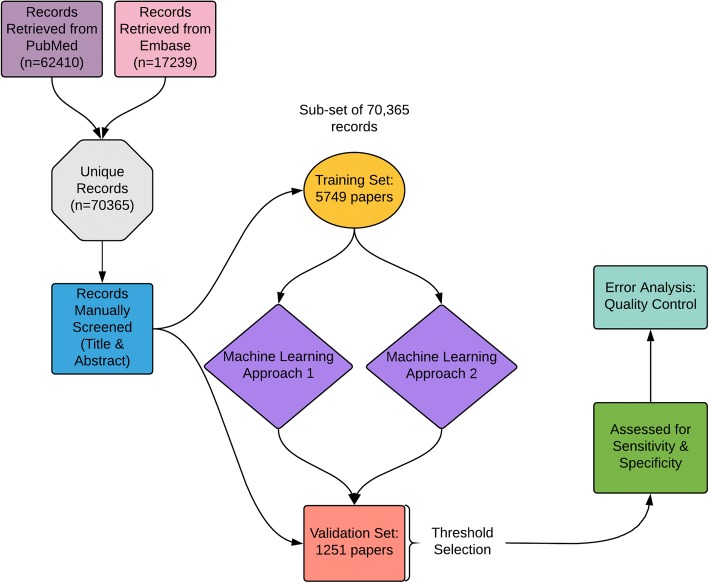
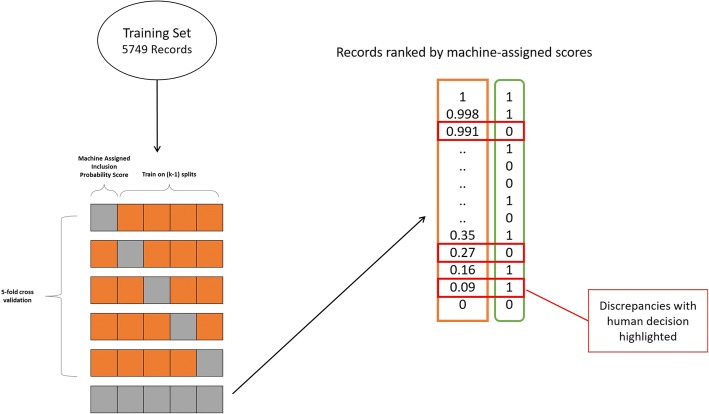
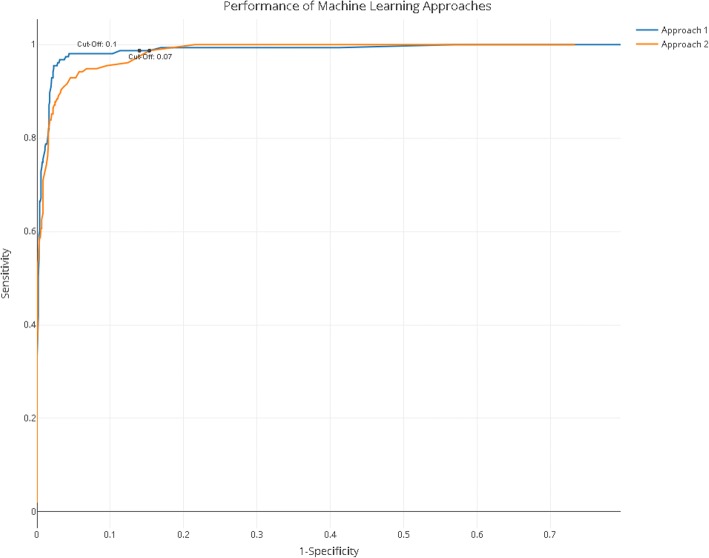
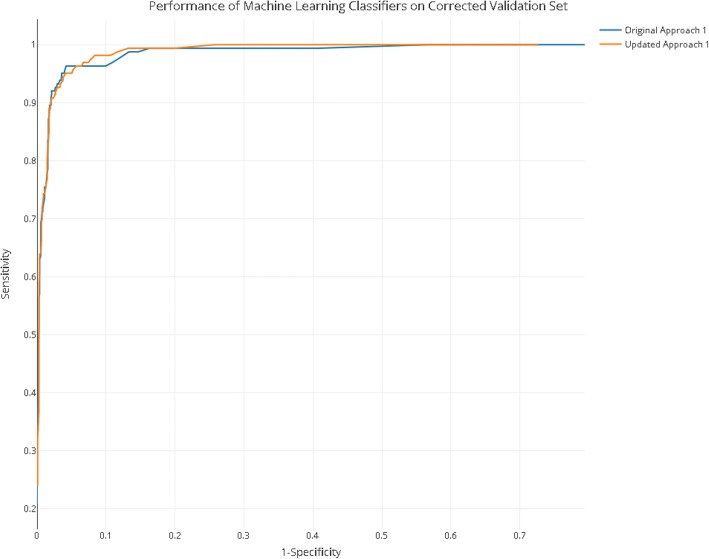
BACKGROUND: Here, we outline a method of applying existing machine learning (ML) approaches to aid citation screening in an on-going broad and shallow systematic review of preclinical animal studies. The aim is to achieve a high-performing algorithm comparable to human screening that can reduce human resources required for carrying out this step of a systematic review. METHODS: We applied ML approaches to a broad systematic review of animal models of depression at the citation screening stage. We tested two independently developed ML approaches which used different classification models and feature sets. We recorded the performance of the ML approaches on an unseen validation set of papers using sensitivity, specificity and accuracy. We aimed to achieve 95% sensitivity and to maximise specificity. The classification model providing the most accurate predictions was applied to the remaining unseen records in the dataset and will be used in the next stage of the preclinical biomedical sciences systematic review. We used a cross-validation technique to assign ML inclusion likelihood scores to the human screened records, to identify potential errors made during the human screening process (error analysis). RESULTS: ML approaches reached 98.7% sensitivity based on learning from a training set of 5749 records, with an inclusion prevalence of 13.2%. The highest level of specificity reached was 86%. Performance was assessed on an independent validation dataset. Human errors in the training and validation sets were successfully identified using the assigned inclusion likelihood from the ML model to highlight discrepancies. Training the ML algorithm on the corrected dataset improved the specificity of the algorithm without compromising sensitivity. Error analysis correction leads to a 3% improvement in sensitivity and specificity, which increases precision and accuracy of the ML algorithm. CONCLUSIONS: This work has confirmed the performance and application of ML algorithms for screening in systematic reviews of preclinical animal studies. It has highlighted the novel use of ML algorithms to identify human error. This needs to be confirmed in other reviews with different inclusion prevalence levels, but represents a promising approach to integrating human decisions and automation in systematic review methodology.
Overview
The claims and statistics of this paper haven’t been checked yet.
Free: it reads the open-access text and checks the first 5 claims that cite a source we can check. Create a free account to check every claim.
Integrity signals
Registry
Cites
Statistics
Figures
Verification
Claims the paper makes
The claims and statistics of this paper haven’t been checked yet.
Free: it reads the open-access text and checks the first 5 claims that cite a source we can check. Create a free account to check every claim.
Claims other papers make about this one
Each is checked against this paper’s own text: does it say what the citing paper says it does?
The source backs part of the claim, not all of it — or backs it for a different population, condition or comparison.
In the citing paper
“However, developing automatic screening tools based on combined ML techniques seems feasible; plenty of research and developments have been done in this field in recent years [26, 39, 41, 46, 52].”
From Machine learning computational tools to assist the performance of systematic reviews: A mapping review. (2022) · cites this paper as [52]
Experimental — accuracy not yet measuredThe source backs part of the claim, not all of it — or backs it for a different population, condition or comparison.
In the citing paper
“In systematic reviews, initial screens to identify papers are based on titles, abstracts, and keywords [156].”
From Reporting animal research: Explanation and elaboration for the ARRIVE guidelines 2.0 (2020) · cites this paper as [156]
Experimental — accuracy not yet measuredThe cited source says what the claim attributes to it.
In the citing paper
“However, current approaches lack robust stopping criteria, so that reviewers do not know when they have seen all or a certain proportion of relevant documents.”
From Statistical stopping criteria for automated screening in systematic reviews (2020) · cites this paper as [10]
The cited source says what the claim attributes to it.
In the citing paper
“as researchers agree that this is one of the most time-consuming steps [58, 67,71].”
From Automation of systematic literature reviews: A systematic literature review (2021) · cites this paper as [58]
In the citing paper
“these tools assist the reviewer by suggesting, classifying, or selecting records, and can either help or even replace the reviewer during certain parts of the process [28, 52, 71]”
From Machine learning computational tools to assist the performance of systematic reviews: A mapping review. (2022) · cites this paper as [52]
1 more claim about this paper
Create a free account to see every claim other papers make about this one.
Self-check
Percentages, sums and reported differences re-computed from the paper’s own numbers.
The self-check needs the paper’s full text.
Citations
Cites
R: A Language and Environment for Statistical Computing
R Core Team (2025) · doi:10.32614/r.manuals · Cited by 352,181
Scikit-learn: Machine Learning in Python
Pedregosa, F., Varoquaux, G., Gramfort, A., Michel, V., Thirion, B., Grisel, O., Blondel, M., Müller, A., Nothman, J., Louppe, G., et al. (2012) · arXiv · doi:10.48550/arxiv.1201.0490 · Cited by 71,016 · cited 1×
“Approach 1 Approach 1 used a tri-gram ‘ bag-of-words ’ model for feature selection and implemented a linear support vector machine (SVM) with stochastic gradient descent (SGD) as supported by the SciKit-Learn python library [25].”
MethodRegularization Paths for Generalized Linear Models via Coordinate Descent
Friedman, J., Hastie, T., & Tibshirani, R. (2010) · Journal of Statistical Software · doi:10.18637/jss.v033.i01 · Cited by 19,927 · cited 1×
“represented by 600 features, and an L1-regularised logistic regression model was built using glmnet package [31]”
MethodIntroduction to information retrieval
(2009) · Choice Reviews Online · doi:10.5860/choice.46-2715 · Cited by 12,278
Introduction to Information Retrieval
Manning, C. D., Raghavan, P., & Schütze, H. (2008) · doi:10.1017/cbo9780511809071 · Cited by 11,288
Pencina, M. J., D' Agostino, R. B., D' Agostino, R. B., & Vasan, R. S. (2008) · Statistics in Medicine · doi:10.1002/sim.2929 · Cited by 6,493 · cited 1×
“The following equation was used [37]: Sensitivity, specificity, precision, accuracy and WSS@95% equations from [5].”
MethodTwo-sided confidence intervals for the single proportion: comparison of seven methods
Newcombe, R. G. (1998) · Statistics in Medicine · doi:10.1002/(sici)1097-0258(19980430)17:8<857::aid-sim777>3.0.co;2-e · Cited by 5,107 · cited 1×
“95% confidence intervals were calculated using the efficient-score method [33].”
MethodSensitivity Analysis of k-Fold Cross Validation in Prediction Error Estimation
Rodriguez, J. D., Perez, A., & Lozano, J. A. (2010) · IEEE Transactions on Pattern Analysis and Machine Intelligence · doi:10.1109/tpami.2009.187 · Cited by 1,890 · cited 1×
“Over five iterations, one subsample is set aside, and the remaining four subsamples are used to train the algorithm [35].”
MethodA sequential algorithm for training text classifiers
Lewis, D., & Gale, W. A. (1994) · arXiv (Cornell University) · doi:10.5555/188490.188495 · Cited by 1,731
Bornmann, L., & Mutz, R. (2015) · Journal of the Association for Information Science and Technology · doi:10.1002/asi.23329 · Cited by 1,576 · cited 1×
“The rate of publication of primary research is increasing exponentially within biomedicine [1].”
Background
Research works printed but not linked: 2
- Thomas J, Brunton J, Graziosi S. EPPI-Reviewer 4.0: software for research synthesis. EPPI-Centre Software. London: Social Science Research Unit, Institute of Education; 2010.
- Robin, X. (2017). “pROC” Package. https://cran.r-project.org/web/packages/pROC/pROC.pdf . Accessed 11 Dec 2018.
Cited by
Reporting animal research: Explanation and elaboration for the ARRIVE guidelines 2.0
Percie du Sert, N., Ahluwalia, A., Alam, S., Avey, M. T., Baker, M., Browne, W. J., Clark, A., Cuthill, I. C., Dirnagl, U., Emerson, M., et al. (2020) · PLOS Biology · doi:10.1371/journal.pbio.3000411 · Cited by 2,677
Self-citationSalameh, J.-P., Bossuyt, P. M., McGrath, T. A., Thombs, B. D., Hyde, C. J., Macaskill, P., Deeks, J. J., Leeflang, M., Korevaar, D. A., Whiting, P., et al. (2020) · BMJ · doi:10.1136/bmj.m2632 · Cited by 719
Automation of systematic literature reviews: A systematic literature review
van Dinter, R., Tekinerdogan, B., & Catal, C. (2021) · Information and Software Technology · doi:10.1016/j.infsof.2021.106589 · Cited by 432
“…Gual ´ an and Saquicela [40] describe an algorithm that automates metadata extraction from articles Cost assignment [66] Data resampling [41,42,58,64] SMOTE [43,53] Feature enrichment [43,63] Cost-sensitive classifiers [43,53, 61,66] Precision@95% recall [ published by IEEE, ACM, Springer,…”
BackgroundMethodError rates of human reviewers during abstract screening in systematic reviews
Wang, Z., Nayfeh, T., Tetzlaff, J., O’Blenis, P., & Murad, M. H. (2020) · PLOS ONE · doi:10.1371/journal.pone.0227742 · Cited by 217
Chai, K. E. K., Lines, R. L. J., Gucciardi, D. F., & Ng, L. (2021) · Systematic Reviews · doi:10.1186/s13643-021-01635-3 · Cited by 190
“Machine learning approaches to the facilitation of title and abstract screening have been examined within many scientific disciplines, such as public health [24], animal studies [3] and genetics [42].”
Background
Metadata
- Authors
- Bannach-Brown, A., Przybyła, P., Thomas, J., Rice, A. S. C., Ananiadou, S., Liao, J., & Macleod, M. R.
- Affiliations
- University of Manchester (GB)
- University College London (GB)
- Imperial College London (GB)
- University of Edinburgh (GB)
- ORCID
- Venue
- Systematic Reviews
- Published
- 2019-01-15
- Volume
- 8
- Issue
- 1
- Pages
- 23-23
- ISSN
- 2046-4053 (ISSN-L)
- PMC
- PMC6334440
- OpenAlex
- W2910642642
- Cited by
- 185
- References
- 44
- Citations by year
- 2026: 12 · 2025: 23 · 2024: 38 · 2023: 30 · 2022: 21 · 2021: 26 · 2020: 27 · 2019: 8
- FWCI
- 4.16
- Type
- journal article
- Language
- en
- Open access
- gold
- doi.org
- Licence
- cc-by
- creativecommons.org/licenses/by/4.0/ (tdm)
- Locations
- Systematic Reviews (publishedVersion, cc-by)
- Europe PMC (PubMed Central) (publishedVersion, other-oa)
- PubMed Central (publishedVersion, cc-by)
- PubMed (publishedVersion)
- Bond University Research Portal (Bond University) (acceptedVersion, cc-by)
- DOAJ (DOAJ: Directory of Open Access Journals) (submittedVersion, cc-by-sa)
- UCL Discovery (University College London) (submittedVersion)
- Research Explorer (The University of Manchester) (submittedVersion, cc-by)
- Scopus (Elsevier) (submittedVersion)
- Edinburgh Research Explorer (University of Edinburgh) (submittedVersion, other-oa)
- Repositori digital de la UPF (Universitat Pompeu Fabra) (submittedVersion, cc-by)
- Spiral (Imperial College London) (submittedVersion, cc-by)
- Funders
- Wellcome Trust (MR/N015665/1)
- Topics
- Social Sciences › Decision Sciences › Statistics, Probability and Uncertainty › Meta-analysis and systematic reviews
- Physical Sciences › Computer Science › Information Systems › Information Retrieval and Search Behavior
- Health Sciences › Health Professions › Health Information Management › Artificial Intelligence in Healthcare
- Keywords
- machine learning, citation screening, systematic reviews, preclinical animal studies, animal models of depression, error analysis, sensitivity and specificity
- MeSH terms
- Machine Learning, Systematic Reviews as Topic, Algorithms, Animals, Depressive Disorder, Humans, Sensitivity and Specificity, Bibliometrics, Workload, Models, Animal
About these checks
Registry, retraction, Cites and statistics results are computed, not judged, with one exception: a printed reference that no index lists is read once by a model before it counts as a citation error. Claims are extracted by a model and kept only when their quote appears verbatim in the text; each cited source is then checked, with a model’s help, for whether it says what the claim relies on. Those verdicts can be wrong — read the claim’s quote and the cited source before relying on one.
Statistics and arithmetic are recomputed, not judged.
Confidence bands are shown only for fields calibrated on our annotated test set. None is calibrated yet, so no band is shown.
What counts as a claim ›How we measure confidence ›How we check this ›
Are you an author, or do you see a problem with this page? Request a review
How to cite
Cite CoChat for the checks on this page, and the paper for its own findings.
- This page
- CoChat. (2026). Citation check: Machine learning algorithms for systematic review: reducing workload in a preclinical review of animal studies and reducing human screening error. https://app.cochat.ai/papers/10.1186/s13643-019-0942-7
- The paper
- Bannach-Brown, A., Przybyła, P., Thomas, J., Rice, A. S. C., Ananiadou, S., Liao, J., & Macleod, M. R. (2019). Machine learning algorithms for systematic review: reducing workload in a preclinical review of animal studies and reducing human screening error. Systematic Reviews. https://doi.org/10.1186/s13643-019-0942-7
Data sources
Bibliographic data: Semantic Scholar, OpenAlex, Crossref.
Contains information from the Semantic Scholar Academic Graph Datasets, made available under the ODC Attribution License (ODC-BY 1.0).
Semantic Scholar’s data is described in: Kinney, R., et al. (2023). The Semantic Scholar Open Data Platform. arXiv:2301.10140.
