

Machine learning for screening prioritization in systematic reviews: comparative performance of Abstrackr and EPPI-Reviewer
Open accessThe DOI matches its Crossref record; 24 of the 24 references it cites were found in a registry or an index; 8 of the 8 sources its claims cite were checked for support.
Abstract
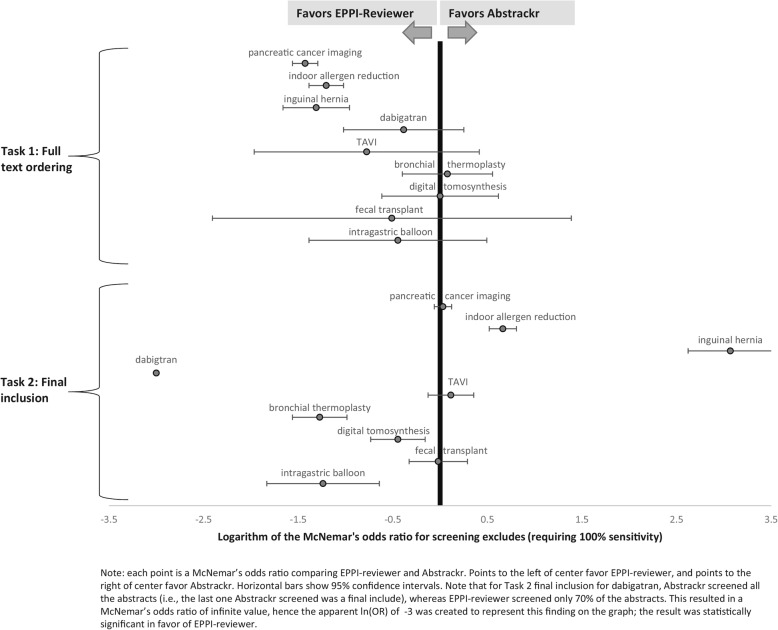
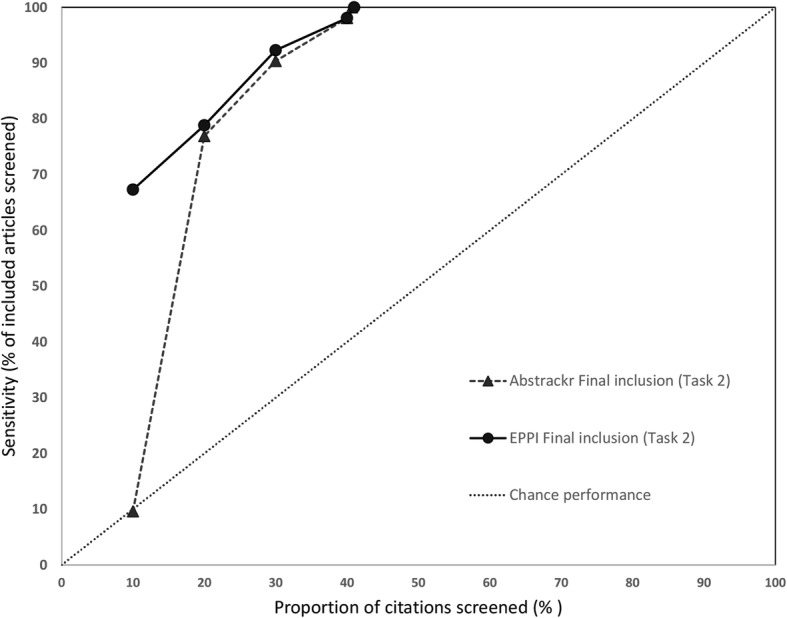
BACKGROUND: Improving the speed of systematic review (SR) development is key to supporting evidence-based medicine. Machine learning tools which semi-automate citation screening might improve efficiency. Few studies have assessed use of screening prioritization functionality or compared two tools head to head. In this project, we compared performance of two machine-learning tools for potential use in citation screening. METHODS: Using 9 evidence reports previously completed by the ECRI Institute Evidence-based Practice Center team, we compared performance of Abstrackr and EPPI-Reviewer, two off-the-shelf citations screening tools, for identifying relevant citations. Screening prioritization functionality was tested for 3 large reports and 6 small reports on a range of clinical topics. Large report topics were imaging for pancreatic cancer, indoor allergen reduction, and inguinal hernia repair. We trained Abstrackr and EPPI-Reviewer and screened all citations in 10% increments. In Task 1, we inputted whether an abstract was ordered for full-text screening; in Task 2, we inputted whether an abstract was included in the final report. For both tasks, screening continued until all studies ordered and included for the actual reports were identified. We assessed potential reductions in hypothetical screening burden (proportion of citations screened to identify all included studies) offered by each tool for all 9 reports. RESULTS: For the 3 large reports, both EPPI-Reviewer and Abstrackr performed well with potential reductions in screening burden of 4 to 49% (Abstrackr) and 9 to 60% (EPPI-Reviewer). Both tools had markedly poorer performance for 1 large report (inguinal hernia), possibly due to its heterogeneous key questions. Based on McNemar's test for paired proportions in the 3 large reports, EPPI-Reviewer outperformed Abstrackr for identifying articles ordered for full-text review, but Abstrackr performed better in 2 of 3 reports for identifying articles included in the final report. For small reports, both tools provided benefits but EPPI-Reviewer generally outperformed Abstrackr in both tasks, although these results were often not statistically significant. CONCLUSIONS: Abstrackr and EPPI-Reviewer performed well, but prioritization accuracy varied greatly across reports. Our work suggests screening prioritization functionality is a promising modality offering efficiency gains without giving up human involvement in the screening process.
Overview
CoChat Summary
## TL;DR
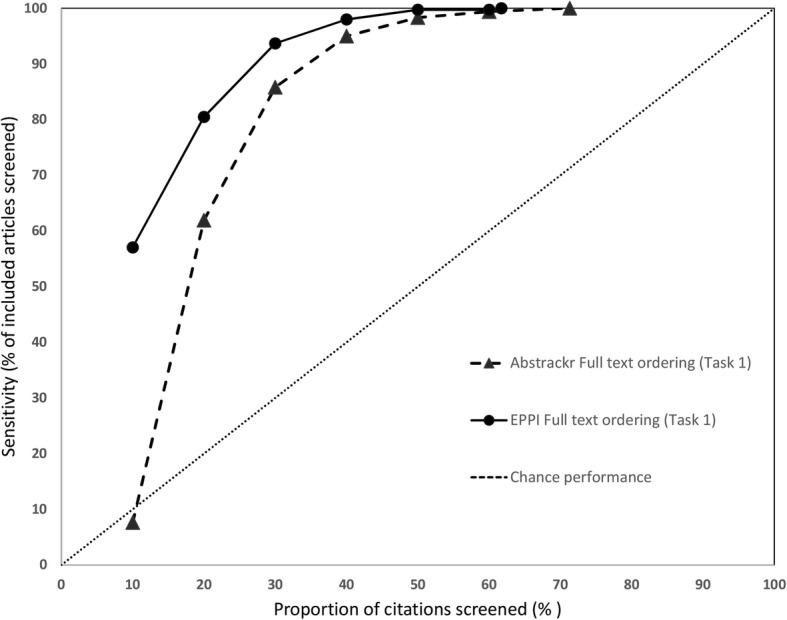
This study compared Abstrackr and EPPI-Reviewer for screening prioritization in 9 completed evidence reports and found that both tools could substantially reduce screening burden, especially in larger reviews. Performance varied widely by report, with EPPI-Reviewer generally doing better for early identification in Task 1 and mixed results for final-inclusion predictions in Task 2.
## Key findings
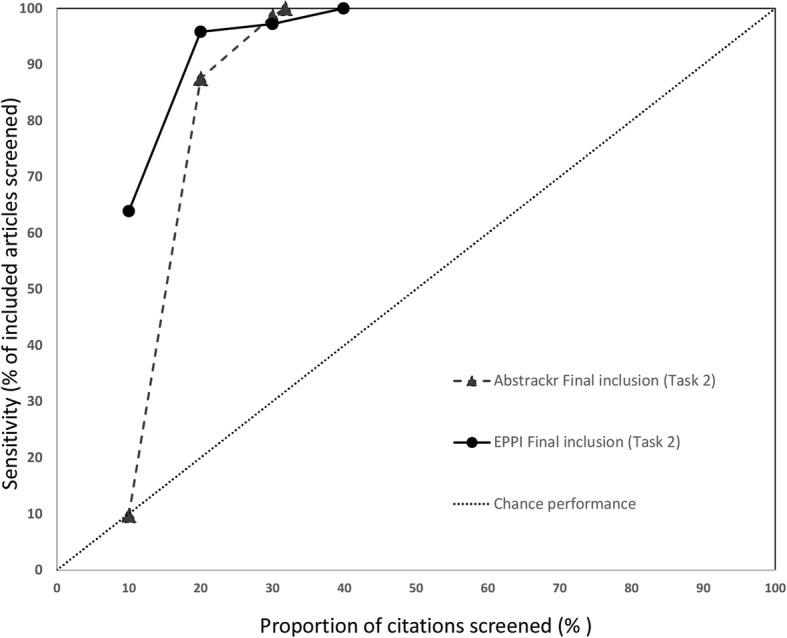
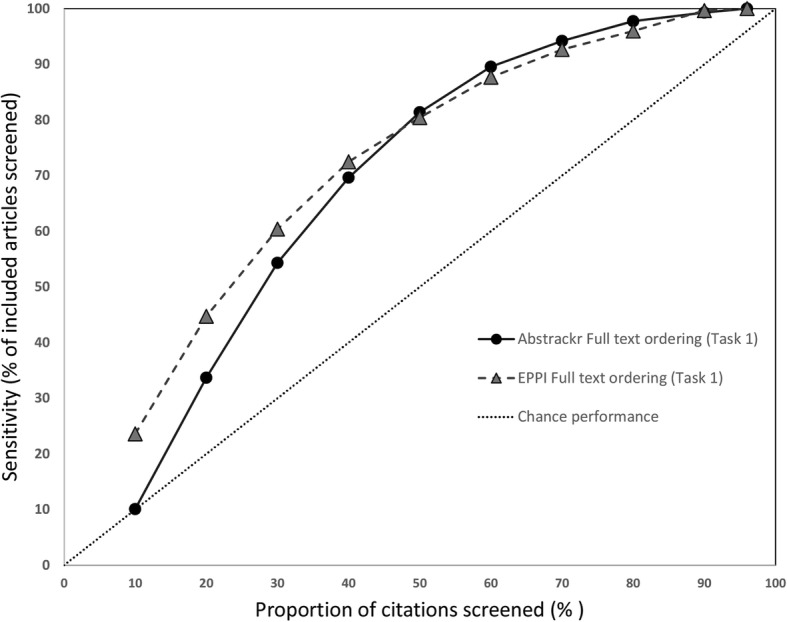
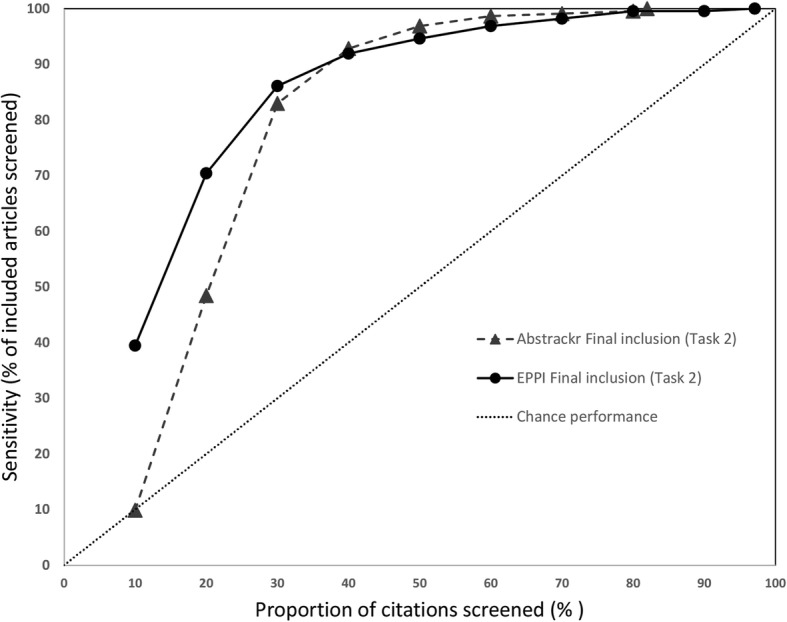
- For the 3 large reports, potential reductions in screening burden were 4 to 49% with Abstrackr and 9 to 60% with EPPI-Reviewer.
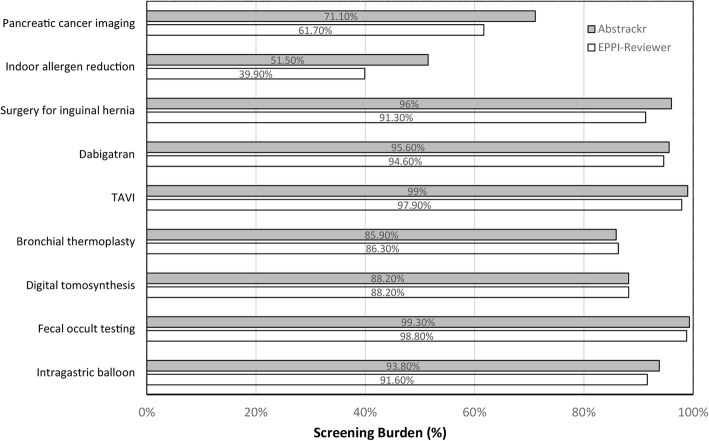
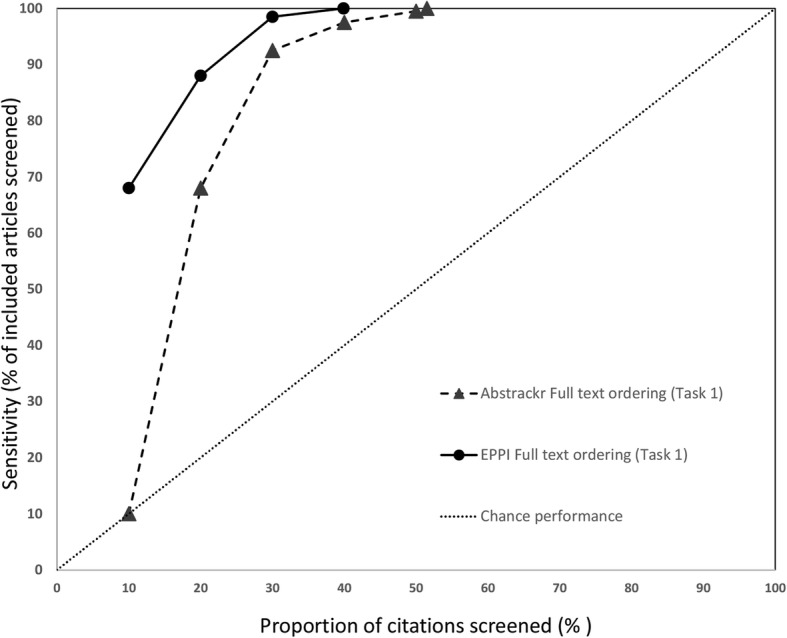
- In one large report, indoor allergen reduction, nearly all relevant citations were identified by the time 50% of citations had been screened; screening burden was 39.9% for EPPI-Reviewer and 51.5% for Abstrackr.
- In the pancreatic cancer imaging report, EPPI-Reviewer identified all abstracts ordered for full text 868 citations earlier than Abstrackr, with a potential screening-burden reduction of nearly 10%.
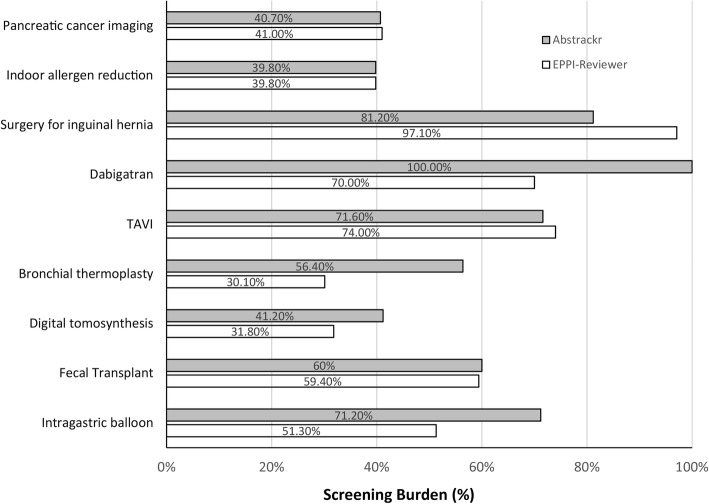
- In 4 of 6 small reports, EPPI-Reviewer identified all included citations earlier than Abstrackr, offering reductions in screening burden of 30 to 70%.
## Methods
- Comparative study using citations from 9 previously completed evidence reports: 3 large and 6 small reports across clinical topics; the large reports were pancreatic cancer imaging, indoor allergen reduction, and inguinal hernia repair.
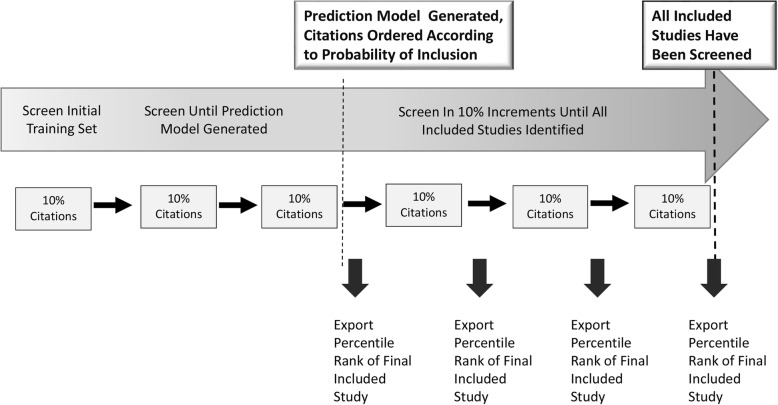
- The tools were trained on the same citation sets and evaluated in 10% increments; Task 1 used decisions about whether an abstract was ordered for full-text screening, and Task 2 used whether an abstract was included in the final report.
- Main analyses used hypothetical screening burden, percentile rank/sensitivity, and McNemar’s test for paired proportions; the dataset included 19,149 citations, minus 505 duplicates and 363 citations excluded for publication year, leaving 18,281 articles.
## Limitations
- The paper states that performance may vary depending on the composition of the initial training set; different random training samples could have produced different results.
- The authors did not use some tool features that might improve performance in real-world use, such as keyword identification and automatic classification.
- Evident from the text: the study measured potential reductions in screening burden under retrospective conditions, and the paper notes these may not translate to actual reductions in real-time use because reviewers cannot know in advance whether performance will be good or bad.
Model-written summary. Check it against the paper before relying on it.
Integrity signals
Registry
Cites
Statistics
Figures
Verification
Claims the paper makes
4 Valid · 1 Not valid · 0 Not checked · 48 Own results and interpretations
The cited sources support only part of this claim — read each source’s verdict below.
In the paper
“Many studies evaluating these tools have assessed automatic classification functionality, in which screening continued until the tool predicts whether studies should be included or not, and remaining citations are not screened [19, 21].”
§ Machine learning for screening prioritization in systematic reviews: comparative performance of Abstrackr and EPPI-Reviewer > Discussion > Encouraging wider adoption
What the sources say
- Supportedcites [19] Gates A, Johnson C, Hartling L. Technology-assisted title and abstract screening for systematic reviews: a retrospective evaluation of the Abstrackr machine learning tool. Syst Rev. 2018;7 [cited 2019 Oct 10] Available from: https://www.ncbi.nlm.nih.gov/pmc/articles/PMC5848519/. PMC5848519 29530097 source
In Methods > Data collection (page unavailable), the authors say they screened records until Abstrackr produced relevance predictions, then discontinued screening. The Discussion also identifies earlier evaluations of Abstrackr’s prediction-based screening, supporting the sentence’s characterization of this evaluation approach. (LLM, conf=0.89)
- Partly supportedcites [21] Rathbone J Hoffmann T Glasziou P Faster title and abstract screening? Evaluating Abstrackr, a semi-automated online screening program for systematic reviewers Syst Rev 2015 4 80 10.1186/s13643-015-0067-6 26073974 PMC4472176 sourceExperimental — accuracy not yet measured
The Results (Atypical haemolytic uremic syndrome dataset) show that Abstrackr made predictions after an initial set of citations was screened, so this paper is an example of evaluating classification-based screening. But the Methods state that reviewers subsequently assessed citations predicted relevant; only those predicted irrelevant counted as screening workload saved. Thus, the claim that the remaining citations were not screened is too broad. (LLM, conf=0.84)
plain- Asserted: passes — The authors put it forward as true.
- Checkable: passes — It can be checked against evidence.
- Load-bearing: passes — The paper’s conclusions depend on it.
- Based: passes — The paper gives a reason why it holds.
- Supported
Every source the paper cites for this claim was checked and supports it.
In the paper
“Despite numerous tools for automation, adoption of these tools has lagged [8, 22].”
§ Machine learning for screening prioritization in systematic reviews: comparative performance of Abstrackr and EPPI-Reviewer > Discussion > Encouraging wider adoption
What the sources say
- Supportedcites [8] Lau J Editorial: systematic review automation thematic series Syst Rev 2019 8 1 70 10.1186/s13643-019-0974-z 30857554 PMC6410513 source
The editorial says researchers have developed automation tools for systematic reviews over the past 15 years, but that a lack of user-friendly software and commercial products has hindered their widespread adoption. This directly supports the attributed claim in the context of systematic reviews. (LLM, conf=0.92)
- Supportedcites [22] O’Connor AM Tsafnat G Thomas J Glasziou P Gilbert SB Hutton B A question of trust: can we build an evidence base to gain trust in systematic review automation technologies? Syst Rev 2019 8 1 143 10.1186/s13643-019-1062-0 31215463 PMC6582554 source
The 'Compatibility with current practice—set-up challenges' section says many automation tools exist, citing 159 indexed tools. The 'Barriers to adoption of automation' section describes an absence of adoption, and the Abstract discussion explicitly calls adoption slow. Page numbers were not supplied. (LLM, conf=0.94)
plain- Asserted: passes — The authors put it forward as true.
- Checkable: passes — It can be checked against evidence.
- Load-bearing: passes — The paper’s conclusions depend on it.
- Based: passes — The paper gives a reason why it holds.
- Supported
A result the paper reports from its own data — it cites no other source for it, so there is none to check. The quote shows it is in the paper.
In the paper
“After 70% of citations had been screened, both citation tools had not yet identified 4 (of 223 total) studies that would be included in the final report.”
§ Machine learning for screening prioritization in systematic reviews: comparative performance of Abstrackr and EPPI-Reviewer > Discussion
plain- Asserted: passes — The authors put it forward as true.
- Checkable: passes — It can be checked against evidence.
- Load-bearing: passes — The paper’s conclusions depend on it.
- Based: passes — The paper gives a reason why it holds.
- Rests on an assumption not shown here.
A result the paper reports from its own data — it cites no other source for it, so there is none to check. The quote shows it is in the paper.
In the paper
“but Abstrackr performed better in 2 of 3 reports for identifying articles included in the final report”
§ Machine learning for screening prioritization in systematic reviews: comparative performance of Abstrackr and EPPI-Reviewer > Abstract > Results
plainstates an association- Asserted: passes — The authors put it forward as true.
- Checkable: passes — It can be checked against evidence.
- Load-bearing: passes — The paper’s conclusions depend on it.
- Based: passes — The paper gives a reason why it holds.
- Rests on an assumption not shown here.
A result the paper reports from its own data — it cites no other source for it, so there is none to check. The quote shows it is in the paper.
In the paper
“For example, for the pancreatic imaging report, EPPI-Reviewer identified all citations ordered for full-text review after only 62% of citations had been screened.”
§ Machine learning for screening prioritization in systematic reviews: comparative performance of Abstrackr and EPPI-Reviewer > Discussion > Limitations
plainstates a causeSingle case- Asserted: passes — The authors put it forward as true.
- Checkable: passes — It can be checked against evidence.
- Load-bearing: unclear — It is unclear whether the paper’s conclusions depend on it.
- Based: passes — The paper gives a reason why it holds.
- Rests on an assumption not shown here.
28 more claims
Create a free account to see all 53 claims and every source verdict.
- Probably not a substantial claim. 7
- It may state two separate claims as one. 15
Claims other papers make about this one
Each is checked against this paper’s own text: does it say what the citing paper says it does?
The source backs part of the claim, not all of it — or backs it for a different population, condition or comparison.
In the citing paper
“Screening burden to identify all title/abstract includes for the de novo review was 85% or more for seven of the nine reviews for both Abstrackr (median: 93.8%, range: 71.1 to 99.0%) and EPPI-Reviewer (median: 91.3%, range: 39.9 to 97.9%).”
From An evaluation of DistillerSR’s machine learning-based prioritization tool for title/abstract screening – impact on reviewer-relevant outcomes (2020) · cites this paper as [15]
Experimental — accuracy not yet measuredThe cited source says what the claim attributes to it.
In the citing paper
“The most advanced technology in this respect is the use of machine learning (ML) to prioritize studies for screening, which has been found to be accurate and efficient in a number of methodological studies [12e14], and is available at the time of writing in several systematic review authoring tools [15,16].”
From In a pilot study, automated real-time systematic review updates were feasible, accurate, and work-saving (2023) · cites this paper as [16]
Citations
Cites
Evidence-Based Medicine: How to Practice and Teach EBM
Sackett, D. L. (2000) · Cited by 5,950
Clinical Practice Guidelines We Can Trust
Committee on Standards for Developing Trustworthy Clinical Practice Guidelines, Board on Health Care Services, & Institute of Medicine (2011) · National Academies Press eBooks · doi:10.17226/13058 · Cited by 3,081
Statistical Methods in Medical Research
Lachenbruch, P. A. (1972) · Technometrics · doi:10.1080/00401706.1972.10488903 · Cited by 1,703
Finding What Works in Health Care: Standards for Systematic Reviews
Eden, J., Levit, L. A., Berg, A. O., & Morton, S. C. (2013) · Cited by 949
Borah, R., Brown, A. W., Capers, P. L., & Kaiser, K. A. (2017) · BMJ Open · doi:10.1136/bmjopen-2016-012545 · Cited by 737
O’Mara-Eves, A., Thomas, J., McNaught, J., Miwa, M., & Ananiadou, S. (2015) · Systematic Reviews · doi:10.1186/2046-4053-4-5 · Cited by 681
Deploying an interactive machine learning system in an evidence-based practice center: abstrackr
Wallace, B. C., Small, K., Brodley, C. E., Lau, J., & Trikalinos, T. A. (2012) · Proceedings of the 2nd ACM SIGHIT International Health Informatics Symposium · doi:10.1145/2110363.2110464 · Cited by 532 · cited 3×
“Both tools are web-based and facilitate citation screening through text-mining tools and machine learning techniques; they employ “ active learning, ” in which ongoing feedback from reviewers is used dynamically to improve predictive accuracy [14, 17].”
BackgroundMethodHarrison, H., Griffin, S. J., Kuhn, I., & Usher-Smith, J. A. (2020) · BMC Medical Research Methodology · doi:10.1186/s12874-020-0897-3 · Cited by 449
O’Mara-Eves, A., Thomas, J., McNaught, J., Miwa, M., & Ananiadou, S. (2015) · Systematic Reviews · doi:10.1186/s13643-015-0031-5 · Cited by 353
Semi-automated screening of biomedical citations for systematic reviews
Wallace, B. C., Trikalinos, T. A., Lau, J., Brodley, C., & Schmid, C. H. (2010) · BMC Bioinformatics · doi:10.1186/1471-2105-11-55 · Cited by 351
Cited by
Bond, M., Khosravi, H., De Laat, M., Bergdahl, N., Negrea, V., Oxley, E., Pham, P., Chong, S. W., & Siemens, G. (2024) · International Journal of Educational Technology in Higher Education · doi:10.1186/s41239-023-00436-z · Cited by 852
“Given the affordances in efficiency that machine learning can bring to evidence synthesis (e.g., Stansfield et al., 2022; Tsou et al., 2020), as well as the enhanced transparency through visualisation tools such as EPPI Visualiser, it is surprising that the AIHEd community has not made more use of…”
MethodArtificial intelligence to automate the systematic review of scientific literature
de la Torre-López, J., Ramírez, A., & Romero, J. R. (2023) · Computing · doi:10.1007/s00607-023-01181-x · Cited by 170
“Five new methods have been proposed in the last four years [26, 27, 34, 35, 40], and supporting tools are subject of evaluations [11, 49, 50].”
BackgroundMethodValizadeh, A., Moassefi, M., Nakhostin-Ansari, A., Hosseini Asl, S. H., Saghab Torbati, M., Aghajani, R., Maleki Ghorbani, Z., & Faghani, S. (2022) · BMC Medical Research Methodology · doi:10.1186/s12874-022-01631-8 · Cited by 159
“Chai et al. in 2021 [21] introduced a new tool named “Research Screener” which utilizes deep learning algorithms for the semi-automated screening process.”
MethodResultInfluentialScherbakov, D., Hubig, N., Jansari, V., Bakumenko, A., & Lenert, L. A. (2024) · arXiv · doi:10.48550/arxiv.2409.04600 · Cited by 156
Scherbakov, D., Hubig, N., Jansari, V., Bakumenko, A., & Lenert, L. A. (2025) · Journal of the American Medical Informatics Association · doi:10.1093/jamia/ocaf063 · Cited by 154
Hamel, C., Kelly, S. E., Thavorn, K., Rice, D. B., Wells, G. A., & Hutton, B. (2020) · BMC Medical Research Methodology · doi:10.1186/s12874-020-01129-1 · Cited by 140
Boetje, J., & van de Schoot, R. (2024) · Systematic Reviews · doi:10.1186/s13643-024-02502-7 · Cited by 146
“However, automation can be used to accelerate several steps in the process, particularly the screening phase [1, 13, 16, 23, 26, 31, 33, 34, 36, 43, 45, 48, 51].”
Hamel, C., Hersi, M., Kelly, S. E., Tricco, A. C., Straus, S., Wells, G., Pham, B., & Hutton, B. (2021) · BMC Medical Research Methodology · doi:10.1186/s12874-021-01451-2 · Cited by 104
“As most research in this area is based on a small number of case studies [30] or small data-sets [33], it is important for knowledge synthesis teams to test prioritization tools in their own projects, and we encourage replication to build to the repository of information.”
BackgroundNußbaumer-Streit, B., Sommer, I., Hamel, C., Devane, D., Noel-Storr, A. H., Puljak, L., Trivella, M., & Gartlehner, G. (2023) · BMJ Evidence-Based Medicine · doi:10.1136/bmjebm-2022-112185 · Cited by 134
“…selection is not optimal, semiautomation (eg, one human screener+machine learning) is promising, at least in reviews of intervention studies 30–33 and could be implemented in RRs. Artificial intelligence also ranks abstracts by relevance, which can be useful for prioritising studies during…”
Robledo, S., Grisales Aguirre, A. M., Hughes, M., & Eggers, F. (2023) · Journal of Small Business Management · doi:10.1080/00472778.2021.1955125 · Cited by 80
“We were able to identify a few papers that compare different ML tools (Gates et al., 2019; Harrison et al., 2020; Marshall & Wallace, 2019; Kohl et al., 2018; Tsou et al., 2020; Van der Mierden et al., 2019).”
BackgroundCampos, D. G., Fütterer, T., Gfrörer, T., Lavelle-Hill, R., Murayama, K., König, L., Hecht, M., Zitzmann, S., & Scherer, R. (2024) · Educational Psychology Review · doi:10.1007/s10648-024-09862-5 · Cited by 75
“Thus, the same factors that pose challenges for designing a search with adequate sensitivity and specificity may also pose problems for active learning algorithms and the use of heuristic stopping rules (Tsou et al., 2020).”
Santos, Á. O. D., da Silva, E. S., Couto, L. M., Reis, G. V. L., & Belo, V. S. (2023) · Journal of Biomedical Informatics · doi:10.1016/j.jbi.2023.104389 · Cited by 64
Tóth, B., Berek, L., Gulácsi, L., Péntek, M., & Zrubka, Z. (2024) · Systematic Reviews · doi:10.1186/s13643-024-02592-3 · Cited by 48
“…41, 54, 68, 77, 87, 88, 93, 107, 120–122 , The off-the shelf or freeware screening automation software were Abstrackr [90, 94, 97, 98, 105, 113, 132], EPPI Reviewer [80, 128, 132, 136], RobotAnalyst [91, 94, 113, 131], Distiller SR [94, 99, 126], Rayyan [103, 131], Systematic Review…”
MethodApplying ChatGPT and AI‐Powered Tools to Accelerate Evidence Reviews
Nguyen-Trung, K., Saeri, A. K., & Kaufman, S. (2024) · Human Behavior and Emerging Technologies · doi:10.1155/2024/8815424 · Cited by 47
Haby, M. M., Barreto, J. O. M., Kim, J. Y. H., Peiris, S., Mansilla, C., Torres, M., Guerrero‐Magaña, D. E., & Revéiz, L. (2023) · Research Synthesis Methods · doi:10.1002/jrsm.1664 · Cited by 53
Nama, N., Hennawy, M., Barrowman, N., O’Hearn, K., Sampson, M., & McNally, J. D. (2021) · Systematic Reviews · doi:10.1186/s13643-021-01632-6 · Cited by 53
“The semiautomation of title and abstract screening: a retrospective exploration of ways to leverage Abstrackr’s relevance predictions in systematic and rapid reviews.”
MethodInfluentialVergani, M., Perry, B., Freilich, J. D., Chermak, S. M., Scrivens, R., Link, R., Kleinsman, D., Betts, J. M., & Iqbal, M. (2024) · Campbell Systematic Reviews · doi:10.1002/cl2.1397 · Cited by 65
Automation tools to support undertaking scoping reviews
Khalil, H., Pollock, D., McInerney, P., Evans, C., Moraes, E. B., Godfrey, C. M., Alexander, L., Tricco, A., Peters, M. D. J., Pieper, D., et al. (2024) · Research Synthesis Methods · doi:10.1002/jrsm.1731 · Cited by 43
“21,30,50,51,53 These four tools had the highest reliability and validity amongst the others that were introduced as undertaking this step.”
Yao, X., Kumar, M. V., Su, E., Flores Miranda, A., Saha, A., & Sussman, J. (2024) · Cancer Epidemiology · doi:10.1016/j.canep.2023.102511 · Cited by 37
Hamel, C., Michaud, A., Thuku, M., Affengruber, L., Skidmore, B., Nussbaumer-Streit, B., Stevens, A., & Garritty, C. (2020) · Journal of Clinical Epidemiology · doi:10.1016/j.jclinepi.2020.06.027 · Cited by 36
Waffenschmidt, S., Sieben, W., Jakubeit, T., Knelangen, M., Overesch, I., Bühn, S., Pieper, D., Skoetz, N., & Hausner, E. (2023) · Systematic Reviews · doi:10.1186/s13643-023-02334-x · Cited by 43
“For example, Tsou 2020 analyzed screenings with 226 to 9038 hits (4–104 relevant studies); prioritization often, but not always, worked better with larger citation sets [27].”
BackgroundMethodResultInfluentialAbdelkader, W., Navarro, T., Parrish, R., Cotoi, C., Germini, F., Iorio, A., Haynes, R. B., & Lokker, C. (2021) · JMIR Medical Informatics · doi:10.2196/30401 · Cited by 41
“For example, active learning was used in the recent work by Gates et al [61] and Tsou et al [62], who used Abstrackr, a freely available active machine learning tool that automates the screening of titles and abstracts [63].”
König, L., Zitzmann, S., Fütterer, T., Campos, D., Scherer, R., & Hecht, M. (2023) · doi:10.31234/osf.io/ybu3w · Cited by 33
Burgard, T., & Bittermann, A. (2023) · Zeitschrift für Psychologie · doi:10.1027/2151-2604/a000509 · Cited by 29
Boosting efficiency in a clinical literature surveillance system with LightGBM
Lokker, C., Abdelkader, W., Bagheri, E., Parrish, R., Cotoi, C., Navarro, T., Germini, F., Linkins, L., Haynes, R. B., Chu, L., et al. (2024) · PLOS Digital Health · doi:10.1371/journal.pdig.0000299 · Cited by 46
König, L., Zitzmann, S., Fütterer, T., Campos, D., Scherer, R., & Hecht, M. (2024) · Research Synthesis Methods · doi:10.1002/jrsm.1762 · Cited by 40
“,54,57 Given the variation in publishing guidelines, keywords, and phrases across different research areas, we anticipate that these distinctions may impact the learning algorithm's capacity to effectively formulate a relevance ranking.”
Decoding semi-automated title-abstract screening: findings from a convenience sample of reviews
Gates, A., Gates, M., DaRosa, D., Elliott, S. A., Pillay, J., Rahman, S., Vandermeer, B., & Hartling, L. (2020) · Systematic Reviews · doi:10.1186/s13643-020-01528-x · Cited by 31
“To what extent ML-assisted methods could compromise the validity of systematic reviews’ findings is vitally important, but few studies have reported on this outcome [17, 18].”
MethodCarey, N., Harte, M., & McCullagh, L. (2022) · Journal of Clinical Epidemiology · doi:10.1016/j.jclinepi.2022.05.017 · Cited by 28
Marshall, I. J., Trikalinos, T. A., Soboczenski, F., Yun, H. S., Kell, G., Marshall, R., & Wallace, B. C. (2023) · Journal of Clinical Epidemiology · doi:10.1016/j.jclinepi.2022.08.013 · Cited by 23
“[10,11] The most advanced technology in this respect is the use of machine learning (ML) to prioritise studies for screening, which has found to be accurate and efficient in a number of methodological studies,[12–14] and is available at the time of writing in several systematic review authoring tools.[15,16]”
BackgroundDigital Tools to Support the Systematic Review Process: An Introduction
Schmidt, L., Cree, I. A., Campbell, F., & WCT EVI MAP group (2025) · Journal of Evaluation in Clinical Practice · doi:10.1111/jep.70100 · Cited by 30
Challenges in assessing the effects of environmental governance systems on conservation outcomes
Ayambire, R. A., Rytwinski, T., Taylor, J. J., Luizza, M. W., Muir, M. J., Cadet, C., Armitage, D. R., Bennett, N. J., Brooks, J. S., Cheng, S. H., et al. (2024) · Conservation Biology · doi:10.1111/cobi.14392 · Cited by 29
“The EPPI-Reviewer’s priority screening effectively reduces the screening burden by up to 60% while retaining human involvement and control over the screening process and outcomes (Tsou et al., 2020).”
Machine learning for accelerating screening in evidence reviews
Chappell, M., Edwards, M., Watkins, D., Marshall, C., & Graziadio, S. (2023) · Cochrane Evidence Synthesis and Methods · doi:10.1002/cesm.12021 · Cited by 20
“Only two comparative studies were identified [33, 34].”
Simulation-based Active Learning for Systematic Reviews: A Scoping Review of Literature
Teijema, J. J., Ribeiro, G., Seuren, S., Anadria, D., Bagheri, A., & van de Schoot, R. (2023) · doi:10.31234/osf.io/67zmt · Cited by 10
Khan, M. T., Pettenella, D., & Masiero, M. (2024) · Forests · doi:10.3390/f15122112 · Cited by 19
Schneider, J., Hoang, L., Kansara, Y., Cohen, A. M., & Smalheiser, N. R. (2022) · JAMIA Open · doi:10.1093/jamiaopen/ooac015 · Cited by 18
Rapid review methods series: Guidance on the use of supportive software
Affengruber, L., Nußbaumer-Streit, B., Hamel, C., van der Maten, M. M., Thomas, J., Mavergames, C., Spijker, R., & Gartlehner, G. (2024) · BMJ Evidence-Based Medicine · doi:10.1136/bmjebm-2023-112530 · Cited by 17
Artificial Intelligence Software to Accelerate Screening for Living Systematic Reviews
Fuller‐Tyszkiewicz, M., Jones, A., Vasa, R., Vasa, R., Grbin, L., Macdonald, J. A., Deane, C., Samuel, D., Evans-Whipp, T., & Olsson, C. A. (2025) · Clinical Child and Family Psychology Review · doi:10.1007/s10567-025-00519-5 · Cited by 22
“…relevant literature (Grames et al., 2019), to artificial intelligence (AI) approaches to rank article relevance to expedite the screening process (Tsou et al., 2020), AI to extract relevant text passages and data for risk of bias assessment (Soboczenski et al., 2019), and literature synthesis…”
Kindinger, T. L., Toy, J. A., & Kroeker, K. J. (2022) · Proceedings of the National Academy of Sciences · doi:10.1073/pnas.2108878119 · Cited by 15
Living evidence and adaptive policy: perfect partners?
Turner, T., Lavis, J. N., Grimshaw, J., Green, S., & Elliott, J. H. (2023) · Health Research Policy and Systems · doi:10.1186/s12961-023-01085-4 · Cited by 18
Rytwinski, T., Öckerman, S. L. A., Taylor, J. J., Bennett, J., Muir, M. J., Miller, J. R. B., Pokempner, A. A., Lam, W. Y., Pickles, R., & Cooke, S. J. (2021) · Ecological Solutions and Evidence · doi:10.1002/2688-8319.12104 · Cited by 11
“While machine learning technologies are still under development, EPPI-Reviewer’s priority screening has been shown to effectively reduce the screening burden by up to 60% (Tsou et al., 2020).”
BackgroundSterud, T., Lunde, L.-K., Berg, R. C., Proper, K. I., & Aanesen, F. (2025) · Occupational and Environmental Medicine · doi:10.1136/oemed-2025-110194 · Cited by 22
“59 The recall plot indicated that relevant study identification plateaued”
Ghazanfari, A., Malzl, L., Pramreiter, M., Konnerth, J., & Kromoser, B. (2025) · Wood Material Science and Engineering · doi:10.1080/17480272.2025.2465562 · Cited by 14
“Such a high accuracy rate underscores the reliability of Abstrackr as a tool for reducing bias in single screenings and workload in the context of our study, as proved in the studies of Rathbone et al. (2015), Gates et al. (2020) and Tsou et al. (2020).”
Pediatric Chronic Critical Illness: Protocol for a Scoping Review
Zorko, D. J., McNally, J. D., Rochwerg, B. N., Pinto, N. P., Couban, R., O’Hearn, K., & Choong, K. L. M. (2021) · JMIR Research Protocols · doi:10.2196/30582 · Cited by 12
“ML algorithms are being increasingly used to assist in citation screening for systematic reviews, particularly in large reviews [28-31].”
MethodMacura, B., Duca, L. D., Soto, A., Carrard, N., Gosling, L., Hannes, K., Thomas, J., Sara, L., Sommer, M., Waddington, H. S., et al. (2021) · Campbell Systematic Reviews · doi:10.1002/cl2.1164 · Cited by 12
van Mossel, S., Wolcherink, M. J. O., Cardet, R. E. D. F., de Geus‐Oei, L., Vriens, D., Koffijberg, H., & Saing, S. (2025) · PharmacoEconomics · doi:10.1007/s40273-025-01481-4 · Cited by 15
Kataoka, Y., So, R., Banno, M., Kumasawa, J., Someko, H., Taito, S., Terasawa, T., Tsujimoto, Y., Tsutsumi, Y., Wada, Y., et al. (2023) · medRxiv · doi:10.1101/2023.10.31.23297818 · Cited by 8
Rapid review: A review of methods and recommendations based on current evidence
Guo, Q., Jiang, G., Zhao, Q., Long, Y., Feng, K., Gu, X., Xu, Y., Li, Z., Huang, J., & Du, L. (2024) · Journal of Evidence-Based Medicine · doi:10.1111/jebm.12594 · Cited by 8
Large-Scale Simulation Study of Active Learning Models for Systematic Reviews
Teijema, J. J., de Bruin, J., Bagheri, A., & van de Schoot, R. (2023) · doi:10.31234/osf.io/2w3rm · Cited by 8
The use of text-mining software to facilitate screening of literature on centredness in health care
Forsgren, E., Wallström, S., Feldthusen, C., Zechner, N., Sawatzky, R. G., & Öhlén, J. (2023) · Systematic Reviews · doi:10.1186/s13643-023-02242-0 · Cited by 7
“It has been estimated that screening burden can be reduced by between 40 and 90%, i.e. the complete sample of studies needed to be screened to include all relevant records [13, 18].”
BackgroundChang, C. H., Cook‐Patton, S. C., Erbaugh, J. T., Lu, L., Masuda, Y. J., Molnár, I. D., Papp, D., & Robinson, B. E. (2025) · Conservation Biology · doi:10.1111/cobi.14464 · Cited by 13
“As more articles are screened, the algorithm’s accuracy improves (Tsou et al., 2020).”
Yao, X., Saha, A., Saravanan, S., Low, A., & SUSSMAN, J. S. (2025) · Cancer Innovation · doi:10.1002/cai2.70021 · Cited by 8
Nieto González, D. M. (2022) · doi:10.11144/javeriana.10554.58492 · Cited by 6
“[68] [90] [91] [68] [92] [93] [94] [95] [96]”
BackgroundInfluentialAccelerating the Early Identification of Relevant Studies in Title and Abstract Screening
Bravo, Á., Bennetts, L. E., & Atanasov, P. (2021) · International Symposium on Computer Science and Intelligent Control (ISCSIC) · doi:10.1109/iscsic54682.2021.00034 · Cited by 6
Machine learning e revisão sistemática de literatura automatizada: uma revisão sistemática
Tsunoda, D. F., Moreira, P. S. D. C., & Guimarães, A. J. R. (2020) · Revista Tecnologia e Sociedade · doi:10.3895/rts.v16n45.12119 · Cited by 12
Artificial intelligence in systematic literature reviews: a case for cautious optimism
Kharawala, S., Mahajan, A., & Gandhi, P. (2021) · Journal of Clinical Epidemiology · doi:10.1016/j.jclinepi.2021.03.012 · Cited by 6
“Therefore, what might be considered ‘state of the art’ today, will likely be different in a matter of months.”
Aguirre, A. M. G., & Figueroa-Vallejo, C. J. (2022) · Revista de Investigación Desarrollo e Innovación · doi:10.19053/20278306.v12.n2.2022.15271 · Cited by 9
Wiwatthanasetthakarn, P., Ponthongmak, W., Looareesuwan, P., Tansawet, A., Numthavaj, P., McKay, G. J., Attia, J. R., & Thakkinstian, A. (2024) · Journal of Medical Internet Research · doi:10.2196/56863 · Cited by 8
“With a 100% principal reviewer recall aim (ie, 0% FNR), Tsou et al [17] found a %Reduced workload of 3.99% to 48.41%, and 8.68% to 60.11% for Abstrackr and EPPI-reviewer, respectively.”
InfluentialCabanillas-García, J. L. (2025) · Informatics · doi:10.3390/informatics12030061 · Cited by 14
Spiero, I., Leeuwenberg, A., Moons, K. G. M., Hooft, L., & Damen, J. A. (2025) · Research Synthesis Methods · doi:10.1017/rsm.2025.10025 · Cited by 6
“…the review, 6,10 number of labeled records used for training the models within the tool, 8,11 complexity/breadth of the research question, 12,13 abstract structure and coherence, 14 number of relevant records, 8,15 review type (e.g., intervention, prognosis, or diagnosis), and/or medical topic .”
Pratte, M., Thirukumar, S., Zhang, C., Slessarev, M., Basmaji, J., & Prager, R. (2026) · Journal of Critical Care · doi:10.1016/j.jcrc.2025.155358 · Cited by 7
Towards Automated Screening of Literature on Artificial Intelligence in Nursing
Moen, H., Alhuwail, D., Björne, J., Block, L., Celin, S., Jeon, E., Kreiner, K., Mitchell, J. L., Ozegovic, G., Ronquillo, C., et al. (2022) · Studies in health technology and informatics · doi:10.3233/shti220155 · Cited by 5
Testing a filtering strategy for systematic reviews: evaluating work savings and recall.
Proescholdt, R., Hsiao, T., Schneider, J., Cohen, A. M., McDonagh, M. S., & Smalheiser, N. R. (2022) · PubMed · Cited by 8
Nabiwa, L., Masekameni, M. D., Hayumbu, P., Sifanu, M., Mmereki, D., & Linde, S. J. L. (2024) · Occupational Health Southern Africa · doi:10.62380/ohsa.2024.30.si.04 · Cited by 4
Gender and social outcomes of WASH interventions: synthesis of research evidence
Macura, B., Dickin, S., Waddington, H. S., Liera, C., Soto, A., Orlando, A., Foggitt, E., Pross, C., McArthur, J., Fadhila, A., et al. (2023) · doi:10.51744/cswp7 · Cited by 8
Yao, X., Low, A., Sivajohanathan, D., Vella, E. T., Wang, P., Kaur, G., Saha, A., & SUSSMAN, J. S. (2025) · Intelligent Medicine · doi:10.1016/j.imed.2025.12.006 · Cited by 8
Connecting the dots in neuroscience research: The future of evidence synthesis
Hair, K., Arroyo-Araujo, M., Vojvodić, S., Economou, M., Wong, C., Tinsdeall, F., Smith, S., Rackoll, T., Sena, E. S., & McCann, S. (2024) · Experimental Neurology · doi:10.1016/j.expneurol.2024.115047 · Cited by 5
“Many systematic review platforms, including EPPI-Reviewer and Abstrackr, offer machine learning technologies to improve the speed of document review, yet rely on text within the title and abstract (Tsou et al., 2020).”
Connecting patients with clinical trials using patient navigation: a scoping review protocol
Hilal, O., Gupta, P., Luginaah, A., Moshref, L. H., Askin, N., Epp, C., Nassar, R., Hirmiz, R., Paunic, M., Hossami, M., et al. (2025) · BMJ Open · doi:10.1136/bmjopen-2024-088828 · Cited by 2
“22 Previous work by Tsou et al supports that artificial intelligence (AI) tools can be beneficial for reviews with ≥ 2500s. 23 We will use DistillerSR’s AI tools to assist with screening.”
König, L., Zitzmann, S., & Hecht, M. (2025) · Research Synthesis Methods · doi:10.1017/rsm.2025.10053 · Cited by 5
“As illustrated in Figure 2, the performance of ML algorithms showed considerable variability in regard to the SC. Notably, the LR + SBERT algorithm achieved the best performance (SC = 35.28% [23.42, 48.16]), followed by RF + SBERT (SC = 37.50% [25.86%, 53.12]).”
InfluentialPatterns and Pitfalls of Short-cuts Used in Environmental Management Rapid Reviews
Harper, M., Rytwinski, T., & Cooke, S. J. (2023) · Environmental Management · doi:10.1007/s00267-023-01901-1 · Cited by 4
“Early adopters of machine learning have provided tools, such as EPPI-Reviewer or Abstrackr, that help decrease the effort and time required to conduct screening (Tsou et al. 2020).”
MethodDuarte, F. P., Ramos, J. P., Barbosa, P., Vergani, M., & de Carvalho, C. M. (2025) · Campbell Systematic Reviews · doi:10.1002/cl2.70042 · Cited by 9
“A recent study evaluating EPPI ‐ Reviewer found that the software significantly reduced screening workload by 9% – 60% and offered good prioritisation accuracy (Tsou et al. 2020).”
Remote digital monitoring for selected chronic diseases in primary health care
Taloyan, M., Jaranka, A., Bidonde, J., Flodgren, G., Roberts, N. W., Hägglund, M., Nilsson, G. H., & Papachristou, P. (2023) · Cochrane Database of Systematic Reviews · doi:10.1002/14651858.cd015479 · Cited by 4
Tóth, B., Berek, L., Gulàcsi, L., Péntek, M., & Zrubka, Z. (2023) · Research Square · doi:10.21203/rs.3.rs-3425312/v1 · Cited by 2
Jhalani, S., Morgan, R. M., Shooter, A., Cassella, J. P., & Pintér, J. (2025) · Forensic Science International Synergy · doi:10.1016/j.fsisyn.2025.100641 · Cited by 6
“The systematic review process was managed using ePPI-Reviewer [36,37], to support systematic reviews and research synthesis.”
InfluentialSimulation-based active learning for systematic reviews: A scoping review of literature
Teijema, J. J., Ribeiro, G., Seuren, S., Anadria, D., Bagheri, A., & van de Schoot, R. (2025) · Journal of Information Science · doi:10.1177/01655515251379058 · Cited by 1
Virendrakumar, B., Waddington, H. S., Scheelbeek, P., Jolley, E., & Schmidt, E. (2026) · Systematic Reviews · doi:10.1186/s13643-026-03101-4 · Cited by 1
“The thresholds for achieving 100% sensitivity for various smaller reports ranged between 86 and 97% [37].”
Tongwu, Y. U., Liu, Y., Ding, C., Wang, S., Wan, Y., 费晓燕, Guan, D., Wang, J., & Hao, L. (2026) · BMC Sports Science Medicine and Rehabilitation · doi:10.1186/s13102-026-01653-5 · Cited by 2
Guan, D., Liu, Y., Yu, T., & Cheng, W. (2026) · Frontiers in Surgery · doi:10.3389/fsurg.2026.1796813 · Cited by 1
“Disagreements between reviewers were resolved through structured discussion based on the appropriateness of studies according to the inclusion and exclusion criteria (17, 18, 20).”
Influential葛, 玲., & Sun, Y. (2026) · Frontiers in Psychology · doi:10.3389/fpsyg.2026.1786104 · Cited by 1
“All citations from the searched databases were imported into Zotero to be managed and initially organised (Tsou et al., 2020; Waffenschmidt et al., 2023).”
Gartlehner, G., Banda, S., Callaghan, M., Chase, J. D., Dobrescu, A. I., Eisele‐Metzger, A., Flemyng, E., Gardner, S., Griebler, U., Helfer, B., et al. (2026) · medRxiv · doi:10.64898/2026.04.13.26350802 · Cited by 1
Literature Filtering for Systematic Reviews with Transformers
Hawkins, J., & Tivey, D. R. (2024) · International Conference on Communications, Computing and Artificial Intelligence (CCCAI) · doi:10.1145/3676581.3676582 · Cited by 3
“However, on some research questions, they perform considerably worse[39].”
Nyan, C. P., Oppong, S. A., Manuh, T., et al. (2025) · Campbell Systematic Reviews · doi:10.1002/cl2.70025
“EPPI ‐ Reviewer is a screening tool developed by reputable systematic review groups (Tsou et al. 2020).”
Motahari-Nezhad, H., & CheshmehSohrabi, M. (2025) · Research Square · doi:10.21203/rs.3.rs-7265470/v1 · Cited by 1
Abdelkader, W., Xie, D., Lokker, C., Chu, L., Schandelmaier, S., Saha, A., Afzal, M., & Iorio, A. (2025) · medRxiv · doi:10.1101/2025.10.13.25337935
“Example model functions include classifying studies and recognizing high-quality evidence 12 , and easing the burden of systematic evidence synthesis by reducing screening workload 13–16 .”
Abògúnr̀in, Ṣ., Slob, B. P. H., Lane, M., Emamipour, S., Twardowski, P., Boersma, C., & van der Schans, J. (2025) · BMJ Open · doi:10.1136/bmjopen-2025-099921 · Cited by 1
“12–19 However, most of the studies focus on just one or two metrics of the tool (eg, workload reduction) and gener-alisability of the results is difficult.”
Kang, Y., Wen, J., Tongwu, Y. U., Qi, Y., & Li, Y. (2026) · BMC Sports Science Medicine and Rehabilitation · doi:10.1186/s13102-025-01457-z
“…of verified references to EPPI-Reviewer Web Version 6.16, where comprehensive duplicate removal and subsequent screening procedures were performed [17] The screening process was performed by two independent reviewers working in parallel to minimize selection bias and ensure comprehensive…”
InfluentialYu, T., Xu, Y., Zhang, Y., & Wang, S. (2026) · BMC Public Health · doi:10.1186/s12889-026-27420-2 · Cited by 2
“The organised references were then exported to EPPI-Reviewer 6 (version 6.17.0.0) for automated duplicate removal and screening [28].”
InfluentialLinguistic Polarity and Decision Architecture in LLM-Based Abstract Screening for Systematic Reviews
Behrouzian, A. M., Meleti, M., Colangelo, M. T., Calciolari, E., & Galli, C. (2026) · Information · doi:10.3390/info17050449 · Cited by 3
Biomarkers in preclinical and early Alzheimer’s disease in China: a scoping review
Peng, G., Yang, Y., Wang, Y., Chandekar, S. A., & Yu, J. (2026) · The Journal of Prevention of Alzheimer s Disease · doi:10.1016/j.tjpad.2026.100599 · Cited by 1
“EPPI-Reviewer, developed by the EPPI-Centre at the University College London, is a recommended web-based tool to support evidence synthesis [22].”
Müller-Eberstein, R., & Barnes, B. (2026) · Research Square · doi:10.21203/rs.3.rs-9789751/v1
Connecting Patients with Clinical Trials Using Patient Navigation: A Scoping Review
Hilal, O., Patel, R., Gupta, P., Askin, N., Ivankovic, V., Epp, C., Nassar, R., Paunic, M., Hossami, M., Abdel-Nabi, R., et al. (2026) · Current Oncology · doi:10.3390/curroncol33060341
“Previous work by Tsou et al. supports the use of artificial intelligence (AI) tools for reviews with more than 2500 citations [16].”
Lai, H., & Li, Y. (2026) · Telematics and Informatics · doi:10.1016/j.tele.2026.102447
Barragán, A. M., Bonett, S. E. O., Rodríguez-Grande, E.-I., Orjuela-Cañón, Á. D., Perdómo, O., & Sánchez, G. (2026) · Cochrane Evidence Synthesis and Methods · doi:10.1002/cesm.70098
“Web applications were the most reported resource ( n = 62) [4, 9, 29, 30, 35, 45, 53–57, 63, 64, 67, 69–72, 76, 82, 85, 88, 89, 93–95, 97, 99, 101, 106, 108, 110, 112, 114, 118, 119, 122–124, 128, 132, 136, 138, 139, 141, 148–153, 158, 161, 163, 167, 169, 171, 172, 175–177] whilst pretrained models…”
InfluentialJay, M., Abi‐Jaoude, J., Straus, S. E., Eskander, A., Lipscombe, L. L., Dharma, C., & Yu, C. (2026) · Global Epidemiology · doi:10.1016/j.gloepi.2026.100282
“Tools such as Rayyan [21], Abstrackr [22], EPPI Reviewer classifiers [22], and DistillerSR machine-learning modules [23] can rank citations, predict relevance, or support semi-automated inclusion decisions.”
Comparative performance of large language models for appraising bias in real-world evidence studies
Okeke, C. M., Nechi, R. N., Khalid, J., Karaye, I. M., Thornton, J. D., & Yunusa, I. U. (2026) · Journal of Managed Care & Specialty Pharmacy · doi:10.18553/jmcp.2026.32.9.1062
Looareesuwan, P., Ponthongmak, W., Tansawet, A., Ratanatharathorn, C., Owasi, H. U. R., McKay, G. J., Attia, J. R., Oami, T., & Thakkinstian, A. (2026) · PLOS Digital Health · doi:10.1371/journal.pdig.0001668
“Under a strict constraint of 100% recall, Tsou et al. [38] reported workload reductions of 4%-49% for Abstrackr and 9%-60% for EPPI-Reviewer.”
Lin, G.-Z., Hsieh, Y.-W., Cheng, C.-Y., Wang, C.-C., Chang, L., Liu, C.-H., Yun, W.-P., Yeh, S., Wuu, C., Chiu, C.-L., et al. (2026) · Life · doi:10.3390/life16091566
“Within the cross-validation test folds, all three BERT-family models achieved high WSS values at high-recall operating points using only titles and abstracts [56,57].”
Adam, G. P., Davies, M. C., Caputo, E. L., Mai, H. J., Coppola, E. L., Holmer, H. K., Kuhn, E., Balk, E. M., Trikalinos, T. A., Ivlev, I., et al. (2026) · Research Synthesis Methods · doi:10.1017/rsm.2026.10118
Metadata
- Authors
- Tsou, A. Y., Treadwell, J. R., Erinoff, E., & Schoelles, K.
- Affiliations
- ECRI Institute (US)
- Corresponding author
- Tsou, Amy Y.
- Venue
- Systematic Reviews
- Published
- 2020-04-02
- Volume
- 9
- Issue
- 1
- Pages
- 73-73
- ISSN
- 2046-4053 (ISSN-L)
- PMC
- PMC7118839
- OpenAlex
- W3014512586
- Semantic Scholar
- 935489033eb450aaf007cc89d974c431b27cdd74
- Cited by
- 122
- References
- 22
- Citations by year
- 2026: 26 · 2025: 24 · 2024: 20 · 2023: 16 · 2022: 9 · 2021: 20 · 2020: 7
- FWCI
- 1.94
- Type
- journal article
- Language
- en
- Open access
- gold
- doi.org
- Licence
- cc-by
- creativecommons.org/licenses/by/4.0/ (tdm)
- creativecommons.org/licenses/by/4.0/ (vor)
- Locations
- Systematic Reviews (publishedVersion, cc-by)
- PubMed Central (publishedVersion, cc-by)
- PubMed (publishedVersion)
- DOAJ (DOAJ: Directory of Open Access Journals) (submittedVersion, cc-by-sa)
- Funders
- Agency for Healthcare Research and Quality (R03 HS25859)
- Topics
- Social Sciences › Decision Sciences › Statistics, Probability and Uncertainty › Meta-analysis and systematic reviews
- Physical Sciences › Computer Science › Information Systems › Information Retrieval and Search Behavior
- Social Sciences › Library and Information Sciences › scientometrics and bibliometrics research
- Keywords
- citation screening, machine learning, abstract screening, full-text screening, tool comparison, evidence reports
- MeSH terms
- Machine Learning, Systematic Reviews as Topic, Humans, Mass Screening, Research, Evidence-Based Medicine
About these checks
Registry, retraction, Cites and statistics results are computed, not judged, with one exception: a printed reference that no index lists is read once by a model before it counts as a citation error. Claims are extracted by a model and kept only when their quote appears verbatim in the text; each cited source is then checked, with a model’s help, for whether it says what the claim relies on. Those verdicts can be wrong — read the claim’s quote and the cited source before relying on one.
The claim verdicts this report counts are experimental: their accuracy is not yet measured.
A language model drew the claims from the paper on 2026-10-11, under version 3 of the claim definition (model deepseek-v4.1-flash, prompt extract-v3).
A second model labelled each claim on 2026-10-11 (model jev-1.13-20260917, definition revision gold-guideline-v0.2).
Cited sources are checked with a language model’s help (gpt-6-sol).
Statistics and arithmetic are recomputed, not judged.
Confidence bands are shown only for fields calibrated on our annotated test set. None is calibrated yet, so no band is shown.
What counts as a claim ›How we measure confidence ›How we check this ›
Are you an author, or do you see a problem with this page? Request a review
Data sources
Bibliographic data: Semantic Scholar, OpenAlex, Crossref.
Contains information from the Semantic Scholar Academic Graph Datasets, made available under the ODC Attribution License (ODC-BY 1.0).
Semantic Scholar’s data is described in: Kinney, R., et al. (2023). The Semantic Scholar Open Data Platform. arXiv:2301.10140.
