

The PRISMA 2020 statement: an updated guideline for reporting systematic reviews
Open accessThe DOI matches its Crossref record; 82 of the 82 references it cites were found in a registry or an index; 47 of the 62 sources its claims cite were checked for support.
Abstract
See the PRISMA 2020 for Abstracts checklist (Table 2).
Overview
CoChat Summary
TL;DR
PRISMA 2020 replaces the 2009 PRISMA statement as updated reporting guidance for systematic reviews, reflecting advances in methods to identify, select, appraise, and synthesise studies. It provides a 27-item checklist, an expanded checklist, an abstract checklist, and revised flow diagrams for original and updated reviews.
Key findings
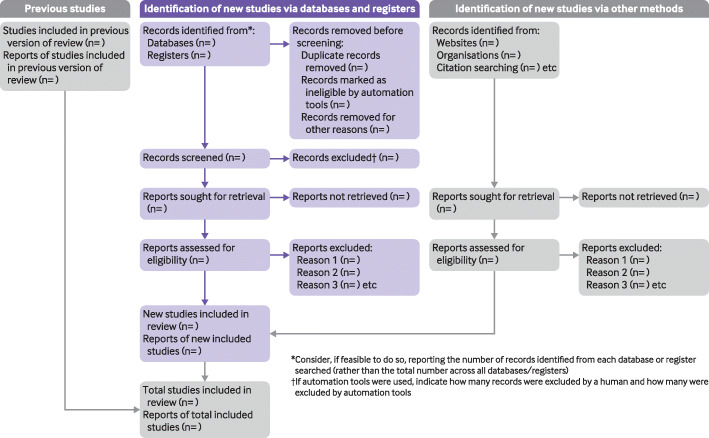
- PRISMA 2020 consists of a 27-item checklist, an expanded checklist detailing reporting recommendations for each item, the PRISMA 2020 abstract checklist, and revised flow diagrams for original and updated reviews.
- Noteworthy changes include inclusion of the abstract reporting checklist within PRISMA 2020; moving protocol and registration to a new Other section with a sub-item on amendments; recommending full search strategies for all databases, registers, and websites; more detail on reviewer screening, data collection, and automation; splitting synthesis methods into six sub-items and synthesis results into four sub-items; and adding items on certainty assessment, competing interests, and availability of data, code, and other materials.
- Development drew on reviews of reporting completeness, 60 documents providing reporting guidance, a survey to which 110 of 220 invited methodologists and journal editors responded, a 21-member two-day in-person meeting in September 2018 in Edinburgh, and feedback from 15 of 22 invited systematic reviewers.
- PRISMA 2009 was cited in over 60,000 reports (Scopus, August 2020) and endorsed by almost 200 journals and systematic review organisations; evidence from observational studies suggests its use is associated with more complete reporting, although more could be done to improve adherence.
Methods
- Guideline update: PRISMA 2020 was developed by adapting the EQUATOR Network’s guidance for developing health research reporting guidelines, identifying incompletely reported PRISMA 2009 items, reviewing 60 guidance documents, surveying methodologists and journal editors, discussing findings at a 21-member two-day meeting, and iteratively revising drafts with co-authors.
- Scope: designed primarily for systematic reviews of studies evaluating effects of health interventions, irrespective of included study design; applicable to other interventions and objectives, reviews with or without synthesis, mixed-methods reviews, and original, updated, or living systematic reviews.
- Analysis: no empirical meta-analysis is reported; the paper presents consensus-based reporting guidance, checklists, and flow diagram templates.
Limitations
- The paper states that it is unclear which strategies should be used to increase adherence to reporting guidelines, because of 31 interventions proposed, the effects of only 11 have been evaluated, mostly in observational studies at high risk of bias due to confounding.
- The paper states PRISMA 2020 is not intended to guide systematic review conduct, assess conduct or methodological quality, or inform reporting of systematic review protocols; separate tools and statements exist for those purposes.
- Evident from the text: PRISMA 2020 is a reporting guideline and consensus statement, not an empirical evaluation of its own impact; the paper notes future research is needed on barriers and facilitators, think-aloud studies, and reliability studies.
Model-written summary. Check it against the paper before relying on it.
Integrity signals
Registry
Cites
Statistics
Figures
Verification
Claims the paper makes
24 Valid · 0 Not valid · 1 Not checked · 25 Own results and interpretations
The sources with a verdict support this claim; the rest weren’t checked yet, have no full text we could read, or their verdicts aren’t rated yet.
In the paper
“Evidence from observational studies suggests that use of the PRISMA 2009 statement is associated with more complete reporting of systematic reviews [17–20], although more could be done to improve adherence to the guideline [21].”
What the sources say
- Supportedcites [17] Page MJ Shamseer L Altman DG Epidemiology and reporting characteristics of systematic reviews of biomedical research: a cross-sectional study PLoS Med 2016 13 e1002028 10.1371/journal.pmed.1002028 27218655 PMC4878797 source
The Results section reports that nearly all 26 characteristics were reported more often in therapeutic systematic reviews that self-reported using PRISMA. The Discussion describes mention of PRISMA as associated with more complete reporting, while cautioning that mention may only be a surrogate for actual use. (LLM, conf=0.92)
- Supportedcites [18] Panic N Leoncini E de Belvis G Ricciardi W Boccia S Evaluation of the endorsement of the preferred reporting items for systematic reviews and meta-analysis (PRISMA) statement on the quality of published systematic review and meta-analyses PLoS One 2013 8 e83138 10.1371/journal.pone.0083138 24386151 PMC3873291 source
The Abstract Results report higher adherence to the PRISMA reporting checklist after gastroenterology and hepatology journals endorsed PRISMA (90.1% versus 83.1%). The evidence concerns journal endorsement; the same section says that explicitly referencing PRISMA in an individual manuscript was not associated with better reporting. (LLM, conf=0.88)
- Not checked — no full text of the sourcecites [19] Agha RA Fowler AJ Limb C Impact of the mandatory implementation of reporting guidelines on reporting quality in a surgical journal: a before and after study Int J Surg 2016 30 169 172 10.1016/j.ijsu.2016.04.032 27112835 source
- Not checked — no full text of the sourcecites [20] Leclercq V Beaudart C Ajamieh S Rabenda V Tirelli E Bruyère O Meta-analyses indexed in PsycINFO had a better completeness of reporting when they mention PRISMA J Clin Epidemiol 2019 115 46 54 10.1016/j.jclinepi.2019.06.014 31254618 source
hedgedstates an association- Asserted: passes — The authors put it forward as true.
- Checkable: passes — It can be checked against evidence.
- Load-bearing: unclear — It is unclear whether the paper’s conclusions depend on it.
- Based: passes — The paper gives a reason why it holds.
- Supported
Every source the paper cites for this claim was checked and supports it.
In the paper
“technological advances have enabled the use of natural language processing and machine learning to identify relevant evidence [22–24]”
What the sources say
- Supportedcites [22] O’Mara-Eves A Thomas J McNaught J Miwa M Ananiadou S Using text mining for study identification in systematic reviews: a systematic review of current approaches Syst Rev 2015 4 5 10.1186/2046-4053-4-5 25588314 PMC4320539 source
The Results section on the suitability of text mining describes natural language processing techniques for improving how studies are classified. The Results section on review updates also describes machine-learning features used to classify studies, and the Discussion notes advances in text-mining technology. Together, these support the broad claim about using these technologies to identify relevant evidence. (LLM, conf=0.88)
- Supportedcites [23] Marshall IJ Noel-Storr A Kuiper J Thomas J Wallace BC Machine learning for identifying randomized controlled trials: an evaluation and practitioner’s guide Res Synth Methods 2018 9 602 614 10.1002/jrsm.1287 29314757 PMC6030513 source
The Aims section describes evaluating machine learning to identify RCTs in health research databases, and the Discussion reports that these approaches outperform traditional filters for systematic reviews. The paper also places its text-classification methods within NLP, supporting the broad claim about using these technologies to identify relevant evidence. (LLM, conf=0.88)
- Supportedcites [24] Marshall IJ Wallace BC Toward systematic review automation: a practical guide to using machine learning tools in research synthesis Syst Rev 2019 8 163 10.1186/s13643-019-1074-9 31296265 PMC6621996 source
The Search section (page not available in our copy) says that machine learning can use a small set of relevant articles to identify other relevant articles and describes semantic search by concept. The methods introduction explains how machine learning classifies articles for inclusion or exclusion, supporting the claim that these technologies can identify relevant evidence. (LLM, conf=0.91)
plainstates a cause- Asserted: passes — The authors put it forward as true.
- Checkable: passes — It can be checked against evidence.
- Load-bearing: unclear — It is unclear whether the paper’s conclusions depend on it.
- Based: passes — The paper gives a reason why it holds.
- Supported
The cited sources support only part of this claim — read each source’s verdict below.
In the paper
“We evaluated the reporting completeness of published systematic reviews [17, 21, 36, 37]”
§ The PRISMA 2020 statement: an updated guideline for reporting systematic reviews > Discussion
What the sources say
- Supportedcites [17] Page MJ Shamseer L Altman DG Epidemiology and reporting characteristics of systematic reviews of biomedical research: a cross-sectional study PLoS Med 2016 13 e1002028 10.1371/journal.pmed.1002028 27218655 PMC4878797 source
The Methods > Data Analysis section says the study assessed whether 26 characteristics of published systematic reviews were reported, and the Discussion > Explanation of Results and Implications discusses how complete that reporting was (page numbers unavailable). This supports citing the paper as an evaluation of reporting completeness. The PRISMA 2020 development context is the citing authors’ framing, not a finding attributed to this 2016 paper. (LLM, conf=0.91)
- Supportedcites [21] Page MJ Moher D Evaluations of the uptake and impact of the preferred reporting items for systematic reviews and meta-analyses (PRISMA) statement and extensions: a scoping review Syst Rev 2017 6 263 10.1186/s13643-017-0663-8 29258593 PMC5738221 source
The Methods section says the authors pooled studies assessing how often published systematic reviews adhered to PRISMA reporting items. The Results section reports their pooled assessment of adherence across 57 studies, supporting the citation’s use as an example of evaluating reporting completeness. (LLM, conf=0.90)
- Supportedcites [36] Page MJ Altman DG Shamseer L Reproducible research practices are underused in systematic reviews of biomedical interventions J Clin Epidemiol 2018 94 8 18 10.1016/j.jclinepi.2017.10.017 29113936 source
The Discussion (p. 20) reports the authors’ assessment of how completely published systematic reviews reported data needed to recreate their meta-analyses and other reproducible research practices. This supports the citation for evaluating reporting completeness; the PRISMA 2020 development context belongs to the citing document, not to this source. (LLM, conf=0.90)
- Partly supportedcites [37] Page MJ Altman DG McKenzie JE Flaws in the application and interpretation of statistical analyses in systematic reviews of therapeutic interventions were common: a cross-sectional analysis J Clin Epidemiol 2018 95 7 18 10.1016/j.jclinepi.2017.11.022 29203419 sourceExperimental — accuracy not yet measured
The Methods (section 2.3) and Results (section 3.6) show that the paper assessed whether selected statistical methods and their rationales were reported in published systematic reviews. It did not assess the completeness of reporting across the reviews as a whole. The citing authors’ PRISMA 2020 development context is their own framing, not a finding attributed to this source. (LLM, conf=0.82)
plain- Asserted: passes — The authors put it forward as true.
- Checkable: passes — It can be checked against evidence.
- Load-bearing: passes — The paper’s conclusions depend on it.
- Based: passes — The paper gives a reason why it holds.
- Supported
Every source the paper cites for this claim was checked and supports it.
In the paper
“new methods have been developed to assess the risk of bias in results of included studies [28, 29]”
What the sources say
- Supportedcites [28] Sterne JAC Savović J Page MJ RoB 2: a revised tool for assessing risk of bias in randomised trials BMJ 2019 366 l4898 10.1136/bmj.l4898 31462531 source
The Summary Points state that the authors developed and piloted RoB 2, a revised tool for assessing risk of bias in randomised trials, and that it produces a judgment for each result assessed. The introduction places risk-of-bias assessment in the context of studies included in systematic reviews. This paper therefore supports the claim as an example of a new method, specifically for randomised trials. (LLM, conf=0.93)
- Supportedcites [29] Sterne JA Hernán MA Reeves BC ROBINS-I: a tool for assessing risk of bias in non-randomised studies of interventions BMJ 2016 355 i4919 10.1136/bmj.i4919 27733354 PMC5062054 source
The Discussion says ROBINS-I was developed primarily for systematic reviews. The ‘Assessing a specific study’ section describes judging risk of bias for an outcome and result in each included non-randomised study, supporting the claim as an example of a new method. (LLM, conf=0.92)
plain- Asserted: passes — The authors put it forward as true.
- Checkable: passes — It can be checked against evidence.
- Load-bearing: unclear — It is unclear whether the paper’s conclusions depend on it.
- Based: passes — The paper gives a reason why it holds.
- Supported
Every source the paper cites for this claim was checked and supports it.
In the paper
“We identified PRISMA 2009 items that were often reported incompletely by examining the results of studies investigating the transparency of reporting of published reviews [17, 21, 36, 37].”
§ The PRISMA 2020 statement: an updated guideline for reporting systematic reviews > Development of PRISMA 2020
What the sources say
- Supportedcites [17] Page MJ Shamseer L Altman DG Epidemiology and reporting characteristics of systematic reviews of biomedical research: a cross-sectional study PLoS Med 2016 13 e1002028 10.1371/journal.pmed.1002028 27218655 PMC4878797 source
The Results (Reporting Characteristics of SRs; page unavailable) quantify incomplete reporting of review characteristics, including review flow and reasons for excluding studies. The Discussion (Explanation of Results and Implications; page unavailable) says reporting of many systematic reviews remains poor despite PRISMA 2009 and explains how individual PRISMA items may be reported incompletely. This supports using the study’s results to identify frequently incomplete reporting items. (LLM, conf=0.90)
- Supportedcites [21] Page MJ Moher D Evaluations of the uptake and impact of the preferred reporting items for systematic reviews and meta-analyses (PRISMA) statement and extensions: a scoping review Syst Rev 2017 6 263 10.1186/s13643-017-0663-8 29258593 PMC5738221 source
In Results (“Evaluations of SR adherence to the PRISMA Statement”), the review pools studies of published systematic reviews and identifies PRISMA items with low reporting adherence. It also reports nine items adhered to by fewer than 67% of reviews published in 2010 or later. The supplied passages do not give page numbers. (LLM, conf=0.94)
- Supportedcites [36] Page MJ Altman DG Shamseer L Reproducible research practices are underused in systematic reviews of biomedical interventions J Clin Epidemiol 2018 94 8 18 10.1016/j.jclinepi.2017.10.017 29113936 source
The Introduction (p. 6) describes studies finding low adherence to a PRISMA reporting item. This paper also examines published systematic reviews and reports incomplete reporting of that item in the Discussion (p. 20), making it a relevant study for identifying incompletely reported PRISMA items. (LLM, conf=0.90)
- Supportedcites [37] Page MJ Altman DG McKenzie JE Flaws in the application and interpretation of statistical analyses in systematic reviews of therapeutic interventions were common: a cross-sectional analysis J Clin Epidemiol 2018 95 7 18 10.1016/j.jclinepi.2017.11.022 29203419 source
The Results (sections 3.5 and 3.6) examine published systematic reviews and report frequent omissions in how statistical analyses were described, including missing rationales for subgroup and sensitivity analyses. This supports citing the paper as a study whose results could be examined to identify incompletely reported items; the identification of PRISMA 2009 items is the citing authors’ own step. (LLM, conf=0.86)
plain- Asserted: passes — The authors put it forward as true.
- Checkable: passes — It can be checked against evidence.
- Load-bearing: passes — The paper’s conclusions depend on it.
- Based: passes — The paper gives a reason why it holds.
- Supported
5 more claims · 2 with their cited sources checked
Create a free account to see all 50 claims and to verify the 3 references still open.
- Probably not a substantial claim. 36
- It may state two separate claims as one. 14
- The quote only partly states this claim. 1
Claims other papers make about this one
Each is checked against this paper’s own text: does it say what the citing paper says it does?
The source backs part of the claim, not all of it — or backs it for a different population, condition or comparison.
In the citing paper
“The PRISMA 2020 statement was designed primarily to provide guidance for systematic reviews of studies that evaluate the effects of interventions.”
From Extension of the PRISMA 2020 statement for living systematic reviews (PRISMA-LSR): checklist and explanation (2024) · cites this paper as [10]
Experimental — accuracy not yet measuredThe source backs part of the claim, not all of it — or backs it for a different population, condition or comparison.
In the citing paper
“This systematic review followed the PRISMA-NMA (Preferred Reporting Items for Systematic Review and Meta-Analyses extension for Network Meta-Analysis) 2020 statement for designing and reporting [38].”
From Assessing the Effectiveness of Digital Health Behavior Strategies on Type 2 Diabetes Management: Systematic Review and Network Meta-Analysis (2025) · cites this paper as [38]
Experimental — accuracy not yet measuredThe source backs part of the claim, not all of it — or backs it for a different population, condition or comparison.
In the citing paper
“This review was planned, conducted, and reported according to the updated guidelines for reporting systematic reviews of the 2020 Preferred Reporting Items for Systematic Reviews and Meta-Analyses (PRISMA) (Page et al., 2021).”
From A Competency Framework for AI Literacy: Variations by Different Learner Groups and an Implied Learning Pathway (2025) · cites this paper as Page et al., 2021
Experimental — accuracy not yet measuredThe source backs part of the claim, not all of it — or backs it for a different population, condition or comparison.
In the citing paper
“First, a systematic review was conducted, based on the PRISMA (Preferred Reporting Items for Systematic Review and Meta-Analysis) methodology (Page et al. 2021) to identify studies about the interaction of citizens with digital public services.”
From Recommendations for digital inclusion in the use of European digital public services (2025) · cites this paper as Page et al. 2021
Experimental — accuracy not yet measuredThe source backs part of the claim, not all of it — or backs it for a different population, condition or comparison.
In the citing paper
“This meta-analytical review was conducted and reported in accordance with the PRISMA 2020 guidelines (Page et al., 2021).”
From Child Maltreatment as a Risk Factor for Rejection Sensitivity: A Three-Level Meta-Analytic Review (2024) · cites this paper as Page et al., 2021
Experimental — accuracy not yet measured
41 more claims about this paper
Create a free account to see every claim other papers make about this one.
Citations
Cites
Preferred Reporting Items for Systematic Reviews and Meta-Analyses: the PRISMA statement
Moher, D., Liberati, A., Tetzlaff, J., Altman, D. G., & for the PRISMA Group (2009) · BMJ · doi:10.1136/bmj.b2535 · Cited by 83,823
Self-citationPreferred Reporting Items for Systematic Reviews and Meta-Analyses: The PRISMA Statement
Moher, D., Liberati, A., Tetzlaff, J., Altman, D. G., & The PRISMA Group (2009) · PLoS Medicine · doi:10.1371/journal.pmed.1000097 · Cited by 64,042
Self-citationPreferred reporting items for systematic reviews and meta-analyses: the PRISMA Statement.
(2009) · PubMed Central · Cited by 44,859
Self-citationPRISMA Extension for Scoping Reviews (PRISMA-ScR): Checklist and Explanation
Tricco, A. C., Lillie, E., Zarin, W., O'Brien, K. K., Colquhoun, H., Levac, D., Moher, D., Peters, M. D. J., Horsley, T., Weeks, L., et al. (2018) · Annals of Internal Medicine · doi:10.7326/m18-0850 · Cited by 43,565
Self-citationPreferred reporting items for systematic reviews and meta-analyses: The PRISMA statement
Moher, D., Liberati, A., Tetzlaff, J., Altman, D. G., & the PRISMA Group* (2009) · Annals of Internal Medicine · doi:10.7326/0003-4819-151-4-200908180-00135 · Cited by 37,554
Self-citationRoB 2: a revised tool for assessing risk of bias in randomised trials
Sterne, J. A. C., Savović, J., Page, M. J., Elbers, R. G., Blencowe, N. S., Boutron, I., Cates, C. J., Cheng, H.-Y., Corbett, M. S., Eldridge, S. M., et al. (2019) · BMJ · doi:10.1136/bmj.l4898 · Cited by 34,787
Self-citationLiberati, A., Altman, D. G., Tetzlaff, J., Mulrow, C., Gøtzsche, P. C., Ioannidis, J. P. A., Clarke, M., Devereaux, P. J., Kleijnen, J., & Moher, D. (2009) · PLoS Medicine · doi:10.1371/journal.pmed.1000100 · Cited by 28,164
Self-citationPRISMA-P Group, Moher, D., Shamseer, L., Clarke, M., Ghersi, D., Liberati, A., Petticrew, M., Shekelle, P., & Stewart, L. A. (2015) · Systematic Reviews · doi:10.1186/2046-4053-4-1 · Cited by 26,223
Self-citationDermyshi, E., Wang, Y., Yan, C., Hong, W., Qiu, G., Gong, X., & Zhang, T. (2017) · Neonatology · doi:10.1159/000454668 · Cited by 24,451
ROBINS-I: a tool for assessing risk of bias in non-randomised studies of interventions
Sterne, J. A., Hernán, M. A., Reeves, B. C., Savović, J., Berkman, N. D., Viswanathan, M., Henry, D., Altman, D. G., Ansari, M. T., Boutron, I., et al. (2016) · BMJ · doi:10.1136/bmj.i4919 · Cited by 20,329
Self-citation
Research works printed but not linked: 1
- Liberati A, Altman DG, Tetzlaff J, et al. The PRISMA statement for reporting. systematic reviews and meta-analyses of studies that evaluate health care. interventions: explanation and elaboration. PLoS Med. 2009;6:e1000100. 10.1371/journal.pmed.1000100. PMC2707010 19621070 · DOI · Paper page
Cited by
Items 2,001–2,100 of 14,579
Prevalence of gestational diabetes mellitus in Pakistan: a systematic review and meta-analysis
Adnan, M., & Aasim, M. (2024) · BMC Pregnancy and Childbirth · doi:10.1186/s12884-024-06290-9 · Cited by 55
Transient Neonatal Myasthenia Gravis as a Common Complication of a Rare Disease: A Systematic Review
Lindroos, J. L. V., Bjørk, M., & Gilhus, N. E. (2024) · Journal of Clinical Medicine · doi:10.3390/jcm13041136 · Cited by 32
A review of life cycle impacts of different pathways for converting food waste into livestock feed
Siddique, S., Grassauer, F., Arulnathan, V., Sadiq, R., & Pelletier, N. L. (2024) · Sustainable Production and Consumption · doi:10.1016/j.spc.2024.02.023 · Cited by 37
Kampaite, A., Gustafsson, R., York, E. N., Foley, P., MacDougall, N., Bastin, M. E., Chandran, S., Waldman, A. D., & Meijboom, R. (2024) · PLoS ONE · doi:10.1371/journal.pone.0299634 · Cited by 33
McConn, B. R., Kraft, A. L., Durso, L. M., Ibekwe, A. M., Frye, J. G., Wells, J. E., Tobey, E., Ritchie, S., Williams, C. F., Cook, K. L., et al. (2024) · The Science of The Total Environment · doi:10.1016/j.scitotenv.2024.172190 · Cited by 36
D’Agostino, S., Valentini, G., Iarussi, F., & Dolci, M. (2024) · Dentistry Journal · doi:10.3390/dj12040102 · Cited by 38
Bulhões, E., Antunes, V., Mazetto, R. A. S. V., Defante, M. L. R., Garcia, A. C., & Guida, C. M. (2024) · Heart Rhythm · doi:10.1016/j.hrthm.2024.04.058 · Cited by 32
Awumey, E., Das, S., & Forlizzi, J. (2024) · ACM Conference on Fairness, Accountability, and Transparency (FAccT) · doi:10.1145/3630106.3658945 · Cited by 46
Backhaus, S., Blackwell, A., & Gardner, F. E. M. (2024) · Child Abuse & Neglect · doi:10.1016/j.chiabu.2024.106850 · Cited by 41
Enes, Y. D. S. O., Demo, G., Porto, R. B., & Zulato, T. S. (2024) · Sustainability · doi:10.3390/su16135412 · Cited by 50
Athinaidou, A.-M., Vounatsou, E., Pappa, I., Harizopoulou, V. C., & Sarantaki, A. (2024) · Cureus · doi:10.7759/cureus.64508 · Cited by 53
Karakasis, P., Patoulias, D., Popovic, D. S., Pamporis, K., Theofilis, P., Nasoufidou, A., Stachteas, P., Samaras, A., Tzikas, A., Giannakoulas, G. A., et al. (2024) · Current Problems in Cardiology · doi:10.1016/j.cpcardiol.2024.102742 · Cited by 32
Wong, S., Le, G. H., Vasudeva, S., Teopiz, K. M., Phan, L., Meshkat, S., Kwan, A. T. H., Rhee, T. G., Ho, R., Choi, H., et al. (2024) · Journal of Affective Disorders · doi:10.1016/j.jad.2024.07.030 · Cited by 31
Tolossa, T., Gold, L. H., Dheresa, M., Turi, E., Yeshitila, Y. G., & Abimanyi-Ochom, J. (2024) · Heliyon · doi:10.1016/j.heliyon.2024.e35629 · Cited by 35
Padhani, Z. A., Salam, R. A., Rahim, K. A., Naz, S., Zulfiqar, A., Memon, Z., Meherali, S. M., Atif, M., & Lassi, Z. S. (2024) · Health Psychology and Behavioral Medicine · doi:10.1080/21642850.2024.2383468 · Cited by 38
Extended Reality Applications for CNC Machine Training: A Systematic Review
Kwick, J. M. I., Hernández-Uribe, Ó., Cárdenas-Robledo, L. A., & Luque-Morales, R. A. (2024) · Multimodal Technologies and Interaction · doi:10.3390/mti8090080 · Cited by 32
Addressing the Digital Divide in Health Education: A Systematic Review
Bhoyar, A. G., Vagha, S. J., Mishra, V., Agrawal, M. S., & Kambala, S. R. (2024) · Cureus · doi:10.7759/cureus.70048 · Cited by 45
Pépin, J., Lehert, P., Messaoud, R. B., Joyeux‐Faure, M., Caussé, C., Asin, J., Barbé, F., Bonsignore, M. R., Randerath, W. J., Verbraecken, J. A., et al. (2024) · EClinicalMedicine · doi:10.1016/j.eclinm.2024.102843 · Cited by 35
Wealth Over Woe: Global Biases in Hydro‐Hazard Research
Stein, L., Mukkavilli, S. K., Pfitzmann, B., Staar, P., Öztürk, U., Berrospi, C., Brunschwiler, T., & Wagener, T. (2024) · Earth s Future · doi:10.1029/2024ef004590 · Cited by 38
Impact of Self‐Regulated Learning Programs in Primary Education: A Systematic Review
Olid‐Luque, M., Salas, P. A., Tirado, J. L. A., & Martín, F. D. F. (2024) · Psychology in the Schools · doi:10.1002/pits.23352 · Cited by 43
Rehman, A., Zhong, S., Du, D., Zheng, X., Arif, M. S., Ijaz, S., & Farooq, M. R. (2024) · Sustainable Production and Consumption · doi:10.1016/j.spc.2024.12.018 · Cited by 32
Identifying social value in tourism: The role of sociocultural indicators
da Costa, R. A., Almeida, L. F. L., Chim‐Miki, A. F., & Brandão, F. (2025) · Journal of Hospitality and Tourism Management · doi:10.1016/j.jhtm.2025.01.006 · Cited by 37
Kumar, P., Kumar, A., Kumar, D., Prajapati, K. B., Mahajan, A. K., Pant, D., Yadav, A., Giri, A., Manda, S., Bhandari, S., et al. (2025) · Journal of Environmental Management · doi:10.1016/j.jenvman.2025.124249 · Cited by 32
Han, Q., Ye, W., Fang, Z., Eagling‐Peche, S., Wang, Y., Zheng, B., & Lachman, J. M. (2025) · EClinicalMedicine · doi:10.1016/j.eclinm.2025.103084 · Cited by 34
Touch, communication and affect: a systematic review on the use of touch in healthcare professions
Buono, R. A., Nygren, M. O., & Bianchi‐Berthouze, N. (2025) · Systematic Reviews · doi:10.1186/s13643-025-02769-4 · Cited by 58
Mastella, E., Calderoni, F., Manco, L., Ferioli, M., Medoro, S., Turra, A., Giganti, M., & Stefanelli, A. (2025) · Physics and Imaging in Radiation Oncology · doi:10.1016/j.phro.2025.100731 · Cited by 31
Zhou, J., Song, Y., Ying, J., Zhang, C., Wu, J., Shan, S., Zha, J., Zhou, L., Xiao, W., & Song, P. (2025) · EClinicalMedicine · doi:10.1016/j.eclinm.2025.103121 · Cited by 38
Resilience of food supply systems to sudden shocks: A global review and narrative synthesis
Huang, I. Y., Forero, O. A., Wagner-Medina, E. V., Diaz, H. F., Tremma, O., Fargetton, X., & Lowenberg-DeBoer, J. M. (2025) · Global Food Security · doi:10.1016/j.gfs.2025.100842 · Cited by 44
A systematic literature review of agile software development projects
Rath, S. P., Jain, N. K., Tomer, G., & Singh, A. K. (2025) · Information and Software Technology · doi:10.1016/j.infsof.2025.107727 · Cited by 44
Nonuniform organic carbon stock loss in soils across disturbed blue carbon ecosystems
Fu, C., Klein, S. G., Breavington, J., Lim, K. K., Steckbauer, A., & Duarte, C. M. (2025) · Nature Communications · doi:10.1038/s41467-025-59752-9 · Cited by 35
Vessonen, T., Hellstrand, H., Kurkela, M., Aunio, P., & Laine, A. (2025) · International Journal of Educational Research · doi:10.1016/j.ijer.2025.102642 · Cited by 54
Khovalyg, D. M., Bivolarova, M. P., Shinoda, J., Assaad, D. A., Vellei, M., Bandurski, K., Chinazzo, G., Kazanci, O. B., Kim, J., Kramer, T., et al. (2025) · Building and Environment · doi:10.1016/j.buildenv.2025.113541 · Cited by 33
A Systematic Literature Review of Hallucinations in Large Language Models
Woesle, C., Fischer-Brandies, L., & Buettner, R. (2025) · IEEE Access · doi:10.1109/access.2025.3601206 · Cited by 40
Abdelazeem, B., Abbas, K. S., Shehata, J., Baral, N., Banour, S., & Hassan, M. (2021) · Phytotherapy Research · doi:10.1002/ptr.7274 · Cited by 35
Du, L., Zhang, X., Chen, K., Ren, X., Chen, S., & He, Q. (2021) · Journal of Cardiovascular Development and Disease · doi:10.3390/jcdd8110158 · Cited by 42
Growth hormone for in vitro fertilisation (IVF)
Sood, A., Mohiyiddeen, G., Ahmad, G., Fitzgerald, C. T., Watson, A., & Mohiyiddeen, L. (2021) · Cochrane Database of Systematic Reviews · doi:10.1002/14651858.cd000099.pub4 · Cited by 29
Sustainable Employability in the Mid and Late Career: An Integrative Review
de la Hera, C. M. A., Mazzetti, G., & Vignoli, M. (2021) · Journal of Work and Organizational Psychology · doi:10.5093/jwop2021a16 · Cited by 43
Tesfaye, B. T., Mulugeta, T., Bekele, A., Gudina, E. K., & Yizengaw, M. A. (2021) · Canadian Journal of Gastroenterology and Hepatology · doi:10.1155/2021/8740157 · Cited by 31
Quality appraisal of guidelines on physical restraints in intensive care units: A systematic review
Cui, N., Zhang, Y., Li, Q., Tang, J., Li, Y., Zhang, H., Chen, D., & Jin, J. (2021) · Intensive and Critical Care Nursing · doi:10.1016/j.iccn.2021.103193 · Cited by 31
Kirkham, A. M., Monaghan, M., Bailey, A. J.-M., Shorr, R., Lalu, M. M., Fergusson, D. A., & Allan, D. (2022) · Cytotherapy · doi:10.1016/j.jcyt.2021.12.001 · Cited by 30
Self-citationBuckley, B. J. R., Lane, D. A., Calvert, P. A. R., Zhang, J., Gent, D. G., Mullins, C. D., Dorian, P., Kohsaka, S., Hohnloser, S. H., & Lip, G. Y. H. (2022) · Journal of Clinical Medicine · doi:10.3390/jcm11133788 · Cited by 35
Chandan, S., Dhindsa, B., Khan, S. R., Deliwala, S. S., Kassab, L. L., Mohan, B. P., Chandan, O. C., Loras, C., Shen, B., & Kochhar, G. S. (2022) · Inflammatory Bowel Diseases · doi:10.1093/ibd/izac153 · Cited by 29
Karjalainen, T., Heikkinen, J., Busija, L., Jokihaara, J., Lewin, A. M., Naylor, J., Harris, L., Harris, I. A., Buchbinder, R., & Adie, S. (2022) · JAMA Network Open · doi:10.1001/jamanetworkopen.2022.23903 · Cited by 32
Resilience: Conceptualization and Keys to Its Promotion in Educational Centers
Riquelme, I. M., Bagur, S., & Ramón, M. R. R. (2022) · Children · doi:10.3390/children9081183 · Cited by 40
Mourato, A., Valente, R., Xavier, J., Brito, M., Avril, S., De, J., Tomás, A. C., & Fragata, J. (2022) · Applied Sciences · doi:10.3390/app12168049 · Cited by 31
Long-term effects of psychosocial interventions on internet-related disorders: A meta-analysis
Lo, C. K. M., Chan, K. L., Yu, L., Chui, W. W. H., & Ip, P. (2022) · Computers in Human Behavior · doi:10.1016/j.chb.2022.107465 · Cited by 27
Alves, A. S., Tan, V., Scampa, M., Kalbermatten, D. F., & Oranges, C. M. (2022) · Cancers · doi:10.3390/cancers14174272 · Cited by 29
Raju, A., Luthra, G., Shahbaz, M., Almatooq, H., Foucambert, P., Esbrand, F. D., Zafar, S., Panthangi, V., Kurupp, A. R. C., & Khan, S. (2022) · Cureus · doi:10.7759/cureus.29205 · Cited by 44
Patterns of multimorbidity and some psychiatric disorders: A systematic review of the literature
Castro-de-Araujo, L. F. S., Cortés, F. M., Filha, N. T. D. S., Rodrigues, E. D. S., Machado, D. B., de Araújo, J. A. P., Lewis, G., Denaxas, S., & Barreto, M. L. (2022) · Frontiers in Psychology · doi:10.3389/fpsyg.2022.940978 · Cited by 35
Three Decades of Fuzzy AHP: A Bibliometric Analysis
Sirvent, F. C., Meneses-Eraso, C., Gómez, J. A., & Peris‐Ortiz, M. (2022) · Axioms · doi:10.3390/axioms11100525 · Cited by 38
Machine Learning and Prediction in Fetal, Infant, and Toddler Neuroimaging: A Review and Primer
Scheinost, D., Pollatou, A., Dufford, A. J., Jiang, R., Farruggia, M. C., Rosenblatt, M., Peterson, H., Rodriguez, R. X., Dadashkarimi, J., Liang, Q., et al. (2022) · Biological Psychiatry · doi:10.1016/j.biopsych.2022.10.014 · Cited by 41
Seid, G., Alemu, A., Dagne, B., Sinshaw, W., & Gumi, B. (2022) · Journal of Clinical Tuberculosis and Other Mycobacterial Diseases · doi:10.1016/j.jctube.2022.100337 · Cited by 34
Designing a Characteristics Effectiveness Model for Internal Audit
Grima, S., Baldacchino, P. J., Grima, S., Kizilkaya, M., Tabone, N., & Ellul, L. (2023) · Journal of risk and financial management · doi:10.3390/jrfm16020056 · Cited by 36
Bonaldi, L., Pretto, A., Pirri, C., Uccheddu, F., Fontanella, C. G., & Stecco, C. (2023) · Bioengineering · doi:10.3390/bioengineering10020137 · Cited by 31
Latinx LGBTQ Youth, COVID-19, and Psychological Well-Being: A Systematic Review
Abreu, R. L., Barrita, A. M., Martin, J. A., Sostre, J. P., & Gonzalez, K. A. (2023) · Journal of Clinical Child & Adolescent Psychology · doi:10.1080/15374416.2022.2158839 · Cited by 37
Bianchi, F. P., Stefanizzi, P., Martinelli, A., Brescia, N., & Tafuri, S. (2023) · Vaccine · doi:10.1016/j.vaccine.2023.01.036 · Cited by 29
Current status of research and gaps in knowledge of geophagic practices in Africa
Davies, T. C. (2023) · Frontiers in Nutrition · doi:10.3389/fnut.2022.1084589 · Cited by 32
Systematic review of health related-quality of life in adults with osteogenesis imperfecta
Donald, D. M., Donnell, T. M., Martin‐Grace, J., Manus, G. M., & Crowley, R. K. (2023) · Orphanet Journal of Rare Diseases · doi:10.1186/s13023-023-02643-3 · Cited by 36
Coding schemes and analytic indicators for dialogic teaching: A systematic review of the literature
Yang, T., & Chen, G. (2023) · Learning Culture and Social Interaction · doi:10.1016/j.lcsi.2023.100702 · Cited by 37
Bias, Halo Effect and Horn Effect: A Systematic Literature Review
Noor, N., Beram, S., Yuet, F. K. C., Gengatharan, K., & Rasidi, M. S. M. (2023) · International Journal of Academic Research in Business and Social Sciences · doi:10.6007/ijarbss/v13-i3/16733 · Cited by 48
Köck, R., Denkel, L. A., Feßler, A. T., Eicker, R., Mellmann, A., Schwarz, Š., Geffers, C., Hübner, N., & Leistner, R. (2023) · Pathogens · doi:10.3390/pathogens12040612 · Cited by 29
Meziou, N., Scholfield, C., Taylor, C. A., & Armstrong, H. L. (2023) · Menopause The Journal of The North American Menopause Society · doi:10.1097/gme.0000000000002185 · Cited by 40
How to write a systematic review
Jennifer, L., & Dream, S. Y. (2023) · The American Journal of Surgery · doi:10.1016/j.amjsurg.2023.05.015 · Cited by 29
Conte, F., Sam, J.-E. S. J. B. , Lefeber, D. J., & Passier, R. C. (2023) · International Journal of Molecular Sciences · doi:10.3390/ijms24108632 · Cited by 33
The Management of Postoperative Atrial Fibrillation (POAF): A Systematic Review
Sundaram, D. M., Vasavada, A. M., Ravindra, C., Rengan, V. S., & Sundaram, P. M. (2023) · Cureus · doi:10.7759/cureus.42880 · Cited by 29
Santos‐Carrasco, D., & la Casa, L. G. D. (2023) · BMC Psychology · doi:10.1186/s40359-023-01253-9 · Cited by 36
Impact of Silymarin Supplements on Liver Enzyme Levels: A Systematic Review
Martinez, E. C., Herrera, D. A., Mogan, S., Hameed, Z. A., Jangda, A. A., Khan, T. J., Mroke, P., Sajid, S., Shah, Y. R., & Baig, I. (2023) · Cureus · doi:10.7759/cureus.47608 · Cited by 29
A Bibliometric Analysis and Systematic Review of Dark Tourism: Trends, Impact, and Prospects
Forero, J. A. M., Mejía, A. N., & León-Gómez, A. (2023) · Administrative Sciences · doi:10.3390/admsci13110238 · Cited by 29
“Thus, this methodology helps researchers to describe bibliographic data, including the total number of publications, citation counts, and other bibliometric indices (Page et al. 2021).”
MethodDwiputra, D. F. K., Azzahra, W., & Heryanto, F. N. (2023) · Indonesian Journal on Learning and Advanced Education (IJOLAE) · doi:10.23917/ijolae.v5i3.22318 · Cited by 29
Kinney, C., Saville, P., Heiderscheit, A., & Himmerich, H. (2025) · Behavioral Sciences · doi:10.3390/bs15020138 · Cited by 28
“InterventionsacrossstudiesincludedHIIT,guidedimagery,relaxationbreathingtraining,cue-controlledrelaxation,pre-performanceroutines,andtheAlexanderTechnique.”
Palagini, L., Brugnoli, R., Dell’ Osso, B. M., Di Nicola, M., Maina, G., Martinotti, G., Maruani, J., Mauries, S., Serafini, G., Mencacci, C., et al. (2025) · Sleep Medicine · doi:10.1016/j.sleep.2025.01.033 · Cited by 28
Hammarberg, K., Stocker, R., Romero, L., & Fisher, J. (2022) · BMC Pregnancy and Childbirth · doi:10.1186/s12884-022-04498-1 · Cited by 33
Kairey, L., Leech, B., El‐Assaad, F., Bugarc̀ić, A., Dawson, D. E., & Lauche, R. (2022) · Nutrition Reviews · doi:10.1093/nutrit/nuac054 · Cited by 36
Extraction, Characterization, and Bioactivity of Phenolic Compounds—A Case on Hibiscus Genera
Duque-Soto, C. M., Expósito-Almellón, X., García, P., Pando, M. E., Borrás‐Linares, I., & Lozano‐Sánchez, J. (2023) · Foods · doi:10.3390/foods12050963 · Cited by 30
Stearns, J. A., Avedzi, H. M., Yim, D., Spence, J. C., Labbaf, F., Lamboglia, C. G., Ko, F., Farmer, C., Lytvyak, E., Kennedy, M., et al. (2023) · Public health reviews · doi:10.3389/phrs.2023.1605474 · Cited by 33
Locatelli, F., Shah, B. D., Thomas, T., Velasco, K., Adedokun, B., Aldoss, I. T., Gore, L., Hoelzer, D. F., Bassan, R., Park, J. H., et al. (2023) · Leukemia & lymphoma/Leukemia and lymphoma · doi:10.1080/10428194.2023.2232496 · Cited by 29
Sansone, P., Conte, D., Tessitore, A., Rampinini, E., & Ferioli, D. (2023) · International Journal of Sports Physiology and Performance · doi:10.1123/ijspp.2023-0104 · Cited by 41
Treatment strategy for acquired pure red cell aplasia: a systematic review and meta-analysis
Lobbes, H., Lega, J., Guenno, G. L., Ruivard, M., & Mainbourg, S. (2023) · Blood Advances · doi:10.1182/bloodadvances.2023010587 · Cited by 28
Sheikh, I. M., Hassan, O. A., Adam, S. M., Ali, A. I., Ogedegbe, O. J., Tabowei, G., Barbarawi, A., Yussuf, F. M., & Nor, M. A. (2023) · Cureus · doi:10.7759/cureus.46911 · Cited by 35
Perceptions, Attitudes, and Knowledge toward Advance Directives: A Scoping Review
Macedo, J. C. G. M., Rêgo, F. M. P. D. S., & Nunes, R. (2023) · Healthcare · doi:10.3390/healthcare11202755 · Cited by 34
Effectiveness of myofascial release for adults with chronic neck pain: a meta-analysis
Overmann, L., Schleip, R., Anheyer, D., & Michalak, J. (2023) · Physiotherapy · doi:10.1016/j.physio.2023.12.002 · Cited by 41
Xie, Z., Ding, J., Jiao, J., Tang, S., & Huang, C. (2023) · BMJ Supportive & Palliative Care · doi:10.1136/spcare-2023-004465 · Cited by 36
Iaquinandi, F., Mongelli, F., Christoforidis, D., Cianfarani, A., Pini, R., Saporito, A., Popeskou, S. G., & Regina, D. L. (2024) · Surgical Endoscopy · doi:10.1007/s00464-023-10658-x · Cited by 29
Utility of Intermediate Care Units: A Systematic Review Study
López-Jardón, P., Martínez-Fernández, M. C., Fernández, R. G., Martín‐Vázquez, C., & Verdeal-Dacal, R. (2024) · Healthcare · doi:10.3390/healthcare12030296 · Cited by 28
Spitzer, E. G., Stearns‐Yoder, K. A., Hoffberg, A. S., Bailey, H. M., Miller, C. J., & Simonetti, J. A. (2024) · Epidemiologic Reviews · doi:10.1093/epirev/mxae001 · Cited by 29
Brennan, C. J., Roberts, C. A., & Cole, J. C. (2024) · BMJ Open · doi:10.1136/bmjopen-2023-071776 · Cited by 34
O'Connell, M., Barry, J., Hartigan, I., Cornally, N., & Saab, M. M. (2024) · Journal of Clinical Nursing · doi:10.1111/jocn.17114 · Cited by 28
Relationship between cyber and in-person dating abuse: A systematic review
Rodríguez‐deArriba, M., Santos, C., Cunha, O. S., Sánchez, V., & Caridade, S. (2024) · Aggression and Violent Behavior · doi:10.1016/j.avb.2024.101943 · Cited by 35
A methodological review of randomised n-of-1 trials
Hawksworth, O., Chatters, R., Julious, S. A., Cook, A., Biggs, K., Solaiman, K., Quah, M. C. H., & Cheong, S. C. (2024) · Trials · doi:10.1186/s13063-024-08100-1 · Cited by 39
Adoption of ICT4D and its determinants: A systematic review and meta-analysis
Amoussouhoui, R., Arouna, A., Ruzzante, S. W., & Banout, J. (2024) · Heliyon · doi:10.1016/j.heliyon.2024.e30210 · Cited by 42
Efficacy and safety of EUS-guided hepatogastrostomy: A systematic review and meta-analysis
Moond, V., Loganathan, P., Koyani, B., Khan, S. R., Kassab, L. L., Chandan, S., Mohan, B. P., Broder, A., & Adler, D. G. (2024) · Endoscopic Ultrasound · doi:10.1097/eus.0000000000000055 · Cited by 32
Impact assessment of electricity shortage on enterprises: A systematic literature review
Lebepe, P., & Mathaba, T. N. D. (2024) · Energy Sustainable Development/Energy for sustainable development · doi:10.1016/j.esd.2024.101468 · Cited by 37
Bakhshimoghaddam, F., Chaharlang, R., Mansoori, A., & Dehghanseresht, N. (2024) · Journal of Health Population and Nutrition · doi:10.1186/s41043-024-00580-w · Cited by 35
Cognitive reserve and cognition in mood disorders: A systematic review and meta-analysis
Camprodon‐Boadas, P., Prisco, M. D., Rabelo‐da‐Ponte, F. D., Sugranyes, G., Clougher, D., Baeza, I., Torrent, C., Castro‐Fornieles, J., Tosetti, Y., Vieta, E., et al. (2024) · Psychiatry Research · doi:10.1016/j.psychres.2024.116083 · Cited by 33
Sabitha, S., Hegde, S. V., Agarwal, S. V., Delna, N. S., Pillai, A., Shah, S. N., & Ramjeela, S. (2024) · Cureus · doi:10.7759/cureus.66570 · Cited by 53
Systematic Review of the Cost of Illness of Parkinson's Disease from a Societal Perspective
Wijers, A., Ravi, A., Evers, S., Tissingh, G., & van Mastrigt, G. A. P. G. (2024) · Movement Disorders · doi:10.1002/mds.29995 · Cited by 34
Theuwis, M., van Ham, C., & Jacobs, K. (2025) · European Journal of Political Research · doi:10.1111/1475-6765.12722 · Cited by 40
Singh, S. T., Mohan, B. P., Vinayek, R., Dutta, S., Dahiya, D. S., Inamdar, S., Kumar, V. C. S., Aswath, G., Sharma, N. R., & Adler, D. G. (2024) · Gastrointestinal Endoscopy · doi:10.1016/j.gie.2024.10.029 · Cited by 28
Ferreira, C. P., Silvino, V. O., Trevisano, R. G., de Moura, R. C., de Almeida, S. S., & dos Santos, M. A. P. (2024) · BMC Sports Science Medicine and Rehabilitation · doi:10.1186/s13102-024-01001-5 · Cited by 27
Yau, J. H.-Y., Wong, E. L. Y., Kanagawa, H. S., Liu, T., Wong, G. H. Y., & Lum, T. Y. S. (2024) · Social Science & Medicine · doi:10.1016/j.socscimed.2024.117491 · Cited by 36
Metadata
- Authors
- Page, M. J., McKenzie, J. E., Bossuyt, P. M., Boutron, I., Hoffmann, T. C., Mulrow, C. D., Shamseer, L., Tetzlaff, J. M., Akl, E. A., Brennan, S. E., Chou, R., Glanville, J., Grimshaw, J. M., Hróbjartsson, A., Lalu, M. M., Li, T., Loder, E. W., Mayo-Wilson, E., McDonald, S., McGuinness, L. A., Stewart, L. A., Thomas, J., Tricco, A. C., Welch, V. A., Whiting, P., & Moher, D.
- Affiliations
- Monash University (AU)
- Amsterdam University Medical Centers (NL)
- Inserm (FR)
- Bond University (AU)
- The University of Texas at San Antonio Health Science Center (US)
- University of Ottawa (CA)
- McMaster University (CA)
- Oregon Health & Science University (US)
- University of York (GB)
- University of Southern Denmark (DK)
- Ottawa Hospital (CA)
- Johns Hopkins University (US)
- Brigham and Women's Hospital (US)
- University of Bristol (GB)
- University College London (GB)
- St. Michael's Hospital (CA)
- Corresponding author
- Page, Matthew J.
- ORCID
- Page, Matthew J.
- McKenzie, Joanne E.
- Bossuyt, Patrick M.
- Boutron, Isabelle
- Hoffmann, Tammy C.
- Mulrow, Cynthia D.
- Shamseer, Larissa
- Tetzlaff, Jennifer M.
- Akl, Elie A.
- Brennan, Sue E.
- Chou, Roger
- Glanville, Julie
- Grimshaw, Jeremy M.
- Hróbjartsson, Asbjørn
- Lalu, Manoj M.
- Li, Tianjing
- Loder, Elizabeth W.
- McDonald, Steve
- McGuinness, Luke A.
- Stewart, Lesley A.
- Thomas, James
- Tricco, Andrea C.
- Welch, Vivian A.
- Whiting, Penny
- Moher, David
- Venue
- Systematic Reviews
- Published
- 2021-03-29
- Volume
- 10
- Issue
- 1
- Pages
- 89-89
- ISSN
- 2046-4053 (ISSN-L)
- PMC
- PMC8008539
- OpenAlex
- W3144543375
- Semantic Scholar
- f4de50b3dc5d1d850d281ef0cfefb80be2af34f2
- Cited by
- 13,874
- References
- 79
- Citations by year
- 2026: 1504 · 2025: 4332 · 2024: 3201 · 2023: 2847 · 2022: 1643 · 2021: 342
- FWCI
- 83.45
- Type
- journal article
- Language
- en
- Open access
- gold
- doi.org
- Licence
- cc-by
- creativecommons.org/licenses/by/4.0/ (tdm)
- creativecommons.org/licenses/by/4.0/ (vor)
- Locations
- Systematic Reviews (publishedVersion, cc-by)
- PubMed Central (publishedVersion, cc-by)
- PubMed (publishedVersion)
- Pure Amsterdam UMC (publishedVersion, cc-by)
- Bond University Research Portal (Bond University) (submittedVersion, other-oa)
- Monash University Research Portal (Monash University) (submittedVersion, cc-by)
- uO Research (University of Ottawa) (submittedVersion, public-domain)
- Data Archiving and Networked Services (DANS) (submittedVersion, other-oa)
- DOAJ (DOAJ: Directory of Open Access Journals) (submittedVersion, cc-by-sa)
- Bristol Research (University of Bristol) (submittedVersion, cc-by)
- University of Southern Denmark Research Portal (University of Southern Denmark) (submittedVersion, cc-by)
- Zenodo (CERN European Organization for Nuclear Research) (submittedVersion, cc-by)
- Funders
- University of Ottawa (Tier 1)
- National Institute for Health and Care Research (DRF-2018-11-ST2-048)
- National Institutes of Health
- Medical Research Council
- Australian Research Council (DE200101618)
- National Health and Medical Research Council (1088535, 1154607, 1143429)
- National Eye Institute (UG1EY020522)
- Topics
- Social Sciences › Decision Sciences › Statistics, Probability and Uncertainty › Meta-analysis and systematic reviews
- Health Sciences › Medicine › Public Health, Environmental and Occupational Health › Clinical practice guidelines implementation
- Social Sciences › Library and Information Sciences › Academic Publishing and Open Access
- Keywords
- PRISMA 2020, reporting guidelines, abstracts, reporting checklist, transparency
- MeSH terms
- Systematic Reviews as Topic, Humans, Publishing, Quality Control
About these checks
Registry, retraction, Cites and statistics results are computed, not judged, with one exception: a printed reference that no index lists is read once by a model before it counts as a citation error. Claims are extracted by a model and kept only when their quote appears verbatim in the text; each cited source is then checked, with a model’s help, for whether it says what the claim relies on. Those verdicts can be wrong — read the claim’s quote and the cited source before relying on one.
The claim verdicts this report counts are experimental: their accuracy is not yet measured.
A language model drew the claims from the paper on 2026-10-10, under version 3 of the claim definition (model deepseek-v4.1-flash, prompt extract-v3).
A second model labelled each claim on 2026-10-10 (model jev-1.13-20260917, definition revision gold-guideline-v0.2).
Cited sources are checked with a language model’s help (gpt-6-sol).
Statistics and arithmetic are recomputed, not judged.
Confidence bands are shown only for fields calibrated on our annotated test set. None is calibrated yet, so no band is shown.
What counts as a claim ›How we measure confidence ›How we check this ›
Are you an author, or do you see a problem with this page? Request a review
Data sources
Bibliographic data: Semantic Scholar, OpenAlex, Crossref.
Contains information from the Semantic Scholar Academic Graph Datasets, made available under the ODC Attribution License (ODC-BY 1.0).
Semantic Scholar’s data is described in: Kinney, R., et al. (2023). The Semantic Scholar Open Data Platform. arXiv:2301.10140.
