

The PRISMA 2020 statement: an updated guideline for reporting systematic reviews
Open accessThe DOI matches its Crossref record; 82 of the 82 references it cites were found in a registry or an index; 47 of the 62 sources its claims cite were checked for support.
Abstract
See the PRISMA 2020 for Abstracts checklist (Table 2).
Overview
CoChat Summary
TL;DR
PRISMA 2020 replaces the 2009 PRISMA statement as updated reporting guidance for systematic reviews, reflecting advances in methods to identify, select, appraise, and synthesise studies. It provides a 27-item checklist, an expanded checklist, an abstract checklist, and revised flow diagrams for original and updated reviews.
Key findings
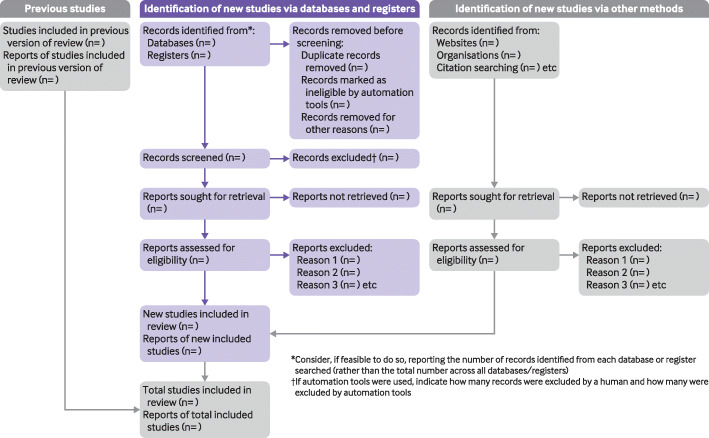
- PRISMA 2020 consists of a 27-item checklist, an expanded checklist detailing reporting recommendations for each item, the PRISMA 2020 abstract checklist, and revised flow diagrams for original and updated reviews.
- Noteworthy changes include inclusion of the abstract reporting checklist within PRISMA 2020; moving protocol and registration to a new Other section with a sub-item on amendments; recommending full search strategies for all databases, registers, and websites; more detail on reviewer screening, data collection, and automation; splitting synthesis methods into six sub-items and synthesis results into four sub-items; and adding items on certainty assessment, competing interests, and availability of data, code, and other materials.
- Development drew on reviews of reporting completeness, 60 documents providing reporting guidance, a survey to which 110 of 220 invited methodologists and journal editors responded, a 21-member two-day in-person meeting in September 2018 in Edinburgh, and feedback from 15 of 22 invited systematic reviewers.
- PRISMA 2009 was cited in over 60,000 reports (Scopus, August 2020) and endorsed by almost 200 journals and systematic review organisations; evidence from observational studies suggests its use is associated with more complete reporting, although more could be done to improve adherence.
Methods
- Guideline update: PRISMA 2020 was developed by adapting the EQUATOR Network’s guidance for developing health research reporting guidelines, identifying incompletely reported PRISMA 2009 items, reviewing 60 guidance documents, surveying methodologists and journal editors, discussing findings at a 21-member two-day meeting, and iteratively revising drafts with co-authors.
- Scope: designed primarily for systematic reviews of studies evaluating effects of health interventions, irrespective of included study design; applicable to other interventions and objectives, reviews with or without synthesis, mixed-methods reviews, and original, updated, or living systematic reviews.
- Analysis: no empirical meta-analysis is reported; the paper presents consensus-based reporting guidance, checklists, and flow diagram templates.
Limitations
- The paper states that it is unclear which strategies should be used to increase adherence to reporting guidelines, because of 31 interventions proposed, the effects of only 11 have been evaluated, mostly in observational studies at high risk of bias due to confounding.
- The paper states PRISMA 2020 is not intended to guide systematic review conduct, assess conduct or methodological quality, or inform reporting of systematic review protocols; separate tools and statements exist for those purposes.
- Evident from the text: PRISMA 2020 is a reporting guideline and consensus statement, not an empirical evaluation of its own impact; the paper notes future research is needed on barriers and facilitators, think-aloud studies, and reliability studies.
Model-written summary. Check it against the paper before relying on it.
Integrity signals
Registry
Cites
Statistics
Figures
Verification
Claims the paper makes
24 Valid · 0 Not valid · 1 Not checked · 25 Own results and interpretations
The sources with a verdict support this claim; the rest weren’t checked yet, have no full text we could read, or their verdicts aren’t rated yet.
In the paper
“Evidence from observational studies suggests that use of the PRISMA 2009 statement is associated with more complete reporting of systematic reviews [17–20], although more could be done to improve adherence to the guideline [21].”
What the sources say
- Supportedcites [17] Page MJ Shamseer L Altman DG Epidemiology and reporting characteristics of systematic reviews of biomedical research: a cross-sectional study PLoS Med 2016 13 e1002028 10.1371/journal.pmed.1002028 27218655 PMC4878797 source
The Results section reports that nearly all 26 characteristics were reported more often in therapeutic systematic reviews that self-reported using PRISMA. The Discussion describes mention of PRISMA as associated with more complete reporting, while cautioning that mention may only be a surrogate for actual use. (LLM, conf=0.92)
- Supportedcites [18] Panic N Leoncini E de Belvis G Ricciardi W Boccia S Evaluation of the endorsement of the preferred reporting items for systematic reviews and meta-analysis (PRISMA) statement on the quality of published systematic review and meta-analyses PLoS One 2013 8 e83138 10.1371/journal.pone.0083138 24386151 PMC3873291 source
The Abstract Results report higher adherence to the PRISMA reporting checklist after gastroenterology and hepatology journals endorsed PRISMA (90.1% versus 83.1%). The evidence concerns journal endorsement; the same section says that explicitly referencing PRISMA in an individual manuscript was not associated with better reporting. (LLM, conf=0.88)
- Not checked — no full text of the sourcecites [19] Agha RA Fowler AJ Limb C Impact of the mandatory implementation of reporting guidelines on reporting quality in a surgical journal: a before and after study Int J Surg 2016 30 169 172 10.1016/j.ijsu.2016.04.032 27112835 source
- Not checked — no full text of the sourcecites [20] Leclercq V Beaudart C Ajamieh S Rabenda V Tirelli E Bruyère O Meta-analyses indexed in PsycINFO had a better completeness of reporting when they mention PRISMA J Clin Epidemiol 2019 115 46 54 10.1016/j.jclinepi.2019.06.014 31254618 source
hedgedstates an association- Asserted: passes — The authors put it forward as true.
- Checkable: passes — It can be checked against evidence.
- Load-bearing: unclear — It is unclear whether the paper’s conclusions depend on it.
- Based: passes — The paper gives a reason why it holds.
- Supported
Every source the paper cites for this claim was checked and supports it.
In the paper
“technological advances have enabled the use of natural language processing and machine learning to identify relevant evidence [22–24]”
What the sources say
- Supportedcites [22] O’Mara-Eves A Thomas J McNaught J Miwa M Ananiadou S Using text mining for study identification in systematic reviews: a systematic review of current approaches Syst Rev 2015 4 5 10.1186/2046-4053-4-5 25588314 PMC4320539 source
The Results section on the suitability of text mining describes natural language processing techniques for improving how studies are classified. The Results section on review updates also describes machine-learning features used to classify studies, and the Discussion notes advances in text-mining technology. Together, these support the broad claim about using these technologies to identify relevant evidence. (LLM, conf=0.88)
- Supportedcites [23] Marshall IJ Noel-Storr A Kuiper J Thomas J Wallace BC Machine learning for identifying randomized controlled trials: an evaluation and practitioner’s guide Res Synth Methods 2018 9 602 614 10.1002/jrsm.1287 29314757 PMC6030513 source
The Aims section describes evaluating machine learning to identify RCTs in health research databases, and the Discussion reports that these approaches outperform traditional filters for systematic reviews. The paper also places its text-classification methods within NLP, supporting the broad claim about using these technologies to identify relevant evidence. (LLM, conf=0.88)
- Supportedcites [24] Marshall IJ Wallace BC Toward systematic review automation: a practical guide to using machine learning tools in research synthesis Syst Rev 2019 8 163 10.1186/s13643-019-1074-9 31296265 PMC6621996 source
The Search section (page not available in our copy) says that machine learning can use a small set of relevant articles to identify other relevant articles and describes semantic search by concept. The methods introduction explains how machine learning classifies articles for inclusion or exclusion, supporting the claim that these technologies can identify relevant evidence. (LLM, conf=0.91)
plainstates a cause- Asserted: passes — The authors put it forward as true.
- Checkable: passes — It can be checked against evidence.
- Load-bearing: unclear — It is unclear whether the paper’s conclusions depend on it.
- Based: passes — The paper gives a reason why it holds.
- Supported
The cited sources support only part of this claim — read each source’s verdict below.
In the paper
“We evaluated the reporting completeness of published systematic reviews [17, 21, 36, 37]”
§ The PRISMA 2020 statement: an updated guideline for reporting systematic reviews > Discussion
What the sources say
- Supportedcites [17] Page MJ Shamseer L Altman DG Epidemiology and reporting characteristics of systematic reviews of biomedical research: a cross-sectional study PLoS Med 2016 13 e1002028 10.1371/journal.pmed.1002028 27218655 PMC4878797 source
The Methods > Data Analysis section says the study assessed whether 26 characteristics of published systematic reviews were reported, and the Discussion > Explanation of Results and Implications discusses how complete that reporting was (page numbers unavailable). This supports citing the paper as an evaluation of reporting completeness. The PRISMA 2020 development context is the citing authors’ framing, not a finding attributed to this 2016 paper. (LLM, conf=0.91)
- Supportedcites [21] Page MJ Moher D Evaluations of the uptake and impact of the preferred reporting items for systematic reviews and meta-analyses (PRISMA) statement and extensions: a scoping review Syst Rev 2017 6 263 10.1186/s13643-017-0663-8 29258593 PMC5738221 source
The Methods section says the authors pooled studies assessing how often published systematic reviews adhered to PRISMA reporting items. The Results section reports their pooled assessment of adherence across 57 studies, supporting the citation’s use as an example of evaluating reporting completeness. (LLM, conf=0.90)
- Supportedcites [36] Page MJ Altman DG Shamseer L Reproducible research practices are underused in systematic reviews of biomedical interventions J Clin Epidemiol 2018 94 8 18 10.1016/j.jclinepi.2017.10.017 29113936 source
The Discussion (p. 20) reports the authors’ assessment of how completely published systematic reviews reported data needed to recreate their meta-analyses and other reproducible research practices. This supports the citation for evaluating reporting completeness; the PRISMA 2020 development context belongs to the citing document, not to this source. (LLM, conf=0.90)
- Partly supportedcites [37] Page MJ Altman DG McKenzie JE Flaws in the application and interpretation of statistical analyses in systematic reviews of therapeutic interventions were common: a cross-sectional analysis J Clin Epidemiol 2018 95 7 18 10.1016/j.jclinepi.2017.11.022 29203419 sourceExperimental — accuracy not yet measured
The Methods (section 2.3) and Results (section 3.6) show that the paper assessed whether selected statistical methods and their rationales were reported in published systematic reviews. It did not assess the completeness of reporting across the reviews as a whole. The citing authors’ PRISMA 2020 development context is their own framing, not a finding attributed to this source. (LLM, conf=0.82)
plain- Asserted: passes — The authors put it forward as true.
- Checkable: passes — It can be checked against evidence.
- Load-bearing: passes — The paper’s conclusions depend on it.
- Based: passes — The paper gives a reason why it holds.
- Supported
Every source the paper cites for this claim was checked and supports it.
In the paper
“new methods have been developed to assess the risk of bias in results of included studies [28, 29]”
What the sources say
- Supportedcites [28] Sterne JAC Savović J Page MJ RoB 2: a revised tool for assessing risk of bias in randomised trials BMJ 2019 366 l4898 10.1136/bmj.l4898 31462531 source
The Summary Points state that the authors developed and piloted RoB 2, a revised tool for assessing risk of bias in randomised trials, and that it produces a judgment for each result assessed. The introduction places risk-of-bias assessment in the context of studies included in systematic reviews. This paper therefore supports the claim as an example of a new method, specifically for randomised trials. (LLM, conf=0.93)
- Supportedcites [29] Sterne JA Hernán MA Reeves BC ROBINS-I: a tool for assessing risk of bias in non-randomised studies of interventions BMJ 2016 355 i4919 10.1136/bmj.i4919 27733354 PMC5062054 source
The Discussion says ROBINS-I was developed primarily for systematic reviews. The ‘Assessing a specific study’ section describes judging risk of bias for an outcome and result in each included non-randomised study, supporting the claim as an example of a new method. (LLM, conf=0.92)
plain- Asserted: passes — The authors put it forward as true.
- Checkable: passes — It can be checked against evidence.
- Load-bearing: unclear — It is unclear whether the paper’s conclusions depend on it.
- Based: passes — The paper gives a reason why it holds.
- Supported
Every source the paper cites for this claim was checked and supports it.
In the paper
“We identified PRISMA 2009 items that were often reported incompletely by examining the results of studies investigating the transparency of reporting of published reviews [17, 21, 36, 37].”
§ The PRISMA 2020 statement: an updated guideline for reporting systematic reviews > Development of PRISMA 2020
What the sources say
- Supportedcites [17] Page MJ Shamseer L Altman DG Epidemiology and reporting characteristics of systematic reviews of biomedical research: a cross-sectional study PLoS Med 2016 13 e1002028 10.1371/journal.pmed.1002028 27218655 PMC4878797 source
The Results (Reporting Characteristics of SRs; page unavailable) quantify incomplete reporting of review characteristics, including review flow and reasons for excluding studies. The Discussion (Explanation of Results and Implications; page unavailable) says reporting of many systematic reviews remains poor despite PRISMA 2009 and explains how individual PRISMA items may be reported incompletely. This supports using the study’s results to identify frequently incomplete reporting items. (LLM, conf=0.90)
- Supportedcites [21] Page MJ Moher D Evaluations of the uptake and impact of the preferred reporting items for systematic reviews and meta-analyses (PRISMA) statement and extensions: a scoping review Syst Rev 2017 6 263 10.1186/s13643-017-0663-8 29258593 PMC5738221 source
In Results (“Evaluations of SR adherence to the PRISMA Statement”), the review pools studies of published systematic reviews and identifies PRISMA items with low reporting adherence. It also reports nine items adhered to by fewer than 67% of reviews published in 2010 or later. The supplied passages do not give page numbers. (LLM, conf=0.94)
- Supportedcites [36] Page MJ Altman DG Shamseer L Reproducible research practices are underused in systematic reviews of biomedical interventions J Clin Epidemiol 2018 94 8 18 10.1016/j.jclinepi.2017.10.017 29113936 source
The Introduction (p. 6) describes studies finding low adherence to a PRISMA reporting item. This paper also examines published systematic reviews and reports incomplete reporting of that item in the Discussion (p. 20), making it a relevant study for identifying incompletely reported PRISMA items. (LLM, conf=0.90)
- Supportedcites [37] Page MJ Altman DG McKenzie JE Flaws in the application and interpretation of statistical analyses in systematic reviews of therapeutic interventions were common: a cross-sectional analysis J Clin Epidemiol 2018 95 7 18 10.1016/j.jclinepi.2017.11.022 29203419 source
The Results (sections 3.5 and 3.6) examine published systematic reviews and report frequent omissions in how statistical analyses were described, including missing rationales for subgroup and sensitivity analyses. This supports citing the paper as a study whose results could be examined to identify incompletely reported items; the identification of PRISMA 2009 items is the citing authors’ own step. (LLM, conf=0.86)
plain- Asserted: passes — The authors put it forward as true.
- Checkable: passes — It can be checked against evidence.
- Load-bearing: passes — The paper’s conclusions depend on it.
- Based: passes — The paper gives a reason why it holds.
- Supported
5 more claims · 2 with their cited sources checked
Create a free account to see all 50 claims and to verify the 3 references still open.
- Probably not a substantial claim. 36
- It may state two separate claims as one. 14
- The quote only partly states this claim. 1
Claims other papers make about this one
Each is checked against this paper’s own text: does it say what the citing paper says it does?
The source backs part of the claim, not all of it — or backs it for a different population, condition or comparison.
In the citing paper
“The PRISMA 2020 statement was designed primarily to provide guidance for systematic reviews of studies that evaluate the effects of interventions.”
From Extension of the PRISMA 2020 statement for living systematic reviews (PRISMA-LSR): checklist and explanation (2024) · cites this paper as [10]
Experimental — accuracy not yet measuredThe source backs part of the claim, not all of it — or backs it for a different population, condition or comparison.
In the citing paper
“This systematic review followed the PRISMA-NMA (Preferred Reporting Items for Systematic Review and Meta-Analyses extension for Network Meta-Analysis) 2020 statement for designing and reporting [38].”
From Assessing the Effectiveness of Digital Health Behavior Strategies on Type 2 Diabetes Management: Systematic Review and Network Meta-Analysis (2025) · cites this paper as [38]
Experimental — accuracy not yet measuredThe source backs part of the claim, not all of it — or backs it for a different population, condition or comparison.
In the citing paper
“This review was planned, conducted, and reported according to the updated guidelines for reporting systematic reviews of the 2020 Preferred Reporting Items for Systematic Reviews and Meta-Analyses (PRISMA) (Page et al., 2021).”
From A Competency Framework for AI Literacy: Variations by Different Learner Groups and an Implied Learning Pathway (2025) · cites this paper as Page et al., 2021
Experimental — accuracy not yet measuredThe source backs part of the claim, not all of it — or backs it for a different population, condition or comparison.
In the citing paper
“First, a systematic review was conducted, based on the PRISMA (Preferred Reporting Items for Systematic Review and Meta-Analysis) methodology (Page et al. 2021) to identify studies about the interaction of citizens with digital public services.”
From Recommendations for digital inclusion in the use of European digital public services (2025) · cites this paper as Page et al. 2021
Experimental — accuracy not yet measuredThe source backs part of the claim, not all of it — or backs it for a different population, condition or comparison.
In the citing paper
“This meta-analytical review was conducted and reported in accordance with the PRISMA 2020 guidelines (Page et al., 2021).”
From Child Maltreatment as a Risk Factor for Rejection Sensitivity: A Three-Level Meta-Analytic Review (2024) · cites this paper as Page et al., 2021
Experimental — accuracy not yet measured
41 more claims about this paper
Create a free account to see every claim other papers make about this one.
Citations
Cites
Preferred Reporting Items for Systematic Reviews and Meta-Analyses: the PRISMA statement
Moher, D., Liberati, A., Tetzlaff, J., Altman, D. G., & for the PRISMA Group (2009) · BMJ · doi:10.1136/bmj.b2535 · Cited by 83,823
Self-citationPreferred Reporting Items for Systematic Reviews and Meta-Analyses: The PRISMA Statement
Moher, D., Liberati, A., Tetzlaff, J., Altman, D. G., & The PRISMA Group (2009) · PLoS Medicine · doi:10.1371/journal.pmed.1000097 · Cited by 64,042
Self-citationPreferred reporting items for systematic reviews and meta-analyses: the PRISMA Statement.
(2009) · PubMed Central · Cited by 44,859
Self-citationPRISMA Extension for Scoping Reviews (PRISMA-ScR): Checklist and Explanation
Tricco, A. C., Lillie, E., Zarin, W., O'Brien, K. K., Colquhoun, H., Levac, D., Moher, D., Peters, M. D. J., Horsley, T., Weeks, L., et al. (2018) · Annals of Internal Medicine · doi:10.7326/m18-0850 · Cited by 43,565
Self-citationPreferred reporting items for systematic reviews and meta-analyses: The PRISMA statement
Moher, D., Liberati, A., Tetzlaff, J., Altman, D. G., & the PRISMA Group* (2009) · Annals of Internal Medicine · doi:10.7326/0003-4819-151-4-200908180-00135 · Cited by 37,554
Self-citationRoB 2: a revised tool for assessing risk of bias in randomised trials
Sterne, J. A. C., Savović, J., Page, M. J., Elbers, R. G., Blencowe, N. S., Boutron, I., Cates, C. J., Cheng, H.-Y., Corbett, M. S., Eldridge, S. M., et al. (2019) · BMJ · doi:10.1136/bmj.l4898 · Cited by 34,787
Self-citationLiberati, A., Altman, D. G., Tetzlaff, J., Mulrow, C., Gøtzsche, P. C., Ioannidis, J. P. A., Clarke, M., Devereaux, P. J., Kleijnen, J., & Moher, D. (2009) · PLoS Medicine · doi:10.1371/journal.pmed.1000100 · Cited by 28,164
Self-citationPRISMA-P Group, Moher, D., Shamseer, L., Clarke, M., Ghersi, D., Liberati, A., Petticrew, M., Shekelle, P., & Stewart, L. A. (2015) · Systematic Reviews · doi:10.1186/2046-4053-4-1 · Cited by 26,223
Self-citationDermyshi, E., Wang, Y., Yan, C., Hong, W., Qiu, G., Gong, X., & Zhang, T. (2017) · Neonatology · doi:10.1159/000454668 · Cited by 24,451
ROBINS-I: a tool for assessing risk of bias in non-randomised studies of interventions
Sterne, J. A., Hernán, M. A., Reeves, B. C., Savović, J., Berkman, N. D., Viswanathan, M., Henry, D., Altman, D. G., Ansari, M. T., Boutron, I., et al. (2016) · BMJ · doi:10.1136/bmj.i4919 · Cited by 20,329
Self-citation
Research works printed but not linked: 1
- Liberati A, Altman DG, Tetzlaff J, et al. The PRISMA statement for reporting. systematic reviews and meta-analyses of studies that evaluate health care. interventions: explanation and elaboration. PLoS Med. 2009;6:e1000100. 10.1371/journal.pmed.1000100. PMC2707010 19621070 · DOI · Paper page
Cited by
Items 2,501–2,600 of 14,579
Reangsing, C., Wongchan, W., Trakooltorwong, P., Thaibandit, J., & Oerther, S. E. (2025) · Psychiatry Research · doi:10.1016/j.psychres.2025.116425 · Cited by 33
Regenerative organic agriculture and soil ecosystem service delivery: A literature review
Colombi, G., Martani, E., & Fornara, D. A. (2025) · Ecosystem Services · doi:10.1016/j.ecoser.2025.101721 · Cited by 31
Bardóczi, A. B., Matics, Z., Turan, C., Szabó, B., Molnár, Z., Hegyi, P., Müller, V., & Horváth, G. (2025) · Sleep Medicine Reviews · doi:10.1016/j.smrv.2025.102119 · Cited by 29
Lai, N. M., Lim, Y. S., Chaiyakunapruk, N., Lee, S. W. H., Liabsuetrakul, T., Sabbir, M., Mahmud, S. M. H., Siddiqi, U. R., Ahmed, T., Hasan, F. U. L., et al. (2025) · Child and Adolescent Mental Health · doi:10.1111/camh.70022 · Cited by 31
Li, Q., Saelens, D., Kayaçetin, N. C., Aslanoğlu, R., van Hoof, J., & Piccardo, C. (2025) · Sustainable Production and Consumption · doi:10.1016/j.spc.2025.07.004 · Cited by 32
Tooki, O. O., & Popoola, O. (2025) · Results in Engineering · doi:10.1016/j.rineng.2025.106237 · Cited by 28
Lerner, G., Nikolaou, M., Stoffel, C. I., Schmauch, E., Kündig, T. M., Passeron, T., Sénéschal, J., van Geel, N., Held, U., & Kolios, A. G. A. (2025) · International Journal of Dermatology · doi:10.1111/ijd.17959 · Cited by 25
Advancing robotic assembly in construction: Innovations, challenges, and opportunities
Chen, Z., & Adel, A. (2025) · Automation in Construction · doi:10.1016/j.autcon.2025.106370 · Cited by 37
Advanced Analyses of Coronary Computed Tomography Angiography to Predict Future Cardiac Events
Bianchini, E., Alqahtani, F., Alsubai, S. E., Sole, P. A. D., Elzomor, H., Sharif, R., McCormick, J., Revaiah, P. C., Andreotti, F., Burzotta, F., et al. (2025) · JACC. Cardiovascular imaging · doi:10.1016/j.jcmg.2025.05.017 · Cited by 29
Baseline OCT Biomarkers Associated with Visual Acuity in Diabetic Macular Edema
Nanji, K., Grad, J., Hatamnejad, A., El‐Sayes, A., Mihalache, A., Gemae, M. R., Huang, R. S., Phillips, M., Kaiser, P. K., Munk, M. R., et al. (2025) · Ophthalmology · doi:10.1016/j.ophtha.2025.07.038 · Cited by 31
Tsipianitis, D., Misirli, A., Lavidas, K., & Komis, V. (2025) · IoT · doi:10.3390/iot6030045 · Cited by 35
Ramirez, Z. R., & Le, T. V. (2025) · Computers & Industrial Engineering · doi:10.1016/j.cie.2025.111518 · Cited by 25
Lean, Green, and Sustainability 4.0—A Systematic Literature Review
Vilaça, D. M., Sá, J. C., Antony, J., Sony, M., & McDermott, O. (2025) · Business Strategy and the Environment · doi:10.1002/bse.70215 · Cited by 38
Artificial Intelligence in urban design: A systematic review
Huang, T., Ye, X., Yiğitcanlar, T., Xu, B., Newman, G., Zhao, B., Ennemoser, B., Wu, D. J., Kim, J., & Wang, D. (2025) · Cities · doi:10.1016/j.cities.2025.106527 · Cited by 29
Dehrashid, P. A., Mansourian, H., & Sharifi, A. (2026) · Progress in Planning · doi:10.1016/j.progress.2025.101032 · Cited by 29
Psychosocial support interventions for women with gestational diabetes mellitus: a systematic review
Jung, S., Kim, Y., Park, J., Choi, M., & Kim, S. (2021) · Korean journal of women health nursing/Yeoseong geon'gang ganho hag'hoeji/Yeoseong geon-gang ganho hakoeji · doi:10.4069/kjwhn.2021.05.13 · Cited by 31
Kafle, S., Basnet, A. K., Karki, K., Magar, M. T., Shrestha, S., & Yadav, R. S. (2021) · Cureus · doi:10.7759/cureus.17883 · Cited by 31
Zhang, X., Svn, Z., Liv, M., Yan, Y., Zeng, R., Huang, Q., & Sun, Q. (2021) · Frontiers in Neurology · doi:10.3389/fneur.2021.720958 · Cited by 27
Sim, J. J. L., & Lim, C. C. (2021) · The American Journal of Medicine · doi:10.1016/j.amjmed.2021.08.038 · Cited by 29
Dyson, J., Bhatnagar, M., Skinner, J. L., III, & Crooks, M. G. (2021) · Patient Education and Counseling · doi:10.1016/j.pec.2021.09.024 · Cited by 25
Disruptive Behavior at Hospitals and Factors Associated to Safer Care: A Systematic Review
Moreno-Leal, P., Leal‐Costa, C., Agea, J. L. D., Jiménez‐Ruiz, I., Ramos‐Morcillo, A. J., Ruzafa‐Martínez, M., & Oliveira, A. C. D. S. (2021) · Healthcare · doi:10.3390/healthcare10010019 · Cited by 28
Bouillod, A., Soto-Romero, G., Grappe, F., Bertucci, W., Brunet, E., & Cassirame, J. (2022) · Sensors · doi:10.3390/s22010386 · Cited by 36
Grebosz‐Haring, K., Thun‐Hohenstein, L., Schuchter-Wiegand, A. K., Irons, J. Y., Bathke, A. C., Phillips, K., & Clift, S. M. (2022) · Frontiers in Psychology · doi:10.3389/fpsyg.2022.821093 · Cited by 31
Lu, Y., Zhang, X., He, J., Dai, Z., Shi, P., Lu, Y., & Chang, F. (2022) · Inflammopharmacology · doi:10.1007/s10787-022-00976-2 · Cited by 25
Abdelazeem, B., Shehata, J., Abbas, K. S., El‐Shahat, N. A., Malik, B. H., Savarapu, P. K., Eltobgy, M. M., & Kunadi, A. R. (2022) · PLoS ONE · doi:10.1371/journal.pone.0266243 · Cited by 28
The Impact of Bariatric Surgery on Cardiovascular Risk Factors and Outcomes: A Systematic Review
Srinivasan, M., Thangaraj, S. R., Arzoun, H., Thomas, S. S., & Mohammed, L. (2022) · Cureus · doi:10.7759/cureus.23340 · Cited by 38
Lippi, L., Alessandro de, S. I. R. E., Losco, L., Mezian, K., Folli, A., Ivanova, M. D., Zattoni, L., Moalli, S., Ammendolia, A., Alfano, C., et al. (2022) · Journal of Clinical Medicine · doi:10.3390/jcm11133839 · Cited by 28
Multiple mutations in the EGFR gene in lung cancer: a systematic review
Castañeda-González, J. P., Cháves, J. J., & Parra-Medina, R. S. (2022) · Translational Lung Cancer Research · doi:10.21037/tlcr-22-235 · Cited by 32
Sodi, T., Quarshie, E. N., Asante, K. O., Radzilani-Makatu, M., Makgahlela, M., Nkoana, S. E., & Mutambara, J. (2022) · BMJ Open · doi:10.1136/bmjopen-2022-063687 · Cited by 28
Molecular Pathways Involved in LRRK2-Linked Parkinson’s Disease: A Systematic Review
Ravinther, A. I., Dewadas, H. D., Tong, S. R., Foo, C. N., Lin, Y., Chien, C., & Lim, Y. M. (2022) · International Journal of Molecular Sciences · doi:10.3390/ijms231911744 · Cited by 27
Gurung, A., Khatiwada, B., Kayastha, B., Parsekar, S. S., Mistry, S. K., & Yadav, U. N. (2022) · Clinical Epidemiology and Global Health · doi:10.1016/j.cegh.2022.101152 · Cited by 37
The Relationship between Self- and Peer Assessment in Higher Education: A Systematic Review
Concina, E. (2022) · Trends in Higher Education · doi:10.3390/higheredu1010004 · Cited by 40
Systematic Review of Smoking Cessation Interventions for Smokers Diagnosed with Cancer
Frazer, K., Bhardwaj, N., Fox, P., Stokes, D., Niranjan, V. R., Quinn, S., Kelleher, C. C., & Fitzpatrick, P. (2022) · International Journal of Environmental Research and Public Health · doi:10.3390/ijerph192417010 · Cited by 24
Yab, L. Y., Wahid, N., & Hamid, R. A. (2022) · IEEE Access · doi:10.1109/access.2022.3221194 · Cited by 24
Storytelling in Pregnancy and Childbirth: An Integrative Review of the Literature
Mahdavi, Z., Amiri‐Farahani, L., & Pezaro, S. (2022) · Journal of Pregnancy · doi:10.1155/2022/8483777 · Cited by 32
Chierici, A. P., Amoretti, P., Drai, C., Fatico, S. D., Barrière, J., Schiavo, L., & Iannelli, A. (2023) · Nutrients · doi:10.3390/nu15020467 · Cited by 25
Yunusa, I. U., Rashid, N., Seyedin, R., Paratane, D., & Rajagopalan, K. (2023) · Journal of Geriatric Psychiatry and Neurology · doi:10.1177/08919887231154933 · Cited by 28
“The reporting of this study follows the preferred reporting items for systematic reviews and meta-analyses (PRISMA) 2020 guideline.(27)”
MethodAlfian, S. D., Insani, W. N., Puspitasari, I. M., Wawruch, M., & Abdulah, R. (2023) · Telemedicine Journal and e-Health · doi:10.1089/tmj.2022.0406 · Cited by 28
“Am I Masculine?” A metasynthesis of qualitative studies on traditional masculinity on infertility
Pakpahan, C., Ibrahim, R., William, W., Kandar, P. S., Darmadi, D., Khaerana, A. S. A., & Supardi, S. (2023) · F1000Research · doi:10.12688/f1000research.131599.1 · Cited by 28
The role of art in coastal and marine sustainability
Matias, A., Carrasco, A. R., Pinto, B., & Reis, J. (2023) · Cambridge Prisms Coastal Futures · doi:10.1017/cft.2023.13 · Cited by 31
Javed, A., Machin, M., Gwozdz, A. M., Turner, B., Onida, S., Shalhoub, J., & Davies, A. H. (2023) · Journal of Vascular Surgery Venous and Lymphatic Disorders · doi:10.1016/j.jvsv.2023.03.017 · Cited by 26
Musgrave, L., Cheney, K., Dorney, E., Homer, C., & Gordon, A. (2023) · Journal of Medical Internet Research · doi:10.2196/41900 · Cited by 27
Mellentin, A. I., Finn, S. W., Skøt, L., Thaysen‐Petersen, D., Mistarz, N. T., Fink‐Jensen, A., & Nielsen, D. G. (2023) · Neuroscience & Biobehavioral Reviews · doi:10.1016/j.neubiorev.2023.105185 · Cited by 31
Diagnosing and managing dysphagia in inclusion body myositis: a systematic review
Ambrocio, K. R., Garand, K. L., Roy, B., Bhutada, A. M., & Malandraki, G. A. (2023) · Rheumatology · doi:10.1093/rheumatology/kead194 · Cited by 27
Anti-inflammatory pathways of kefir in murine model: a systematic review
Pereira, M. D. F. A., Albuini, F. M., & Pelúzio, M. D. C. G. (2023) · Nutrition Reviews · doi:10.1093/nutrit/nuad052 · Cited by 27
Chiew, J. K., Low, C. J. W., Zeng, K., Goh, Z. J., Ling, R. R., Chen, Y., Ti, L. K., & Ramanathan, K. R. (2023) · Anesthesia & Analgesia · doi:10.1213/ane.0000000000006532 · Cited by 31
Shahzad, N., Elsherif, M., Obaidat, I., & Brar, R. (2023) · European Journal of Vascular and Endovascular Surgery · doi:10.1016/j.ejvs.2023.06.002 · Cited by 24
Tousignant‐Laflamme, Y., Houle, C., Longtin, C., Gérard, T., Lagueux, É., Perreault, K., Beaudry, H., Tétreault, P., Blanchette, M., & Décary, S. (2023) · Musculoskeletal Science and Practice · doi:10.1016/j.msksp.2023.102825 · Cited by 31
Metabolic fingerprinting of systemic sclerosis: a systematic review
Morales-González, V., Galeano-Sánchez, D., Covaleda-Vargas, J. E., Rodríguez, Y., Monsalve, D. M., Pardo-Rodriguez, D., Cala, M. P., Acosta‐Ampudia, Y., & Ramírez-Santana, C. (2023) · Frontiers in Molecular Biosciences · doi:10.3389/fmolb.2023.1215039 · Cited by 27
Nyasulu, P. S., Tamuzi, J. L., & Erasmus, R. T. (2023) · IJID Regions · doi:10.1016/j.ijregi.2023.08.004 · Cited by 26
A systematic review of the role of clozapine for severe borderline personality disorder
Han, J., Allison, S. C., Looi, J. C., Chan, S. K. W., & Bastiampillai, T. J. (2023) · Psychopharmacology · doi:10.1007/s00213-023-06431-6 · Cited by 30
Agastache Species: A Comprehensive Review on Phytochemical Composition and Therapeutic Properties
Nechita, M.-A., Toiu, A., Benedec, D., Hanganu, D., Ielciu, I., Oniga, O., Nechita, V.-I., & Oniga, I. (2023) · Plants · doi:10.3390/plants12162937 · Cited by 27
Pesticide Application as a Risk Factor/Behaviour for Workers’ Health: A Systematic Review
Moreira, A., & da Silva (2023) · Environments · doi:10.3390/environments10090160 · Cited by 25
Odoma, V. A., Pitliya, A., AlEdani, E. M., Bhangu, J. K., Javed, K., Manshahia, P. K., Nahar, S., Kanda, S., Chatha, U., & Mohammed, L. (2023) · Cureus · doi:10.7759/cureus.45485 · Cited by 28
Corporate Reputation in Industry 4.0: A Systematic Literature Review and Bibliometric Analysis
Hamidi, S. R., Ismail, M. A., Shuhidan, S. M., & Kadir, S. A. (2023) · SAGE Open · doi:10.1177/21582440231200951 · Cited by 28
Al-Haddad, A. Y., Arsheed, N. A. A., Yee, A., & Kohli, S. (2023) · The Saudi Dental Journal · doi:10.1016/j.sdentj.2023.10.004 · Cited by 34
Shoaib, M. H., Sikandar, M., Yousuf, R. I., Parkash, M., Kazmi, S. J. H., Ahmed, F. R., Ahmed, K., Saleem, M. T., & Zaidi, S. H. (2023) · Systematic Reviews · doi:10.1186/s13643-023-02359-2 · Cited by 30
Framework for the Strategic Adoption of Industry 4.0: A Focus on Intelligent Systems
Serey, J., Alfaro, M. D., Fuertes, G., Vargas, M., Ternero, R., Durán, C., Sabattin, J., & Gutiérrez, S. (2023) · Processes · doi:10.3390/pr11102973 · Cited by 35
Comparative efficacy of human papillomavirus vaccines: systematic review and network meta-analysis
Lin, R., Jin, H., & Fu, X. (2023) · Expert Review of Vaccines · doi:10.1080/14760584.2023.2287135 · Cited by 33
Varman, S. D., Jones, R. A., Kelly, B., Hammersley, M. L., Parrish, A., Stanley, R. M., & Cliff, D. P. (2023) · PLoS ONE · doi:10.1371/journal.pone.0294987 · Cited by 35
Light at night exposure and risk of breast cancer: a meta-analysis of observational studies
Luo, Z., Liu, Z., Chen, H., Liu, Y., Tang, N., & Li, H. (2023) · Frontiers in Public Health · doi:10.3389/fpubh.2023.1276290 · Cited by 29
Prokopidis, K., Triantafyllidis, K. K., Kechagias, K. S., Mitropoulos, A., Sankaranarayanan, R., & Isanejad, M. (2023) · Clinical Research in Cardiology · doi:10.1007/s00392-023-02360-8 · Cited by 27
What can we learn from historical pandemics? A systematic review of the literature
Doran, Á., Colvin, C. L., & McLaughlin, E. (2023) · Social Science & Medicine · doi:10.1016/j.socscimed.2023.116534 · Cited by 32
Bakker, L. B. M., Lamoth, C. J. C., Větrovský, T., Grüber, M., Caljouw, S. R., Nieboer, W., Taube, W., van Dieën, J. H., Granacher, U., & Hortobágyi, T. (2024) · Sports Medicine - Open · doi:10.1186/s40798-023-00668-3 · Cited by 26
Single-Port vs Multiport Robot-Assisted Partial Nephrectomy: A Meta-Analysis
Nguyen, T. T., Ngo, X. T., Duong, N. X., Dobbs, R. W., Vuong, H. G., Nguyen, D., Basilius, J., Onder, N. K., Mendiola, D. F., Hoang, T.-D., et al. (2024) · Journal of Endourology · doi:10.1089/end.2023.0505 · Cited by 42
Talebi, S., Shahi, M. H. P., Zeraattalab-Motlagh, S., Asoudeh, F., Ranjbar, M., Hemmati, A., Talebi, A., Wong, A., & Mohammadi, H. (2024) · Clinical Nutrition ESPEN · doi:10.1016/j.clnesp.2024.01.015 · Cited by 29
Exercise-based gaming in patients with multiple sclerosis: A systematic review and meta-analysis
Elhusein, A. M., Fadlalmola, H. A., Awadalkareem, E. M., Alhusain, E. Y. M., Alnassry, S. M. A., Alshammari, M., Abdulrahman, E. E. H., Fadila, D. E. S., Ibrahim, F. M., Saeed, A., et al. (2024) · Belitung Nursing Journal · doi:10.33546/bnj.3006 · Cited by 27
Should an Incidental Meckel Diverticulum Be Resected? A Systematic Review
Yagnik, V. D., Garg, P. K., & Dawka, S. (2024) · Clinical and Experimental Gastroenterology · doi:10.2147/ceg.s460053 · Cited by 24
Arce-López, B., Coton, M., Coton, E., & Hymery, N. (2024) · Environmental Toxicology and Pharmacology · doi:10.1016/j.etap.2024.104489 · Cited by 24
Jiang, Y., Jeusfeld, M. A., Mosaad, M., & Oo, N. (2024) · International Journal of Critical Infrastructure Protection · doi:10.1016/j.ijcip.2024.100700 · Cited by 38
A survey of artificial intelligence in gait-based neurodegenerative disease diagnosis
Rao, H., Zeng, M., Zhao, X., & Miao, C. (2025) · Neurocomputing · doi:10.1016/j.neucom.2025.129533 · Cited by 33
A Comprehensive Systematic Review of YOLO for Medical Object Detection (2018 to 2023)Preprint
Qureshi, R., Ragab, M. G., Abdulkadir, S. J., Muneer, A., ALQUSHAIB, A., Sumiea, E. H., Alhussian, H., & Al-Selwi, S. M. (2023) · doi:10.36227/techrxiv.23681679.v1 · Cited by 43
Guidelines for Meta-analyses and Systematic Reviews in Urology
Vickers, A. J., Assel, M. J., Dunn, R. L., MacLennan, G., Becker, B. J., & Riley, R. D. (2025) · European Urology · doi:10.1016/j.eururo.2025.07.021 · Cited by 27
Use of e-cigarettes in pregnancy: A systematic review of evidence published from 2020-2022
Bell, L., Whelan, M., Thomas, L., Edwards, E., Lycett, D., Hayward, K., Wilson, K., Harrison, R., & Patel, R. (2025) · Journal of Public Health · doi:10.1007/s10389-023-02026-9 · Cited by 23
“A systematic review was carried out and written in accordance with the PRISMA 2020 guidelines (Page et al. 2021).”
Ammar, A., Trabelsi, K., Boujelbane, M. A., Boukhris, O., Glenn, J. M., Chtourou, H., & Schöllhorn, W. I. (2023) · Educational Research Review · doi:10.1016/j.edurev.2023.100537 · Cited by 23
Schäfer, A., Jírů-Hillmann, S., Widmann, J., Montellano, F. A., Salmen, J., Pryss, R., Wöckel, A., & Heuschmann, P. U. (2025) · Journal of Cancer Survivorship · doi:10.1007/s11764-023-01470-6 · Cited by 23
“1 PRISMA 2020 flow diagram [66].”
Marino, G., & Iannelli, L. (2023) · Frontiers in Sociology · doi:10.3389/fsoc.2023.1174161 · Cited by 28
Galvis, M. M., Tjioe, K. C., Balas, E. A., Agrawal, G., & Cortes, J. E. (2023) · Blood Advances · doi:10.1182/bloodadvances.2023010690 · Cited by 26
A Review of Creative Play Interventions to Improve Children’s Hospital Experience and Wellbeing
Signorelli, C., Robertson, E. G., Valentin, C., Alchin, J. E., & Treadgold, C. (2023) · Hospital Pediatrics · doi:10.1542/hpeds.2022-006994 · Cited by 26
Measuring Financial Well-Being: A Systematic Review of Psychometric Instruments
Cardoso, N. D. O., Markus, J., Machado, W. D. L., & Guilherme, A. A. (2023) · Journal of Happiness Studies · doi:10.1007/s10902-023-00697-5 · Cited by 28
Gebeyehu, D. T., East, L., Wark, S., & Islam, M. S. (2023) · BMC Public Health · doi:10.1186/s12889-023-17104-6 · Cited by 27
Gamificación: Un Recurso que Promueve las Competencias Matemáticas en la Educación Peruana
Cueva-Cáceres, J. (2023) · Revista Docentes 2 0 · doi:10.37843/rted.v16i2.397 · Cited by 23
“El protocolo se basó en las directrices establecidas en la declaración PRISMA sobre revisiones sistemáticas (Page et al., 2021), en la que se creó un diagrama de flujo del proceso a seguir (ver Figura 1).”
The Shape of Mobile Health: A Systematic Review of Health Visualization on Mobile Devices
Chan, G., Nwagu, C., Odenigbo, I. P., Alslaity, A., & Orji, R. (2024) · International Journal of Human-Computer Interaction · doi:10.1080/10447318.2024.2313282 · Cited by 31
Moltrecht, B., Lange, A. M. C., Merrick, H., & Radley, J. (2024) · European Child & Adolescent Psychiatry · doi:10.1007/s00787-024-02380-3 · Cited by 34
Saini, R. S., Ibrahim, M., Khader, M. A., Kanji, M. A., Mosaddad, S. A., & Heboyan, A. G. (2024) · Head & Face Medicine · doi:10.1186/s13005-024-00416-2 · Cited by 25
Rehabilitation delivery models to foster healthy ageing—a scoping review
Seijas, V., Maritz, R., Fernandes, P. D. S., Bernard, R. M., Lugo‐Agudelo, L. H., Bickenbach, J., & Sabariego, C. (2024) · Frontiers in Rehabilitation Sciences · doi:10.3389/fresc.2024.1307536 · Cited by 28
The efficacy and safety of GLP-1 receptor agonists in youth with type 2 diabetes: a meta-analysis
Yugar, L. B. T., Sedenho-Prado, L. G., da Silva Ferreira, I. M. C., Silva, C. A. M., Sposito, A. C., & Cercato, C. (2024) · Diabetology & Metabolic Syndrome · doi:10.1186/s13098-024-01337-5 · Cited by 23
McDermott, O., & Kearney, B. (2024) · International Journal of Pharmaceutical and Healthcare Marketing · doi:10.1108/ijphm-07-2023-0060 · Cited by 31
Honorato, N., Soltiyeva, A., Oliveira, W., Delabrida, S. E., Hamari, J., & Alimanova, M. (2024) · Smart Learning Environments · doi:10.1186/s40561-024-00309-6 · Cited by 30
“This systematic review was conducted based on the PRISMA protocol 1 that allows the conduction of a systematic process, from the collection of data to the writing of the results (Page et al., 2021).”
MethodEjaz, H., Sultan, B., Pienaar, A. J., & Froelicher, E. S. (2024) · Nurse Education in Practice · doi:10.1016/j.nepr.2024.104014 · Cited by 23
Kaymakcioglu, A. G., & Thomas, M. (2024) · Social Sciences & Humanities Open · doi:10.1016/j.ssaho.2024.101066 · Cited by 31
Rethinking Public Participation in Forest Policies: A Literature Review of Participatory Techniques
MEO, I. D., Paletto, A., & Baldessari, S. (2024) · Forests · doi:10.3390/f15091514 · Cited by 24
Bishaw, S., Coyne, E., Halkett, G. K. B., & Bloomer, M. J. (2024) · Palliative Medicine · doi:10.1177/02692163241277380 · Cited by 38
Mackay, B. R., & Shaker, R. R. (2024) · Sustainability · doi:10.3390/su16188076 · Cited by 26
What should be understood to promote environmentally sustainable diets?
Wu, Y., Kurisu, K., & Fukushi, K. (2024) · Sustainable Production and Consumption · doi:10.1016/j.spc.2024.10.001 · Cited by 27
van Eekhout, J. C. A., Becking, E. C., Scheffer, P. G., Koutsoliakos, I., Bax, C. J., Henneman, L., Bekker, M. N., & Schuit, E. (2024) · BJOG An International Journal of Obstetrics & Gynaecology · doi:10.1111/1471-0528.17983 · Cited by 30
Madrigal-Martínez, S., Gielen, E., Garcia, J. L. M. I., & Parra, F. (2024) · Cities · doi:10.1016/j.cities.2024.105519 · Cited by 26
Kang, J., Xu, X., & Yan, L. (2024) · Education and Information Technologies · doi:10.1007/s10639-024-13079-y · Cited by 48
Conceptualizing circular economy policy instruments: The case of recycled content standards
Maeder, M., & Fröhling, M. (2024) · Sustainable Production and Consumption · doi:10.1016/j.spc.2024.11.009 · Cited by 30
Desye, B., Berihun, G., Geto, A. K., Berhanu, L., & Daba, C. (2024) · Frontiers in Public Health · doi:10.3389/fpubh.2024.1488028 · Cited by 28
Metadata
- Authors
- Page, M. J., McKenzie, J. E., Bossuyt, P. M., Boutron, I., Hoffmann, T. C., Mulrow, C. D., Shamseer, L., Tetzlaff, J. M., Akl, E. A., Brennan, S. E., Chou, R., Glanville, J., Grimshaw, J. M., Hróbjartsson, A., Lalu, M. M., Li, T., Loder, E. W., Mayo-Wilson, E., McDonald, S., McGuinness, L. A., Stewart, L. A., Thomas, J., Tricco, A. C., Welch, V. A., Whiting, P., & Moher, D.
- Affiliations
- Monash University (AU)
- Amsterdam University Medical Centers (NL)
- Inserm (FR)
- Bond University (AU)
- The University of Texas at San Antonio Health Science Center (US)
- University of Ottawa (CA)
- McMaster University (CA)
- Oregon Health & Science University (US)
- University of York (GB)
- University of Southern Denmark (DK)
- Ottawa Hospital (CA)
- Johns Hopkins University (US)
- Brigham and Women's Hospital (US)
- University of Bristol (GB)
- University College London (GB)
- St. Michael's Hospital (CA)
- Corresponding author
- Page, Matthew J.
- ORCID
- Page, Matthew J.
- McKenzie, Joanne E.
- Bossuyt, Patrick M.
- Boutron, Isabelle
- Hoffmann, Tammy C.
- Mulrow, Cynthia D.
- Shamseer, Larissa
- Tetzlaff, Jennifer M.
- Akl, Elie A.
- Brennan, Sue E.
- Chou, Roger
- Glanville, Julie
- Grimshaw, Jeremy M.
- Hróbjartsson, Asbjørn
- Lalu, Manoj M.
- Li, Tianjing
- Loder, Elizabeth W.
- McDonald, Steve
- McGuinness, Luke A.
- Stewart, Lesley A.
- Thomas, James
- Tricco, Andrea C.
- Welch, Vivian A.
- Whiting, Penny
- Moher, David
- Venue
- Systematic Reviews
- Published
- 2021-03-29
- Volume
- 10
- Issue
- 1
- Pages
- 89-89
- ISSN
- 2046-4053 (ISSN-L)
- PMC
- PMC8008539
- OpenAlex
- W3144543375
- Semantic Scholar
- f4de50b3dc5d1d850d281ef0cfefb80be2af34f2
- Cited by
- 13,874
- References
- 79
- Citations by year
- 2026: 1504 · 2025: 4332 · 2024: 3201 · 2023: 2847 · 2022: 1643 · 2021: 342
- FWCI
- 83.45
- Type
- journal article
- Language
- en
- Open access
- gold
- doi.org
- Licence
- cc-by
- creativecommons.org/licenses/by/4.0/ (tdm)
- creativecommons.org/licenses/by/4.0/ (vor)
- Locations
- Systematic Reviews (publishedVersion, cc-by)
- PubMed Central (publishedVersion, cc-by)
- PubMed (publishedVersion)
- Pure Amsterdam UMC (publishedVersion, cc-by)
- Bond University Research Portal (Bond University) (submittedVersion, other-oa)
- Monash University Research Portal (Monash University) (submittedVersion, cc-by)
- uO Research (University of Ottawa) (submittedVersion, public-domain)
- Data Archiving and Networked Services (DANS) (submittedVersion, other-oa)
- DOAJ (DOAJ: Directory of Open Access Journals) (submittedVersion, cc-by-sa)
- Bristol Research (University of Bristol) (submittedVersion, cc-by)
- University of Southern Denmark Research Portal (University of Southern Denmark) (submittedVersion, cc-by)
- Zenodo (CERN European Organization for Nuclear Research) (submittedVersion, cc-by)
- Funders
- University of Ottawa (Tier 1)
- National Institute for Health and Care Research (DRF-2018-11-ST2-048)
- National Institutes of Health
- Medical Research Council
- Australian Research Council (DE200101618)
- National Health and Medical Research Council (1088535, 1154607, 1143429)
- National Eye Institute (UG1EY020522)
- Topics
- Social Sciences › Decision Sciences › Statistics, Probability and Uncertainty › Meta-analysis and systematic reviews
- Health Sciences › Medicine › Public Health, Environmental and Occupational Health › Clinical practice guidelines implementation
- Social Sciences › Library and Information Sciences › Academic Publishing and Open Access
- Keywords
- PRISMA 2020, reporting guidelines, abstracts, reporting checklist, transparency
- MeSH terms
- Systematic Reviews as Topic, Humans, Publishing, Quality Control
About these checks
Registry, retraction, Cites and statistics results are computed, not judged, with one exception: a printed reference that no index lists is read once by a model before it counts as a citation error. Claims are extracted by a model and kept only when their quote appears verbatim in the text; each cited source is then checked, with a model’s help, for whether it says what the claim relies on. Those verdicts can be wrong — read the claim’s quote and the cited source before relying on one.
The claim verdicts this report counts are experimental: their accuracy is not yet measured.
A language model drew the claims from the paper on 2026-10-10, under version 3 of the claim definition (model deepseek-v4.1-flash, prompt extract-v3).
A second model labelled each claim on 2026-10-10 (model jev-1.13-20260917, definition revision gold-guideline-v0.2).
Cited sources are checked with a language model’s help (gpt-6-sol).
Statistics and arithmetic are recomputed, not judged.
Confidence bands are shown only for fields calibrated on our annotated test set. None is calibrated yet, so no band is shown.
What counts as a claim ›How we measure confidence ›How we check this ›
Are you an author, or do you see a problem with this page? Request a review
Data sources
Bibliographic data: Semantic Scholar, OpenAlex, Crossref.
Contains information from the Semantic Scholar Academic Graph Datasets, made available under the ODC Attribution License (ODC-BY 1.0).
Semantic Scholar’s data is described in: Kinney, R., et al. (2023). The Semantic Scholar Open Data Platform. arXiv:2301.10140.
